
Overview of GAO’s Manufacturing WIP Systems Using RFID Technologies
Manufacturing Work-In-Progress systems using RFID technologies provide continuous, transaction-level visibility into materials, subassemblies, tools, and production orders as they move through shop floor operations. These systems instrument production workflows to capture real-time status, location, and condition data across work cells, staging areas, quality checkpoints, and material handling interfaces. Manufacturing WIP tracking platforms support takt time enforcement, constraint identification, genealogy tracking, and labor utilization analysis across discrete, batch, and hybrid manufacturing environments.
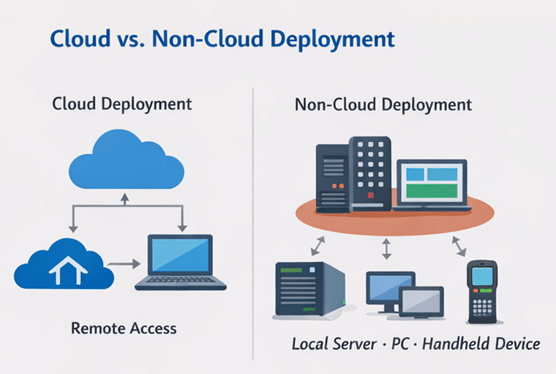
RFID-enabled Manufacturing WIP solutions are structured around automated identification events that replace manual scanning and paper travelers, improving data accuracy and production synchronization. Multiple deployment options are supported, including cloud-based platforms and non-cloud implementations running on handheld computers, PCs, local servers, or remote servers. This flexibility allows manufacturers to align operational visibility, cybersecurity posture, latency tolerance, and regulatory compliance with enterprise IT policies. GAO delivers Manufacturing WIP systems engineered for integration with MES, ERP, and quality management infrastructures while supporting scalable RFID architectures.
GAO’s Manufacturing WIP Systems Using RFID: Purpose and Scope
Description of RFID-Based Manufacturing WIP Systems
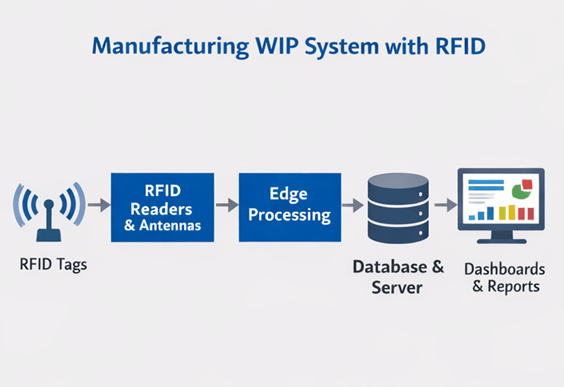
Manufacturing WIP systems using RFID technologies establish a digital control layer over physical production assets. RFID identifiers embedded in pallets, bins, fixtures, work orders, and serialized components generate machine-readable events as items pass through readers positioned at production lines, kitting stations, conveyors, and inspection zones. The system correlates RFID events with routing logic, bill of materials, operator credentials, and machine states to maintain a continuously updated WIP ledger.
Operational Purposes Addressed by RFID-Based WIP Platforms
- Enforcing production routing compliance across multi-stage manufacturing
- Maintaining real-time WIP inventory accuracy without manual intervention
- Supporting lot traceability, serialization, and genealogy capture
- Synchronizing material availability with work center scheduling
- Enabling closed-loop quality controls and rework management
- Providing auditable production records for regulatory reporting
Manufacturing Issues Addressed
- Manual data entry errors and delayed production reporting
- WIP accumulation at bottleneck work centers
- Lost or misrouted subassemblies and tooling
- Limited visibility into real-time production status
- Difficulty correlating quality defects to upstream processes
Business and Operational Benefits
- Improved throughput predictability and cycle time control
- Reduced labor overhead for WIP tracking and reconciliation
- Enhanced production transparency for operations leadership
- Improved compliance with industry and customer traceability mandates
- Faster root cause analysis for quality and yield deviations
GAO supports these Manufacturing WIP objectives by delivering configurable RFID software frameworks aligned with real-world plant operations and IT governance models.
System Architecture for Manufacturing WIP Systems Using RFID Technologies
Cloud Architecture for Manufacturing WIP Systems
Cloud-based Manufacturing WIP systems centralize RFID event processing, business logic, and analytics within a managed cloud environment. RFID data is securely transmitted from edge readers through encrypted channels to cloud ingestion services. Processing engines normalize tag reads, apply production rules, and update WIP states in centralized databases. Cloud architectures support elastic scalability, cross-plant visibility, and integration with enterprise MES, ERP, and analytics platforms.
Operational responsibility is shared between manufacturing operations and IT security teams, with clearly defined security boundaries between shop floor networks and cloud services. Scalability considerations include reader density, event throughput, and multi-site data aggregation. GAO designs cloud WIP architectures to align with corporate cybersecurity standards and data residency requirements.
Non-Cloud Architecture for Manufacturing WIP Systems
Non-cloud Manufacturing WIP systems operate within controlled network environments where RFID software executes locally. Deployment models include handheld-based applications for localized workflows, PC-based systems for single-line oversight, local servers for plant-wide control, and remote servers hosted in private data centers.
Data flows remain within defined network boundaries, reducing external dependencies and supporting low-latency operations. Security boundaries are managed through internal access controls, network segmentation, and on-premises authentication services. Scalability depends on local compute capacity and network design. GAO engineers non-cloud architectures for manufacturers with strict regulatory, uptime, or connectivity constraints.
Cloud vs Non-Cloud Manufacturing WIP Systems Comparison
| Evaluation Dimension | Cloud-Based Manufacturing WIP Systems | Non-Cloud Manufacturing WIP Systems |
| Deployment Scope | Multi-plant and enterprise-wide visibility | Single line, plant, or private infrastructure |
| Latency Sensitivity | Moderate tolerance with buffered edge processing | Optimized for real-time local operations |
| IT Governance | Centralized security and identity management | Localized control and internal policies |
| Regulatory Alignment | Suitable where cloud use is permitted | Preferred for restricted or classified environments |
| Scalability Model | Elastic scaling across sites | Capacity planning per deployment |
| Typical Use Scenarios | Distributed manufacturing networks, contract manufacturing | Defense production, offline plants, legacy MES environments |
| Handheld Execution | Used for data capture and exception handling | Can host full WIP logic for mobile workflows |
| PC-Based Execution | Supervisory dashboards and operator stations | Primary control for small production cells |
| Local Server Execution | Limited caching and failover | Core WIP processing and storage |
| Remote Server Execution | Hybrid cloud extensions | Private data center consolidation |
GAO assists organizations in selecting cloud or non-cloud Manufacturing WIP deployments based on operational risk tolerance and enterprise architecture strategy.
Cloud Integration and Data Management for Manufacturing WIP Systems
Manufacturing WIP cloud integration focuses on the controlled lifecycle of RFID-generated production data. Data ingestion services authenticate and validate incoming RFID events before routing them through processing pipelines. Business rules engines contextualize events with production orders, routing steps, and quality states. Persisted data is stored in structured repositories optimized for time-series and transactional workloads.
Analytics services support throughput analysis, WIP aging, exception monitoring, and historical trend evaluation. Integration layers synchronize WIP data with MES, ERP, supply chain planning, and compliance systems using secured APIs and message brokers. Security controls enforce encryption, role-based access, audit logging, and data retention policies. Access governance ensures that operators, engineers, and executives view only authorized datasets. GAO designs Manufacturing WIP data governance models aligned with ISO, NIST, and industry-specific compliance frameworks.
Major Components of Manufacturing WIP Systems Using RFID
- RFID Credentials
RFID credentials represent physical identifiers attached to WIP assets. Selection considerations include memory capacity, durability, and lifecycle alignment with production artifacts. Operational roles include serialization and association with digital production records.
- RFID Readers
Readers capture RFID signals at defined control points. Constraints include read zone precision, interference tolerance, and integration with industrial networks. Readers act as the primary data acquisition layer.
- Edge Devices
Edge devices perform local filtering, buffering, and event aggregation. Selection depends on processing capacity and environmental resilience. Operational roles include latency reduction and fault tolerance.
- Middleware Platforms
Middleware normalizes RFID data and applies production logic. Constraints include configurability and integration compatibility. Middleware bridges shop floor events and enterprise systems.
- Cloud Platforms
Cloud platforms host centralized WIP processing and analytics. Selection considerations include compliance certifications and scalability. Operational roles include cross-site visibility and data consolidation.
- Local and Remote Servers
Servers support non-cloud execution models. Constraints include hardware capacity and maintenance requirements. Roles include primary WIP control and data persistence.
- Databases
Databases store WIP states and history. Selection focuses on transaction integrity and query performance. Databases support reporting and auditability.
- Dashboards and Reporting Tools
Dashboards present WIP metrics to stakeholders. Constraints include real-time refresh and role-based views. Operational roles include decision support and exception management.
GAO configures these components to align with specific Manufacturing WIP operational requirements.
RFID Technologies Used in Manufacturing WIP Systems
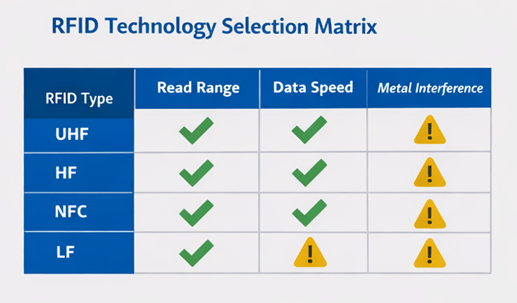
- UHF RFID
UHF RFID supports long read ranges and high tag population handling. Performance characteristics include sensitivity to environmental interference and directional antenna requirements. Operational characteristics involve infrastructure planning and tuning.
- HF RFID
HF RFID operates at shorter ranges with stable performance near liquids and metals. Characteristics include moderate data rates and defined read zones suitable for controlled interactions.
- NFC RFID
NFC enables very short-range, intentional interactions. Operational characteristics include device interoperability and secure peer-to-peer exchanges.
- LF RFID
LF RFID offers low read ranges with high tolerance to harsh environments. Characteristics include slower data rates and limited tag memory.
RFID Technology Comparison for Manufacturing WIP Systems
| RFID Technology | Role in Manufacturing WIP Systems | Typical Decision Drivers |
| UHF | Bulk WIP movement tracking across production zones | High throughput and spatial coverage |
| HF | Workstation-level process confirmation | Controlled read precision |
| NFC | Operator interactions and authorization | Intentional, secure engagement |
| LF | Harsh environment asset identification | Environmental resilience |
Combining Multiple RFID Technologies in Manufacturing WIP Systems
Combining multiple RFID technologies is appropriate when Manufacturing WIP workflows span varied physical and operational contexts. Architectural benefits include optimized read performance and risk mitigation across diverse production zones. Trade-offs include increased system complexity, integration overhead, and testing requirements. Complexity risks involve cross-technology data normalization and maintenance coordination. GAO evaluates multi-technology architectures when operational justification outweighs added complexity.
Applications of Manufacturing WIP Systems Using RFID Technologies
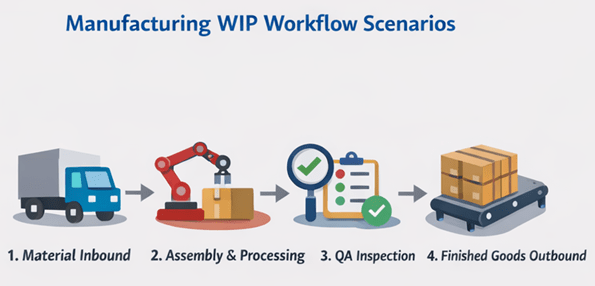
- Assembly line WIP tracking capturing station-to-station progression of serialized subassemblies using automated read points and operator validation workflows
- Tool and fixture readiness monitoring correlating RFID-tagged assets with scheduled work orders and preventive maintenance states
- Quality inspection gating enforcing inspection completion before WIP advancement through controlled production zones
- Rework and deviation management tracking nonconforming units through corrective action loops and disposition stations
- Kitting verification ensuring correct material staging at line-side buffers using RFID validation against BOM requirements
- Production labor attribution associating operator credentials with WIP transactions for accountability and compliance
- Work order sequencing visibility aligning real-time WIP states with finite scheduling systems
- Traceability for regulated manufacturing capturing full genealogy for audits and recalls
- Buffer and supermarket control monitoring WIP accumulation against takt targets
- Subcontractor WIP oversight extending visibility into outsourced processing stages
GAO applies field experience across these Manufacturing WIP scenarios to tailor system configurations.
Deployment Options for Manufacturing WIP Systems Using RFID
- Cloud Deployment Use Cases and Advantages
Cloud deployments suit manufacturers requiring cross-site visibility, centralized analytics, and rapid scalability. Organizational advantages include reduced local infrastructure management and standardized governance. Regulatory suitability depends on data residency allowances. Operational decision factors include network reliability and cybersecurity integration.
- Non-Cloud Deployment Use Cases and Advantages
Non-cloud deployments align with organizations prioritizing deterministic latency, restricted connectivity, or internal data control. Handheld deployments support mobile workflows. PC-based systems address localized supervision. Local servers enable plant-wide control. Remote servers consolidate private infrastructure. GAO supports these models where regulatory or operational constraints dictate.
GAO Case Studies of Manufacturing WIP (Work-In-Progress) System Using RFID Technologies
United States Case Studies
Discrete Electronics Manufacturing Facility, San Jose, California
- Problem
High-mix SMT and final assembly operations relied on barcode scans and manual updates, resulting in delayed WIP reporting and frequent mismatches between MES records and physical subassemblies during demand spikes.
- Solution
A Manufacturing WIP system using RFID technologies deployed UHF RFID for palletized WIP and HF RFID at workstation checkpoints. Processing ran on a local server integrated with the existing MES. GAO supported reader zoning and middleware rule configuration.
- Result
WIP record accuracy increased from approximately 92 percent to 99.6 percent within three months.
Lesson or Trade-Off
Local server deployment minimized latency but required dedicated on-site IT support.
Aerospace Components Plant, Wichita, Kansas
- Problem
Serialized aerospace components required enforced routing and auditable WIP records. Paper travelers increased compliance risk and inspection delays.
- Solution
A non-cloud Manufacturing WIP system using RFID technologies employed LF RFID on fixtures and HF RFID for operator verification. Software operated on secured PCs within an isolated network. GAO assisted with compliance alignment.
- Result
Inspection cycle time decreased by 27 percent while maintaining audit readiness.
Lesson or Trade-Off
LF RFID ensured metal tolerance but limited read speed.
Automotive Powertrain Facility, Detroit, Michigan
- Problem
High-volume machining lines experienced WIP congestion between operations, reducing takt adherence.
- Solution
A cloud-based Manufacturing WIP system using RFID technologies leveraged UHF RFID for carrier tracking with edge filtering. Data synchronized to enterprise analytics platforms. GAO designed the hybrid cloud architecture.
- Result
Average buffer dwell time declined by 18 percent.
Lesson or Trade-Off
Cloud analytics required network redundancy planning.
Medical Device Assembly Site, Minneapolis, Minnesota
- Problem
Regulated assembly required complete genealogy capture, yet manual data entry caused omissions.
- Solution
HF RFID at assembly stations and NFC for operator authentication supported a Manufacturing WIP system running on a remote private server. GAO supported validation documentation.
- Result
Genealogy completeness reached 100 percent for regulated SKUs.
Lesson or Trade-Off
Operator training was required for NFC interactions.
Heavy Equipment Manufacturing Plant, Peoria, Illinois
- Problem
Large WIP assemblies moved across expansive shop floors without reliable location visibility.
- Solution
UHF RFID-based Manufacturing WIP tracking operated on a local server. GAO assisted with antenna zoning and interference mitigation.
- Result
Unplanned WIP search time dropped by 34 percent.
Lesson or Trade-Off
High-metal environments required careful tuning.
Consumer Appliances Factory, Louisville, Kentucky
- Problem
Limited visibility into rework loops caused inaccurate production forecasts.
- Solution
HF RFID at rework stations supported a PC-based Manufacturing WIP system with exception workflows configured by GAO.
- Result
Schedule variance related to rework decreased by 15 percent.
Lesson or Trade-Off
PC-based deployments were less scalable for multi-site operations.
Pharmaceutical Packaging Facility, Raleigh, North Carolina
- Problem
Packaging operations required precise batch-level WIP control to avoid product mixing.
- Solution
UHF RFID-enabled Manufacturing WIP tracking ran on a non-cloud local server to meet data residency requirements. GAO supported validation testing.
- Result
Internal audits reported near-zero batch discrepancies.
Lesson or Trade-Off
Validation requirements extended deployment timelines.
Industrial Controls Manufacturer, Austin, Texas
- Problem
Engineering change orders disrupted WIP routing across production lines.
- Solution
A cloud-based Manufacturing WIP system using RFID technologies enabled dynamic routing updates via HF RFID checkpoints. GAO supported ERP integration.
- Result
Change implementation delays fell by 22 percent.
Lesson or Trade-Off
Cloud dependency required fallback procedures.
Metal Fabrication Facility, Milwaukee, Wisconsin
- Problem
Visual boards provided inaccurate WIP status across welding and finishing operations.
- Solution
UHF RFID-based Manufacturing WIP tracking operated on handheld computers with offline synchronization. GAO supported workflow design.
- Result
Physical-to-system WIP alignment reached 98.9 percent.
Lesson or Trade-Off
Handheld accuracy depended on disciplined use.
Defense Manufacturing Site, Huntsville, Alabama
- Problem
Security policies prohibited external connectivity for WIP systems.
- Solution
A fully non-cloud Manufacturing WIP system using RFID technologies ran on an isolated local server with LF RFID. GAO designed security boundaries.
- Result
Real-time WIP visibility achieved without policy violations.
Lesson or Trade-Off
Isolated systems limited enterprise analytics.
Plastics Processing Plant, Akron, Ohio
- Problem
WIP gaps between molding and finishing created production imbalances.
- Solution
HF RFID checkpoints supported PC-based Manufacturing WIP tracking. GAO assisted with process mapping.
- Result
Inter-department handoff delays decreased by 19 percent.
Lesson or Trade-Off
Manual consolidation was needed for enterprise reporting.
Food Processing Equipment Manufacturer, Fresno, California
- Problem
WIP staging areas lacked sequencing visibility.
- Solution
UHF RFID-enabled Manufacturing WIP tracking operated on a remote private server. GAO configured role-based dashboards.
- Result
Sequencing errors dropped by 21 percent.
Lesson or Trade-Off
Remote servers required disciplined network management.
Industrial Pump Manufacturing Facility, Tulsa, Oklahoma
- Problem
Long production cycles made WIP aging difficult to monitor.
- Solution
HF RFID-based Manufacturing WIP software ran on a local server integrated with quality systems. GAO supported tag lifecycle planning.
- Result
Overdue assemblies declined by 16 percent.
Lesson or Trade-Off
HF read zones required precise station layout.
Robotics Manufacturing Site, Boston, Massachusetts
- Problem
High-value WIP moved between engineering and production without updates.
- Solution
NFC-enabled Manufacturing WIP workflows allowed intentional state updates using secured interactions. GAO defined credential policies.
- Result
Untracked WIP movements decreased by 29 percent.
Lesson or Trade-Off
System effectiveness depended on user compliance.
Canada Case Studies
Automotive Tier-2 Supplier, Windsor, Ontario
- Problem
Multi-line operations required synchronized WIP reporting across shifts.
- Solution
A cloud-based Manufacturing WIP system using RFID technologies consolidated UHF RFID data across lines. GAO configured shift-based analytics.
- Result
Shift transition discrepancies declined by 24 percent.
Lesson or Trade-Off
Cloud deployment required reliable shop floor connectivity.
Electronics Assembly Facility, Markham, Ontario
- Problem
Manual WIP tracking delayed high-mix changeovers.
- Solution
HF RFID checkpoints supported PC-based Manufacturing WIP software. GAO assisted with changeover modeling.
- Result
Changeover-related WIP delays dropped by 17 percent.
Lesson or Trade-Off
Configuration discipline was required for frequent product changes.
Mining Equipment Manufacturer, Sudbury, Ontario
- Problem
Harsh environments disrupted conventional identification methods.
- Solution
LF RFID-based Manufacturing WIP tracking operated on a local server to support rugged conditions. GAO supported environmental testing.
- Result
WIP identification reliability exceeded 99 percent.
Lesson or Trade-Off
LF RFID limited read speed.
Advanced Materials Plant, Sherbrooke, Quebec
- Problem
Complex batch workflows required strict sequencing and auditability.
- Solution
A hybrid Manufacturing WIP system using UHF and HF RFID technologies ran on a remote server. GAO supported data normalization.
- Result
Batch sequencing errors declined by 20 percent.
Lesson or Trade-Off
Multi-technology integration increased system complexity.
Industrial Machinery Assembly Facility, Mississauga, Ontario
- Problem
Coordination gaps existed between assembly and testing departments.
- Solution
UHF RFID-enabled Manufacturing WIP tracking with handheld computer support enabled mobile verification. GAO assisted with workflow design.
- Result
Assembly-to-test handoff delays decreased by 14 percent.
Lesson or Trade-Off
Ongoing training was required for handheld workflows.
Our products and systems have been developed and deployed for a wide range of industrial applications. They are available off-the-shelf or can be customized to meet your needs. If you have any questions, our technical experts can help you.
For any further information on GAO’s products and systems, to request evaluation kits, free samples, recorded video demos, or explore partnership opportunities, please fill out this form or email us.