
Overview of Construction Equipment RFID Systems
Construction Equipment RFID Systems provide structured, data-driven control over heavy machinery, powered tools, attachments, and supporting assets across construction yards, job sites, maintenance depots, and logistics corridors. These systems establish persistent digital identities for equipment and bind them to operational workflows such as dispatch, utilization tracking, inspection, servicing, and redeployment. Visibility extends across owned, leased, and subcontractor-managed assets, supporting accountability across fragmented project environments.
The platform supports multiple RFID technologies selected based on read range, environmental exposure, and asset form factor, while maintaining a unified operational model. Data collection can occur through mobile readers, fixed portals, or embedded checkpoints, feeding into configurable software layers. Deployment flexibility supports both cloud-based environments and non-cloud implementations running on handheld computers, PCs, local servers, or remote servers. This architectural adaptability allows construction enterprises to align with regulatory constraints, connectivity limitations, and internal IT governance models without sacrificing system integrity or operational continuity.
Construction Equipment GAO’S RFID Systems: Purpose, Problems Addressed, and Benefits
Detailed System Description
Construction Equipment RFID Systems integrate tagged physical assets, reader infrastructure, software platforms, and operational governance into a single asset intelligence framework. Equipment identifiers become system-recognized credentials tied to job codes, work orders, operator authorizations, and maintenance states. Field activity, yard movements, and cross-site transfers are digitally logged, reducing manual reconciliation across spreadsheets, paper logs, and disparate ERP modules.
Operational Purposes
- Establishing verifiable chain-of-custody for machinery, attachments, and high-value tools
- Enforcing equipment allocation rules across projects, crews, and subcontractors
- Supporting preventive maintenance cycles tied to usage metrics rather than calendar estimates
- Enabling audit-ready records for insurance, safety, and regulatory reporting
- Synchronizing asset availability with procurement and rental management processes
Issues Addressed in Construction Environments
- Loss and misplacement of mobile assets across unsecured job sites
- Inaccurate utilization reporting leading to excess rentals or underused capital equipment
- Manual inspection logs disconnected from actual equipment movement
- Delayed incident investigations due to incomplete historical data
- Fragmented visibility across regional offices, yards, and project teams
System Benefits
- Real-time operational awareness without reliance on constant human input
- Reduced shrinkage and dispute resolution costs through verifiable records
- Improved maintenance compliance aligned with OEM and safety requirements
- Faster project mobilization and demobilization cycles
- Stronger data foundation for capital planning and lifecycle cost analysis
System Architecture of Construction Equipment RFID Systems Using RFID Technologies
Cloud Architecture Overview
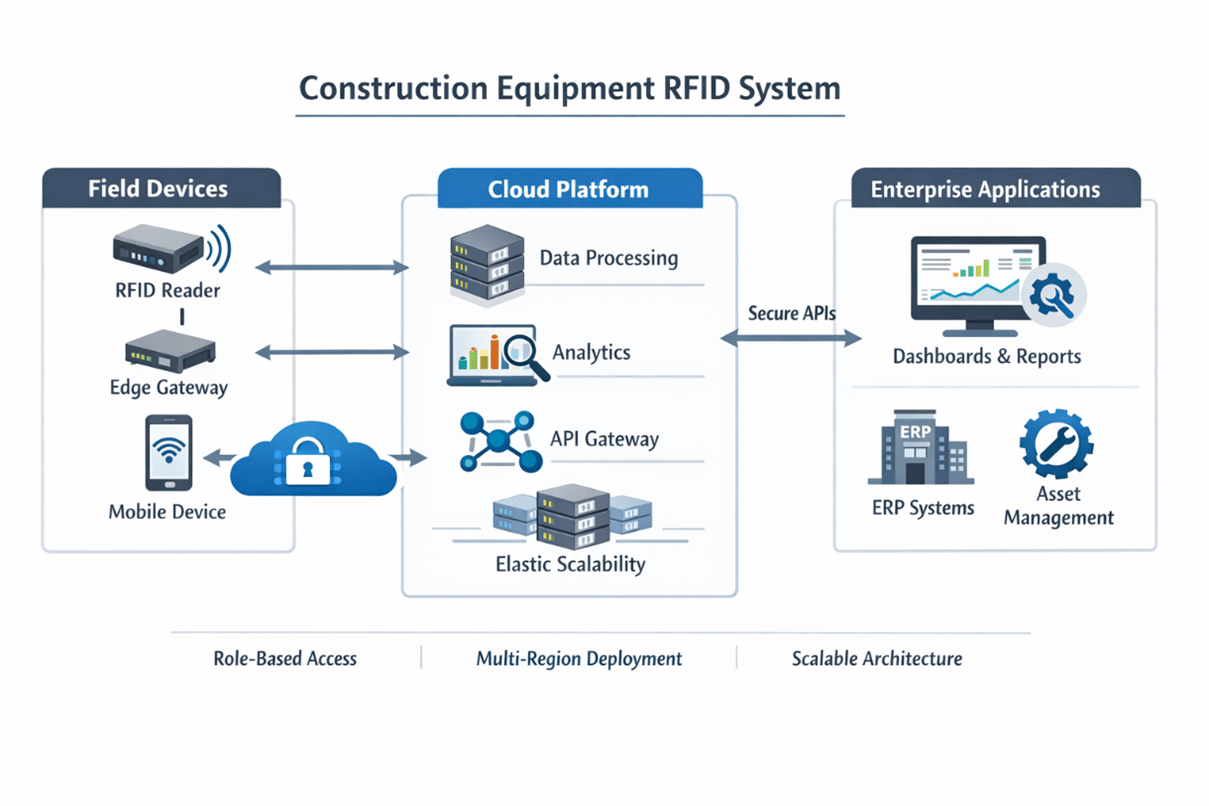
Cloud-based Construction Equipment RFID Systems centralize data ingestion, processing, and analytics within a managed cloud platform. Edge readers and mobile devices transmit event data through secure network channels into centralized services. Operational teams, compliance officers, and executives access dashboards through role-based interfaces. Security boundaries separate field devices, integration services, and enterprise applications. Elastic scaling supports seasonal workload spikes, multi-region deployments, and portfolio-wide analytics.
Non-Cloud Architecture Overview
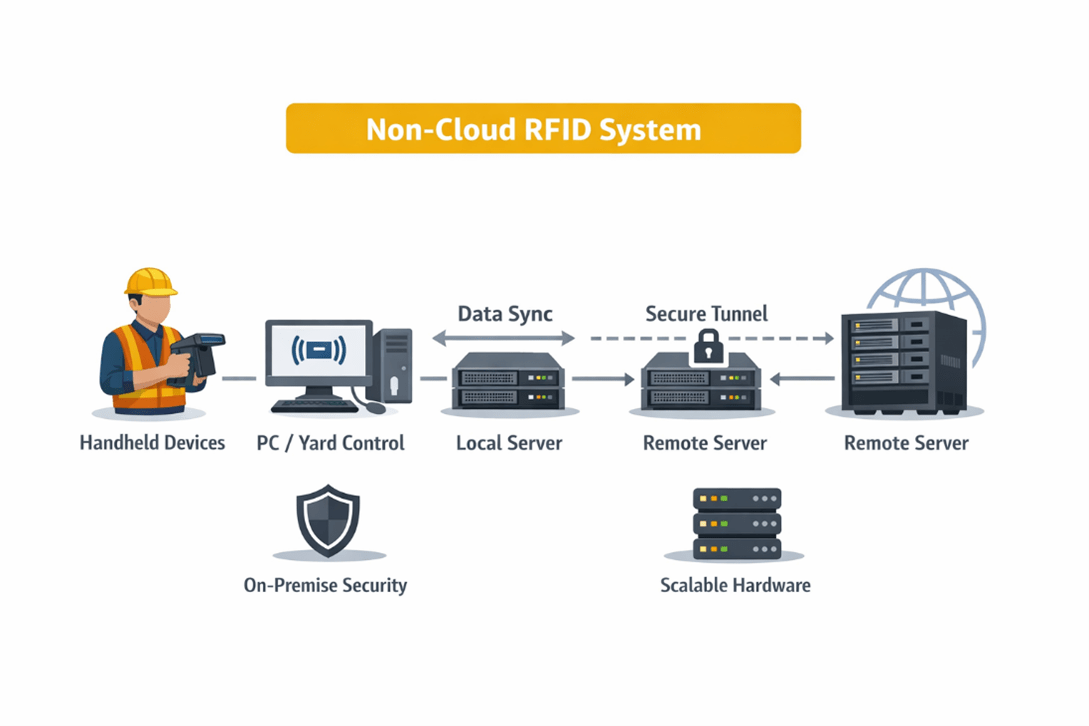
Non-cloud Construction Equipment RFID Systems operate within controlled IT environments where data sovereignty, latency, or connectivity constraints apply. Software may run directly on handheld computers for isolated sites, on PCs for yard-level control, on local servers for regional operations, or on remote servers managed by the enterprise. Data flows remain internal, with synchronization occurring through scheduled exports or secure tunnels when required. Security boundaries align with on-premise policies, and scalability is managed through hardware provisioning and system segmentation.
Cloud vs Non-Cloud Deployment Comparison for Construction Equipment RFID Systems
| Decision Factor | Cloud-Based System | Non-Cloud System |
| Deployment Scope | Multi-site, multi-region portfolios | Single site or regulated environments |
| Connectivity Dependency | Requires reliable network access | Operates offline or intermittently |
| Data Governance | Centralized policies and analytics | Locally enforced data controls |
| Scalability Model | Elastic resource allocation | Hardware-bound scaling |
| Typical Scenarios | National contractors, equipment rental firms | Secure sites, remote projects, defense-related builds |
| Operational Ownership | Shared responsibility with provider | Fully internal IT ownership |
Non-cloud variations apply based on operational scale. Handheld-based systems support temporary or remote sites. PC-based deployments suit small yards. Local servers align with regional hubs. Remote servers support centralized IT control without public cloud reliance.
Cloud Integration and Data Management for Construction Equipment RFID Systems
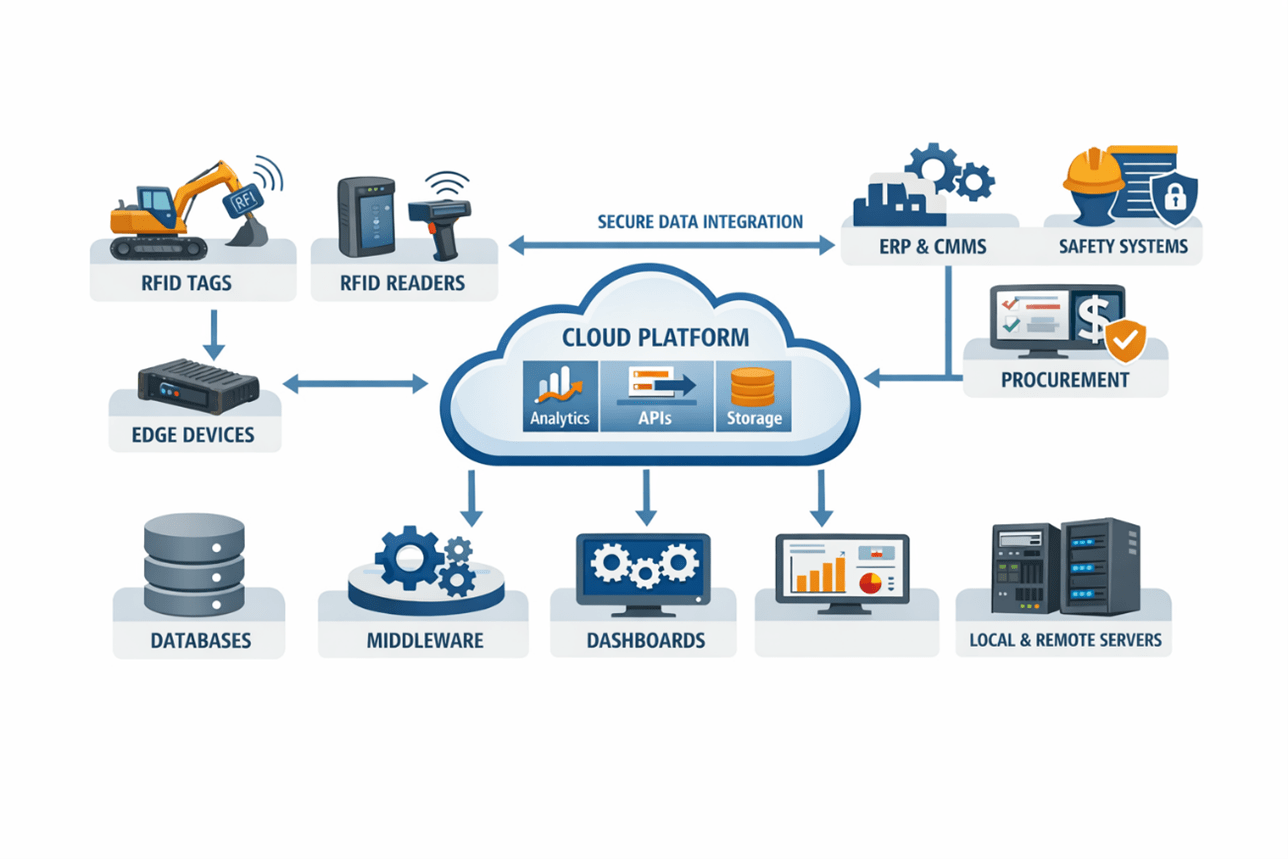
Cloud data management within Construction Equipment RFID Systems focuses on lifecycle governance from ingestion to archival. Event streams from RFID readers enter validation pipelines enforcing schema consistency and timestamp integrity. Processed data is stored in tiered repositories aligned with retention policies. Analytics services generate utilization metrics, compliance indicators, and anomaly detection outputs.
Integration services exchange data with ERP, CMMS, safety platforms, and procurement systems through secured APIs. Access governance enforces least-privilege policies across operations, finance, and compliance teams. Encryption, audit logging, and data residency controls support regulatory obligations. GAO designs these frameworks to balance analytical depth with governance rigor, supporting enterprise risk management strategies.
Major Components of Construction Equipment RFID Systems Architecture
- RFID Credentials
Equipment-mounted tags function as durable digital identifiers. Selection considers environmental exposure, mounting constraints, and lifecycle alignment with assets.
- RFID Readers
Readers capture identification events across fixed portals, mobile inspections, and yard checkpoints. Constraints include power availability, read zone control, and interference management.
- Edge Devices
Edge computing nodes aggregate reader data, enforce local logic, and buffer events during connectivity disruptions.
- Middleware
Middleware normalizes data, applies business rules, and manages device orchestration. Selection emphasizes configurability and integration compatibility.
- Cloud Platforms
Cloud platforms host analytics, dashboards, and integration services. Constraints include compliance, latency tolerance, and enterprise IT standards.
- Local and Remote Servers
Servers support non-cloud deployments requiring internal control. Considerations include redundancy, patch management, and physical security.
- Databases
Databases store transactional and historical records. Selection balances performance, retention, and auditability.
- Dashboards and Reporting Tools
Visualization layers present operational KPIs, compliance status, and exception alerts. Usability and role alignment guide configuration.
RFID Technologies Used in Construction Equipment RFID Systems
- UHF RFID
UHF RFID supports long read ranges and high-throughput environments. Performance remains sensitive to metal proximity and site-specific interference. Operational tuning is required in dense equipment yards.
- HF RFID
HF RFID offers moderate read ranges with stable performance near metal. Environmental resilience supports controlled checkpoints and inspection workflows.
- NFC
NFC operates at very short ranges, enabling intentional interactions. Performance relies on proximity and user participation, supporting controlled authorization points.
- LF RFID
LF RFID provides short-range operation with strong resistance to metal and moisture. Read rates are lower, and data capacity is limited.
RFID Technology Comparison for Construction Equipment RFID Systems
| Technology | Typical Role in Construction Equipment RFID Systems | Selection Rationale |
| UHF | Yard exits, laydown areas, logistics gates | High-volume movement tracking |
| HF | Maintenance bays, inspection stations | Controlled read environments |
| NFC | Operator verification points | Intentional authentication |
| LF | Harsh environments, embedded assets | Environmental tolerance |
Combining Multiple RFID Technologies in Construction Equipment RFID Systems
Hybrid RFID architectures become appropriate when operational zones present conflicting requirements. Combining UHF for perimeter tracking with HF or NFC for controlled interactions improves data fidelity. Architectural benefits include layered validation and reduced false positives. Trade-offs include increased system complexity, integration overhead, and maintenance coordination. GAO applies multi-technology designs when operational gains justify lifecycle costs and governance effort.
Applications of Construction Equipment RFID Systems
- Equipment yard inventory reconciliation across shifting project demands
- Automated gate control for machinery ingress and egress logging
- Maintenance compliance tracking tied to actual operating cycles
- Tool crib accountability for high-value powered equipment
- Rental asset utilization verification for billing accuracy
- Subcontractor equipment segregation on shared sites
- Safety inspection validation before equipment activation
- Incident investigation support through historical movement logs
- Capital asset depreciation modeling based on usage intensity
- Cross-border equipment transfers with customs documentation alignment
Deployment Options for Construction Equipment RFID Systems
Cloud Deployment Use Cases and Advantages
Cloud deployments align with organizations managing distributed fleets, centralized analytics, and standardized governance. Advantages include rapid scalability, centralized compliance reporting, and simplified cross-project visibility.
Non-Cloud Deployment Use Cases and Advantages
Non-cloud deployments suit environments with connectivity constraints, strict data residency rules, or internal IT mandates. Handheld and PC-based systems support temporary sites. Local and remote servers enable controlled scalability without public cloud exposure.
GAO Expertise and Support
GAO operates across North America with engineering and solution teams based in New York City and Toronto. Decades of experience supporting regulated industries, infrastructure projects, and government programs inform system design decisions. Investment in R&D, quality assurance, and expert support allows GAO to deliver Construction Equipment RFID Systems aligned with real-world construction operations, compliance obligations, and long-term asset strategies.
Case Studies of Construction Equipment RFID Systems Using RFID Technologies
U.S. Case Studies
Construction Equipment RFID Systems Deployment in Houston, Texas
- Problem
A large civil construction program operating across multiple highway expansion sites faced recurring discrepancies between scheduled and actual availability of earthmoving equipment. Manual sign-out logs and fragmented maintenance records resulted in average weekly utilization variance exceeding 18 percent, affecting rental costs and crew scheduling. Connectivity varied across sites, limiting centralized oversight.
- Solution
GAO supported deployment of Construction Equipment RFID Systems using UHF RFID technologies at yard gates and maintenance zones. A hybrid architecture was selected, combining cloud-based analytics with non-cloud software running on local servers at each yard. Data synchronized during scheduled network windows.
- Result
Verified equipment utilization accuracy improved to within 4 percent variance within three months.
- Lesson or Trade-Off
Local server maintenance required disciplined patch management by site IT staff.
Heavy Equipment Tracking Program in Phoenix, Arizona
- Problem
A regional contractor managing desert infrastructure projects experienced frequent disputes with rental partners over billable equipment hours. Temperature extremes and metallic equipment frames challenged sensor reliability. Existing ERP data lacked field-level verification.
- Solution
Construction Equipment RFID Systems using LF RFID technologies were applied to critical assets, paired with handheld-based non-cloud software for field supervisors. GAO assisted with configuration to accommodate offline operation and harsh environmental exposure.
- Result
Rental billing disputes dropped by 62 percent within the first project cycle.
- Lesson or Trade-Off
Short read range required disciplined inspection workflows by supervisors.
Multi-Site Construction Fleet Visibility in Chicago, Illinois
- Problem
Urban construction projects across dense job sites struggled with unauthorized equipment movement between locations. Compliance teams lacked auditable records for insurance and municipal reporting.
- Solution
GAO enabled Construction Equipment RFID Systems using UHF RFID technologies integrated with a cloud deployment. Fixed readers were installed at controlled egress points, feeding centralized dashboards accessible to compliance officers.
- Result
Unauthorized asset transfers declined by 41 percent within six months.
- Lesson or Trade-Off
Dense RF environments required careful antenna tuning during commissioning.
Equipment Maintenance Compliance in Atlanta, Georgia
- Problem
Maintenance schedules were calendar-based rather than usage-driven, resulting in premature servicing of some machines and delayed servicing of others. Audit findings cited inconsistent inspection records.
- Solution
Construction Equipment RFID Systems using HF RFID technologies were deployed at maintenance bays with PC-based non-cloud software. GAO configured usage counters tied to inspection workflows.
- Result
Maintenance compliance deviations were reduced by 33 percent over two quarters.
- Lesson or Trade-Off
PC-based systems limited remote visibility outside maintenance facilities.
Infrastructure Expansion Project in Seattle, Washington
- Problem
Frequent rain and moisture exposure degraded barcode labels on equipment, leading to manual data entry errors during inspections and transfers.
- Solution
GAO supported Construction Equipment RFID Systems using LF RFID technologies resistant to moisture. A remote server non-cloud architecture was selected to centralize data without public cloud exposure.
- Result
Inspection data capture accuracy increased to 98.7 percent.
- Lesson or Trade-Off
Lower data capacity limited additional metadata storage on tags.
Airport Construction Equipment Control in Denver, Colorado
- Problem
Security policies required strict segregation of airside and landside equipment. Manual logs failed to provide real-time enforcement.
- Solution
Construction Equipment RFID Systems using UHF RFID technologies were integrated with access control logic on a cloud platform. GAO assisted with security boundary definition aligned with aviation regulations published by the FAA.
- Result
Policy violations related to equipment zone breaches fell to zero during active monitoring periods.
- Lesson or Trade-Off
Cloud reliance required redundant network connectivity planning.
Roadway Rehabilitation Program in Columbus, Ohio
- Problem
Short-duration projects rotated crews and equipment frequently, creating gaps in asset accountability during mobilization and demobilization.
- Solution
GAO implemented Construction Equipment RFID Systems using NFC RFID technologies with handheld-based non-cloud software. Supervisors performed intentional scans during handoff events.
- Result
Equipment handoff discrepancies decreased by 47 percent across projects.
- Lesson or Trade-Off
User compliance was critical due to proximity-based scanning.
Energy Sector Construction Yard in Midland, Texas
- Problem
Oilfield-related construction required tracking of specialized machinery across remote yards with limited connectivity and strict internal IT controls.
- Solution
Construction Equipment RFID Systems using UHF RFID technologies were deployed with software running on local servers. GAO supported secure data synchronization with enterprise systems.
- Result
Asset availability reporting latency dropped from days to under four hours.
- Lesson or Trade-Off
Hardware scaling required upfront capacity planning.
Municipal Construction Operations in San Diego, California
- Problem
Public works projects required transparent reporting for audits and public accountability. Existing systems lacked traceability.
- Solution
GAO enabled cloud-based Construction Equipment RFID Systems using HF RFID technologies at inspection checkpoints. Reporting aligned with municipal oversight requirements.
- Result
Audit preparation time was reduced by 29 percent year over year.
- Lesson or Trade-Off
HF read zones required controlled physical layouts.
High-Rise Construction Program in New York City, New York
- Problem
Vertical construction environments created congestion and risk of equipment misplacement across floors and staging areas.
- Solution
Construction Equipment RFID Systems using UHF RFID technologies were integrated with cloud analytics. GAO leveraged experience from dense urban deployments supported by its New York engineering teams.
- Result
Reported equipment search incidents declined by 38 percent.
- Lesson or Trade-Off
Reader placement required coordination with safety teams.
Bridge Rehabilitation Project in St. Louis, Missouri
- Problem
Equipment sharing between contractors led to unclear responsibility during damage investigations.
- Solution
GAO supported Construction Equipment RFID Systems using NFC RFID technologies with PC-based non-cloud software for controlled sign-in processes.
- Result
Damage attribution resolution time decreased by 44 percent.
- Lesson or Trade-Off
Manual interaction increased administrative overhead.
Mining-Adjacent Construction in Reno, Nevada
- Problem
Dust and vibration affected optical identification systems, impacting inspection accuracy.
- Solution
Construction Equipment RFID Systems using LF RFID technologies were deployed with handheld-based non-cloud software optimized for rugged environments.
- Result
Inspection completion rates improved by 31 percent.
- Lesson or Trade-Off
Short read range limited automated capture.
Port Infrastructure Development in Savannah, Georgia
- Problem
Equipment frequently moved between port zones subject to federal reporting requirements.
- Solution
GAO implemented cloud-based Construction Equipment RFID Systems using UHF RFID technologies integrated with reporting aligned to U.S. Department of Transportation guidance.
- Result
Regulatory reporting errors dropped by 26 percent.
- Lesson or Trade-Off
Integration testing required coordination with port IT teams.
Renewable Energy Construction in Bakersfield, California
- Problem
Large solar installations involved temporary yards with rotating equipment inventories.
- Solution
Construction Equipment RFID Systems using HF RFID technologies operated on remote server non-cloud infrastructure. GAO assisted with rapid deployment templates.
- Result
Inventory reconciliation cycle time shortened by 35 percent.
- Lesson or Trade-Off
Remote server access required secure VPN management.
Canadian Case Studies
Transit Infrastructure Construction in Toronto, Ontario
- Problem
Multiple contractors shared staging areas, creating asset visibility gaps and compliance challenges under provincial safety regulations.
- Solution
GAO supported cloud-based Construction Equipment RFID Systems using UHF RFID technologies. Dashboards provided shared visibility while maintaining data segregation.
- Result
Shared equipment conflicts decreased by 28 percent.
- Lesson or Trade-Off
Data governance policies required upfront alignment.
Industrial Construction Program in Hamilton, Ontario
- Problem
Steel-intensive environments interfered with existing identification methods, delaying inspections.
- Solution
Construction Equipment RFID Systems using HF RFID technologies were deployed with local server non-cloud software. GAO leveraged regional support from Toronto-based teams.
- Result
Inspection throughput increased by 22 percent.
- Lesson or Trade-Off
Local server redundancy planning was essential.
Resource Development Construction in Fort McMurray, Alberta
- Problem
Extreme cold and remote locations limited connectivity and device reliability.
- Solution
GAO implemented Construction Equipment RFID Systems using LF RFID technologies with handheld-based non-cloud software designed for offline operation.
- Result
Asset status reporting completeness improved from 71 to 93 percent.
- Lesson or Trade-Off
Manual data synchronization required procedural discipline.
Urban Development Projects in Vancouver, British Columbia
- Problem
Sustainability reporting required accurate utilization data to support emissions analysis.
- Solution
Cloud-based Construction Equipment RFID Systems using UHF RFID technologies were integrated with analytics modules. GAO supported data governance alignment.
- Result
Utilization data confidence increased sufficiently to support third-party sustainability audits.
- Lesson or Trade-Off
Cloud analytics required standardized data schemas.
Transportation Corridor Construction in Laval, Quebec
- Problem
Bilingual reporting requirements and regional IT policies complicated system adoption.
- Solution
Construction Equipment RFID Systems using NFC RFID technologies operated on PC-based non-cloud software. GAO assisted with configurable reporting templates.
- Result
Report preparation time decreased by 19 percent.
- Lesson or Trade-Off
Proximity-based scanning limited automation potential.
These case studies reflect GAO’s experience supporting Construction Equipment RFID Systems across diverse regulatory, environmental, and operational conditions throughout the U.S. and Canada, informed by decades of serving enterprise, government, and research-driven organizations.
Our products and systems have been developed and deployed for a wide range of industrial applications. They are available off-the-shelf or can be customized to meet your needs. If you have any questions, our technical experts can help you.
For any further information on GAO’s products and systems, to request evaluation kits, free samples, recorded video demos, or explore partnership opportunities, please fill out this form or email us.