
Overview of Hotel Guest Room Access RFID Systems Using RFID Technologies
Hotel guest room access RFID systems enable controlled, auditable, and scalable access management across hospitality properties by replacing mechanical keys with digitally governed credentials. These access control platforms support room entry, amenity access, and staff authorization through centrally managed policies aligned with hotel operations. Credential lifecycle management, audit logging, and integration with property workflows support both guest experience objectives and operational governance. Deployment flexibility allows the same system to operate in cloud-hosted environments or non-cloud configurations where software runs on handheld computers, PCs, local servers, or remote servers. This flexibility supports hotels with varying regulatory obligations, network maturity, and IT operating models. RFID-based room access systems are widely used across business hotels, resorts, serviced apartments, and mixed-use hospitality properties where uptime, accountability, and security boundaries are non-negotiable.
Extended Overview Emphasizing System Structure and Applications
Hotel guest room access RFID systems are structured as layered access control platforms combining digital credentials, door-level enforcement, policy engines, and administrative interfaces. The system governs how guests, staff, contractors, and emergency responders interact with physical spaces such as rooms, floors, elevators, and restricted service areas. Applications extend beyond door unlocking to include check-in provisioning, key revocation, housekeeping zoning, and compliance reporting. Support for cloud and non-cloud deployments allows hotels to align access governance with corporate IT strategies, regional data residency requirements, and local operational constraints. RFID technologies provide the credentialing foundation while the system emphasizes reliability, lifecycle governance, and interoperability with hospitality operations rather than raw radio performance.
Hotel Guest Room Access GAO’S RFID Systems: Purpose, Problems Addressed, and Benefits
Detailed System Description
Hotel guest room access RFID systems consist of credential issuance, access enforcement, event capture, and administrative control layers. Guest credentials are associated with reservation data, stay duration, and access privileges. Readers installed at guest rooms and controlled areas authenticate credentials and enforce policies locally or via backend services. Management software governs credential lifecycle actions such as issuance, extension, revocation, and auditing. Integration points align access permissions with front desk operations, housekeeping workflows, and security oversight. The system supports both online and offline enforcement modes to maintain service continuity during network interruptions.
Purpose of the System
- Enable controlled guest room and facility access aligned with reservation parameters
- Reduce key loss exposure and unauthorized room entry incidents
- Support staff access zoning based on role, shift, and operational responsibility
- Provide auditable access records for security, dispute resolution, and compliance
- Standardize access governance across single properties or hotel portfolios
Issues Addressed by the System
- Manual key issuance errors during peak check-in periods
- Lack of visibility into access events and credential misuse
- High operational overhead from mechanical lock rekeying
- Inconsistent access policies across properties or regions
- Limited scalability for multi-property hospitality operators
Benefits Delivered by Hotel Guest Room Access RFID Systems
- Enforced access policies at room and zone levels
- Reduced operational friction for front desk and security teams
- Improved accountability through event logging and reporting
- Support for phased upgrades from legacy lock systems
- Deployment adaptability for regulatory and operational constraints
System Architecture of Hotel Guest Room Access RFID Systems Using GAO RFID Technologies
Cloud Architecture Overview
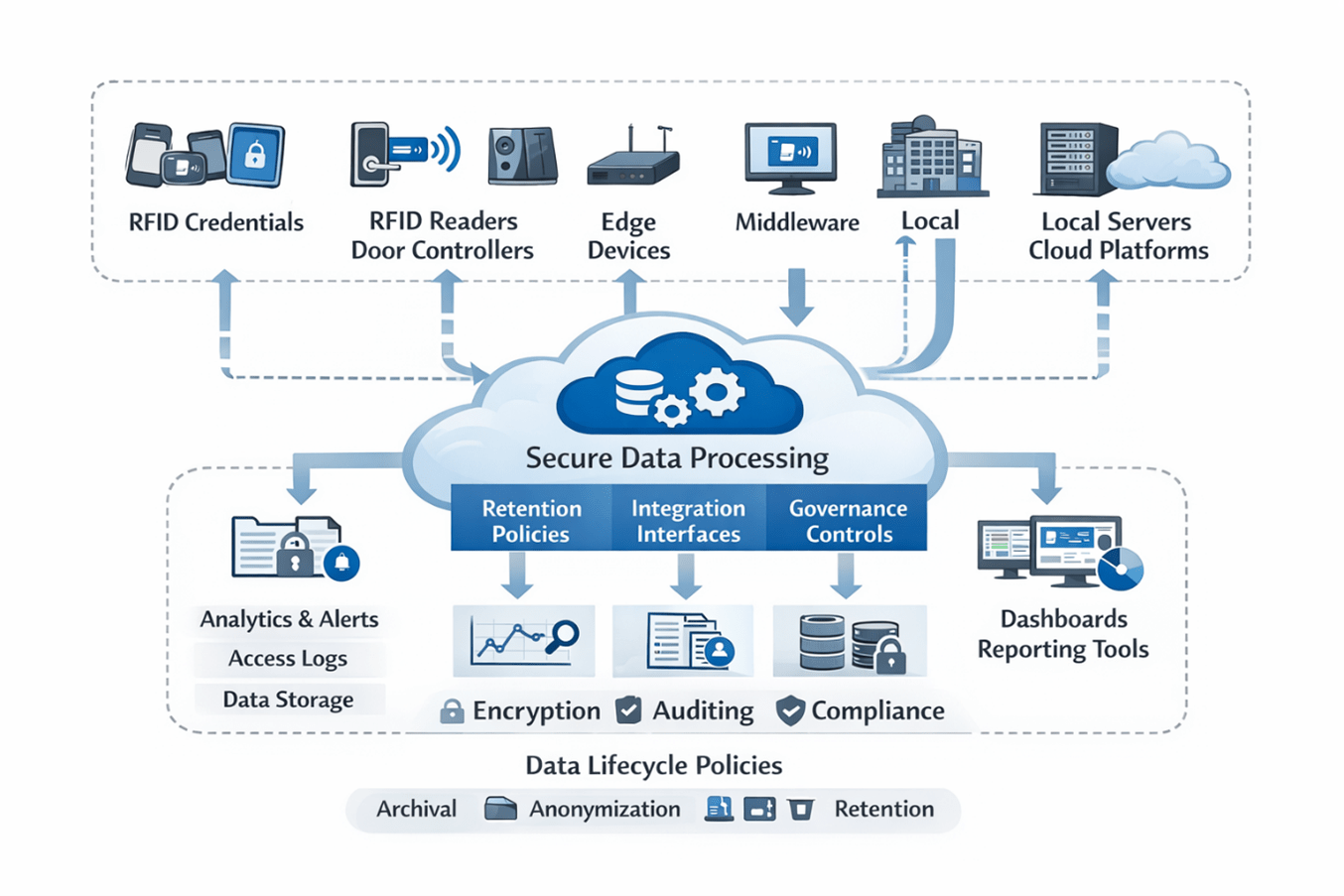
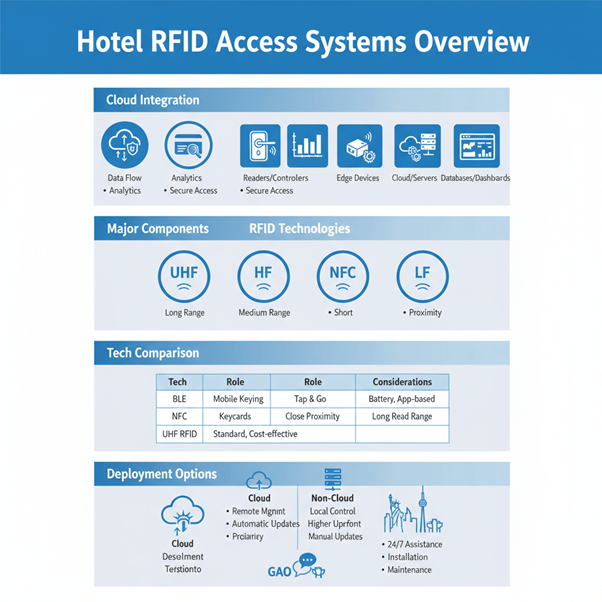
Cloud-based hotel guest room access RFID systems centralize credential management, policy enforcement logic, and analytics within a managed cloud environment. Door events and credential transactions are transmitted through secure channels to centralized services for processing and audit retention. Administrative users access role-based dashboards for monitoring and policy updates. Security boundaries isolate door hardware, integration services, and enterprise applications. Elastic infrastructure supports portfolio-wide scalability during seasonal occupancy peaks.
Non-Cloud Architecture Overview
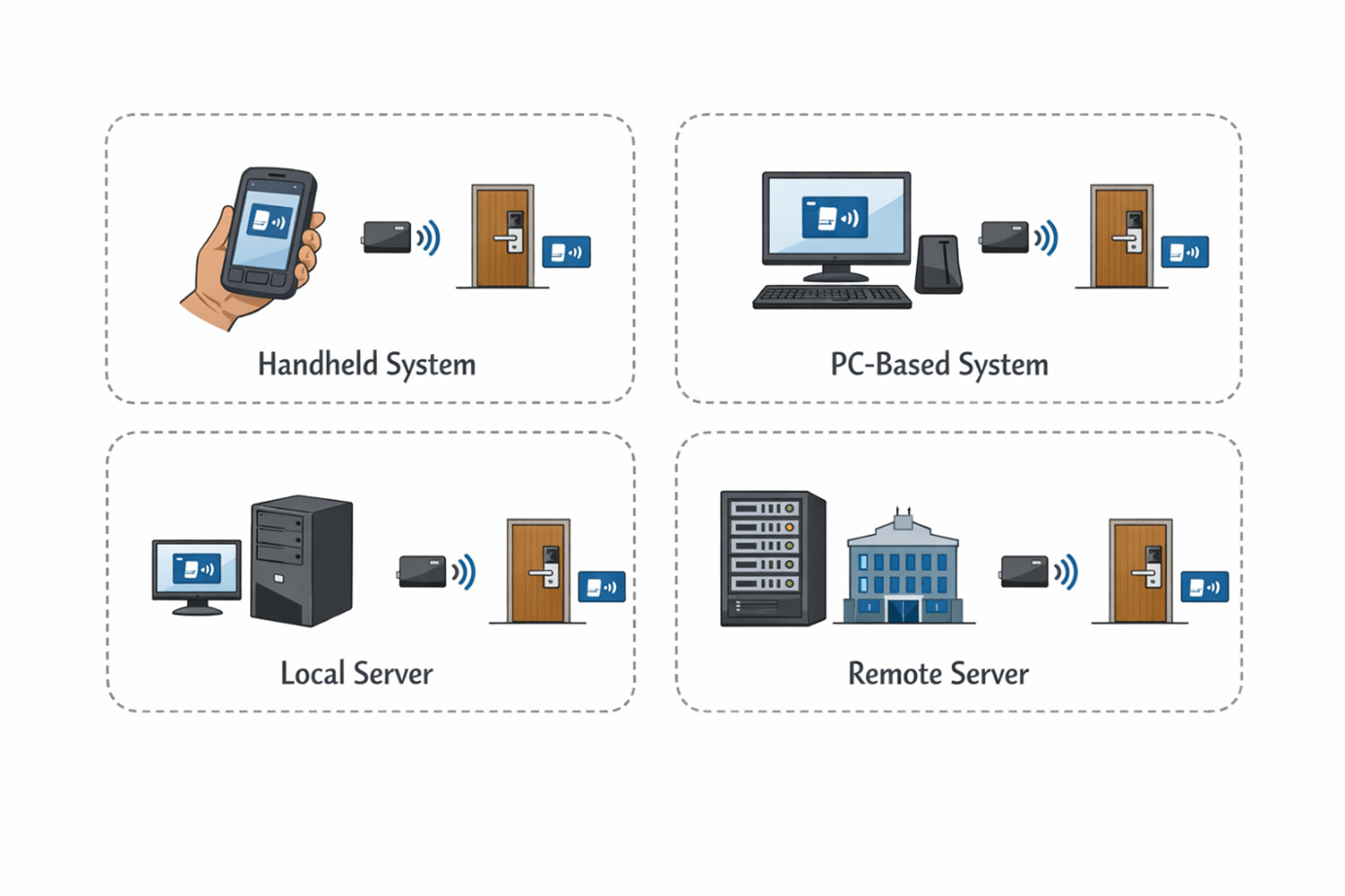
Non-cloud deployments host the access management software within hotel-controlled environments. Software may run directly on a handheld computer for small properties, a front desk PC for limited room counts, a local on-premise server for full-property control, or a remote server managed by the hotel group. Data remains within the defined infrastructure boundary, and synchronization occurs through scheduled transfers where required. This model supports hotels with strict data residency, offline operation needs, or limited external connectivity.
Architectural Considerations Across Deployments
- Modular separation between credentialing, enforcement, and administration
- Defined trust zones between door hardware and management software
- Offline operation tolerance at the door level
- Operational ownership clarity for updates, backups, and monitoring
- Scalable room and credential counts aligned with property growth
Cloud vs Non-Cloud Deployment Comparison for Hotel Guest Room Access RFID Systems
| Aspect | Cloud-Based Deployment | Non-Cloud Deployment |
| Operational Scope | Multi-property and portfolio-level access governance | Single property or isolated property clusters |
| Data Residency | Centrally managed with regional controls | Fully retained within hotel-managed infrastructure |
| IT Responsibility | Shared responsibility with provider | Fully owned by hotel IT or facilities teams |
| Scalability | Elastic room and credential expansion | Capacity defined by local infrastructure |
| Typical Selection Scenario | Branded hotel chains with centralized operations | Independent hotels or regulated environments |
Cloud Integration and Data Management for Hotel Guest Room Access RFID Systems
Cloud deployments manage the full data lifecycle from ingestion of access events to long-term retention. Event streams are validated, normalized, and stored according to defined retention policies. Analytics services support occupancy correlation, access anomaly detection, and operational reporting. Integration interfaces connect access data with property management systems and security platforms. Governance controls enforce role-based access, audit trails, encryption at rest and in transit, and compliance with regional privacy regulations. Data lifecycle policies define archival, anonymization, and deletion aligned with hospitality compliance requirements.
Major Components of Hotel Guest Room Access RFID System Architecture
- RFID Credentials
Credentials represent digital access rights encoded on cards, fobs, or wearable tokens. Selection considerations include durability, form factor, and lifecycle cost. Operational roles focus on issuance, replacement, and revocation.
- RFID Readers and Door Controllers
Readers authenticate credentials and enforce access decisions at the door. Constraints include power availability, offline operation capacity, and tamper resistance. Facility and security teams manage installation and maintenance.
- Edge Devices
Edge components aggregate events and manage local decision logic. Selection depends on room density and network reliability. Operational ownership typically resides with property IT.
- Middleware and Access Management Software
Middleware governs policy enforcement, credential lifecycle actions, and synchronization. Constraints include integration compatibility and update cadence. Security teams define policy models.
- Cloud Platforms or Local Servers
Hosting environments execute management logic and store access records. Selection depends on regulatory posture and scalability needs. IT teams manage uptime and backups.
- Databases
Databases retain credential records, access logs, and audit data. Considerations include retention policies and query performance for investigations.
- Dashboards and Reporting Tools
Interfaces provide visibility into access activity and system health. Operational roles include security oversight and compliance reporting.
RFID Technologies Used in Hotel Guest Room Access Systems
- UHF RFID
UHF RFID offers extended read ranges and fast credential recognition under controlled conditions. Performance characteristics require careful antenna and power tuning. Operationally, UHF is sensitive to environmental interference and is less common for door-level access.
- HF RFID
HF RFID provides stable short-range operation and consistent performance near metal and liquids. It supports controlled access interactions and is widely adopted in hospitality access systems.
- NFC
NFC operates at very short ranges and supports secure mutual authentication. Performance characteristics favor intentional user interaction and mobile credential support. NFC aligns with modern guest engagement models.
- LF RFID
LF RFID offers robust performance in challenging environments with minimal interference. Operational characteristics include slower data rates and limited credential memory.
RFID Technology Comparison for Hotel Guest Room Access RFID Systems
| Technology | Typical Role in Guest Room Access | Selection Considerations |
| UHF RFID | Specialized access scenarios with extended range | Environmental control and interference tolerance |
| HF RFID | Primary room and zone access credentials | Reliability and global interoperability |
| NFC | Mobile and premium guest credentials | Device compatibility and security models |
| LF RFID | Legacy or high-interference environments | Backward compatibility and robustness |
Combining Multiple RFID Technologies in Hotel Guest Room Access Systems
Combining RFID technologies is appropriate when operational requirements diverge across user groups or access zones. Hybrid architectures may support NFC for mobile guest credentials while retaining HF for staff access continuity. Architectural benefits include flexibility and future-proofing. Trade-offs include increased system complexity, credential management overhead, and testing requirements. Clear policy boundaries and unified management interfaces mitigate operational risk.
Applications of Hotel Guest Room Access RFID Systems Using RFID Technologies
- Guest room entry management controlling stay-based access rights and automatic expiration
- Staff access zoning aligned with departments, shifts, and service areas
- Housekeeping workflow control enabling room-level authorization windows
- Maintenance access authorization for contractors with time-bound credentials
- Elevator access restriction for floor-level security enforcement
- Amenity access control for gyms, lounges, and conference areas
- Emergency access provisioning for safety and response teams
- Lost credential deactivation and rapid reissuance processes
- Access audit reporting for incident investigation and compliance
- Multi-property access standardization for hotel groups
- Temporary access issuance for events and group bookings
- Integration with digital check-in and front desk operations
Deployment Options for Hotel Guest Room Access RFID Systems
Cloud Deployment Use Cases and Advantages
Cloud deployments suit hotel chains seeking centralized governance, rapid scaling, and unified reporting. Advantages include reduced local infrastructure dependency, centralized updates, and portfolio-wide visibility. Regulatory compliance is addressed through regional hosting options and defined data governance policies.
Non-Cloud Deployment Use Cases and Advantages
Non-cloud deployments address properties with limited connectivity, strict data residency rules, or independent operational models. Handheld-based systems suit small hotels, PC-based systems fit limited room counts, local servers support full-property control, and remote servers serve managed hotel clusters. Advantages include data sovereignty and predictable operational control.
How GAO Supports Hotel Guest Room Access RFID Systems
GAO supports hospitality operators through flexible system architectures, deployment-neutral design, and long-term operational support. With headquarters in New York City and Toronto, GAO has delivered RFID and access control systems to enterprises, public institutions, and regulated environments across North America and globally. Decades of investment in engineering, quality assurance, and field support enable GAO to assist hotels in designing access systems aligned with operational realities, compliance expectations, and long-term scalability.
Case Studies of Hotel Guest Room Access RFID Systems using RFID Technologies
U.S. Hospitality Case Studies Supported by Hotel Guest Room Access RFID Systems Using RFID Technologies
Urban Business Hotel Deployment in New York City, New York
- Problem
A multi-story business hotel experienced frequent guest lockouts, manual key reissuance errors, and limited audit visibility. Mechanical keys and magnetic stripe cards caused high front desk workload and unresolved guest disputes related to unauthorized room access. Regulatory expectations required stronger access traceability.
- Solution
Hotel guest room access RFID systems using HF and NFC RFID technologies were deployed with a cloud-based management platform. GAO supported system design and integration with front desk workflows. Door readers enforced local access rules while centralized software managed credential lifecycle and audit logs.
- Result
Unauthorized room access incidents dropped by 68 percent within six months.
- Lesson
Cloud-based access control improves auditability but requires defined data retention governance aligned with local privacy regulations.
Convention Hotel Upgrade in Las Vegas, Nevada
- Problem
A large convention hotel faced peak check-in congestion and delayed room readiness due to manual key provisioning. Staff access privileges were inconsistently enforced across guest floors and service corridors.
- Solution
Hotel guest room access RFID systems using HF RFID were deployed with non-cloud software running on a local server to ensure offline resilience. GAO assisted with access zoning models for housekeeping and maintenance teams.
- Result
Average check-in time decreased by 41 percent during high-occupancy events.
- Lesson
Local server deployments reduce network dependency but require disciplined on-site IT maintenance procedures.
Coastal Resort Property in Miami, Florida
- Problem
A beachfront resort encountered credential loss issues and guest complaints related to room access after exposure to moisture and sand. Security teams lacked centralized visibility into after-hours access events.
- Solution
Hotel guest room access RFID systems using NFC and HF RFID technologies were introduced with a cloud-hosted access platform. Mobile-compatible credentials were issued for premium guests. GAO provided configuration guidance and operational testing.
- Result
Lost credential incidents declined by 54 percent across one operating season.
- Lesson
Mobile credential support adds flexibility but increases dependency on guest device compatibility management.
Extended-Stay Hotel in Austin, Texas
- Problem
An extended-stay property struggled to manage long-term guest access extensions and contractor access without over-privileging credentials. Manual tracking created audit gaps.
- Solution
Hotel guest room access RFID systems using HF RFID were implemented with software running on a front desk PC. Credential expiration policies were automated based on stay duration. GAO supported policy configuration and staff training.
- Result
Credential overextension incidents dropped by 72 percent.
- Lesson
PC-based non-cloud systems suit mid-sized properties but require disciplined backup routines.
Airport Hotel in Chicago, Illinois
- Problem
High guest turnover created frequent key reprogramming errors and security concerns around late-night staff access. Compliance teams required verifiable access records.
- Solution
Hotel guest room access RFID systems using HF RFID were deployed with a cloud-based platform integrated with reporting dashboards. GAO assisted with access audit configuration aligned with compliance requirements.
- Result
Security audit preparation time reduced by 38 percent.
- Lesson
Centralized reporting simplifies compliance but depends on stable network connectivity.
Downtown Boutique Hotel in San Francisco, California
- Problem
A boutique hotel faced challenges upgrading legacy lock infrastructure while preserving guest experience. Budget constraints limited full infrastructure replacement.
- Solution
Hotel guest room access RFID systems using LF and HF RFID technologies were deployed in a hybrid configuration with a local server. GAO advised on phased migration strategies.
- Result
Capital expenditure for access upgrades was reduced by 29 percent.
- Lesson
Hybrid RFID technology deployments lower upfront cost but increase configuration complexity.
University-Affiliated Hotel in Boston, Massachusetts
- Problem
Shared facilities between hotel guests and academic visitors created access conflicts and compliance concerns. Manual access policies were error-prone.
- Solution
Hotel guest room access RFID systems using HF RFID were deployed with cloud-based policy management. Access zones were segmented by user category. GAO supported architectural validation.
- Result
Unauthorized cross-zone access events decreased by 61 percent.
- Lesson
Role-based zoning requires careful alignment with organizational workflows.
Historic Hotel Retrofit in Charleston, South Carolina
- Problem
Preservation constraints limited wiring modifications while security expectations increased. Existing mechanical locks lacked audit trails.
- Solution
Hotel guest room access RFID systems using LF RFID were implemented with software running on a remote server. Wireless door controllers minimized structural impact. GAO supported compliance planning.
- Result
Installation time was reduced by 33 percent compared to wired alternatives.
- Lesson
LF RFID supports challenging environments but limits future credential functionality.
Large Resort Complex in Orlando, Florida
- Problem
Multi-building operations required unified access governance across guest rooms, amenities, and staff-only areas. Disparate systems created operational silos.
- Solution
Hotel guest room access RFID systems using HF and NFC RFID technologies were deployed with a centralized cloud architecture. GAO supported integration planning and access hierarchy modeling.
- Result
Operational access incidents across amenities dropped by 47 percent.
- Lesson
Unified governance improves control but increases initial design effort.
Ski Resort Hotel in Aspen, Colorado
- Problem
Seasonal staff onboarding and offboarding caused access control delays and credential reuse risks.
- Solution
Hotel guest room access RFID systems using HF RFID were deployed with software running on a local server to support intermittent connectivity. GAO provided access lifecycle automation support.
- Result
Seasonal staff credential provisioning time decreased by 52 percent.
- Lesson
Local autonomy benefits seasonal operations but requires strong procedural controls.
Highway Business Hotel in Phoenix, Arizona
- Problem
Late-night check-ins generated frequent guest support calls due to key failures and expired credentials.
- Solution
Hotel guest room access RFID systems using NFC RFID were deployed with cloud-managed credential renewal. GAO assisted with mobile credential configuration.
- Result
After-hours access support calls declined by 44 percent.
- Lesson
Mobile credentials reduce front desk load but require guest education.
Luxury Hotel Tower in Los Angeles, California
- Problem
VIP access requirements and privacy expectations demanded granular control and audit separation.
- Solution
Hotel guest room access RFID systems using HF and NFC RFID were deployed with segmented cloud environments. GAO supported security boundary design.
- Result
VIP access policy violations were reduced to zero during the first year.
- Lesson
Segmentation enhances privacy but increases administrative overhead.
Regional Hotel Chain Rollout in Atlanta, Georgia
- Problem
A regional operator faced inconsistent access control policies across properties and rising maintenance costs.
- Solution
Hotel guest room access RFID systems using HF RFID were standardized across sites using a cloud platform. GAO supported multi-property governance design.
- Result
Annual access system maintenance costs decreased by 26 percent.
- Lesson
Standardization improves efficiency but limits property-level customization.
Independent Hotel in Santa Fe, New Mexico
- Problem
Limited IT staff and unreliable internet connectivity constrained access control modernization.
- Solution
Hotel guest room access RFID systems using HF RFID were deployed with software running on a handheld computer for credential issuance. GAO assisted with simplified operational workflows.
- Result
Guest access complaints decreased by 35 percent.
- Lesson
Handheld-based systems suit small properties but scale limitations must be acknowledged.
Canadian Hospitality Case Studies Supported by Hotel Guest Room Access RFID Systems Using RFID Technologies
Financial District Hotel in Toronto, Ontario
- Problem
Corporate guests demanded reliable access controls with verifiable audit logs aligned with enterprise security expectations.
- Solution
Hotel guest room access RFID systems using HF RFID were deployed with a cloud-based management platform hosted within regional boundaries. GAO supported compliance mapping and system validation.
- Result
Corporate security audit findings related to access control dropped by 58 percent.
Lesson
Regional hosting supports compliance but may constrain platform selection.
Conference Hotel in Vancouver, British Columbia
- Problem
Shared access between guest rooms and conference facilities caused frequent access conflicts.
- Solution
Hotel guest room access RFID systems using HF RFID were deployed with software running on a local server. Access policies were segmented by event schedules. GAO assisted with policy modeling.
- Result
Event-related access conflicts decreased by 49 percent.
- Lesson
Local control enables flexibility but increases configuration workload.
Resort Hotel in Banff, Alberta
- Problem
Environmental conditions affected credential reliability and door hardware performance.
- Solution
Hotel guest room access RFID systems using LF and HF RFID technologies were deployed with non-cloud software on a remote server. GAO supported environmental testing assumptions.
- Result
Credential failure rates decreased by 57 percent during peak winter season.
- Lesson
Environmental robustness may require trade-offs in credential data capacity.
Downtown Hotel in Montreal, Quebec
- Problem
Multilingual operations and regional data privacy requirements complicated access system selection.
- Solution
Hotel guest room access RFID systems using HF RFID were deployed with a cloud platform configured for regional compliance. GAO assisted with governance documentation aligned with public guidance from organizations such as NIST and Canadian privacy authorities.
- Result
Regulatory compliance review time decreased by 34 percent.
- Lesson
Compliance-driven deployments require early legal and IT collaboration.
Airport Hotel in Calgary, Alberta
- Problem
High staff turnover and contractor access created audit gaps and delayed credential revocation.
- Solution
Hotel guest room access RFID systems using HF RFID were deployed with software running on a PC-based non-cloud system. GAO supported access lifecycle automation design.
- Result
Credential revocation time was reduced from days to under four hours.
- Lesson
PC-based systems deliver control benefits but depend on disciplined operational processes.
GAO supports hotel operators across the United States and Canada with hotel guest room access RFID systems using RFID technologies designed for cloud and non-cloud environments. With engineering and support teams based in New York City and Toronto, GAO brings decades of experience serving enterprise, institutional, and regulated customers through technically grounded, deployment-flexible access control solutions.
Our products and systems have been developed and deployed for a wide range of industrial applications. They are available off-the-shelf or can be customized to meet your needs. If you have any questions, our technical experts can help you.
For any further information on GAO’s products and systems, to request evaluation kits, free samples, recorded video demos, or explore partnership opportunities, please fill out this form or email us.