
RFID Alerting Framework Overview for Enterprise Operations
RFID Alerting Framework refers to an integrated alert management and event-notification system that uses RFID technologies to detect, correlate, and respond to predefined operational conditions across physical and digital environments. The framework continuously monitors RFID-generated events from assets, personnel, tools, and controlled zones, transforming raw identification reads into actionable alerts, alarms, and escalation workflows.
The alerting framework is structured around configurable rules engines, policy enforcement logic, and role-based notification channels that support operational, safety, compliance, and security requirements. Deployment flexibility remains a core design principle. The system supports cloud-based implementations for centralized, multi-site operations as well as non-cloud deployments where software executes on handheld computers, PCs, local servers, or remote servers.
RFID Alerting Framework deployments are commonly used to enforce procedural compliance, reduce operational blind spots, and provide real-time situational awareness without depending on continuous human supervision. GAO designs these alerting systems to align with enterprise governance models, regulatory constraints, and IT security architectures while supporting heterogeneous RFID technologies where operationally justified.
RFID Alerting Framework Overview Emphasizing System Value
RFID Alerting Framework functions as an enterprise-grade monitoring and notification layer that sits between RFID data capture infrastructure and operational decision-makers. The framework focuses on interpreting RFID events in context, applying business logic, and triggering time-sensitive alerts when deviations, exceptions, or threshold breaches occur.
System value is derived from structured alert pipelines, configurable escalation matrices, and auditable event histories rather than from RFID identification alone. The framework supports alerting across safety operations, asset control, access governance, maintenance workflows, and regulatory enforcement.
Architecturally, the framework is modular. RFID data ingestion, rule evaluation, alert generation, notification delivery, and reporting operate as distinct but coordinated subsystems. Deployment options include centralized cloud platforms for distributed enterprises and non-cloud environments for latency-sensitive, air-gapped, or regulation-bound facilities.
GAO implements RFID Alerting Framework solutions with a strong emphasis on operational realism, ensuring alerts are actionable, traceable, and aligned with how engineering teams, compliance officers, and operations managers actually work.
GAO RFID Alerting Framework : System Description, Purpose, Problems Addressed, and Benefits
System Description
RFID Alerting Framework is an event-driven system designed to monitor RFID-based interactions involving physical assets, personnel credentials, tools, and controlled locations. The system evaluates RFID reads against predefined conditions such as unauthorized movement, dwell time violations, missing assets, process deviations, or safety breaches.
The framework includes rule configuration interfaces, alert severity classifications, notification routing logic, and audit logging mechanisms. Alerts may be delivered through dashboards, email, SMS, mobile applications, or integration with enterprise ticketing and incident management systems.
GAO engineers the framework to operate reliably under variable read conditions, intermittent connectivity, and heterogeneous infrastructure landscapes.
System Purposes
The RFID Alerting Framework serves multiple enterprise objectives:
- Enforcing operational compliance across regulated workflows
- Reducing response time to safety, security, and process anomalies
- Providing automated oversight in environments where manual supervision is impractical
- Supporting traceability and audit readiness for internal and external reviews
Issues Addressed
Organizations typically deploy the framework to address:
- Delayed detection of asset loss, misplacement, or misuse
- Inconsistent enforcement of access and process controls
- Alert fatigue caused by unprioritized or noisy event streams
- Limited visibility across geographically distributed facilities
- Audit gaps due to incomplete event documentation
Benefits Delivered
When properly configured, RFID Alerting Framework delivers:
- Deterministic, rule-based alerting aligned with operational policies
- Reduced dependency on manual checks and visual inspections
- Improved accountability through time-stamped, attributed alerts
- Measurable reductions in operational risk exposure
- Scalable governance without proportional staffing increases
GAO emphasizes realistic alert thresholds and escalation logic to prevent operational disruption.
System Architecture of the RFID Alerting Framework
Cloud Architecture Overview
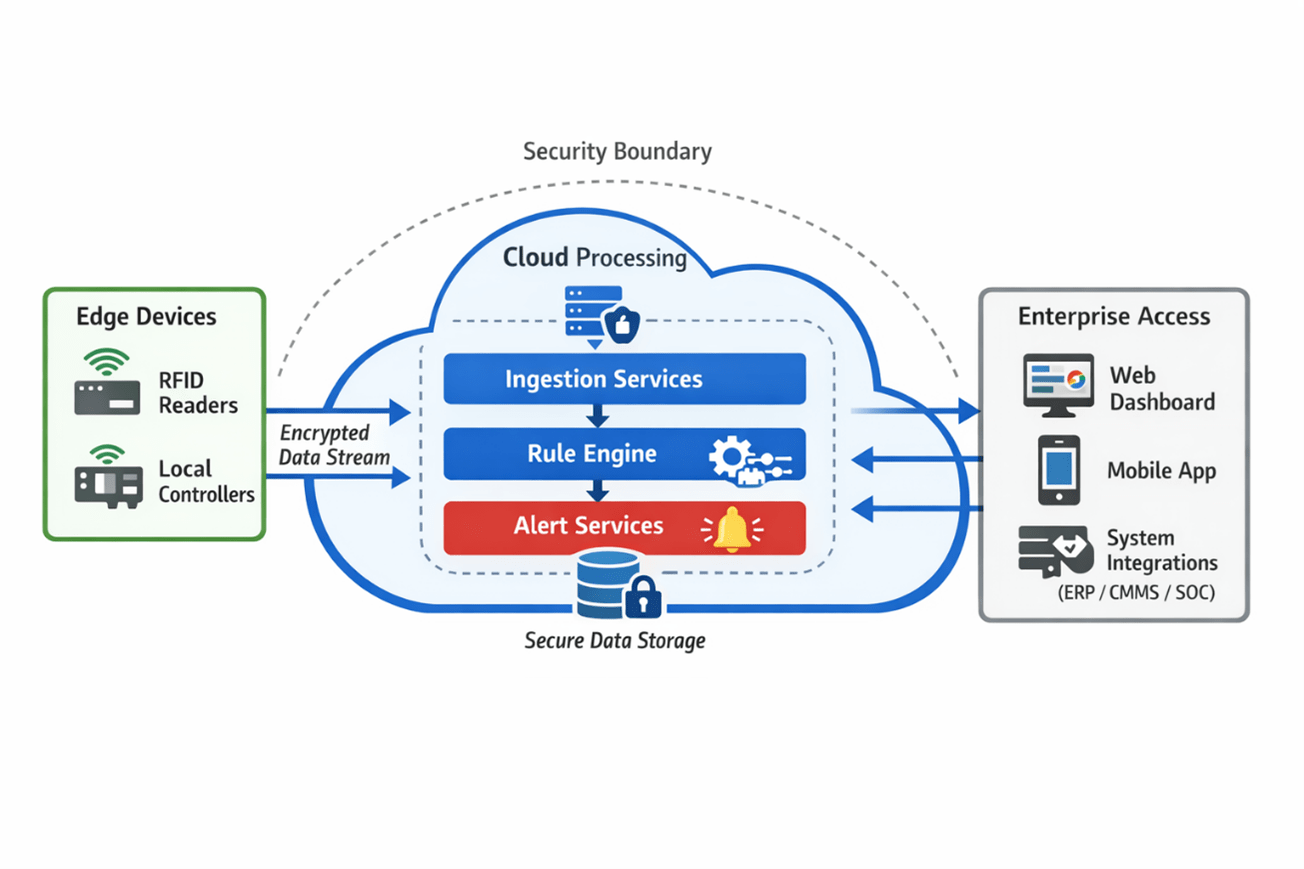
Cloud-based RFID Alerting Framework deployments centralize event processing, rule evaluation, and alert management within a secure, managed cloud environment. RFID event data flows from edge readers and local controllers into cloud ingestion services through encrypted channels.
The overall structure separates field-level data capture, centralized alert logic, and enterprise access layers. Operational teams interact with alerts through web dashboards and mobile interfaces, while integrations synchronize alerts with ERP, CMMS, EHS, or SOC platforms.
Security boundaries isolate ingestion endpoints, processing services, and data stores. Scalability is achieved through elastic processing layers that accommodate fluctuating event volumes across multiple sites. GAO designs cloud architectures to align with enterprise identity management and data residency requirements.
Non-Cloud Architecture Overview
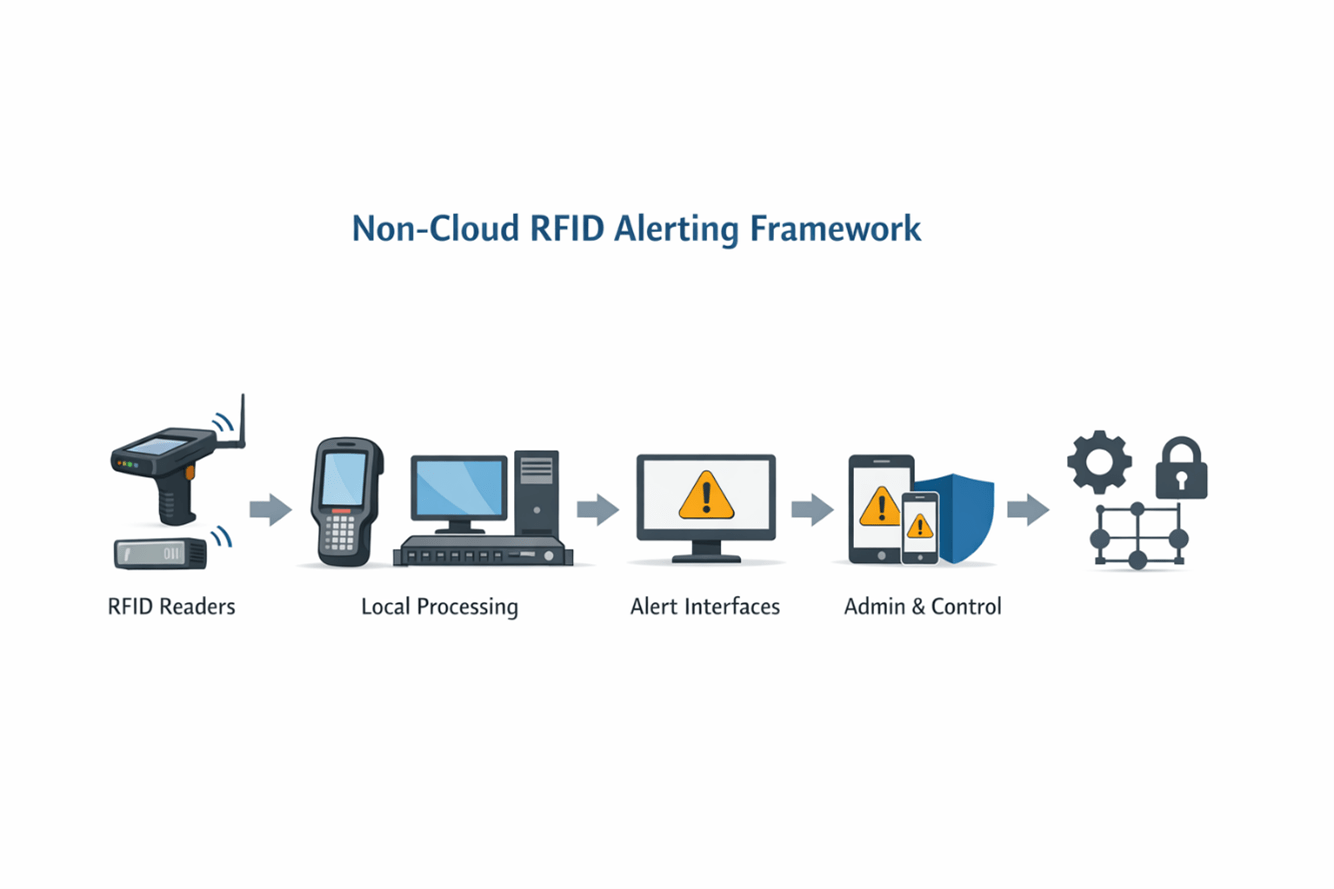
Non-cloud RFID Alerting Framework deployments execute alert logic within controlled environments such as handheld computers, PCs, local servers, or remote servers. These architectures prioritize deterministic latency, local autonomy, and regulatory isolation.
Handheld-based implementations support mobile inspections and localized alerting for field operations. PC-based deployments serve single workstations or control rooms. Local servers support facility-wide alerting with on-premises governance, while remote servers support private hosting models without public cloud dependency.
Operational responsibilities typically fall to site IT or engineering teams. Security boundaries are enforced through network segmentation and role-based access controls. Scalability is achieved through vertical resource planning rather than elastic expansion.
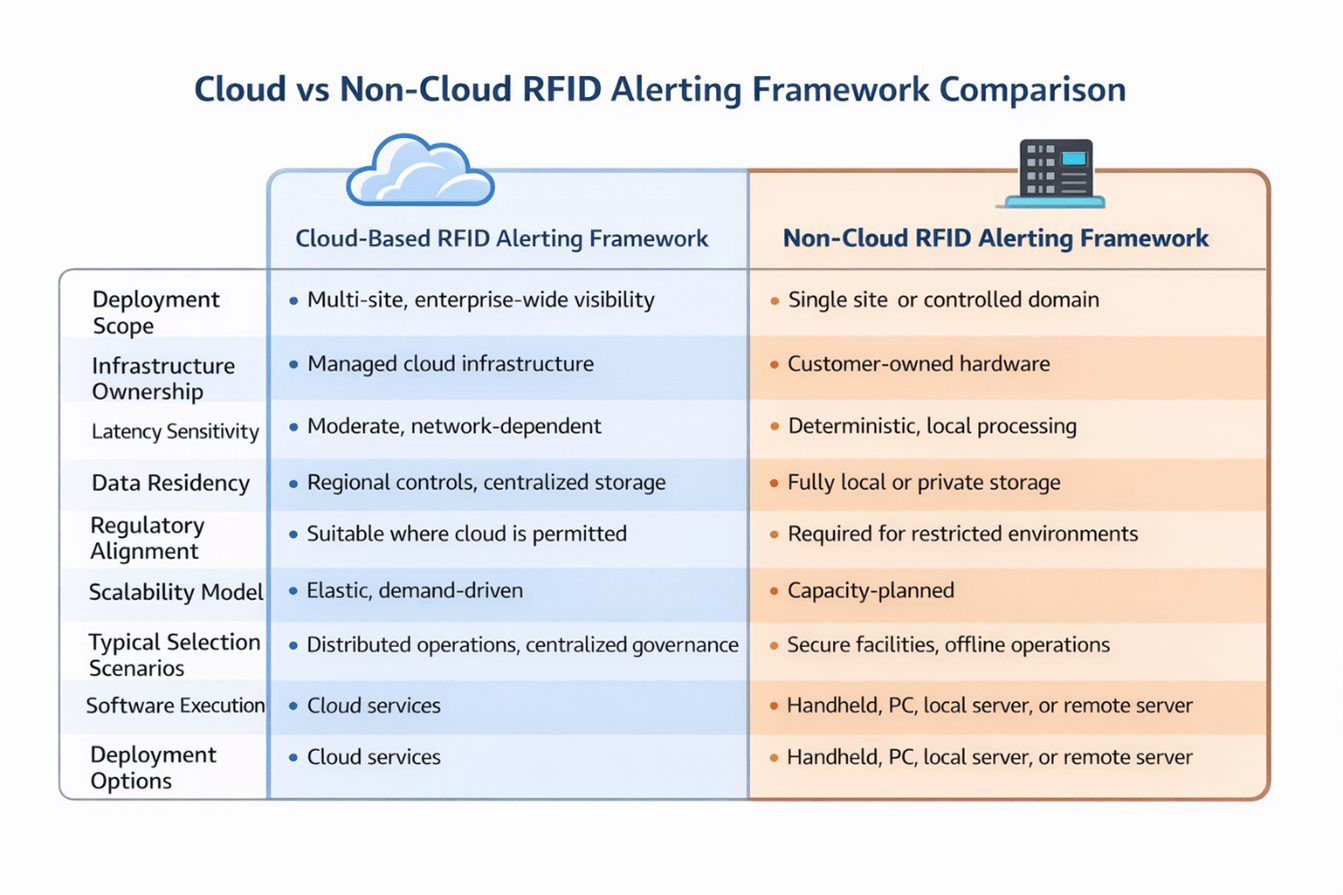
Cloud vs Non-Cloud RFID Alerting Framework Comparison
| Aspect | Cloud-Based RFID Alerting Framework | Non-Cloud RFID Alerting Framework |
| Deployment Scope | Multi-site, enterprise-wide visibility | Single site or controlled domain |
| Infrastructure Ownership | Managed cloud infrastructure | Customer-owned hardware |
| Latency Sensitivity | Moderate, network-dependent | Deterministic, local processing |
| Data Residency | Regional controls, centralized storage | Fully local or private storage |
| Regulatory Alignment | Suitable where cloud is permitted | Required for restricted environments |
| Scalability Model | Elastic, demand-driven | Capacity-planned |
| Typical Selection Scenarios | Distributed operations, centralized governance | Secure facilities, offline operations |
| Software Execution | Cloud services | Handheld, PC, local server, or remote server |
GAO assists clients in selecting deployment models based on governance, risk tolerance, and operational maturity.
Cloud Integration and Data Management for RFID Alerting Framework
Cloud-based RFID Alerting Framework implementations focus on disciplined data lifecycle management. Event data is ingested through validated pipelines, normalized, and timestamped before entering rule evaluation processes.
Processing layers correlate events across time, location, and asset identity. Only relevant alert records are persisted long-term, reducing storage overhead. Data storage policies support retention schedules aligned with audit and compliance mandates.
Analytics layers support trend analysis, false alert tuning, and operational performance reviews. Integration services expose alert data to external systems using secured APIs and message brokers.
Security controls include encryption at rest and in transit, identity federation, role-based access governance, and immutable audit logs. GAO designs cloud data management to satisfy both operational efficiency and governance accountability without exposing unnecessary data.
Major Components of the RFID Alerting Framework Architecture
- RFID Credentials
Serve as unique identifiers attached to assets, personnel badges, tools, or containers. Selection considerations include durability, memory requirements, and environmental tolerance.
- RFID Readers
Capture credential interactions within defined zones. Operational constraints include read density, interference management, and placement governance.
- Edge Devices
Aggregate reader data, apply preliminary filtering, and maintain buffering during connectivity disruptions. Selection depends on processing capacity and environmental conditions.
- Middleware
Normalizes event data, enforces validation rules, and forwards qualified events to alert logic layers. Acts as a control point for noise reduction.
- Cloud Platforms
Host centralized rule engines, alert services, dashboards, and integrations. Operational role centers on scalability and governance.
- Local or Remote Servers
Execute alert logic in non-cloud deployments. Selection depends on regulatory, latency, and availability requirements.
- Databases
Store alert records, configuration data, and audit trails. Constraints include retention policy enforcement and access control.
- Dashboards and Reporting Tools
Provide situational awareness, alert acknowledgment, and historical analysis. Designed for operations, compliance, and management roles.
RFID Technologies Used Within the RFID Alerting Framework
- UHF RFID
Supports long read ranges and high tag populations. Operational characteristics include sensitivity to environmental factors and strong suitability for wide-area monitoring.
- HF RFID
Operates reliably near liquids and metals. Performance favors controlled proximity interactions and consistent read behavior.
- NFC
Optimized for very short-range, intentional interactions. Supports secure credential validation and user-mediated workflows.
- LF RFID
Provides stable performance in harsh environments with limited read range. Suitable where interference resilience outweighs data rate.
RFID Technology Comparison for RFID Alerting Framework Selection
| RFID Technology | Framework Role | Deployment Context | Selection Drivers |
| UHF | Zone-level alert triggering | Warehouses, yards | Read density, range |
| HF | Process checkpoint validation | Manufacturing lines | Environmental stability |
| NFC | Identity-confirmed alerts | Secure access points | Intentional interaction |
| LF | Presence confirmation | Industrial facilities | Interference tolerance |
Combining Multiple RFID Technologies in the RFID Alerting Framework
Combining RFID technologies is appropriate when alerting requirements span different interaction models. UHF may monitor asset movement while NFC enforces personnel authorization at control points.
Architectural benefits include layered validation and reduced false alerts. Trade-offs involve increased system complexity, configuration overhead, and integration testing effort. GAO typically recommends multi-technology architectures only when governance or safety requirements justify the added operational burden.
Applications of the RFID Alerting Framework
- Asset Misplacement Alerts
Tracks unauthorized movement of tools, containers, or equipment across controlled zones, notifying supervisors when location policies are violated.
- Safety Zone Breach Monitoring
Detects personnel or asset entry into hazardous areas, triggering immediate alerts to safety officers and control rooms.
- Maintenance Compliance Enforcement
Flags overdue inspections or unauthorized equipment usage based on RFID-tagged maintenance status indicators.
- Access Policy Violations
Monitors credential-based access attempts against approved schedules and roles, generating alerts for anomalies.
- Process Sequence Validation
Ensures manufacturing or logistics steps occur in defined order, alerting operators to deviations.
- Inventory Shrinkage Detection
Identifies unexpected asset removal events outside approved workflows.
- Cold Chain Integrity Alerts
Monitors container presence at checkpoints to enforce temperature-sensitive handling processes.
- Tool Control Accountability
Tracks tool issuance and return cycles, alerting when tools remain unaccounted.
- Regulatory Audit Monitoring
Provides real-time alerts for non-compliant movements in regulated environments.
- Emergency Evacuation Accountability
Confirms personnel presence or absence during evacuation procedures.
Deployment Options for the RFID Alerting Framework
Cloud Deployment Use Cases and Advantages
Cloud deployments suit organizations requiring centralized oversight across multiple facilities. Advantages include unified policy management, enterprise-wide visibility, and simplified integration with corporate systems. Regulatory acceptance and reliable connectivity are assumed.
Non-Cloud Deployment Use Cases and Advantages
Non-cloud deployments are selected where data sovereignty, deterministic latency, or network isolation is mandatory. Handheld and PC-based systems support mobile or single-station operations. Local servers suit facilities with dedicated IT teams, while remote servers enable private hosting without public cloud exposure.
GAO supports all deployment models and assists clients in aligning technical architecture with organizational constraints, regulatory obligations, and operational risk profiles.
Case Studies of Alerting Framework using RFID Technologies
U.S. Case Studies Demonstrating RFID Alerting Framework Deployments
Manufacturing Safety Compliance Monitoring in Detroit, Michigan
- Problem
A heavy manufacturing facility faced repeated safety incidents caused by unauthorized personnel entering restricted equipment zones. Existing badge systems lacked real-time alerting, and safety supervisors relied on manual spot checks, creating delayed incident response and audit gaps.
- Solution
GAO supported deployment of an RFID Alerting Framework using UHF RFID technologies integrated with fixed readers and a local server. Alert logic executed on premises to meet latency and labor safety requirements. Zone violation rules triggered alerts to safety dashboards and handheld devices carried by supervisors.
- Result
Unauthorized zone entry incidents decreased by 38 percent within six months. A key trade-off involved additional upfront configuration time to tune alert thresholds and reduce false positives during shift transitions.
Hospital Asset Loss Prevention in Chicago, Illinois
- Problem
A large urban hospital experienced frequent loss and misplacement of mobile medical equipment, increasing rental costs and delaying clinical workflows. Asset tracking data existed but lacked actionable alerting mechanisms.
- Solution
GAO implemented a cloud-based RFID Alerting Framework using UHF RFID technologies to monitor asset movement across clinical zones. Centralized rule engines generated alerts when equipment exited approved areas or exceeded dwell time thresholds. Alerts integrated with the hospital operations dashboard.
- Result
Annual equipment loss was reduced by 27 percent. Dependence on reliable network connectivity required additional investment in wireless coverage within older hospital wings.
Data Center Access Control Oversight in Ashburn, Virginia
- Problem
A colocation data center required stronger enforcement of access policies for contractors entering sensitive server halls. Badge access logs were reviewed post-event, limiting proactive risk mitigation.
- Solution
An RFID Alerting Framework using HF RFID technologies was deployed with software running on a local server. Alert rules evaluated badge access sequences and time windows, triggering notifications to security operations when deviations occurred. GAO assisted with role-based access configuration.
- Result
Unauthorized access attempts declined by 42 percent. The local server model limited remote visibility but satisfied strict client data sovereignty requirements.
Warehouse Process Deviation Detection in Dallas, Texas
- Problem
A regional distribution center struggled with process nonconformance during peak shipping periods, leading to shipment errors and compliance penalties. Manual audits lagged behind real-time operations.
- Solution
GAO supported a cloud-based RFID Alerting Framework using UHF RFID technologies to validate pick-pack-ship sequences. Alerting logic flagged skipped process steps and routed notifications to floor supervisors via dashboards.
- Result
Process deviation rates dropped by 31 percent. The primary trade-off involved retraining warehouse staff to interpret alert severity levels correctly.
Utility Field Equipment Accountability in Phoenix, Arizona
- Problem
A municipal utility lacked visibility into field-deployed tools and test equipment, resulting in frequent losses and delayed maintenance tasks.
- Solution
A non-cloud RFID Alerting Framework using LF RFID technologies was deployed on handheld computers used by field technicians. Alerts were generated locally when equipment was not returned to vehicles or depots within defined intervals.
- Result
Equipment loss incidents were reduced by 45 percent. Limited historical analytics capability was accepted to maintain offline functionality in remote service areas.
University Laboratory Compliance Enforcement in Boston, Massachusetts
- Problem
Research laboratories faced compliance risks related to unauthorized movement of controlled materials between labs. Existing inventory systems lacked real-time alerts.
- Solution
GAO implemented an RFID Alerting Framework using HF RFID technologies with software running on a PC-based system within the laboratory network. Alert rules monitored material movement across lab boundaries and logged events for audit review.
- Result
Compliance violations decreased by 33 percent. The PC-based deployment required disciplined patch management by campus IT staff.
Airport Ground Equipment Monitoring in Atlanta, Georgia
- Problem
Ground support equipment frequently migrated between terminals without authorization, disrupting flight turnaround schedules.
- Solution
A cloud-based RFID Alerting Framework using UHF RFID technologies monitored equipment location across airside zones. Alerts were delivered to operations coordinators when assets crossed terminal boundaries without approval.
- Result
Equipment availability improved by 29 percent. High reader density required careful radio planning to avoid interference.
Pharmaceutical Warehouse Temperature Chain Oversight in Raleigh, North Carolina
- Problem
Pharmaceutical storage facilities needed to ensure handling compliance for regulated materials. Missed checkpoints increased audit exposure.
- Solution
GAO supported a hybrid RFID Alerting Framework using UHF RFID technologies with alert processing on a remote private server. Alerts flagged missed storage checkpoints and unauthorized transfers.
- Result
Audit exceptions related to handling procedures dropped by 41 percent. Private server hosting required additional cybersecurity controls.
Construction Site Tool Control in Denver, Colorado
- Problem
High-value tools frequently went missing across multi-phase construction sites, increasing project costs and delays.
- Solution
A non-cloud RFID Alerting Framework using UHF RFID technologies ran on a local server within the site office. Alert rules detected tools leaving defined zones outside approved hours.
- Result
Tool loss was reduced by 36 percent. Power and network reliability at temporary sites required contingency planning.
Retail Distribution Shrinkage Detection in Columbus, Ohio
- Problem
Distribution shrinkage increased during seasonal staffing surges, overwhelming manual oversight processes.
- Solution
GAO deployed a cloud-based RFID Alerting Framework using UHF RFID technologies to monitor pallet and carton movement. Alerts highlighted anomalies for investigation teams.
- Result
Shrinkage-related losses declined by 22 percent. Alert tuning was required to accommodate variable staffing patterns.
Energy Facility Safety Zone Enforcement in Houston, Texas
- Problem
Restricted safety zones around active equipment required real-time monitoring to prevent personnel exposure incidents.
- Solution
An RFID Alerting Framework using LF RFID technologies operated on a local server to ensure deterministic response times. Alerts were delivered to control room dashboards.
- Result
Recordable safety incidents related to zone breaches declined by 47 percent. Limited scalability was accepted to meet safety latency requirements.
Government Archive Asset Tracking in Washington, D.C.
- Problem
Sensitive archival materials required strict movement controls to meet regulatory mandates.
- Solution
GAO supported deployment of an RFID Alerting Framework using HF RFID technologies with alert processing on a remote server hosted in a private data center. Alerts enforced movement authorization rules.
- Result
Unauthorized material movement incidents dropped to near zero. Additional procedural training was needed for archivists.
Food Processing Plant Sanitation Compliance in Fresno, California
- Problem
Sanitation protocols required verification of equipment cleaning sequences. Manual logs were inconsistent.
- Solution
A non-cloud RFID Alerting Framework using HF RFID technologies ran on a PC within the plant network. Alerts flagged missed sanitation checkpoints.
- Result
Sanitation nonconformance findings declined by 34 percent. Manual intervention remained necessary during equipment maintenance periods.
Logistics Yard Asset Visibility in Memphis, Tennessee
- Problem
Trailer and container movements within a logistics yard lacked real-time oversight, causing dispatch delays.
- Solution
GAO implemented a cloud-based RFID Alerting Framework using UHF RFID technologies to monitor yard movements and generate alerts for unauthorized exits.
- Result
Dispatch delays decreased by 26 percent. Weather conditions occasionally impacted read accuracy, requiring antenna adjustments.
Canadian Case Studies Demonstrating RFID Alerting Framework Deployments
Mining Site Safety Monitoring in Sudbury, Ontario
- Problem
Underground mining operations required immediate detection of personnel entering hazardous zones.
- Solution
A non-cloud RFID Alerting Framework using LF RFID technologies was deployed on a local server underground. Alerts triggered audible and visual notifications.
- Result
Safety zone violations decreased by 44 percent. Limited analytics capability was accepted due to underground connectivity constraints.
Public Transit Maintenance Control in Toronto, Ontario
- Problem
Maintenance tools frequently moved between depots without documentation, affecting fleet availability.
- Solution
GAO supported a cloud-based RFID Alerting Framework using UHF RFID technologies to monitor tool movement and issue alerts to maintenance supervisors.
- Result
Tool availability improved by 28 percent. Cloud dependency required alignment with municipal IT policies.
Research Campus Access Oversight in Vancouver, British Columbia
- Problem
Research facilities needed to enforce time-based access rules for visiting researchers.
- Solution
An RFID Alerting Framework using NFC technologies ran on a local server, enforcing credential-based access alerts at entry points.
- Result
Access policy violations declined by 35 percent. NFC interaction required user compliance at access points.
Food Distribution Cold Storage Monitoring in Winnipeg, Manitoba
- Problem
Cold storage compliance required confirmation of container movement through temperature-controlled zones.
- Solution
GAO assisted with a hybrid RFID Alerting Framework using UHF RFID technologies and a remote server for alert processing. Alerts flagged missed cold chain checkpoints.
- Result
Cold chain compliance exceptions declined by 39 percent. Network redundancy planning was required during winter conditions.
Municipal Equipment Accountability in Halifax, Nova Scotia
- Problem
Public works departments struggled with accountability for shared equipment across crews.
- Solution
A non-cloud RFID Alerting Framework using UHF RFID technologies operated on handheld computers. Alerts notified supervisors when equipment was not returned after shifts.
- Result
Equipment loss incidents decreased by 32 percent. Historical reporting depth was limited by handheld storage capacity.
GAO supports RFID Alerting Framework deployments across cloud and non-cloud architectures, drawing on decades of experience serving complex operational environments throughout the United States and Canada.
Our products and systems have been developed and deployed for a wide range of industrial applications. They are available off-the-shelf or can be customized to meet your needs. If you have any questions, our technical experts can help you.
For any further information on GAO’s products and systems, to request evaluation kits, free samples, recorded video demos, or explore partnership opportunities, please fill out this form or email us.