
RFID Collision Avoidance Systems Using GAO RFID Technologies for Industrial and Enterprise Environments
RFID Collision Avoidance Systems are engineered to reduce operational risk by detecting, predicting, and preventing unsafe proximity events among people, vehicles, and physical assets. These systems rely on RFID technologies to establish real-time spatial awareness within complex work environments such as factories, logistics yards, ports, warehouses, mines, campuses, and critical infrastructure sites.
RFID-based collision prevention platforms operate as an integrated safety layer across industrial workflows, capturing identity, location context, and movement data to enforce safety rules and alert thresholds. The system architecture supports multiple deployment options, including cloud and non-cloud implementations, allowing organizations to align with latency, regulatory, and operational constraints. Non-cloud deployments may run on handheld computers, industrial PCs, local servers, or remotely hosted private servers, while cloud deployments centralize orchestration, analytics, and governance.
RFID Collision Avoidance Systems are often implemented alongside access control, fleet management, and safety compliance frameworks, providing a scalable foundation for hazard mitigation, workforce protection, and asset coordination across distributed operations.
RFID Collision Avoidance Systems Overview and Operational Value
RFID Collision Avoidance Systems function as a coordinated set of sensing, decision, and response components designed to minimize unsafe interactions in dynamic environments. The system continuously monitors the proximity relationships between tagged entities, such as forklifts and pedestrians, automated guided vehicles and storage racks, or heavy machinery and exclusion zones.
Operational value is derived from predictable enforcement of safety logic, reduced reliance on human perception, and the ability to audit near-miss events. Structured proximity rules, zone definitions, and escalation workflows are configured to reflect site-specific safety policies, labor regulations, and insurance requirements.
The system structure typically includes RFID credentials attached to people or equipment, readers positioned to create detection zones, edge processing layers to apply collision logic, and centralized platforms for oversight. Applications span regulated industries where safety incidents carry operational, financial, and reputational consequences.
GAO designs RFID Collision Avoidance Systems with flexible deployment models to accommodate both real-time safety enforcement and long-term risk analytics without forcing organizations into a single infrastructure pattern.
RFID Collision Avoidance Systems: Detailed Description, Purpose, Issues Addressed, and Benefits
System Description
RFID Collision Avoidance Systems integrate RFID technologies into a rules-driven safety control framework. The system captures identity signals from RFID credentials, correlates them with spatial boundaries and motion context, and applies predefined safety logic to determine collision risk. Actions may include local alerts, machine slowdowns, event logging, or escalation to supervisory systems.
Personnel safety officers, operations managers, compliance teams, and equipment operators interact with the system through dashboards, configuration tools, and reporting interfaces. Integration points often include industrial control systems, maintenance platforms, workforce management tools, and incident management software.
Core Purposes
- Prevent collisions between mobile equipment and personnel
- Enforce safety zones and exclusion areas dynamically
- Reduce reliance on visual line-of-sight in congested spaces
- Support regulatory compliance and safety audits
- Capture near-miss and behavioral safety data
Issues Addressed
- Limited situational awareness in noisy or obstructed environments
- Human error in high-traffic operational zones
- Inconsistent enforcement of safety procedures across shifts
- Latency in manual incident reporting
- Difficulty proving compliance during investigations
Benefits
- Deterministic proximity enforcement
- Reduced incident rates and downtime
- Improved safety culture through objective data
- Actionable analytics for risk mitigation
- Configurable deployment aligned with IT governance
System Architecture of RFID Collision Avoidance Systems Using GAO RFID Technologies
Cloud Architecture Model
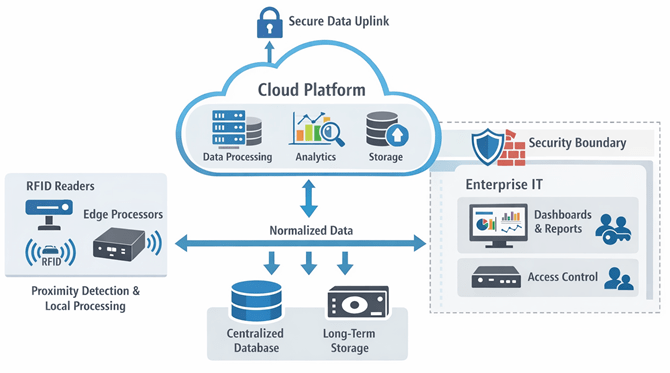
Cloud-based architectures centralize system configuration, policy management, analytics, and historical storage while maintaining real-time decision logic at the edge. RFID readers and edge processors perform proximity detection and rule execution locally, ensuring responsiveness even during network disruptions.
Cloud platforms manage fleet-wide configuration consistency, cross-site reporting, user access governance, and long-term trend analysis. Data flows from edge devices through secure ingestion pipelines into centralized processing layers, where it is normalized, enriched, and stored according to retention policies.
Security boundaries separate operational technology networks from enterprise IT domains, with role-based access control and audit logging enforced centrally. Scalability is achieved through elastic compute and storage resources that accommodate growth in tagged entities and monitored zones.
Non-Cloud Architecture Model
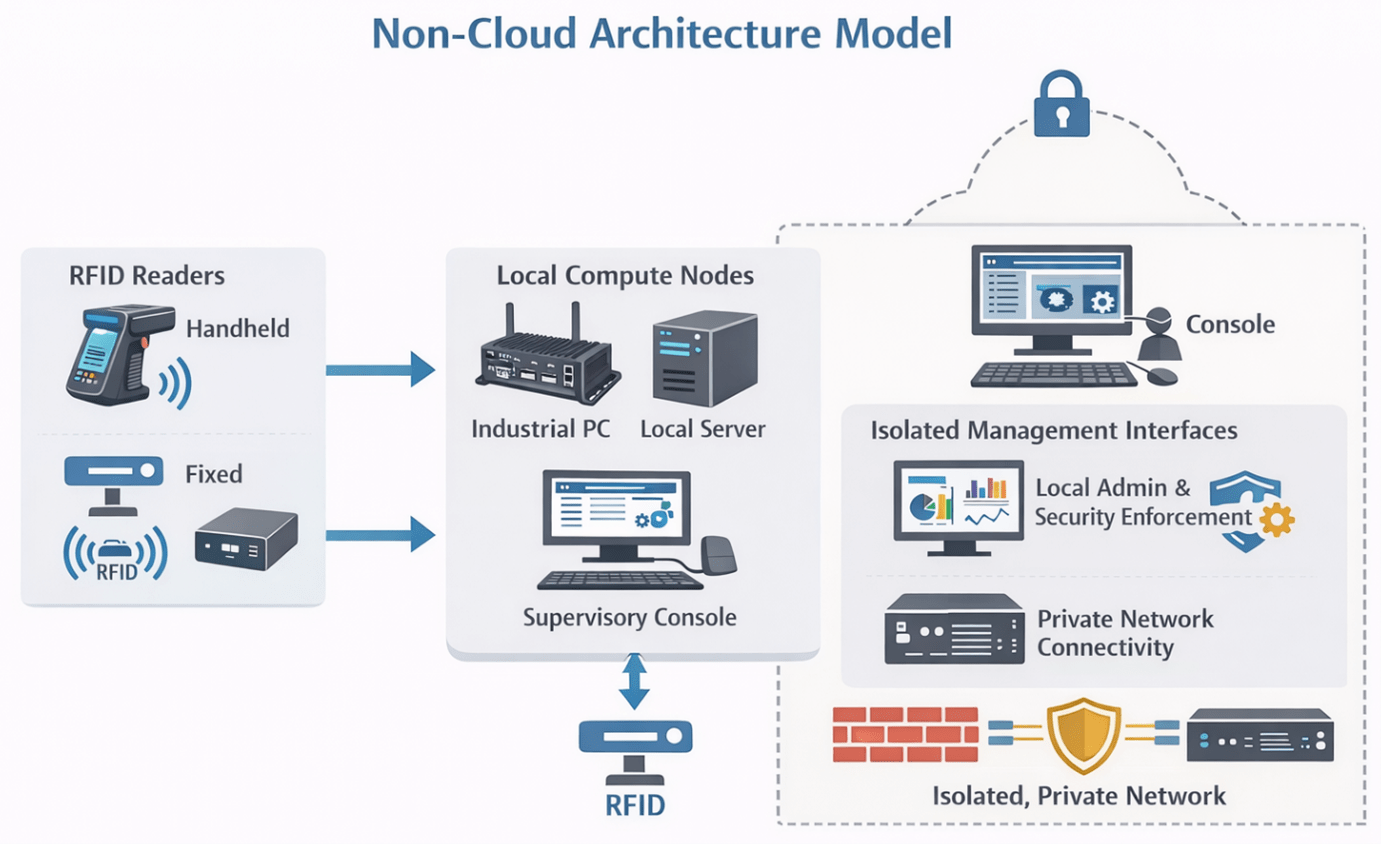
Non-cloud architectures prioritize local execution and data sovereignty. Collision avoidance logic, event storage, and user interfaces operate within controlled environments such as handheld devices, industrial PCs, local servers, or privately hosted remote servers.
Handheld deployments are common for mobile inspection teams and temporary sites. PC-based systems support fixed workstations and supervisory consoles. Local servers provide centralized control within a facility, while remote servers enable private WAN-based oversight without public cloud dependencies.
Operational responsibility remains with the organization’s IT and OT teams, including system updates, backups, and security enforcement. Scalability is constrained by on-premise resources but offers deterministic latency and full control over data residency.
Cloud vs Non-Cloud RFID Collision Avoidance Systems Comparison
| Aspect | Cloud-Based Deployment | Non-Cloud Deployment |
| Operational Scope | Multi-site and enterprise-wide | Single site or controlled domain |
| Latency Profile | Network-dependent but optimized via edge logic | Deterministic local processing |
| Data Governance | Centralized retention and policy enforcement | Fully local or privately governed |
| IT Responsibility | Shared responsibility with provider | Fully customer-managed |
| Typical Scenarios | Distributed operations, analytics-driven safety | High-security, low-latency environments |
Non-cloud variations include handheld systems for field teams, PC-based systems for control rooms, local servers for plants, and private remote servers for regulated industries.
Cloud Integration and Data Management for RFID Collision Avoidance Systems
Cloud integration focuses on data lifecycle management rather than device operation. Data ingestion pipelines receive structured proximity events, alerts, and system health metrics. Processing layers normalize data, apply enrichment logic, and support aggregation across sites and time periods.
Storage services enforce retention rules aligned with regulatory and insurance requirements. Analytics modules support incident trend analysis, safety KPI tracking, and compliance reporting. Integration interfaces connect with enterprise systems such as ERP, EHS platforms, and business intelligence tools.
Security controls include encryption at rest and in transit, identity federation, access logging, and segregation of tenant data. Governance frameworks define who can configure safety rules, access historical data, or export reports, supporting audit readiness and internal controls.
Major Components of RFID Collision Avoidance Systems Architecture
- RFID Credentials
Credentials uniquely identify personnel, vehicles, or assets. Selection considerations include durability, form factor, read range, and environmental resistance. Operational roles include identity enforcement and association with safety rules.
- RFID Readers
Readers create detection zones and capture credential signals. Constraints include interference, mounting locations, and integration with edge logic. Readers act as the primary sensing layer.
- Edge Devices
Edge devices execute collision logic locally. They manage latency-sensitive decisions, alert triggering, and temporary buffering. Selection depends on compute capacity, industrial certifications, and integration interfaces.
- Middleware
Middleware orchestrates data normalization, rule management, and system coordination. It bridges RFID data with safety workflows and enterprise systems.
- Cloud Platforms
Cloud platforms support centralized configuration, analytics, and governance. Constraints include regulatory acceptance and network reliability.
- Local and Remote Servers
Servers host non-cloud deployments. Selection balances performance, redundancy, and administrative overhead.
- Databases
Databases store events, configurations, and audit records. Design considerations include write throughput and retention policies.
- Dashboards and Reporting Tools
Interfaces provide visibility to safety officers and executives. Operational roles include monitoring, investigation, and compliance reporting.
RFID Technologies Used in RFID Collision Avoidance Systems
- UHF RFID
UHF supports longer read ranges and high tag density detection. Operational characteristics include sensitivity to environmental factors and suitability for vehicle and asset monitoring.
- HF RFID
HF offers controlled read zones and resistance to interference. It is often used where precision is prioritized over distance.
- NFC
NFC operates at very short ranges. Characteristics include intentional interaction and strong access control alignment.
- LF RFID
LF performs reliably around metal and liquids. Operational characteristics favor harsh environments with limited read range requirements.
RFID Technology Comparison for RFID Collision Avoidance Systems
| Technology | Typical Role in Collision Avoidance | Deployment Considerations |
| UHF | Wide-area proximity detection | Zone planning and interference management |
| HF | Controlled interaction zones | Reader placement precision |
| NFC | Intentional safety acknowledgments | User training and workflow alignment |
| LF | Harsh environment monitoring | Limited data rates |
Combining Multiple RFID Technologies in Collision Avoidance Architectures
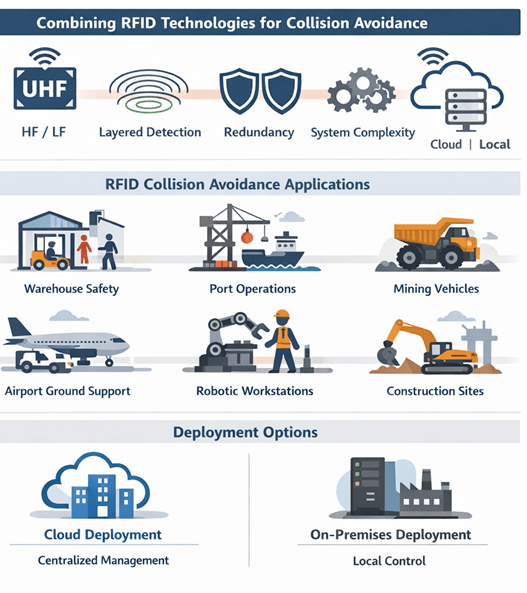
Combining RFID technologies is appropriate when operational zones exhibit varied physical constraints. Hybrid architectures may use UHF for wide-area detection and HF or LF for precision checkpoints. Architectural benefits include layered detection and redundancy. Trade-offs include increased system complexity, integration overhead, and maintenance coordination risks. GAO mitigates these risks through unified middleware and consistent rule management frameworks.
Applications of Collision Avoidance Systems Using RFID Technologies
- Forklift and pedestrian separation in warehouses using zone-based enforcement and event logging
- Crane and ground crew coordination in ports with dynamic exclusion boundaries
- Mining vehicle proximity monitoring across underground haulage routes
- Airport ground support equipment collision prevention in apron areas
- Manufacturing cell safety enforcement around robotic workstations
- Rail yard vehicle and personnel segregation across switching zones
- Construction site heavy equipment monitoring with evolving site layouts
- Oil and gas facility access restriction near hazardous processes
- Utility maintenance crew safety near energized assets
- Campus service vehicle monitoring in mixed pedestrian environments
Deployment Options for RFID Collision Avoidance Systems
Cloud Deployment Use Cases and Advantages
Cloud deployments suit organizations managing multiple facilities, requiring centralized oversight and analytics. Advantages include unified policy management, cross-site benchmarking, and reduced infrastructure burden.
Non-Cloud Deployment Use Cases and Advantages
Non-cloud deployments are selected for environments with strict latency, security, or data residency requirements. Handheld systems support temporary sites, PC-based systems support control rooms, local servers serve plants, and remote private servers support regulated industries.
Throughout these deployments, GAO supports organizations with architecture design, system integration, validation testing, and long-term operational support. GAO’s experience serving Fortune 500 enterprises, research institutions, and government agencies across North America informs practical design decisions, risk management, and compliance alignment.
Case Studies of Collision Avoidance Systems Using RFID Technologies
U.S. Case Study
Industrial Distribution Center, Chicago, Illinois
- Problem
Congested forklift aisles and mixed pedestrian traffic created repeated near-miss incidents during peak shifts. Manual safety procedures relied on visual awareness and audible alarms that were frequently ignored due to ambient noise. Compliance audits identified insufficient objective data to demonstrate enforcement of internal safety policies.
- Solution
GAO supported deployment of RFID Collision Avoidance Systems using UHF RFID technologies for wide-area vehicle detection and HF RFID for pedestrian checkpoints. The system operated in a non-cloud configuration on a local server to meet latency requirements. Proximity rules were enforced at edge devices integrated with forklift control systems.
- Result
Recorded vehicle-pedestrian near-miss events declined by 43 percent within six months. A trade-off involved additional calibration time to minimize false positives in narrow aisles.
Automotive Manufacturing Plant, Detroit, Michigan
- Problem
Robotic assembly cells shared space with maintenance staff during changeovers. Safety interlocks were static and did not reflect dynamic human presence, increasing risk during unscheduled interventions.
- Solution
Collision Avoidance Systems Using RFID technologies were implemented with LF RFID tags for reliable detection near metal-heavy equipment. The solution ran on an industrial PC deployed locally, enabling deterministic response times. Integration with existing safety PLCs allowed dynamic zone enforcement.
- Result
Unplanned safety stoppages dropped by 28 percent while maintaining zero recordable injury incidents. The system required disciplined tag management during contractor onboarding.
Logistics Yard, Dallas, Texas
- Problem
Yard tractors, trailers, and pedestrians operated across open spaces with limited line-of-sight visibility. Incident investigations lacked precise movement records.
- Solution
GAO assisted with a cloud-based RFID Collision Avoidance System using UHF RFID technologies. Edge devices handled proximity alerts while centralized analytics correlated movement patterns across shifts. Cloud dashboards supported safety management reviews.
- Result
Reported yard safety incidents declined by 35 percent year over year. Network dependency required local buffering strategies during connectivity interruptions.
Food Processing Facility, Fresno, California
- Problem
Wet environments and metal infrastructure interfered with optical safety sensors around material handling equipment.
- Solution
RFID Collision Avoidance Systems using LF RFID technologies were deployed due to performance stability around liquids. The system operated on a local server within the facility network. Safety zones were reconfigured per production line.
- Result
Equipment-related safety alerts increased in accuracy by 31 percent, reducing unnecessary stoppages. Limited read range required higher reader density.
Airport Ground Operations, Phoenix, Arizona
- Problem
Ground support equipment frequently crossed active service zones shared with personnel. Existing procedures depended on radio coordination, leading to inconsistent compliance.
- Solution
GAO supported a hybrid RFID Collision Avoidance System using UHF RFID for vehicle tracking and NFC for intentional personnel acknowledgments. A cloud deployment enabled centralized oversight across terminals.
- Result
Ground equipment incursions into restricted zones decreased by 39 percent. Personnel training was critical to ensure proper NFC interaction.
Mining Operation, Reno, Nevada
- Problem
Underground haulage routes limited visibility and radio coverage, increasing collision risk between heavy vehicles and maintenance crews.
- Solution
RFID Collision Avoidance Systems using LF RFID technologies were deployed with software running on a remote private server connected via mine network infrastructure. Edge processing enforced local alerts without cloud dependency.
- Result
Vehicle-to-person proximity violations declined by 46 percent. System scalability was constrained by underground network expansion costs.
Chemical Plant, Baton Rouge, Louisiana
- Problem
Hazardous process areas required strict enforcement of exclusion zones, yet manual badge checks were inconsistent during maintenance windows.
- Solution
GAO implemented RFID Collision Avoidance Systems using HF RFID technologies integrated with access control workflows. The solution ran on a local server isolated from corporate IT systems.
- Result
Unauthorized zone entries were reduced by 52 percent. Badge issuance governance became a critical operational dependency.
Construction Site, Seattle, Washington
- Problem
Evolving site layouts and mixed equipment types made fixed safety barriers impractical.
- Solution
A non-cloud RFID Collision Avoidance System using UHF RFID technologies was deployed on handheld computers carried by safety supervisors. Temporary readers defined dynamic zones.
- Result
Documented near-miss reports increased by 61 percent, improving hazard visibility. Manual synchronization of handheld data required disciplined procedures.
Rail Yard, Omaha, Nebraska
- Problem
Switching operations exposed ground crews to moving railcars with limited warning mechanisms.
- Solution
RFID Collision Avoidance Systems using UHF RFID technologies operated on a local server connected to yard management systems. Proximity alerts were delivered through wearable devices.
- Result
Ground crew exposure incidents declined by 33 percent. Reader placement required iterative refinement due to steel interference.
University Research Campus, Raleigh, North Carolina
- Problem
Service vehicles shared pedestrian pathways across a dense campus environment with varied compliance expectations.
- Solution
GAO supported a cloud-based RFID Collision Avoidance System using NFC for intentional access points and UHF RFID for vehicle tracking. Centralized governance supported campus-wide policies.
- Result
Vehicle-pedestrian complaints dropped by 29 percent. Privacy considerations required clear communication and access controls.
Distribution Hub, Columbus, Ohio
- Problem
Third-party contractors operated forklifts with inconsistent safety training.
- Solution
Collision Avoidance Systems Using RFID technologies were deployed on a PC-based non-cloud system. Contractor credentials enforced zone restrictions automatically.
- Result
Contractor-related safety violations decreased by 41 percent. Credential lifecycle management required additional administrative effort.
Port Terminal, Savannah, Georgia
- Problem
Container handling equipment and dockworkers operated in close proximity under variable lighting conditions.
- Solution
GAO assisted with RFID Collision Avoidance Systems using UHF RFID technologies integrated with terminal operating systems. A cloud deployment supported multi-terminal analytics.
- Result
Reported dockside incidents declined by 37 percent. Environmental noise occasionally masked audible alerts, requiring visual redundancy.
Oil Refinery, Corpus Christi, Texas
- Problem
Maintenance crews accessed live processing units during turnaround operations with elevated risk exposure.
- Solution
RFID Collision Avoidance Systems using HF and LF RFID technologies were deployed on a local server to ensure deterministic behavior. Zone enforcement aligned with permit-to-work systems.
- Result
Permit violations related to proximity hazards declined by 48 percent. System complexity increased due to dual-technology management.
E-Commerce Fulfillment Center, Allentown, Pennsylvania
- Problem
High-speed automated equipment intersected with manual picking operations.
- Solution
GAO supported a cloud-enabled RFID Collision Avoidance System using UHF RFID technologies with edge-based control logic. Analytics identified congestion patterns.
- Result
Equipment slowdown events due to unsafe proximity dropped by 26 percent. Analytics required ongoing tuning to avoid alert fatigue.
Canadian Case Study
Automotive Parts Plant, Windsor, Ontario
- Problem
Forklift traffic intersected with assembly line operators during material replenishment.
- Solution
Collision Avoidance Systems Using RFID technologies were deployed on a local server to comply with internal data residency policies. UHF RFID supported vehicle detection.
- Result
Material handling incidents declined by 34 percent. Physical layout changes required periodic system reconfiguration.
Port Facility, Vancouver, British Columbia
- Problem
Container movements and pedestrian access overlapped in constrained dock areas.
- Solution
GAO assisted with a cloud-based RFID Collision Avoidance System using UHF RFID technologies to support centralized oversight across terminals.
- Result
Dockworker safety alerts increased by 45 percent while incident rates declined. Network resilience planning was essential for continuous operations.
Mining Site, Sudbury, Ontario
- Problem
Low-visibility underground conditions increased collision risk during shift changes.
- Solution
RFID Collision Avoidance Systems using LF RFID technologies were deployed on a remote private server managed by site IT teams.
- Result
Shift-change proximity violations decreased by 40 percent. Hardware maintenance cycles required careful planning.
Healthcare Campus Logistics, Montreal, Quebec
- Problem
Service vehicles operated near patient and staff walkways with limited enforcement capability.
- Solution
GAO supported RFID Collision Avoidance Systems using NFC and HF RFID technologies. The system ran on a PC-based non-cloud deployment.
- Result
Unauthorized vehicle access incidents declined by 27 percent. Multilingual training materials were necessary for staff adoption.
Distribution Warehouse, Mississauga, Ontario
- Problem
High-density pallet storage and pedestrian picking created frequent congestion.
- Solution
RFID Collision Avoidance Systems using UHF RFID technologies were implemented with software running on a local server. GAO supported configuration and validation.
- Result
Recorded near-miss events declined by 38 percent. Reader density increased initial deployment cost but improved detection reliability.
Our products and systems have been developed and deployed for a wide range of industrial applications. They are available off-the-shelf or can be customized to meet your needs. If you have any questions, our technical experts can help you.
For any further information on GAO’s products and systems, to request evaluation kits, free samples, recorded video demos, or explore partnership opportunities, please fill out this form or email us.