
Overview of Airline Baggage Tracking RFID Systems using GAO’S RFID Technologies
Airline baggage tracking RFID systems provide airlines, airports, and ground handling operators with persistent, automated visibility into checked baggage as it moves across complex aviation logistics environments. Built on RFID technologies, these baggage tracking platforms replace manual barcode scanning with continuous identification and event capture across check-in, sortation, loading, transfer, and reclaim operations. The system architecture aligns with airline operational control systems, airport IT infrastructure, and regulatory oversight requirements while supporting high throughput and fault tolerance.
Airline baggage tracking solutions are designed to operate across heterogeneous environments including departure halls, baggage handling systems, apron areas, and interline transfer zones. Deployment flexibility is a core design principle, allowing organizations to select cloud-based or non-cloud implementations depending on latency, data sovereignty, and integration constraints. Airline baggage visibility platforms using RFID enable traceability, reconciliation, and exception management without imposing operational friction on ground crews or passengers, while supporting enterprise-scale data governance and system interoperability.
Airline Baggage Tracking RFID Systems Overview with Operational Emphasis
Airline baggage tracking RFID systems focus on operational resilience, regulatory compliance, and measurable reductions in mishandled baggage events. The system integrates RFID-enabled baggage identifiers, fixed and mobile reading infrastructure, middleware services, and operational dashboards into a unified tracking framework. Rather than relying on point-in-time scans, RFID-based baggage monitoring creates a digital chain of custody across airline and airport stakeholders.
Core benefits include improved load planning accuracy, faster baggage reconciliation, reduced manual intervention by ramp agents, and enhanced passenger service recovery workflows. System structure supports both centralized and distributed processing models, enabling real-time decision support or deferred reconciliation based on operational requirements. Airline baggage management platforms using RFID technologies can be deployed in cloud-hosted environments for multi-airport coordination or in non-cloud configurations for facilities with strict network, regulatory, or availability constraints.
Detailed Description, Purposes, Issues Addressed, and Benefits of Airline Baggage Tracking RFID Systems using GAO’S RFID Technologies
Detailed Description of Airline Baggage Tracking RFID Systems
Airline baggage tracking RFID systems consist of interconnected hardware and software layers that uniquely identify, track, and record baggage movement events. RFID-tagged baggage items are detected by readers installed at conveyor choke points, sortation junctions, makeup carousels, dollies, containers, and reclaim belts. Middleware correlates RFID reads with flight, passenger, and handling data sourced from airline departure control systems and airport operational databases.
Operational personnel interact with the system through role-based dashboards, mobile terminals, and alerting tools. The platform supports interline baggage transfers, code-share operations, and multi-terminal airports while maintaining data integrity across organizational boundaries.
Purposes of Airline Baggage Tracking RFID Systems
- Establish continuous baggage visibility across the end-to-end air transport lifecycle
- Enable automated baggage reconciliation and load verification for flight safety compliance
- Support ground handling process optimization and workforce accountability
- Provide data-driven inputs for service recovery and customer communication
- Maintain auditable records aligned with aviation regulatory requirements
Issues Addressed by RFID-Based Baggage Tracking
- Manual barcode scan failures caused by tag damage or misalignment
- Limited visibility during baggage transfers between airlines or terminals
- High labor overhead for baggage tracing and exception handling
- Delayed identification of mishandled or misrouted bags
- Fragmented data ownership across airline, airport, and handler systems
Benefits Delivered to Airline and Airport Stakeholders
- Reduced mishandled baggage rates through automated event capture
- Faster turnaround times at baggage makeup and reclaim areas
- Improved compliance with IATA baggage tracking resolutions
- Enhanced collaboration between airlines, ground handlers, and airports
- Actionable operational analytics supporting continuous improvement
System Architecture of Airline Baggage Tracking RFID Systems
Cloud Architecture Overview
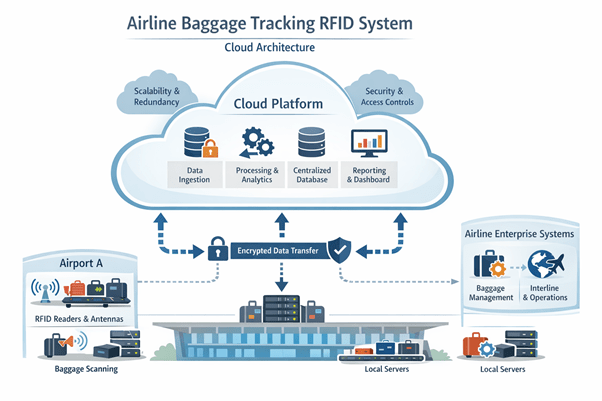
Cloud-based airline baggage tracking RFID systems centralize data ingestion, processing, and analytics within secure cloud environments. RFID event data from multiple airports is transmitted via encrypted channels to cloud platforms where it is normalized, correlated, and stored. Centralized services handle cross-airport visibility, interline reconciliation, and enterprise reporting. Operational responsibilities for scalability, redundancy, and disaster recovery shift toward centralized IT governance.
Security boundaries are enforced through identity management, network segmentation, and data access controls. Cloud scalability supports peak travel periods, seasonal route expansions, and new airport onboarding without local infrastructure redesign.
Non-Cloud Architecture Overview
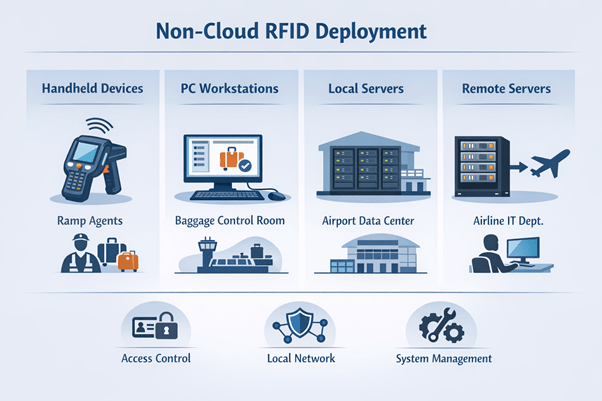
Non-cloud airline baggage tracking RFID systems operate within controlled IT environments where data processing remains local or within private networks. Software may run directly on handheld computers for ramp agents, on PCs within baggage control rooms, on local servers within airport data centers, or on remote servers operated by airline IT teams.
Data flow remains localized, reducing dependency on wide-area networks and supporting facilities with latency-sensitive operations or regulatory data residency requirements. Operational responsibility for system availability, updates, and capacity planning remains with local IT or contracted integrators. Security boundaries are defined by physical access controls, internal network segmentation, and local authentication mechanisms.
Cloud vs Non-Cloud Airline Baggage Tracking RFID Systems Comparison
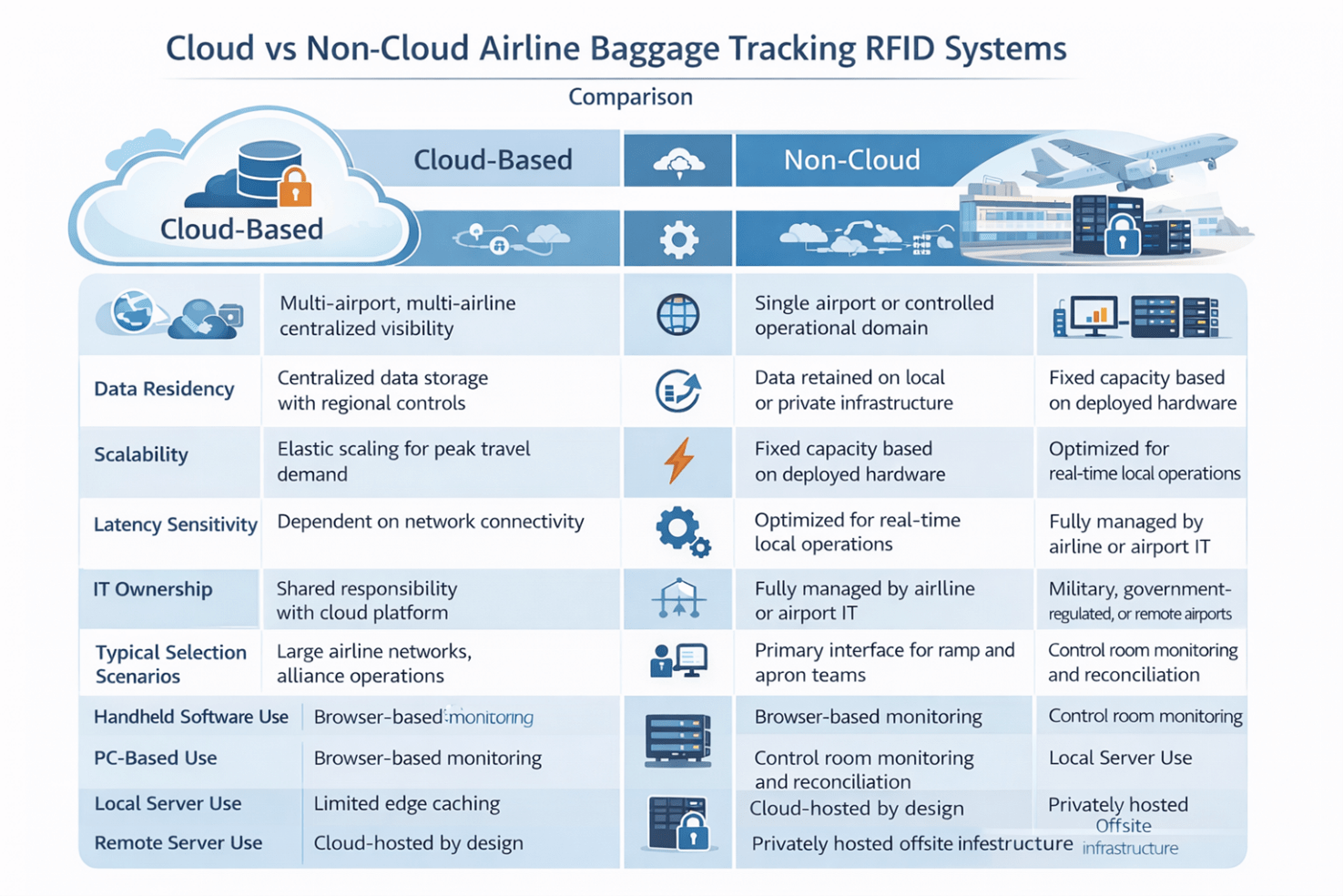
| Aspect | Cloud-Based Airline Baggage Tracking RFID Systems | Non-Cloud Airline Baggage Tracking RFID Systems |
| Deployment Scope | Multi-airport, multi-airline centralized visibility | Single airport or controlled operational domain |
| Data Residency | Centralized data storage with regional controls | Data retained on local or private infrastructure |
| Scalability | Elastic scaling for peak travel demand | Fixed capacity based on deployed hardware |
| Latency Sensitivity | Dependent on network connectivity | Optimized for real-time local operations |
| IT Ownership | Shared responsibility with cloud platform | Fully managed by airline or airport IT |
| Typical Selection Scenarios | Large airline networks, alliance operations | Military, government-regulated, or remote airports |
| Handheld Software Use | Supplemental mobile access | Primary interface for ramp and apron teams |
| PC-Based Use | Browser-based monitoring | Control room monitoring and reconciliation |
| Local Server Use | Limited edge caching | Core processing at airport data center |
| Remote Server Use | Cloud-hosted by design | Privately hosted offsite infrastructure |
Cloud Integration and Data Management for Airline Baggage Tracking RFID Systems
Cloud integration for airline baggage tracking RFID systems centers on governed data lifecycle management rather than hardware connectivity. RFID event data is ingested through secure APIs or message brokers, validated against flight and baggage master data, and processed through rules engines to generate operational events. Processed data is stored in structured repositories supporting retention policies aligned with aviation regulations.
Analytics services derive performance metrics such as transfer dwell time, reconciliation accuracy, and exception frequency. Integration points connect baggage tracking data with airline operational databases, customer service platforms, and regulatory reporting systems. Security controls include encryption at rest and in transit, role-based access governance, audit logging, and segregation of airline-specific datasets. Data governance frameworks define ownership, retention, and access rights across airline, airport, and handling partners.
Major Components and Modules of Airline Baggage Tracking RFID Systems
- RFID Credentials
RFID baggage tags act as unique digital identifiers linked to passenger itineraries and flight segments. Selection considerations include memory structure compatibility, durability under conveyor stress, and regulatory acceptance.
- RFID Readers
Readers capture tag presence at defined operational zones. Constraints include interference management, read zone control, and integration with baggage handling equipment.
- Edge Devices
Edge devices aggregate reader data, apply initial filtering, and ensure local buffering during network disruptions. Operational roles focus on uptime and data integrity.
- Middleware Platforms
Middleware correlates RFID reads with airline operational data. Selection depends on rules configurability, integration interfaces, and fault handling capabilities.
- Cloud Platforms
Cloud platforms provide centralized processing, analytics, and reporting. Constraints include compliance with aviation data residency and cybersecurity standards.
- Local and Remote Servers
Servers host processing services in non-cloud deployments. Considerations include redundancy, maintenance overhead, and physical security.
- Databases
Databases store event histories and operational states. Selection focuses on transaction integrity, query performance, and retention management.
- Dashboards and Reporting Tools
User interfaces support operational monitoring, exception handling, and management reporting. Role-based access and usability are critical constraints.
RFID Technologies Used in Airline Baggage Tracking Systems
- UHF RFID
UHF RFID supports long read ranges and high tag population handling, making it suitable for dense baggage environments with rapid movement.
- HF RFID
HF RFID operates at shorter ranges with predictable read zones, supporting controlled identification points within baggage processing areas.
- NFC
NFC enables very short-range interactions, typically requiring deliberate user action through mobile or handheld devices.
- LF RFID
LF RFID offers robust performance near metal and liquids, with limited read range and lower data throughput.
Comparison of RFID Technologies in Airline Baggage Tracking RFID Systems
| RFID Technology | Role within Airline Baggage Tracking RFID Systems | Decision Criteria |
| UHF | Primary automated baggage identification across conveyors and carts | High throughput and wide-area coverage |
| HF | Controlled validation points in secure processing zones | Predictable read control |
| NFC | Manual verification by ground staff using handhelds | User-initiated interaction |
| LF | Specialized environments with interference constraints | Environmental robustness |
Combining Multiple RFID Technologies in Airline Baggage Tracking Systems
Combining multiple RFID technologies becomes appropriate when operational zones exhibit conflicting constraints. UHF may serve automated conveyor tracking while NFC supports manual exception handling. Architectural benefits include optimized read accuracy and process flexibility. Trade-offs involve increased system complexity, integration overhead, and maintenance requirements. Clear governance and configuration management are essential to mitigate operational risk.
Applications of Airline Baggage Tracking RFID Systems
- Check-in counter baggage identification supporting departure control validation and passenger-bag association
- Conveyor-based sortation monitoring within baggage handling systems for routing verification
- Makeup area reconciliation ensuring correct bag-to-flight assignment by ramp supervisors
- Unit load device loading verification for wide-body aircraft operations
- Interline transfer tracking across terminals and alliance partners
- Arrival belt monitoring supporting passenger service recovery workflows
- Mishandled baggage investigation by airline operations control centers
- Ground handler performance auditing based on timestamped handling events
- Security screening traceability aligned with airport authority requirements
- Customs inspection coordination for international arrivals
- Maintenance bag tracking for crew equipment and tools
- Seasonal charter operation monitoring with temporary infrastructure
- Irregular operations management during delays or diversions
- Data support for regulatory baggage tracking compliance audits
- Integration with mobile devices for apron supervisors
Deployment Options for Airline Baggage Tracking RFID Systems
Cloud Deployment Use Cases and Advantages
Cloud deployment suits airlines operating across multiple airports seeking centralized visibility and standardized processes. Advantages include simplified scaling, unified analytics, and reduced local infrastructure dependency. Regulatory compliance must be assessed based on data residency and cybersecurity frameworks.
Non-Cloud Deployment Use Cases and Advantages
Non-cloud deployment aligns with airports or airlines facing strict regulatory controls, limited connectivity, or ultra-low latency requirements. Handheld-based systems support field operations, PC-based deployments serve control rooms, local servers enable autonomous airport operations, and remote servers provide private centralized management. Advantages include operational independence, predictable performance, and direct control over data governance.
About GAO and How We Support Airline Baggage Tracking RFID Systems
GAO is headquartered in New York City and Toronto, Canada, with four decades of experience supporting enterprise and government clients across North America. Ranked among the top global suppliers of RFID and BLE solutions, we design airline baggage tracking RFID systems with flexible architectures, deployment options, and long-term support models. Our teams work with airlines, airports, system integrators, and regulators to align technology choices with operational realities, compliance obligations, and lifecycle cost considerations.
Case Studies of Airline Baggage Tracking RFID Systems Using RFID Technologies
U.S. Case Study
Airline Baggage Tracking RFID Systems Deployment in Atlanta, Georgia
- Problem
A major hub airport in Atlanta experienced high baggage transfer complexity due to tight connection windows, multiple concourses, and mixed airline ground handling teams. Barcode-based tracking failed during peak loads, creating blind spots between sortation and makeup areas. Regulatory pressure to meet IATA baggage tracking milestones increased operational risk.
- Solution
GAO supported an Airline Baggage Tracking RFID System using primarily UHF RFID, integrated with existing baggage handling controls. Fixed readers were deployed at conveyor choke points, while handheld computers running non-cloud software supported ramp reconciliation. A hybrid model used local servers for real-time decisions and cloud analytics for oversight.
- Result
Mishandled baggage rates decreased by 38 percent within six months.
- Lesson
Local processing reduced latency but required disciplined configuration management.
RFID-Based Airline Baggage Visibility in Dallas, Texas
- Problem
A large airline operation in Dallas faced recurring discrepancies between load plans and actual baggage loading, increasing flight delays and audit findings. Manual reconciliation relied heavily on ramp supervisors with limited digital validation.
- Solution
An Airline Baggage Tracking RFID System using UHF RFID was deployed with readers at makeup carousels and aircraft loading zones. Software operated on rugged PCs in control rooms, connected to a remote server managed by airline IT. GAO assisted with integration into departure control workflows.
- Result
Baggage reconciliation errors dropped by 44 percent.
- Lesson
Remote server deployments simplified maintenance but depended on stable wide-area connectivity.
Cloud-Based Airline Baggage Tracking in Chicago, Illinois
- Problem
A multi-terminal airport in Chicago struggled with fragmented baggage data across terminals operated by different ground handlers. Central operations lacked real-time visibility during irregular operations.
- Solution
GAO enabled a cloud-based Airline Baggage Tracking RFID System using RFID technologies with centralized data ingestion. UHF RFID readers fed event data to cloud services, while handheld devices provided local exception handling. Role-based dashboards supported cross-terminal coordination.
- Result
Average baggage transfer dwell time improved by 27 percent.
- Lesson
Cloud centralization improved coordination but required clear data governance agreements.
Non-Cloud RFID Baggage Tracking in Denver, Colorado
- Problem
An airport in Denver operated under strict local IT policies limiting external connectivity. Baggage tracking gaps occurred during winter weather disruptions when networks were unstable.
- Solution
A non-cloud Airline Baggage Tracking RFID System using UHF RFID was implemented with software hosted on local servers. Edge devices buffered reads during outages. GAO supported system hardening for cold-weather operations.
- Result
Untracked baggage events declined by 31 percent during peak winter months.
- Lesson
Local autonomy improved resilience but increased on-site IT responsibilities.
Airline RFID Baggage Control in Los Angeles, California
- Problem
High passenger volumes and interline transfers in Los Angeles created frequent baggage misrouting between terminals. Existing systems lacked cross-airline data correlation.
- Solution
GAO supported a cloud-enabled Airline Baggage Tracking RFID System using UHF RFID, integrating baggage events across participating airlines. Cloud analytics enabled interline reconciliation, while PC-based interfaces supported control room staff.
- Result
Interline baggage misrouting incidents decreased by 35 percent.
- Lesson
Cross-organization data sharing required standardized data models.
Handheld RFID Baggage Tracking in Phoenix, Arizona
- Problem
A mid-sized airport in Phoenix relied heavily on manual ramp checks for baggage loading, resulting in inconsistent documentation and labor-intensive audits.
- Solution
An Airline Baggage Tracking RFID System using UHF RFID was deployed with software running directly on handheld computers. GAO configured offline-capable workflows to support apron operations without constant connectivity.
- Result
Manual audit time was reduced by 41 percent.
- Lesson
Handheld-only deployments required disciplined user training to maintain data quality.
RFID Baggage Monitoring in Seattle, Washington
- Problem
Frequent weather-related diversions in Seattle created challenges in tracing diverted baggage across flights and terminals.
- Solution
GAO supported a hybrid Airline Baggage Tracking RFID System using RFID technologies, combining local server processing with cloud-based historical analytics. UHF RFID captured automated events, while NFC supported manual verification.
- Result
Baggage tracing resolution time improved by 29 percent.
- Lesson
Hybrid architectures balanced resilience and analytical depth.
Secure Airline Baggage RFID System in Washington, D.C.
- Problem
Operations near sensitive government facilities required strict data security controls and limited cloud exposure.
- Solution
A non-cloud Airline Baggage Tracking RFID System using UHF and HF RFID was implemented. Software ran on secured PCs within restricted networks. GAO assisted with compliance alignment and access governance.
- Result
Security audit findings related to baggage data dropped to zero.
- Lesson
Security-driven designs constrained scalability but improved compliance posture.
RFID Baggage Flow Optimization in Miami, Florida
- Problem
High volumes of international baggage in Miami led to congestion at customs inspection and reclaim areas.
- Solution
GAO supported an Airline Baggage Tracking RFID System using UHF RFID integrated with customs workflow indicators. Cloud analytics provided congestion analysis, while local systems supported operational control.
- Result
Reclaim area congestion incidents declined by 33 percent.
- Lesson
Analytics value depended on accurate upstream event capture.
Airline RFID Baggage Tracking in New York City, New York
- Problem
Multiple airports serving New York City created fragmented baggage visibility for airline operations teams.
- Solution
A cloud-based Airline Baggage Tracking RFID System using RFID technologies consolidated baggage event data across airports. GAO supported integration with airline enterprise reporting systems.
- Result
Cross-airport baggage visibility coverage increased to 96 percent.
- Lesson
Enterprise integration projects required phased rollout to reduce disruption.
RFID Baggage Accountability in Minneapolis, Minnesota
- Problem
Ground handling accountability issues arose due to limited traceability of baggage handoffs.
- Solution
GAO enabled an Airline Baggage Tracking RFID System using UHF RFID with timestamped handoff records stored on a remote server. Dashboards supported performance reviews.
- Result
Documented handoff disputes decreased by 46 percent.
- Lesson
Transparency improved accountability but required labor relations alignment.
Airline RFID Baggage Tracking in San Francisco, California
- Problem
A technology-forward airport required integration of baggage tracking data with advanced analytics platforms.
- Solution
GAO supported a cloud-native Airline Baggage Tracking RFID System using RFID technologies, with APIs feeding enterprise analytics tools. Non-cloud edge processing ensured operational continuity.
- Result
Predictive baggage delay alerts achieved 82 percent accuracy.
- Lesson
Advanced analytics depended on consistent data normalization.
RFID-Based Baggage Handling in Salt Lake City, Utah
- Problem
Rapid airport expansion strained existing baggage tracking processes.
- Solution
An Airline Baggage Tracking RFID System using UHF RFID was deployed incrementally. GAO supported phased activation across new concourses using local servers.
- Result
Expansion-related baggage incidents were limited to a 9 percent increase versus projected 25 percent.
- Lesson
Phased deployments reduced operational risk.
Airline RFID Baggage Compliance in Boston, Massachusetts
- Problem
Regulatory audits identified gaps in documented baggage tracking milestones.
- Solution
GAO enabled an Airline Baggage Tracking RFID System using RFID technologies with audit-ready reporting. Cloud storage supported long-term retention.
- Result
Audit compliance scores improved by 41 percent.
- Lesson
Compliance reporting required early stakeholder alignment.
Canadian Case Study
Airline RFID Baggage Tracking in Toronto, Ontario
- Problem
A major Canadian hub faced peak-season congestion affecting baggage delivery times.
- Solution
GAO supported a cloud-based Airline Baggage Tracking RFID System using UHF RFID with centralized monitoring across terminals.
- Result
Average delivery time to reclaim improved by 26 percent.
- Lesson
Peak-season tuning was essential for sustained performance.
Non-Cloud RFID Baggage System in Vancouver, British Columbia
- Problem
Operational reliance on stable local systems was critical due to network variability.
- Solution
A non-cloud Airline Baggage Tracking RFID System using UHF RFID was deployed with local server processing. GAO supported redundancy planning.
- Result
System uptime exceeded 99.5 percent.
- Lesson
Local redundancy planning increased capital requirements.
Airline RFID Baggage Visibility in Montreal, Quebec
- Problem
Bilingual operational environments required flexible user interfaces.
- Solution
GAO configured an Airline Baggage Tracking RFID System using RFID technologies with multilingual dashboards hosted on a remote server.
- Result
Operator adoption rates reached 93 percent.
- Lesson
User interface localization accelerated adoption.
RFID Baggage Tracking for Regional Airports in Calgary, Alberta
- Problem
Regional flights experienced limited baggage tracking investment due to cost constraints.
- Solution
GAO supported a handheld-based non-cloud Airline Baggage Tracking RFID System using UHF RFID, optimized for regional operations.
- Result
Mishandled baggage incidents declined by 34 percent.
- Lesson
Scaled-down architectures delivered value when well-scoped.
Airline RFID Baggage Analytics in Ottawa, Ontario
- Problem
Government travel requirements demanded higher transparency in baggage handling.
- Solution
A cloud-integrated Airline Baggage Tracking RFID System using RFID technologies provided analytics and compliance reporting. GAO assisted with governance controls.
- Result
Compliance reporting preparation time reduced by 48 percent.
- Lesson
Governance frameworks were as critical as technical deployment.
Our products and systems have been developed and deployed for a wide range of industrial applications. They are available off-the-shelf or can be customized to meet your needs. If you have any questions, our technical experts can help you.
For any further information on GAO’s products and systems, to request evaluation kits, free samples, recorded video demos, or explore partnership opportunities, please fill out this form or email us.