
GAO’s PPE Management Systems using RFID Technologies: Overview
PPE Management Systems using RFID technologies provide a structured, auditable framework for managing personal protective equipment across regulated and industrial work environments. These systems establish digital accountability for PPE issuance, inspection, certification, usage, and lifecycle tracking across personnel, tools, and work zones. Safety managers, operations leaders, and compliance officers rely on PPE control systems to reduce exposure risk, enforce policy adherence, and meet regulatory mandates.
RFID-enabled PPE management platforms support distributed operational models, ranging from centralized cloud deployments to non-cloud implementations operating on handheld devices, PCs, local servers, or remote servers. This deployment flexibility allows organizations to align PPE governance with network availability, data residency requirements, and site-level autonomy. System architectures are designed to integrate with existing safety programs, access control policies, maintenance workflows, and workforce credentialing systems. GAO supports these deployment models to address diverse industrial, institutional, and government safety environments without forcing a single operating paradigm.
GAO’s PPE Management Systems using RFID: Functional Scope and Objectives
System Description
PPE Management Systems using RFID technologies digitally bind protective equipment, authorized personnel, work activities, and environmental constraints into a unified operational control layer. RFID identifiers are assigned to PPE assets such as helmets, respirators, harnesses, gloves, and protective garments. Personnel credentials are associated with training status, certification validity, and role-based access rules. System logic enforces issuance eligibility, inspection intervals, and compliance thresholds across the PPE lifecycle.
Operational workflows include controlled PPE issuance, automated verification during work execution, scheduled inspection enforcement, and exception handling for expired or non-compliant equipment. These systems operate within high-risk environments such as construction sites, manufacturing plants, laboratories, utilities, and energy facilities where PPE adherence is mandatory.
Purposes
- Establish traceable PPE ownership and custody chains
- Enforce role-based PPE authorization and issuance policies
- Validate inspection, calibration, and certification schedules
- Support regulatory audits and safety incident investigations
- Reduce manual recordkeeping and administrative overhead
- Improve workforce safety accountability across shifts and locations
Issues Addressed
- Inconsistent PPE issuance and undocumented equipment reuse
- Expired or uncertified PPE entering active work zones
- Limited visibility into PPE inventory condition and location
- Audit gaps caused by paper-based or siloed tracking methods
- Disconnected safety, training, and asset management processes
Benefits
- Policy-driven PPE compliance enforcement
- Improved operational discipline in hazardous environments
- Reduced safety violations and incident exposure
- Structured PPE lifecycle governance
- Scalable safety oversight across multiple facilities
System Architecture for PPE Management Systems using RFID Technologies
Cloud Architecture Overview
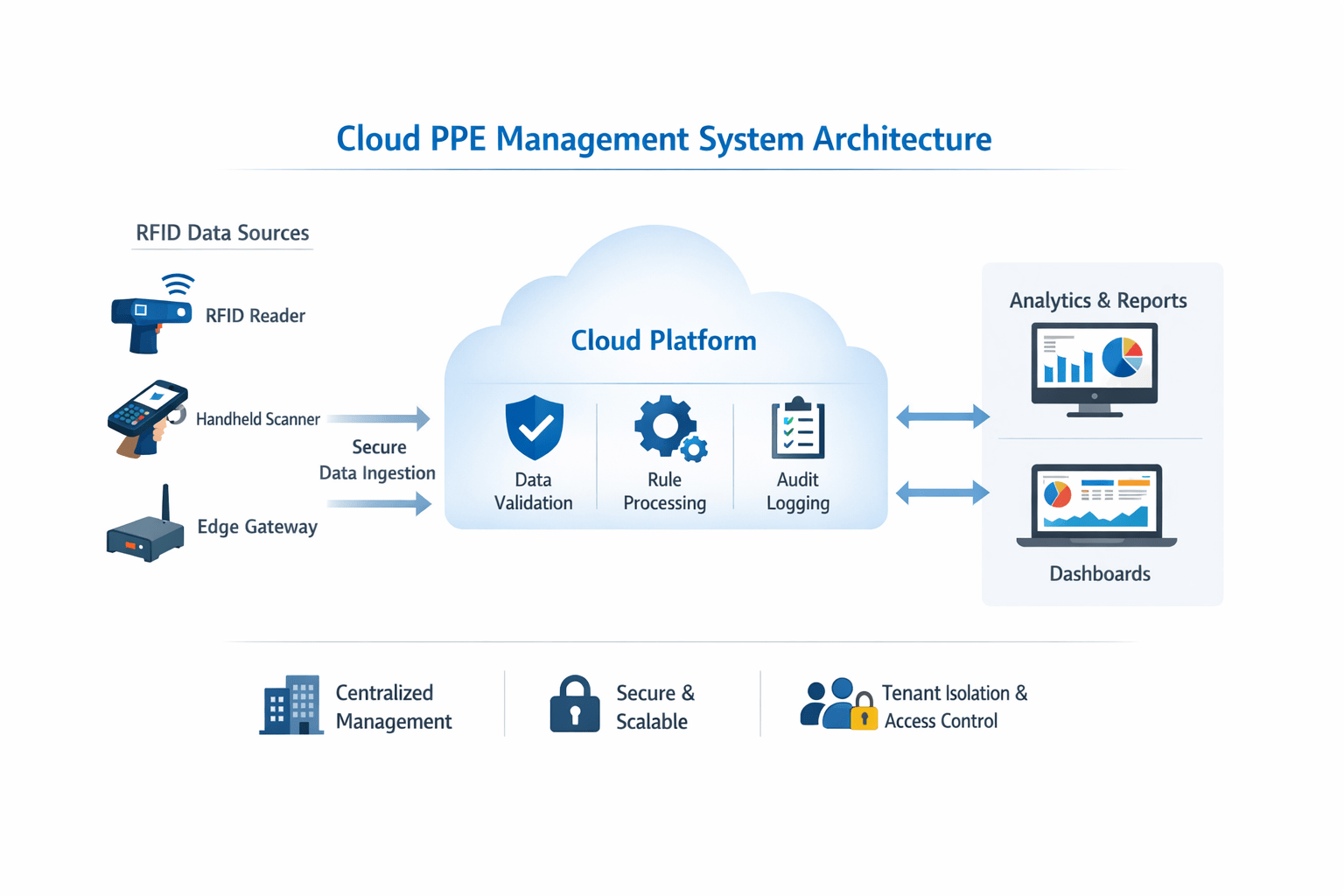
Cloud-based PPE management architectures centralize data ingestion, policy enforcement, and compliance reporting within a secure cloud environment. RFID events generated by readers, handheld devices, or edge gateways are transmitted through encrypted channels to cloud services where validation, rule processing, and audit logging occur.
System governance resides within the cloud platform, enabling enterprise-wide visibility across multiple sites. Operational responsibilities such as system availability, backups, disaster recovery, and version control are managed centrally. Security boundaries are defined through tenant isolation, role-based access control, and identity federation. Scalability is achieved through elastic processing and storage resources aligned with workforce size and PPE volume.
Non-Cloud Architecture Overview
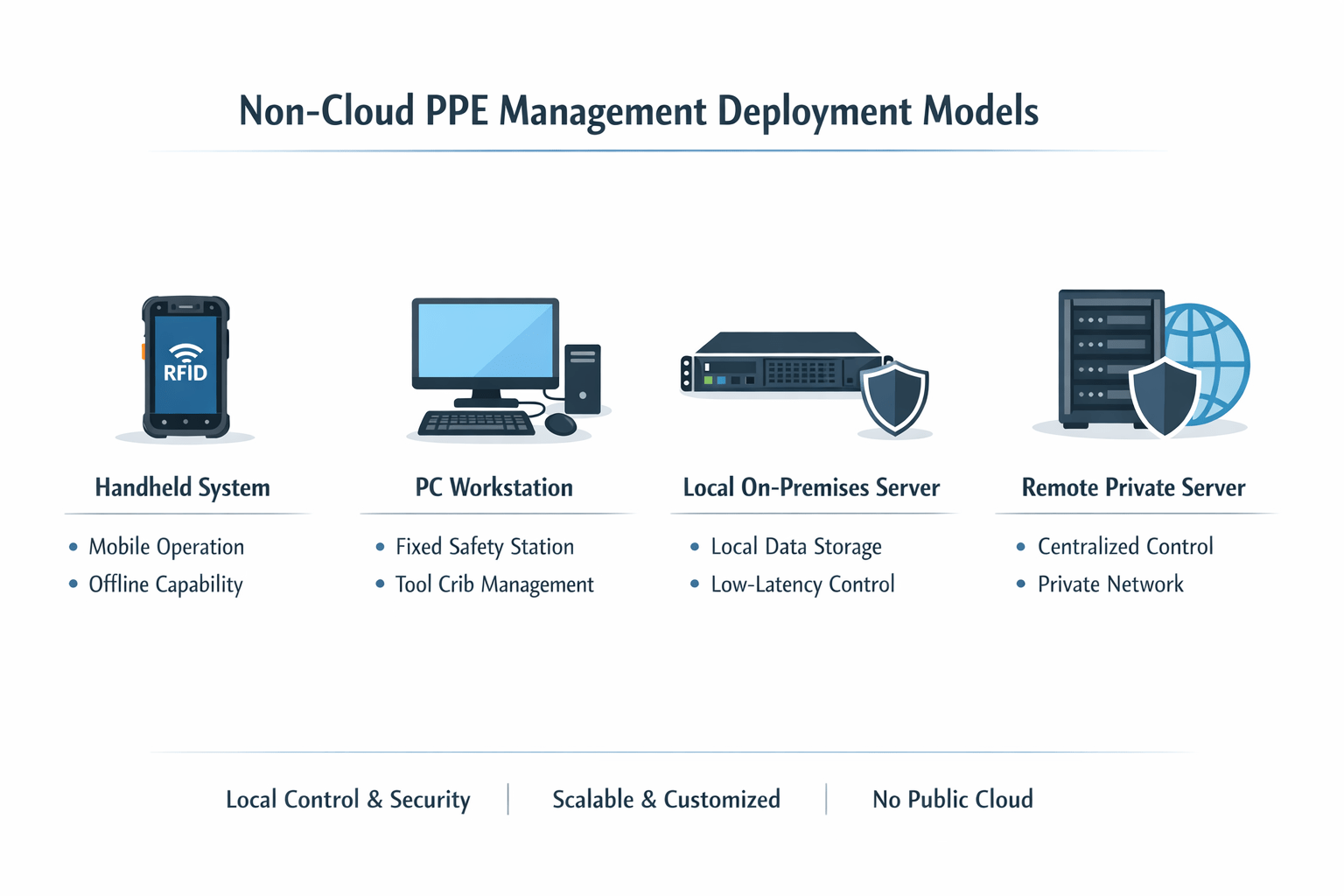
Non-cloud PPE management architectures support environments where connectivity, regulatory constraints, or operational autonomy require local control. Software may run on a handheld computer, a workstation PC, a local on-premises server, or a remotely hosted private server.
Handheld-based deployments prioritize mobility and offline operation for field inspections and issuance control. PC-based deployments support fixed safety stations or tool cribs. Local server deployments centralize data within a facility boundary, supporting low-latency enforcement and local compliance storage. Remote server deployments provide centralized control without public cloud dependencies.
Operational responsibilities such as updates, backups, and access control reside with the organization or designated integrator. Security boundaries are enforced through network segmentation, local authentication services, and physical access controls. Scalability depends on hardware capacity planning and system configuration.
Cloud vs Non-Cloud PPE Management Systems Comparison
| Aspect | Cloud-Based PPE Management Systems | Non-Cloud PPE Management Systems |
| Deployment Control | Centralized enterprise control | Site-level or system-level control |
| Connectivity Dependence | Requires reliable network access | Operates offline or within closed networks |
| Data Residency | Shared or regionally hosted | Fully controlled by organization |
| Scalability | Elastic across sites and users | Hardware-bound scaling |
| Typical Use Scenarios | Multi-site enterprises, distributed workforce | Secure facilities, remote sites, regulated environments |
| PPE Compliance Oversight | Unified global reporting | Localized compliance governance |
| Handheld Usage | Acts as data capture endpoint | Acts as primary system controller |
| IT Operational Load | Lower internal maintenance | Higher internal responsibility |
Cloud Integration and Data Management for PPE Management Systems
Cloud integration for PPE management focuses on governing the full data lifecycle from ingestion to archival. RFID events representing PPE issuance, verification, inspection, or exception states are securely ingested through validated endpoints. Processing services apply business rules tied to PPE eligibility, certification status, and role-based permissions.
Validated records are stored in structured databases supporting long-term retention, audit reconstruction, and compliance reporting. Analytics engines aggregate PPE usage patterns, inspection compliance rates, and risk exposure metrics. Integration interfaces enable controlled data exchange with HR systems, training platforms, access control systems, and enterprise safety management tools.
Security controls include encryption at rest and in transit, identity-based access governance, segregation of duties, and immutable audit logs. Data governance policies define retention periods, access entitlements, and regulatory compliance alignment for U.S. and Canadian safety standards.
Major Components of PPE Management Systems using RFID
RFID Credentials
RFID tags embedded in PPE serve as durable digital identifiers. Selection depends on environmental exposure, attachment method, and expected lifecycle. Constraints include chemical resistance, washability, and mechanical stress tolerance.
RFID Readers
Readers capture PPE and personnel interactions at issuance points, work zones, or inspection stations. Selection considerations include read range control, interference tolerance, and integration interfaces.
Edge Devices
Edge gateways preprocess RFID data, apply local validation logic, and buffer events during connectivity interruptions. Operational roles include latency reduction and network load management.
Middleware
Middleware translates raw RFID events into normalized system transactions. Configuration flexibility, rule definition capability, and integration support are key selection criteria.
Cloud Platforms
Cloud platforms host centralized processing, analytics, and reporting services. Considerations include compliance certifications, regional hosting options, and access governance maturity.
Local Servers
Local servers support non-cloud PPE systems requiring on-premises control. Hardware reliability, backup strategy, and patch management are critical constraints.
Databases
Databases store PPE asset records, inspection histories, and compliance logs. Selection depends on transaction volume, retention policies, and audit query requirements.
Dashboards and Reporting Tools
Dashboards provide role-specific visibility into PPE compliance status. Reporting tools support regulatory audits, incident analysis, and operational planning.
RFID Technologies Used in PPE Management Systems
UHF RFID
UHF RFID offers extended read ranges and supports bulk identification. Performance varies based on material composition and environmental conditions. Operational tuning is required to manage read zones.
HF RFID
HF RFID operates at shorter ranges with stable performance near liquids and metals. Interaction requires deliberate proximity, supporting controlled verification workflows.
NFC
NFC provides user-confirmed interactions with very short read distances. Performance consistency supports personnel accountability and intentional PPE validation steps.
LF RFID
LF RFID delivers minimal interference sensitivity and performs reliably in harsh industrial environments. Read ranges are limited, supporting precise equipment-level identification.
RFID Technology Comparison for PPE Management Systems
| Technology | Read Range | Environmental Sensitivity | Interaction Model | PPE System Alignment |
| UHF RFID | Several meters | Higher sensitivity | Passive detection | Area-level PPE presence |
| HF RFID | Centimeters | Moderate sensitivity | Proximity-based | Issuance and inspection |
| NFC | Few centimeters | Low sensitivity | User-confirmed | Personnel verification |
| LF RFID | Very short | Minimal sensitivity | Close-contact | Rugged PPE tracking |
Combining Multiple RFID Technologies in PPE Management Systems
Multi-technology RFID architectures are appropriate when PPE workflows span different operational layers. Combining technologies allows organizations to balance automation with control.
Architectural benefits include optimized read accuracy, differentiated interaction intent, and reduced false positives. Trade-offs include increased system complexity, integration overhead, and operational training requirements. Complexity risks are mitigated through clear zoning, disciplined configuration management, and consistent governance policies. GAO designs hybrid RFID architectures when operational justification outweighs system simplicity concerns.
Applications of PPE Management Systems using RFID Technologies
- Construction site PPE issuance control enforcing role-based equipment eligibility across subcontractors and supervisors
- Manufacturing floor PPE verification aligned with workstation hazard classifications and shift assignments
- Utility field crew PPE tracking linked to work orders, permits, and geographic zones
- Laboratory PPE compliance monitoring supporting biosafety and contamination protocols
- Mining operation PPE lifecycle management under extreme environmental conditions
- Oil and gas facility PPE access enforcement tied to confined space entry procedures
- Renewable energy site PPE governance for tower climbing and electrical safet
- Warehousing PPE accountability across forklift zones and material handling areas
- Transportation hub PPE management supporting maintenance and inspection teams
- Defense and government facility PPE tracking under restricted access policies
Deployment Options for PPE Management Systems using RFID
Cloud Deployment Use Cases and Advantages
Cloud deployment supports organizations requiring enterprise-wide PPE visibility, centralized compliance reporting, and scalable growth. Regulatory alignment is achieved through regional hosting options and standardized governance frameworks. Operational advantages include reduced IT overhead and faster policy updates.
Non-Cloud Deployment Use Cases and Advantages
Non-cloud deployment suits environments with strict data control, limited connectivity, or low-latency enforcement needs. Handheld systems enable mobile field operations. PC-based systems support fixed issuance points. Local servers provide on-premises compliance control. Remote servers offer centralized oversight without public cloud exposure.
Organizational decision factors include regulatory mandates, network reliability, operational autonomy, and internal IT capabilities.
Case Studies of PPE Management Systems using RFID Technologies
U.S. Case Studies
Industrial Manufacturing PPE Compliance Program | Detroit, Michigan
- Problem
A multi-line manufacturing facility experienced recurring PPE compliance gaps across welding, machining, and assembly areas. Manual issuance logs and visual checks failed to ensure task-specific PPE alignment, leading to audit findings related to incomplete inspection histories and inconsistent enforcement during shift transitions.
- Solution
GAO supported a PPE Management System using RFID technologies with HF and NFC credentials embedded in PPE and personnel badges. The system operated in a non-cloud deployment on a local server to align with internal data governance requirements. Fixed readers were installed at tool cribs, while supervisors used handheld computers for validation.
- Result
Recorded PPE non-compliance events declined by 46 percent within nine months.
Lesson or Trade-off
Local server control reduced external dependencies but increased internal responsibility for system maintenance.
Large-Scale Construction PPE Accountability | Austin, Texas
- Problem
A commercial construction site faced frequent PPE misuse among rotating subcontractor crews, especially fall protection gear. Paper-based tracking could not scale across dynamic site zones.
- Solution
GAO assisted with a cloud-based PPE Management System using RFID technologies. UHF RFID supported zone-level monitoring, while NFC confirmed deliberate PPE issuance. Centralized dashboards provided real-time oversight.
- Result
Unauthorized PPE usage incidents dropped by 38 percent across two project phases.
Lesson or Trade-off
UHF zone monitoring required careful configuration to manage signal reflection from steel structures.
Utility Field Workforce PPE Governance | Phoenix, Arizona
- Problem
Field technicians performing live electrical work lacked verifiable assurance that certified PPE was present and valid. Remote job sites limited centralized monitoring.
- Solution
GAO supported a non-cloud PPE Management System using RFID technologies running on rugged handheld computers. LF RFID tags ensured reliable reads near metal equipment, with synchronization to a remote server when connectivity allowed.
- Result
Use of expired PPE during field operations was reduced to zero within six months.
Lesson or Trade-off
Offline operation delayed centralized reporting until synchronization events occurred.
Pharmaceutical Laboratory PPE Controls | Cambridge, Massachusetts
- Problem
Hazardous research laboratories required PPE validation aligned with biosafety levels. Existing badge systems did not verify PPE inspection status.
- Solution
GAO implemented a cloud-based PPE Management System using RFID technologies with HF credentials integrated into laboratory PPE. Access control systems validated PPE compliance prior to lab entry.
- Result
PPE-related biosafety audit findings decreased by 52 percent year over year.
Lesson or Trade-off
System reliability depended on consistent network availability.
Food Processing Plant PPE Hygiene Tracking | Fresno, California
- Problem
Reusable PPE garments lacked reliable tracking for sanitation cycles, increasing hygiene compliance risks.
- Solution
GAO supported a PPE Management System using RFID technologies with HF tags embedded in garments. A PC-based non-cloud deployment captured wash cycles and issuance events.
- Result
Missed sanitation intervals declined by 41 percent within one production season.
Lesson or Trade-off
PC-based deployments required strict physical and access security.
Oil Refinery Confined Space PPE Enforcement | Baton Rouge, Louisiana
- Problem
Confined space entry procedures relied heavily on supervisor verification, creating enforcement gaps.
- Solution
GAO supported a hybrid PPE Management System using RFID technologies combining NFC for personnel confirmation and UHF for equipment presence checks, operating on a local server.
- Result
Unauthorized confined space entries were eliminated during scheduled shutdowns.
Lesson or Trade-off
Hybrid RFID architectures required disciplined configuration management.
Warehouse Material Handling PPE Enforcement | Columbus, Ohio
- Problem
Distribution centers experienced inconsistent PPE usage in forklift zones.
- Solution
GAO deployed a cloud-based PPE Management System using RFID technologies with UHF zone readers and NFC issuance validation.
- Result
PPE-related recordable incidents declined by 29 percent over twelve months.
Lesson or Trade-off
Role-based access governance was necessary to control dashboard visibility.
Aerospace Maintenance PPE Traceability | Wichita, Kansas
- Problem
Aircraft maintenance audits required rapid reconstruction of PPE compliance data.
- Solution
GAO supported a non-cloud PPE Management System using RFID technologies on a local server with HF-tagged PPE linked to certified technicians.
- Result
Audit preparation time decreased by 57 percent.
Lesson or Trade-off
Capacity planning was required during peak maintenance cycles.
Municipal Water Treatment PPE Oversight | San Diego, California
- Problem
Chemical handling operations showed inconsistent PPE enforcement across shifts.
- Solution
GAO implemented a cloud-based PPE Management System using RFID technologies integrated with training compliance records.
- Result
Chemical handling PPE violations declined by 34 percent.
Lesson or Trade-off
Ongoing data governance was required to align training and PPE records.
Mining Operation PPE Lifecycle Management | Elko, Nevada
- Problem
Remote mining sites struggled with tracking PPE inspection intervals under harsh conditions.
- Solution
GAO supported a non-cloud PPE Management System using RFID technologies deployed on a remote server with LF-tagged PPE.
- Result
Overdue PPE inspections declined by 49 percent.
Lesson or Trade-off
Redundant connectivity planning was necessary.
Logistics Hub PPE Zone Compliance | Memphis, Tennessee
- Problem
High-throughput cross-dock facilities lacked automated PPE enforcement.
- Solution
GAO deployed a cloud-based PPE Management System using RFID technologies with UHF-based zone monitoring.
- Result
Zone-specific PPE violations dropped by 31 percent.
Lesson or Trade-off
Environmental tuning was required to prevent overlapping reads.
Power Generation Facility PPE Governance | Des Moines, Iowa
- Problem
Maintenance teams required verified PPE during turbine servicing.
- Solution
GAO supported a local server-based PPE Management System using RFID technologies with HF credentials.
- Result
Maintenance-related PPE incidents decreased by 27 percent.
Lesson or Trade-off
Clear escalation procedures were required for enforcement exceptions.
Healthcare Facility PPE Inventory Control | Cleveland, Ohio
- Problem
Reusable PPE shortages occurred during demand surges.
- Solution
GAO implemented a cloud-based PPE Management System using RFID technologies to track PPE circulation and availability.
- Result
PPE availability improved by 35 percent during peak periods.
Lesson or Trade-off
Inventory accuracy depended on disciplined issuance workflows.
Port Authority Contractor PPE Oversight | Long Beach, California
- Problem
Contractor PPE compliance varied across port operations.
- Solution
GAO supported a hybrid PPE Management System using RFID technologies across cloud dashboards and handheld non-cloud devices.
- Result
Reported PPE violations declined by 42 percent.
Lesson or Trade-off
Contractor onboarding required structured credential provisioning.
Canadian Case Studies
Steel Manufacturing PPE Compliance | Hamilton, Ontario
- Problem
Fabrication operations showed inconsistent PPE enforcement and audit gaps.
- Solution
GAO supported a non-cloud PPE Management System using RFID technologies on a local server.
- Result
PPE audit discrepancies declined by 39 percent.
Lesson or Trade-off
Internal server ownership was required for long-term sustainability.
Public Transit Maintenance PPE Tracking | Toronto, Ontario
- Problem
Maintenance teams lacked centralized PPE traceability.
- Solution
GAO implemented a cloud-based PPE Management System using RFID technologies integrated with maintenance workflows.
- Result
PPE compliance reporting accuracy improved by 44 percent.
Lesson or Trade-off
Legacy integration required phased deployment.
Mining PPE Inspection Governance | Sudbury, Ontario
- Problem
Inspection completion rates were inconsistent across shifts.
- Solution
GAO supported a non-cloud PPE Management System using RFID technologies running on handheld computers.
- Result
Inspection completion rates increased to 96 percent.
Lesson or Trade-off
Device lifecycle management required defined policies.
University Laboratory PPE Controls | Vancouver, British Columbia
- Problem
Academic laboratories lacked accountability for shared PPE.
- Solution
GAO deployed a cloud-based PPE Management System using RFID technologies to enforce lab-level PPE requirements.
- Result
PPE-related lab safety violations declined by 33 percent.
Lesson or Trade-off
User training influenced adoption consistency.
Utility Infrastructure PPE Oversight | Calgary, Alberta
- Problem
Field crews operated without consistent PPE validation across job sites.
- Solution
GAO supported a remote server-based PPE Management System using RFID technologies for centralized oversight without public cloud reliance.
- Result
Unauthorized PPE usage incidents declined by 28 percent.
Lesson or Trade-off
Clear service ownership was required for remote hosting.
Our products and systems have been developed and deployed for a wide range of industrial applications. They are available off-the-shelf or can be customized to meet your needs. If you have any questions, our technical experts can help you.
For any further information on GAO’s products and systems, to request evaluation kits, free samples, recorded video demos, or explore partnership opportunities, please fill out this form or email us.