
Overview of GAO’s RFID Digital Twin Systems using RFID Technologies
RFID Digital Twin Systems create continuously synchronized digital representations of physical assets, operational states, and workflows by binding RFID-generated identity and event data to virtual models. These systems link tagged equipment, tools, containers, vehicles, and inventory items to structured digital twins that reflect location, status, custody, and lifecycle conditions in near real time. RFID Digital Twin Systems support deterministic traceability, operational transparency, and system-level observability across industrial, institutional, and regulated environments.
RFID technologies such as UHF, HF, NFC, and LF act as the data acquisition layer, while the digital twin layer governs modeling logic, state transitions, historical context, and rule enforcement. Multiple deployment models are supported, including cloud-based implementations and non-cloud configurations running on handheld computers, PCs, local servers, or remote servers. This flexibility allows organizations to align RFID Digital Twin Systems with data residency policies, latency tolerances, security postures, and operational autonomy requirements. GAO supports these architectures to ensure continuity between physical operations and their digital counterparts.
Description of RFID Digital Twin Systems
RFID Digital Twin Systems consist of an identity resolution layer, an event ingestion layer, a digital twin modeling layer, and an analytics and visualization layer. Physical assets equipped with RFID credentials generate read events captured by fixed readers, mobile readers, or handheld computers. These events update corresponding digital twin objects that maintain current state, historical transitions, and relational mappings.
Purpose of RFID Digital Twin Systems
The system establishes a single operational truth for assets, tools, materials, and work-in-progress. It enables synchronized coordination between operations teams, engineering groups, compliance officers, and IT administrators by ensuring all stakeholders reference the same authoritative digital state.
Issues Addressed by RFID Digital Twin Systems
- Asset misplacement due to fragmented tracking systems
- Manual inventory reconciliation errors
- Latency in operational reporting
- Compliance gaps in chain-of-custody documentation
- Limited visibility across distributed facilities
- Inconsistent data models across departments
Benefits of RFID Digital Twin Systems
- Deterministic asset traceability
- Reduced operational friction across workflows
- Improved audit readiness and compliance reporting
- Scalable observability across physical environments
- Structured data for analytics and forecasting
- Alignment between operational technology and IT governance
GAO applies field experience from enterprise and government deployments to design RFID Digital Twin Systems that address these issues without overengineering.
System Architecture of RFID Digital Twin Systems using RFID Technologies
Cloud Architecture
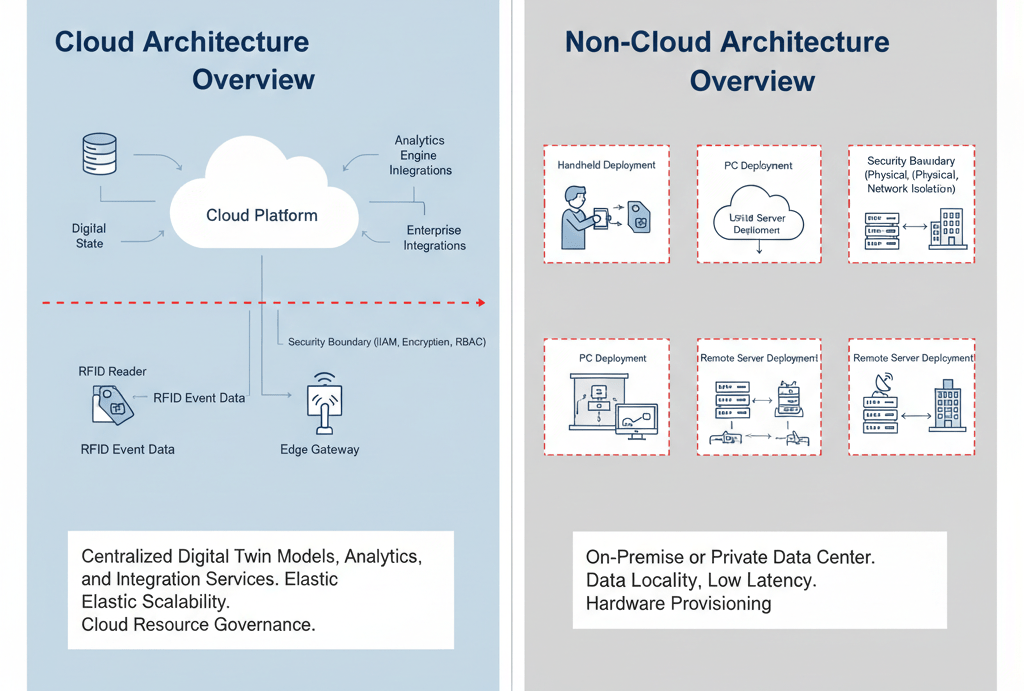
Cloud-based RFID Digital Twin Systems centralize digital twin models, analytics engines, and integration services within secure cloud infrastructure. RFID event data is transmitted from edge readers or gateways to cloud ingestion endpoints. Processing services update digital twin states, enforce business rules, and persist data in governed storage layers.
Security boundaries are defined using identity and access management, network segmentation, encryption at rest and in transit, and role-based access controls. Scalability is achieved through elastic compute and storage, allowing the system to support multi-site operations and variable read volumes. Operational responsibilities include cloud resource governance, monitoring, and lifecycle management.
Non-Cloud Architecture
Non-cloud RFID Digital Twin Systems operate within controlled environments where data locality, latency, or regulatory constraints dominate architectural decisions. The software may run directly on handheld computers for mobile operations, on PCs for workstation-centric workflows, on local servers within a facility, or on remote servers hosted in private data centers.
Data flow remains localized, with RFID events processed and stored within defined security perimeters. Operational responsibilities include on-premise system maintenance, patching, and capacity planning. Security boundaries are enforced through physical access controls, network isolation, and local authentication mechanisms. Scalability is managed through hardware provisioning and architectural segmentation.
Cloud vs Non-Cloud RFID Digital Twin Systems Comparison
| Decision Factor | Cloud RFID Digital Twin Systems | Non-Cloud RFID Digital Twin Systems |
| Data residency | Centralized cloud regions | Local or private data environments |
| Latency sensitivity | Network-dependent | Deterministic local processing |
| Deployment scope | Multi-site, distributed enterprises | Facility-specific or regulated sites |
| IT governance | Shared responsibility model | Full organizational control |
| Scalability | Elastic resource allocation | Hardware-bound scaling |
| Typical selection scenarios | Global operations, analytics-driven programs | Defense, healthcare, manufacturing cells, disconnected sites |
Non-cloud variants further align as follows:
- Handheld computer deployments support mobile inspections and field operations
- PC deployments support workstation-based control rooms
- Local server deployments support plant-level autonomy
- Remote server deployments support private data center strategies
GAO assists organizations in selecting the appropriate model based on operational and regulatory constraints.
Cloud Integration and Data Management for RFID Digital Twin Systems
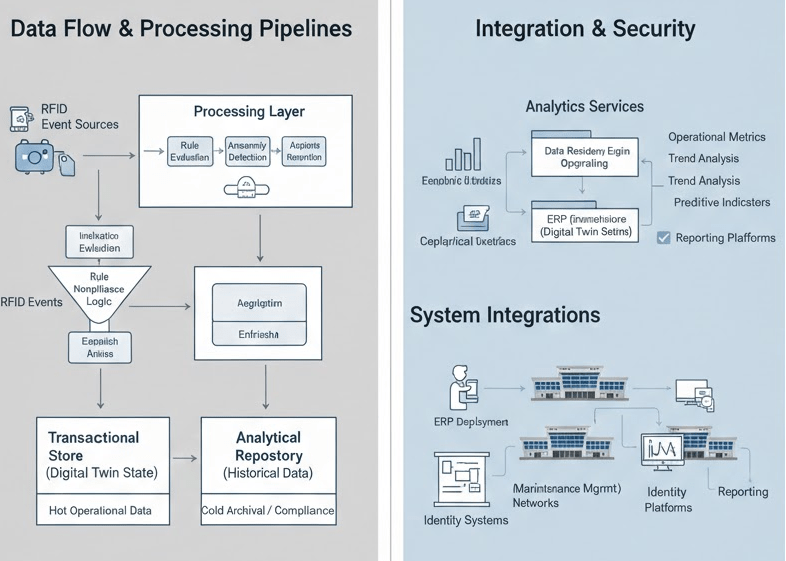
Cloud integration focuses on structured data lifecycle management rather than hardware orchestration. RFID events enter ingestion pipelines where validation, normalization, and enrichment occur. Digital twin state changes are persisted in transactional stores, while historical data is retained in analytical repositories.
Processing layers support rule evaluation, anomaly detection, and aggregation. Data storage strategies balance hot operational data with cold archival records to meet compliance retention requirements. Analytics services expose operational metrics, trend analysis, and predictive indicators.
System integrations include enterprise resource planning, maintenance management systems, identity systems, and reporting platforms. Security controls encompass encryption, access governance, audit logging, and policy enforcement. GAO emphasizes data ownership clarity, governance frameworks, and compliance alignment throughout the lifecycle.
Major Components of RFID Digital Twin Systems Architecture
RFID Credentials
RFID credentials serve as unique identifiers bound to assets or personnel. Selection considers durability, memory structure, and environmental constraints.
- RFID Readers
Readers capture identity and event data under defined power, range, and interference conditions. Operational roles include continuous monitoring or transaction-based reads.
- Edge Devices
Edge devices aggregate, filter, and forward RFID events. Constraints include processing capacity and environmental robustness.
- Middleware
Middleware handles protocol normalization, event correlation, and error handling. Selection depends on throughput and integration requirements.
- Cloud Platforms
Cloud platforms host digital twin logic, analytics, and integrations. Constraints include compliance certifications and regional availability.
- Local Servers
Local servers provide autonomy and low-latency processing. Operational roles include facility-level control and data retention.
- Databases
Databases store digital twin states and histories. Selection considers consistency models, query patterns, and retention policies.
- Dashboards and Reporting Tools
Dashboards provide operational visibility. Constraints include role-based access and visualization latency.
GAO aligns component selection with operational context and lifecycle expectations.
RFID Technologies within RFID Digital Twin Systems
- UHF RFID
UHF operates at longer read ranges and supports high tag densities. Performance is sensitive to RF interference and environmental conditions.
- HF RFID
HF provides moderate read ranges with stable performance near liquids and metals. Operational characteristics support controlled interaction zones.
- NFC
NFC enables very short-range interactions with secure user intent. Performance depends on proximity and device compatibility.
- LF RFID
LF offers short read ranges with high tolerance to harsh environments. Data rates remain limited.
RFID Technology Comparison for RFID Digital Twin Systems
| Technology | Role within RFID Digital Twin Systems | Selection Considerations |
| UHF | Bulk identity acquisition | Read density, environmental RF profile |
| HF | Zone-based interaction | Material compatibility, read stability |
| NFC | User-mediated state changes | Security, intentional interactions |
| LF | Harsh environment identification | Durability, low interference |
Combining Multiple RFID Technologies in RFID Digital Twin Systems
Multi-technology architectures are appropriate when operational zones impose conflicting constraints. Combining RFID technologies enables layered identification strategies. Architectural benefits include flexibility and resilience. Trade-offs include increased system complexity, higher integration effort, and expanded testing requirements. GAO recommends multi-technology designs only when justified by operational or regulatory drivers.
Applications of RFID Digital Twin Systems using RFID Technologies
- Manufacturing asset lifecycle management linking tooling, fixtures, and work orders across production cells
- Warehouse inventory governance tracking pallets, bins, and staging zones with real-time reconciliation
- Healthcare equipment tracking maintaining custody records for infusion pumps, carts, and diagnostic devices
- Data center asset management mapping servers, racks, and maintenance activities
- Defense logistics monitoring serialized equipment and deployment readiness states
- Research laboratory sample tracking preserving chain-of-custody and audit trails
- Airport ground support equipment coordination across operational zones
- Utilities infrastructure management for meters, transformers, and maintenance assets
- Construction site material tracking coordinating subcontractor workflows
- Mining operations equipment visibility across hazardous environments
- Fleet maintenance management synchronizing vehicle status and service records
- Campus facilities management tracking movable assets and room utilization
- Retail backroom inventory governance supporting loss prevention processe
- Pharmaceutical cold chain monitoring integrating custody and compliance data
Each application leverages digital twin modeling rather than raw RFID reads.
Deployment Options for RFID Digital Twin Systems
Cloud Deployment Use Cases and Advantages
Cloud deployment suits organizations requiring cross-site visibility, centralized analytics, and integration with enterprise platforms. Advantages include elastic scalability, centralized governance, and rapid rollout across geographies.
Non-Cloud Deployment Use Cases and Advantages
Non-cloud deployment suits regulated, latency-sensitive, or disconnected environments. Handheld deployments support mobile operations. PC deployments support localized control rooms. Local servers provide facility autonomy. Remote servers support private infrastructure strategies.
Decision factors include regulatory compliance, data sovereignty, operational continuity, and IT governance maturity. GAO supports hybrid and migration strategies to align with evolving enterprise needs.
GAO Case Studies of RFID Digital Twin Systems using RFID Technologies
U.S. Case Studies
Manufacturing Asset Traceability in Detroit, Michigan using RFID Digital Twin Systems
- Problem
A multi-plant manufacturing operation in Detroit faced inconsistent asset visibility across machining centers, tool cribs, and maintenance bays. Manual logs and barcode scans failed to reflect real-time equipment state, causing unplanned downtime and audit gaps. - Solution
GAO supported deployment of RFID Digital Twin Systems using UHF RFID technologies. The system ran in a non-cloud configuration on a local server integrated with plant PCs. Digital replicas of tools and machines were updated automatically through fixed readers at choke points. - Result
Tool search time dropped by 42 percent within six months. - Lesson
Local server deployments reduced latency but required disciplined patch management by plant IT.
Hospital Equipment Management in Boston, Massachusetts using RFID Digital Twin Systems
- Problem
A large urban hospital experienced frequent loss of mobile medical devices, leading to delayed procedures and compliance risks related to equipment maintenance cycles. - Solution
RFID Digital Twin Systems using HF and NFC RFID technologies were implemented. A cloud deployment centralized digital twin records across campuses, while handheld computers supported clinical staff workflows. GAO assisted with data governance design. - Result
Equipment utilization increased by 31 percent and preventive maintenance compliance reached 98 percent. - Lesson
Cloud visibility improved coordination, but clinical Wi-Fi coverage became a dependency.
Warehouse Inventory Control in Columbus, Ohio using RFID Digital Twin Systems
- Problem
A regional distribution center struggled with inventory mismatches between warehouse management systems and physical stock, particularly during peak seasons. - Solution
GAO enabled RFID Digital Twin Systems using UHF RFID technologies, deployed on a PC-based non-cloud setup for operational autonomy. Digital inventory twins synchronized inbound and outbound movements through dock door readers. - Result
Inventory accuracy improved from 92 percent to 99.1 percent. - Lesson
PC-based deployments worked well for single facilities but limited cross-site analytics.
Defense Logistics Readiness in San Diego, California using RFID Digital Twin Systems
- Problem
A defense logistics operation required deterministic chain-of-custody tracking for serialized equipment under strict data sovereignty rules. - Solution
RFID Digital Twin Systems using LF and HF RFID technologies were deployed on a remote private server. GAO assisted with secure data modeling and access controls aligned to defense compliance requirements. - Result
Audit reconciliation time was reduced by 55 percent. - Lesson
Enhanced security controls increased system complexity and onboarding time.
Data Center Asset Governance in Ashburn, Virginia using RFID Digital Twin Systems
- Problem
Rapid server turnover created discrepancies between asset registers and physical racks, increasing risk during audits. - Solution
GAO supported RFID Digital Twin Systems using UHF RFID technologies in a cloud deployment. Digital twins represented rack, server, and component hierarchies updated via handheld readers. - Result
Audit preparation effort dropped by 47 percent. - Lesson
Cloud analytics improved oversight, but strict access governance was required.
Airport Ground Equipment Coordination in Dallas, Texas using RFID Digital Twin Systems
- Problem
Ground support equipment availability was poorly synchronized across terminals, impacting turnaround times. - Solution
RFID Digital Twin Systems using UHF RFID technologies were deployed on local servers for low-latency updates. Fixed readers tracked equipment movement between operational zones. - Result
Equipment idle time decreased by 29 percent. - Lesson
Local servers minimized latency but required redundancy planning.
Pharmaceutical Cold Chain Monitoring in Raleigh, North Carolina using RFID Digital Twin Systems
- Problem
Cold chain integrity documentation relied on manual reconciliation of shipment logs and temperature records. - Solution
GAO enabled RFID Digital Twin Systems using HF RFID technologies with a cloud-based digital twin repository. Data ingestion integrated custody and compliance metadata. - Result
Regulatory audit findings related to documentation dropped to zero. - Lesson
Cloud storage simplified compliance but required careful data retention policies.
Construction Material Tracking in Denver, Colorado using RFID Digital Twin Systems
- Problem
Large construction sites experienced material loss and workflow delays due to poor visibility across subcontractors. - Solution
RFID Digital Twin Systems using UHF RFID technologies were deployed on handheld computers operating in non-cloud mode. Digital twins tracked material state and location. - Result
Material shrinkage reduced by 23 percent. - Lesson
Handheld deployments depended heavily on operator training consistency.
Utilities Infrastructure Management in Phoenix, Arizona using RFID Digital Twin Systems
- Problem
Field teams lacked synchronized visibility into meter and transformer service history. - Solution
GAO supported RFID Digital Twin Systems using LF RFID technologies deployed on remote servers. Field data synced periodically from handheld devices. - Result
Service record accuracy improved by 38 percent. - Lesson
Intermittent connectivity required robust synchronization logic.
Research Laboratory Sample Governance in San Diego, California using RFID Digital Twin Systems
- Problem
Sample mislabeling and custody disputes affected reproducibility of research results. - Solution
RFID Digital Twin Systems using HF and NFC RFID technologies were implemented in a cloud deployment. Digital sample twins maintained custody and state transitions. - Result
Sample loss incidents decreased by 61 percent. - Lesson
NFC interactions required disciplined procedural adherence.
Fleet Maintenance Operations in Memphis, Tennessee using RFID Digital Twin Systems
- Problem
Fleet maintenance records lagged behind actual vehicle status, causing scheduling inefficiencies. - Solution
GAO deployed RFID Digital Twin Systems using UHF RFID technologies on a local server. Vehicle and component twins updated automatically during service events. - Result
Maintenance backlog reduced by 34 percent. - Lesson
Local server scaling required upfront capacity planning.
Campus Facilities Asset Control in Palo Alto, California using RFID Digital Twin Systems
- Problem
A large campus struggled to track movable assets across departments. - Solution
RFID Digital Twin Systems using UHF RFID technologies were deployed in a cloud configuration. GAO assisted with role-based access governance. - Result
Asset recovery rates improved by 45 percent. - Lesson
Cross-department governance alignment was critical.
Retail Backroom Inventory Oversight in Chicago, Illinois using RFID Digital Twin Systems
- Problem
Backroom inventory discrepancies caused frequent stockouts. - Solution
GAO enabled RFID Digital Twin Systems using UHF RFID technologies on PC-based non-cloud systems for store-level control. - Result
Stock availability improved by 18 percent. - Lesson
Store-level autonomy limited centralized analytics.
Mining Equipment Visibility in Reno, Nevada using RFID Digital Twin Systems
- Problem
Harsh environmental conditions disrupted traditional tracking systems. - Solution
RFID Digital Twin Systems using LF RFID technologies were deployed on local servers. Digital twins tracked equipment operational state. - Result
Equipment downtime incidents reduced by 26 percent. - Lesson
LF reliability came at the cost of limited data throughput.
Canadian Case Studies
Manufacturing Tool Governance in Hamilton, Ontario using RFID Digital Twin Systems
- Problem
Tooling loss and misallocation disrupted production scheduling. - Solution
GAO supported RFID Digital Twin Systems using UHF RFID technologies deployed on local servers. Digital tool twins synchronized usage and availability. - Result
Production delays linked to tooling dropped by 33 percent. - Lesson
Local governance required clear ownership models.
Healthcare Asset Tracking in Toronto, Ontario using RFID Digital Twin Systems
- Problem
Urban healthcare facilities faced equipment sharing challenges across sites. - Solution
RFID Digital Twin Systems using HF RFID technologies were deployed in the cloud. Handheld devices supported staff workflows. - Result
Inter-facility equipment transfer time decreased by 28 percent. - Lesson
Cloud reliance increased dependency on network uptime.
Logistics Hub Operations in Mississauga, Ontario using RFID Digital Twin Systems
- Problem
Cross-dock operations lacked synchronized visibility. - Solution
GAO enabled RFID Digital Twin Systems using UHF RFID technologies on PC-based non-cloud deployments. - Result
Dock-to-dock processing time improved by 21 percent. - Lesson
PC-based systems limited future scalability.
Energy Infrastructure Maintenance in Calgary, Alberta using RFID Digital Twin Systems
- Problem
Maintenance records were fragmented across field teams. - Solution
RFID Digital Twin Systems using LF RFID technologies ran on remote servers. GAO supported secure data synchronization. - Result
Maintenance audit discrepancies fell by 40 percent. - Lesson
Remote servers required disciplined access control.
University Research Asset Oversight in Vancouver, British Columbia using RFID Digital Twin Systems
- Problem
Shared research equipment lacked usage transparency. - Solution
RFID Digital Twin Systems using HF and NFC RFID technologies were deployed in a cloud model. Digital twins governed scheduling and access. - Result
Equipment utilization improved by 37 percent. - Lesson
User adoption depended on clear process communication.
Our products and systems have been developed and deployed for a wide range of industrial applications. They are available off-the-shelf or can be customized to meet your needs. If you have any questions, our technical experts can help you.
For any further information on GAO’s products and systems, to request evaluation kits, free samples, recorded video demos, or explore partnership opportunities, please fill out this form or email us.