
Overview of the RFID Logistics Pack Using GAO RFID Technologies
RFID Logistics Pack is an enterprise-grade logistics identification and control system designed to digitize physical asset movement, material handling workflows, and inventory state transitions using RFID technologies. The system focuses on persistent traceability, process enforcement, and operational accountability across logistics environments such as warehouses, distribution centers, yards, production buffers, and transport interfaces.
This logistics RFID platform structures how tag events are captured, contextualized, validated, and transformed into operational intelligence. The RFID Logistics Pack integrates identity layers, event rules, data normalization, and role-based visibility into a single operational framework. Deployment flexibility is central to its design, supporting both cloud-based and non-cloud implementations depending on regulatory, latency, or infrastructure constraints. Non-cloud configurations include execution on handheld computers, PCs, local servers, or remote servers under customer control.
Across logistics operations, RFID Logistics Pack supports high-volume item flow, exception management, audit readiness, and system interoperability without forcing a single infrastructure model. This architectural flexibility allows organizations to align logistics digitization initiatives with internal IT governance, compliance mandates, and regional operational realities.
GAO RFID Logistics Pack Purpose, Operational Challenges Addressed, and Business Value
System Purpose and Operational Role
RFID Logistics Pack functions as a control layer between physical logistics assets and enterprise systems. The system governs how RFID-identified objects are recognized, validated, tracked, and reconciled across operational processes such as receiving, put-away, picking, staging, dispatch, and returns handling.
Key objectives include:
- Enforcing standardized logistics workflows across sites and shifts
- Creating deterministic asset and inventory states
- Reducing manual reconciliation and scan dependency
- Supporting audit trails and chain-of-custody records
- Enabling cross-system logistics visibility
Issues Commonly Addressed
Logistics organizations often face fragmented identification processes, inconsistent data capture, and delayed exception detection. RFID Logistics Pack is designed to address issues such as:
- Manual barcode dependency causing labor inefficiency
- Inventory mismatches between physical stock and ERP records
- Lack of real-time visibility across logistics handoff points
- Inconsistent compliance reporting across facilities
- Latency-sensitive operations constrained by cloud-only systems
Resulting Benefits
By formalizing logistics identification and event handling, RFID Logistics Pack delivers measurable operational outcomes:
- Reduced handling errors and mis-shipments
- Improved inventory accuracy and location certainty
- Faster throughput across inbound and outbound processes
- Stronger compliance posture through immutable event records
- Infrastructure flexibility aligned with enterprise IT policy
GAO supports customers throughout requirements analysis, system configuration, and operational rollout, ensuring the logistics RFID system aligns with real-world constraints rather than theoretical architectures.
System Architecture of Logistics Pack Using RFID Technologies
Cloud Architecture Model for RFID Logistics Pack
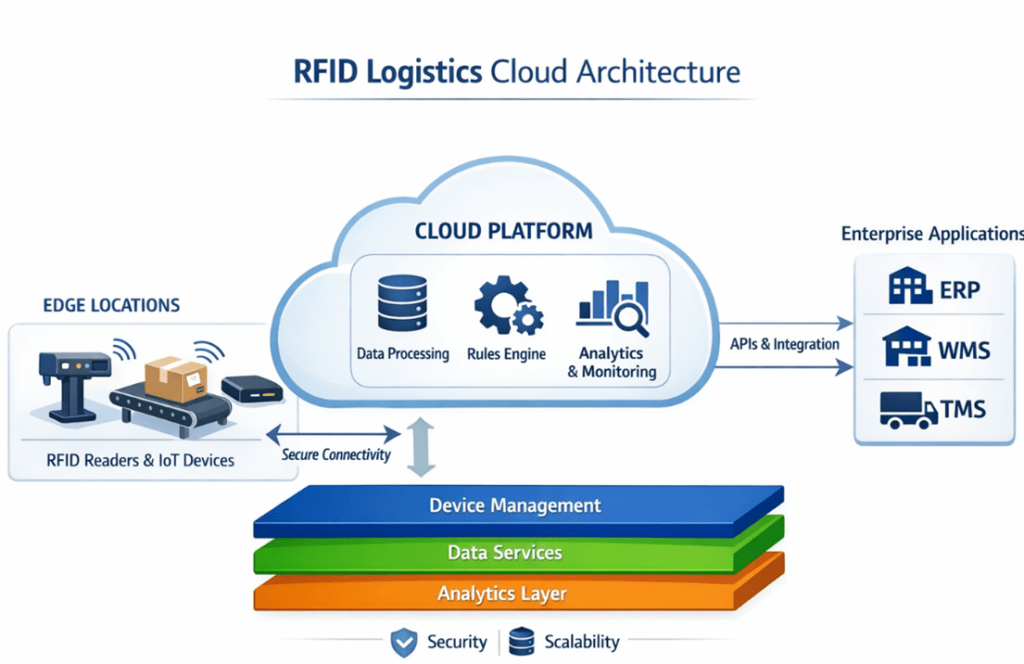
Cloud-based deployments centralize orchestration, data management, and analytics while distributing RFID execution at edge locations. RFID readers and edge devices perform event capture and preliminary filtering before transmitting normalized data to centralized services.
Architectural characteristics include:
- Centralized rules management and configuration control
- Multi-site visibility through shared data services
- Role-based dashboards for operations, compliance, and management
- API-driven integration with ERP, WMS, and TMS platforms
- Logical separation of device, integration, and analytics layers
Security boundaries typically isolate edge devices from cloud services using encrypted channels, identity certificates, and access policies. Scalability is achieved through elastic data ingestion and horizontally scalable processing services.
Non-Cloud Architecture Model for RFID Logistics Pack
Non-cloud deployments retain execution and data control within customer-managed environments. The RFID Logistics Pack software can operate on:
- Handheld computers for mobile or temporary operations
- PCs for workstation-based logistics processing
- Local servers within a facility network
- Remote servers hosted in private data centers
Operational logic, event processing, and data storage remain local or privately hosted. These architectures favor deterministic latency, offline resilience, and strict data residency.
Responsibilities shift toward internal IT teams for patching, backups, and capacity planning. Security boundaries are enforced through network segmentation, local authentication, and physical access controls. 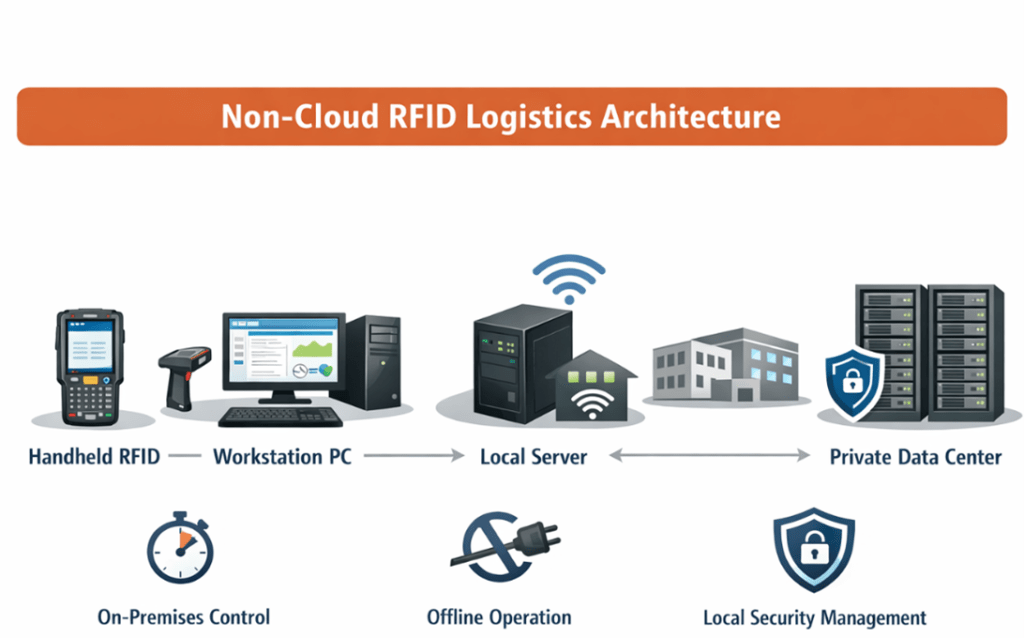
Cloud vs Non-Cloud RFID Logistics Pack Comparison
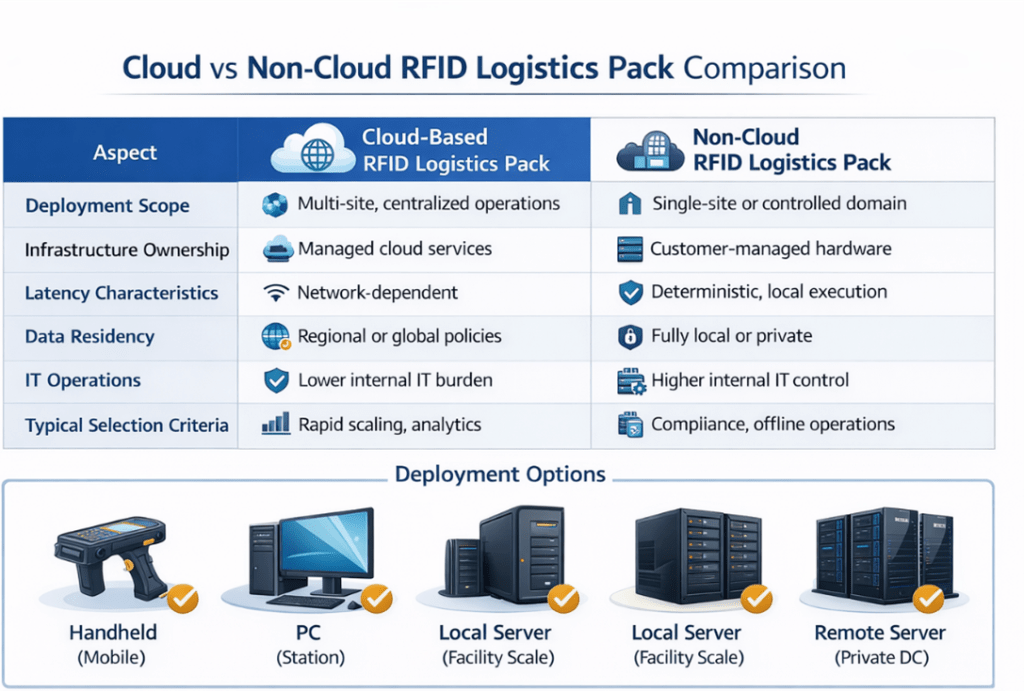
| Aspect | Cloud-Based RFID Logistics Pack | Non-Cloud RFID Logistics Pack |
| Deployment Scope | Multi-site, centralized operations | Single-site or controlled domain |
| Infrastructure Ownership | Managed cloud services | Customer-managed hardware |
| Latency Characteristics | Network-dependent | Deterministic, local execution |
| Data Residency | Regional or global policies | Fully local or private |
| IT Operations | Lower internal IT burden | Higher internal IT control |
| Typical Selection Criteria | Rapid scaling, analytics | Compliance, offline operations |
Handheld-based
non-cloud deployments suit mobile logistics teams, PC-based systems fit controlled stations, local servers support facility-scale operations, and remote servers serve centralized private environments.
Cloud Integration and Data Management for RFID Logistics Pack
RFID Logistics Pack cloud integration emphasizes structured data lifecycle management rather than device mechanics. Data ingestion pipelines validate RFID events against business rules before persistence.
Core data management principles include:
- Event normalization across sites and device types
- Policy-driven data retention and archival
- Secure storage with access segmentation
- Analytics optimized for logistics KPIs
- Controlled data sharing with enterprise systems
Security controls include identity-based access, audit logging, and role-based governance. Integration endpoints support ERP, WMS, compliance systems, and reporting platforms. GAO assists organizations in aligning logistics data governance with corporate security and compliance frameworks.
Major Components of the RFID Logistics Pack Architecture
- RFID Credentials
Tags and identifiers define asset identity and state. Selection depends on durability, memory requirements, and lifecycle expectations.
- RFID Readers
Readers perform identification and timestamping. Constraints include read density, interference, and environmental conditions.
- Edge Devices
Edge systems execute filtering, validation, and buffering. Selection depends on processing needs, power availability, and mobility.
- Middleware Layer
Middleware enforces logistics rules and normalizes events. Configuration discipline is critical to prevent logic drift.
- Cloud Platforms
Cloud platforms manage orchestration, analytics, and integrations. Selection depends on compliance posture and scalability needs.
- Local and Remote Servers
Servers host processing logic and databases in non-cloud environments. Capacity planning and redundancy remain customer responsibilities.
- Databases
Databases store event histories and operational states. Schema design impacts performance and auditability.
- Dashboards and Reporting Tools
Visualization layers present logistics KPIs, exceptions, and compliance records. Access governance controls exposure.
RFID Technologies Used Within RFID Logistics Pack
- UHF RFID
UHF supports long read ranges and high tag volumes. Environmental sensitivity and tuning discipline are operational considerations.
- HF RFID
HF operates reliably near liquids and metals. Read range constraints influence workflow design.
- NFC
NFC enables short-range, user-initiated interactions. Device compatibility governs adoption.
- LF RFID
LF offers stable performance in harsh environments. Lower data rates and tag density affect throughput.
RFID Technology Comparison for RFID Logistics Pack
| Technology | Read Range | Read Density | Environmental Sensitivity | System Fit |
| UHF | Long | High | Moderate | High-throughput logistics |
| HF | Medium | Moderate | Low | Controlled handling |
| NFC | Very short | Low | Very low | Human interaction points |
| LF | Short | Low | Very low | Harsh environments |
Combining Multiple RFID Technologies in RFID Logistics Pack
Multi-technology deployments are appropriate when logistics workflows span automated bulk movement and human-controlled verification points. Architectural benefits include workflow segmentation and risk isolation. Trade-offs include integration complexity, reader coexistence planning, and operational training overhead. GAO helps customers evaluate whether complexity aligns with operational value.
Applications of Logistics Pack Using RFID Technologies
- Warehouse inbound receiving control
Supports pallet and case validation at dock doors, enforcing ASN alignment and discrepancy detection within receiving workflows.
- Put-away verification
Tracks material movement from staging to storage locations, ensuring location integrity and reducing misplaced inventory.
- Order picking confirmation
Validates picked items against work orders, reducing mis-picks in high-volume fulfillment environments.
- Cross-docking operations
Enables rapid transfer between inbound and outbound flows with automated reconciliation.
- Yard asset tracking
Monitors trailers, containers, and equipment within yard perimeters to optimize yard management.
- Work-in-process logistics
Tracks semi-finished goods across production buffers and logistics handoffs.
- Returns processing
Supports identification and disposition of returned materials through controlled inspection workflows.
- Compliance and audit support
Maintains traceable movement records for regulated goods and contractual audits.
- Tool and equipment logistics
Controls circulation of reusable logistics assets such as cages, totes, and racks.
- Third-party logistics oversight
Provides visibility across outsourced logistics operations without relinquishing data control.
Deployment Options for RFID Logistics Pack
Cloud Deployment Considerations
Cloud deployment suits organizations prioritizing multi-site visibility, centralized governance, and analytics-driven optimization. Regulatory acceptance, network reliability, and shared IT ownership often drive selection.
Non-Cloud Deployment Considerations
Non-cloud deployment fits operations requiring strict data residency, offline capability, or deterministic response times. Handheld, PC, local server, and remote server models align with varying operational scales and IT maturity levels.
GAO works closely with customers to align deployment strategy with compliance mandates, operational risk tolerance, and long-term scalability planning.
GAO’s Role in Delivering RFID Logistics Pack
GAO brings decades of experience supporting logistics, industrial, and institutional customers across North America and globally. With headquarters in New York City and Toronto, GAO has supported Fortune 500 enterprises, government agencies, research institutions, and complex operational environments through disciplined system design, R&D investment, and quality assurance.
Our role extends beyond technology supply. GAO supports architecture evaluation, deployment planning, validation testing, and long-term operational support, ensuring RFID Logistics Pack delivers measurable logistics outcomes under real-world constraints.
Case Studies of Logistics Pack Using RFID Technologies
U.S. Case Studies
Distribution Center Inventory Control Using RFID Logistics Pack in Dallas, Texas
- Problem
A regional distribution center in Dallas experienced recurring inventory mismatches between physical stock and warehouse management records. Manual barcode scans at inbound docks caused delays, while cycle counts consumed excessive labor hours. Network latency made cloud-only tracking unreliable during peak receiving windows.
- Solution
GAO supported deployment of the RFID Logistics Pack using UHF RFID technologies with a non-cloud architecture hosted on a local server. Fixed readers were installed at dock doors, while middleware executed validation and reconciliation logic locally. ERP integration was handled through scheduled data synchronization.
- Result
Inventory accuracy improved from 92 percent to 99.4 percent within three months.
- Lesson or trade-off
Local execution reduced latency but required internal IT ownership for patching and backups.
Pharmaceutical Warehouse Traceability Using RFID Logistics Pack in Newark, New Jersey
- Problem
A pharmaceutical distribution facility faced compliance pressure to maintain immutable movement records for regulated products. Cloud data residency policies limited the use of shared infrastructure, while manual logs created audit risk.
- Solution
RFID Logistics Pack was implemented using HF RFID technologies on a remote private server within a controlled data center. The system enforced chain-of-custody validation and timestamped event logging with restricted access controls. GAO assisted with compliance mapping and system validation documentation.
- Result
Audit preparation time was reduced by 47 percent year over year.
- Lesson or trade-off
HF RFID provided reliable reads near liquid containers but limited read range increased reader density requirements.
Manufacturing Work-in-Process Logistics Using RFID Logistics Pack in Detroit, Michigan
- Problem
A manufacturing plant struggled to track work-in-process pallets across production buffers and staging areas. ERP visibility lagged physical movement by several hours, leading to line stoppages.
- Solution
GAO supported a hybrid deployment of RFID Logistics Pack using UHF RFID technologies. Edge readers processed events locally on industrial PCs, while aggregated data synchronized to a cloud environment for cross-plant reporting.
- Result
Production line stoppages related to missing materials decreased by 31 percent.
- Lesson or trade-off
Hybrid architectures improved visibility but required careful rules alignment between local and cloud layers.
Cold Storage Logistics Monitoring Using RFID Logistics Pack in Minneapolis, Minnesota
- Problem
Cold storage operators experienced scan failures due to condensation and PPE restrictions. Manual verification slowed throughput during outbound shipments.
- Solution
RFID Logistics Pack was deployed using LF RFID technologies on a local server architecture. LF tags were selected for environmental tolerance, and middleware enforced outbound validation rules without cloud dependency.
- Result
Outbound shipment verification time was reduced by 38 percent.
- Lesson or trade-off
LF RFID reliability came at the cost of lower read density, limiting batch processing size.
Retail Distribution Cross-Docking Using RFID Logistics Pack in Fontana, California
- Problem
A high-volume retail cross-docking operation lacked real-time reconciliation between inbound trailers and outbound staging lanes, resulting in misroutes.
- Solution
GAO implemented RFID Logistics Pack using UHF RFID technologies with cloud-based orchestration. Fixed readers captured pallet movement, while centralized analytics identified routing exceptions in near real time.
- Result
Misrouted pallets declined by 26 percent within the first quarter.
- Lesson or trade-off
Cloud dependency required redundant network connectivity planning.
Aerospace Parts Logistics Using RFID Logistics Pack in Wichita, Kansas
- Problem
Aerospace components required strict traceability across storage and kitting operations. Manual logs increased the risk of documentation gaps.
- Solution
RFID Logistics Pack was deployed using HF RFID technologies on a local server. Controlled read zones enforced part-level validation before kitting release. GAO supported system qualification aligned with aerospace quality standards.
- Result
Documentation discrepancies were reduced to zero during internal audits.
- Lesson or trade-off
System rigidity improved compliance but reduced flexibility for ad hoc handling.
Port Logistics Asset Tracking Using RFID Logistics Pack in Savannah, Georgia
- Problem
Port operations lacked accurate tracking of reusable containers moving between yards and warehouses. Barcode scans failed due to weather exposure.
- Solution
GAO supported deployment of RFID Logistics Pack using UHF RFID technologies with edge processing on rugged PCs. Data synchronized to a remote server for consolidated reporting.
- Result
Container loss incidents declined by 19 percent annually.
- Lesson or trade-off
Environmental tuning of UHF antennas required periodic recalibration.
Healthcare Supply Chain Logistics Using RFID Logistics Pack in Cleveland, Ohio
- Problem
A healthcare distribution hub faced difficulty tracking high-value medical supplies across multiple internal handoffs.
- Solution
RFID Logistics Pack was implemented using NFC RFID technologies on handheld computers for point-of-use confirmation, combined with UHF for bulk movement. GAO assisted with workflow segmentation.
- Result
Shrinkage of high-value supplies decreased by 22 percent.
- Lesson or trade-off
Multi-technology deployments increased training requirements for staff.
Automotive Aftermarket Fulfillment Using RFID Logistics Pack in Memphis, Tennessee
- Problem
High SKU counts and fast order cycles caused frequent picking errors.
- Solution
GAO deployed RFID Logistics Pack using UHF RFID technologies with PC-based execution at pick stations. Middleware validated picks before carton sealing.
- Result
Picking accuracy improved to 99.7 percent.
- Lesson or trade-off
Station-based execution limited mobility outside fixed zones.
Food Distribution Traceability Using RFID Logistics Pack in Fresno, California
- Problem
Food distributors needed rapid traceback capability during recall events.
- Solution
RFID Logistics Pack was deployed using HF RFID technologies on a cloud architecture. Event histories were indexed for rapid recall queries.
- Result
Traceback queries executed 63 percent faster than prior systems.
- Lesson or trade-off
Cloud retention policies required alignment with food safety regulations.
Defense Logistics Depot Tracking Using RFID Logistics Pack in San Antonio, Texas
- Problem
A logistics depot required secure, offline-capable tracking for controlled materials.
- Solution
GAO supported a non-cloud RFID Logistics Pack deployment using UHF RFID technologies on a local server with isolated network access.
- Result
Material accountability discrepancies dropped by 41 percent.
- Lesson or trade-off
Isolated networks limited integration with external systems.
E-commerce Fulfillment Center Using RFID Logistics Pack in Reno, Nevada
- Problem
Peak season volumes overwhelmed manual scan-based verification.
- Solution
RFID Logistics Pack was implemented using UHF RFID technologies with cloud scaling for peak ingestion. Edge devices buffered events during network congestion.
- Result
Peak-season throughput increased by 18 percent.
- Lesson or trade-off
Cloud scaling benefits depended on accurate capacity forecasting.
Industrial Tool Logistics Using RFID Logistics Pack in Peoria, Illinois
- Problem
Reusable industrial tools frequently went missing between job staging areas.
- Solution
GAO deployed RFID Logistics Pack using LF RFID technologies on handheld devices for controlled issue and return tracking.
- Result
Tool loss incidents declined by 34 percent.
- Lesson or trade-off
Manual interaction steps increased operator responsibility.
Energy Sector Materials Yard Using RFID Logistics Pack in Midland, Texas
- Problem
Outdoor materials yards lacked reliable visibility of pipe and equipment inventory.
- Solution
RFID Logistics Pack was deployed using UHF RFID technologies with local server execution and weather-resistant infrastructure.
- Result
Inventory reconciliation time decreased by 29 percent.
- Lesson or trade-off
Outdoor RF variability required conservative read zone design.
Canadian Case Studies
National Retail Distribution Using RFID Logistics Pack in Brampton, Ontario
- Problem
A national retailer required consistent logistics visibility across regional distribution centers.
- Solution
GAO supported a cloud-based RFID Logistics Pack deployment using UHF RFID technologies, with standardized rules across sites.
- Result
Inter-DC inventory variance declined by 21 percent.
- Lesson or trade-off
Standardization reduced local customization flexibility.
Cold Climate Warehouse Operations Using RFID Logistics Pack in Winnipeg, Manitoba
- Problem
Extreme temperatures degraded barcode reliability during winter operations.
- Solution
RFID Logistics Pack was implemented using LF RFID technologies on a local server architecture.
- Result
Winter-related scan failures were eliminated.
- Lesson or trade-off
Lower data rates limited batch processing throughput.
Mining Supply Chain Logistics Using RFID Logistics Pack in Sudbury, Ontario
- Problem
Mining logistics required rugged identification under harsh conditions.
- Solution
GAO deployed RFID Logistics Pack using UHF RFID technologies with edge execution on industrial PCs.
- Result
Supply availability delays dropped by 27 percent.
- Lesson or trade-off
Rugged hardware increased upfront capital cost.
Academic Research Logistics Using RFID Logistics Pack in Montreal, Quebec
- Problem
Research institutions struggled with asset circulation tracking across labs.
- Solution
RFID Logistics Pack was deployed using NFC RFID technologies on handheld devices with centralized reporting.
- Result
Asset utilization improved by 24 percent.
- Lesson or trade-off
Short read ranges required disciplined user interaction.
Government Materials Management Using RFID Logistics Pack in Ottawa, Ontario
- Problem
Government facilities required auditable logistics records with strict data residency.
- Solution
GAO supported a non-cloud RFID Logistics Pack deployment using HF RFID technologies on a remote private server.
- Result
Audit findings related to logistics records were reduced by 52 percent.
- Lesson or trade-off
Private hosting increased long-term infrastructure responsibility.
GAO draws on decades of experience supporting logistics and institutional systems across the U.S. and Canada, including Fortune 500 enterprises, government agencies, and research organizations. Our investment in RFID systems engineering, quality assurance, and expert support enables RFID Logistics Pack deployments that withstand real operational, regulatory, and technical constraints.
Our products and systems have been developed and deployed for a wide range of industrial applications. They are available off-the-shelf or can be customized to meet your needs. If you have any questions, our technical experts can help you.
For any further information on GAO’s products and systems, to request evaluation kits, free samples, recorded video demos, or explore partnership opportunities, please fill out this form or email us.