
Overview of Temperature Tag Systems Using RFID Technologies
RFID Temperature Tag Systems are designed to continuously capture, associate, and manage temperature data linked to physical assets, containers, products, or equipment throughout operational workflows. These systems combine RFID identification with embedded or integrated temperature sensing to provide traceable, time-stamped thermal histories across storage, transit, and handling environments. Such systems are increasingly used where temperature excursions directly impact safety, quality, compliance, or asset integrity.
The system structure typically includes temperature-enabled RFID tags, fixed or mobile RFID readers, edge processing layers, and centralized software platforms that correlate identification data with temperature records. Deployment flexibility is a core design principle, allowing operation in cloud-based environments as well as non-cloud configurations such as handheld computers, PCs, local servers, or remotely hosted private servers. This adaptability supports diverse regulatory, latency, connectivity, and data residency requirements while enabling organizations to scale monitoring coverage across facilities, fleets, or distributed supply chains.
RFID Temperature Tag Systems Architecture, Value, and Operational Scope
RFID Temperature Tag Systems function as an integrated monitoring and traceability framework rather than a standalone sensing solution. The system continuously associates temperature readings with uniquely identified items, enabling operational teams to detect deviations, audit handling conditions, and enforce compliance protocols across complex workflows.
Primary system purposes include maintaining temperature integrity for sensitive goods, supporting regulatory documentation, reducing manual inspection overhead, and enabling rapid exception handling. Common issues addressed include undetected cold-chain breaks, inconsistent manual logging, delayed response to thermal excursions, fragmented data across sites, and lack of verifiable audit trails.
Operational benefits include improved asset accountability, reduced spoilage or degradation, faster root-cause analysis, and enhanced coordination between logistics, quality assurance, compliance, and operations teams. From an organizational perspective, RFID-based temperature monitoring supports standardized operating procedures, reduces human error, and improves cross-functional visibility without introducing excessive process friction.
System Architecture for Cloud and Non-Cloud RFID Temperature Tag Systems
Cloud-Based Architecture for RFID Temperature Tag Systems
Cloud-based deployments centralize temperature and identification data within a secure, scalable cloud environment. RFID readers and edge devices capture tag IDs and temperature values, perform initial validation, and transmit structured data streams to cloud services. Centralized processing layers apply business rules, time-series correlation, and exception logic before storing records in managed databases.
Operational responsibilities such as system updates, analytics scaling, redundancy management, and cross-site aggregation are handled centrally. Security boundaries typically rely on encrypted data transmission, role-based access controls, and continuous audit logging. Cloud architecture supports elastic scalability, multi-site deployments, and enterprise-wide analytics while reducing on-premises infrastructure complexity.
Non-Cloud Architecture for RFID Temperature Tag Systems
Non-cloud deployments are designed for environments with strict data residency, latency, or connectivity constraints. Software may run directly on handheld computers for field inspections, on PCs for workstation-based monitoring, on local servers for facility-level control, or on remote private servers managed by the organization or a trusted partner.
Data flows remain localized, with processing and storage occurring within controlled network boundaries. Operational responsibilities such as system maintenance, backups, and scaling are managed internally. Security controls are enforced through network segmentation, local authentication mechanisms, and physical access restrictions. Non-cloud architectures prioritize deterministic performance, offline resilience, and regulatory compliance over centralized aggregation.
Cloud vs Non-Cloud RFID Temperature Tag Systems Comparison
| Aspect | Cloud-Based RFID Temperature Tag Systems | Non-Cloud RFID Temperature Tag Systems |
| Deployment Model | Centralized cloud infrastructure | Handheld, PC, local server, or private remote server |
| Data Accessibility | Multi-site, role-based global access | Site-specific or organization-controlled access |
| Scalability Approach | Elastic scaling via cloud resources | Planned scaling via hardware and network capacity |
| Connectivity Dependency | Requires reliable network connectivity | Can operate offline or with intermittent connectivity |
| Compliance Strategy | Centralized policy enforcement | Localized compliance control |
| Typical Selection Criteria | Distributed operations, analytics-driven oversight | Regulatory constraints, low-latency requirements |
| Operational Ownership | Shared responsibility with cloud provider | Fully managed by internal IT or partners |
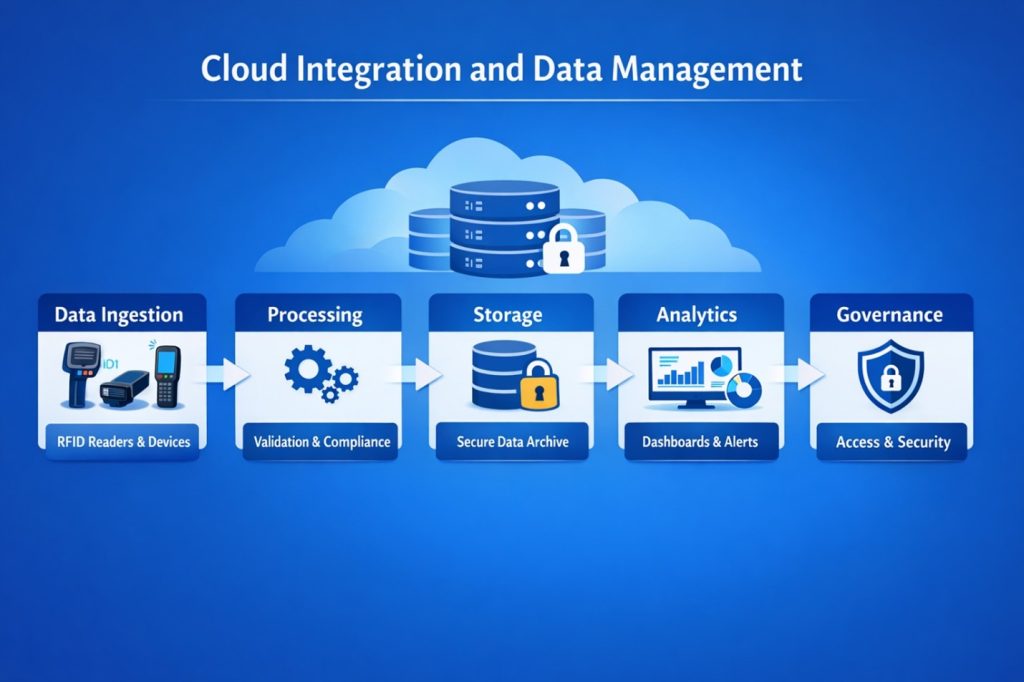
Cloud Integration and Data Management for RFID Temperature Tag Systems
Cloud integration focuses on governing the entire data lifecycle generated by RFID Temperature Tag Systems. Data ingestion pipelines collect temperature-tagged RFID events from readers, edge gateways, and mobile devices. Processing layers validate timestamps, sensor integrity, calibration status, and association logic before committing records to storage.
Storage architectures retain historical temperature data using defined retention policies, redundancy mechanisms, and integrity checks. Analytics engines support real-time dashboards, trend analysis, compliance reporting, and predictive alerts for temperature excursions or sensor anomalies. Integration services connect the system with ERP, WMS, TMS, and quality management platforms through secure APIs.
Security controls include encryption at rest and in transit, role-based access governance, multi-factor authentication, and detailed audit logs. Access governance policies ensure data visibility aligns with organizational roles, regulatory mandates, and operational responsibilities.
Major Components of RFID Temperature Tag Systems
- RFID Temperature Tags
Provide unique identification combined with temperature sensing capabilities. Selection depends on sensing range, memory capacity, sampling intervals, and environmental durability. Operational constraints include battery life for active tags and read sensitivity for passive variants.
- RFID Readers
Capture tag identifiers and temperature data across fixed, portal, vehicle-mounted, or handheld configurations. Placement, antenna design, and read zones influence data reliability and operational coverage.
- Edge Devices
Perform initial data filtering, aggregation, and validation close to the data source. Edge processing reduces bandwidth usage and supports local decision-making during connectivity disruptions.
- Middleware Platforms
Coordinate data normalization, rule execution, and system interoperability. Middleware selection impacts integration complexity, latency tolerance, and extensibility.
- Cloud Platforms and Local Servers
Host processing logic, databases, and analytics services. Selection criteria include scalability requirements, regulatory constraints, and internal IT capabilities.
- Databases
Store time-series temperature data, tag associations, and audit records. Schema design must support high write volumes and long-term retention.
- Dashboards and Reporting Tools
Provide operational visibility, compliance documentation, and exception tracking. Visualization requirements vary by role, from operations to compliance officers.
RFID Technologies Used in RFID Temperature Tag Systems
- UHF RFID
Offers long read ranges and high read rates, supporting bulk monitoring across warehouses, docks, and transit points. Performance is influenced by environmental interference and tag orientation.
- HF RFID
Provides moderate read ranges with stable performance near liquids and dense materials. Often used where controlled read zones and precision are required.
- NFC
Supports very short-range interaction, typically requiring deliberate user engagement. Operational characteristics favor authentication, inspection, or point verification workflows.
- LF RFID
Operates reliably in harsh environments with minimal interference sensitivity. Read ranges are limited, but performance remains consistent near metal or liquids.
RFID Technology Comparison for RFID Temperature Tag Systems
| Technology | Typical Read Range | Data Interaction Style | Environmental Sensitivity | System Integration Fit |
| UHF RFID | Several meters | Automated, high-volume | Higher sensitivity | Large-scale monitoring |
| HF RFID | Up to tens of centimeters | Controlled proximity | Moderate sensitivity | Precision workflows |
| NFC | A few centimeters | User-initiated | Low sensitivity | Inspection and validation |
| LF RFID | Short range | Passive, stable | Very low sensitivity | Harsh environments |
Combining Multiple RFID Technologies in Temperature Tag Systems
Multi-technology architectures are appropriate when operational zones have distinct physical or regulatory constraints. Combining UHF for bulk monitoring with NFC for inspection checkpoints enables both automation and human verification. Architectural benefits include coverage optimization and workflow segmentation.
Trade-offs include increased system complexity, higher integration overhead, and expanded maintenance requirements. Complexity risks arise from managing multiple reader infrastructures, harmonizing data models, and enforcing consistent governance across technologies. Such designs should be justified by clear operational gains rather than convenience.
Applications of RFID Temperature Tag Systems
- Pharmaceutical cold-chain monitoring ensuring compliance with validated temperature ranges during storage and distribution
• Vaccine logistics tracking with time-stamped thermal histories across transport stages
• Biotech sample management within controlled laboratory environments
• Food processing quality assurance across production and storage zones
• Perishable food distribution monitoring throughout logistics networks
• Chemical storage compliance monitoring in regulated facilities
• Clinical trial material tracking under controlled conditions
• Blood bank inventory temperature validation
• Medical device storage condition monitoring
• Semiconductor fabrication material handling oversight
• Aerospace composite material temperature exposure tracking
• Data center equipment transport monitoring
• Fine art and museum artifact preservation monitoring
• Industrial freezer and cold room compliance audits
• Agricultural produce export temperature verification
Deployment Options for RFID Temperature Tag Systems
Cloud Deployment Use Cases and Advantages
Cloud deployments are selected by organizations managing distributed operations, requiring centralized oversight, analytics-driven decision-making, and standardized compliance reporting. Advantages include rapid scalability, simplified updates, and cross-site visibility without duplicating infrastructure.
Non-Cloud Deployment Use Cases and Advantages
Non-cloud deployments are chosen where regulatory mandates restrict data transmission, where ultra-low latency is required, or where network reliability is limited. Handheld-based systems suit field inspections, PC-based deployments support localized monitoring, local servers enable facility autonomy, and remote private servers balance control with centralized access.
U.S. Case Studies Using RFID Temperature Tag Systems and RFID Technologies
Pharmaceutical Distribution Center Temperature Compliance in Chicago, Illinois
- Problem
A pharmaceutical distribution center in Chicago experienced repeated temperature compliance gaps during pallet staging and outbound loading. Manual logs and barcode checks failed to capture short-duration excursions at dock doors, increasing FDA and USP audit risk.
- Solution
GAO supported RFID Temperature Tag Systems using UHF RFID technologies with temperature-enabled tags at pallet level. Fixed readers streamed data to a cloud platform, while a non-cloud local server maintained redundant compliance records. Threshold validation logic was executed at the edge.
- Result
Documented temperature excursions decreased by 38 percent within six months.
Lesson
Extended read ranges improved coverage but required precise antenna tuning near metal docks.
Cold Storage Warehouse Monitoring in Fresno, California
- Problem
A cold storage warehouse handling perishable produce lacked consistent freezer temperature verification across multiple chambers, especially during night shifts.
- Solution
RFID Temperature Tag Systems using HF RFID technologies were deployed for stable performance in moist environments. Software ran on a local server, and handheld computers supported exception reviews. GAO assisted with system validation.
- Result
Manual temperature logging effort was reduced by 52 percent.
Lesson
Shorter read ranges required disciplined tag placement during pallet rotation.
Biotech Sample Transport Validation in Cambridge, Massachusetts
- Problem
Biological samples transported between laboratory buildings lacked verifiable temperature history beyond periodic checks.
- Solution
GAO supported RFID Temperature Tag Systems using NFC RFID technologies embedded in transport containers. Handheld readers captured data offline and synchronized to a cloud system for audit review. - Result
Temperature traceability coverage reached 100 percent at container level.
Lesson
User interaction reduced automation but strengthened chain-of-custody accountability.
Medical Device Storage Oversight in Minneapolis, Minnesota
- Problem
Recurring CAPA findings occurred due to undocumented temperature deviations in long-term storage zones.
- Solution
RFID Temperature Tag Systems using UHF RFID technologies were deployed on storage racks. Data was processed through a PC-based non-cloud system integrated with quality workflows, with GAO providing architectural guidance.
- Result
Temperature-related audit findings were eliminated over two inspection cycles.
Lesson
High tag density required careful reader power management.
Food Processing Facility Compliance in Omaha, Nebraska
- Problem
Intermediate processing stages lacked continuous temperature verification as products moved between controlled environments.
- Solution
GAO enabled RFID Temperature Tag Systems combining UHF and HF RFID technologies. UHF supported conveyor monitoring, while HF provided close-proximity verification. Processing ran on a local server due to network segregation.
- Result
Process deviation response time improved by 41 percent.
Lesson
Hybrid RFID architectures increased integration and validation effort.
Vaccine Distribution Hub Monitoring in Atlanta, Georgia
- Problem
Cross-docking operations lacked real-time visibility into vaccine temperature stability.
- Solution
RFID Temperature Tag Systems using UHF RFID technologies were deployed with cloud-based analytics and automated alerts. GAO assisted with deployment design and qualification.
- Result
Excursion detection latency dropped from hours to minutes.
Lesson
Cloud dependence required contingency planning for connectivity loss.
Chemical Storage Facility Oversight in Houston, Texas
- Problem
Chemical storage operations required continuous temperature verification under OSHA and internal safety requirements.
- Solution
GAO supported RFID Temperature Tag Systems using LF RFID technologies for reliable operation near metal containers. Software ran on a remote private server managed internally.
- Result
Sensor maintenance incidents declined by 29 percent annually.
Lesson
Lower data throughput limited high-frequency sampling.
Blood Bank Inventory Control in Cleveland, Ohio
- Problem
Temperature records were not consistently associated with individual blood inventory units, complicating inspections.
- Solution
RFID Temperature Tag Systems using HF RFID technologies were deployed across storage units. A local server handled processing with role-based access controls, supported by GAO validation expertise.
- Result
Inspection preparation time decreased by 46 percent.
Lesson
Controlled read zones were critical to prevent misassociation during handling.
Aerospace Materials Handling in Wichita, Kansas
- Problem
Composite materials required documented temperature exposure limits during internal transport.
- Solution
GAO implemented RFID Temperature Tag Systems using UHF RFID technologies with edge processing. A PC-based system handled shop-floor monitoring, while cloud analytics supported engineering review.
- Result
Material rejection due to undocumented exposure fell by 33 percent.
Lesson
Electromagnetic interference required shielding near machining equipment.
Agricultural Export Verification in Yakima, Washington
- Problem
Paper-based temperature records delayed export shipments subject to international compliance checks.
- Solution
RFID Temperature Tag Systems using UHF RFID technologies tracked temperature during packing and staging. Cloud deployment enabled secure data sharing with export stakeholders, supported by GAO configuration services.
- Result
Shipment holds related to documentation dropped by 44 percent.
Lesson
Access governance was essential to protect commercial data.
Data Center Equipment Transport in Ashburn, Virginia
- Problem
Thermal stress during inter-facility transport led to disputed equipment warranty claims.
- Solution
GAO supported RFID Temperature Tag Systems using NFC RFID technologies embedded in transport cases. Handheld readers synchronized data to the cloud upon delivery.
- Result
Disputed warranty claims decreased by 27 percent.
Lesson
Short read ranges ensured deliberate verification but limited automation.
Industrial Freezer Compliance in Green Bay, Wisconsin
- Problem
Periodic temperature checks failed to satisfy regulatory audit expectations.
- Solution
RFID Temperature Tag Systems using HF RFID technologies were deployed with software on a local server. Automated reports supported audit readiness with GAO system support.
- Result
Non-compliance incidents dropped to zero over twelve months.
Lesson
Accuracy depended on disciplined tag lifecycle management.
Clinical Trial Material Management in San Diego, California
- Problem
Clinical trial materials required documented temperature stability across multiple trial sites.
- Solution
GAO supported RFID Temperature Tag Systems using UHF RFID technologies with centralized cloud oversight and handheld non-cloud capture at remote sites.
- Result
Temperature-related protocol deviations declined by 35 percent.
Lesson
Consistent training across sites was critical for data integrity.
Semiconductor Material Handling in Chandler, Arizona
- Problem
Temperature-sensitive materials required reliable monitoring during intra-fab transfers.
- Solution
RFID Temperature Tag Systems using LF RFID technologies were deployed for performance near metal equipment. Data processing ran on a local server.
- Result
Material handling exceptions decreased by 31 percent.
Lesson
Lower read speeds required optimized transfer workflows.
Canadian Case Studies Using RFID Temperature Tag Systems and RFID Technologies
Hospital Pharmacy Storage Monitoring in Toronto, Ontario
- Problem
Controlled substance storage required continuous temperature documentation to meet provincial regulations.
- Solution
GAO supported RFID Temperature Tag Systems using HF RFID technologies with software running on a PC-based non-cloud system for on-premise control.
- Result
Audit documentation preparation time decreased by 39 percent.
Lesson
On-premise deployments required dedicated IT support.
Food Distribution Center Oversight in Mississauga, Ontario
- Problem
Incomplete temperature histories led to recurring customer disputes.
- Solution
RFID Temperature Tag Systems using UHF RFID technologies were deployed with cloud analytics and local server redundancy. GAO assisted with integration and governance design.
- Result
Temperature-related customer claims declined by 42 percent.
Lesson
Redundant storage improved resilience but increased configuration complexity.
Research Laboratory Sample Storage in Vancouver, British Columbia
- Problem
Long-term sample storage required precise, auditable temperature histories.
- Solution
GAO supported RFID Temperature Tag Systems using NFC RFID technologies for controlled access verification, synchronized to a remote server.
- Result
Sample loss due to temperature exposure dropped by 28 percent.
Lesson
Manual interaction reduced throughput but improved traceability.
Pharmaceutical Manufacturing Plant Monitoring in Laval, Quebec
- Problem
Process intermediates required documented temperature verification between production stages.
- Solution
RFID Temperature Tag Systems combining UHF and HF RFID technologies were deployed. Processing occurred on a local server to meet internal validation policies, with GAO architectural support.
- Result
Deviation investigation time was reduced by 34 percent.
Lesson
Hybrid systems required rigorous validation planning.
Government Cold Storage Facility Oversight in Ottawa, Ontario
- Problem
A government-operated cold storage facility required defensible temperature records for audit transparency.
- Solution
GAO supported RFID Temperature Tag Systems using UHF RFID technologies with cloud deployment and strict access governance controls.
- Result
Audit findings related to temperature documentation were eliminated.
Lesson
Cross-department governance alignment was essential.
About GAO and How We Support RFID Temperature Tag Systems
GAO is headquartered in New York City and Toronto, Canada, and is recognized among the top global suppliers of RFID and BLE solutions for B2B and B2G markets. Our systems support customers across the U.S., Canada, and global operations, including Fortune 500 enterprises, research institutions, and government agencies. Decades of R&D investment, rigorous quality assurance, and expert technical support enable GAO to deliver flexible RFID Temperature Tag Systems tailored to real-world operational constraints.
Our products and systems have been developed and deployed for a wide range of industrial applications. They are available off-the-shelf or can be customized to meet your needs. If you have any questions, our technical experts can help you.
For any further information on GAO’s products and systems, to request evaluation kits, free samples, recorded video demos, or explore partnership opportunities, please fill out this form or email us.