
Overview of the RFID Edge SDK Using GAO RFID Technologies
RFID Edge SDK is an extensible software framework designed to operationalize RFID technologies across heterogeneous enterprise environments. The platform abstracts RFID event capture, normalization, and orchestration into a configurable edge-centric system that supports both centralized cloud deployments and fully non-cloud architectures. Its primary role is to bridge physical RFID-enabled assets with digital operational systems while maintaining deterministic control, security boundaries, and governance alignment.
The SDK is structured as a modular runtime that executes close to RFID readers or mobile endpoints, enabling real-time decision logic, filtering, and workflow enforcement before data is forwarded upstream. Multiple deployment models are supported, including execution on handheld computers, industrial PCs, local servers, and remote private servers, in addition to cloud-based platforms. This flexibility allows organizations to align RFID-driven processes with regulatory constraints, latency sensitivity, and operational autonomy requirements.
Across logistics, manufacturing, healthcare, infrastructure, and regulated environments, RFID Edge SDK functions as the control plane that standardizes how RFID technologies are consumed, managed, and integrated into enterprise systems without mandating a single infrastructure strategy.
GAO RFID Edge SDK: System Description, Purpose, Problems Addressed, and Benefits
System Description
RFID Edge SDK is architected as a policy-driven middleware and execution environment responsible for managing RFID data flows from tag interrogation through enterprise consumption. The system operates at the intersection of physical operations and digital systems, enforcing business rules, data quality controls, and integration logic at or near the point of data generation.
The SDK incorporates configurable adapters for RFID readers, mobile devices, and edge gateways, translating raw RFID signals into structured, context-aware events. These events are enriched with operational metadata such as location zones, timestamps, operator identifiers, and asset states before being persisted or transmitted. The architecture supports both synchronous and asynchronous processing models, enabling deterministic workflows in latency-critical environments and aggregated analytics in centralized environments.
Designed for long-lived enterprise deployments, RFID Edge SDK emphasizes versioned configuration management, offline survivability, and controlled upgrade paths. GAO deploys this SDK as a foundational layer that aligns physical asset tracking, compliance enforcement, and operational intelligence without forcing customers into a single infrastructure or vendor dependency model.
Purposes Addressed by RFID Edge SDK
RFID Edge SDK is deployed to formalize how RFID technologies are consumed within complex operational environments where consistency, auditability, and system interoperability are mandatory.
Primary purposes include:
- Standardizing RFID event handling across disparate facilities, equipment types, and operational teams
- Enforcing business rules and exception handling at the edge to prevent invalid or non-compliant transactions
- Decoupling RFID reader hardware from downstream enterprise systems to reduce integration fragility
- Supporting regulatory audit trails through deterministic event processing and retention controls
- Enabling phased modernization by supporting both legacy non-cloud systems and cloud-native platforms
Operational Issues Addressed
Operational environments deploying RFID technologies often face fragmentation, latency exposure, and governance gaps. RFID Edge SDK directly addresses these challenges.
Key issues mitigated include:
- Uncontrolled proliferation of reader-specific logic embedded in applications
- Network dependency risks affecting time-sensitive workflows
- Inconsistent data schemas across sites and vendors
- Limited visibility into edge-level failures and exceptions
- Compliance exposure due to incomplete or unverifiable RFID event histories
By centralizing control logic within the SDK while distributing execution, organizations gain predictability without sacrificing deployment flexibility.
Benefits of RFID Edge SDK for Enterprises
RFID Edge SDK delivers benefits rooted in architectural discipline rather than marketing abstraction.
Key benefits include:
- Deterministic processing for mission-critical workflows
- Reduced integration complexity through standardized APIs and data contracts
- Improved operational resilience through offline-capable edge execution
- Scalable governance across multi-site deployments
- Lower total cost of ownership by minimizing custom reader-level development
GAO applies this SDK across diverse industries where operational correctness and system longevity outweigh short-term convenience.
System Architecture of Edge SDK using RFID Technologies
Cloud Architecture Model
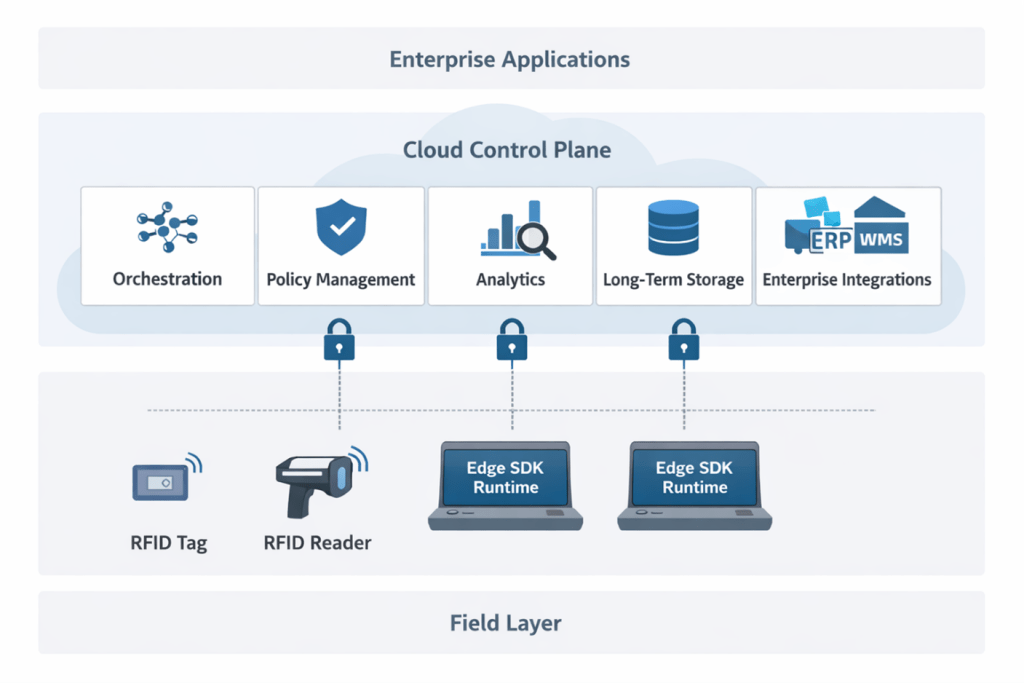
Cloud-based RFID Edge SDK deployments position the SDK runtime at edge devices while centralizing orchestration, configuration management, analytics, and long-term storage within a managed cloud environment. Edge nodes execute filtering, validation, and local decision logic, then transmit structured events through secure channels.
The overall structure separates field operations from enterprise services. Cloud components handle cross-site visibility, policy distribution, historical analytics, and enterprise integrations. Security boundaries isolate device networks, cloud ingestion endpoints, and downstream applications. Scalability is achieved through elastic compute and storage, enabling seasonal or event-driven workload surges.
Operational responsibility is shared, with site teams managing physical devices while central IT governs policies, updates, and access controls.
Non-Cloud Architecture Model
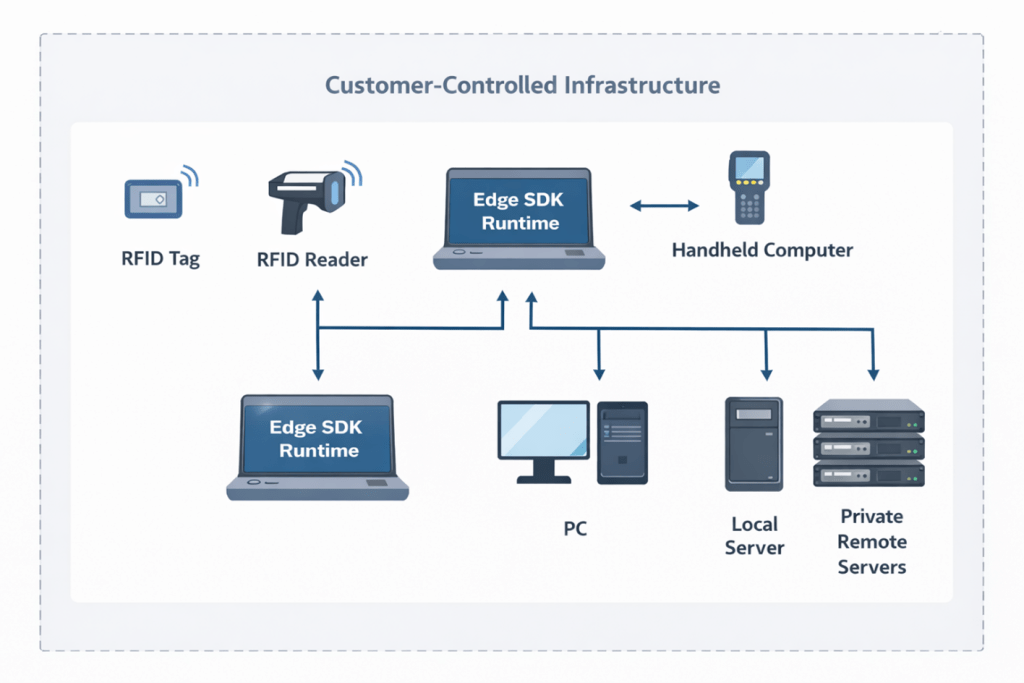
Non-cloud deployments execute RFID Edge SDK entirely within customer-controlled infrastructure. The SDK may run on handheld computers for mobile workflows, industrial PCs for workstation-centric processes, local servers for site-level aggregation, or remote private servers for centralized but non-cloud environments.
Data flow remains fully internal, with RFID events processed, stored, and consumed within controlled network domains. Security boundaries align with existing IT segmentation, and scalability is achieved through horizontal expansion of local resources. Operational ownership resides with the customer, enabling strict compliance with data residency, latency, and air-gap requirements.
Cloud vs Non-Cloud RFID Edge SDK Comparison
| Aspect | Cloud-Based RFID Edge SDK | Non-Cloud RFID Edge SDK |
| Deployment Scope | Multi-site, centralized governance | Single site or controlled domain |
| Infrastructure Ownership | Cloud provider managed | Customer-owned infrastructure |
| Latency Profile | Network-dependent, acceptable for analytics | Deterministic, real-time |
| Data Residency | Regional controls | Fully local or private |
| Typical Selection Criteria | Enterprise visibility, scalability | Compliance, autonomy, low latency |
| Common Scenarios | Distributed operations, analytics-heavy | Regulated facilities, offline workflows |
| Handheld Execution | Edge capture with cloud sync | Fully local mobile processing |
| PC-Based Execution | Thin edge client | Primary execution environment |
| Local Server Use | Edge aggregation | Central processing node |
| Remote Server Use | Cloud alternative | Private centralized control |
Cloud Integration and Data Management
RFID Edge SDK manages the RFID data lifecycle from ingestion through archival under explicit governance controls. Data ingestion pipelines validate, normalize, and enrich events before processing. Policy-driven routing determines whether data is retained locally, forwarded to analytics services, or integrated into enterprise platforms.
Processing layers apply aggregation, exception detection, and correlation logic. Storage strategies separate operational datasets from historical records, aligning retention policies with compliance mandates. Analytics services consume curated datasets rather than raw RFID reads, improving signal quality.
Integration interfaces support ERP, WMS, CMMS, and compliance systems using controlled APIs. Security controls include encryption, role-based access, audit logging, and configuration immutability. Access governance ensures separation of duties between operators, administrators, and auditors.
Major Components of RFID Edge SDK Architecture
- RFID Credentials
RFID credentials represent uniquely encoded identifiers bound to physical assets or entities. Selection considerations include memory structure, durability, and lifecycle management constraints.
- RFID Readers
Readers act as interrogation endpoints responsible for signal acquisition and preliminary filtering. Operational roles include zone enforcement and read quality management.
- Edge Devices
Edge devices host the SDK runtime, executing business logic close to operations. Constraints include compute capacity, power stability, and environmental conditions.
- Middleware Runtime
The SDK middleware enforces policies, data contracts, and exception handling. Selection depends on extensibility and lifecycle support.
- Cloud Platforms
Cloud platforms provide centralized orchestration, analytics, and integration services. Constraints include compliance and network reliability.
- Local and Remote Servers
Servers aggregate, persist, and distribute RFID data in non-cloud models. Considerations include redundancy and administrative overhead.
- Databases
Databases store structured RFID events under retention and performance constraints.
- Dashboards and Reporting Tools
Dashboards present operational and compliance views tailored to role-specific requirements.
RFID Technologies Supported by RFID Edge SDK
- UHF RFID
UHF systems emphasize long read ranges and high tag density handling, suitable for distributed environments requiring rapid interrogation.
- HF RFID
HF systems provide controlled proximity reads and stable performance in environments with electromagnetic interference.
- NFC
NFC supports intentional, user-mediated interactions with short read distances and device interoperability.
- LF RFID
LF systems operate reliably near metal and liquids with short read ranges and low data rates.
RFID Technology Comparison for RFID Edge SDK
| Technology | Primary Role within RFID Edge SDK | Deployment Preference | Decision Drivers |
| UHF | High-volume asset flow capture | Warehouses, yards | Throughput, range |
| HF | Controlled process checkpoints | Manufacturing, labs | Precision |
| NFC | Operator-initiated workflows | Access points | Intentional interaction |
| LF | Harsh environments | Industrial sites | Stability |
Combining Multiple RFID Technologies
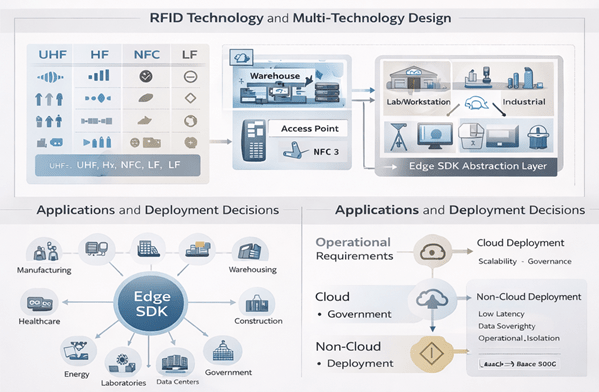
Combining multiple RFID technologies is appropriate when operational zones impose conflicting requirements. RFID Edge SDK enables abstraction layers that harmonize heterogeneous inputs into unified workflows. Architectural benefits include optimized performance per zone and reduced compromise. Trade-offs include increased system complexity, testing overhead, and governance demands. GAO recommends multi-technology architectures only when justified by measurable operational constraints.
Applications of Edge SDK using RFID Technologies
- Industrial asset lifecycle control managing serialized tools, calibration states, and custody transfers across production cells
- Warehouse execution validation enforcing pick, pack, and ship confirmations tied to operator credentials and dock zones
- Healthcare equipment utilization tracking monitoring mobile devices, sterilization cycles, and departmental allocation
- Construction material accountability correlating tagged materials with work orders, crews, and site zones
- Aviation ground support equipment tracking controlling movement, maintenance status, and apron access
- Energy infrastructure inspection workflows validating technician presence and asset interaction sequences
- Laboratory sample chain-of-custody enforcement aligning specimen movement with compliance protocols
- Data center asset governance tracking rack-level hardware movements and authorization states
- Government facility access logging integrating personnel badges with secured asset zones
- Retail backroom inventory verification synchronizing store operations with central planning systems
Deployment Options for RFID Edge SDK
Cloud Deployment Considerations
Cloud deployments suit organizations prioritizing centralized governance, analytics, and cross-site coordination. Advantages include scalable visibility, simplified updates, and consolidated compliance reporting. Regulatory acceptance and network reliability remain key decision factors.
Non-Cloud Deployment Considerations
Non-cloud deployments are selected when data sovereignty, latency determinism, or operational isolation is mandatory. Handheld-based deployments support mobile workflows, PC-based deployments suit workstation processes, local servers enable site aggregation, and remote private servers provide centralized control without public cloud exposure.
GAO supports all deployment models, enabling enterprises to align RFID Edge SDK adoption with organizational, regulatory, and operational realities rather than vendor-imposed constraints. Throughout these deployments, GAO applies decades of enterprise delivery experience across North America, supporting regulated industries, large-scale operations, and long-lived infrastructure investments through disciplined engineering, quality assurance, and expert support.
Case Studies of Edge SDK using RFID Technologies
U.S. Case Studies
Manufacturing Asset Traceability in Detroit, Michigan
- Problem
A multi-line automotive manufacturing facility in Detroit experienced inconsistent asset traceability across stamping, welding, and final assembly zones. Tooling and returnable containers were frequently misplaced, causing line stoppages averaging 22 minutes per incident. Existing barcode-based tracking failed under oil residue and high-speed workflows.
- Solution
GAO supported deployment of RFID Edge SDK using UHF RFID technologies. The SDK was executed on local servers within the plant network to ensure deterministic latency. Edge logic filtered redundant reads and enforced zone-based asset state transitions before synchronizing summarized events to a cloud analytics layer for corporate visibility.
- Result
Unplanned line stoppages related to missing assets dropped by 47 percent within six months.
Lesson learned: Local processing reduced latency risk, but required disciplined configuration management across shifts.
Hospital Equipment Utilization in Boston, Massachusetts
- Problem
A large urban hospital in Boston lacked accurate visibility into mobile medical equipment usage, leading to over-purchasing and delayed procedures. Manual audits consumed clinical staff time and produced inconsistent results, raising compliance concerns.
- Solution
RFID Edge SDK using HF and NFC RFID technologies was deployed. The SDK ran on a combination of handheld computers for ward-level audits and a remote private server for centralized reporting. GAO assisted with policy configuration to distinguish patient-care zones from storage areas.
- Result
Equipment utilization accuracy improved from an estimated 62 percent to 91 percent.
Trade-off observed: HF proximity controls improved accuracy but required more reader placement planning.
Distribution Center Inventory Control in Dallas, Texas
- Problem
A regional distribution center serving consumer goods retailers in Dallas struggled with inventory discrepancies exceeding acceptable audit thresholds. Network outages periodically halted centralized tracking systems.
- Solution
GAO implemented RFID Edge SDK using UHF RFID technologies with execution on industrial PCs at dock doors. Non-cloud deployment allowed continued operation during network interruptions, while batch synchronization occurred when connectivity was restored.
- Result
Inventory variance was reduced by 38 percent during the first annual audit cycle.
Operational note: Offline survivability required additional local storage governance.
Government Records Management in Sacramento, California
- Problem
A state-level records facility in Sacramento required verifiable chain-of-custody tracking for sensitive physical files. Regulatory requirements prohibited use of public cloud services.
- Solution
RFID Edge SDK using HF RFID technologies was deployed entirely on a local server within a segmented government network. The SDK enforced role-based access logging and immutable event records. GAO supported validation against internal audit criteria.
- Result
Audit exceptions related to physical file movement decreased to zero during the subsequent compliance review.
Constraint acknowledged: Scalability depended on internal infrastructure capacity planning.
Airport Ground Equipment Tracking in Phoenix, Arizona
- Problem
An airport operations authority in Phoenix lacked real-time awareness of ground support equipment locations, contributing to delayed gate turnarounds during peak hours.
- Solution
GAO enabled RFID Edge SDK using UHF RFID technologies with a hybrid architecture. Edge processing occurred on local servers near airside zones, while aggregated metrics were sent to a cloud environment for performance analysis.
- Result
Average gate turnaround time improved by 14 percent during high-traffic periods.
Trade-off: RF tuning required coordination with airport safety regulations.
Pharmaceutical Warehouse Compliance in Newark, New Jersey
- Problem
A pharmaceutical distribution site near Newark faced challenges meeting serialized product handling requirements under federal regulations. Manual logs increased error risk.
- Solution
RFID Edge SDK using HF RFID technologies was deployed on a local server to enforce controlled scan points. Cloud access was restricted to compliance reporting only. GAO assisted with validation documentation.
- Result
Regulatory audit preparation time was reduced by 31 percent.
Limitation: Controlled read zones constrained throughput in peak receiving windows.
University Research Lab Asset Control in Palo Alto, California
- Problem
A research laboratory supporting federally funded projects required accurate tracking of shared instrumentation to support grant reporting and cost allocation.
- Solution
GAO supported RFID Edge SDK using NFC and HF RFID technologies, running on PCs within lab networks. Cloud synchronization was used only for consolidated reporting across departments.
- Result
Discrepancies in asset usage logs declined by 44 percent.
Lesson learned: User adoption improved when NFC workflows aligned with existing access badges.
Oil and Gas Maintenance Operations in Houston, Texas
- Problem
Field maintenance teams in Houston lacked reliable verification of tool calibration and job-site presence, increasing operational risk.
- Solution
RFID Edge SDK using LF and HF RFID technologies was deployed on rugged handheld computers. Non-cloud execution ensured operation in low-connectivity environments. GAO assisted with offline policy enforcement.
- Result
Non-compliant tool usage incidents were reduced by 52 percent.
Trade-off: LF read range limitations required disciplined scanning procedures.
Retail Backroom Accuracy in Chicago, Illinois
- Problem
A multi-store retail operation in Chicago faced frequent stock mismatches between backroom inventory and point-of-sale systems, affecting replenishment.
- Solution
GAO enabled RFID Edge SDK using UHF RFID technologies with cloud-based aggregation. Edge filtering on PCs reduced false positives before transmission.
- Result
Backroom inventory accuracy increased from 78 percent to 93 percent.
Constraint: Cloud dependency required network redundancy planning.
Logistics Hub Yard Management in Memphis, Tennessee
- Problem
A logistics hub in Memphis lacked reliable tracking of trailers and containers across yard zones, causing dispatch delays.
- Solution
RFID Edge SDK using UHF RFID technologies was deployed on local servers for yard operations, with cloud dashboards for regional managers. GAO supported phased rollout to minimize disruption.
- Result
Trailer search time decreased by 41 percent.
Operational note: Weather-resistant tag selection proved critical.
Data Center Asset Governance in Ashburn, Virginia
- Problem
A hyperscale data center campus required precise tracking of server movements to maintain security and audit compliance.
- Solution
GAO implemented RFID Edge SDK using HF RFID technologies on local servers within secured network segments. Cloud integration was excluded due to policy constraints.
- Result
Unauthorized asset movement incidents dropped by 36 percent.
Trade-off: Expansion required upfront infrastructure provisioning.
Food Processing Plant Hygiene Control in Fresno, California
- Problem
A food processing facility in Fresno needed verification that sanitation equipment followed mandated cleaning cycles.
- Solution
RFID Edge SDK using LF RFID technologies was deployed on PCs near sanitation zones. Non-cloud deployment ensured compliance with internal IT policies.
- Result
Missed sanitation events declined by 29 percent.
Lesson learned: LF reliability benefited wet environments but limited read speed.
Municipal Fleet Management in Columbus, Ohio
- Problem
A city fleet department in Columbus lacked accurate tracking of specialized vehicles and equipment usage across departments.
- Solution
GAO supported RFID Edge SDK using UHF RFID technologies with execution on a remote private server managed by the municipality. Handheld computers supported field verification.
- Result
Fleet utilization reporting accuracy improved by 33 percent.
Constraint: Training was required to standardize handheld usage.
Defense Logistics Storage in San Antonio, Texas
- Problem
A defense-related storage facility in San Antonio required controlled asset tracking under strict data isolation policies.
- Solution
RFID Edge SDK using HF RFID technologies was deployed entirely on local servers. GAO assisted with security boundary validation and documentation.
- Result
Asset reconciliation time during inspections decreased by 27 percent.
Trade-off: System updates required scheduled maintenance windows.
Canadian Case Studies
Aerospace Component Tracking in Montreal, Quebec
- Problem
An aerospace manufacturing site in Montreal required serialized component traceability across controlled assembly stages.
- Solution
GAO enabled RFID Edge SDK using HF and UHF RFID technologies. Local server execution supported deterministic processing, while cloud analytics supported program-level reporting.
- Result
Traceability gaps identified during audits were reduced by 46 percent.
Lesson learned: Multi-technology environments required disciplined governance.
Healthcare Linen Management in Toronto, Ontario
- Problem
A hospital network in Toronto experienced linen shortages and unexplained losses across multiple facilities.
- Solution
RFID Edge SDK using UHF RFID technologies was deployed with cloud aggregation. Edge processing occurred on PCs within laundry facilities. GAO supported rollout and tuning.
- Result
Linen loss rates declined by 34 percent within one year.
Constraint: Tag durability influenced replacement cycles.
Mining Equipment Accountability in Sudbury, Ontario
- Problem
A mining operation near Sudbury lacked reliable tracking of underground equipment due to harsh environmental conditions.
- Solution
GAO supported RFID Edge SDK using LF RFID technologies deployed on handheld computers. Non-cloud execution ensured operation in isolated environments.
- Result
Equipment retrieval delays decreased by 39 percent.
Trade-off: Short read ranges required procedural enforcement.
University Library Asset Control in Vancouver, British Columbia
- Problem
A research library in Vancouver needed improved tracking of special collections without disrupting patron workflows.
- Solution
RFID Edge SDK using HF RFID technologies was deployed on local servers. Limited cloud reporting supported administrative oversight. GAO assisted with integration planning.
- Result
Mis-shelved item incidents declined by 28 percent.
Lesson learned: Reader placement influenced user experience.
Provincial Infrastructure Maintenance in Edmonton, Alberta
- Problem
A provincial agency in Edmonton required verification of maintenance activities across distributed infrastructure assets.
- Solution
GAO enabled RFID Edge SDK using NFC and HF RFID technologies on handheld computers with synchronization to a remote private server.
- Result
Maintenance record completeness increased by 42 percent.
Constraint: Field conditions required ruggedized devices.
These case studies reflect GAO’s experience delivering Edge SDK using RFID technologies across diverse operational, regulatory, and geographic contexts, supporting organizations in the United States and Canada through disciplined engineering, deployment flexibility, and long-term system support.
Our products and systems have been developed and deployed for a wide range of industrial applications. They are available off-the-shelf or can be customized to meet your needs. If you have any questions, our technical experts can help you.
For any further information on GAO’s products and systems, to request evaluation kits, free samples, recorded video demos, or explore partnership opportunities, please fill out this form or email us.