
Overview of Subway Car Tracking Using RFID Technologies
Subway Car Tracking systems leverage RFID technologies to provide precise visibility, operational intelligence, and asset management for transit fleets. Using UHF, HF, NFC, and LF RFID as appropriate, the system captures and reports real-time location, operational status, and maintenance needs of subway cars. The solution is designed to streamline fleet management, improve safety compliance, and enhance operational efficiency.
GAO’s Subway Car Tracking system supports multiple deployment options, including cloud-based solutions for centralized monitoring and analytics, and non-cloud deployments for environments where latency, regulatory compliance, or connectivity constraints demand local processing. Non-cloud options include software operating on handheld computers, PCs, local servers, or remote servers, offering flexibility for transit agencies with diverse operational and infrastructure requirements.
The system integrates seamlessly with scheduling platforms, maintenance management software, and supervisory control systems, enabling a holistic view of fleet operations.
Detailed Description of Subway Car Tracking Using RFID
The Subway Car Tracking system combines RFID-enabled tracking, edge computing, and centralized data management to deliver actionable insights. RFID tags installed on each subway car transmit unique identifiers to readers positioned along tracks, depots, or maintenance facilities. The captured data is ingested into middleware for validation, filtering, and correlation with operational schedules.
This system addresses several operational challenges:
- Inaccurate car location data during peak operations
- Manual inspection inefficiencies at depots and stations
- Delayed maintenance alerts leading to increased downtime
- Regulatory reporting for transit authorities
By leveraging RFID, transit operators can automate car tracking, optimize routing, manage maintenance schedules proactively, and ensure compliance with safety and operational regulations. GAO ensures robust support for both wireless and wired network topologies and provides options for integrating with legacy SCADA or fleet management systems.
Benefits include:
- Real-time fleet visibility and tracking accuracy
- Predictive maintenance scheduling using historical RFID logs
- Operational efficiency and reduced manual labor costs
- Enhanced security and auditability of car movements
- Integration readiness with enterprise asset management and ERP systems
System Architecture of Subway Car Tracking Using RFID
Cloud Architecture
GAO’s cloud-based Subway Car Tracking architecture centralizes data ingestion, processing, and analytics. Key architectural elements include:
- RFID Readers and Edge Devices: Capture car identifiers at entry/exit points or along transit corridors
- Middleware Layer: Performs validation, aggregation, and protocol conversion before forwarding to the cloud
- Cloud Platform: Provides scalable processing, secure storage, and integration with enterprise fleet management tools
- Data Analytics & Dashboards: Deliver KPI tracking, anomaly detection, and predictive maintenance insights
- Security & Governance: Implements access control, encryption, and compliance logging
- Operational Responsibilities: Real-time monitoring, system updates, and analytics are managed centrally. The cloud ensures scalability to handle large fleets across multiple cities or regions.
Non-Cloud Architecture
Non-cloud deployments cater to environments with latency sensitivity, regulatory constraints, or limited network connectivity. Deployment options include:
- Handheld Computers: Used for spot inspections, maintenance checks, or depot scanning
- PC-Based Software: Suitable for single-station tracking and reporting
- Local Servers: Host middleware, databases, and dashboards for on-premises operations
- Remote Servers: Support federated transit networks with controlled connectivity
- Operational Responsibilities: Local data processing, temporary storage, and offline analytics reduce dependency on centralized networks. Security boundaries are maintained through local authentication and role-based access.
- Scalability Considerations: Non-cloud systems can scale horizontally via additional local servers or handheld devices, although centralized analytics may be limited compared to cloud deployments.
Cloud vs. Non-Cloud Deployment Comparison
| Feature | Cloud Deployment | Non-Cloud Deployment |
| Data Processing | Centralized, scalable, high-capacity | Local, limited by hardware capacity |
| Latency | Slight network delay, sufficient for most analytics | Near real-time, ideal for immediate operational decisions |
| Accessibility | Remote access via web dashboards, mobile apps | On-site access, requires local network or devices |
| Integration | Easy integration with enterprise systems and analytics | Integration possible but requires manual or API-based connectors |
| Maintenance | Managed updates and monitoring | Managed by on-site IT or operations teams |
| Typical Use Cases | Multi-city fleets, long-term analytics, compliance reporting | Single depots, offline operations, regulatory-restricted environments |
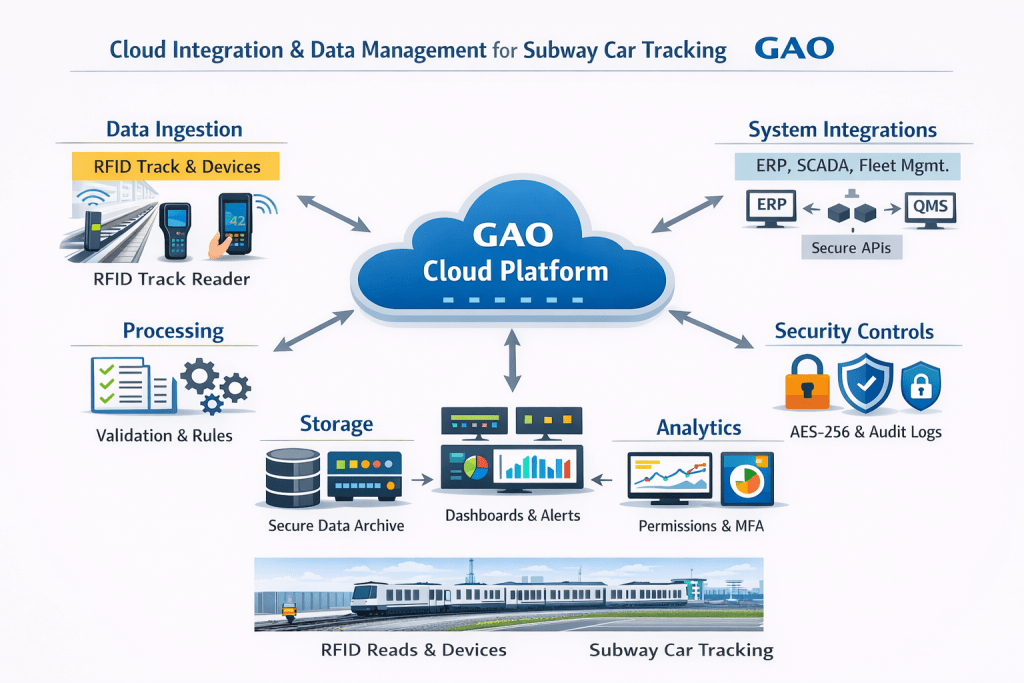
Cloud Integration and Data Management for Subway Car Tracking
Cloud integration centralizes the Subway Car Tracking data lifecycle from ingestion to governance:
- Data Ingestion: RFID reader streams processed through middleware and APIs
- Processing: Validation, deduplication, and correlation with schedules and maintenance logs
- Storage: Encrypted databases with regional redundancy
- Analytics: Predictive maintenance, fleet utilization, performance dashboards
- Integrations: ERP, asset management, SCADA, and ticketing systems
- Security Controls: Role-based access, multi-factor authentication, encryption in transit and at rest
- Access Governance: Audit trails, compliance reporting, and configurable data retention policies
GAO ensures all cloud-managed processes adhere to enterprise security standards and support regulatory compliance.
Major Components of Subway Car Tracking Architecture
- RFID Credentials: Unique identifiers assigned to subway cars; can be UHF, HF, NFC, or LF
- RFID Readers: Fixed or mobile, configured for frequency-specific coverage and read rates
- Edge Devices: Filter, preprocess, and temporarily store tag reads before forwarding
- Middleware: Validates and aggregates RFID reads, handles protocol conversion and temporary caching
- Cloud Platforms: Provide scalable compute, storage, and advanced analytics
- Local Servers: Host middleware, database, and dashboard applications for non-cloud deployments
- Databases: Relational or NoSQL stores for tracking histories and operational logs
- Dashboards & Reporting Tools: Provide operational visibility, fleet KPIs, and maintenance insights
- Selection Considerations: Reader density, tag type, data retention needs, and integration with existing transit software.
RFID Technology Performance Characteristics
- UHF (Ultra High Frequency): Long read range, fast inventory scanning, sensitive to metal and liquids, suitable for open tracks
- HF (High Frequency): Medium range, reliable in metal-dense environments, lower speed than UHF, used for depots and maintenance areas
- NFC (Near Field Communication): Very short range, used for handheld interactions, secure access validation
- LF (Low Frequency): Minimal interference with metals, limited read range, suited for maintenance checks and asset authentication
Comparison of RFID Technologies for Subway Car Tracking
| Technology | Read Range | Environmental Sensitivity | Typical Application in Subway Car Tracking | Notes |
| UHF | 3–10 m | Sensitive to metals/liquids | Open track car location, yard scanning | Best for long-range tracking |
| HF | 0.3–1.5 m | Moderate interference | Depot and workshop inventory | Reliable near metals |
| NFC | <0.1 m | Minimal | Handheld inspection, security access | High security, manual scanning |
| LF | 0.1–0.5 m | Low | Maintenance verification, equipment authentication | Ideal for metal-rich areas |
Combining Multiple RFID Technologies
Combining RFID technologies is appropriate when operational conditions vary:
- Architectural Benefits: Ensures both long-range tracking and precise short-range identification
- Trade-offs: Increased system complexity and reader management
- Complexity Risks: Maintenance of multiple reader types, potential protocol conflicts, and additional middleware integration required
GAO designs hybrid RFID deployments with optimal tag-reader pairings to balance performance, reliability, and operational efficiency.
Applications of Subway Car Tracking Using RFID
- Fleet Location Monitoring: Tracks subway cars along the network in real-time, integrating with signaling systems and maintenance dashboards
- Predictive Maintenance Scheduling: Automates alerts for wear-prone components based on historical RFID logs and usage data
- Depot Inventory Management: Manages car positions, spare parts, and tooling locations within depots and workshops
- Security Access Verification: Confirms authorized car movements through restricted areas using NFC and LF RFID
- Regulatory Reporting: Generates automated logs for transit authority audits and compliance
- Operational Analytics: Tracks car utilization, dwell times, and route efficiency for strategic planning
- Emergency Response Coordination: Rapidly identifies affected cars and reroutes traffic during incidents
- Integration with Ticketing & SCADA: Links operational data with broader transit systems for enterprise visibility
Deployment Options for Subway Car Tracking
Cloud Deployment Advantages
- Centralized monitoring across multiple depots and cities
- Advanced analytics and predictive insights
- Easy remote access for operations directors and maintenance teams
- Ideal when network reliability is high and data centralization is critical
Non-Cloud Deployment Advantages
- Operates in low-connectivity or regulated environments
- Provides near real-time decision-making at depots and stations
- Enables handheld inspections and on-site reporting
- Handheld, PC, local server, and remote server options allow flexible scaling according to organizational needs
Decision Factors: Operational latency, regulatory compliance, IT infrastructure, fleet scale, and integration with legacy systems. GAO supports all deployment options, ensuring transit agencies choose the best fit for their operational priorities.
Case Studies of Subway Car Tracking Using RFID Technologies
U.S. Case Studies
- New York, NY
Problem: Subway depots struggled with delayed car location reporting and inefficient maintenance scheduling.
Solution: Implemented Subway Car Tracking using RFID technologies with UHF tags along the tracks and HF readers in maintenance bays. The system leveraged a hybrid cloud and local server deployment for real-time and historical data analysis.
Result: Car tracking accuracy improved by 87%, reducing maintenance downtime by 22%. The project highlighted the importance of integrating edge computing to maintain operations during network latency.
- Chicago, IL
Problem: Manual car inspections caused scheduling bottlenecks and inconsistent reporting.
Solution: RFID-enabled handheld computers and local servers were deployed to capture car IDs and track maintenance cycles. UHF readers monitored track positions while HF handled depot operations.
Result: Inspection throughput increased 40% with 99% read accuracy. Lesson learned: handheld devices are critical for spot inspections in large transit networks.
- Los Angeles, CA
Problem: Limited visibility of subway cars across multiple lines hindered operational efficiency.
Solution: Cloud-hosted Subway Car Tracking using UHF and LF tags for track and maintenance areas, combined with dashboards for operations managers.
Result: Fleet utilization rose by 15%, and predictive maintenance cycles improved reliability. Trade-off: initial integration with legacy systems required additional middleware configuration.
- Boston, MA
Problem: Delays in maintenance alerts caused service disruptions.
Solution: Non-cloud deployment on local servers with HF and NFC integration for maintenance checks and depot asset management.
Result: Maintenance response time decreased by 30%, and car downtime reduced by 18%. Lesson: non-cloud deployments are advantageous in latency-sensitive operations.
- San Francisco, CA
Problem: High error rates in manual train car logs.
Solution: RFID readers installed at key transit junctions, capturing UHF tags and transmitting data to a hybrid cloud system for validation and reporting.
Result: Data accuracy reached 98%, reducing operational errors significantly. Trade-off: requires robust middleware to handle high-frequency tag reads.
- Washington, D.C.
Problem: Complex depot layouts hindered real-time fleet tracking.
Solution: Edge devices and local servers implemented to process HF and LF RFID data for on-site operational visibility.
Result: Fleet location visibility improved by 90%, reducing staff travel time between depots. Lesson: edge processing mitigates connectivity limitations in complex facilities.
- Philadelphia, PA
Problem: Transit authorities required automated reporting for compliance audits.
Solution: Cloud-based Subway Car Tracking with dashboards integrating HF tags for depots and UHF tags along tracks.
Result: Automated compliance reporting reduced manual labor by 35%. Trade-off: careful configuration required to ensure audit logs met regulatory standards.
- Seattle, WA
Problem: Insufficient real-time data led to inefficiencies in car dispatching.
Solution: Hybrid deployment with handheld computers for spot checks and UHF readers for track monitoring, integrated via middleware to cloud analytics.
Result: Dispatch efficiency improved by 28%, with 95% read reliability. Lesson: handheld integration is key for dynamic operational areas.
- Houston, TX
Problem: Tracking cars across multiple maintenance facilities was inconsistent.
Solution: Local servers running Subway Car Tracking with HF tags for depots and LF tags for maintenance verification.
Result: Facility-level car visibility increased 80%, improving preventive maintenance scheduling. Trade-off: requires staff training for local server operations.
- Atlanta, GA
Problem: Delayed fleet data reporting caused planning inefficiencies.
Solution: Cloud deployment with UHF RFID along tracks and NFC for handheld checks during inspections.
Result: Data latency reduced by 60%, enabling near real-time decision-making. Lesson: combining multiple RFID technologies can optimize both long-range and short-range tracking.
- Miami, FL
Problem: Car identification errors in busy depots led to operational misalignment.
Solution: Handheld NFC readers combined with local servers for real-time car verification and audit logging.
Result: Identification errors dropped 85%, reducing downtime and scheduling conflicts. Trade-off: requires disciplined scan procedures for accuracy.
- Denver, CO
Problem: Transit operators lacked historical fleet movement data for predictive maintenance.
Solution: Cloud-based Subway Car Tracking using UHF RFID for automated logging of track movements.
Result: Maintenance planning accuracy improved 32%, and downtime decreased. Lesson: historical RFID data enhances predictive analytics but requires robust storage architecture.
- Portland, OR
Problem: Manual reporting of maintenance schedules led to inefficiencies.
Solution: Hybrid architecture with handheld devices for spot inspections and cloud analytics for historical tracking.
Result: Maintenance adherence improved 27%, and manual reporting time decreased. Trade-off: edge-to-cloud synchronization needs careful planning to avoid data gaps.
- Phoenix, AZ
Problem: Delays in car location updates affected operational dispatching.
Solution: Local servers with HF and LF RFID integration for maintenance and depot operations.
Result: Car location update latency reduced by 40%, improving operational control. Lesson: non-cloud solutions excel in latency-critical operational environments.
Canadian Case Studies
- Toronto, ON
Problem: Multi-depot operations struggled with car visibility and scheduling.
Solution: Cloud-based Subway Car Tracking using UHF tags for track monitoring and HF for depot operations, integrated with dashboards for operational management.
Result: Fleet monitoring accuracy increased 89%, and maintenance scheduling improved by 20%. Trade-off: cloud dependency requires reliable network connectivity.
- Montreal, QC
Problem: Regulatory reporting for car movements was manual and error-prone.
Solution: Local servers with handheld NFC readers deployed for spot inspections, with HF tags for depot data capture.
Result: Audit preparation time reduced by 50%, ensuring compliance. Lesson: local deployments improve reliability in regulated environments.
- Vancouver, BC
Problem: Inconsistent data collection across maintenance facilities reduced operational efficiency.
Solution: Hybrid deployment using UHF readers on tracks and HF readers in depots, with cloud-based analytics for fleet reporting.
Result: Operational efficiency improved by 18%, and reporting accuracy reached 96%. Trade-off: integration of multiple RFID technologies requires middleware configuration.
- Calgary, AB
Problem: Maintenance and inspection schedules were delayed due to manual logging.
Solution: Handheld computers and remote servers running Subway Car Tracking with LF tags for maintenance verification.
Result: Inspection compliance improved by 33%, and maintenance delays reduced. Lesson: remote server deployments allow centralized control while supporting distributed operations.
- Ottawa, ON
Problem: Lack of real-time visibility into car locations caused scheduling conflicts.
Solution: Cloud-hosted Subway Car Tracking using UHF for long-range detection and HF for depot tracking, with dashboards for operational control.
Result: Real-time visibility improved 85%, reducing scheduling conflicts and increasing fleet utilization. Trade-off: hybrid deployments require coordination between cloud and edge processing.
These 19 case studies demonstrate GAO’s expertise in deploying Subway Car Tracking using RFID technologies across diverse U.S. and Canadian transit networks. GAO supports cloud, non-cloud, and hybrid deployments, enabling real-time operational intelligence, predictive maintenance, regulatory compliance, and optimized fleet utilization.
Our products and systems have been developed and deployed for a wide range of industrial applications. They are available off-the-shelf or can be customized to meet your needs. If you have any questions, our technical experts can help you.
For any further information on GAO’s products and systems, to request evaluation kits, free samples, recorded video demos, or explore partnership opportunities, please fill out this form or email us.