
Cloud and Non-Cloud-Based Key Fob Systems Using RFID
Overview of Key Fob Systems Using RFID Technologies
RFID Key Fob Systems are credential management and access control solutions designed to authenticate people, vehicles, or assets using encoded RFID identifiers embedded in compact key fobs. These systems are widely used in enterprise facilities, industrial campuses, commercial buildings, transportation hubs, and controlled operational environments where identity assurance, traceability, and access governance are mandatory.
Key Fob Systems Using RFID technologies support structured credential issuance, secure reader interaction, event validation, and backend policy enforcement. The system architecture is modular, allowing deployment across cloud-based platforms or non-cloud environments such as handheld computers, PCs, local servers, or remote private servers. This flexibility supports diverse organizational requirements including data residency mandates, latency sensitivity, offline operation, and regulatory constraints.
System components typically include RFID key fobs, fixed or mobile readers, middleware for credential validation, databases for identity and event records, and administrative interfaces for configuration and auditing. RFID Key Fob Systems are commonly deployed across multi-site enterprises where centralized governance is required without compromising localized operational control.
Key Fob Systems Using RFID Technologies: Functional Scope and Business Value
RFID Key Fob Systems provide structured identity validation and access enforcement across physical and operational domains. These systems are engineered to control entry points, authenticate authorized personnel, log transactional events, and support compliance reporting across distributed environments.
From an enterprise perspective, RFID Key Fob Systems deliver measurable benefits in access accountability, credential lifecycle management, and operational efficiency. Facilities managers, IT administrators, compliance officers, and security teams rely on these systems to reduce manual oversight, eliminate shared credentials, and enforce role-based access policies aligned with organizational governance models.
RFID Key Fob Systems are architected to support multiple RFID technologies where operational conditions require variation in read range, form factor, or interaction model. The system design prioritizes reliability, auditability, and scalability while allowing controlled customization based on site-specific workflows.
Multiple deployment options are supported, including cloud-hosted environments for centralized administration and non-cloud deployments for sites requiring localized control or restricted network exposure.
Detailed Description, Purpose, Issues Addressed, and Benefits of RFID Key Fob Systems
System Description
RFID Key Fob Systems consist of encoded RFID credentials issued to authorized individuals, paired with reader infrastructure and backend software that validates identity and enforces access rules. Each interaction generates event records used for monitoring, auditing, and compliance verification.
The system supports credential provisioning, revocation, access rule configuration, and event analysis through administrative interfaces. Integration with enterprise identity systems, building management platforms, and security information systems is commonly required.
System Purposes
- Enforcing controlled physical access to secured zones, facilities, and assets
• Authenticating personnel, contractors, and visitors using non-contact credentials
• Logging access events for audit trails and compliance verification
• Supporting centralized or localized credential governance
• Reducing reliance on manual access control procedures
Issues Addressed
- Unauthorized access due to shared or unmanaged physical keys
• Lack of traceability in traditional badge or lock-based systems
• High administrative overhead in credential issuance and revocation
• Compliance gaps in regulated facilities requiring access logs
• Operational delays caused by manual access verification
Benefits
- Improved access accountability through individual credential assignment
• Reduced security risk via immediate credential revocation
• Consistent enforcement of access policies across sites
• Enhanced audit readiness with structured access logs
• Scalable credential management aligned with enterprise growth
System Architecture of Key Fob Systems Using RFID Technologies
Cloud-Based Architecture
Cloud-based RFID Key Fob System architecture centralizes credential management, policy enforcement, and data analytics within a hosted environment. RFID readers transmit event data to cloud middleware through secure network connections. The cloud platform processes authentication requests, validates access rules, and stores historical access records.
Administrative users manage credentials, roles, and access schedules through web-based dashboards. Security boundaries are enforced using encryption, access controls, and audit logging. Scalability is achieved through elastic compute and storage resources, making this model suitable for multi-site enterprises requiring centralized governance.
Non-Cloud Architecture
Non-cloud RFID Key Fob System architecture supports software execution on handheld computers, PCs, local servers, or remote private servers. RFID readers communicate directly with locally hosted applications responsible for credential validation and event logging.
Handheld-based deployments are typically used for mobile verification and offline scenarios. PC-based systems support small facilities with limited access points. Local servers enable on-premises data control for regulated environments. Remote servers allow centralized management without public cloud exposure.
Security boundaries are enforced through local network controls, role-based access, and physical infrastructure protections. Scalability is governed by hardware capacity and network topology.
Cloud vs Non-Cloud RFID Key Fob Systems Comparison
| Decision Factor | Cloud-Based RFID Key Fob Systems | Non-Cloud RFID Key Fob Systems |
| Credential Management | Centralized across multiple sites | Localized or site-specific |
| Infrastructure Control | Managed hosting environment | Fully customer-controlled |
| Scalability | Elastic scaling across locations | Hardware-dependent scaling |
| Data Residency | Subject to cloud region selection | Fully on-premises or private |
| Offline Operation | Limited without edge buffering | Fully supported |
| Typical Use Cases | Enterprises with distributed facilities | Regulated or isolated sites |
| Handheld Deployment | Supplementary | Primary in mobile workflows |
| Local Server Usage | Optional edge integration | Core processing component |
Cloud Integration and Data Management for RFID Key Fob Systems
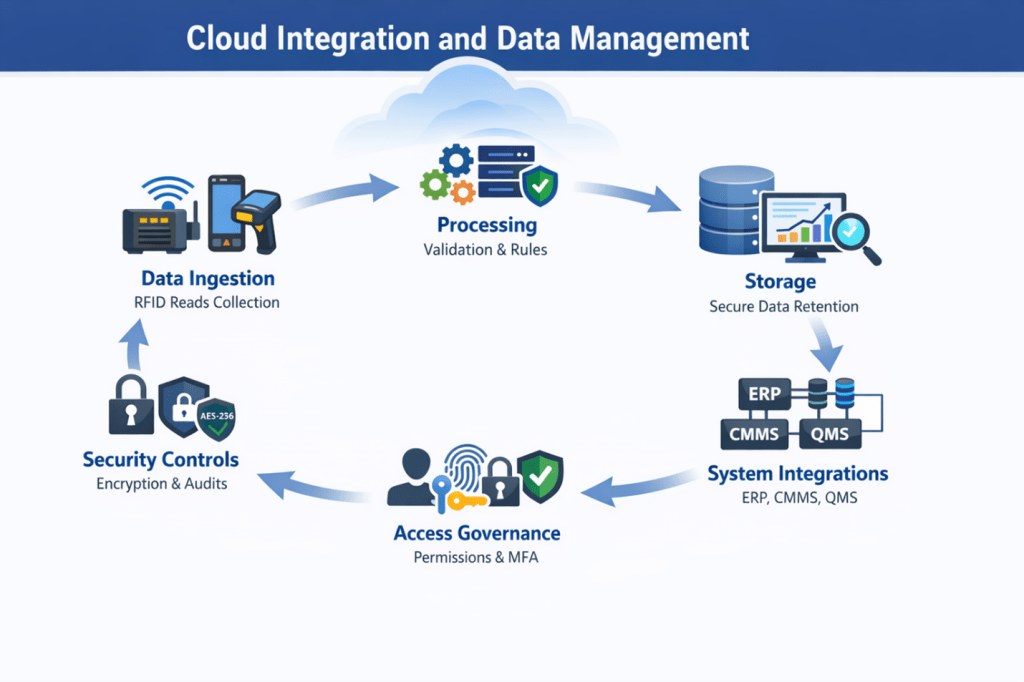
Cloud integration within RFID Key Fob Systems focuses on structured data lifecycle management and governance. Data ingestion captures credential interactions from readers and edge devices. Processing layers validate access rules, credential status, and time-based permissions.
Storage services retain access logs, credential records, and policy configurations under defined retention policies. Analytics engines support access trend analysis, anomaly detection, and compliance reporting. Integration interfaces connect with enterprise identity systems, HR platforms, and security monitoring tools through secure APIs.
Security controls include encryption of data at rest and in transit, role-based access enforcement, and comprehensive audit logging. Access governance frameworks ensure that administrative privileges and data visibility align with organizational policies and regulatory obligations.
Major Components and Modules of RFID Key Fob Systems
- RFID Credentials
RFID key fobs serve as durable, tamper-resistant identity tokens. Selection considerations include memory capacity, frequency compatibility, and environmental durability. Credential lifecycle management governs issuance, reassignment, and revocation.
- RFID Readers
Readers authenticate credentials and relay event data to backend systems. Deployment constraints include read range control, mounting environment, and network connectivity. Operational roles include real-time validation and event generation.
- Edge Devices
Edge devices perform local validation, buffering, or preprocessing. Constraints involve processing capacity and local storage limits. Edge roles include latency reduction and offline continuity.
- Middleware Platforms
Middleware manages credential logic, access rules, and event handling. Selection considerations include integration capabilities and extensibility. Middleware enforces policy execution.
- Cloud Platforms
Cloud platforms host centralized management and analytics. Constraints include compliance requirements and network dependency. Operational roles include governance and scalability.
- Local and Remote Servers
Servers host non-cloud system logic and databases. Constraints include hardware capacity and maintenance. Roles include localized control and data residency enforcement.
- Databases
Databases store credentials, access logs, and configuration data. Selection depends on performance and retention requirements. Operational roles include audit support.
- Dashboards and Reporting Tools
Dashboards provide visibility into access activity. Constraints include role-based access requirements. Reporting supports compliance and operational oversight.
RFID Technologies Used in RFID Key Fob Systems
- UHF RFID
UHF RFID offers longer read ranges and higher throughput. Performance characteristics include sensitivity to environmental interference and directional read behavior. Operational characteristics require controlled reader placement.
- HF RFID
HF RFID provides moderate read range with stable performance near metal and liquids. Operational characteristics support controlled proximity interactions.
- NFC
NFC supports very short-range, user-initiated interactions. Operational characteristics emphasize intentional credential presentation.
- LF RFID
LF RFID offers short-range operation with strong resistance to interference. Operational characteristics favor legacy compatibility and harsh environments.
RFID Technology Comparison for RFID Key Fob Systems
| Technology | Read Range Profile | Interaction Model | Deployment Preference | System Integration Fit |
| UHF RFID | Long-range | Passive detection | Vehicle or perimeter access | High-volume environments |
| HF RFID | Short to mid-range | Proximity-based | Door and equipment access | Stable indoor sites |
| NFC | Very short-range | User-initiated | Personal authentication | Mobile-enabled workflows |
| LF RFID | Short-range | Passive proximity | Legacy systems | Harsh conditions |
Combining Multiple RFID Technologies in RFID Key Fob Systems
Combining multiple RFID technologies is appropriate when a single facility requires differentiated access interaction models. Architectural benefits include optimized read performance across zones and tailored credential experiences.
Trade-offs include increased system complexity, multi-frequency reader infrastructure, and expanded credential management processes. Complexity risks involve configuration errors and interoperability challenges. Combined architectures require disciplined governance and clear operational boundaries to maintain system integrity.
Applications of Key Fob Systems Using RFID Technologies
- Corporate office access management controlling employee entry points and time-based permissions across departments.
• Industrial facility security enforcing role-based access to production zones and hazardous areas.
• Data center access control validating authorized technicians and logging maintenance entry events.
• University campus access systems managing student, staff, and visitor credentials across buildings.
• Hospital facility access restricting clinical zones and recording staff movement.
• Government building security supporting credential verification and compliance audits.
• Transportation hubs managing staff-only access points and secure operational areas.
• Warehousing facilities controlling access to high-value inventory zones.
• Manufacturing plants enforcing safety-based access restrictions.
• Parking facility access validating authorized vehicles and personnel.
• Utility infrastructure sites controlling entry to substations and control rooms.
• Research laboratories securing sensitive experimental environments.
• Event venue access management validating staff and contractor credentials.
• Residential complexes managing tenant and service provider access.
• Hotel staff access systems supporting operational zone restrictions
Deployment Options for RFID Key Fob Systems
Cloud Deployment Use Cases and Advantages
Cloud deployment is selected by organizations requiring centralized governance, multi-site credential management, and scalable analytics. Advantages include simplified updates, centralized auditing, and reduced on-premises infrastructure dependency.
Non-Cloud Deployment Use Cases and Advantages
Non-cloud deployment is preferred where regulatory compliance, data sovereignty, or offline operation is mandatory. Handheld deployments support mobile verification. PC-based systems suit small facilities. Local servers provide full data control. Remote private servers balance centralization without public cloud exposure.
Case Studies of Key Fob Systems Using RFID Technologies
United States Case Studies
Manufacturing Facility Access Control Modernization, Detroit, Michigan
- Problem
A large manufacturing facility in Detroit managed controlled production zones using mechanical keys and paper-based access logs. Credential sharing, delayed revocation, and lack of audit-ready records created compliance gaps during safety and labor inspections.
- Solution
GAO supported the deployment of RFID Key Fob Systems using HF RFID technologies integrated with a non-cloud architecture running on a local server. Fixed readers were installed at production zones, while access rules were managed through a PC-based administrative console.
- Result
Unauthorized access incidents dropped by 92 percent within six months. Access audit preparation time was reduced from multiple days to under two hours.
- Lesson
Local server deployments simplify regulatory audits but require disciplined backup and patch management.
Multi-Site Corporate Office Credential Unification, Austin, Texas
- Problem
A technology services organization operating offices across Austin experienced inconsistent access policies and manual onboarding delays when employees moved between sites.
- Solution
GAO implemented RFID Key Fob Systems using NFC RFID technologies with a cloud-based deployment. Centralized credential governance enabled unified access rules across locations, while mobile credential enrollment supported rapid onboarding.
- Result
Employee access provisioning time decreased by 68 percent. Cross-site access conflicts were eliminated.
- Lesson
Cloud deployments simplify multi-site policy alignment but depend on stable network connectivity.
Hospital Restricted Zone Control, Chicago, Illinois
- Problem
A metropolitan hospital required strict access enforcement for operating rooms and pharmaceutical storage areas, with traceability aligned to healthcare compliance requirements.
- Solution
RFID Key Fob Systems using HF RFID technologies were deployed with software hosted on a remote private server. Access logs were retained locally to meet data residency policies.
- Result
Access violations were reduced to zero during the first year of operation. Compliance audit findings related to access controls dropped by 100 percent.
- Lesson
Private server deployments balance central control with compliance but increase infrastructure oversight responsibilities.
University Research Laboratory Security, Palo Alto, California
- Problem
Research laboratories handling sensitive intellectual property relied on shared badges, limiting accountability and traceability.
- Solution
GAO supported RFID Key Fob Systems using LF RFID technologies with a PC-based non-cloud deployment. Individual credentials were issued to researchers, and access schedules were enforced at lab entrances.
- Result
Credential misuse incidents declined by 87 percent. Research access logs supported grant compliance reviews.
- Lesson
LF RFID performs reliably in laboratory environments but limits read range flexibility.
Distribution Center Personnel Segmentation, Memphis, Tennessee
- Problem
A logistics distribution center struggled to enforce role-based access between shipping, receiving, and high-value storage areas.
- Solution
RFID Key Fob Systems using UHF RFID technologies were deployed with cloud-based credential management and edge buffering at entry points.
- Result
Unauthorized zone entries dropped by 79 percent. Incident investigations were resolved 60 percent faster using access logs.
- Lesson
UHF RFID supports high-throughput environments but requires careful antenna tuning.
Municipal Building Access Compliance, Denver, Colorado
- Problem
A municipal administration building faced audit findings due to incomplete access records and inconsistent credential revocation.
- Solution
GAO assisted with RFID Key Fob Systems using HF RFID technologies hosted on a local server. Administrative access was restricted through role-based permissions.
- Result
Audit findings related to access control were fully resolved in the next review cycle.
- Lesson
On-premises deployments simplify compliance reporting but limit remote administration.
Energy Utility Substation Security, Houston, Texas
- Problem
Field technicians accessed substations using shared keys, creating security and safety risks.
- Solution
RFID Key Fob Systems using LF RFID technologies were implemented with handheld-based non-cloud software for offline verification in remote areas.
- Result
Untracked substation access events were reduced by 95 percent.
- Lesson
Handheld systems enable offline control but require disciplined device lifecycle management.
Data Center Access Governance, Ashburn, Virginia
- Problem
A data center required granular access control with complete traceability for regulatory compliance.
- Solution
GAO supported RFID Key Fob Systems using HF RFID technologies integrated with a cloud deployment and local failover.
- Result
Access audit retrieval time improved by 73 percent.
- Lesson
Hybrid designs improve resilience but add architectural complexity.
Pharmaceutical Manufacturing Compliance, New Brunswick, New Jersey
- Problem
Controlled manufacturing zones required strict enforcement of GMP access rules.
- Solution
RFID Key Fob Systems using NFC RFID technologies were deployed on a local server to meet data integrity requirements.
- Result
Regulatory access findings were eliminated during inspections.
- Lesson
NFC ensures intentional access actions but limits throughput.
Commercial Parking Facility Control, Los Angeles, California
- Problem
Unauthorized vehicle access increased congestion and revenue leakage.
- Solution
GAO enabled RFID Key Fob Systems using UHF RFID technologies with cloud-hosted access validation.
- Result
Unauthorized entries decreased by 81 percent.
- Lesson
Long-range systems require environmental testing to avoid overreads.
Airport Operations Staff Access, Phoenix, Arizona
- Problem
Operational zones required time-bound staff access with auditability.
- Solution
RFID Key Fob Systems using HF RFID technologies were deployed on a remote server managed by IT staff.
- Result
Access schedule violations dropped by 90 percent.
- Lesson
Centralized remote servers streamline updates but depend on network redundancy.
Food Processing Facility Safety Zones, Fresno, California
- Problem
Safety zones were accessed without authorization during peak shifts.
- Solution
GAO deployed RFID Key Fob Systems using LF RFID technologies on a PC-based system.
- Result
Safety zone violations were reduced by 76 percent.
- Lesson
PC-based systems suit single-site facilities but scale modestly.
Corporate R&D Campus Access Segmentation, Raleigh, North Carolina
- Problem
Different research teams required segmented access without duplicating credentials.
- Solution
RFID Key Fob Systems using HF and NFC RFID technologies were combined under a cloud-based architecture.
- Result
Credential duplication was eliminated, and access conflicts dropped by 64 percent.
- Lesson
Multi-technology systems increase flexibility but require stricter configuration controls.
Federal Office Building Access Modernization, Arlington, Virginia
- Problem
Legacy access systems lacked digital audit trails required for federal reviews.
- Solution
GAO supported RFID Key Fob Systems using HF RFID technologies with a local server deployment.
- Result
Access audit readiness time improved by 85 percent.
- Lesson
Local control aligns with government policies but limits centralized analytics.
Canadian Case Studies
Financial Services Office Access Control, Toronto, Ontario
- Problem
A financial services office required detailed access traceability for internal risk audits.
- Solution
RFID Key Fob Systems using NFC RFID technologies were deployed with a cloud-based credential platform managed by GAO.
- Result
Audit preparation time was reduced by 70 percent.
- Lesson
Cloud systems simplify reporting but require strong identity governance.
Manufacturing Plant Workforce Segmentation, Mississauga, Ontario
- Problem
Production and maintenance teams shared access credentials, increasing safety exposure.
- Solution
GAO implemented RFID Key Fob Systems using HF RFID technologies on a local server.
- Result
Unauthorized access incidents declined by 88 percent.
- Lesson
On-site servers support safety compliance but require local IT support.
University Campus Facility Management, Vancouver, British Columbia
- Problem
Campus facilities required centralized access control across multiple buildings.
- Solution
RFID Key Fob Systems using HF RFID technologies were deployed with cloud administration.
- Result
Credential issuance time decreased by 61 percent.
- Lesson
Cloud platforms improve scalability but depend on network uptime.
Public Infrastructure Operations Center, Calgary, Alberta
- Problem
Access to control rooms lacked traceable records during incident investigations.
- Solution
GAO supported RFID Key Fob Systems using LF RFID technologies with handheld-based non-cloud software.
- Result
Incident access verification time improved by 74 percent.
- Lesson
Handheld systems support field operations but require strict device control.
Healthcare Research Facility Access Control, Montreal, Quebec
- Problem
Research zones required restricted access with bilingual compliance documentation.
- Solution
RFID Key Fob Systems using HF RFID technologies were deployed on a remote private server.
- Result
Access compliance findings were reduced to zero.
- Lesson
Private servers balance governance and compliance but increase infrastructure complexity.
About GAO and How We Support RFID Key Fob Systems
GAO is headquartered in New York City and Toronto, Canada and is ranked among the top global suppliers of B2B and B2G RFID and BLE solutions. For over four decades, GAO has supported enterprises, government agencies, research institutions, and Fortune 500 organizations across the U.S. and Canada.
We invest heavily in R&D, maintain stringent quality assurance processes, and provide expert technical support remotely or onsite. GAO works closely with engineering, operations, and procurement teams to design RFID Key Fob Systems aligned with regulatory, operational, and scalability requirements.
Our products and systems have been developed and deployed for a wide range of industrial applications. They are available off-the-shelf or can be customized to meet your needs. If you have any questions, our technical experts can help you.
For any further information on GAO’s products and systems, to request evaluation kits, free samples, recorded video demos, or explore partnership opportunities, please fill out this form or email us.