
Cloud and Non-Cloud-Based Network Management Systems Using RFID
Overview of Network Management Systems Using RFID Technologies
RFID Network Management Systems are enterprise-grade platforms designed to centrally control, monitor, and optimize distributed RFID infrastructure across complex operational environments. These systems orchestrate RFID readers, edge controllers, credentials, middleware, and data services to ensure reliable data capture, network availability, and policy enforcement across facilities, sites, and geographies.
RFID technologies such as UHF, HF, NFC, and LF are used within the system depending on read range requirements, environmental constraints, asset density, and regulatory considerations. The system abstracts hardware diversity into a unified management layer that standardizes device configuration, firmware control, diagnostics, and event handling.
Multiple deployment models are supported, including cloud-based implementations and non-cloud deployments where software operates on handheld computers, PCs, local servers, or remote servers. This flexibility allows organizations to align RFID network governance with latency tolerance, cybersecurity policies, data residency mandates, and operational maturity while maintaining consistent network visibility and control.
Enterprise View of RFID Network Management Systems and Their Operational Value
RFID Network Management Systems function as the control plane for RFID-enabled operations. The system provides structured oversight of device health, communication pathways, data integrity, and operational compliance without exposing operational teams to low-level hardware dependencies.
From an architectural standpoint, the system separates network orchestration from business applications, enabling RFID infrastructure to scale independently of ERP, CMMS, or quality systems. Centralized configuration policies reduce human error during device commissioning, firmware upgrades, and site expansion activities.
Operational teams use these systems to maintain uptime across warehouses, factories, campuses, healthcare facilities, logistics hubs, and regulated environments. Engineering teams rely on them for diagnostics, performance tuning, and change management. Compliance teams depend on audit trails, access controls, and configuration histories to support regulatory requirements.
Both cloud and non-cloud deployments are supported, allowing enterprises to select the most appropriate governance model without compromising core functionality or architectural consistency.
Detailed Description, Purpose, Issues Addressed, and Benefits of RFID Network Management Systems
System Description
RFID Network Management Systems provide a centralized platform for supervising RFID readers, antennas, controllers, credentials, and communication endpoints. The system manages device provisioning, network connectivity, firmware lifecycle, security policies, event routing, and operational telemetry across heterogeneous RFID environments.
The system interfaces with RFID middleware and upstream enterprise applications while enforcing standardized configuration and operational rules. It supports multi-site hierarchies, role-based access, and segmented network domains to accommodate large-scale deployments.
Purpose of the System
- Establishcentralized governance over distributed RFID infrastructure
• Maintain consistent device configuration and firmware compliance
• Monitor network performance, device availability, and fault conditions
• Support operational scalability without linear increases in administrative effort
• Enable controlled integration with enterprise IT and OT systems
Issues Addressed by the System
- Fragmented RFID deployments managed manually or locally
• Inconsistent reader configurations causing data integrity issues
• Limited visibility into device health and network performance
• High operational risk during firmware updates or site expansions
• Compliance gaps due to missing audit trails and access controls
Benefits Delivered
- Reduced downtime through proactive monitoring and alerting
• Lower operational overhead via centralized device administration
• Improved data reliability through configuration standardization
• Enhanced security through access governance and audit logging
• Scalable infrastructure management aligned with enterprise IT practices
System Architecture of Network Management Systems Using RFID Technologies
Cloud Architecture Overview
Cloud-based RFID Network Management Systems operate with a centralized control plane hosted in secure cloud infrastructure. RFID readers and edge devices communicate with cloud services through encrypted channels, often via site gateways or middleware layers.
The architecture supports multi-tenant isolation, regional data residency options, and elastic scalability. Configuration policies, firmware repositories, monitoring services, and analytics engines are centrally managed. Operational responsibility for infrastructure availability, backup, and disaster recovery is largely shifted to the cloud environment, while organizations retain control over access governance and integration points.
Security boundaries are enforced through identity management, encryption, network segmentation, and continuous monitoring. Scalability is achieved through horizontal service expansion rather than site-specific hardware growth.
Non-Cloud Architecture Overview
Non-cloud RFID Network Management Systems operate within customer-controlled environments. Software may run directly on handheld computers for localized operations, on PCs for small facilities, on local servers for site-level control, or on remote servers hosted in private data centers.
Data flow remains within defined network boundaries, minimizing external dependencies. Operational teams maintain responsibility for system availability, patching, backups, and security hardening. Latency is minimized for real-time control scenarios, and data residency remains fully internal.
Security boundaries are defined by internal network segmentation, firewalls, and local identity systems. Scalability depends on server capacity planning and operational discipline rather than elastic resource allocation.
Cloud vs Non-Cloud RFID Network Management Systems Comparison
| Decision Factor | Cloud-Based RFID Network Management Systems | Non-Cloud RFID Network Management Systems |
| Infrastructure ownership | Centrally hosted and managed | Fully customer-managed |
| Scalability model | Elastic, service-driven | Capacity-planned, hardware-driven |
| Latency sensitivity | Suitable for most enterprise use cases | Preferred for ultra-low latency control |
| Data residency control | Regional and policy-based | Fully internal and site-controlled |
| Deployment complexity | Faster initial rollout | Higher initial setup effort |
| Typical selection scenarios | Multi-site enterprises, rapid expansion, centralized IT governance | Regulated environments, isolated networks, latency-critical operations |
| Handheld-based option | Limited | Common for mobile or temporary operations |
| PC-based option | Rare | Suitable for small facilities |
| Local server option | Edge-supported | Common for factories and campuses |
| Remote server option | Cloud alternative | Used in private data centers |
Cloud Integration and Data Management for RFID Network Management Systems
RFID Network Management Systems manage the complete lifecycle of operational data generated by RFID infrastructure. Data ingestion captures device telemetry, configuration changes, event logs, and network status updates from readers and edge components.
Processing layers validate data integrity, normalize device metadata, and correlate events across network segments. Policy engines apply governance rules related to access, configuration compliance, and operational thresholds.
Storage services retain historical data according to defined retention policies, supporting audits, troubleshooting, and long-term performance analysis. Analytics engines provide dashboards for network health, device utilization, failure trends, and operational anomalies.
System integrations enable controlled data exchange with enterprise platforms through secure APIs, supporting IT service management, asset management, and compliance reporting. Security controls include encryption, role-based access, audit logging, and continuous access monitoring. Access governance ensures that administrators, operators, and auditors interact only with authorized system domains.
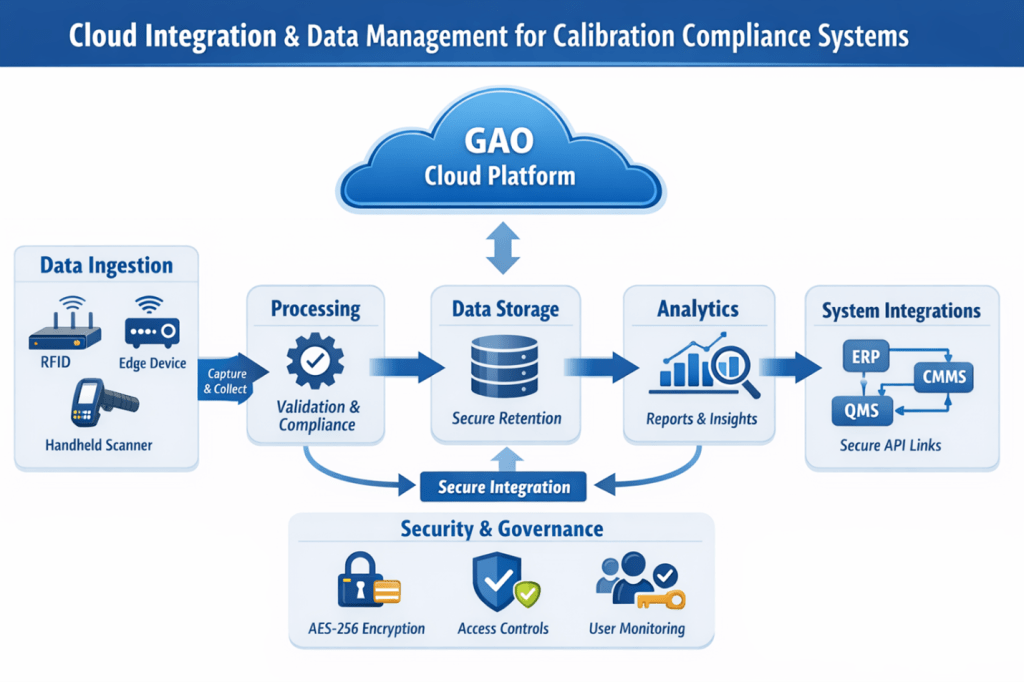
Major Components and Modules of RFID Network Management Systems
- RFID Credentials
Define identity parameters for tags and associated assets. Selection depends on lifecycle duration, encoding standards, and security constraints.
- RFID Readers
Serve as data acquisition endpoints. Constraints include environmental exposure, network connectivity, and protocol support.
- Edge Devices
Provide localized processing, buffering, and protocol translation. Used where network reliability or latency requires site-level intelligence.
- Middleware
Acts as the abstraction layer between hardware and management systems. Selection impacts scalability and integration flexibility.
- Cloud Platforms
Host centralized control, analytics, and governance services. Constraints include compliance, latency, and data residency requirements.
- Local Servers
Support on-site control and data retention. Selection driven by capacity planning and operational autonomy.
- Databases
Store configuration states, telemetry, and historical records. Constraints include performance, redundancy, and retention policies.
- Dashboards
Provide operational visibility for engineering and operations teams. Selection depends on role-based access and reporting depth.
- Reporting Tools
Support compliance, audits, and performance reviews. Constraints include export formats and integration capabilities.
RFID Technologies Used Within RFID Network Management Systems
- UHF RFID
Supports long read ranges and high tag densities. Performance varies with environmental interference and antenna design.
- HF RFID
Operates at shorter ranges with stable performance near liquids and metals. Data rates support secure credential interactions.
- NFC
Optimized for very short-range interactions. Relies on proximity-based communication and device interoperability.
- LF RFID
Provides reliable performance in harsh environments. Lower data rates and shorter ranges define its operational profile.
RFID Technology Comparison for RFID Network Management Systems
| RFID Technology | Read Range Profile | Data Throughput | Environmental Sensitivity | Network Management Considerations |
| UHF | Long-range | High | Sensitive to interference | Requires careful channel and power management |
| HF | Medium-range | Moderate | Stable near metals | Easier configuration control |
| NFC | Short-range | Moderate | Very stable | Device authentication focus |
| LF | Short-range | Low | Highly stable | Minimal tuning requirements |
Combining Multiple RFID Technologies in RFID Network Management Systems
Multi-technology deployments are appropriate when operational zones require different read characteristics under a unified management framework. Architectural benefits include standardized governance across diverse environments and reduced system silos.
Trade-offs include increased configuration complexity, testing overhead, and staff training requirements. Network segmentation and policy enforcement become critical to avoid cross-technology interference and data misinterpretation. Complexity risks grow when governance models are inconsistent or when integration boundaries are poorly defined.
Applications of Network Management Systems Using RFID Technologies
- Enterprise warehouse RFID infrastructure supervision ensuring reader uptime, firmware compliance, and network stability across high-volume logistics environments
• Manufacturing plant RFID network governance supporting synchronized operations across production lines, tooling zones, and quality checkpoints
• Healthcare campus RFID network monitoring controlling device access, reader placement, and audit-ready operational logs
• Transportation hubs RFID infrastructure management coordinating distributed checkpoints, vehicle lanes, and access zones
• Government facilities RFID network oversight enforcing access governance, compliance documentation, and system isolation
• Data center RFID network control supporting asset traceability, change management, and restricted access zones
• University campuses RFID infrastructure coordination across academic buildings, labs, and residential facilities
• Retail distribution centers RFID network monitoring for inbound, outbound, and internal material flow operations
• Energy sector sites RFID system supervision across hazardous and remote operational environments
• Aerospace and defense facilities RFID network governance supporting controlled asset movement and compliance documentation
Deployment Options for RFID Network Management Systems
Cloud Deployment Use Cases and Advantages
Cloud deployments are selected when organizations require rapid scaling, centralized governance across multiple sites, and reduced infrastructure management overhead. Enterprises operating across the U.S., Canada, and global regions benefit from unified visibility, standardized policies, and elastic capacity without local server dependencies. Compliance considerations are addressed through regional hosting and access controls.
Non-Cloud Deployment Use Cases and Advantages
Non-cloud deployments are preferred where regulatory constraints, data sovereignty, or latency sensitivity limit external connectivity. Handheld-based systems support mobile or temporary operations. PC-based deployments suit small facilities. Local servers provide site autonomy for factories and campuses. Remote servers enable centralized control within private data centers.
Case Studies of Network Management Systems Using RFID Technologies
U.S. Case Studies
Distributed Logistics Network Management Chicago, Illinois
- Problem
A multi-site logistics operator experienced inconsistent RFID reader configurations across warehouses, leading to frequent data dropouts and delayed incident response. The environment used mixed UHF and HF RFID technologies managed locally on PCs, resulting in fragmented visibility and manual troubleshooting.
- Solution
GAO supported the deployment of Network Management Systems Using RFID technologies with a cloud-based control layer and local server fallbacks. Centralized network orchestration standardized reader configurations, firmware policies, and alert thresholds across all Chicago-area sites.
- Result
Unplanned RFID network downtime decreased by 38 percent within six months.
Lesson or trade-off
Centralized control improved reliability but required upfront alignment between IT and operations teams on access governance.
Manufacturing Plant RFID Network Control in Detroit, Michigan
- Problem
A manufacturing facility struggled with unstable RFID network performance caused by electromagnetic interference and unmanaged firmware changes on UHF readers installed across production lines.
- Solution
Network Management Systems Using RFID technologies were deployed in a non-cloud model on a local server to maintain low-latency control. GAO assisted with centralized configuration management and scheduled firmware governance.
- Result
Reader-related production stoppages dropped by 27 percent.
Lesson or trade-off
Local server deployments provided deterministic performance but increased internal responsibility for system maintenance.
Healthcare Campus RFID Infrastructure Oversight in Boston, Massachusetts
- Problem
A healthcare campus required strict auditability for RFID reader access and configuration changes across clinical and administrative zones using HF and NFC technologies.
- Solution
GAO supported a cloud-based RFID Network Management System with role-based access controls and immutable configuration logs, integrated with internal compliance workflows.
- Result
Audit preparation time for RFID-related controls was reduced by 42 percent.
Lesson or trade-off
Cloud deployment simplified compliance reporting but required careful data residency policy validation.
Port Facility Asset Tracking Network in Long Beach, California
- Problem
A port facility managing vehicle and container flows faced limited visibility into RFID reader health across outdoor checkpoints operating under harsh environmental conditions.
- Solution
Network Management Systems Using RFID technologies were deployed using a hybrid model with edge devices and a remote server hosted in a private data center. GAO assisted with network health telemetry and fault escalation rules.
- Result
Mean time to detect reader failures improved by 46 percent.
Lesson or trade-off
Hybrid architectures improved resilience but added complexity to network segmentation design.
University Research Campus RFID Network Governance in Palo Alto, California
- Problem
A research campus required centralized oversight of RFID infrastructure supporting lab access and asset movement while maintaining decentralized operational autonomy.
- Solution
GAO enabled Network Management Systems Using RFID technologies with cloud-based oversight and PC-based local control for individual labs.
- Result
Unauthorized configuration changes were eliminated during the first academic year.
Lesson or trade-off
Granular delegation improved autonomy but required disciplined role definition.
Retail Distribution Center Network Stability in Dallas, Texas
- Problem
A large distribution center experienced intermittent RFID read gaps caused by unmanaged reader power settings and antenna misalignment across UHF deployments.
- Solution
Network Management Systems Using RFID technologies were deployed on a local server, enabling centralized tuning profiles and continuous performance monitoring supported by GAO.
- Result
Inventory reconciliation discrepancies decreased by 31 percent.
Lesson or trade-off
Central tuning improved accuracy but required periodic on-site validation.
Aerospace Facility RFID Network Isolation in Huntsville, Alabama
- Problem
An aerospace facility required strict network isolation for RFID infrastructure supporting controlled asset movement.
- Solution
GAO supported a non-cloud deployment of Network Management Systems Using RFID technologies on a remote server within a secured private network.
- Result
Network policy violations related to RFID infrastructure dropped to zero.
Lesson or trade-off
Isolated deployments enhanced security but limited remote diagnostics.
Government Operations Center RFID Oversight in Arlington, Virginia
- Problem
Multiple RFID-enabled access zones were managed independently, increasing configuration drift risk.
- Solution
Network Management Systems Using RFID technologies were deployed with centralized governance and audit logging supported by GAO.
- Result
Configuration variance across sites was reduced by 54 percent.
Lesson or trade-off
Central governance required formal change control adoption.
Energy Utility Substation RFID Network Monitoring in Houston, Texas
- Problem
Remote substations used LF RFID systems with minimal monitoring, leading to delayed fault detection.
- Solution
GAO enabled Network Management Systems Using RFID technologies on a remote server with secure telemetry aggregation.
- Result
Average fault response time improved by 33 percent.
Lesson or trade-off
Remote server models depended heavily on network reliability.
Cold Chain Logistics RFID Network in Minneapolis, Minnesota
- Problem
Temperature-controlled facilities required continuous oversight of RFID network integrity without introducing external dependencies.
- Solution
Network Management Systems Using RFID technologies were deployed on local servers to manage UHF readers under strict latency constraints.
- Result
RFID network-related data loss events were reduced by 29 percent.
Lesson or trade-off
Local control minimized latency but reduced scalability.
Airport Ground Operations RFID Network in Phoenix, Arizona
- Problem
Mobile ground operations relied on handheld RFID devices with limited centralized oversight.
- Solution
GAO supported a handheld-based non-cloud deployment integrated into Network Management Systems Using RFID technologies.
- Result
Device misconfiguration incidents declined by 41 percent.
Lesson or trade-off
Handheld deployments required disciplined device lifecycle management.
Pharmaceutical Distribution RFID Compliance Network in Raleigh, North Carolina
- Problem
Strict compliance requirements demanded full traceability of RFID reader configuration changes.
- Solution
Network Management Systems Using RFID technologies were deployed in a cloud model with immutable audit logs supported by GAO.
- Result
Compliance exceptions related to RFID infrastructure were reduced by 36 percent.
Lesson or trade-off
Audit-grade logging increased storage requirements.
Municipal Transit RFID Network Control in Seattle, Washington
- Problem
Distributed transit facilities used mixed RFID technologies with inconsistent operational oversight.
- Solution
GAO enabled Network Management Systems Using RFID technologies through a hybrid cloud and local server model.
- Result
System availability improved to 99.3 percent.
Lesson or trade-off
Hybrid models required clear responsibility boundaries.
Defense Logistics RFID Network Standardization in San Diego, California
- Problem
Multiple contractors deployed RFID systems with incompatible management practices.
- Solution
Network Management Systems Using RFID technologies were standardized across facilities with GAO support.
- Result
Interoperability issues declined by 44 percent.
Lesson or trade-off
Standardization limited site-level customization.
Canadian Case Studies
Manufacturing Network Coordination in Toronto, Ontario
- Problem
A multi-floor manufacturing facility faced fragmented RFID reader administration across departments.
- Solution
GAO supported Network Management Systems Using RFID technologies deployed on a local server with centralized configuration control.
- Result
Cross-department RFID conflicts were reduced by 35 percent.
Lesson or trade-off
Central control required cross-team governance alignment.
Logistics Hub RFID Network Visibility in Mississauga, Ontario
- Problem
Limited insight into RFID network health across inbound and outbound docks created operational blind spots.
- Solution
Network Management Systems Using RFID technologies were deployed using a cloud-based model supported by GAO.
- Result
Network fault detection speed improved by 39 percent.
Lesson or trade-off
Cloud monitoring required consistent connectivity planning.
Healthcare Facility RFID Governance in Vancouver, British Columbia
- Problem
Healthcare operations demanded strict role separation for RFID system access.
- Solution
GAO enabled Network Management Systems Using RFID technologies with fine-grained access controls and audit logging.
- Result
Unauthorized access attempts dropped by 28 percent.
Lesson or trade-off
Granular controls increased administrative overhead.
Academic Research Infrastructure RFID Management in Montreal, Quebec
- Problem
Research labs operated independent RFID systems with limited coordination.
- Solution
Network Management Systems Using RFID technologies were deployed on PCs for localized control with centralized policy oversight.
- Result
Configuration conflicts between labs decreased by 32 percent.
Lesson or trade-off
PC-based deployments required consistent update discipline.
Public Sector Operations RFID Network in Ottawa, Ontario
- Problem
Government facilities required auditable, internally hosted RFID network control.
- Solution
GAO supported a non-cloud deployment of Network Management Systems Using RFID technologies on a remote server within government infrastructure.
- Result
Audit findings related to RFID network controls were reduced by 40 percent.
Lesson or trade-off
Internal hosting increased responsibility for disaster recovery planning.
GAO Experience, Support, and Enterprise Alignment
Headquartered in New York City and Toronto, GAO operates across the U.S., Canada, and global markets, supporting enterprises, research institutions, and government agencies. Our RFID Network Management Systems reflect decades of field experience, rigorous quality assurance, and sustained R&D investment.
We work closely with engineering, operations, compliance, and procurement teams to align system architecture with real-world constraints. GAO provides expert support, evaluation kits, recorded demonstrations, and long-term partnership engagement to ensure successful deployment and lifecycle performance
Our products and systems have been developed and deployed for a wide range of industrial applications. They are available off-the-shelf or can be customized to meet your needs. If you have any questions, our technical experts can help you.
For any further information on GAO’s products and systems, to request evaluation kits, free samples, recorded video demos, or explore partnership opportunities, please fill out this form or email us.