
AI and RFID for Automotive Manufacturing: Intelligent Asset Visibility, Production Traceability, and Factory Automation
How AI and RFID Are Transforming Automotive Manufacturing
Artificial Intelligence (AI) and Radio Frequency Identification (RFID) are reshaping automotive manufacturing by enabling real-time visibility, intelligent decision-making, and automated production control throughout the vehicle manufacturing lifecycle. Combining AI with UHF RFID, HF RFID, and LF RFID allows manufacturers to automatically identify, track, authenticate, and analyze components, tooling, work-in-progress (WIP), returnable transport items (RTIs), finished vehicles, and production assets without requiring manual data entry. AI continuously analyzes RFID-generated operational data to identify production bottlenecks, predict equipment issues, optimize inventory movement, improve quality assurance, and support data-driven manufacturing decisions.
Modern automotive facilities depend on synchronized production, supplier collaboration, just-in-time (JIT) manufacturing, just-in-sequence (JIS) delivery, and strict traceability requirements. AI-enhanced RFID systems improve manufacturing intelligence by transforming continuous identification data into predictive operational insights. RFID captures physical events while AI interprets production patterns, detects anomalies, forecasts demand, and recommends operational improvements across assembly plants, warehouses, paint shops, logistics centers, and supplier facilities.
GAO has helped organizations implement RFID hardware products and systems for industrial automation, manufacturing visibility, logistics, and enterprise asset tracking. Headquartered in New York City and Toronto, Canada, GAO is recognized among the world’s leading B2B suppliers of RFID and BLE technologies, supporting industrial organizations with engineering expertise, quality-focused products, and technical support.
AI and RFID Ecosystem for Automotive Manufacturing
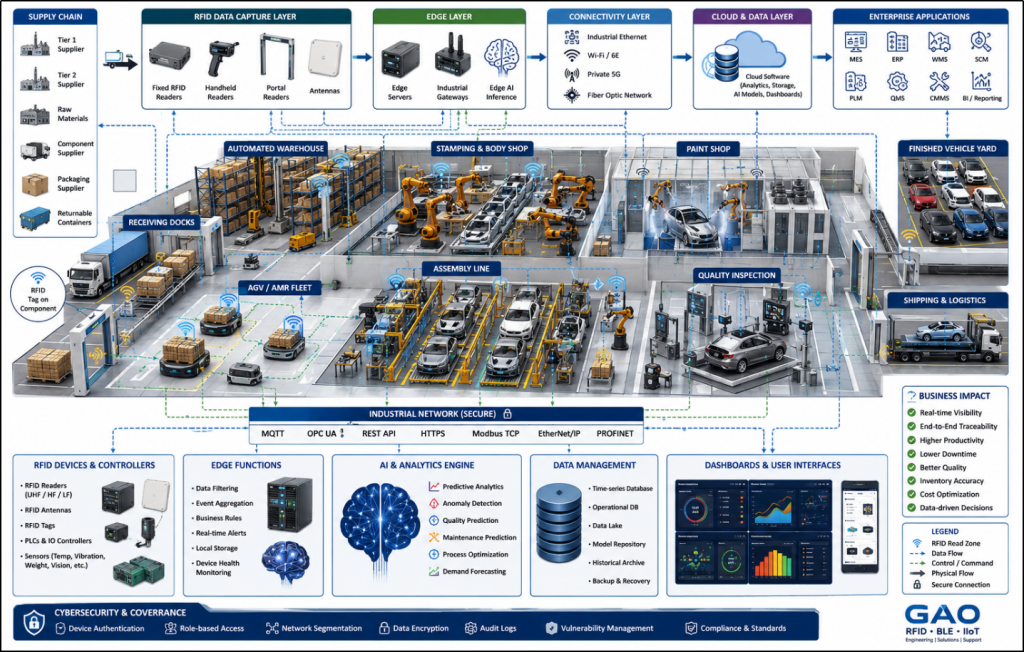
This ecosystem presents an end-to-end AI and RFID ecosystem for automotive manufacturing, connecting suppliers, RFID-enabled material tracking, automated warehouses, AGVs, robotic production, quality inspection, and finished vehicle logistics. It highlights how edge computing, AI analytics, cloud platforms, MES, ERP, WMS, PLCs, and secure industrial networks work together to deliver real-time visibility, predictive maintenance, operational efficiency, and data-driven manufacturing.
Fundamental Concepts of AI and RFID in Automotive Manufacturing
Automotive manufacturing requires continuous synchronization between thousands of components, suppliers, production stations, robots, operators, warehouses, and logistics systems. Vehicle production frequently involves tens of thousands of individual parts that must arrive at precise assembly stations in the correct sequence while maintaining complete production genealogy.
RFID serves as the automatic identification layer of the manufacturing environment.
AI serves as the intelligence layer that continuously evaluates operational conditions and recommends or performs optimized actions.
Together, AI and RFID form an important segment of AIoT, also known as the Artificial Intelligence of Things, where physical assets continuously generate operational information that AI transforms into actionable manufacturing intelligence.
RFID Technologies Used in Automotive Manufacturing
Different RFID technologies address different manufacturing requirements.
UHF RFID
Ultra High Frequency RFID is commonly deployed for:
- Vehicle body tracking
- Work-in-progress monitoring
- Warehouse inventory
- Finished vehicle logistics
- Returnable container tracking
- Pallet identification
- Shipping verification
- Yard management
Advantages include:
- Long read distance
- Simultaneous reading of hundreds of tags
- High-speed portal scanning
- Excellent warehouse performance
- Fast production line identification
HF RFID
High Frequency RFID is frequently used for:
- Tool identification
- Electronic work instructions
- Manufacturing fixtures
- Component authentication
- Operator interaction
- Production verification
Advantages include:
- Short controlled reading zones
- Reduced interference
- Better operation around metal with specialized tags
- Reliable workstation identification
LF RFID
Low Frequency RFID remains valuable for:
- Harsh industrial environments
- Specialized tooling
- Heavy equipment identification
- High contamination areas
- Applications requiring excellent penetration through dirt or moisture
Advantages include:
- Reliable operation near liquids
- Stable reads under difficult environmental conditions
- Long operational lifetime
Relationship Between AI and RFID in Automotive Production
RFID continuously answers questions such as:
- What asset is this?
- Where is it?
- When was it scanned?
- Which workstation processed it?
- Which operator handled it?
- Which production batch does it belong to?
AI expands these answers by determining:
- Why production delays are occurring
- Which machines are becoming inefficient
- Which suppliers consistently introduce delays
- Which inventory shortages may stop production
- Which quality defects share common causes
- Which assembly stations require optimization
- Which maintenance activities should occur before failure
Rather than functioning independently, AI depends on high-quality operational data generated by RFID infrastructure. Better RFID data quality directly improves AI model accuracy.
Why Automotive Manufacturing Benefits from AI and RFID
Vehicle manufacturing represents one of the most complex industrial production environments.
Thousands of synchronized operations occur simultaneously across:
- Body shop
- Stamping operations
- Welding cells
- Paint shop
- Engine assembly
- Battery assembly
- Interior installation
- Chassis assembly
- Final assembly
- Quality inspection
- Vehicle testing
- Distribution logistics
RFID automates identification throughout these operations.
AI transforms operational information into production optimization.
Together they improve:
- Manufacturing traceability
- Production scheduling
- Material availability
- Production throughput
- Inventory accuracy
- Equipment utilization
- Workforce productivity
- Quality management
- Supplier coordination
- Operational visibility
End-to-End AI and RFD Operational Workflow
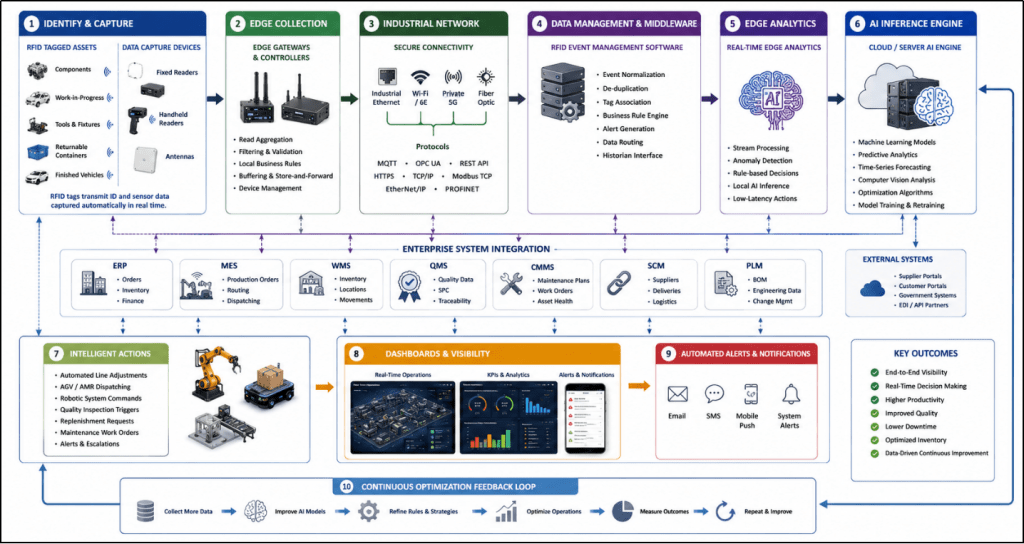
This end-to-end workflow illustrates how RFID data is captured, processed through edge devices and industrial networks, enriched by middleware, analyzed with AI, and integrated with enterprise systems such as ERP, MES, WMS, and maintenance platforms. The resulting insights power dashboards, automated alerts, robotic actions, and a continuous feedback loop that improves operational efficiency, product quality, and decision-making.
Complete Operational Workflow of AI and RFID in Automotive Manufacturing
Modern automotive facilities implement an integrated workflow that combines physical identification with intelligent analytics.
Step 1. RFID Data Acquisition
RFID tags are attached to:
- Vehicle bodies
- Engine blocks
- Gearboxes
- Battery packs
- Doors
- Instrument panels
- Production tooling
- Welding fixtures
- Returnable containers
- Material racks
- Finished vehicles
- Warehouse inventory
Readers automatically capture:
- Tag ID
- Timestamp
- Reader location
- Signal strength
- Direction of movement
- Event status
- Read confidence
Specialized industrial RFID antennas improve read reliability near metal structures, robotic equipment, conveyors, and automated storage systems.
Step 2. Local Edge Processing
Industrial edge computers process RFID events close to production equipment.
Typical functions include:
- Duplicate read removal
- Event filtering
- Data validation
- Business rule execution
- Local buffering
- Device health monitoring
- Temporary storage during network interruptions
Edge processing minimizes latency while reducing unnecessary network traffic.
Step 3. Communication Infrastructure
RFID devices communicate through industrial communication networks including:
- Ethernet
- Industrial Ethernet
- Wi-Fi
- Private 5G
- Fiber backbone
- VPN connectivity
- Secure TCP/IP
Industrial communication protocols frequently include:
- MQTT
- OPC UA
- HTTPS
- REST API
- Modbus TCP
- EtherNet/IP
- PROFINET
These protocols allow RFID information to be exchanged with manufacturing software and industrial automation systems.
Step 4. RFID Data Management Software
RFID event management software performs:
- Device management
- Reader configuration
- Tag filtering
- Event aggregation
- Rule processing
- Alert generation
- Historical data storage
- Data synchronization
The software normalizes information before distributing it throughout enterprise environments.
Step 5. Enterprise Software Integration
RFID information integrates with business systems such as:
- Manufacturing Execution System (MES)
- Enterprise Resource Planning (ERP)
- Warehouse Management System (WMS)
- Supply Chain Management (SCM)
- Computerized Maintenance Management System (CMMS)
- Product Lifecycle Management (PLM)
- Quality Management System (QMS)
- Manufacturing intelligence software
- Business intelligence software
This integration creates a digital thread that links production activities with enterprise operations, enabling complete genealogy and lifecycle traceability for every major component and finished vehicle.
AI Analytics and Intelligent Decision-Making
Once RFID event data has been validated and integrated with enterprise software, AI converts operational records into manufacturing intelligence. Multiple AI techniques are often combined because automotive production environments involve diverse data types, varying production rates, and strict quality requirements.
Machine Learning for Production Optimization
Supervised and unsupervised machine learning models analyze historical RFID event streams together with production metrics, equipment status, and quality records to identify recurring operational patterns.
Typical use cases include:
- Predicting production delays before line stoppages occur
- Identifying recurring inventory shortages
- Forecasting material replenishment requirements
- Optimizing workstation balancing
- Improving warehouse slotting strategies
- Detecting abnormal production cycle times
Machine learning models improve over time as additional RFID observations become available, allowing manufacturers to continuously refine scheduling accuracy and operational efficiency.
Computer Vision Combined with RFID
Computer vision complements RFID by validating physical conditions that RFID alone cannot determine.
Typical implementations combine:
- Industrial cameras
- RFID identification
- AI image recognition
- Barcode verification
- Automated inspection systems
For example, RFID confirms that the correct door module arrives at an assembly station, while AI-powered vision verifies paint quality, fastener placement, connector installation, or dimensional alignment before assembly continues.
Predictive Analytics for Manufacturing Intelligence
Predictive analytics uses RFID event histories, machine telemetry, environmental sensor data, production schedules, and historical quality information to forecast future manufacturing conditions rather than simply reporting current status. AI models continuously evaluate operational trends to identify conditions that may reduce throughput or product quality.
Common predictive analytics functions include:
- Forecasting production line congestion
- Predicting inventory depletion
- Estimating component consumption rates
- Identifying supplier delivery risks
- Forecasting equipment maintenance windows
- Predicting quality deviations
- Estimating order completion times
- Detecting abnormal production trends
Automotive manufacturers benefit from predictive insights because corrective actions can be taken before operational disruptions affect vehicle production.
Deep Learning for Complex Manufacturing Analysis
Deep learning is particularly valuable when analyzing large, multidimensional manufacturing datasets collected across multiple facilities and production lines.
Typical applications include:
- Multi-stage defect prediction
- Production sequence optimization
- Vehicle genealogy analysis
- Supplier performance evaluation
- Intelligent material flow optimization
- Complex anomaly detection
- Autonomous scheduling recommendations
Neural networks can discover relationships between RFID events, machine performance, production timing, and quality outcomes that are difficult to identify using traditional statistical methods.
Reinforcement Learning for Dynamic Process Optimization
Reinforcement learning continuously evaluates manufacturing decisions and learns which operational strategies maximize production efficiency while minimizing downtime and waste.
Typical optimization objectives include:
- Conveyor routing
- AGV dispatching
- Warehouse traffic optimization
- Production scheduling
- Buffer inventory management
- Energy-efficient equipment operation
- Robotic task sequencing
Rather than relying solely on predefined rules, reinforcement learning improves decision quality as operating conditions evolve.
Hardware Components Supporting AI and RFID Solutions
Successful AI and RFID deployments depend on carefully selected industrial hardware designed for automotive production environments that include metal structures, electromagnetic interference, high temperatures, vibration, paint operations, welding equipment, and continuous material movement.
RFID Tags
Tag selection depends on the application, reading distance, environmental conditions, and mounting surface.
Common tag types include:
- Passive UHF RFID tags
- Rugged industrial RFID tags
- Metal-mount RFID tags
- High-temperature RFID tags
- Paint shop resistant RFID tags
- Reusable RFID tags
- Battery-assisted passive RFID tags
- HF RFID tags
- LF RFID tags
Selection considerations include:
- Read range
- Memory capacity
- Chemical resistance
- Heat tolerance
- Metal compatibility
- Mechanical durability
- IP rating
- Expected service life
RFID Antennas
Industrial antenna configurations include:
- Linear polarization antennas
- Circular polarization antennas
- Near-field antennas
- Far-field antennas
- Compact workstation antennas
- High-gain warehouse antennas
Engineering teams evaluate:
- Read zone geometry
- Conveyor speed
- Tag orientation
- Metal reflections
- Environmental interference
- Required reading distance
RFID Readers
Reader types commonly deployed include:
- Fixed industrial readers
- Handheld RFID readers
- Vehicle-mounted readers
- Conveyor-mounted readers
- Portal readers
- Forklift readers
- Mobile inspection readers
Reader placement significantly influences system performance. Proper antenna orientation, shielding, read zone design, and power configuration help minimize missed reads and unintended tag detection.
Edge Computing Equipment
Edge computing equipment performs localized processing close to production assets.
Typical hardware includes:
- Industrial edge computers
- Industrial PCs
- Embedded controllers
- Industrial gateways
- Edge AI accelerators
- GPU-enabled edge servers
Edge processing reduces communication latency while maintaining production continuity during temporary network interruptions.
Supporting Industrial Infrastructure
Additional infrastructure often includes:
- Industrial Ethernet switches
- Fiber optic backbone
- Wireless access points
- Private 5G infrastructure
- UPS systems
- Industrial cabinets
- Environmental monitoring devices
- Time synchronization servers
- Backup storage systems
GAO supplies RFID hardware products and systems that support demanding industrial environments where reliability, durability, and interoperability are essential to long-term operational performance.
Software Architecture for AI and RFID Deployments
Automotive manufacturers require software that coordinates RFID event management, AI analytics, enterprise integration, and operational monitoring while supporting high transaction volumes and low-latency decision-making.
RFID Management Software
Core functions include:
- Device enrollment
- Reader configuration
- Tag event filtering
- Data validation
- Event correlation
- Alarm generation
- User administration
- Audit logging
- Firmware management
- Diagnostics
AI Analytics Software
AI software processes manufacturing information using:
- Classification algorithms
- Regression models
- Clustering algorithms
- Neural networks
- Time-series forecasting
- Optimization algorithms
- Natural language processing for maintenance records
- Anomaly detection models
Results are presented through operational dashboards, alerts, reports, and decision support functions.
Database Technologies
Common database technologies include:
- Relational databases
- Time-series databases
- Distributed databases
- Object storage
- Data lakes
- Historical archives
These repositories support production genealogy, traceability, regulatory compliance, AI model training, and long-term manufacturing analysis.
Cloud Version and Server Version Deployment Models
Selecting the appropriate deployment model depends on production scale, cybersecurity requirements, regulatory obligations, latency constraints, and enterprise IT strategy.
Cloud Version
Cloud-hosted deployments place RFID management software, AI analytics, reporting functions, and centralized data storage within managed cloud infrastructure.
Typical advantages include:
- Rapid deployment
- Elastic computing resources
- Centralized multi-site management
- Simplified software updates
- High availability
- Scalable storage
- Easier integration across geographically distributed facilities
Cloud deployments are particularly suitable for manufacturers operating multiple production plants, supplier networks, and regional distribution centers requiring consolidated operational visibility.
Server Version
Server deployments operate on customer-managed servers located in private data centers, factory server rooms, or other privately managed computing environments.
Typical advantages include:
- Full control of operational data
- Reduced dependence on external connectivity
- Low-latency processing
- Custom security policies
- Greater configuration flexibility
- Easier integration with legacy manufacturing infrastructure
Server deployments are often preferred where intellectual property protection, regulatory requirements, or deterministic production performance require local control of manufacturing data.
Hybrid Architecture
Many automotive manufacturers implement hybrid architectures that combine local server processing with cloud-based analytics.
Typical hybrid distribution includes:
- Local RFID event processing
- Edge AI inference
- Factory production control
- Cloud reporting
- Enterprise-wide analytics
- Fleet-wide benchmarking
- Long-term data retention
- Disaster recovery
Hybrid deployments provide operational resilience while supporting enterprise-level visibility across multiple manufacturing locations.
Cloud Version Vs Server Version for AI and RFID in Automotive Manufacturing
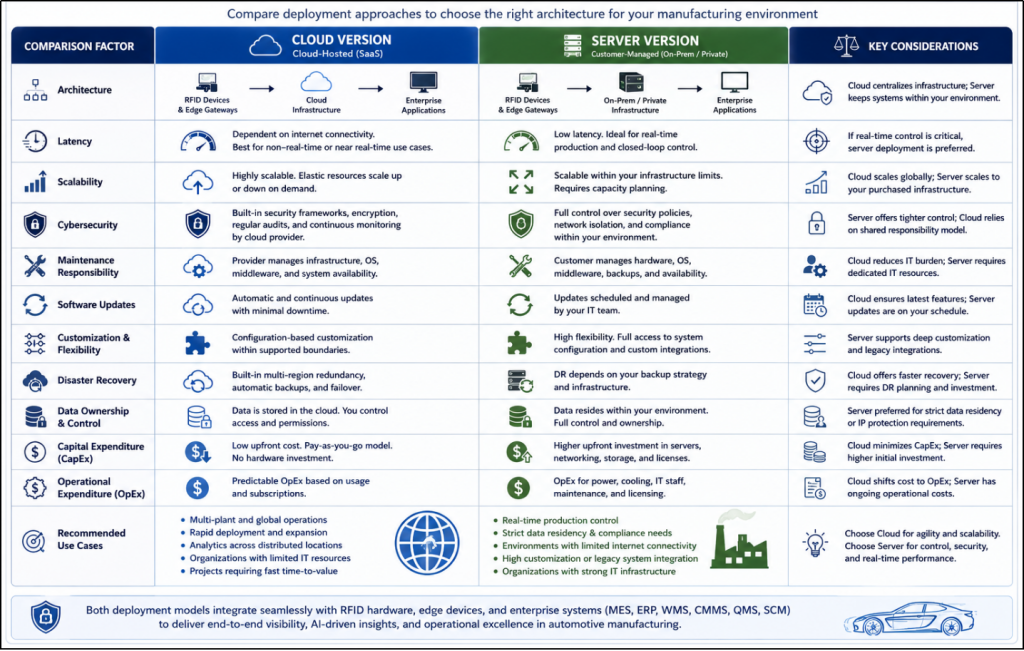
The deployment comparison evaluates cloud-hosted and on-premises server deployment models for AI and RFID solutions in automotive manufacturing. It compares architecture, latency, scalability, cybersecurity, maintenance, software updates, customization, disaster recovery, data ownership, costs, and recommended use cases. The key takeaway is that cloud deployment offers greater scalability and lower upfront costs, while server deployment provides stronger control, lower latency, and enhanced customization for real-time manufacturing environments.
Cybersecurity, Privacy, and Operational Security
Automotive manufacturing environments require comprehensive cybersecurity because RFID systems exchange operational data with production equipment and enterprise software.
Recommended security measures include:
- Mutual device authentication
- Role-based access control
- Multi-factor authentication
- TLS-encrypted communications
- VPN connectivity for remote access
- Secure API authentication
- Network segmentation
- Industrial firewalls
- Intrusion detection and prevention
- Security information and event management
- Continuous vulnerability assessment
- Secure firmware updates
- Hardware security modules where appropriate
RFID tag security may include:
- Password protection
- Memory locking
- Kill commands where applicable
- Cryptographic authentication
- Digital signatures for specialized applications
Security monitoring should include continuous auditing of reader activity, unauthorized device detection, abnormal access attempts, and operational anomaly identification using AI-assisted cybersecurity analytics.
Standards, Protocols, and Interoperability
Interoperability is essential because automotive manufacturers operate diverse equipment from multiple suppliers across production, logistics, and quality functions.
Common RFID standards include:
- ISO/IEC 18000 series
- EPCglobal Gen2
- ISO/IEC 15693
- ISO/IEC 14443
Common communication protocols include:
- MQTT
- OPC UA
- REST API
- HTTPS
- TCP/IP
- EtherNet/IP
- PROFINET
- Modbus TCP
Enterprise integration commonly involves:
- MES
- ERP
- WMS
- SCM
- PLM
- CMMS
- QMS
- Business intelligence software
Standards-based integration simplifies expansion, reduces vendor lock-in, and supports interoperability throughout the manufacturing lifecycle.
Component Traceability
Benefits include:
- Complete production genealogy
- Recall management
- Supplier accountability
- Warranty analysis
- Regulatory compliance
Work-in-Progress Tracking
Capabilities include:
- Real-time production visibility
- Automated station confirmation
- Production sequence validation
- Cycle time measurement
- Bottleneck identification
Tool and Fixture Management
AI and RFID improve:
- Tool utilization
- Calibration scheduling
- Maintenance planning
- Loss prevention
- Asset availability
Warehouse and Inventory Management
Applications include:
- Automated inventory counting
- Receiving verification
- Picking validation
- Shipping confirmation
- Safety stock optimization
Finished Vehicle Logistics
Functions include:
- Yard management
- Vehicle identification
- Shipping verification
- Dealer allocation support
- Transportation visibility
Returnable Asset Management
Manufacturers use RFID to monitor:
- Returnable containers
- Racks
- Pallets
- Battery transport carriers
- Supplier packaging assets
AI analyzes circulation patterns to reduce losses, improve asset utilization, and optimize return logistics.
Major AI and RFID Applications Across Automotive Manufacturing
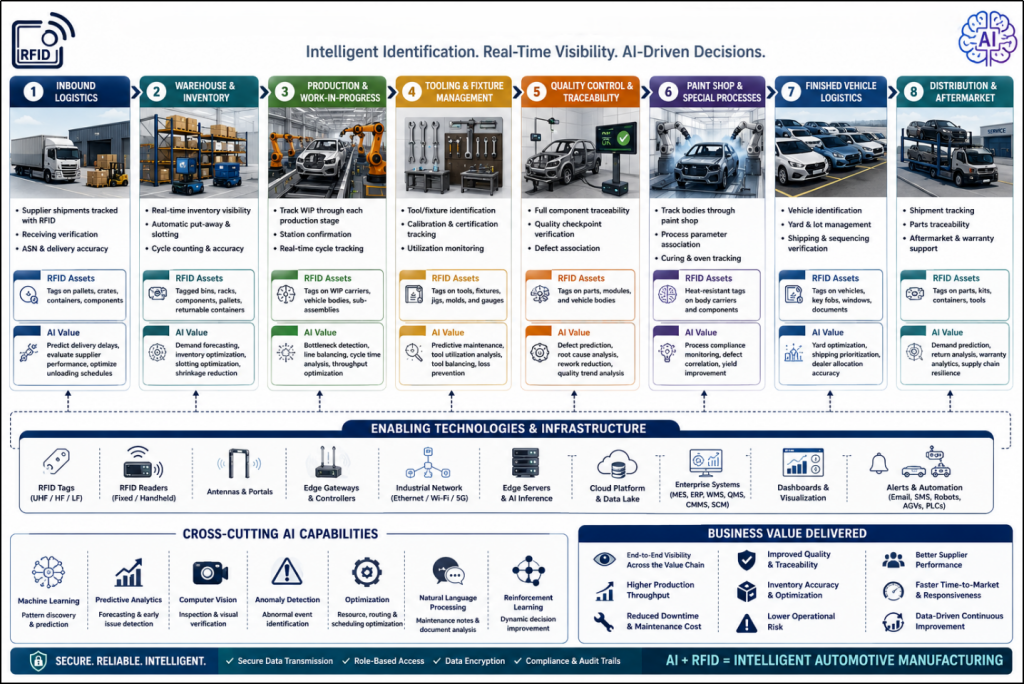
The visual overview highlights how RFID and AI enable end-to-end visibility, automation, and data-driven decision-making across the automotive manufacturing lifecycle. It highlights eight operational stages from inbound logistics and warehouse management to production, quality control, paint shop, finished vehicle logistics, and aftermarket distribution along with the enabling technologies, AI capabilities, and resulting business value such as improved traceability, optimized inventory, predictive maintenance, and higher operational efficiency.
Deployment Lifecycle and Engineering Best Practices
A successful implementation follows a structured engineering lifecycle.
Planning and Requirements Analysis
Activities include:
- Business objective definition
- Process mapping
- Asset identification
- Read point analysis
- Environmental assessment
- ROI evaluation
- Risk assessment
Technology and Hardware Selection
Engineering teams evaluate:
- RFID frequency selection
- Tag durability
- Reader coverage
- Antenna placement
- Edge computing requirements
- Network capacity
- AI workload characteristics
System Design
Architecture design includes:
- Read zone optimization
- Network topology
- Software integration
- Data governance
- Redundancy planning
- Cybersecurity architecture
Installation and Commissioning
Implementation includes:
- Reader installation
- Antenna tuning
- Tag validation
- Connectivity verification
- Software configuration
- Initial AI model deployment
Testing and Validation
Testing should verify:
- Read accuracy
- Production throughput
- AI prediction quality
- Failover operation
- Data integrity
- Integration performance
- Cybersecurity controls
Operational Optimization
Continuous improvement activities include:
- AI model retraining
- Reader recalibration
- Performance monitoring
- Software updates
- Hardware maintenance
- KPI evaluation
- Process refinement
Practical engineering experience shows that pilot deployments on representative production lines help validate RF performance, metal interference mitigation, and AI model accuracy before expanding to full-scale factory implementation.
Operational Benefits and Business Value
Organizations implementing AI and RFID in automotive manufacturing commonly realize improvements such as:
- Greater production visibility
- Higher inventory accuracy
- Faster component traceability
- Reduced manual data collection
- Improved quality control
- Lower operational risk
- Better supplier coordination
- Reduced production downtime
- Increased asset utilization
- Enhanced maintenance planning
- Improved regulatory compliance
- Higher manufacturing throughput
- Better decision support through AI-driven analytics
These benefits result from the combination of reliable RFID identification, integrated manufacturing data, and AI models capable of transforming operational events into actionable recommendations.
Why Organizations Choose GAO for AI and RFID Solutions
For more than three decades, GAO and its sister companies, GAO Research Inc. and GAO Tek Inc., have supported customers throughout the United States and Canada, including Fortune 500 enterprises, leading research organizations, prestigious universities, and government agencies. Operating from New York City and the City of Toronto, the organizations have invested extensively in research and development, maintain rigorous quality assurance processes, and provide expert remote and onsite technical support.
We help organizations evaluate RFID technologies, select appropriate hardware products and systems, design scalable architectures, and integrate AI-enabled identification solutions with existing manufacturing environments. Our engineering experience supports deployments ranging from pilot projects to enterprise-scale automotive manufacturing operations.
Building the Future of Automotive Manufacturing with AI and RFID
AI and RFID are becoming foundational technologies for intelligent automotive manufacturing by combining automated identification with advanced analytics, predictive decision-making, and end-to-end production visibility. UHF RFID, HF RFID, and LF RFID each address distinct operational requirements, while AI enhances these technologies through machine learning, predictive analytics, computer vision, and optimization algorithms that improve traceability, quality, inventory control, equipment utilization, and manufacturing efficiency.
Successful implementations depend on thoughtful planning, appropriate hardware selection, standards-based integration, robust cybersecurity, scalable software architecture, and continuous optimization throughout the deployment lifecycle. Organizations that align RFID infrastructure with AI-driven operational intelligence are better positioned to improve production resilience, support regulatory compliance, and respond to changing manufacturing demands.
Whether evaluating cloud-hosted or customer-managed server deployments, manufacturers should prioritize interoperability, data quality, and long-term scalability. GAO can assist organizations in exploring RFID hardware products and systems, engineering guidance, and technical expertise to support reliable AI and RFID solutions tailored to modern automotive manufacturing environments.