
AI + RFID in Education
How AI + RFID Is Transforming the Education Industry
Artificial Intelligence (AI) combined with Radio Frequency Identification (RFID) is reshaping how educational institutions manage people, assets, facilities, libraries, laboratories, and campus operations. AI + RFID enables schools, colleges, universities, research institutions, and educational campuses to automatically identify physical objects and individuals while transforming RFID-generated data into meaningful operational intelligence. Rather than relying solely on identification and tracking, AI analyzes historical and real-time RFID data to improve resource utilization, automate workflows, predict operational issues, enhance security, and support data-driven decision making.
Within the education industry, AI + RFID extends beyond student attendance. Modern deployments integrate UHF RFID, HF RFID, and LF RFID with enterprise software, campus management systems, learning management systems, security systems, library management software, laboratory asset management, maintenance software, and business intelligence functions. These integrated environments provide continuous visibility into educational resources while reducing administrative workloads and improving operational efficiency.
Educational organizations increasingly require accurate real-time information to manage thousands of students, faculty members, classrooms, laboratories, research assets, books, IT equipment, medical simulation devices, and campus facilities. AI enhances RFID by recognizing operational patterns, identifying anomalies, forecasting equipment utilization, recommending maintenance schedules, and optimizing resource allocation.
GAO has supported organizations throughout North America by supplying RFID hardware products and integrated systems that help educational institutions modernize identification, asset visibility, and operational automation while maintaining reliable engineering practices suitable for enterprise environments.
AI + RFID Enterprise Architecture for Educational Institutions
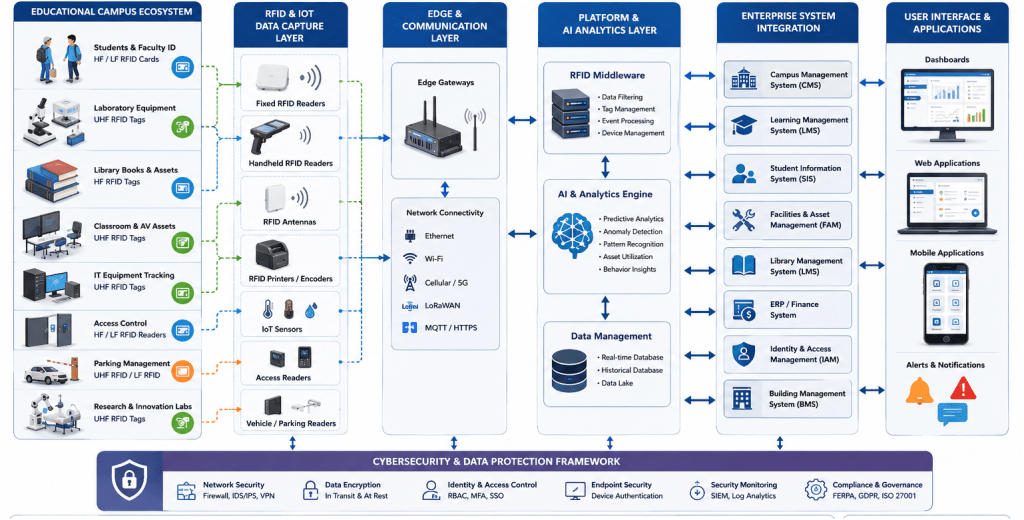
This enterprise architecture shows how AI and RFID technologies integrate across an educational institution to provide intelligent identification, asset tracking, access control, resource management, and operational analytics. The architecture connects UHF, HF, and LF RFID devices through edge gateways, middleware, AI analytics, enterprise systems, and user applications while incorporating end-to-end cybersecurity to enable secure, real-time campus operations and data-driven decision-making.
Understanding AI + RFID in Modern Educational Environments
Educational institutions manage enormous numbers of interconnected physical and digital resources. Students move across multiple buildings, laboratories contain expensive research equipment, libraries circulate thousands of books daily, IT departments manage large inventories of computing devices, and facilities teams maintain classrooms distributed across expansive campuses.
Traditional RFID systems automate identification by assigning unique electronic identities to physical objects. Artificial intelligence extends these capabilities by interpreting RFID data continuously, discovering hidden operational patterns, predicting future events, and recommending corrective actions.
Depending on operational requirements, educational organizations typically deploy multiple RFID technologies simultaneously.
UHF RFID
Ultra High Frequency RFID supports long reading distances and rapid identification of numerous tagged objects simultaneously.
Typical education applications include:
- Library inventory automation
- Laboratory equipment tracking
- Classroom asset management
- Computer inventory
- Furniture management
- Sports equipment tracking
- Warehouse inventory
- Research asset visibility
HF RFID
High Frequency RFID provides reliable short-range identification and supports applications requiring intentional user interaction.
Common deployments include:
- Student identification cards
- Faculty credentials
- Library borrowing
- Cashless campus payments
- Secure authentication
- Visitor management
LF RFID
Low Frequency RFID performs well near metal, moisture, and harsh environments where robustness is prioritized over reading distance.
Typical applications include:
- Building access
- Mechanical room access
- Parking authorization
- Equipment authorization
- Specialized laboratory environments
Rather than treating RFID as a standalone identification technology, AI converts continuous RFID events into operational intelligence capable of improving educational planning, facility utilization, equipment availability, and campus safety.
Educational institutions frequently integrate RFID-generated data with scheduling software, identity management software, maintenance software, security monitoring software, library software, and enterprise reporting functions to create a unified operational view.
GAO has supplied RFID readers, tags, antennas, handheld readers, and supporting IoT hardware for organizations requiring dependable identification and tracking solutions across complex operational environments.
Enterprise Architecture of AI + RFID in Education
Successful educational deployments depend upon multiple interconnected technology layers working together as an integrated enterprise solution.
RFID Data Acquisition Layer
This foundational layer captures physical events occurring throughout the campus.
Primary hardware includes:
- UHF RFID tags
- HF RFID smart cards
- LF RFID credentials
- Fixed RFID readers
- Handheld RFID readers
- RFID printer encoders
- RFID antennas
- Access control readers
- RFID-enabled kiosks
- Self-service library stations
These devices continuously identify people, books, equipment, laboratory instruments, classroom assets, medical simulation equipment, maintenance tools, and research materials.
RFID Middleware Layer
Middleware converts raw RFID observations into structured business events understandable by enterprise software.
Typical functions include:
- Device management
- Reader configuration
- Tag filtering
- Event normalization
- Location calculation
- Asset association
- Student identity mapping
- Duplicate suppression
- API integration
- Audit logging
Rather than storing millions of repetitive tag reads, middleware produces meaningful operational events suitable for AI analysis.
Edge Computing Layer
Edge computing performs localized processing before transmitting information to centralized software.
Edge functions commonly include:
- RFID event filtering
- Duplicate tag elimination
- Local authentication
- Temporary data buffering
- Device health monitoring
- Local rule execution
- Access authorization
- Initial anomaly detection
Edge processing significantly reduces unnecessary network traffic while enabling rapid operational responses even during temporary network interruptions.
Communication Infrastructure Layer
Captured RFID events travel securely through campus communication networks.
Common communication technologies include:
- Ethernet
- Wi-Fi
- Wi-Fi 6
- Private LTE
- 5G
- Fiber backbone
- VPN
- TLS encryption
Industrial and enterprise communication protocols commonly include:
- MQTT
- HTTPS
- REST API
- WebSocket
- OPC UA where laboratory automation exists
- SNMP
- TCP/IP
Reliable communication infrastructure ensures low-latency transmission while supporting thousands of concurrent RFID events generated across distributed educational campuses.
Artificial Intelligence Layer
Artificial intelligence transforms RFID-generated operational events into predictive insights.
Frequently deployed AI methods include:
- Machine learning
- Deep learning
- Time-series forecasting
- Computer vision integration
- Natural language processing for operational reporting
- Reinforcement learning
- Graph analytics
- Clustering algorithms
- Classification models
- Predictive analytics
- Prescriptive analytics
AI continuously evaluates operational behavior to identify inefficiencies, predict resource shortages, optimize scheduling, detect abnormal movement, and improve educational resource utilization.
Educational Institution Workflow Using AI + RFID
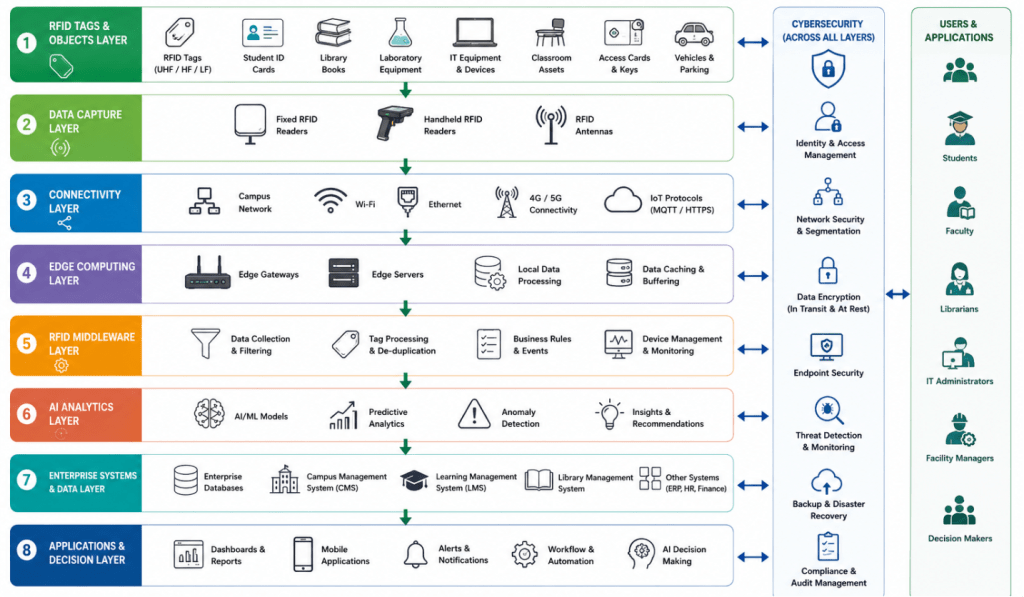
This layered workflow provides an overview of how AI and RFID technologies work together within educational institutions. It demonstrates the flow of data from RFID-enabled people and assets through data capture, networking, edge computing, middleware, AI analytics, enterprise systems, and user applications to enable secure, real-time visibility, intelligent automation, and data-driven campus management.
End-to-End Operational Workflow for AI + RFID in Education
AI + RFID environments follow a structured operational workflow that converts physical identification events into enterprise decisions.
Identification and Data Capture
Students enter classrooms using HF RFID credentials.
Library books are identified using UHF RFID.
Laboratory equipment automatically reports movement.
Faculty credentials authenticate access to restricted facilities.
Maintenance teams identify assets using handheld RFID readers.
Research equipment continuously reports inventory status.
Every RFID interaction generates timestamped identification records associated with users, locations, assets, and operational events.
Secure Data Transmission
RFID readers securely transmit event information through institutional communication networks.
Event information generally contains:
- RFID tag identifier
- Reader identifier
- Timestamp
- Signal strength
- Location identifier
- Event type
- Authentication status
- Device health information
Transmission mechanisms frequently employ encrypted MQTT messaging, HTTPS communication, secure REST APIs, or TCP/IP communication depending upon enterprise architecture requirements.
Local Processing and Event Validation
Before reaching centralized software, edge computing resources validate and preprocess collected information.
Typical operations include:
- Removing duplicate reads
- Verifying reader health
- Confirming authorized identities
- Filtering invalid events
- Aggregating high-frequency observations
- Performing local access decisions
- Detecting immediate operational anomalies
Validated events are then forwarded to centralized software for enterprise-wide analysis.
Enterprise Software Integration for AI + RFID in Education
Centralized enterprise software converts validated RFID events into actionable operational information that supports academic administration, campus security, facilities management, library operations, laboratory management, and executive decision making. AI continuously analyzes these consolidated data streams to automate workflows, identify operational trends, and recommend improvements across the institution.
Educational organizations often integrate AI + RFID environments with:
- Student Information System (SIS)
- Learning Management System (LMS)
- Enterprise Resource Planning (ERP)
- Computerized Maintenance Management System (CMMS)
- Identity and Access Management (IAM)
- Human Resources Information System (HRIS)
- Library Management System (LMS for libraries)
- Visitor Management Software
- Security Information and Event Management (SIEM)
- Building Management System (BMS)
- Geographic Information System (GIS) for campus mapping
- Business Intelligence (BI) and reporting software
- Mobile workforce applications
- Classroom scheduling software
- Procurement and inventory management software
These integrations eliminate isolated information repositories and create a unified operational environment where AI correlates RFID events with academic schedules, maintenance records, security policies, inventory status, and facility utilization.
GAO has helped educational organizations implement RFID hardware that integrates with enterprise software through standardized interfaces, enabling scalable identification and asset visibility across complex campus environments.
AI Models Supporting RFID-Based Education Solutions
Different artificial intelligence techniques address different operational objectives. Rather than relying on a single algorithm, enterprise deployments combine multiple AI models according to institutional priorities.
Predictive Analytics
Predictive models analyze historical RFID activity to forecast future events.
Typical predictions include:
- Classroom occupancy
- Laboratory utilization
- Library circulation demand
- Equipment availability
- Maintenance requirements
- Student attendance trends
- Peak campus traffic
- Parking demand
Educational administrators can proactively allocate resources before operational bottlenecks occur.
Natural Language Processing
Natural language processing transforms operational data into readable reports.
Examples include:
- Daily utilization summaries
- Executive dashboards
- Maintenance recommendations
- Security incident reports
- Inventory status updates
- Compliance documentation
Decision-makers receive understandable explanations instead of raw technical information.
Computer Vision Integration
Computer vision complements RFID in locations where visual confirmation improves operational accuracy.
Applications include:
- Laboratory compliance monitoring
- Classroom occupancy validation
- Equipment verification
- Visitor identification
- Safety monitoring
- Asset confirmation
Computer vision and RFID together significantly reduce false positives associated with either technology alone.
Resource Optimization
Optimization algorithms recommend improved allocation of institutional resources.
Typical optimization objectives include:
- Classroom scheduling
- Laboratory assignment
- Equipment sharing
- Faculty workspace utilization
- Maintenance scheduling
- Library staffing
- Student service allocation
Recommendations are based on historical usage, academic calendars, seasonal demand, and current operational conditions.
Anomaly Detection
Machine learning models identify unusual RFID activity that may indicate operational issues.
Examples include:
- Unauthorized laboratory access
- Unexpected equipment movement
- Missing research assets
- Duplicate identity usage
- Unusual after-hours building occupancy
- Repeated authentication failures
- Suspicious library activity
These models continuously improve by learning normal operational behavior.
Cloud Version and Server Version Deployment
Educational institutions should select a deployment model according to cybersecurity policies, privacy regulations, IT staffing, operational complexity, budget, and infrastructure strategy.
Cloud Version
Cloud-hosted deployments operate within professionally managed cloud infrastructure where software updates, scalability, redundancy, and infrastructure maintenance are handled by the provider.
Typical characteristics include:
- Rapid implementation
- Centralized software updates
- Elastic computing resources
- Simplified disaster recovery
- Multi-campus accessibility
- High AI training capacity
- Automatic backup
- Reduced infrastructure management
Cloud deployment is well suited for:
- School districts
- Multi-campus universities
- Distributed educational organizations
- Institutions with limited internal IT resources
- Organizations requiring remote administration
Server Version
Server deployments operate on customer-managed infrastructure, including private data centers, institutional edge servers, or privately hosted enterprise environments.
Typical characteristics include:
- Full administrative control
- Local data governance
- Low processing latency
- Custom integration flexibility
- Institution-controlled cybersecurity
- Compliance with internal policies
- Greater infrastructure customization
Server deployment is commonly selected by:
- Research universities
- Government-funded institutions
- Defense education organizations
- Medical schools
- Institutions with strict privacy requirements
- Organizations operating private campus infrastructure
Cloud Version vs Server Version for AI + RFID in Education
| Feature | Cloud Version | Server Version |
| Infrastructure Management | Managed by the cloud service provider | Managed by the educational institution’s IT team |
| Initial Deployment | Rapid deployment with minimal local infrastructure | Planned implementation requiring server provisioning and configuration |
| Data Location | Hosted in secure cloud infrastructure | Hosted on private campus servers or institutional data centers |
| Scalability | Easily scales to support multiple campuses, students, and assets | Limited by available server, storage, and networking resources |
| Remote Accessibility | Secure access from any authorized location via the internet | Configurable remote access through institutional VPN or private networks |
| AI Processing & Model Training | Utilizes scalable cloud computing resources for AI analytics and model training | Uses institution-managed servers or edge computing resources for AI processing |
| Latency | Dependent on network connectivity and internet performance | Very low latency for campus-based RFID processing and AI inference |
| Data Governance | Shared responsibility between the cloud provider and the institution | Full institutional control over student, faculty, and research data |
| Regulatory Compliance | Supports compliance through provider-managed security and certifications | Institution manages compliance with education, privacy, and internal governance policies |
| Maintenance Responsibility | Software updates, backups, and infrastructure maintenance handled by the provider | Software updates, server maintenance, backups, and hardware lifecycle managed by the institution |
| Campus Integration | Simplifies integration across geographically distributed campuses | Optimized for integration with existing campus networks, legacy systems, and private infrastructure |
| Typical Use Cases | Multi-campus universities, school districts, institutions requiring remote administration | Research universities, government-funded institutions, medical schools, and campuses with strict data sovereignty requirements |
Cybersecurity, Privacy, and Standards
Educational institutions process personally identifiable information, research data, financial records, and intellectual property. Security must therefore be incorporated throughout the AI + RFID solution lifecycle rather than added after deployment.
Important cybersecurity controls include:
- Role-based access control (RBAC)
- Multi-factor authentication (MFA)
- End-to-end encryption
- TLS-secured communications
- Secure API authentication
- Digital certificates
- Network segmentation
- Zero Trust architecture
- Continuous vulnerability assessments
- Security event monitoring
- Backup and disaster recovery
- Audit logging
- Firmware integrity verification
- Secure device onboarding
Privacy protection should also address data minimization, retention policies, consent management where applicable, and controlled access to student and staff records.
Common standards and technologies include:
- ISO/IEC 18000 RFID standards
- EPCglobal Gen2
- ISO/IEC 15693
- ISO/IEC 14443
- NIST Cybersecurity Framework
- ISO/IEC 27001
- TLS
- OAuth 2.0
- OpenID Connect
- SAML
- MQTT
- HTTPS
- REST API
GAO emphasizes industry-recognized security practices when supplying RFID hardware and integrated identification systems for enterprise environments.
Applications of AI + RFID Across the Education Industry
AI + RFID supports numerous operational functions beyond attendance tracking.
Student Attendance and Academic Engagement
RFID credentials automate attendance collection while AI analyzes attendance patterns, identifies students at risk of disengagement, and provides early intervention recommendations.
Laboratory Asset Management
Research laboratories contain valuable scientific instruments requiring continuous visibility.
AI assists by:
- Predicting utilization
- Detecting unauthorized movement
- Optimizing equipment scheduling
- Forecasting maintenance
- Reducing asset loss
Campus Security
Integrated RFID access control and AI enhance physical security through:
- Identity verification
- Occupancy monitoring
- Restricted area protection
- Visitor management
- Emergency response support
- Real-time alert generation
Smart Library Management
RFID automates book borrowing, inventory verification, shelf management, and self-service checkout. AI forecasts demand, recommends collection adjustments, and detects unusual circulation patterns.
Facilities Management
Maintenance teams use RFID to monitor equipment and building assets.
AI supports:
- Preventive maintenance
- Predictive maintenance
- Energy optimization
- Spare parts planning
- Facility utilization analysis
Information Technology Asset Tracking
Educational institutions manage thousands of laptops, servers, networking devices, and classroom technologies.
AI improves:
- Inventory accuracy
- Asset lifecycle management
- Device utilization
- Procurement planning
- Warranty tracking
Deployment Lifecycle and Engineering Best Practices
Successful AI + RFID implementations require disciplined planning and continuous optimization.
Planning
Planning activities include:
- Operational assessment
- Business objective definition
- Stakeholder engagement
- Site surveys
- RF environment analysis
- Budget planning
- Risk assessment
Hardware Selection
Engineering teams evaluate:
- RFID frequency
- Reader performance
- Antenna configuration
- Tag durability
- Environmental conditions
- Read range requirements
- Power availability
System Integration
Successful deployments integrate RFID with:
- SIS
- ERP
- LMS
- CMMS
- IAM
- BMS
- Security systems
- Reporting software
Open standards and documented APIs simplify long-term interoperability.
Architecture Design
Design considerations include:
- Network topology
- Edge computing requirements
- AI workload distribution
- Data storage strategy
- High availability
- Scalability planning
- Disaster recovery
Commissioning and Testing
Validation activities include:
- Reader calibration
- RF coverage testing
- Tag performance verification
- Integration testing
- Security validation
- Load testing
- User acceptance testing
- Operational simulation
Continuous Optimization
Operational improvements continue after deployment.
Continuous optimization includes:
- AI model retraining
- Firmware updates
- RFID performance tuning
- Security monitoring
- Database optimization
- Infrastructure scaling
- Operational audits
- Performance benchmarking
Engineering teams should periodically review AI recommendations against real operational outcomes to maintain model accuracy and institutional confidence.
Technical Capabilities and Business Benefits
Combining AI with RFID creates measurable improvements across educational operations.
Technical capabilities include:
- Real-time asset visibility
- Intelligent attendance automation
- Predictive maintenance
- Automated inventory management
- Resource utilization optimization
- Operational analytics
- Intelligent security monitoring
- Enterprise-wide reporting
- Decision support automation
- Historical trend analysis
Business benefits include:
- Reduced administrative workload
- Improved student experience
- Increased asset accountability
- Lower operational costs
- Better regulatory compliance
- Enhanced campus safety
- Improved research asset utilization
- Faster decision making
- Greater inventory accuracy
- More effective facility management
Organizations benefit because AI transforms RFID-generated events into operational intelligence that supports proactive management rather than reactive administration.
Why Educational Institutions Choose GAO
Educational institutions require dependable RFID hardware supported by experienced engineering expertise. Headquartered in New York City and Toronto, Canada, GAO is recognized among the world’s leading B2B suppliers of RFID and BLE technologies. For more than three decades, GAO and its sister companies, GAO Research and GAO Tek, have served organizations throughout the United States and Canada, including Fortune 500 companies, leading research organizations, universities, and government agencies. This experience, combined with substantial investment in research and development, rigorous quality assurance processes, and expert remote and onsite technical support, enables us to provide RFID hardware and integrated systems that meet the operational requirements of modern educational environments.
Advancing the Future of Education with AI + RFID
AI + RFID is transforming the education industry by connecting intelligent identification with predictive analytics, automation, and enterprise decision support. Educational institutions can improve campus safety, optimize resource utilization, automate administrative processes, strengthen inventory accuracy, and enhance operational efficiency through carefully designed AI + RFID architectures. Successful implementations require thoughtful planning, standards-based integration, appropriate deployment models, cybersecurity by design, and continuous optimization.
Whether deploying cloud-hosted software or privately managed server environments, organizations should align architecture decisions with institutional objectives, regulatory obligations, and long-term scalability requirements. GAO provides RFID hardware products, engineering expertise, and technical guidance that help educational organizations build reliable AI + RFID solutions capable of supporting evolving academic, research, and operational needs. To learn more about our RFID technologies, engineering expertise, and technical support services, please visit our Contact Us page.
Advisory Invitation
Aperture is advancing a portfolio of Industrial AI + IoT ventures, each organized as an independent Delaware C-Corp with its own founding leadership team and seed financing. These initiatives build upon the 30-year enterprise IoT foundation established by GAO Tek and GAO RFID, benefiting from proven engineering resources, deep domain expertise, and established core technologies. We are inviting a select group of experienced executives, technology leaders, entrepreneurs, and industry specialists to serve as founding advisors. If this opportunity interests you or you would like additional information, we welcome your inquiries through our Contact Us page.