
Why Artificial Intelligence Needs RFID Data
Why AI Needs RFID Data to Understand Physical Operations
Artificial intelligence can analyze patterns, predict outcomes, identify anomalies, and recommend actions, but its effectiveness depends on the quality, timeliness, and operational relevance of the data it receives. RFID provides AI with machine-readable information about physical objects, assets, inventory, tools, equipment, products, credentials, and people-associated identifiers without requiring direct line of sight. This makes AI + RFID particularly valuable across industrial and commercial sectors where decisions depend on knowing what is present, where it was detected, when an event occurred, and how physical entities move through operational processes.
UHF RFID supports high-volume, longer-range identification of pallets, cases, inventory, tools, and assets. HF RFID is suited to shorter-range applications such as item identification, smart cards, libraries, and controlled interactions, while LF RFID serves proximity-based identification, animal identification, immobilizers, and challenging material environments. When RFID event data is combined with AI, machine learning, edge computing, enterprise software, and automation systems, raw tag reads can become operational intelligence.
The technical significance is fundamental: AI cannot reliably optimize a physical process it cannot observe. RFID supplies a persistent digital identity and event history for physical entities, helping AI models connect computational reasoning with real-world operations.
How RFID Data Powers AI Intelligence
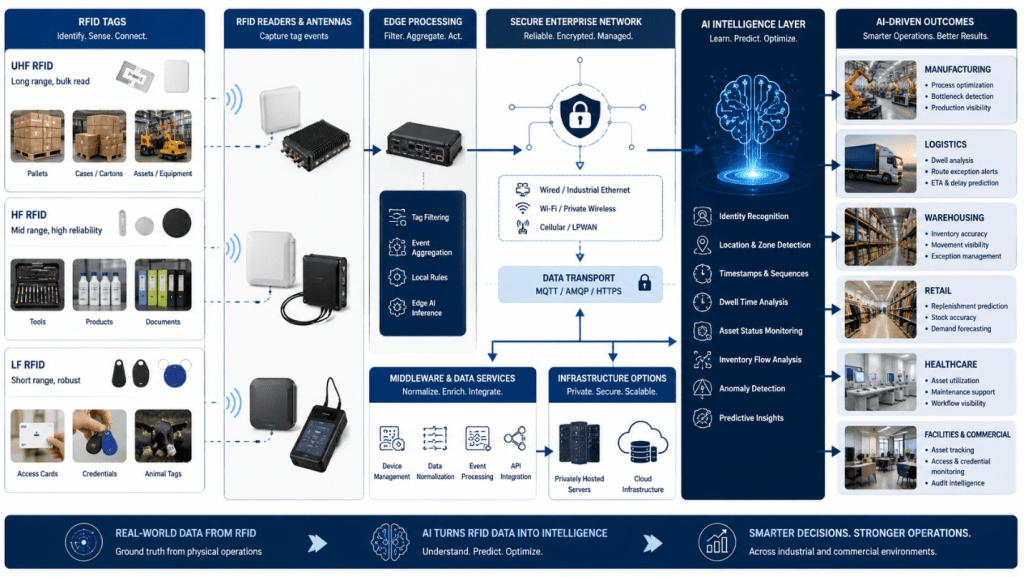
Artificial intelligence needs reliable RFID data to understand what physical assets exist, where they are detected, when they move, how long they remain in specific zones, and whether unusual events occur. UHF RFID, HF RFID, and LF RFID provide real-world operational data that AI can analyze to improve asset visibility, inventory accuracy, anomaly detection, predictive insights, and decision-making across manufacturing, logistics, warehousing, retail, healthcare, and commercial facilities.
The Fundamental Relationship Between Artificial Intelligence and RFID
AI and RFID perform different but complementary technical functions. RFID identifies physical entities and records detection events. Artificial intelligence analyzes those events, combines them with contextual data, discovers relationships, and supports decisions or automated actions.
An RFID tag generally stores or references a unique identifier, such as an Electronic Product Code (EPC), Unique Item Identifier (UII), serial number, credential identifier, or application-specific data. A reader interrogates compatible tags using radio-frequency energy, captures responses, and generates read events containing fields such as tag identity, reader identity, antenna port, timestamp, received signal strength indicator (RSSI), phase information, read count, and protocol control data.
Raw RFID reads are not automatically equivalent to business truth. One tagged item may be read hundreds of times while stationary. Reflections, RF interference, antenna overlap, orientation, tag placement, conductive materials, liquids, and environmental conditions can influence detection behavior. Consequently, an enterprise AI + RFID architecture requires filtering, deduplication, event normalization, temporal aggregation, zone logic, contextual enrichment, and confidence scoring before many AI functions can use the data effectively.
AI can then analyze questions such as:
- Is an asset moving through the expected sequence of operational zones?
- Does an inventory movement indicate replenishment demand, congestion, or possible shrinkage?
- Is a tool missing from its assigned work area?
- Does an unusual dwell time indicate a production bottleneck?
- Is a shipment likely to miss a service-level target based on current movement patterns?
- Are repeated RFID read anomalies caused by operational behavior, RF conditions, or hardware degradation?
- Does the combination of RFID events, machine telemetry, and enterprise records indicate a developing exception?
GAO supplies RFID hardware products and systems that help organizations establish this physical data acquisition layer. The engineering value of such infrastructure depends not simply on collecting more reads, but on generating reliable, contextualized events that downstream AI functions can interpret.
RFID Gives AI a Machine-Readable Identity Layer for Physical Entities
Computer vision can identify visible objects, but it may be affected by lighting, occlusion, camera angle, image quality, privacy requirements, and visually identical items. Barcodes are economical and widely used but generally require optical visibility and deliberate scanning. RFID provides a different sensing mechanism by enabling wireless identification without optical line of sight.
This capability gives AI access to persistent identities for:
- Raw materials and work-in-process items
- Pallets, cases, cartons, and reusable transport items
- Tools, instruments, and maintenance equipment
- IT assets and electronic equipment
- Uniforms, textiles, and reusable containers
- Books, documents, files, and evidence items
- Access cards and credentials
- Livestock and animal identifiers
- Medical equipment and selected healthcare assets
- Retail merchandise and inventory
- Vehicles and tagged transportation assets
Identity alone, however, is only the beginning. AI derives greater value when tag identity is associated with timestamps, zones, business processes, product master data, work orders, maintenance histories, warehouse locations, shipment records, and other contextual information.
RFID Events Provide Temporal and Spatial Context for AI
A typical RFID event answers several foundational questions: what was detected, which reader detected it, when the event occurred, and under what RF conditions. With engineered antenna zones and appropriate event processing, additional operational context can be inferred.
For example, a UHF RFID deployment may detect a tagged pallet near a receiving dock, storage aisle, production staging area, packing zone, and outbound portal. The sequence and timing of these detections can provide an AI model with a movement history. Machine learning can then analyze cycle time, dwell time, route deviation, congestion, throughput patterns, and exception probability.
RFID is not inherently a universal centimeter-level positioning technology. Location accuracy depends on reader type, antenna design, tag characteristics, RF propagation, deployment density, algorithms, and environmental conditions. Zone-level presence is often more reliable than attempting to infer precise coordinates from conventional passive RFID infrastructure. Experienced engineering therefore aligns location claims with actual hardware capabilities rather than treating every tag read as exact positioning data.
How RFID Data Gives Artificial Intelligence Physical-World Context
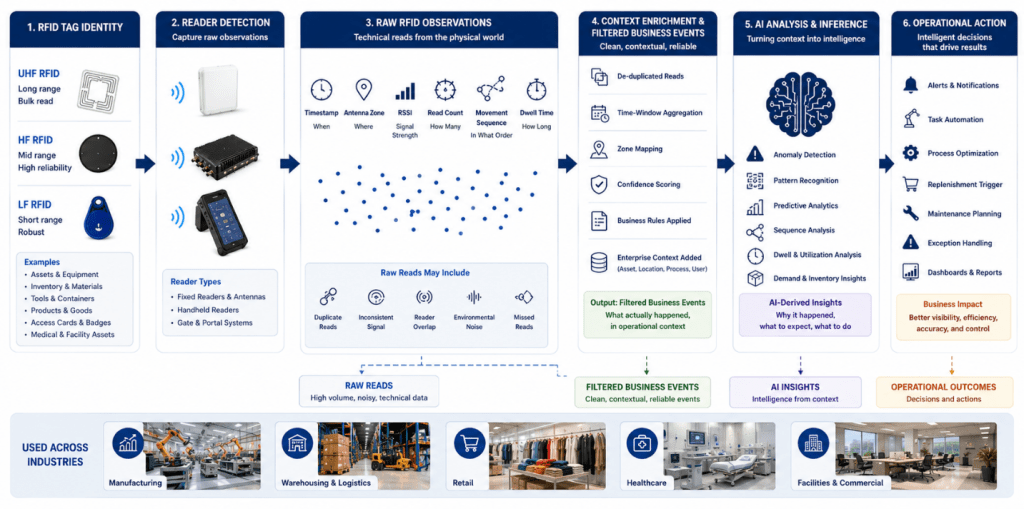
Artificial intelligence needs RFID data to identify physical assets, understand when and where they are detected, analyze movement sequences and dwell times, and recognize operational patterns. By transforming raw UHF RFID, HF RFID, and LF RFID observations into contextual business events, AI can detect anomalies, predict outcomes, optimize processes, and support better decisions across manufacturing, warehousing, logistics, retail, healthcare, and commercial facilities.
How RFID Data Becomes AI-Driven Operational Intelligence
The complete AI + RFID workflow extends from electromagnetic tag interrogation to enterprise action. Each stage affects data quality, model reliability, scalability, latency, cybersecurity, and operational value.
RFID Tags Establish Physical Identity and Data Association
RFID tags may be passive, battery-assisted passive, or active, depending on the application and technology. Passive UHF RFID tags are widely used for supply chains, inventory, asset identification, manufacturing, logistics, and retail because they can support relatively long read ranges and simultaneous identification of multiple tags under suitable conditions.
HF RFID, commonly operating at 13.56 MHz, supports applications requiring shorter-range interactions and includes technologies associated with ISO/IEC 14443, ISO/IEC 15693, and NFC-related implementations. LF RFID, commonly operating around 125 kHz or 134.2 kHz, is used for selected proximity identification, animal identification, access-related functions, and environments where lower-frequency propagation characteristics are advantageous.
Tag selection must account for:
- Operating frequency and regional regulations
- Read-range requirements
- Tag memory architecture
- Surface material, including metal or liquid exposure
- Temperature and environmental conditions
- Mechanical durability
- Attachment method
- Form factor and orientation
- Chemical exposure
- Required lifespan
- Cost per tagged entity
- Applicable air-interface and application standards
Poor tag selection creates weak input data before AI processing even begins. No machine learning algorithm can fully compensate for systematically missing observations caused by unsuitable tag construction, poor placement, inadequate antenna coverage, or incorrect RF engineering.
Readers and Antennas Capture Physical Events
RFID readers generate the observation stream used by downstream software and AI functions. Fixed readers may monitor dock doors, portals, production cells, storage areas, chokepoints, access zones, and conveyor systems. Handheld readers support mobile inventory, cycle counting, asset search, commissioning, exception handling, and maintenance activities. Embedded and integrated readers can support kiosks, cabinets, machines, vehicles, workstations, and specialized equipment.
A reader event may contain:
- EPC or another tag identifier
- Reader identifier
- Antenna identifier
- Event timestamp
- RSSI
- Phase data where supported
- Channel or frequency information
- Read count
- Protocol metadata
- General-purpose input/output state
- Reader health information
A well-designed deployment treats these attributes as evidence rather than assuming every individual read is a confirmed business event. AI and rules-based processing can improve interpretation, but reliable RF engineering remains essential.
Edge Processing Converts Noisy Reads Into Meaningful Events
RFID infrastructure can produce large volumes of repetitive observations. Sending every raw read directly into long-term enterprise storage is often inefficient and can increase bandwidth, storage costs, processing overhead, and model noise.
Edge software or middleware can perform:
- Duplicate suppression
- Read smoothing
- Time-window aggregation
- Tag filtering
- Reader and antenna normalization
- Zone mapping
- Direction-of-travel inference
- Threshold processing
- Event correlation
- Data compression
- Local buffering during network interruptions
- Rules-based exception handling
AI inference may also run near the RFID infrastructure when low latency, bandwidth limitations, operational continuity, or data governance requires local processing. An edge server could, for example, identify an unauthorized asset movement and trigger a local alert without waiting for remote processing.
GAO has helped organizations by supplying RFID and IoT hardware products and systems that can support data capture across asset tracking, inventory visibility, access-related applications, industrial operations, and other enterprise use cases. Effective deployments match the reader, antenna, tag, communication interface, and processing architecture to the actual operational environment.
Secure Communication Infrastructure Moves RFID Events to Software
Processed RFID data may travel through Ethernet, Wi-Fi, cellular connectivity, serial interfaces, industrial networks, or other communication methods depending on the reader and deployment architecture. Application-layer integration can involve REST APIs, webhooks, message queues, MQTT, AMQP, WebSocket connections, database interfaces, vendor SDKs, or middleware connectors.
Network architecture should consider:
- Expected read-event volume
- Peak burst traffic
- Acceptable latency
- Offline buffering requirements
- Quality of service
- Network segmentation
- Device authentication
- Encryption in transit
- Certificate management
- Firewall rules
- High availability
- Remote management
- Time synchronization
Timestamp integrity is especially important. AI models analyzing movement sequences, process durations, dwell times, or anomalies can produce misleading conclusions when reader clocks are inconsistent. Network Time Protocol synchronization, standardized time zones, event-order handling, and clock-drift monitoring should therefore be included in the architecture.
AI Methods That Depend on RFID Data
RFID data can support multiple AI and machine learning methods. The appropriate model depends on the business question, data volume, event structure, latency requirements, availability of labeled examples, and consequences of incorrect predictions.
Anomaly Detection for Unusual RFID Events
Anomaly detection identifies behavior that deviates from established operational patterns. Relevant methods may include Isolation Forest, One-Class Support Vector Machines, autoencoders, clustering techniques, statistical process monitoring, or custom time-series methods.
Examples include:
- A tagged asset appearing in an unexpected zone
- An inventory item bypassing a required process stage
- Unusually long dwell time between production operations
- Unexpected movement outside scheduled hours
- Abnormal read-rate changes that may indicate antenna, tag, reader, or environmental issues
An important engineering distinction exists between an operational anomaly and a data-quality anomaly. A missing read may indicate that an asset failed to pass through a checkpoint, but it could also result from RF shadowing, tag damage, orientation, interference, or hardware failure. Reliable AI systems should consider reader health, historical detection probability, adjacent antenna observations, and contextual enterprise data before assigning confidence to an exception.
Predictive Analytics for Inventory, Assets, and Process Flow
Historical RFID event sequences can support predictive models for demand, replenishment, cycle times, asset utilization, congestion, maintenance planning, and process delays.
Feature engineering may derive variables such as:
- Frequency of tag detections
- Time since last observation
- Average dwell time by zone
- Transition probability between locations
- Asset utilization frequency
- Inventory velocity
- Process cycle duration
- Number of route deviations
- Detection confidence
- Reader health status
These features can be processed by regression models, decision trees, random forests, gradient boosting methods, neural networks, or specialized time-series models. Model complexity should be justified by measurable performance. For many enterprise RFID applications, interpretable models combined with strong event engineering can outperform unnecessarily complex architectures from an operational governance perspective.
Sequence Analysis for Movement and Process Intelligence
RFID naturally generates sequential data. A tagged item may progress from receiving to inspection, storage, production, quality control, packaging, and shipping. AI can analyze such sequences to identify normal paths, unexpected transitions, skipped stages, rework loops, and bottlenecks.
Relevant techniques may include:
- Markov models
- Hidden Markov Models
- Recurrent neural networks
- Long short-term memory networks
- Transformer-based sequence models
- Process mining
- Graph-based analytics
Process mining is particularly useful when RFID events can be associated with business process stages. Rather than analyzing isolated reads, the software reconstructs event sequences and compares actual operations with expected workflows.
How RFID Signals Become AI Predictions and Operational Decisions
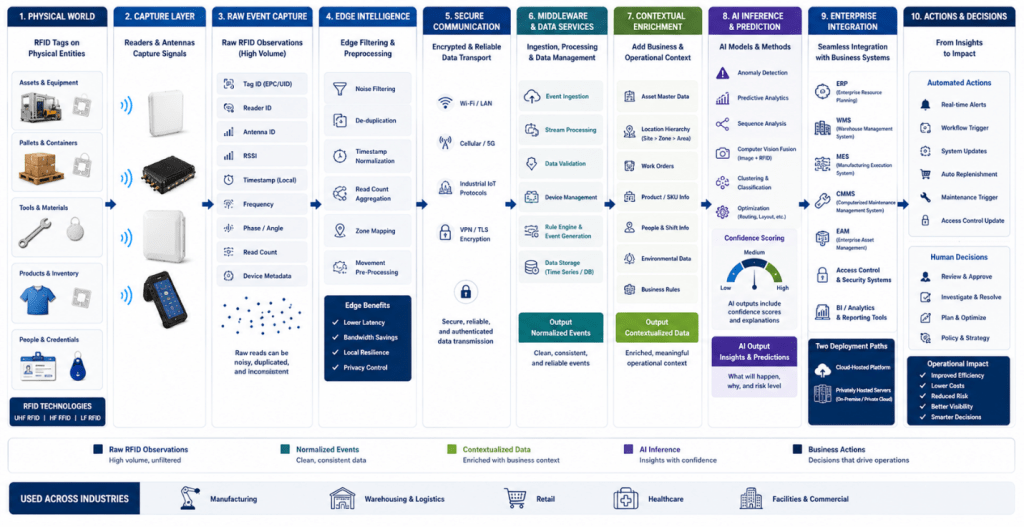
RFID data gives artificial intelligence the physical-world evidence needed to understand assets, inventory, materials, tools, and operational movements. The workflow transforms raw RFID observations through edge filtering, secure communication, contextual enrichment, and AI inference into predictions, anomaly detection, automated actions, and human decisions across manufacturing, warehousing, logistics, retail, healthcare, and commercial facilities.
Enterprise Architecture for AI and RFID Systems
An enterprise AI + RFID architecture usually contains several interconnected layers. The exact design varies according to operational scale, latency, security policy, existing IT and operational technology infrastructure, and whether processing is cloud-hosted or privately hosted.
Physical RFID Layer
The physical layer contains UHF RFID, HF RFID, or LF RFID tags; fixed or handheld readers; antennas; cables; mounting infrastructure; power supplies; and environmental protection where required.
Engineering decisions at this layer determine:
- Detection reliability
- Read-zone boundaries
- Tag orientation tolerance
- Simultaneous tag population handling
- Interference susceptibility
- Environmental resilience
- Maintenance requirements
Site surveys, RF testing, antenna tuning, reader power configuration, tag placement studies, and representative load testing are critical before full-scale commissioning.
Edge and Middleware Layer
The edge and middleware layer converts device-specific observations into structured events. Functions may include reader management, protocol translation, filtering, buffering, device health monitoring, business-rule execution, and API exposure.
Standards such as EPCglobal Low Level Reader Protocol (LLRP) can support reader communication in compatible UHF RFID environments, while EPC Information Services (EPCIS) can help represent visibility events across supply chains and enterprise processes. MQTT, REST APIs, AMQP, and message brokers may support event distribution depending on system requirements.
Data and AI Layer
The data layer may use relational databases, time-series databases, object storage, event streams, caches, or graph databases depending on the workload. AI processing can occur at the edge, on customer-managed servers, within private data centers, or through cloud-hosted infrastructure.
Data architecture should preserve distinctions among:
- Raw RFID observations
- Filtered reader events
- Business events
- AI-generated features
- Model predictions
- Confidence scores
- Human decisions
- Automated actions
- Audit records
Combining these records into a single undifferentiated dataset can make troubleshooting, regulatory review, model validation, and root-cause analysis difficult.
Enterprise Integration Layer
AI + RFID software commonly exchanges information with:
- Enterprise Resource Planning systems
- Warehouse Management Systems
- Manufacturing Execution Systems
- Enterprise Asset Management software
- Computerized Maintenance Management Systems
- Transportation Management Systems
- Product Lifecycle Management software
- Access control systems
- Point-of-sale software
- Laboratory Information Management Systems
- Business intelligence and reporting software
Bidirectional integration provides the greatest operational context. An ERP system may tell the AI function what an item is and which order it belongs to, while RFID reports where and when it was observed. The AI model can then evaluate whether the observed physical state aligns with the expected business state.
GAO’s experience serving organizations across the U.S. and Canada includes customers such as Fortune 500 companies, leading R&D organizations, prestigious universities, and government agencies. This enterprise context is relevant because successful RFID deployment requires coordination among RF hardware, networking, cybersecurity, software integration, operational workflows, and long-term technical support.
Cloud Version and Server Version for AI + RFID Deployments
AI and RFID software can be deployed through a Cloud Version or Server Version. Neither architecture is universally superior. Selection should be based on latency, cybersecurity, scalability, data governance, operational continuity, IT resources, connectivity, integration requirements, and total cost of ownership.
Cloud Version
A Cloud Version runs within cloud-hosted infrastructure and is typically managed as a centrally accessible service. It can be appropriate for geographically distributed facilities, centralized analytics, large device fleets, rapid capacity expansion, and organizations that prefer reduced responsibility for maintaining application infrastructure.
Cloud deployments can support:
- Centralized multi-site RFID visibility
- Elastic compute resources for AI training and inference
- Consolidated reporting
- Remote access for authorized users
- Central model deployment
- Cross-facility benchmarking
- Scalable event processing
Reliable connectivity must be considered. Edge buffering and local fallback logic are often necessary when operations cannot stop during WAN interruptions.
Server Version
A Server Version runs on edge servers, customer-managed servers, factory servers, private data centers, or other privately hosted enterprise infrastructure. It is not restricted to physically on-premises deployment.
Server deployments may be preferred when organizations require:
- Direct control over data residency
- Low-latency local processing
- Operation during external connectivity interruptions
- Integration with isolated operational technology networks
- Internally controlled cybersecurity policies
- Private AI model execution
- Customized infrastructure management
A Server Version places greater responsibility on the organization for infrastructure capacity, patching, backup, disaster recovery, monitoring, cybersecurity, and high availability unless these services are provided by an external managed infrastructure partner.
| Deployment Consideration | Cloud Version | Server Version |
| RFID data processing | Centralizes RFID events from multiple readers and sites for AI analysis. | Processes RFID events on privately managed edge, factory, or enterprise servers. |
| AI decision speed | Best for forecasting, historical analytics, and multi-site intelligence. | Best for low-latency AI decisions and immediate RFID-triggered actions. |
| Data control | RFID and AI data are managed through cloud security controls. | Greater direct control over RFID data, AI models, and infrastructure. |
| Connectivity | May use edge buffering when internet connectivity is interrupted. | Can continue local RFID processing without external cloud connectivity. |
| Best fit | Multi-site inventory, asset visibility, and centralized AI analytics. | Factories, private networks, sensitive data, and real-time automation. |
A hybrid architecture is often appropriate. RFID reads can be filtered locally, urgent AI inference can occur at the edge, and selected events can be forwarded to centralized cloud-hosted software for long-term analytics, fleet-wide reporting, and model improvement.
Data Quality Determines Whether AI Can Trust RFID Events
Artificial intelligence requires representative, consistent, and correctly contextualized input. RFID data quality can be affected by tag placement, RF propagation, antenna geometry, reader configuration, electromagnetic interference, environmental changes, network interruptions, clock synchronization, duplicate observations, and incorrect business mappings.
AI models should not be trained directly on uncontrolled RFID read streams without data-quality analysis. A technically sound workflow evaluates:
- Read completeness
- False-positive event probability
- Duplicate-read behavior
- Zone overlap
- Time synchronization
- Missing-event patterns
- Reader uptime
- Tag population density
- Environmental variation
- Ground-truth accuracy
- Label quality
- Model drift
GAO has invested heavily in research and development, stringent quality assurance processes, and expert technical support delivered remotely or onsite. These capabilities matter because the performance of AIoT and Artificial Intelligence of Things deployments begins with dependable physical data acquisition and careful system engineering rather than AI algorithms alone.
H3: Confidence Scoring Improves AI Decision Reliability
Not every RFID event should receive equal confidence. A stronger event interpretation may combine multiple observations, including reader identity, antenna zone, RSSI patterns, temporal consistency, adjacent reader detections, expected process routes, and enterprise records.
For example, one isolated read from a distant antenna may have lower confidence than repeated detections from a defined portal combined with a matching shipment record and expected movement sequence.
Confidence scoring can help AI distinguish among:
- Confirmed operational events
- Probable events
- Ambiguous observations
- Suspected RF artifacts
- Missing expected events
- Hardware-related anomalies
This approach reduces the risk of treating every individual tag response as definitive physical truth and creates a more defensible foundation for automated decision-making.
Ground Truth Remains Essential for Model Validation
Ground truth is required to determine whether an AI prediction reflects reality. During commissioning, engineers may compare RFID-derived events with manual observations, barcode scans, machine states, weight sensors, photoelectric sensors, video records where appropriate, or enterprise transaction records.
A model that reports 99 percent accuracy can still be operationally weak if the training dataset is imbalanced, critical exceptions are rare, or the validation data does not represent actual production conditions. Precision, recall, false-positive rate, false-negative rate, detection probability, latency, and business impact should be evaluated according to the application.
For safety-sensitive, security-sensitive, financial, or compliance-related actions, human review or deterministic validation rules may remain necessary even when AI confidence is high.
Key Technical Capabilities Enabled by AI + RFID
Combining artificial intelligence with RFID allows industrial and commercial organizations to move beyond basic identification toward contextual awareness, predictive analysis, exception detection, and operational optimization. The value does not come from applying AI to every tag read. It comes from transforming reliable RFID observations into structured events, combining those events with operational context, and applying appropriate AI methods to clearly defined business problems.
Real-Time Asset and Inventory Visibility
RFID enables rapid identification of tagged assets, materials, inventory, tools, containers, and equipment without requiring individual line-of-sight scanning. AI improves this visibility by evaluating detection histories, movement patterns, expected locations, process states, and enterprise records.
AI + RFID software can help determine:
- Which tagged entities are currently detected within monitored zones
- When an asset was last observed
- Whether an item followed its expected route
- Which inventory has remained stationary beyond an acceptable threshold
- Whether an asset has moved into an unauthorized or unexpected area
- Which missing observations require immediate investigation
- Whether apparent inventory discrepancies are likely operational exceptions or RFID data-quality issues
Operational visibility should always be expressed according to the actual detection architecture. A passive UHF RFID portal designed for chokepoint monitoring should not be represented as providing continuous precise coordinates unless additional location technology and validated algorithms support that capability.
AI-Driven Exception Detection
Traditional RFID software often depends on predefined rules. A rule might trigger an alert whenever an asset enters a restricted zone. AI can extend this capability by detecting deviations that were not explicitly programmed as fixed thresholds.
Machine learning may identify:
- Abnormal dwell times
- Unexpected movement sequences
- Unusual asset utilization
- Inventory flow deviations
- Process-stage omissions
- Recurring congestion patterns
- Suspicious combinations of RFID events
- Reader-performance degradation
- Changes in expected tag detection behavior
Effective exception detection requires careful tuning. Excessive alerts create alarm fatigue and reduce operational trust. Thresholds, confidence scores, suppression windows, escalation policies, and human feedback should therefore be incorporated into the operational design.
Predictive Inventory and Replenishment Intelligence
RFID creates frequent observations of inventory movement, which can improve the data available to forecasting and replenishment models. AI can combine RFID-derived inventory velocity with sales transactions, production schedules, purchase orders, supplier lead times, seasonal patterns, and historical demand.
Potential outcomes include:
- Earlier detection of stockout risk
- Improved replenishment timing
- Reduced safety-stock requirements where data quality supports it
- Identification of slow-moving inventory
- Better allocation across facilities
- Improved production-material availability
- More accurate inventory reconciliation
AI does not eliminate the need for inventory controls. Cycle counting, exception investigation, master-data governance, tag commissioning, and physical verification remain necessary. The objective is to reduce uncertainty and focus human effort on high-value exceptions.
Process Optimization Through RFID Event Sequences
Manufacturing, logistics, healthcare, retail, and commercial facilities generate sequences of physical events. RFID can capture these sequences when tagged entities pass through monitored areas.
AI and process-mining methods can analyze:
- Actual versus expected process paths
- Average and abnormal cycle times
- Rework loops
- Skipped process stages
- Queue formation
- Resource utilization
- Work-in-process accumulation
- Repeated operational bottlenecks
GAO supplies RFID, BLE, and other IoT technology-based hardware products and systems that can support these physical data acquisition requirements. Reliable process intelligence begins with correct tag selection, RF engineering, reader placement, event filtering, and integration with the operational systems that define expected business states.
Industrial and Commercial Applications of AI + RFID
AI and RFID can support different operational objectives depending on the sector, physical environment, tagged entity, required read range, process velocity, data sensitivity, and enterprise integration requirements. Deployment architecture should therefore be application-specific rather than based on a universal template.
Manufacturing and Smart Factory Operations
Manufacturers can use UHF RFID to identify raw materials, work-in-process, finished goods, reusable containers, tools, fixtures, and selected production assets. AI can analyze the resulting event histories to identify bottlenecks, route deviations, production delays, unusual dwell times, and material shortages.
Typical integrations include Manufacturing Execution Systems, ERP software, warehouse software, Programmable Logic Controllers, industrial gateways, machine telemetry, and quality management software.
Engineering considerations include:
- Metal-rich RF environments
- Machinery-generated electromagnetic interference
- High-temperature processes
- Tag survivability
- Rapid conveyor movement
- Dense tag populations
- Production takt time
- Required inference latency
- Integration with machine control
AI-driven improvements may include production-flow prediction, work-in-process visibility, automated material verification, cycle-time analysis, and early detection of process exceptions.
Warehousing, Distribution, and Logistics
Warehouses and distribution centers can use RFID at receiving doors, storage zones, picking areas, packing stations, conveyor systems, and outbound portals. AI analyzes movement sequences and inventory events to detect misplaced goods, unexpected dwell times, shipment exceptions, congestion, and replenishment requirements.
A practical architecture may combine fixed UHF RFID portals for chokepoint monitoring with handheld readers for exception resolution and cycle counting. Edge filtering can suppress duplicate observations before normalized events are sent to warehouse software or AI functions.
Expected business outcomes can include:
- Faster inventory verification
- Reduced manual scanning
- Improved shipment accuracy
- Earlier exception detection
- Better dock utilization
- More efficient cycle counting
- Improved traceability
Read-zone design is critical. Overlapping dock-door antennas can create ambiguous location events unless shielding, antenna selection, power tuning, direction logic, and event correlation are properly engineered.
Retail and Commercial Inventory Management
Retail environments can use item-level RFID to improve inventory visibility, stockroom accuracy, replenishment, loss investigation, and omnichannel fulfillment. AI can analyze RFID events together with point-of-sale transactions, product master data, online orders, returns, and historical demand.
Relevant AI functions include:
- Stockout prediction
- Replenishment prioritization
- Inventory discrepancy detection
- Product movement analysis
- Return anomaly detection
- Demand forecasting
- Fulfillment optimization
Privacy must be considered carefully when RFID tags remain attached to purchased items. Organizations should evaluate data minimization, tag deactivation or kill functionality where appropriate, access controls, retention policies, applicable privacy obligations, and transparent operational practices.
Healthcare Assets and Medical Operations
Hospitals and healthcare facilities may use RFID to identify selected medical equipment, instruments, supplies, textiles, credentials, and other tagged entities. AI can analyze usage frequency, dwell time, movement histories, equipment availability, and process exceptions.
Potential applications include:
- Medical equipment availability
- Inventory management
- Instrument workflow monitoring
- Linen and textile management
- Asset utilization analysis
- Maintenance scheduling support
Healthcare environments introduce strict requirements for cybersecurity, privacy, infection control, electromagnetic compatibility, data governance, and system reliability. RFID architecture must be designed according to the specific clinical environment and applicable regulatory requirements rather than assuming that an industrial deployment pattern can be transferred unchanged.
Transportation and Fleet-Related Operations
RFID can support identification of vehicles, reusable transport items, containers, cargo, maintenance tools, and access credentials. AI can correlate these observations with transportation schedules, telematics, maintenance histories, GPS data, and shipment records.
Potential improvements include:
- Yard visibility
- Vehicle identification
- Container tracking
- Maintenance planning
- Route exception analysis
- Turnaround-time optimization
RFID and GPS perform different functions. RFID generally provides identification or localized detection when a tagged entity interacts with reader infrastructure, while GPS supports broader outdoor geolocation. Combining these technologies can give AI both identity and location context where technically appropriate.
Data Centers, Offices, and Commercial Facilities
Commercial facilities can use RFID for IT asset identification, equipment audits, document management, access credentials, tool tracking, and other asset-management functions.
AI can help identify:
- Unusual asset movements
- Missing equipment
- Underutilized assets
- Audit discrepancies
- Unexpected access-related patterns
- Maintenance requirements
GAO is headquartered in New York City and Toronto, Canada, and is ranked among the top 10 leading B2B and B2G, and to a lesser degree B2B2C and B2D, BLE and RFID suppliers worldwide. This operational experience supports organizations evaluating RFID hardware and systems for complex industrial and commercial requirements.
| Sector | Why AI Needs RFID Data | AI Application | Operational Value |
| Manufacturing | RFID provides real-time identity and movement data for materials, work-in-process, tools, and containers. | AI detects bottlenecks, abnormal process sequences, and production delays. | Improves production visibility and reduces cycle-time losses. |
| Warehousing | RFID shows AI which pallets, cases, and inventory items are present, moved, or missing. | AI predicts inventory needs and identifies movement exceptions. | Improves inventory accuracy and shipment control. |
| Logistics | RFID captures cargo identity, checkpoint events, and container dwell times. | AI predicts delays and detects route or handling exceptions. | Improves traceability and turnaround times. |
| Retail | RFID supplies item-level inventory and product movement data. | AI predicts replenishment needs, stockouts, and inventory discrepancies. | Improves product availability and fulfillment efficiency. |
| Healthcare | RFID identifies equipment, instruments, supplies, and their movement histories. | AI analyzes utilization, anomalies, and maintenance requirements. | Improves asset availability and operational workflows. |
| Commercial Facilities | RFID provides detection histories for IT assets, equipment, documents, and credentials. | AI identifies unusual movements, missing assets, and audit discrepancies. | Strengthens asset control and operational accountability. |
Deployment Lifecycle for Enterprise AI + RFID Systems
Successful AI + RFID implementation requires coordinated planning across RF engineering, operational processes, IT architecture, data engineering, artificial intelligence, cybersecurity, enterprise integration, and change management. Installing readers before defining operational requirements frequently creates unnecessary hardware costs and poor data quality.
Requirements and Operational Process Assessment
Deployment planning should begin with the business process rather than the AI model. Engineering teams should determine which physical entities require identification, which operational events matter, what decisions will use the resulting data, and what accuracy and latency are actually required.
Requirements should define:
- Tagged entity types
- Expected tag population
- Required read zones
- Process velocity
- Environmental conditions
- Detection probability targets
- Acceptable false-positive rates
- Decision latency
- Data retention
- Enterprise integration requirements
- Cybersecurity requirements
- Privacy constraints
- Business continuity requirements
A clearly defined operational event such as “tagged pallet confirmed through outbound portal” is more useful than a vague objective such as “use AI for warehouse optimization.”
RFID Technology and Hardware Selection
UHF RFID, HF RFID, and LF RFID have different physical characteristics, standards, read ranges, tag costs, environmental behaviors, and application suitability.
UHF RFID is often appropriate for:
- Inventory
- Pallets and cases
- Logistics
- Warehousing
- Manufacturing
- Asset identification
- Longer-range passive identification
HF RFID may be selected for:
- Shorter-range item identification
- Smart cards
- Library applications
- Controlled proximity interactions
- NFC-related use cases
LF RFID may be suitable for:
- Close-proximity identification
- Animal identification
- Vehicle immobilizer applications
- Selected environments where lower-frequency characteristics are advantageous
Hardware selection should include representative testing with actual objects, packaging, materials, environmental conditions, tag orientations, process speeds, and expected tag populations.
Site Survey and RF Engineering
RF performance can change substantially between a laboratory and an operating facility. Metal racks, liquids, machinery, people, forklifts, moving equipment, structural materials, electromagnetic noise, and adjacent readers can influence detection.
A site survey should evaluate:
- Physical layout
- RF reflections
- Interference sources
- Antenna mounting positions
- Cable lengths and losses
- Reader placement
- Network availability
- Power availability
- Environmental protection
- Maintenance access
- Safety restrictions
Read power should not simply be maximized. Excessive power can expand detection zones, create cross-reads, increase ambiguity, and interfere with adjacent read points. Effective engineering seeks the minimum reliable configuration that meets the required detection objective.
Architecture and Cloud Versus Server Selection
Architecture decisions should consider where filtering, event processing, AI inference, model training, databases, enterprise integration, dashboards, and audit records will operate.
A Cloud Version may be suitable when centralized management, multi-site visibility, elastic processing, and remote accessibility are priorities.
A Server Version may be appropriate when organizations require private infrastructure, local processing, controlled data residency, isolated networks, or operation without continuous external connectivity.
Hybrid deployment can provide local resilience and low-latency inference while supporting centralized analytics and model improvement.
GAO can help organizations evaluate RFID hardware and system requirements based on read environment, tag type, operational process, communication architecture, and integration objectives rather than selecting technology solely from nominal product specifications.
System Integration, Commissioning, and Interoperability
RFID and AI systems rarely operate independently. Their value increases when physical observations are associated with ERP records, warehouse transactions, production orders, maintenance histories, access permissions, product master data, and other enterprise information.
Enterprise Software Integration
Integration may use:
- REST APIs
- Webhooks
- MQTT
- AMQP
- Message brokers
- Database connectors
- Vendor SDKs
- WebSocket connections
- File exchange
- Industrial gateways
Data contracts should define identifiers, timestamps, event types, schema versions, confidence values, error handling, retry behavior, and ownership of master data.
Identifier consistency is essential. If an RFID EPC maps incorrectly to a product, asset, shipment, or employee-associated credential record, AI can make technically sophisticated but operationally incorrect conclusions.
Commissioning and Acceptance Testing
Commissioning should validate the complete data chain from physical tag response to business action.
Testing should include:
- Representative tag populations
- Expected and unexpected tag orientations
- Normal operating speeds
- Peak process volumes
- Adjacent reader interference
- Network interruption
- Server or service restart
- Duplicate observations
- Missing reads
- Clock drift
- Database recovery
- Enterprise API failure
- AI model timeout
- False-positive and false-negative events
Acceptance criteria should be measurable. Examples include detection probability, event latency, inventory accuracy, portal direction accuracy, uptime, processing throughput, and maximum acceptable exception rates.
Interoperability and Standards
Standards can reduce integration complexity and improve long-term maintainability. Relevant standards and specifications may include:
- EPCglobal Class 1 Generation 2
- ISO/IEC 18000-63
- ISO/IEC 14443
- ISO/IEC 15693
- ISO 11784 and ISO 11785 for relevant animal identification applications
- EPCIS
- LLRP
- GS1 identification standards
- MQTT
- HTTPS
- TLS
Standards compliance does not guarantee complete interoperability. Vendor-specific extensions, data schemas, firmware behavior, tag memory configuration, antenna design, APIs, and enterprise business rules still require validation.
Cybersecurity, Privacy, and AI Governance for RFID Data
RFID systems connect physical operations with digital infrastructure, which makes cybersecurity an architectural requirement rather than an optional software feature.
Device and Network Security
Security controls may include:
- Network segmentation
- Device authentication
- Role-based access control
- Least-privilege authorization
- TLS encryption
- Certificate management
- Secure credential storage
- Firewall policies
- Firmware management
- Security logging
- Vulnerability management
- Backup and recovery procedures
RFID readers should not be unnecessarily exposed to public networks. Management interfaces, APIs, default credentials, firmware versions, and remote-access methods require controlled administration.
Data Security and Privacy
RFID event records can become sensitive when they reveal information about assets, inventory, operations, credentials, or people-associated identifiers. Data governance should address:
- Data minimization
- Encryption in transit
- Encryption at rest
- Access controls
- Retention periods
- Audit logging
- Data residency
- Backup protection
- Secure deletion
- Privacy impact assessments where appropriate
Organizations should avoid collecting data simply because it is technically possible. Each retained RFID event should have a defined operational, analytical, security, or regulatory purpose.
AI Model Governance
AI-generated decisions require traceability, particularly when models influence security, compliance, financial, safety-sensitive, or high-impact operational actions.
Governance should document:
- Model purpose
- Training data
- Feature definitions
- Validation methods
- Performance metrics
- Confidence thresholds
- Known limitations
- Model version
- Deployment date
- Drift monitoring
- Human override procedures
- Rollback procedures
GAO and its sister companies, GAO Research Inc. and GAO Tek Inc., form GAO Group, with operations based in New York City and Toronto, Canada. Three decades of serving enterprise, research, academic, and government customers have reinforced the importance of reliability, quality assurance, controlled implementation, and expert technical support in IoT deployments.
How AI + RFID Security Protects Data From Tag Capture to Enterprise Action
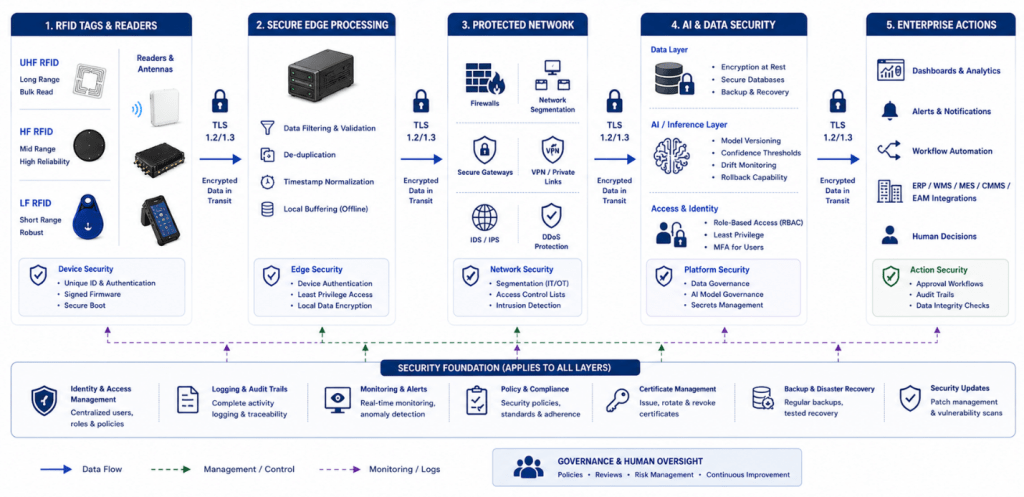
AI needs trustworthy RFID data, making security essential from initial UHF RFID, HF RFID, and LF RFID capture through AI inference and enterprise action. Defense-in-depth controls such as device authentication, TLS encryption, network segmentation, role-based access, model governance, continuous monitoring, and audit trails help protect RFID data while supporting reliable analytics, automation, alerts, and human decisions.
Scalability and Performance Engineering for Large RFID Data Volumes
RFID event volumes can grow rapidly when thousands or millions of tagged entities interact with multiple readers. Scalability therefore depends on more than database capacity.
Architecture should account for:
- Reader count
- Antenna count
- Tag population
- Reads per second
- Peak burst rates
- Duplicate-event volume
- Network bandwidth
- Edge filtering efficiency
- Message queue capacity
- Database write throughput
- AI inference latency
- Historical retention
- Disaster recovery
Raw observations and business events should often have different retention policies. High-volume raw data may be retained temporarily for troubleshooting or model development, while normalized business events can be stored longer for operational analytics and audit requirements.
Horizontal scaling can distribute event processing across multiple compute nodes. Partitioning by facility, reader, zone, tenant, or time period can improve throughput. Message queues can decouple RFID ingestion from AI inference and enterprise integration, reducing the risk that one downstream failure interrupts the entire event pipeline.
Edge AI Versus Centralized AI Processing
Edge AI can provide:
- Lower decision latency
- Reduced bandwidth requirements
- Local operation during WAN outages
- Greater control over sensitive operational data
Centralized AI can provide:
- Larger shared compute resources
- Consolidated multi-site analysis
- Central model governance
- Easier fleet-wide comparison
The optimal architecture may divide responsibilities. Edge software can filter RFID reads and execute urgent inference, while centralized infrastructure performs long-term analysis, model training, cross-site benchmarking, and capacity-intensive optimization.
Maintenance, Monitoring, and Continuous Optimization
An AI + RFID deployment is not complete when the readers are installed and the initial AI model is commissioned. Physical environments, tag populations, workflows, equipment layouts, software versions, and operational behavior change over time.
Ongoing monitoring should evaluate:
- Reader uptime
- Antenna performance
- Read rates
- Missing-event frequency
- Tag failure patterns
- Network latency
- Processing backlog
- API failures
- Database health
- AI inference latency
- Prediction confidence
- Model drift
- False-positive trends
- False-negative trends
A sudden decline in detection performance should not automatically trigger AI retraining. Engineers should first investigate hardware condition, antenna movement, cable damage, environmental changes, tag placement, reader configuration, interference, network problems, and process modifications.
AI models should be retrained only when justified by validated evidence, representative data, and controlled testing.
Engineering Best Practices for Reliable AI + RFID Deployments
Practical implementation lessons include:
- Define business events before selecting AI models.
- Validate RFID performance with real tagged objects under actual operating conditions.
- Treat individual RFID reads as observations, not unquestionable physical truth.
- Use edge filtering to reduce duplicate data and unnecessary processing.
- Preserve raw data selectively for troubleshooting and model development.
- Synchronize reader and server clocks.
- Separate device events, business events, predictions, and actions.
- Design for network interruptions and offline buffering.
- Establish measurable acceptance criteria.
- Monitor both RF performance and AI performance.
- Use human review for high-impact decisions where appropriate.
- Maintain rollback procedures for models, software, firmware, and configurations.
- Document limitations and confidence levels.
- Apply cybersecurity controls from the initial architecture stage.
These practices help ensure that AI and RFID deployments remain technically defensible, maintainable, scalable, and aligned with operational reality.
Why Reliable RFID Data Is Essential for Artificial Intelligence
Artificial intelligence needs RFID data because AI cannot independently know the identity, presence, movement, sequence, and operational history of physical entities that are outside its digital data sources. RFID provides a machine-readable connection between physical objects and enterprise software, giving AI structured evidence about real-world operations.
The strongest AI + RFID implementations combine reliable RF engineering, appropriate tag selection, correctly configured readers and antennas, edge processing, secure communication, normalized events, contextual enterprise data, suitable AI methods, confidence scoring, cybersecurity, and continuous validation.
AIoT and the broader Artificial Intelligence of Things become operationally useful when physical-world data is accurate enough to support trustworthy decisions. UHF RFID, HF RFID, and LF RFID each contribute to this objective in different applications based on frequency characteristics, read range, environment, standards, and deployment requirements.
Organizations evaluating AI + RFID should begin with a specific operational question, validate the required physical observations, engineer the RFID infrastructure, establish reliable data pipelines, and then select AI methods appropriate to the available evidence and business consequences.
GAO provides RFID, BLE, and other IoT technology-based hardware products and systems for industrial and commercial applications. Organizations seeking to evaluate tag selection, reader infrastructure, deployment architecture, system integration, or AI-ready RFID data acquisition can learn more about GAO’s technology solutions, products, engineering expertise, and technical support.
An Invitation to Advise Industrial AI + IoT Ventures
Aperture is developing Industrial AI + IoT ventures, each structured as an independent Delaware C-Corp with its own founding team and seed raise. These ventures build on the 30-year enterprise IoT foundation of GAO Tek and GAO RFID, drawing on established engineering teams, domain expertise, and core technologies. A select group of experienced executives, technology leaders, entrepreneurs, and industry experts is being invited to participate as founding advisors. If this opportunity is of interest or you have questions, please submit your inquiry through the Contact Us page.