
AI and BLE for Iron & Steel Production: Intelligent Industrial Monitoring, Asset Intelligence, and Operational Optimization
AI and BLE Solutions for Modern Iron & Steel Production Operations
Iron and steel production are one of the most demanding continuous manufacturing environments in the Metal Processing industry. Steel plants operate continuously through tightly integrated processes that include raw material receiving, coke production, blast furnace operations, basic oxygen furnace (BOF) steelmaking, electric arc furnace (EAF) steelmaking, continuous casting, hot rolling, cold rolling, heat treatment, finishing, warehousing, and shipping. Stable production depends on precise coordination among heavy industrial equipment, mobile assets, maintenance teams, operators, quality engineers, and production planners while operating under extreme temperatures, dust, vibration, electromagnetic interference, and hazardous working conditions.
Artificial Intelligence (AI) combined with Bluetooth Low Energy (BLE) enables steel manufacturers to capture real-time operational information from BLE beacons, BLE gateways, and BLE sensors deployed throughout production facilities. AI transforms this information into operational intelligence by detecting equipment anomalies, predicting failures, optimizing maintenance schedules, improving workforce safety, increasing asset visibility, and supporting data-driven production decisions. AI and BLE also accelerate digital manufacturing initiatives by connecting operational information with manufacturing software, improving production efficiency, reducing downtime, increasing equipment availability, and enhancing product quality.
For more than three decades, GAO has supplied industrial BLE, RFID, and IoT hardware products and systems that help manufacturers improve operational visibility, equipment monitoring, and intelligent automation. Headquartered in New York City and Toronto, Canada, GAO is recognized among the world’s leading B2B suppliers of BLE and RFID technologies, serving Fortune 500 companies, leading research organizations, prestigious universities, and government agencies across North America.
AI and BLE Architecture for Intelligent Iron & Steel Production Operations
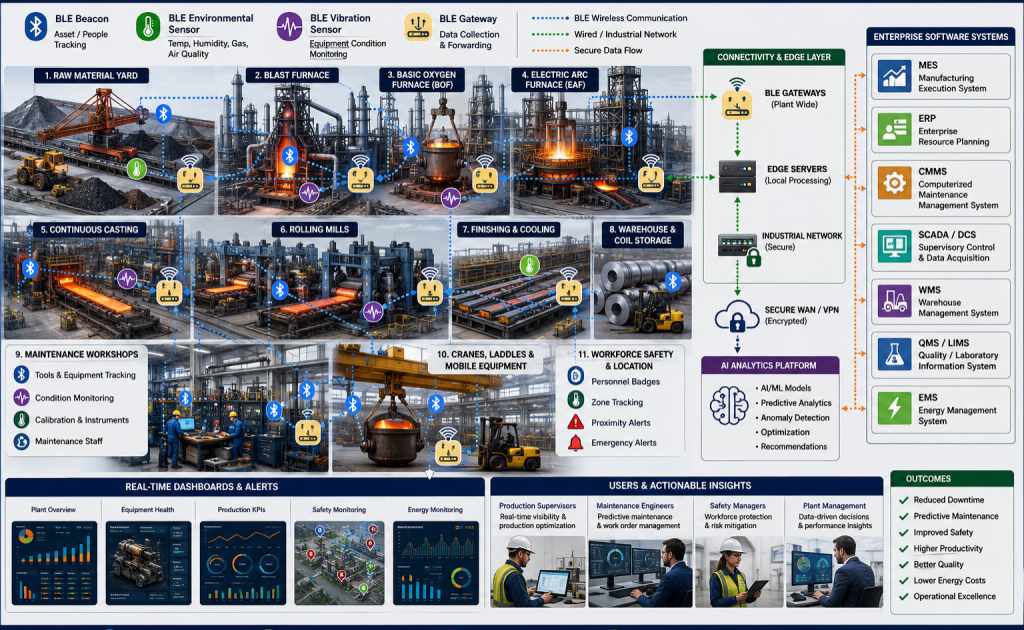
This demonstrates how BLE beacons, BLE gateways, and BLE sensors collect real-time operational data throughout an Iron & Steel Production facility. The diagram shows secure communication to edge computing and AI analytics, followed by integration with enterprise software such as MES, ERP, CMMS, SCADA, WMS, and QMS to support predictive maintenance, asset intelligence, workforce safety, production optimization, and data-driven decision-making.
Understanding AI and BLE in Iron & Steel Production
Iron and steel production generate enormous volumes of operational information every second. Every production area continuously produces equipment status, maintenance records, workforce activities, environmental measurements, material movement information, quality inspection data, and production performance metrics. Capturing and analyzing this information accurately is essential for maintaining stable operations, reducing downtime, improving safety, maximizing equipment utilization, and ensuring consistent steel quality.
BLE technology provides an energy-efficient method for collecting operational information from mobile equipment, personnel, maintenance tools, environmental sensors, transport assets, and production support equipment. Unlike conventional wired instrumentation that primarily monitors fixed machinery through PLCs and industrial controllers, BLE extends operational visibility to mobile assets that are traditionally difficult to monitor continuously.
Typical BLE devices deployed throughout Iron & Steel Production facilities include:
- BLE Beacons
- BLE Gateways
- BLE Temperature Sensors
- BLE Vibration Sensors
- BLE Environmental Sensors
- BLE Humidity Sensors
- BLE Personnel Badges
- BLE Asset Tags
- BLE Tool Tracking Tags
- BLE Mobile Equipment Sensors
- BLE Condition Monitoring Devices
- BLE Door and Access Sensors
BLE gateways securely collect information from nearby BLE devices before forwarding it through industrial communication networks to edge servers or centralized AI software.
Artificial intelligence complements BLE by continuously analyzing operational information alongside maintenance history, production schedules, environmental conditions, equipment relationships, and historical operating behavior. Rather than relying solely on threshold alarms, AI identifies hidden operational patterns that indicate developing equipment problems before failures occur.
Machine learning models continuously improve prediction accuracy by learning from historical production cycles, maintenance records, equipment failures, and operational outcomes. This enables production managers, reliability engineers, and maintenance supervisors to make proactive operational decisions rather than reactive repairs.
Together, AI and BLE create an intelligent monitoring solution that supports predictive maintenance, operational optimization, workforce safety, asset intelligence, and continuous improvement across modern steel manufacturing facilities.
AI and BLE Applications Throughout Iron & Steel Production
BLE technology delivers operational value across virtually every production area by improving equipment visibility, workforce coordination, maintenance efficiency, and operational intelligence.
Raw Material Receiving and Stockyard Operations
Raw material handling facilities manage iron ore, coal, limestone, coke, scrap steel, ferroalloys, and recycled materials across large outdoor storage yards.
BLE continuously monitors:
- Wheel loaders
- Stacker reclaimers
- Conveyor maintenance equipment
- Inspection vehicles
- Mobile sampling equipment
- Portable testing instruments
- Maintenance personnel
- Mobile cranes
AI evaluates equipment utilization, loading cycles, traffic congestion, maintenance scheduling, and material movement efficiency to improve stockyard productivity.
Coke Plant Operations
Coke production involves complex thermal processing supported by numerous maintenance and inspection activities.
BLE monitors:
- Coke oven maintenance equipment
- Quenching vehicles
- Conveyor systems
- Gas handling equipment
- Inspection personnel
- Environmental monitoring devices
AI analyzes maintenance activities, inspection schedules, equipment availability, and environmental conditions to improve operational reliability while reducing production interruptions.
Blast Furnace Operations
Blast furnace operations require continuous coordination among maintenance teams, refractory specialists, inspection crews, operators, and heavy mobile equipment.
BLE provides operational visibility for:
- Maintenance carts
- Refractory repair equipment
- Oxygen lance support equipment
- Portable gas analyzers
- Thermal inspection devices
- Worker safety badges
- Mobile communication devices
AI detects abnormal operating patterns, predicts maintenance requirements, and supports safer scheduling of inspection activities.
Basic Oxygen Furnace and Electric Arc Furnace Operations
Steelmaking operations require synchronized movement of steel ladles, cranes, alloy handling systems, refractory maintenance assets, and production personnel.
BLE continuously tracks:
- Steel ladles
- Overhead cranes
- Slag handling equipment
- Maintenance tools
- Portable inspection devices
- Mobile instrumentation
- Alloy transport equipment
AI analyzes production timing, equipment movement, maintenance history, and operational coordination to minimize production delays and improve resource utilization.
Continuous Casting
Continuous casting requires uninterrupted synchronization among multiple production systems.
BLE supports monitoring of:
- Mold maintenance equipment
- Roller inspection tools
- Cooling system assets
- Mobile quality inspection devices
- Maintenance personnel
- Portable lubrication equipment
AI detects developing bottlenecks, predicts equipment degradation, and supports stable casting operations by correlating operational information with production performance.
Hot Rolling and Cold Rolling Mills
Rolling mills contain numerous rotating assets requiring continuous condition monitoring.
BLE sensors monitor:
- Bearing vibration
- Motor temperatures
- Gearbox condition
- Lubrication systems
- Hydraulic equipment
- Roll inventory
- Maintenance tools
- Portable balancing equipment
AI evaluates vibration patterns, lubrication performance, temperature trends, and maintenance history to predict equipment failures before production interruptions occur.
Coil Processing, Warehousing, and Shipping
Finished steel products move through large storage facilities before shipment.
BLE enables:
- Coil identification
- Storage location verification
- Forklift tracking
- Warehouse equipment monitoring
- Shipping preparation
- Yard management
- Trailer loading verification
AI improves inventory visibility, warehouse routing, shipping efficiency, and material retrieval by continuously analyzing asset movement throughout storage operations.
Plant Maintenance Operations
Maintenance organizations rely heavily on mobile assets, specialized diagnostic equipment, portable instruments, and skilled technical personnel.
BLE continuously tracks:
- Calibration equipment
- Welding machines
- Portable vibration analyzers
- Thermal imaging cameras
- Maintenance vehicles
- Spare parts carts
- Portable diagnostic instruments
- Tool cabinets
AI supports predictive maintenance scheduling, workforce planning, tool utilization optimization, maintenance backlog reduction, and spare parts forecasting.
End-to-End Operational Workflow of AI and BLE in Iron & Steel Production
Successful AI and BLE deployments require a structured operational workflow that transforms field-level information into actionable business intelligence.
BLE Data Acquisition
BLE beacons, BLE sensors, and BLE asset tags continuously collect operational information from production equipment, maintenance assets, environmental monitoring devices, warehouse operations, transportation systems, and personnel.
Collected operational information commonly includes:
- Equipment vibration
- Temperature
- Humidity
- Worker location
- Tool utilization
- Asset movement
- Equipment operating hours
- Maintenance activities
- Environmental conditions
- Material transportation
- Coil movement
- Forklift utilization
BLE gateways aggregate thousands of wireless transmissions while performing secure device authentication, duplicate filtering, signal quality analysis, and encrypted communications before forwarding operational information to edge computing systems.
Industrial Communication Infrastructure
Reliable communication is essential for AI and BLE solutions operating within Iron & Steel Production facilities. BLE gateways securely forward operational information to edge servers or centralized software using industrial communication networks designed for high availability, low latency, and secure data transmission.
Common communication technologies include:
- Industrial Ethernet
- Fiber Optic Networks
- Industrial Wi-Fi
- MQTT
- OPC UA
- Modbus TCP
- PROFINET
- EtherNet/IP
- HTTPS
- REST APIs
- TCP/IP
- VLAN-enabled Industrial Networks
- VPN Connectivity
- TLS Encryption
These communication methods allow BLE monitoring systems to integrate with existing automation infrastructure without disrupting blast furnace control systems, rolling mill automation, continuous casting controls, or warehouse operations.
Edge Computing and Local Data Processing
Many Iron & Steel Production facilities require immediate operational responses that cannot depend solely on cloud computing. Edge servers installed within production facilities process BLE information close to where it is generated, reducing latency while maintaining operational reliability.
Typical edge computing functions include:
- Device authentication
- Signal filtering
- Data normalization
- Event aggregation
- Temporary data buffering
- Local AI inference
- Rule-based alert generation
- Equipment health scoring
- Communication redundancy
- Short-term operational data storage
Local processing supports applications requiring immediate action, including crane movement monitoring, worker safety alerts, equipment condition monitoring, restricted area access control, and emergency response.
Artificial Intelligence Software
Artificial intelligence software transforms BLE information into actionable operational intelligence by combining sensor data with production records, maintenance history, quality information, and historical operating patterns.
Common AI methods include:
- Machine Learning
- Deep Learning
- Predictive Analytics
- Time Series Forecasting
- Reinforcement Learning
- Classification Models
- Regression Models
- Anomaly Detection
- Pattern Recognition
- Root Cause Analysis
- Digital Twin Modeling
- Remaining Useful Life Prediction
Rather than reacting after equipment failures occur, AI continuously predicts abnormal operating conditions by identifying subtle deviations across thousands of operational variables.
Typical AI outputs include:
- Equipment health scores
- Failure probability predictions
- Maintenance recommendations
- Production optimization suggestions
- Workforce allocation insights
- Asset utilization reports
- Safety risk indicators
- Energy optimization recommendations
GAO has supported manufacturers by providing industrial BLE hardware products and systems that deliver reliable operational data for AI-driven monitoring and predictive maintenance applications.
Enterprise Software Integration
AI-generated operational intelligence becomes significantly more valuable when integrated with the software already used throughout steel manufacturing operations.
Common enterprise software integrations include:
- Manufacturing Execution Systems (MES)
- Enterprise Resource Planning (ERP)
- Computerized Maintenance Management Systems (CMMS)
- Warehouse Management Systems (WMS)
- Asset Performance Management (APM)
- Supervisory Control and Data Acquisition (SCADA)
- Distributed Control Systems (DCS)
- Laboratory Information Management Systems (LIMS)
- Quality Management Systems (QMS)
- Energy Management Systems (EMS)
- Product Lifecycle Management (PLM)
- Manufacturing Intelligence Software
Integration allows maintenance engineers, production supervisors, warehouse managers, reliability specialists, quality engineers, and plant executives to access AI-generated operational intelligence within their existing workflows.
Cloud Version and Server Version Deployment
Cloud Version
Cloud-hosted deployments are appropriate for organizations operating multiple production facilities or requiring centralized monitoring across geographically distributed plants.
Typical characteristics include:
- Centralized software management
- Automatic software updates
- Enterprise scalability
- Multi-site operational visibility
- AI model updates
- Disaster recovery
- Flexible computing resources
- Secure remote monitoring
- Long-term operational analytics
- Simplified software maintenance
Cloud deployments are commonly selected for corporate asset management, enterprise maintenance analytics, production reporting, and centralized operational intelligence.
Server Version
Server deployments operate on customer-managed infrastructure located within factory data centers, private cloud environments, edge computing facilities, or other privately managed enterprise servers.
Typical characteristics include:
- Local operational control
- Reduced communication latency
- Greater control over production information
- Direct integration with industrial automation systems
- Operation during limited external connectivity
- Customized software configurations
- Compliance with internal cybersecurity policies
- Support for isolated production environments
Server deployments are commonly preferred for blast furnace operations, rolling mills, electric arc furnaces, continuous casting lines, and other production environments requiring deterministic response times.
Cybersecurity
Industrial cybersecurity is essential because AI and BLE solutions interact with production equipment, operational personnel, and enterprise software systems.
Important security mechanisms include:
- Role-based access control
- Multi-factor authentication
- Device authentication
- TLS encryption
- VPN connectivity
- Certificate management
- Secure boot
- Firmware integrity validation
- Network segmentation
- Security event logging
- Continuous vulnerability monitoring
Security strategies should align with recognized industrial cybersecurity standards including IEC 62443, ISO 27001, and the NIST Cybersecurity Framework.
AI and BLE Block Diagram for Iron & Steel Production
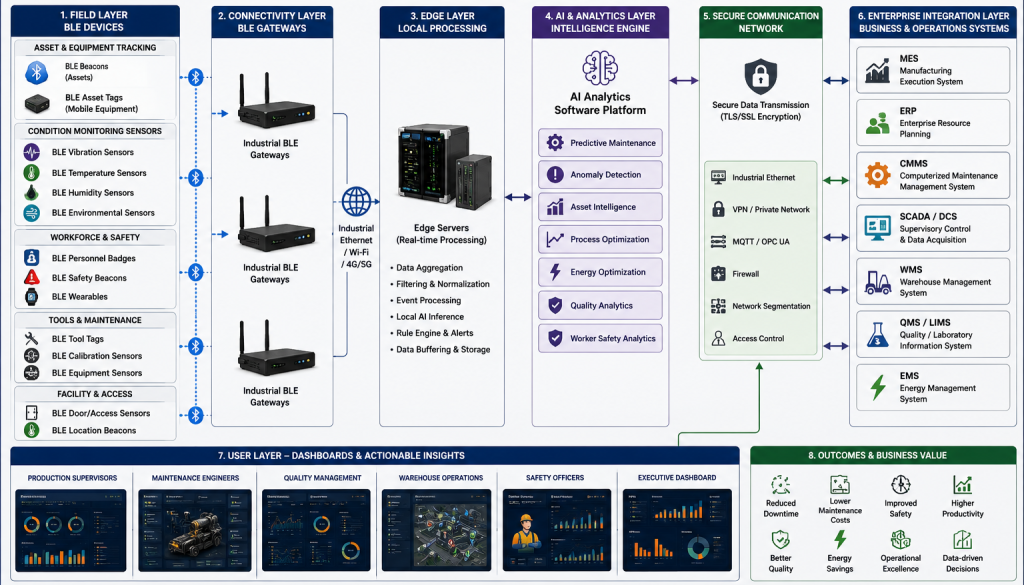
This block diagram depicts the complete AI and BLE solution for Iron & Steel Production, showing how BLE beacons, BLE sensors, and BLE gateways securely collect operational data and transmit it through industrial communication networks to edge servers, AI analytics software, and enterprise systems such as MES, ERP, CMMS, and SCADA. The solution enables predictive maintenance, asset visibility, production monitoring, warehouse management, and data-driven operational decision-making.
Technical Capabilities and Business Value of AI and BLE for Iron & Steel Production
Combining AI with BLE technologies delivers measurable operational improvements by transforming real-time operational information into intelligent recommendations that improve equipment reliability, production efficiency, workforce safety, and operational decision-making.
Improved Asset Visibility
BLE continuously tracks mobile production assets including overhead cranes, steel ladles, forklifts, maintenance equipment, inspection tools, portable analyzers, and warehouse vehicles.
AI analyzes movement patterns to improve:
- Asset utilization
- Equipment availability
- Material flow
- Production scheduling
- Maintenance planning
Predictive Maintenance
Rather than relying solely on scheduled inspections, AI evaluates vibration, temperature, operating hours, maintenance history, and environmental conditions to predict equipment degradation.
Benefits include:
- Reduced unplanned downtime
- Lower maintenance costs
- Extended equipment life
- Improved spare parts planning
- Increased equipment availability
Workforce Safety
BLE personnel badges combined with AI improve worker safety by monitoring:
- Restricted area access
- Lone worker activity
- Emergency evacuation
- Worker proximity to hazardous equipment
- Heat exposure
- Confined space operations
AI continuously evaluates operational conditions to identify elevated safety risks before incidents occur.
Production Optimization
AI analyzes operational information across production areas to improve:
- Blast furnace utilization
- Electric arc furnace scheduling
- Continuous casting performance
- Rolling mill efficiency
- Material flow
- Equipment coordination
These improvements reduce bottlenecks, increase throughput, and improve production consistency.
Energy Optimization
Iron and steel production consumes significant electrical and thermal energy.
AI evaluates:
- Equipment operating efficiency
- Idle equipment
- Furnace operating conditions
- Utility consumption
- Production schedules
- Energy demand
Improved operational planning reduces unnecessary energy consumption while maintaining production targets.
Quality Improvement
AI correlates BLE information with production quality records to identify operational factors affecting finished steel quality.
Applications include:
- Process stability monitoring
- Equipment condition correlation
- Inspection optimization
- Maintenance effectiveness
- Product consistency improvement
Improved process consistency supports higher-quality steel products while reducing scrap and rework.
Scalability
BLE deployments can expand gradually from individual production units to entire integrated steel manufacturing facilities.
Organizations commonly deploy AI and BLE across:
- Raw material yards
- Coke plants
- Blast furnaces
- Basic oxygen furnaces
- Electric arc furnaces
- Continuous casting
- Rolling mills
- Warehouses
- Shipping operations
- Maintenance departments
This phased deployment approach minimizes operational disruption while supporting long-term digital modernization.
Implementation Recommendations
Successful AI and BLE implementation should begin with clearly defined operational objectives supported by measurable key performance indicators.
Recommended engineering practices include:
- Conduct comprehensive wireless site surveys before deployment.
- Select industrial-grade BLE hardware suitable for high-temperature environments.
- Validate BLE gateway coverage throughout production facilities.
- Integrate AI with MES, ERP, CMMS, SCADA, and maintenance software.
- Establish data quality validation procedures before AI model training.
- Implement cybersecurity controls throughout the solution lifecycle.
- Continuously retrain AI models using updated production and maintenance information.
- Monitor operational KPIs to measure performance improvements.
- Expand deployments incrementally following successful pilot projects.
- Develop preventive maintenance procedures for BLE infrastructure.
GAO supports manufacturers by providing industrial BLE hardware products, technical expertise, deployment guidance, and engineering support for intelligent monitoring systems across demanding manufacturing environments.
Key Takeaways for AI and BLE in Iron & Steel Production
AI and BLE technologies are transforming Iron & Steel Production by delivering continuous operational visibility, predictive maintenance, intelligent asset monitoring, workforce safety improvements, and data-driven production optimization. Combining BLE beacons, BLE gateways, and BLE sensors with AI enables manufacturers to improve equipment reliability, production efficiency, product quality, energy utilization, and operational resilience.
Organizations pursuing digital modernization should adopt phased implementation strategies that prioritize operational objectives, integration with existing manufacturing software, cybersecurity, and scalable deployment. For more than three decades, GAO has helped organizations improve industrial operations by supplying reliable BLE, RFID, and IoT hardware products, engineering expertise, and comprehensive technical support.
Complete AI and BLE Solution Overview for Iron & Steel Production
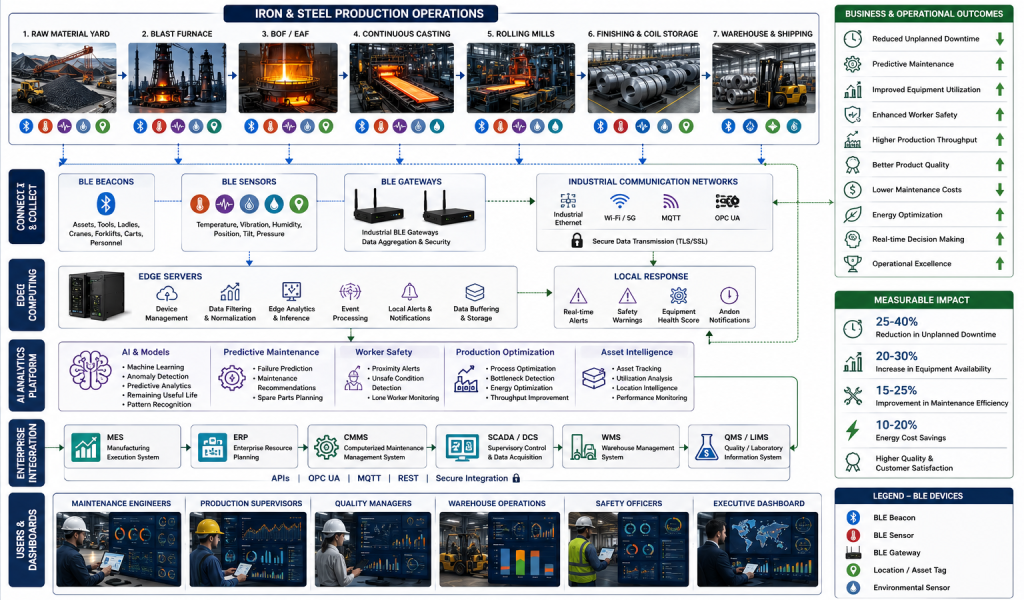
This solution overview diagram illustrates how BLE beacons, BLE sensors, and BLE gateways collect operational data across an Iron & Steel Production facility and securely transmit it through industrial communication networks to edge computing, AI analytics, and enterprise software such as MES, ERP, CMMS, and SCADA. The solution supports predictive maintenance, worker safety, asset tracking, warehouse logistics, production optimization, and executive decision-making through real-time operational intelligence.
Building the Future of Industrial AI and IoT with Aperture Venture Studio and GAO
For more than three decades, GAO Group of Companies has invested extensively in research and development of industrial BLE, RFID, and IoT technologies. As AI has become increasingly valuable for modern manufacturing, we have expanded our work in AI and IoT solutions for Iron & Steel Production while establishing Aperture Venture Studio to accelerate the development and adoption of advanced industrial AI and IoT solutions across multiple industries.
Aperture has attracted leading AI and IoT technical experts, experienced business executives, influential investors, and major industry organizations. Through initiatives such as Aperture Ventures Summit and TekSummit, we continue to promote collaboration, technical knowledge sharing, and innovation within the AI and IoT community. We welcome advisors, employees, investors, and customers who want to help shape the future of intelligent industrial operations.