
AI and BLE for Intelligent Buildings: Enhancing Smart Building Operations with Intelligent Wireless Sensing
How AI and BLE Are Transforming Intelligent Buildings
Modern intelligent buildings are rapidly evolving into data-driven environments where occupants, building systems, and physical assets operate as an interconnected digital infrastructure. Artificial Intelligence (AI) combined with Bluetooth Low Energy (BLE) technologies, including BLE beacons, BLE gateways, and BLE sensors, enables building operators to continuously monitor occupancy, indoor environmental conditions, energy consumption, equipment utilization, and occupant movement with exceptional accuracy and minimal power consumption. AI transforms raw BLE data into actionable intelligence by identifying operational trends, predicting equipment failures, optimizing HVAC performance, improving occupant comfort, and strengthening physical security.
Within intelligent buildings, AI and BLE support continuous operational optimization across commercial office buildings, corporate campuses, healthcare facilities, educational institutions, airports, hotels, mixed-use developments, and government facilities. Rather than functioning as isolated technologies, AI and BLE become integral components of intelligent building management systems that improve operational efficiency, sustainability, occupant experience, maintenance planning, and business decision-making.
Understanding AI and BLE in Intelligent Building Operations
Intelligent buildings integrate numerous interconnected systems that continuously generate operational data. Heating, ventilation, air conditioning (HVAC), lighting, elevators, access control, environmental monitoring, security, workspace utilization, and facility management all contribute valuable information that can improve building performance when analyzed collectively.
BLE serves as an ideal wireless technology for intelligent buildings because it provides:
- Extremely low power consumption
- Long battery life for wireless devices
- Cost-effective deployment
- Reliable indoor wireless communication
- Accurate proximity detection
- Scalable indoor positioning
- Simple installation within existing buildings
Artificial Intelligence complements BLE by processing large volumes of real-time operational information collected from distributed BLE devices. Rather than relying solely on threshold-based automation, AI continuously learns building behavior, recognizes occupancy patterns, predicts future conditions, detects anomalies, and recommends operational improvements.
Typical AI models deployed within intelligent buildings include:
- Machine learning for occupancy prediction
- Deep learning for indoor positioning optimization
- Time-series forecasting for energy demand
- Predictive maintenance models
- Reinforcement learning for HVAC optimization
- Computer vision integration with BLE location services
- Anomaly detection algorithms
- Large language models supporting facility management knowledge systems
Together, AI and BLE form an AIoT solution that transforms intelligent buildings into adaptive environments capable of responding dynamically to changing occupancy, environmental conditions, and operational demands.
GAO has supplied BLE hardware and IoT solutions to organizations requiring reliable indoor sensing, location awareness, and operational visibility across commercial buildings, research facilities, educational campuses, healthcare environments, and government infrastructure.
AI and BLE System for Intelligent Building Automation and Operations
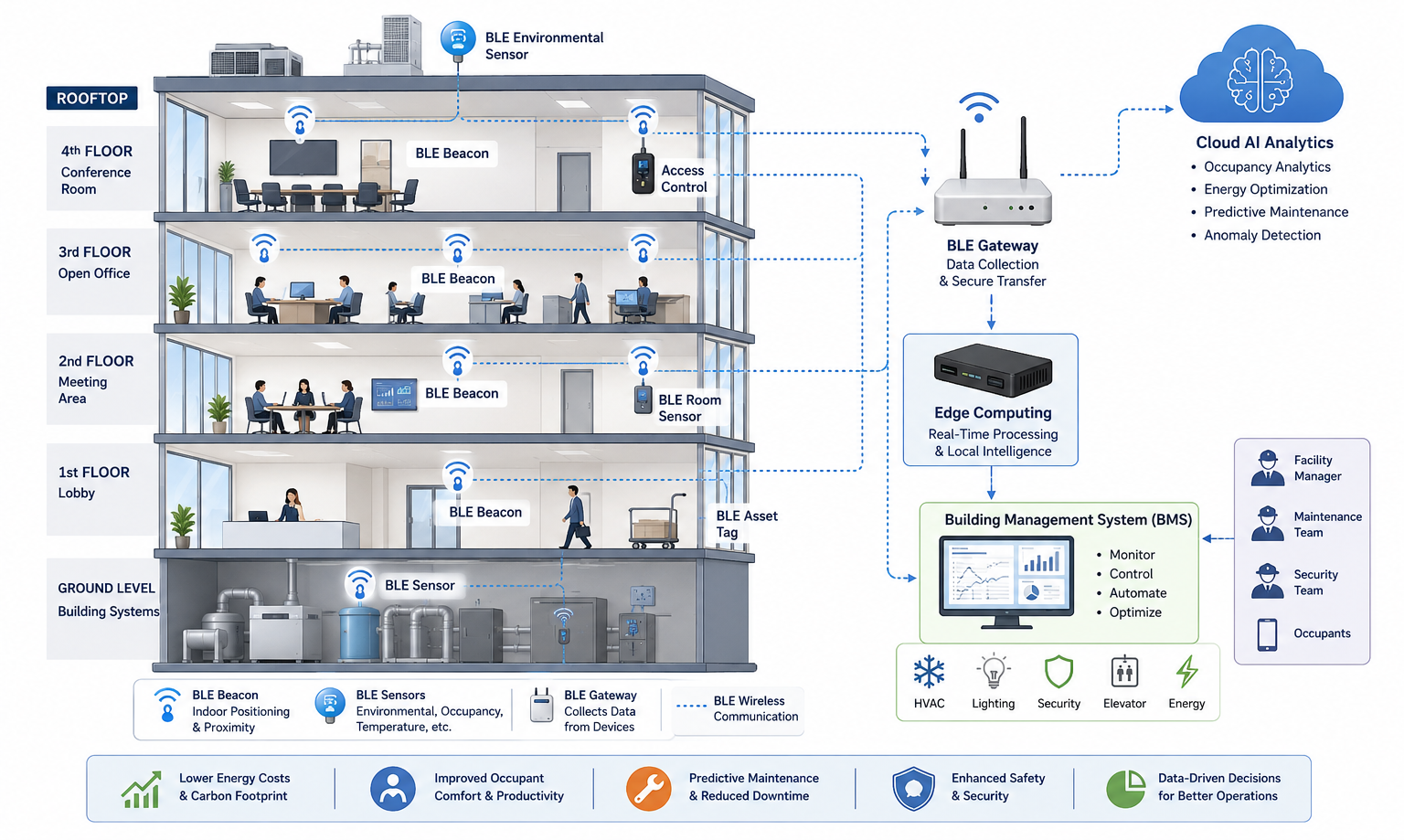
A simplified AI and BLE solution for intelligent buildings showing how BLE beacons, BLE sensors, and BLE gateways collect operational data and transmit it to edge computing, cloud AI analytics, and the Building Management System (BMS). The visual highlights how AI enables occupancy analytics, predictive maintenance, energy optimization, security monitoring, and intelligent building automation.
Intelligent Building Applications of AI and BLE
AI and BLE technologies support numerous operational functions throughout intelligent buildings. Unlike traditional building automation systems that operate independently, AI integrates information collected from thousands of BLE devices to optimize entire building operations.
Intelligent Occupancy Management
BLE occupancy sensors and mobile device detection continuously estimate occupancy throughout offices, meeting rooms, auditoriums, cafeterias, shared workspaces, reception areas, corridors, and parking structures.
AI analyzes occupancy trends to:
- Optimize HVAC scheduling
- Reduce unnecessary lighting
- Allocate workspace dynamically
- Improve meeting room utilization
- Predict building traffic patterns
- Support hybrid workplace management
Indoor Positioning and Navigation
BLE beacons provide highly accurate indoor positioning where GPS signals are unavailable.
Typical applications include:
- Employee navigation
- Visitor wayfinding
- Emergency evacuation guidance
- Conference attendee navigation
- Hospital navigation
- Airport terminal navigation
- Maintenance technician routing
- Accessibility assistance
AI continuously improves positioning accuracy by learning radio signal characteristics unique to each building.
Asset Tracking
Thousands of valuable assets move throughout intelligent buildings every day.
Common BLE tracked assets include:
- Medical equipment
- Audio visual equipment
- Mobile workstations
- Conference equipment
- Maintenance tools
- Cleaning equipment
- Security equipment
- Emergency response equipment
- Laboratory instruments
- Portable diagnostic devices
AI automatically predicts equipment availability, identifies underutilized assets, and recommends optimized asset allocation across facilities.
Predictive Facility Maintenance
BLE vibration sensors, temperature sensors, humidity sensors, current sensors, and environmental sensors continuously monitor building equipment including:
- HVAC chillers
- Air handling units
- Cooling towers
- Pumps
- Boilers
- Variable air volume units
- Elevators
- Escalators
- Backup generators
- Electrical switchgear
AI models recognize subtle performance degradation long before traditional alarm thresholds are reached.
Maintenance teams can therefore transition from reactive maintenance toward predictive maintenance strategies.
Environmental Monitoring
BLE environmental sensors continuously measure:
- Temperature
- Relative humidity
- Carbon dioxide
- Volatile organic compounds
- Particulate matter
- Occupancy
- Ambient light
- Noise levels
- Air pressure
AI correlates environmental conditions with occupant productivity, comfort, HVAC efficiency, and energy consumption to optimize indoor environmental quality.
Physical Security Enhancement
BLE integrates with physical security systems by supporting:
- Visitor tracking
- Personnel location awareness
- Restricted area monitoring
- Emergency mustering
- Security patrol verification
- Access credential validation
- Panic alarm localization
- Asset theft prevention
AI enhances security by detecting unusual occupant movement, abnormal access behavior, unauthorized equipment relocation, and suspicious occupancy patterns.
Benefits of AI and BLE for Intelligent Building Management
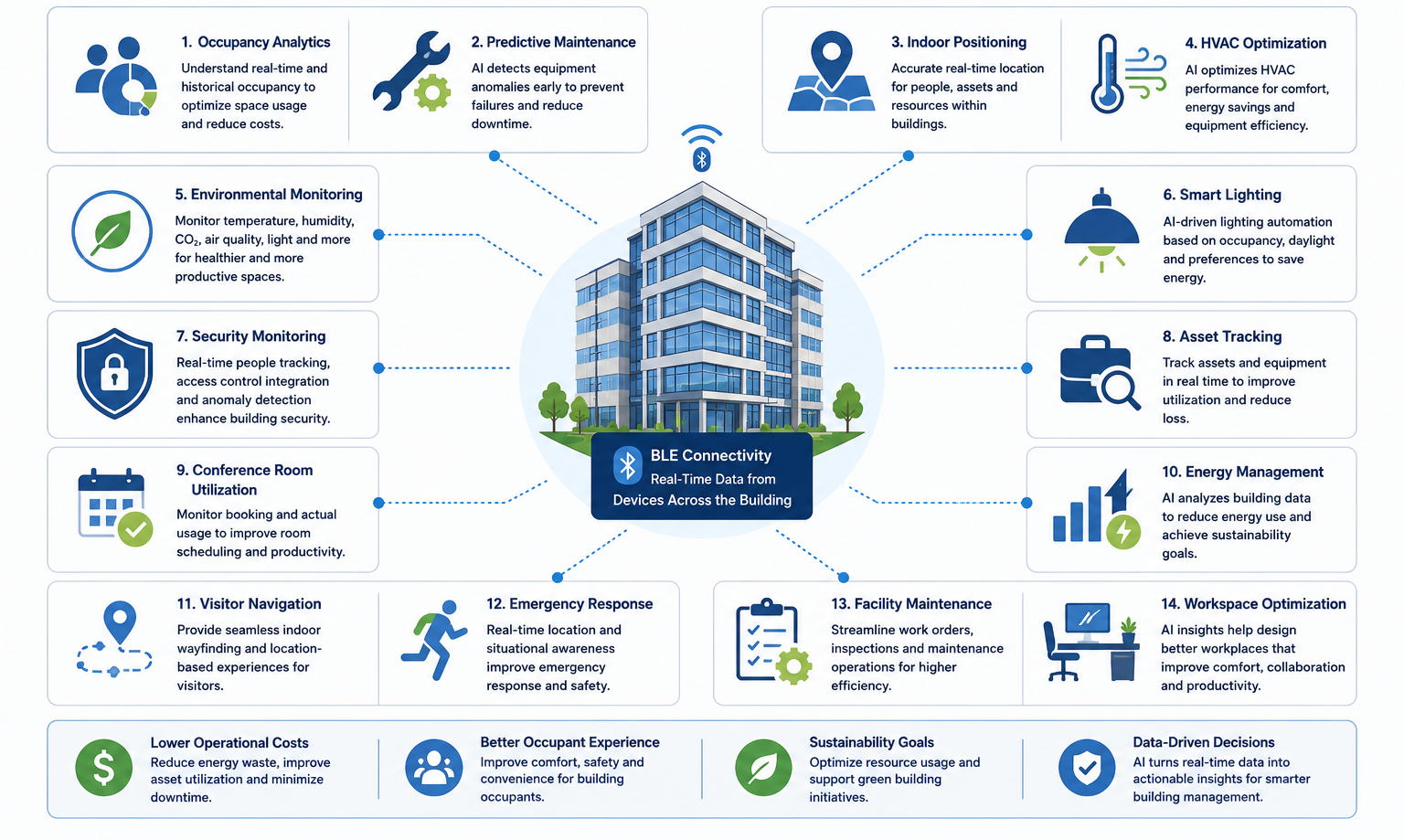
A professional infographic summarizing the key operational benefits of AI and BLE for intelligent buildings. It illustrates how occupancy analytics, predictive maintenance, indoor positioning, HVAC optimization, environmental monitoring, smart lighting, security monitoring, asset tracking, conference room utilization, energy management, visitor navigation, emergency response, facility maintenance, and workspace optimization improve building efficiency, occupant experience, and operational performance.
Operational Workflow of AI and BLE in Intelligent Buildings
An AI and BLE solution for intelligent buildings follows a continuous operational workflow that transforms physical events into actionable intelligence supporting facility operations.
BLE Data Acquisition
Distributed BLE devices continuously collect operational information throughout the building.
Typical sensing devices include:
- BLE environmental sensors
- BLE occupancy sensors
- BLE vibration sensors
- BLE current sensors
- BLE temperature sensors
- BLE humidity sensors
- BLE asset tags
- BLE personnel badges
- BLE gateways
- Mobile BLE devices
Collected information includes:
- Occupancy events
- Equipment status
- Indoor location
- Environmental measurements
- Asset movement
- User proximity
- Device health
- Battery status
- Beacon signal strength
- Gateway communication quality
Wireless Communication Layer
BLE gateways receive advertisements transmitted by BLE devices.
Gateways aggregate information before forwarding data through building communication networks using protocols including:
- Ethernet
- Wi-Fi
- MQTT
- HTTPS
- TLS encrypted communication
- IPv6
- BACnet/IP
- Modbus TCP
- OPC UA
Reliable wireless planning requires careful consideration of:
- Signal propagation
- Wall attenuation
- Elevator shafts
- Mechanical rooms
- RF interference
- Beacon density
- Gateway placement
- Battery replacement schedules
Edge Intelligence
Edge computing devices perform immediate processing close to the building systems.
Typical edge functions include:
- Signal filtering
- Device authentication
- Occupancy estimation
- Sensor validation
- Local anomaly detection
- Data compression
- Event prioritization
- Temporary data storage
Processing information locally reduces cloud bandwidth while enabling rapid response during safety events.
AI Analytics
After preprocessing, AI software analyzes operational data using multiple analytical techniques.
Examples include:
- Occupancy forecasting
- HVAC demand prediction
- Indoor positioning refinement
- Equipment health scoring
- Energy optimization
- Space utilization analysis
- Predictive maintenance
- Environmental quality assessment
- Security anomaly detection
AI continuously improves prediction accuracy as additional building operational history becomes available.
Enterprise Software Integration
Processed information is shared with intelligent building software including:
- Building Management Systems (BMS)
- Computerized Maintenance Management Systems (CMMS)
- Integrated Workplace Management Systems (IWMS)
- Enterprise Asset Management (EAM)
- Computer-Aided Facility Management (CAFM)
- Energy Management Systems (EMS)
- Security Information and Event Management (SIEM)
- Identity and Access Management (IAM)
- Enterprise Resource Planning (ERP)
- Business Intelligence (BI) software
Facility managers receive dashboards, alerts, predictive recommendations, and automated work orders that improve operational decision making.
AI and BLE Operational Workflow for Intelligent Buildings
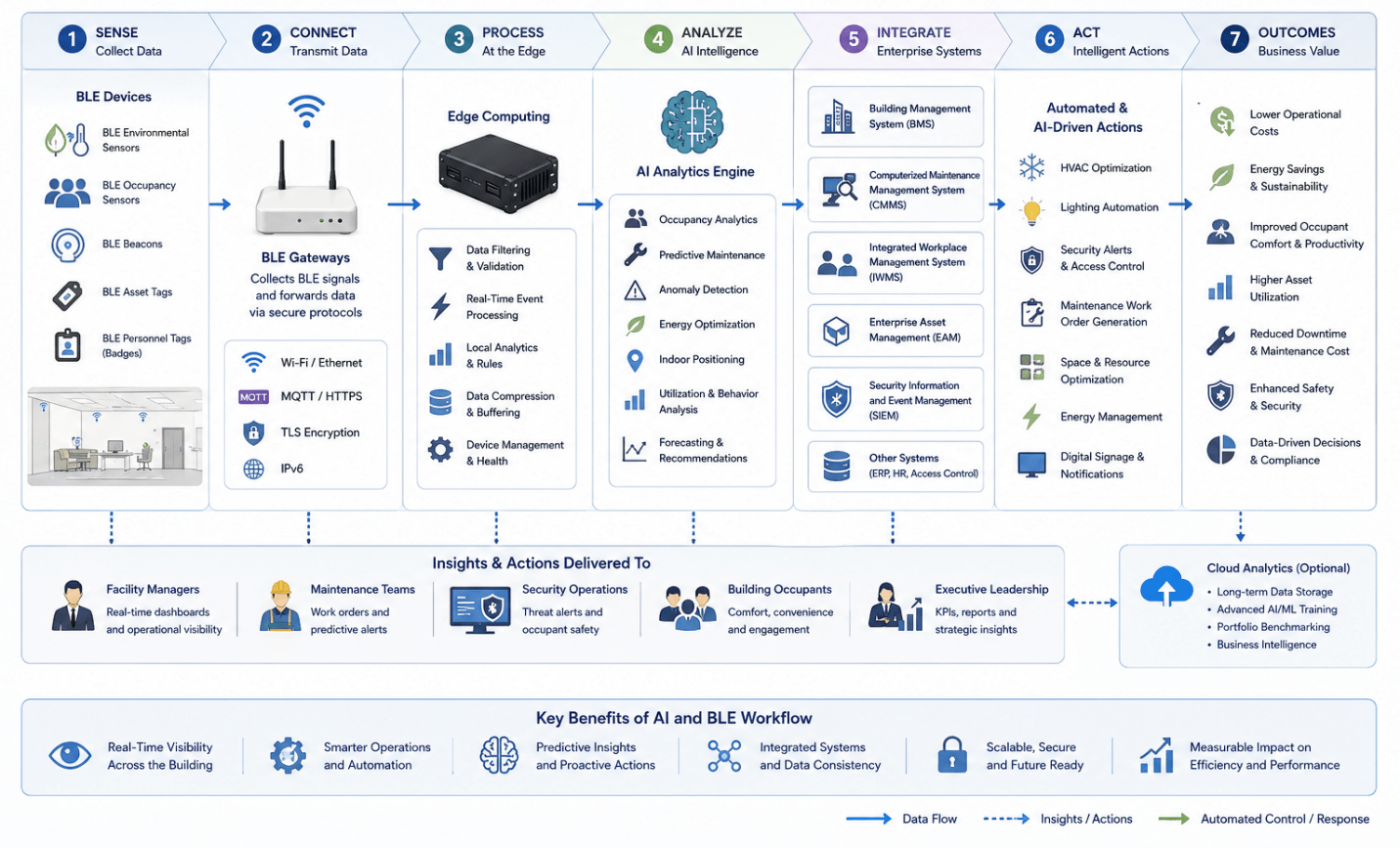
The complete AI and BLE operational workflow within an intelligent building, from BLE data collection and wireless communication to edge computing, AI analytics, enterprise software integration, and automated building operations. The visual demonstrates how actionable insights support facility management, predictive maintenance, energy optimization, security, and business decision-making.
AI and BLE Technology Components Supporting Intelligent Buildings
An intelligent building solution depends on the coordinated operation of BLE hardware, AI software, secure networking, enterprise integration, and scalable computing infrastructure. Selecting the appropriate combination of components requires balancing building size, occupancy density, latency requirements, cybersecurity objectives, existing Building Management Systems, and long-term operational costs.
BLE Hardware Infrastructure
BLE hardware forms the sensing and communication foundation of intelligent buildings.
BLE Beacons
BLE beacons periodically transmit unique identifiers that enable indoor positioning, proximity detection, room-level occupancy awareness, visitor navigation, and asset localization. Battery-powered beacons are commonly installed in meeting rooms, corridors, lobbies, elevators, stairwells, parking garages, and emergency exits. Proper beacon density and placement are essential to maintain consistent positioning accuracy while minimizing radio interference.
BLE Gateways
BLE gateways receive wireless advertisements from nearby BLE devices and forward validated information to edge servers or cloud software over Ethernet or Wi-Fi connections. Modern gateways frequently support multiple communication technologies, allowing them to bridge BLE networks with BACnet/IP, MQTT, OPC UA, and Modbus TCP environments commonly found in intelligent buildings. Strategic gateway placement improves coverage across multi-story facilities, mechanical rooms, and high-density office areas while supporting resilient communication during peak occupancy.
BLE Sensors
BLE sensors continuously monitor operational conditions throughout the building, including temperature, humidity, carbon dioxide concentration, particulate matter, ambient light, vibration, equipment status, occupancy, and door or window activity. These battery-powered devices enable extensive monitoring without the installation complexity associated with wired sensing systems.
AI Software and Edge Intelligence
AI software converts BLE telemetry into operational intelligence by combining real-time sensor inputs with historical building data. Machine learning models classify occupancy patterns, forecast HVAC demand, identify abnormal equipment behavior, estimate remaining useful life for mechanical assets, and recommend energy-saving actions. Edge computing devices perform latency-sensitive functions such as occupancy estimation, anomaly detection, and preliminary signal filtering before forwarding enriched data to centralized analytics software.
Cloud Version and Server Version Deployments
Selecting the appropriate deployment model depends on building size, cybersecurity requirements, regulatory obligations, network availability, and operational objectives. Many intelligent buildings adopt a hybrid deployment in which latency-sensitive processing occurs locally while advanced analytics and long-term reporting are performed centrally.
Cloud Version
The Cloud Version hosts AI software within a cloud-managed environment where software updates, AI model improvements, storage, and computing resources are centrally maintained. This deployment is well suited for organizations operating multiple office buildings, corporate campuses, retail chains, healthcare networks, hospitality portfolios, or geographically distributed facilities.
Cloud deployments commonly provide:
- Centralized monitoring across multiple buildings
- Unified AI model management
- Enterprise reporting and benchmarking
- Long-term historical data storage
- Disaster recovery and backup
- Elastic computing resources for AI workloads
- Remote software maintenance
- API integration with cloud business software
Organizations using cloud deployments should implement strong identity management, multi-factor authentication, encrypted communications, role-based access control, and continuous security monitoring.
Server Version
The Server Version deploys AI software on privately managed servers located within a building, regional data center, or customer-managed computing environment. This model is appropriate when organizations require greater control over operational data, reduced network dependency, or compliance with internal cybersecurity policies.
Typical advantages include:
- Low-latency AI decision making
- Greater control of operational data
- Local processing during Internet outages
- Integration with existing private networks
- Flexible customization
- Compliance with organization-specific security policies
Organizations operating airports, defense facilities, financial institutions, research laboratories, government buildings, and critical infrastructure frequently select privately managed server deployments because of stricter operational and security requirements.
Communication Infrastructure
Reliable BLE communication requires careful planning throughout the building lifecycle. Radio coverage should account for concrete walls, glass partitions, elevator shafts, metallic structures, underground parking, and high-density office areas.
Common communication technologies include:
- Bluetooth Low Energy
- Ethernet
- Wi-Fi
- IPv6
- MQTT
- OPC UA
- BACnet/IP
- Modbus TCP
- HTTPS
- TLS encryption
- Virtual Private Networks (VPNs)
- Network Time Protocol (NTP)
Network segmentation, quality-of-service policies, redundant gateways, and continuous health monitoring improve communication reliability while minimizing service interruptions.
Cybersecurity and Operational Security
Because intelligent buildings increasingly connect operational technology with information technology, cybersecurity becomes an integral design consideration rather than an afterthought.
Recommended security measures include:
- Secure BLE device provisioning
- Certificate-based authentication
- Encrypted BLE communications where supported
- Secure gateway firmware updates
- Zero Trust network principles
- Network segmentation
- Continuous vulnerability assessment
- Device identity management
- Security Information and Event Management integration
- AI-assisted threat detection
- Audit logging
- Secure API authentication
Facility managers should establish lifecycle management procedures covering device onboarding, firmware updates, battery replacement, decommissioning, and periodic security validation.
GAO supports customers by providing BLE hardware products and systems that are designed for reliable integration into secure intelligent building deployments. Headquartered in New York City and Toronto, Canada, GAO is recognized among the world’s leading B2B and B2G suppliers of BLE and RFID technologies, with decades of experience supporting Fortune 500 organizations, research institutions, universities, and government agencies throughout the United States and Canada.
Technical Capabilities and Business Value of AI and BLE for Intelligent Buildings
Combining AI with BLE extends beyond simple wireless sensing by enabling intelligent operational decisions that continuously improve building performance.
Occupancy Intelligence
AI evaluates occupancy trends using BLE sensor data to optimize workspace allocation, meeting room scheduling, cleaning services, and HVAC operation. Predictive occupancy models reduce wasted energy while improving occupant comfort during peak and off-peak periods.
Energy Optimization
BLE environmental sensors combined with AI forecasting enable continuous optimization of:
- HVAC operation
- Smart lighting
- Ventilation rates
- Demand-controlled cooling
- Peak demand reduction
- Renewable energy utilization
- Building energy benchmarking
These improvements help reduce operating expenses while supporting sustainability initiatives and energy performance certifications.
Predictive Maintenance
AI identifies gradual degradation in mechanical and electrical systems before failures occur.
Typical monitored assets include:
- Chillers
- Air handling units
- Pumps
- Cooling towers
- Boilers
- Elevators
- Escalators
- Electrical distribution equipment
- Emergency generators
Maintenance activities become proactive rather than reactive, reducing downtime and extending equipment service life.
Indoor Environmental Quality
Occupant comfort directly affects productivity and building satisfaction. AI continuously correlates temperature, humidity, carbon dioxide, particulate matter, occupancy density, and ventilation performance to maintain healthier indoor environments.
Indoor Location Intelligence
BLE beacons support precise indoor positioning for employees, visitors, contractors, maintenance technicians, and emergency responders.
Benefits include:
- Faster emergency response
- Improved visitor experiences
- Reduced maintenance travel time
- Efficient workforce dispatch
- Better accessibility support
Asset Visibility
AI continuously analyzes BLE asset location history to identify:
- Frequently relocated equipment
- Idle assets
- Equipment bottlenecks
- Unauthorized movement
- Asset utilization trends
- Inventory shortages
Facility managers gain improved visibility without relying on manual audits.
Security Monitoring
AI strengthens physical security by recognizing abnormal movement patterns, unusual access events, unauthorized occupancy, and suspicious equipment relocation.
Integrated security operations benefit from:
- Faster incident detection
- Automated alerts
- Reduced false alarms
- Improved compliance reporting
- Enhanced emergency preparedness
Scalability
BLE networks scale efficiently from individual buildings to global property portfolios. Additional sensors, gateways, and AI services can be incorporated with minimal disruption when communication planning and device management are properly designed.
GAO has helped organizations deploy BLE hardware products and systems supporting scalable intelligent building initiatives while emphasizing interoperability, quality assurance, and expert technical support delivered remotely or onsite.
Simplified AI and BLE System for Intelligent Buildings
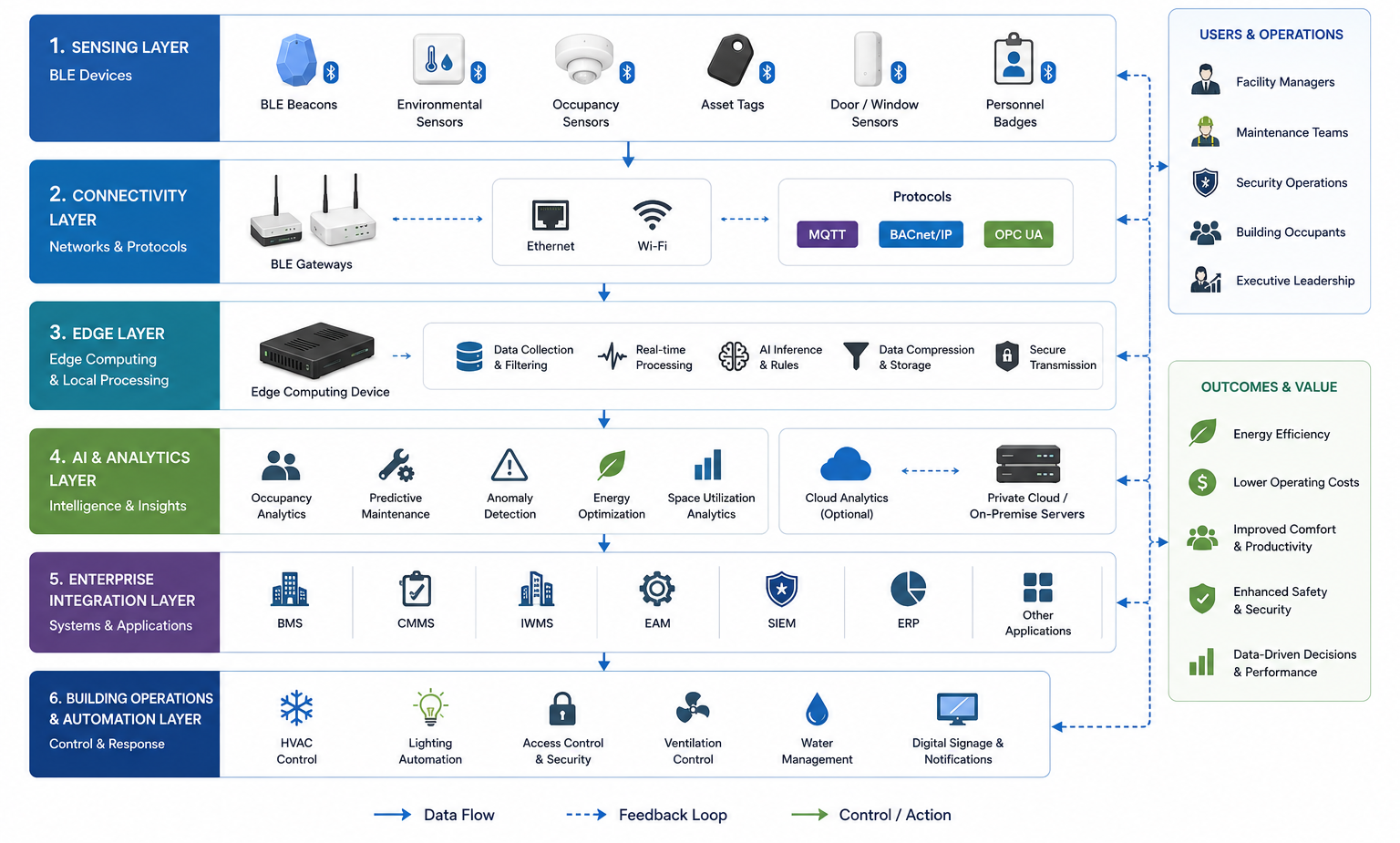
The layered flow of AI and BLE in an intelligent building, showing how BLE devices collect building data, transmit it through gateways and networks to edge computing and AI analytics, integrate with enterprise software, and automate building operations. The visual highlights the complete process from sensing to data-driven actions that improve efficiency, security, energy management, and occupant comfort.
Cloud Version vs. Server Version for AI and BLE Intelligent Buildings
| Comparison Category | ☁️ Cloud Version | 🖥️ Server Version |
| 📍 Deployment Location | Hosted in a cloud data center and managed by the cloud provider. | Installed on privately managed servers within a building, campus, or private data center. |
| ⚡ Latency | Moderate latency depending on Internet connectivity. | Low latency with real-time local processing for building operations. |
| 📈 Scalability | Easily scales across multiple buildings and distributed property portfolios. | Scales by expanding local server infrastructure and computing resources. |
| 🔒 Cybersecurity Control | Shared responsibility with cloud provider using cloud security services and access controls. | Full organizational control over security policies, network segmentation, and data management. |
| 🛠️ Maintenance Responsibility | Software updates, backups, and infrastructure maintenance are primarily managed by the cloud provider. | IT or facility teams manage servers, software updates, backups, and hardware maintenance. |
| 🌐 Connectivity Requirements | Requires reliable Internet connectivity for optimal performance and remote access. | Can continue operating with limited or no Internet connectivity for local building functions. |
| 🔗 Integration Flexibility | Easily integrates with cloud-based BMS, CMMS, ERP, analytics, and remote monitoring software. | Integrates directly with existing private building systems and operational technology networks. |
| 🛡️ Operational Resilience | High availability through cloud redundancy and disaster recovery services. | High resilience for local operations with reduced dependency on external network availability. |
| 💰 Cost Considerations | Lower upfront investment with subscription-based operational expenses. | Higher initial hardware investment with long-term control over infrastructure costs. |
| 🏢 Recommended Building Scenarios | Commercial real estate portfolios, corporate campuses, retail chains, hospitality groups, educational institutions, and organizations managing multiple intelligent buildings. | Government buildings, healthcare facilities, financial institutions, research laboratories, airports, critical infrastructure, and organizations requiring strict data control or low-latency processing. |
Engineering Best Practices and Implementation Considerations
Successful AI and BLE implementations require disciplined planning, commissioning, and ongoing optimization.
Key engineering recommendations include:
- Conduct comprehensive RF site surveys before beacon and gateway installation.
- Define occupancy, asset tracking, environmental monitoring, and maintenance objectives before selecting BLE hardware.
- Calibrate BLE beacon density based on positioning accuracy requirements.
- Validate sensor accuracy under expected environmental conditions.
- Integrate BLE data with existing BMS, CMMS, IWMS, EAM, and ERP software using standardized interfaces.
- Establish AI model validation procedures and periodic retraining using representative operational data.
- Design redundant communication paths for mission-critical building functions.
- Apply role-based access control, encryption, and secure firmware management across all connected devices.
- Monitor battery health and establish preventive replacement schedules.
- Develop lifecycle management procedures covering commissioning, maintenance, upgrades, and device retirement.
Organizations should also define measurable performance indicators, including:
- Building energy intensity
- Occupancy prediction accuracy
- Indoor positioning accuracy
- HVAC energy savings
- Mean Time Between Failures (MTBF)
- Mean Time To Repair (MTTR)
- Equipment availability
- Space utilization rate
- Indoor environmental quality scores
- Asset utilization percentage
- Maintenance response time
- Occupant satisfaction metrics
AI and BLE Implementation Roadmap for Intelligent Buildings
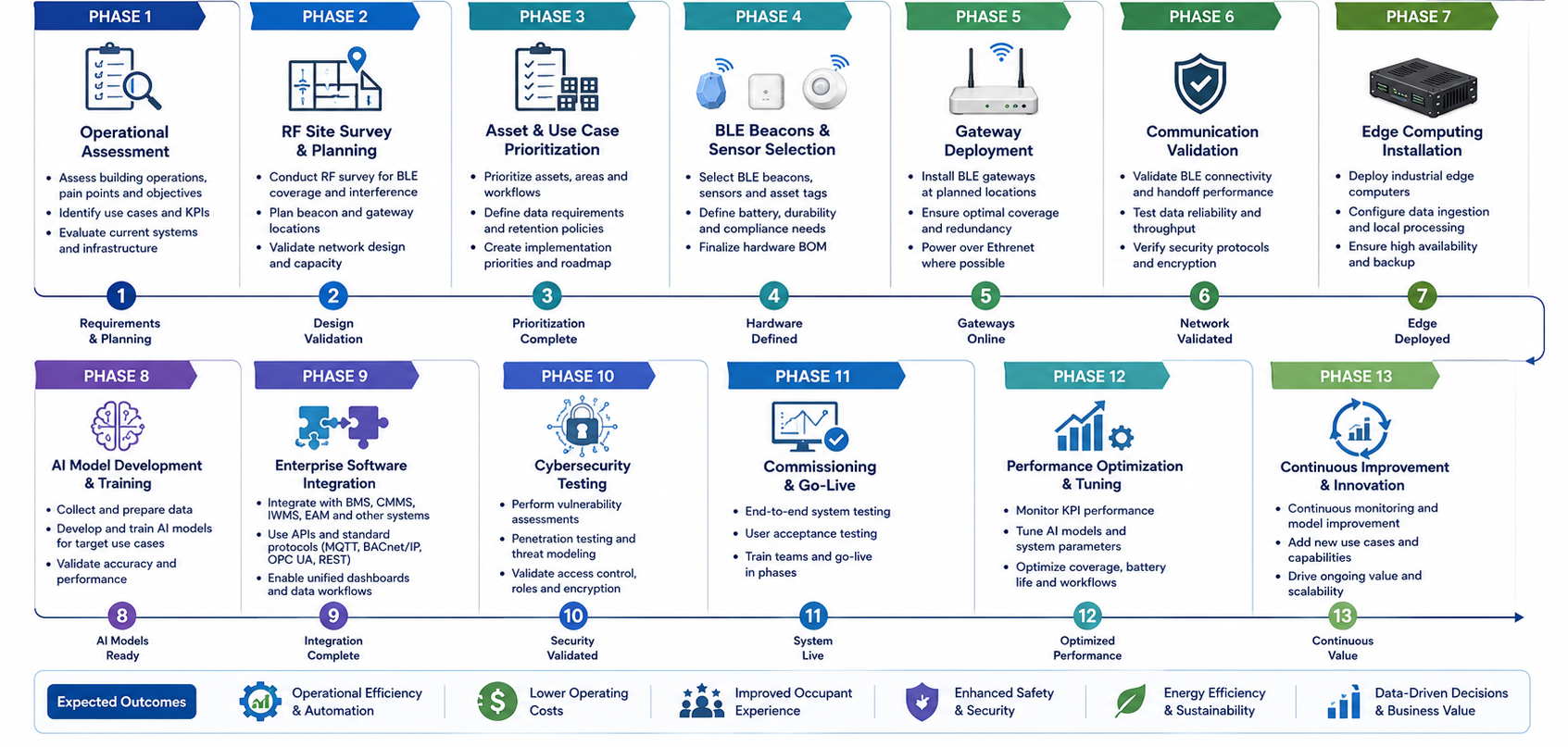
A phased implementation roadmap for deploying AI and BLE in intelligent buildings, covering operational assessment, RF site surveys, hardware selection, gateway deployment, communication validation, edge computing, AI model development, enterprise software integration, cybersecurity testing, commissioning, performance optimization, and continuous improvement. The visual provides a structured path for planning, deploying, and optimizing intelligent building solutions.
Advancing Intelligent Buildings with AI and BLE
AI and BLE are reshaping intelligent buildings by transforming distributed wireless sensing into continuous operational intelligence. Occupancy analytics, predictive maintenance, indoor positioning, environmental monitoring, energy optimization, asset visibility, and physical security become significantly more effective when AI interprets BLE data in real time. Successful deployments depend on thoughtful hardware selection, communication planning, cybersecurity, integration with building software, and continuous AI model improvement.
Drawing on more than three decades of research, development, and practical experience in BLE, RFID, and IoT technologies, GAO continues to supply hardware products and systems that help organizations implement reliable intelligent building solutions. Through rigorous quality assurance and experienced engineering support, we assist customers in deploying scalable AI and BLE systems that improve operational efficiency, occupant experience, sustainability, and long-term building performance.
Building the Future of Industrial AI and IoT with Aperture Venture Studio and GAO RFID Inc.
For more than three decades, GAO Group of Companies has invested heavily in the research and development of industrial BLE, RFID, and IoT technologies. As AI has demonstrated increasing value in intelligent building management, we have expanded our work in AI and IoT, including BLE and RFID solutions, and established Aperture Venture Studio to accelerate the advancement and adoption of AI and IoT technologies across intelligent buildings and connected facilities.
Aperture has attracted leading AI and IoT experts, experienced business and operational leaders, respected investors, and globally recognized organizations. We have also developed the highly successful Aperture Ventures Summit and TekSummit to foster collaboration on advanced AI and IoT topics. These initiatives have strengthened diverse technical communities and industry collaboration. We welcome you to engage with us as:
- Advisors, co-founders, or employees
- Investors
- Customers seeking advanced AI, BLE, RFID, and IoT technology solutions and engineering expertise