
AI and RFID for Fertilizer Manufacturing
AI and RFID for Fertilizer Manufacturing: Intelligent RFID Systems for Smart Fertilizer Production
Modern fertilizer manufacturing depends on precise raw material handling, tightly controlled chemical processing, strict quality assurance, hazardous material management, and efficient warehouse operations. Artificial intelligence (AI) combined with RFID technologies enables fertilizer manufacturers to improve operational visibility, automate material tracking, optimize production scheduling, and enhance supply chain traceability while maintaining compliance with environmental and safety regulations.
AI and RFID solutions allow manufacturers to identify, monitor, and analyze every stage of fertilizer production, from receiving phosphate rock, potash, sulfur, ammonia, urea, and micronutrients through granulation, drying, coating, packaging, warehouse storage, and outbound logistics. AI continuously analyzes RFID-generated operational data to predict equipment failures, detect production anomalies, improve inventory accuracy, reduce production losses, and support intelligent operational decision-making.
Organizations implementing AI and RFID solutions throughout fertilizer manufacturing gain higher production efficiency, improved inventory visibility, better quality consistency, reduced operational costs, enhanced worker safety, and stronger regulatory compliance. Drawing on decades of experience supplying RFID and IoT hardware products and systems, GAO has supported manufacturers across North America with reliable identification, tracking, and industrial automation technologies.
Understanding AI and RFID in Fertilizer Manufacturing Operations
Fertilizer manufacturing facilities operate highly integrated production systems involving chemical reactions, continuous processing, bulk material handling, blending operations, packaging lines, storage silos, warehouses, rail loading terminals, truck dispatching, and laboratory quality verification. Each production stage generates valuable operational information that can improve efficiency when collected and analyzed intelligently.
RFID provides automatic identification of materials, containers, pallets, equipment, vehicles, and production assets without requiring direct line-of-sight scanning. Depending on the operational environment, fertilizer manufacturers may deploy:
- LF RFID for harsh industrial environments and metallic equipment identification
- HF RFID for work orders, maintenance records, laboratory samples, and personnel identification
- UHF RFID for warehouse inventory, pallet tracking, bulk material logistics, finished fertilizer inventory, and shipping operations
Artificial intelligence transforms RFID data into operational intelligence by identifying production bottlenecks, forecasting inventory requirements, predicting equipment degradation, detecting process deviations, optimizing warehouse operations, and supporting production planning.
Rather than relying solely on historical reports, fertilizer manufacturers obtain continuously updated operational insights that improve production efficiency while reducing waste, downtime, and manual intervention.
AI and RFID Across the Fertilizer Manufacturing Lifecycle
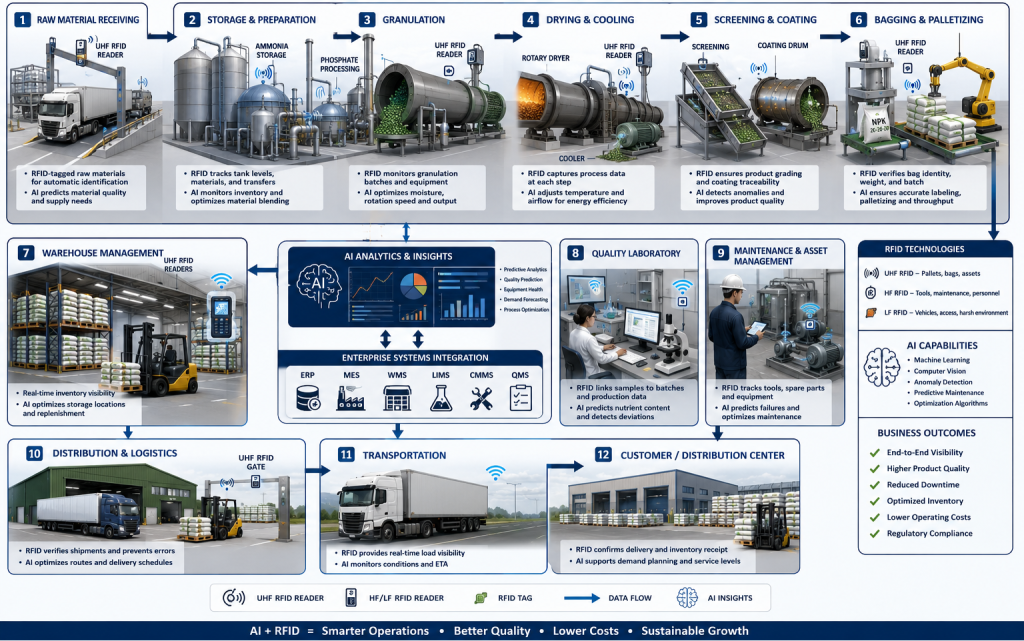
AI and RFID technologies enhance the complete fertilizer manufacturing lifecycle, from raw material receiving and storage through granulation, drying, coating, packaging, warehousing, maintenance, quality control, transportation, and distribution. The visual highlights RFID-based identification, AI-driven analytics, enterprise software integration, and real-time operational visibility to improve production efficiency, traceability, inventory management, predictive maintenance, and regulatory compliance.
Why AI and RFID Matter in Fertilizer Manufacturing
Fertilizer production presents unique operational challenges compared with many other chemical manufacturing processes. Plants process abrasive materials, corrosive chemicals, combustible dust, hazardous gases, and large volumes of bulk solids while maintaining continuous production schedules.
Common operational challenges include:
- Tracking thousands of raw material batches across multiple production lines
- Maintaining traceability for blended fertilizer formulations
- Managing returnable intermediate bulk containers (IBCs)
- Preventing raw material shortages
- Identifying production bottlenecks
- Monitoring warehouse inventory accuracy
- Reducing manual inventory counting
- Minimizing packaging errors
- Coordinating truck and railcar loading
- Improving turnaround time for outbound shipments
- Tracking maintenance tools and critical spare parts
- Monitoring high-value rotating equipment
- Supporting preventive maintenance scheduling
- Improving laboratory sample traceability
- Meeting environmental reporting requirements
- Maintaining product genealogy for customer quality investigations
AI and RFID address these challenges by providing continuous visibility into material movement, inventory status, equipment utilization, production throughput, and operational performance.
Because RFID captures identification data automatically and AI continuously analyzes operational trends, fertilizer manufacturers can make faster operational decisions while minimizing manual recordkeeping.
For organizations operating multiple fertilizer production plants, centralized AI analysis also supports benchmarking production efficiency, inventory turnover, equipment reliability, and warehouse performance across facilities.
AI and RFID Applications Across Fertilizer Manufacturing
AI and RFID technologies support nearly every operational function within fertilizer production facilities.
Raw Material Receiving
RFID identifies incoming shipments of ammonia, phosphate rock, sulfur, potash, urea, micronutrients, limestone, additives, and packaging materials.
AI verifies supplier deliveries, predicts inventory shortages, and recommends replenishment schedules.
Bulk Material Storage
RFID tracks storage silos, chemical tanks, bulk bins, and intermediate inventory locations.
AI predicts storage utilization and recommends optimized material movement.
Production Line Traceability
Each production batch receives a unique RFID identity linking raw materials, process parameters, laboratory inspections, and packaging information.
AI identifies abnormal production trends before quality deviations become significant.
Warehouse Inventory Management
RFID automatically records pallet movement through receiving, storage, picking, staging, and shipping operations.
AI optimizes warehouse slotting, forklift routing, inventory replenishment, and shipping priorities.
Equipment Maintenance
RFID identifies motors, conveyors, bucket elevators, granulators, dryers, rotary kilns, pumps, compressors, and dust collection systems.
AI predicts maintenance requirements using historical maintenance records combined with operational utilization.
Laboratory Quality Control
HF RFID identifies laboratory samples collected throughout production.
AI correlates laboratory results with production batches to improve process consistency and reduce quality variation.
Finished Product Distribution
RFID verifies pallet identity before truck loading.
AI reduces shipping errors by validating destination, product grade, customer order, and transportation schedules.
AI and RFID in Fertilizer Manufacturing: Traditional vs. Intelligent Operations
| Operational Area | Traditional Fertilizer Manufacturing | AI and RFID-Enabled Fertilizer Manufacturing |
| 🧪 Raw Material Traceability | Manual batch records and barcode scanning with limited real-time visibility | Automated RFID identification provides end-to-end traceability of raw materials, intermediates, and finished products with AI-driven tracking |
| 📦 Inventory Visibility | Periodic manual inventory counts with delayed updates | Real-time inventory visibility using RFID with AI-powered stock monitoring and replenishment forecasting |
| 🏭 Warehouse Operations | Manual pallet tracking and paper-based inventory management | Automated pallet identification, optimized storage allocation, and AI-guided warehouse workflows |
| 📅 Production Scheduling | Reactive scheduling based on historical production data | AI analyzes RFID production data to optimize schedules, reduce bottlenecks, and improve throughput |
| 🔧 Equipment Maintenance | Time-based or reactive maintenance after equipment failures | AI predicts equipment failures using RFID asset histories and operational data to enable predictive maintenance |
| 🔬 Laboratory Testing | Manual sample identification and disconnected quality records | RFID links laboratory samples to production batches while AI analyzes test results for quality optimization |
| 📦 Packaging Accuracy | Manual verification increases the risk of labeling and packaging errors | RFID automatically verifies product grade, batch, weight, and packaging accuracy before shipment |
| 🚚 Outbound Logistics | Manual shipment verification and loading documentation | RFID validates shipments automatically while AI optimizes loading schedules and transportation planning |
| 👷 Workforce Productivity | Employees spend significant time on manual tracking, data entry, and inventory audits | Automated identification reduces manual tasks, allowing personnel to focus on production, maintenance, and quality activities |
| 📋 Compliance Reporting | Regulatory documentation compiled manually from multiple systems | Automated data collection simplifies environmental reporting, product genealogy, and regulatory compliance documentation |
| 🌱 Sustainability Monitoring | Limited visibility into material waste, energy consumption, and process efficiency | AI analyzes production and RFID data to reduce waste, optimize resource utilization, and improve sustainability performance |
| 📈 Operational Efficiency | Limited operational visibility with slower decision-making and higher manual intervention | AI-driven insights, real-time RFID tracking, predictive analytics, and automated workflows improve productivity, quality, and overall equipment effectiveness (OEE) |
Operational Workflow of AI and RFID for Fertilizer Manufacturing
Successful AI and RFID deployments integrate production assets, industrial communication systems, enterprise software, and AI analytics into a unified operational workflow.
RFID Data Acquisition
Industrial RFID readers identify:
- Raw material containers
- Pallets
- Bulk bags
- Forklifts
- Mobile equipment
- Maintenance tools
- Production assets
- Packaging materials
- Finished fertilizer inventory
- Laboratory samples
Fixed readers monitor conveyor transfer points, production entrances, warehouse doors, palletizing systems, loading docks, and vehicle checkpoints.
Handheld RFID readers support maintenance personnel, warehouse operators, inventory audits, and quality inspectors.
Industrial Communication
Captured RFID events are transmitted through industrial communication infrastructure using technologies such as:
- Industrial Ethernet
- Wi-Fi 6
- Private 5G
- LTE
- OPC UA
- MQTT
- REST APIs
- Modbus TCP
- EtherNet/IP
Reliable communication ensures continuous synchronization between production equipment, warehouse systems, AI software, and business applications.
Edge Data Processing
Edge computers filter duplicate RFID reads, validate tag quality, normalize event data, and aggregate production information before forwarding it to enterprise software.
Local processing reduces network traffic while supporting low-latency operational decisions.
AI Analytics
Machine learning models analyze RFID event histories together with production information collected from manufacturing systems.
AI identifies:
- Production bottlenecks
- Equipment utilization trends
- Inventory shortages
- Material flow inefficiencies
- Quality deviations
- Maintenance priorities
- Warehouse congestion
- Shipping delays
Predictive models continuously improve recommendations using historical production data.
Enterprise Software Integration
AI software exchanges information with:
- ERP systems
- Manufacturing Execution Systems (MES)
- Warehouse Management Systems (WMS)
- Enterprise Asset Management (EAM)
- Computerized Maintenance Management Systems (CMMS)
- Laboratory Information Management Systems (LIMS)
- Quality Management Systems (QMS)
- Supply Chain Management (SCM)
- Business Intelligence (BI) software
Integrated business workflows eliminate duplicate data entry while improving operational coordination across production, maintenance, logistics, procurement, and quality assurance.
Operational Decision Support
Operational dashboards present production managers with actionable intelligence, including:
- Inventory shortages
- Production throughput
- Warehouse utilization
- Equipment maintenance priorities
- Shipment readiness
- Product traceability
- Production efficiency KPIs
- Overall Equipment Effectiveness (OEE)
- Inventory turnover
AI and RFID Workflow for Fertilizer Manufacturing
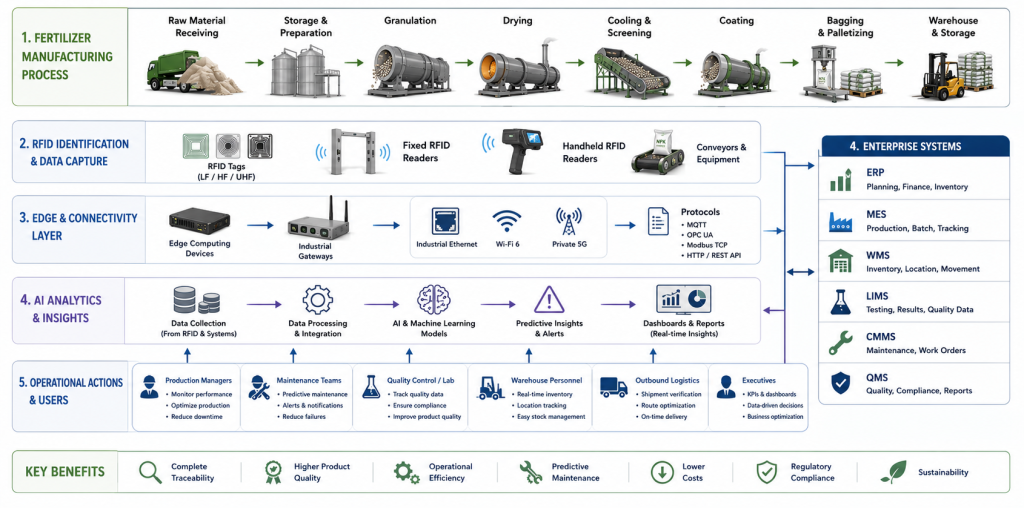
AI and RFID workflow illustrating how fertilizer manufacturing data flows from raw material receiving and RFID identification through edge computing, industrial communication, AI analytics, enterprise software integration, and operational decision-making. The diagram highlights the connection between production processes, inventory tracking, maintenance, quality control, and logistics to improve efficiency, traceability, and compliance.
AI and RFID Technologies Supporting Fertilizer Manufacturing
Effective AI and RFID deployments require carefully selected hardware, software, communication technologies, and security controls that operate reliably in demanding fertilizer production environments. Abrasive dust, corrosive chemicals, high humidity, elevated temperatures, vibration, and outdoor storage areas all influence technology selection. Proper engineering ensures consistent tag readability, dependable data collection, and long-term system performance.
RFID Hardware Components
RFID hardware forms the foundation of intelligent material identification and traceability throughout fertilizer manufacturing facilities.
RFID Tags
- UHF RFID tags for palletized fertilizer products, warehouse inventory, reusable containers, and logistics assets
- HF RFID tags for laboratory samples, maintenance documentation, employee identification, and quality records
- LF RFID tags for metallic assets, maintenance tools, and equipment operating in harsh industrial environments
RFID Readers and Antennas
Industrial fixed RFID readers are installed at receiving docks, conveyor transfer points, bagging stations, palletizers, warehouse entry points, and shipping lanes to capture material movements automatically. Handheld RFID readers support cycle counting, maintenance inspections, exception handling, and field verification, while ruggedized directional antennas are selected to minimize interference from metal structures and dense fertilizer packaging.
AI Software and Machine Learning Models
AI software transforms RFID event data into operational intelligence by combining identification records with production parameters, maintenance history, laboratory results, and logistics information. Common techniques include supervised learning for production forecasting, anomaly detection for identifying process deviations, predictive maintenance models for rotating equipment, computer vision for packaging inspection, and reinforcement learning for optimizing warehouse traffic and forklift routing. These models enable fertilizer manufacturers to shift from reactive operations to predictive decision-making while improving production stability and inventory accuracy.
Industrial Communication Infrastructure
Reliable communication is essential for maintaining uninterrupted visibility across fertilizer production, warehousing, quality control, and logistics. RFID events, sensor measurements, and AI-generated recommendations must be exchanged with minimal latency while maintaining high reliability in environments containing dust, vibration, electromagnetic interference, and large metallic equipment.
Common communication technologies include:
- Industrial Ethernet for deterministic communication between RFID readers, PLCs, HMIs, and production equipment
- Wi-Fi 6 for warehouse mobility, handheld RFID readers, and maintenance personnel
- Private 5G or LTE for outdoor storage yards, rail loading terminals, and vehicle tracking
- Fiber optic networks for high-bandwidth communication between production buildings and data centers
- VPN connections for secure remote monitoring and technical support
Frequently used communication protocols include:
- MQTT for lightweight IoT messaging
- OPC UA for standardized industrial data exchange
- Modbus TCP for communication with industrial controllers
- EtherNet/IP for manufacturing automation
- REST APIs for integration with business software
- HTTPS for secure web communications
- SNMP for network monitoring
Each communication layer contributes to timely data availability, allowing AI models to evaluate production conditions and operational performance without unnecessary delays.
Enterprise Software Components
Successful AI and RFID solutions extend beyond identification hardware by integrating with operational software used throughout fertilizer manufacturing.
Typical software components include:
- Enterprise Resource Planning (ERP) for procurement, production planning, finance, and inventory management
- Manufacturing Execution Systems (MES) for production scheduling, batch genealogy, and work order management
- Warehouse Management Systems (WMS) for inventory control and warehouse optimization
- Laboratory Information Management Systems (LIMS) for fertilizer sample testing and laboratory traceability
- Quality Management Systems (QMS) for compliance documentation and nonconformance management
- Computerized Maintenance Management Systems (CMMS) for maintenance scheduling and work order execution
- Enterprise Asset Management (EAM) software for lifecycle management of production equipment
- Business Intelligence (BI) software for executive reporting and operational analytics
Rather than functioning independently, these systems exchange RFID events and AI insights to create a unified operational view across production, maintenance, logistics, procurement, and quality assurance.
GAO has supported manufacturers by supplying RFID hardware and IoT technologies that integrate with widely deployed industrial software, helping organizations improve operational visibility while preserving existing business processes.
Cloud Version and Server Version Deployment
Fertilizer manufacturers select deployment models based on production requirements, cybersecurity policies, network availability, data sovereignty, and operational objectives.
Cloud Version
Cloud-hosted AI and RFID software is managed within secure cloud infrastructure and is appropriate for organizations operating multiple fertilizer plants, geographically distributed warehouses, or regional distribution centers.
Advantages include:
- Centralized monitoring across multiple facilities
- Simplified software updates
- Elastic computing resources for AI model training
- Rapid deployment of analytical capabilities
- Lower infrastructure management requirements
- Centralized disaster recovery
- Enterprise-wide reporting and benchmarking
Cloud deployment is often preferred when production facilities require centralized visibility, supplier collaboration, or corporate-level analytics.
Server Version
Server-based deployment places RFID software and AI processing on privately managed infrastructure such as factory servers, edge servers, private data centers, or customer-managed hosting environments.
Advantages include:
- Lower operational latency
- Greater control over production data
- Compliance with internal cybersecurity policies
- Continued operation during limited Internet connectivity
- Custom integration with proprietary manufacturing systems
- Simplified integration with local industrial controllers
Server deployments are commonly selected by fertilizer manufacturers operating continuous production facilities where uninterrupted operation and local processing are business-critical.
Many organizations adopt hybrid deployments in which operational decisions occur locally while long-term reporting and AI model optimization are performed centrally.
Cybersecurity and Operational Security
Fertilizer manufacturing facilities are designated as critical industrial infrastructure in many jurisdictions, making cybersecurity a primary design consideration.
Recommended security mechanisms include:
- Role-based access control (RBAC)
- Multi-factor authentication (MFA)
- TLS encryption
- HTTPS-secured communications
- Network segmentation
- Industrial firewalls
- Secure VPN access
- Digital certificates
- Security Information and Event Management (SIEM) integration
- Continuous vulnerability assessments
- RFID device authentication
- Secure firmware management
- Audit logging
- Backup and disaster recovery procedures
AI further strengthens operational security by detecting unusual RFID activity, abnormal inventory movements, unauthorized equipment access, and suspicious production patterns that may indicate operational errors or cyber threats.
Layered AI and RFID System for Fertilizer Manufacturing
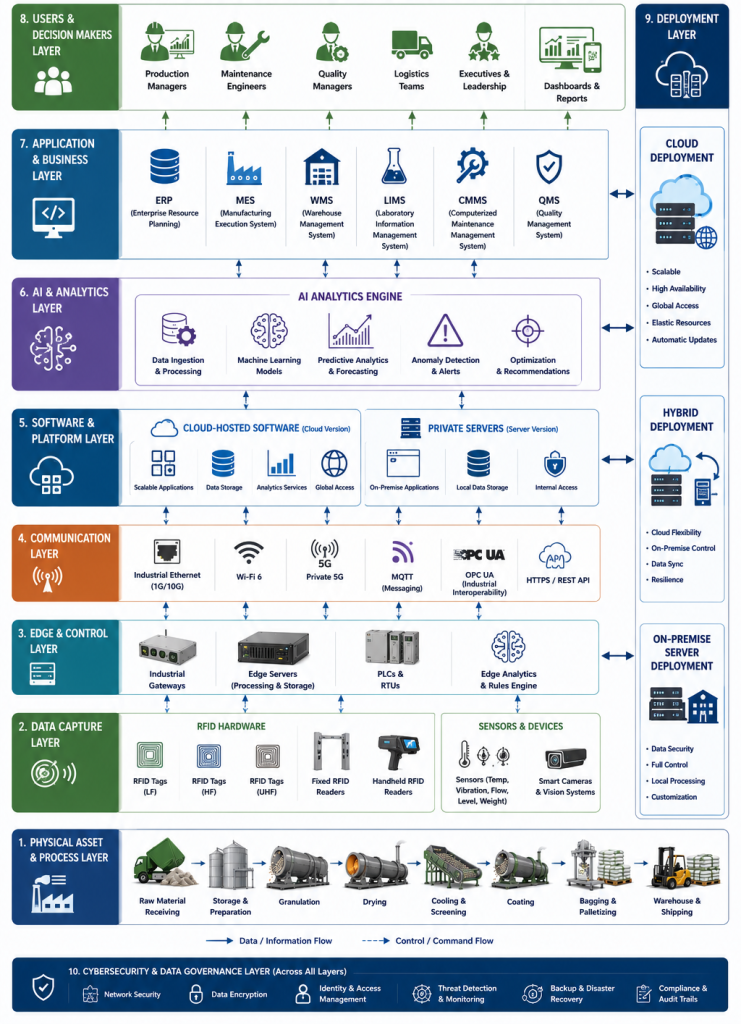
Layered AI and RFID system for fertilizer manufacturing integrates physical production assets, RFID hardware, industrial communication, edge computing, AI analytics, enterprise software, deployment models, cybersecurity, and operational decision-making. The visual highlights end-to-end data flow supporting production, maintenance, quality management, inventory control, and logistics.
Technical Capabilities and Business Value of AI and RFID for Fertilizer Manufacturing
Combining AI with RFID transforms operational data into measurable improvements across production, quality assurance, maintenance, warehousing, and supply chain operations.
Production Visibility
RFID enables continuous tracking of raw materials, intermediate products, and finished fertilizer throughout production. AI correlates production events with process variables, helping operators identify bottlenecks, optimize production scheduling, and improve throughput.
End-to-End Traceability
Every production batch can be associated with raw material sources, laboratory test results, processing conditions, packaging records, warehouse locations, and customer shipments. This level of traceability simplifies quality investigations, product recalls, and regulatory reporting.
Inventory Accuracy
Automated RFID identification minimizes manual inventory counting while improving visibility into raw materials, work-in-progress inventory, and finished goods. AI predicts replenishment needs and recommends optimized stock levels, reducing carrying costs and preventing production interruptions.
Predictive Maintenance
AI analyzes RFID equipment histories together with maintenance records and operational data to identify patterns indicating wear or potential failures. Maintenance teams can schedule repairs before unplanned downtime affects production.
Warehouse Optimization
AI evaluates forklift travel paths, warehouse congestion, pallet movements, and storage utilization. Intelligent recommendations improve warehouse efficiency, reduce travel distances, and accelerate shipping operations.
Quality Consistency
RFID links laboratory testing results with production batches, allowing AI to identify subtle relationships between raw materials, processing parameters, and final product quality. Manufacturers achieve more consistent nutrient composition and reduced production variability.
Worker Safety
RFID identifies personnel, hazardous material movements, maintenance activities, and restricted-area access. AI detects unusual activity and assists supervisors in enforcing operational safety procedures.
Regulatory Compliance
Comprehensive identification records simplify compliance with environmental regulations, hazardous chemical documentation, product traceability requirements, and internal quality management procedures.
AI and RFID Business Value in Fertilizer Manufacturing
| Performance Area | Traditional Fertilizer Manufacturing | AI and RFID-Enabled Fertilizer Manufacturing |
| 🔗 Batch Traceability | Manual records and paper-based documentation make end-to-end batch tracking slow and error-prone | RFID automatically links raw materials, production batches, laboratory results, packaging, and shipments for complete traceability |
| 📦 Inventory Accuracy | Inventory counts rely on manual inspections and periodic audits, resulting in discrepancies | Real-time RFID tracking provides highly accurate inventory visibility while AI predicts replenishment requirements |
| 🏭 Warehouse Productivity | Manual pallet identification and storage decisions increase travel time and handling effort | RFID automates pallet tracking while AI optimizes storage locations, picking routes, and warehouse utilization |
| 🔧 Maintenance Efficiency | Reactive or calendar-based maintenance often leads to unexpected equipment downtime | AI analyzes RFID asset histories and equipment data to enable predictive maintenance and better maintenance scheduling |
| 👀 Production Visibility | Limited real-time monitoring makes production bottlenecks difficult to identify | Continuous RFID data collection combined with AI provides real-time visibility into production status and material flow |
| 🚚 Shipment Verification | Manual verification increases the risk of shipping incorrect products or quantities | RFID automatically verifies product identity, batch, pallet, and shipment accuracy before dispatch |
| 🧪 Quality Consistency | Laboratory data is often isolated from production records, limiting process optimization | AI correlates RFID-tracked production batches with laboratory results to improve product consistency and reduce quality variation |
| 📋 Compliance Reporting | Regulatory documentation requires manual data collection from multiple systems | Automated RFID data capture and AI-generated reports simplify compliance, audits, and product genealogy documentation |
| 👷 Workforce Productivity | Employees spend significant time on manual tracking, inventory counting, and paperwork | Automation reduces manual tasks, allowing personnel to focus on production optimization, maintenance, and quality assurance |
| ⚡ Decision-Making Speed | Operational decisions depend on delayed reports and historical information | AI delivers real-time analytics, predictive insights, and operational recommendations based on continuously updated RFID data |
Engineering Best Practices for AI and RFID Deployment
Successful implementations require careful engineering throughout the deployment lifecycle.
Recommended practices include:
- Perform RFID site surveys before selecting reader locations.
- Evaluate fertilizer dust, moisture, metallic structures, and chemical exposure when selecting RFID tags.
- Validate antenna placement using production-scale testing.
- Integrate RFID events with MES, ERP, WMS, CMMS, and LIMS through standardized interfaces.
- Establish data quality rules before training AI models.
- Implement cybersecurity controls from the initial design stage.
- Use phased deployment beginning with pilot production lines.
- Monitor AI model accuracy and retrain models using updated operational data.
- Define measurable KPIs before implementation, including OEE, inventory accuracy, warehouse throughput, maintenance response time, and shipment accuracy.
- Develop preventive maintenance procedures for RFID readers, antennas, and industrial networking equipment.
Organizations that treat AI and RFID as long-term operational systems rather than isolated automation projects generally achieve greater operational value and scalability.
Key Takeaways for AI and RFID in Fertilizer Manufacturing
AI and RFID are reshaping fertilizer manufacturing by providing continuous visibility into materials, production assets, warehouse operations, maintenance activities, and finished product distribution. Intelligent identification combined with AI-driven analytics supports higher inventory accuracy, improved production consistency, predictive maintenance, optimized logistics, and stronger regulatory compliance.
For more than three decades, GAO, headquartered in New York City and Toronto, Canada, has invested extensively in RFID, BLE, and IoT research and development. Ranked among the world’s leading B2B suppliers of RFID and BLE technologies, GAO has supplied hardware products and systems to Fortune 500 companies, leading research institutions, universities, and government organizations across the United States and Canada. Through stringent quality assurance and expert remote and onsite technical support, we continue helping organizations deploy reliable RFID and AIoT solutions tailored to demanding industrial environments.
AI and RFID Deployment Decision Tree for Fertilizer Manufacturing
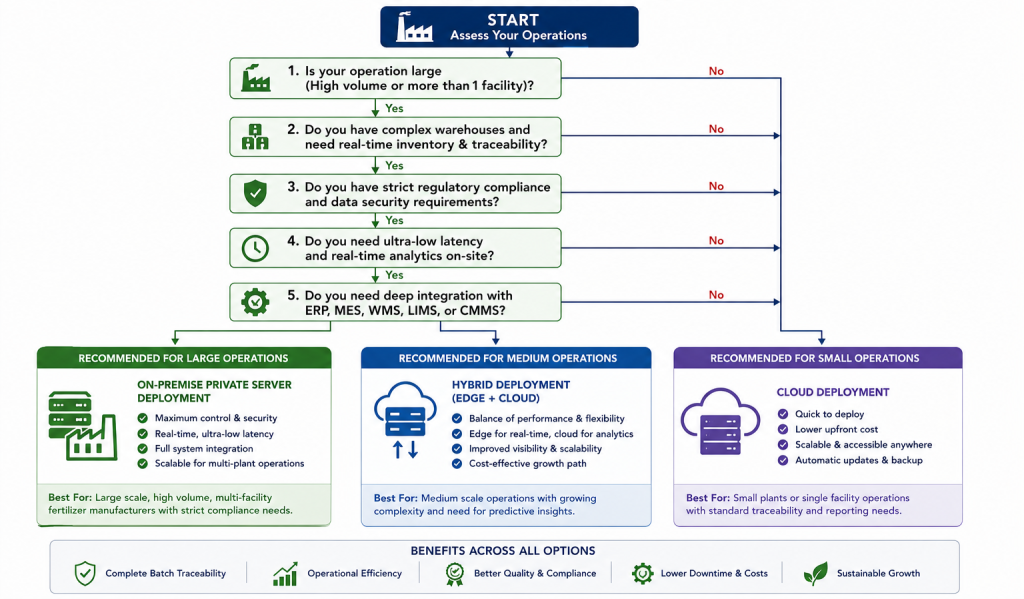
Simple decision tree for selecting an appropriate AI and RFID deployment strategy based on operational size, production complexity, compliance requirements, integration needs, and deployment preferences. The visual concludes with recommended approaches for small, medium, and large fertilizer manufacturing operations.
Building the Future of Industrial AI and IoT with Aperture Venture Studio and GAO RFID Inc.
For more than three decades, GAO Group of Companies has invested heavily in research and development of industrial RFID, BLE, and IoT technologies. As AI has become increasingly valuable for fertilizer manufacturing, we have expanded our AI and IoT capabilities and established Aperture Venture Studio to accelerate the development and adoption of advanced AI and IoT solutions across industrial sectors, including chemical and fertilizer manufacturing.
Aperture has attracted leading AI researchers, IoT specialists, experienced business executives, strategic investors, and established technology organizations. Through initiatives such as the Aperture Ventures Summit and TekSummit, we foster technical collaboration and knowledge sharing on advanced AI and IoT applications. Together, these initiatives strengthen technical communities and encourage innovation across industrial automation.
We welcome you to engage with us as:
- Advisors, co-founders, or employees
- Investors
- Customers interested in advanced AI and RFID solutions for fertilizer manufacturing