
AI and RFID for Electric Vehicle (EV) Manufacturing: Intelligent Production, Traceability, and Smart Factory Operations
AI and RFID Transforming Electric Vehicle (EV) Manufacturing
Electric Vehicle (EV) Manufacturing is undergoing rapid transformation as battery technologies, high-voltage electrical systems, autonomous driving electronics, and highly automated production lines continue to increase manufacturing complexity. Modern EV factories require complete visibility of thousands of components, precise production sequencing, end-to-end traceability, and continuous quality assurance from incoming materials through final vehicle delivery. AI and RFID technologies work together to provide this visibility by combining automatic identification, real-time location awareness, production intelligence, and predictive decision support across manufacturing operations.
RFID enables automatic identification of battery modules, electric motors, power electronics, traction inverters, charging components, body assemblies, tooling, returnable transport items, and work-in-progress vehicles without manual scanning. AI transforms these RFID-generated operational events into actionable intelligence by identifying production bottlenecks, forecasting shortages, detecting quality anomalies, optimizing manufacturing schedules, and improving material flow throughout EV facilities. Together, AI and RFID support highly connected AIoT manufacturing environments capable of improving productivity, reducing operational risk, and strengthening product traceability while supporting continuous manufacturing improvement.
GAO has supplied RFID hardware products and intelligent identification solutions to organizations across North America for decades, helping manufacturers implement reliable asset visibility, inventory intelligence, and production traceability systems tailored to demanding industrial environments.
AI and RFID for Intelligent Electric Vehicle (EV) Manufacturing with Real-Time Production Visibility and AI-Driven Automation
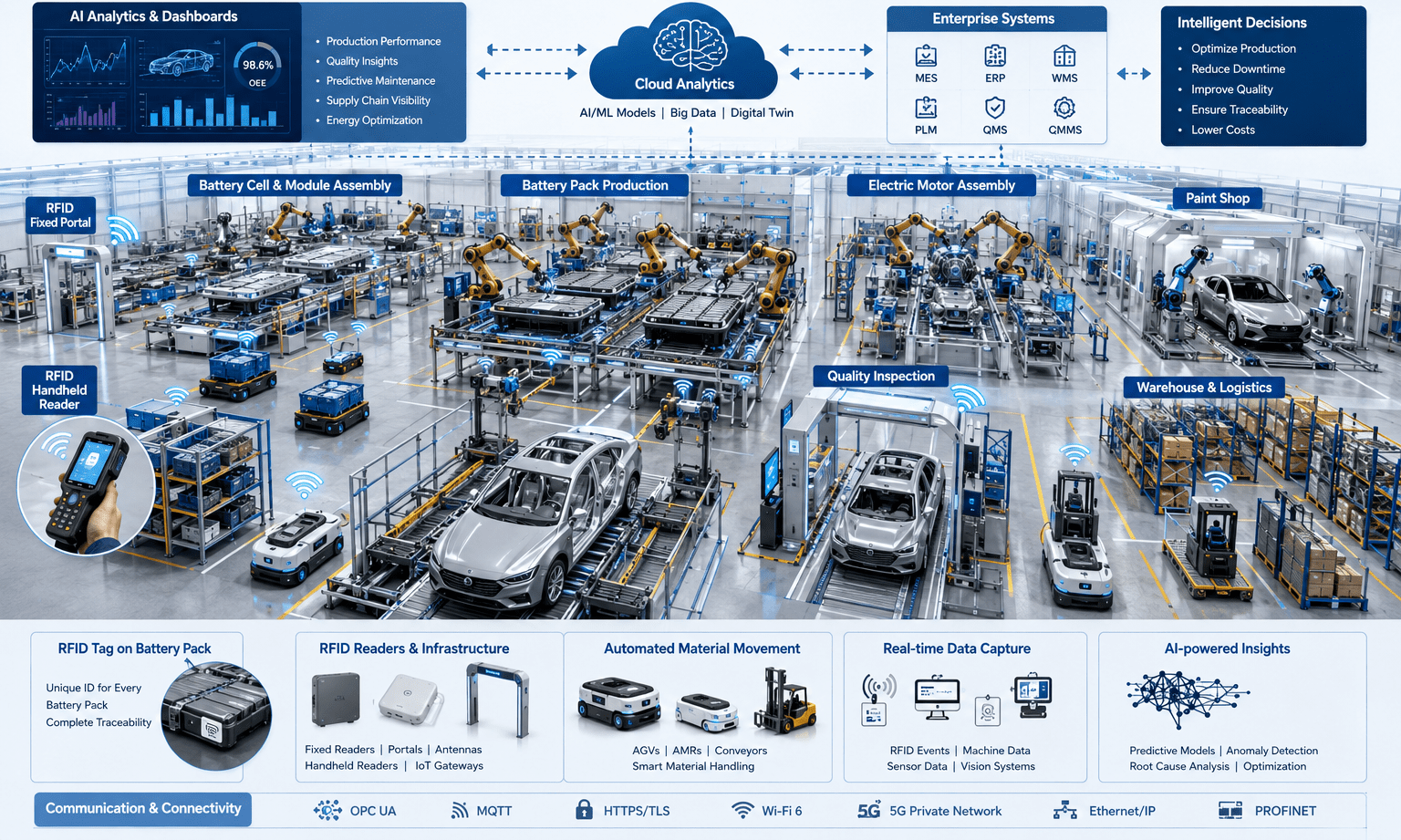
This illustration presents a modern AI and RFID-enabled Electric Vehicle (EV) manufacturing facility, highlighting automated battery production, electric motor assembly, robotic welding, paint operations, quality inspection, warehouse logistics, and intelligent material handling. RFID readers continuously capture asset and production data, while AI analytics integrate with MES, ERP, WMS, PLM, QMS, and CMMS to provide real-time visibility, predictive insights, production optimization, and end-to-end traceability. The visual demonstrates how AIoT technologies improve manufacturing efficiency, quality assurance, inventory management, and operational decision-making throughout the EV production lifecycle.
Understanding AI and RFID in Electric Vehicle Manufacturing
Electric Vehicle manufacturing differs significantly from conventional automotive production because EVs contain high-value lithium-ion battery packs, battery management systems (BMS), power electronics, traction motors, thermal management systems, high-voltage wiring harnesses, charging systems, advanced sensors, and sophisticated electronic control units (ECUs). These components require strict traceability throughout production to satisfy quality assurance requirements, warranty analysis, product recalls, and regulatory compliance.
RFID provides non-contact automatic identification using LF RFID, HF RFID, and UHF RFID technologies. Depending on manufacturing requirements, RFID tags may be attached to:
- Battery cells
- Battery modules
- Battery packs
- Electric drive units
- Motor stators
- Motor rotors
- Inverters
- Power distribution units
- High-voltage cable assemblies
- Cooling assemblies
- Chassis subassemblies
- Vehicle bodies
- Production pallets
- Returnable containers
- Manufacturing tools
- Torque tools
- Calibration fixtures
- AGVs
- Material carts
- Finished vehicles
AI analyzes the continuous stream of RFID events generated throughout manufacturing. Machine learning models identify deviations in production flow, predict inventory shortages, optimize line balancing, estimate completion times, detect abnormal production sequences, and recommend corrective actions before operational disruptions occur.
Rather than relying on periodic barcode scanning or manual inventory updates, AI and RFID create continuous digital visibility across production, warehousing, logistics, maintenance, and quality management.
Modern EV manufacturers increasingly integrate RFID-generated operational data with Manufacturing Execution Systems (MES), Enterprise Resource Planning (ERP), Warehouse Management Systems (WMS), Product Lifecycle Management (PLM), Computerized Maintenance Management Systems (CMMS), Manufacturing Intelligence software, Statistical Process Control (SPC), and Quality Management Systems (QMS). This integration enables AI models to correlate production history, supplier information, equipment performance, and inspection results for comprehensive manufacturing intelligence.
GAO supports organizations implementing RFID-based identification systems by supplying industrial RFID readers, antennas, tags, gateways, and related hardware designed for demanding manufacturing environments.
AI and RFID Applications Across Electric Vehicle Manufacturing Operations
Electric Vehicle production involves numerous interconnected manufacturing processes where component traceability and production visibility directly influence product quality, throughput, and operational efficiency.
Battery Cell and Battery Pack Manufacturing
Battery production represents one of the highest-value operations in EV manufacturing. Every battery cell, module, and completed battery pack requires lifetime traceability.
AI and RFID support:
- Cell genealogy tracking
- Module assembly verification
- Battery pack serialization
- Production sequence validation
- Electrode material traceability
- Electrolyte batch tracking
- Formation cycle monitoring
- Aging process tracking
- Battery testing history
- Warranty data association
AI continuously evaluates manufacturing history to identify hidden relationships between production parameters and future battery performance.
Electric Motor Manufacturing
Electric traction motors require precise assembly and testing.
RFID identifies:
- Rotor assemblies
- Stators
- Bearings
- Magnets
- Cooling jackets
- Assembly fixtures
- Test stations
AI analyzes:
- Assembly cycle times
- Torque measurements
- Vibration test results
- Electrical performance
- End-of-line testing
- Process capability trends
Manufacturers can identify process drift before product quality deteriorates.
Body Shop and Robotic Welding
Hundreds of robotic workstations assemble vehicle structures.
RFID automatically tracks:
- Vehicle body shells
- Welding fixtures
- Robotic tooling
- Production pallets
- Conveyor carriers
AI evaluates:
- Robotic utilization
- Fixture availability
- Welding sequence efficiency
- Production bottlenecks
- Cycle time variation
- Overall Equipment Effectiveness (OEE)
This visibility helps optimize production throughput while reducing idle time.
Paint Shop Operations
Paint facilities require strict process sequencing.
RFID enables automatic tracking of:
- Vehicle bodies
- Paint carriers
- Pretreatment stages
- Curing ovens
- Inspection stations
AI predicts:
- Paint defects
- Production delays
- Carrier congestion
- Oven utilization
- Rework probability
Historical production data improves future process optimization.
Final Vehicle Assembly
Vehicle assembly combines thousands of serialized components.
RFID verifies:
- Correct battery installation
- Correct motor installation
- ECU installation
- Wiring harness installation
- Interior components
- Charging system installation
- Vehicle identification sequence
AI monitors:
- Assembly quality
- Line balancing
- Labor productivity
- Material shortages
- Production forecasting
- Dynamic scheduling
This minimizes assembly errors while improving manufacturing efficiency.
Warehouse and Intralogistics
EV factories rely heavily on automated material movement.
RFID tracks:
- Raw materials
- Battery inventory
- Supplier containers
- Returnable transport items
- Warehouse locations
- AGVs
- AMRs
- Forklifts
- Finished goods
AI optimizes:
- Warehouse slotting
- Inventory replenishment
- Picking routes
- Material availability
- Traffic congestion
- Logistics scheduling
These capabilities improve inventory accuracy while reducing production interruptions caused by missing materials.
AI and RFID Workflow for Electric Vehicle (EV) Manufacturing: Intelligent Production, Traceability, and Real-Time Operational Visibility
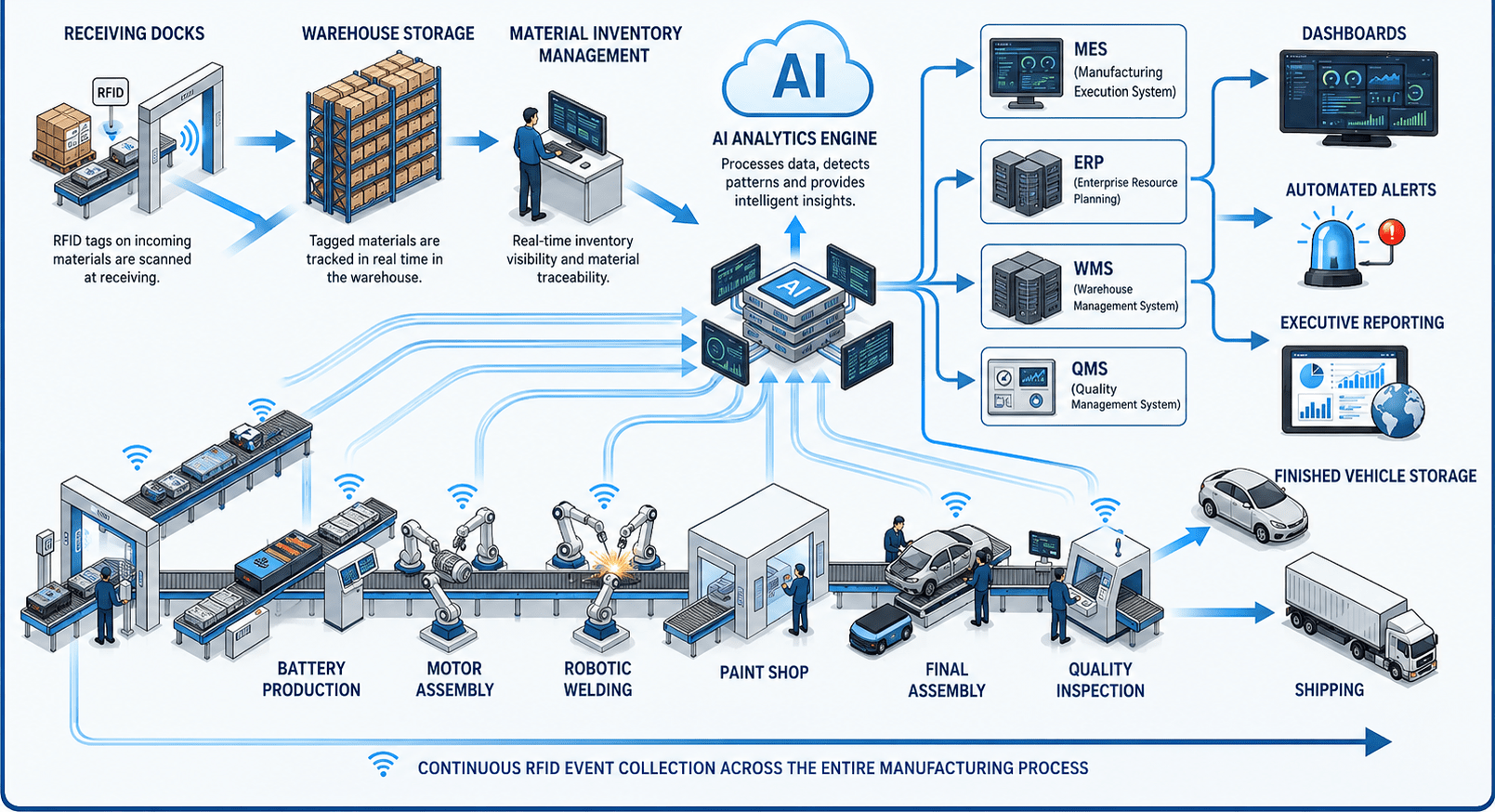
This workflow diagram illustrates the complete AI and RFID-enabled manufacturing lifecycle for Electric Vehicle (EV) production, from RFID-tagged material receiving and warehouse inventory through battery production, motor assembly, robotic welding, paint operations, final assembly, quality inspection, finished vehicle storage, and shipping. Continuous RFID event collection feeds an AI analytics engine that integrates with MES, ERP, WMS, and QMS to deliver real-time dashboards, automated alerts, executive reporting, and data-driven operational decisions. The visual highlights how AI and RFID improve production visibility, inventory traceability, manufacturing efficiency, and quality control across the entire EV manufacturing process.
Operational Workflow from RFID Data Capture to AI-Driven Manufacturing Intelligence
AI and RFID systems in Electric Vehicle manufacturing operate as an integrated information pipeline that continuously transforms physical production activities into actionable manufacturing intelligence.
The workflow begins with RFID-tagged raw materials, battery components, electric motor parts, stamped body panels, production tooling, returnable containers, and work-in-progress assemblies entering receiving operations. Fixed UHF RFID portals installed at dock doors automatically identify inbound shipments, verify supplier deliveries against purchase orders, and associate serialized components with production lots. Handheld RFID readers support exception handling, inventory reconciliation, and engineering inspections where fixed infrastructure is impractical.
As materials progress through warehouse storage and production supermarkets, strategically positioned RFID readers, antennas, and conveyor-mounted interrogation points capture movement events without interrupting production. AI software continuously evaluates these events to detect inventory imbalances, excessive dwell times, route deviations, or replenishment delays that could interrupt battery pack assembly or final vehicle production.
Production workstations, robotic welding cells, battery module assembly lines, motor assembly stations, paint conveyors, torque verification systems, and end-of-line testing stations generate additional RFID events as tagged assemblies advance through each manufacturing stage. Edge servers aggregate RFID reads locally, perform event filtering, remove duplicate reads, and correlate identification data with production orders before securely forwarding structured events to manufacturing software.
Middleware translates RFID events into business transactions that integrate with MES, ERP, WMS, PLM, QMS, and CMMS software. AI models then combine RFID history with machine telemetry, production schedules, inspection results, supplier information, equipment utilization, and workforce activity to generate predictive insights. These insights include estimated production completion times, bottleneck forecasts, quality risk assessments, battery genealogy verification, asset utilization trends, and maintenance recommendations.
Automated workflows can trigger replenishment requests, adjust production sequencing, notify supervisors of abnormal conditions, or recommend corrective actions based on predefined operational policies. Decision-makers access these insights through role-specific dashboards, enabling production managers, quality engineers, maintenance teams, and supply chain personnel to respond proactively rather than reactively.
AI and RFID Solution for Electric Vehicle (EV) Manufacturing: Intelligent Traceability, Enterprise Integration, and Production Optimization
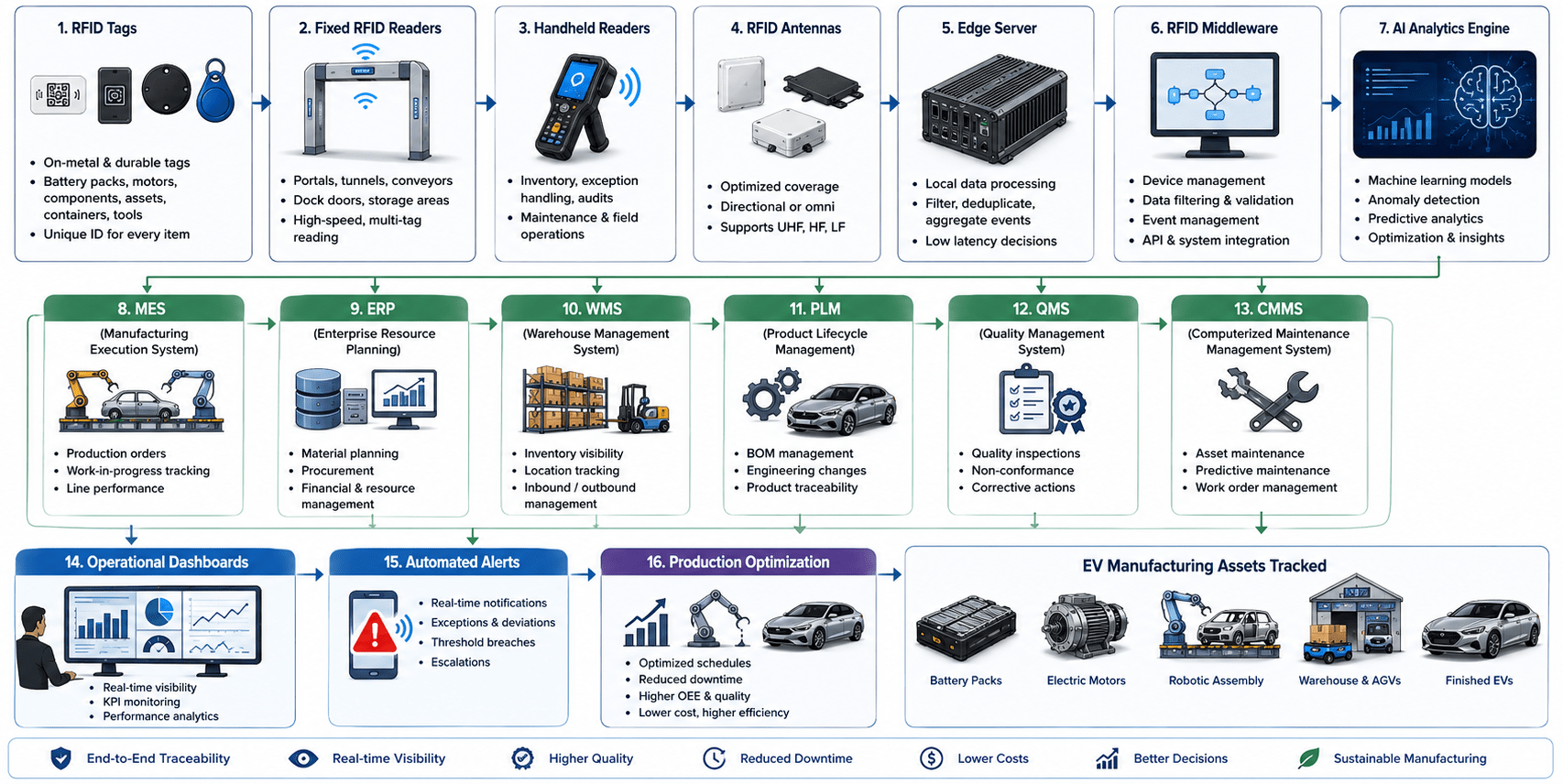
This solution block diagram illustrates the complete AI and RFID technology stack for Electric Vehicle (EV) manufacturing, showing the flow of data from RFID tags, fixed and handheld readers, antennas, edge servers, and RFID middleware to an AI analytics engine. The AI-generated insights integrate with MES, ERP, WMS, PLM, QMS, and CMMS to deliver operational dashboards, automated alerts, predictive maintenance, and production optimization. The visual demonstrates how AI and RFID enable end-to-end traceability, real-time manufacturing visibility, intelligent decision-making, and continuous process improvement across EV production operations.
RFID Technologies, AI Software, Infrastructure, and Deployment Models for EV Manufacturing
Electric Vehicle manufacturing requires RFID solutions capable of operating reliably across metal-intensive production environments, high-temperature processes, automated assembly equipment, and large-scale logistics operations. Successful AI and RFID implementations depend on selecting appropriate RFID technologies, industrial-grade hardware, intelligent software, secure communications, and deployment models that align with production throughput, cybersecurity requirements, and operational resilience.
UHF RFID is the primary identification technology for production logistics, warehouse operations, finished vehicle tracking, returnable transport item management, and conveyor-based automation because it offers longer read ranges, rapid multi-tag reading, and compatibility with dock door portals, overhead readers, tunnel readers, and automated storage systems. Specialized on-metal UHF tags are commonly attached to battery packs, steel containers, body carriers, tooling fixtures, and reusable manufacturing assets to maintain reliable performance despite reflective metallic surfaces.
HF RFID is frequently selected for manufacturing workstations where close-range identification, controlled read zones, and high write reliability are essential. Typical applications include battery module assembly, torque verification stations, calibration fixtures, electronic component validation, and process confirmation steps where only a single tagged item should be read at a time. LF RFID remains valuable for selected tooling identification and harsh industrial environments where short-range, interference-resistant operation is advantageous.
Industrial fixed RFID readers connect to multiple antennas positioned along conveyors, robotic cells, warehouse aisles, automated guided vehicle routes, and inspection stations. Handheld RFID readers complement fixed infrastructure by supporting engineering investigations, inventory audits, maintenance activities, and exception handling. Rugged RFID printers and encoders generate durable labels capable of withstanding vibration, chemical exposure, and thermal cycles encountered during EV production.
AI software operates on the structured event stream generated by the RFID system. Depending on the manufacturing objective, organizations may deploy supervised learning models for quality prediction, unsupervised learning for anomaly detection, reinforcement learning for dynamic production scheduling, and time-series forecasting models for inventory demand, equipment utilization, and production throughput.
RFID Technologies, AI Software, Infrastructure, and Deployment Models for EV Manufacturing (Continued)
Computer vision models are frequently integrated with RFID to verify component installation, inspect weld quality, detect cosmetic defects, confirm connector placement, and validate battery pack assembly. Combining RFID identification with machine vision allows AI to associate inspection results with the exact serialized component, creating complete production genealogy for every vehicle.
Natural language processing (NLP) models can analyze maintenance logs, quality reports, engineering change orders, supplier corrective action reports, and operator comments to identify recurring production issues that may not be evident from structured manufacturing data alone. Generative AI can further assist production engineers by summarizing manufacturing performance, explaining root causes, recommending corrective actions, and generating operational reports based on RFID and production data.
Communication Infrastructure
Reliable communication is essential for AI and RFID systems deployed across large EV manufacturing facilities.
Common communication technologies include:
- Ethernet for fixed industrial networking
- Industrial Wi-Fi (IEEE 802.11) for mobile devices and handheld RFID readers
- Private 5G for large manufacturing campuses requiring low latency and mobility
- OPC UA for secure industrial data exchange
- MQTT for lightweight event messaging
- REST APIs for enterprise software integration
- HTTPS/TLS for secure cloud communication
- Modbus TCP where legacy industrial equipment is integrated
- EtherNet/IP for industrial automation environments
- PROFINET for programmable logic controller (PLC) communications
RFID middleware aggregates reader events, removes duplicate reads, validates business rules, filters noise, and forwards only meaningful production events to higher-level software. This significantly reduces unnecessary processing while improving the accuracy of AI analytics.
Enterprise Software Integration
RFID-derived operational events become substantially more valuable when combined with manufacturing business systems.
Typical integrations include:
- Manufacturing Execution Systems (MES)
- Enterprise Resource Planning (ERP)
- Warehouse Management Systems (WMS)
- Product Lifecycle Management (PLM)
- Quality Management Systems (QMS)
- Computerized Maintenance Management Systems (CMMS)
- Supply Chain Management (SCM)
- Transportation Management Systems (TMS)
- Manufacturing Intelligence software
- Statistical Process Control (SPC)
- Digital Twin software where applicable
Rather than treating RFID as an isolated identification technology, successful EV manufacturers use AI to correlate production history, supplier information, equipment utilization, inspection results, maintenance history, and logistics activities into a unified operational view.
Cloud Version
Cloud-hosted deployments are well suited for organizations operating multiple EV production facilities, geographically distributed suppliers, or centralized manufacturing operations.
Cloud deployments commonly provide:
- Multi-site manufacturing visibility
- Fleet-wide production analytics
- Centralized AI model training
- Enterprise reporting
- Supplier collaboration
- Software updates
- Long-term historical analytics
- Disaster recovery
- Elastic computing resources for AI workloads
Organizations introducing new EV production lines often select cloud deployments because infrastructure expansion can occur rapidly without significant investment in additional computing hardware.
Server Version
Many EV manufacturers prefer privately managed server deployments because production systems frequently require deterministic performance, low latency, and strict cybersecurity controls.
Server deployments may operate within:
- Factory server rooms
- Customer-managed private data centers
- Regional manufacturing data centers
- Industrial edge computing facilities
- Hybrid private cloud environments
Server deployments are particularly appropriate when:
- Production must continue during Internet outages.
- Sensitive manufacturing intellectual property must remain under customer control.
- AI inference requires millisecond response times.
- Regulatory requirements restrict external data storage.
- Large volumes of machine data are generated continuously.
Many organizations ultimately adopt hybrid deployments where edge servers perform immediate production analytics while cloud software supports enterprise-wide optimization and long-term planning.
Cybersecurity and Operational Resilience
EV manufacturing increasingly depends on connected production systems, making cybersecurity a fundamental engineering requirement rather than an afterthought.
Recommended security mechanisms include:
- Mutual device authentication
- Role-based access control (RBAC)
- Multi-factor authentication (MFA)
- Transport Layer Security (TLS)
- Virtual Private Networks (VPN)
- Network segmentation
- Zero Trust security principles
- Secure boot
- Firmware signing
- Device certificate management
- Security Information and Event Management (SIEM)
- Continuous vulnerability assessment
- Security patch management
- Comprehensive audit logging
AI can also enhance cybersecurity by identifying abnormal RFID activity, unusual equipment access patterns, unauthorized asset movement, or suspicious production behavior that may indicate operational errors or malicious activity.
GAO assists organizations by supplying industrial RFID hardware designed for reliable operation in demanding manufacturing environments while supporting integration into secure industrial networks and modern AI-driven production systems.
Cloud and Server Deployment for AI and RFID in Electric Vehicle (EV) Manufacturing
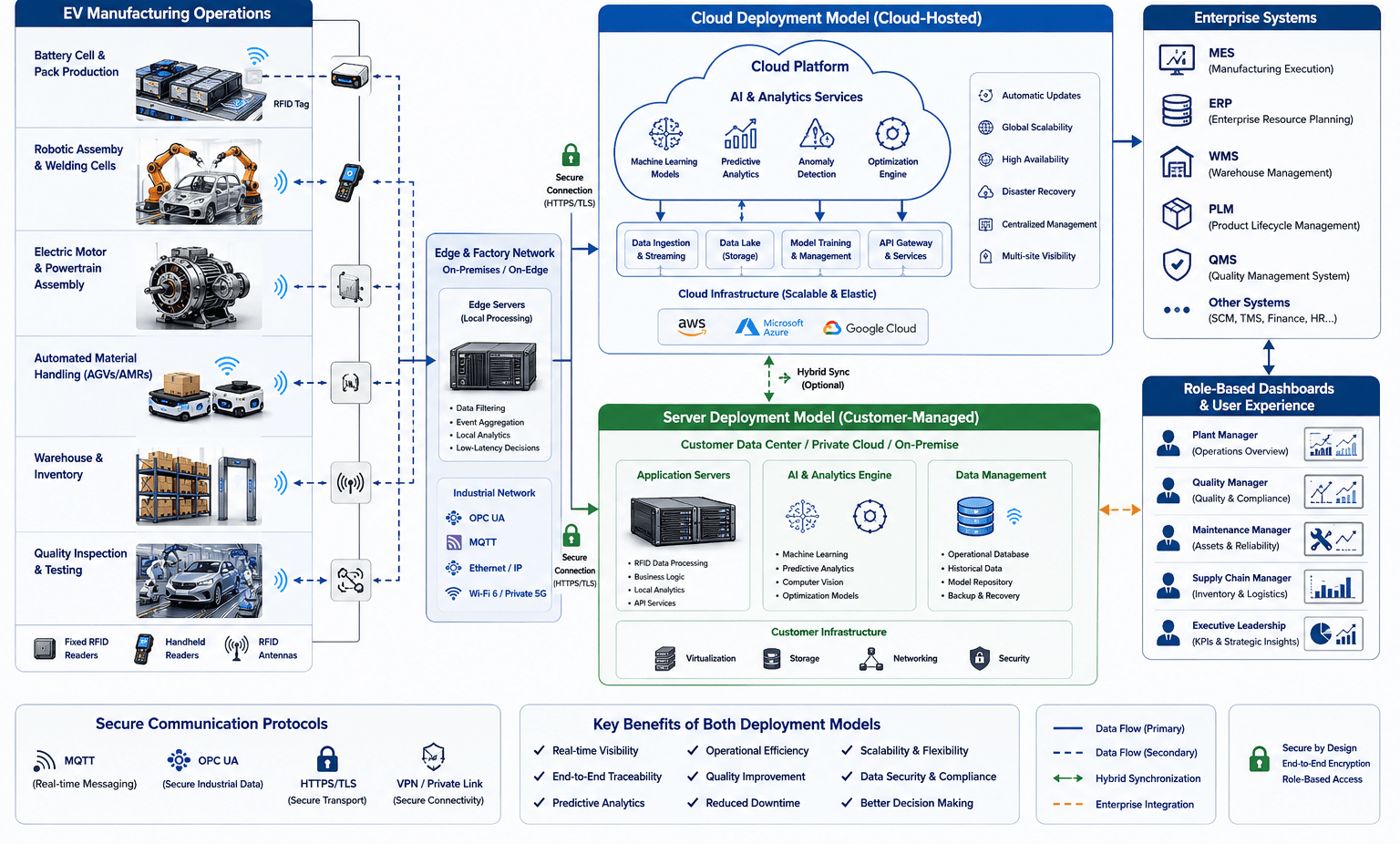
This cloud and server deployment diagram compares cloud-hosted and customer-managed server deployments for AI and RFID solutions in Electric Vehicle (EV) manufacturing. It illustrates how RFID readers, handheld devices, production equipment, edge servers, factory networks, and secure communication protocols collect operational data and deliver it to either cloud-based AI services or privately managed servers. The visual also demonstrates integration with MES, ERP, WMS, PLM, and QMS, enabling role-based dashboards, predictive analytics, secure data management, and intelligent production optimization across EV manufacturing operations.
Technical Capabilities and Operational Value of AI and RFID in Electric Vehicle Manufacturing
Combining AI with RFID delivers measurable improvements throughout EV manufacturing by transforming identification data into operational intelligence that supports engineering, production, quality, maintenance, and supply chain decisions.
End-to-End Battery Genealogy
Battery packs represent the highest-value assemblies in most electric vehicles. AI and RFID establish complete genealogy by linking every battery cell, module, manufacturing batch, inspection result, and performance test to the finished battery pack. This traceability simplifies warranty investigations, targeted recalls, and continuous quality improvement.
Production Flow Optimization
AI continuously evaluates RFID events to identify congestion, excessive dwell times, workstation imbalances, and material shortages before they disrupt production. Production planners can adjust schedules proactively, reducing bottlenecks and improving line throughput.
Intelligent Inventory Management
RFID provides continuous inventory visibility without manual scanning. AI predicts replenishment requirements, optimizes warehouse slotting, recommends inventory transfers, and minimizes stockouts while reducing excess inventory held across manufacturing facilities.
Quality Assurance and Defect Prevention
By correlating RFID traceability with inspection results, torque measurements, machine parameters, and environmental conditions, AI identifies subtle production patterns associated with future quality issues. Manufacturing engineers can implement corrective actions before defects propagate through downstream operations.
Asset and Tool Management
Manufacturing tools, calibration equipment, welding fixtures, battery handling devices, and returnable transport items are valuable operational assets. RFID automatically tracks their location and utilization while AI recommends maintenance schedules, identifies underutilized assets, and reduces unnecessary equipment purchases.
Predictive Maintenance
RFID identifies equipment undergoing maintenance while AI analyzes maintenance history, equipment runtime, spare parts consumption, and operational trends to forecast failures. Planned maintenance minimizes unexpected downtime and improves Overall Equipment Effectiveness (OEE).
Workforce Productivity
Operators spend less time searching for materials, tools, and production information because RFID continuously updates manufacturing status. AI further assists supervisors by prioritizing alerts, summarizing operational performance, and recommending workload adjustments based on production conditions.
Supply Chain Visibility
EV manufacturers depend on globally distributed suppliers. AI and RFID improve supplier visibility by tracking inbound materials, verifying deliveries, monitoring returnable containers, and identifying logistics delays before they affect production schedules.
Sustainability and Resource Efficiency
Improved inventory accuracy, optimized production sequencing, and reduced rework contribute to lower material waste and more efficient use of manufacturing resources. AI also identifies opportunities to improve energy utilization by analyzing production schedules, equipment operation, and material movement.
GAO has helped organizations improve operational visibility by providing RFID readers, antennas, tags, and related identification hardware that support intelligent manufacturing, logistics, and asset tracking initiatives.
Business and Technical Benefits of AI and RFID for Electric Vehicle (EV) Manufacturing Across the Production Lifecycle
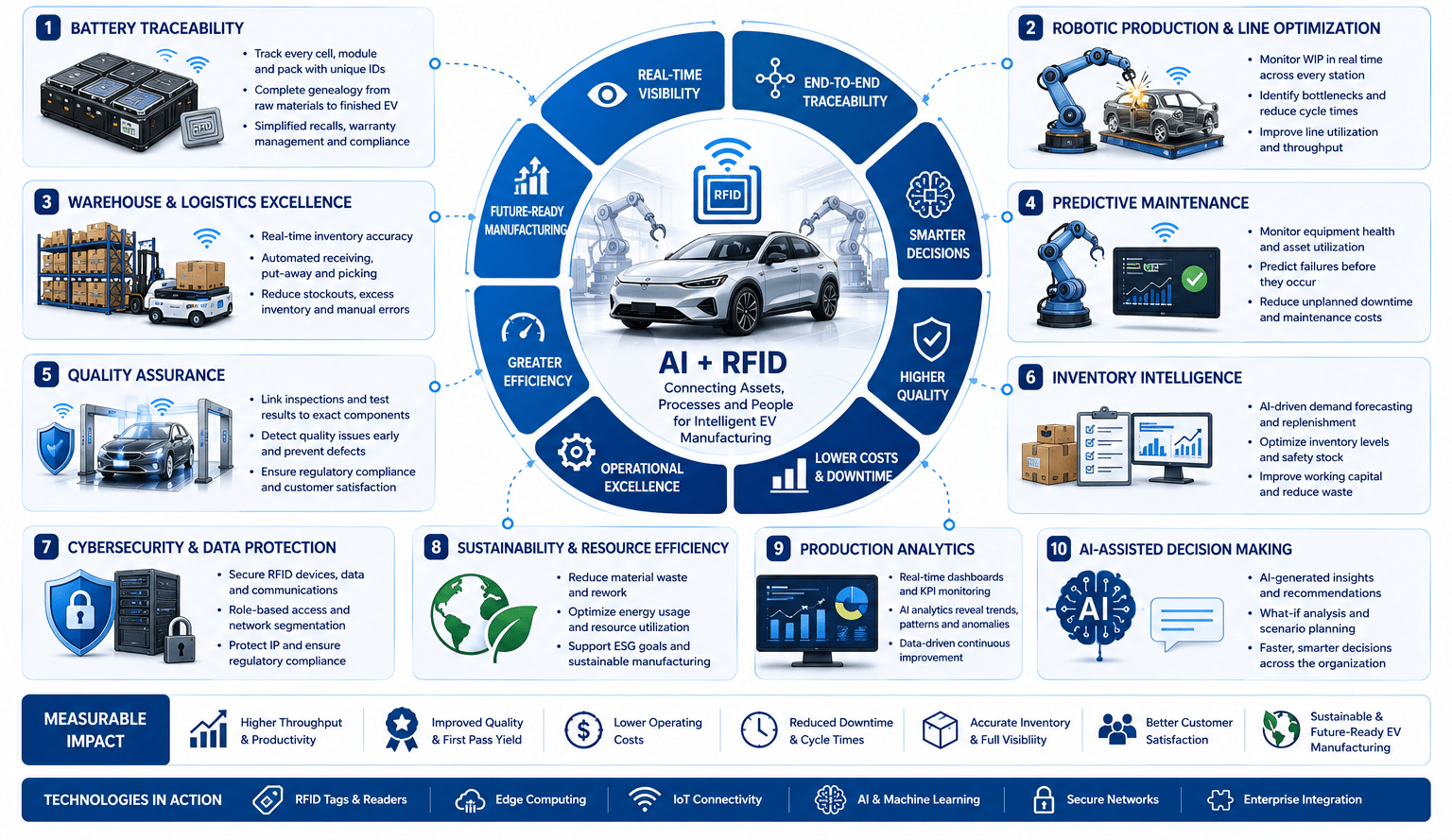
This infographic summarizes the key business and technical advantages of implementing AI and RFID throughout the Electric Vehicle (EV) manufacturing lifecycle. It highlights critical capabilities including battery traceability, robotic production optimization, warehouse logistics, predictive maintenance, quality assurance, inventory intelligence, cybersecurity, sustainability, production analytics, and AI-assisted decision-making. The visual demonstrates how AI and RFID improve operational visibility, manufacturing efficiency, product quality, cost optimization, and data-driven decision-making while supporting end-to-end traceability across EV production.
Engineering Recommendations for Successful AI and RFID Deployment
Organizations planning AI and RFID initiatives for EV manufacturing should adopt a phased implementation strategy that aligns technology investments with measurable operational objectives.
Recommended engineering practices include:
- Select RFID tag types based on battery materials, metallic surfaces, temperature exposure, and expected read distances.
- Conduct comprehensive RF site surveys before installing fixed readers.
- Validate antenna placement to minimize blind spots and unintended read zones.
- Establish standardized serialization and asset identification policies across suppliers and production facilities.
- Integrate RFID events with MES, ERP, WMS, QMS, and maintenance software from the beginning of the project.
- Deploy edge processing to reduce latency and filter duplicate reads before forwarding data to AI software.
- Continuously retrain AI models using updated production data to maintain prediction accuracy.
- Define measurable KPIs such as OEE, First Pass Yield (FPY), inventory accuracy, cycle time, throughput, defect rate, and unplanned downtime before implementation.
- Apply cybersecurity controls consistently across readers, servers, software, and network infrastructure.
- Pilot deployments on a single production line before expanding to full-scale manufacturing operations.
Organizations that approach AI and RFID as long-term operational improvement programs rather than isolated technology projects generally achieve higher adoption rates and more sustainable business outcomes.
Advancing Intelligent EV Manufacturing with AI and RFID
Electric Vehicle manufacturing demands exceptional traceability, production visibility, quality assurance, and operational agility. AI and RFID address these requirements by combining automatic identification with intelligent analytics that improve manufacturing performance from raw material receiving through final vehicle delivery. Properly integrated systems enhance battery genealogy, production scheduling, inventory management, predictive maintenance, and quality control while supporting data-driven decision making across manufacturing operations.
Headquartered in New York City and Toronto, Canada, GAO is recognized among the world’s leading B2B and B2G suppliers of RFID and BLE technologies. Together with its sister companies, GAO Research Inc. and GAO Tek Inc., GAO has served Fortune 500 companies, leading research organizations, prestigious universities, and government agencies throughout the United States and Canada for more than three decades. Through sustained investment in research and development, rigorous quality assurance, and expert remote and onsite technical support, we continue helping organizations deploy reliable RFID and AIoT solutions that solve real operational challenges in advanced manufacturing environments.
Complete AI and RFID Solution for Electric Vehicle (EV) Manufacturing: Intelligent Production, Enterprise Integration, and Operational Optimization
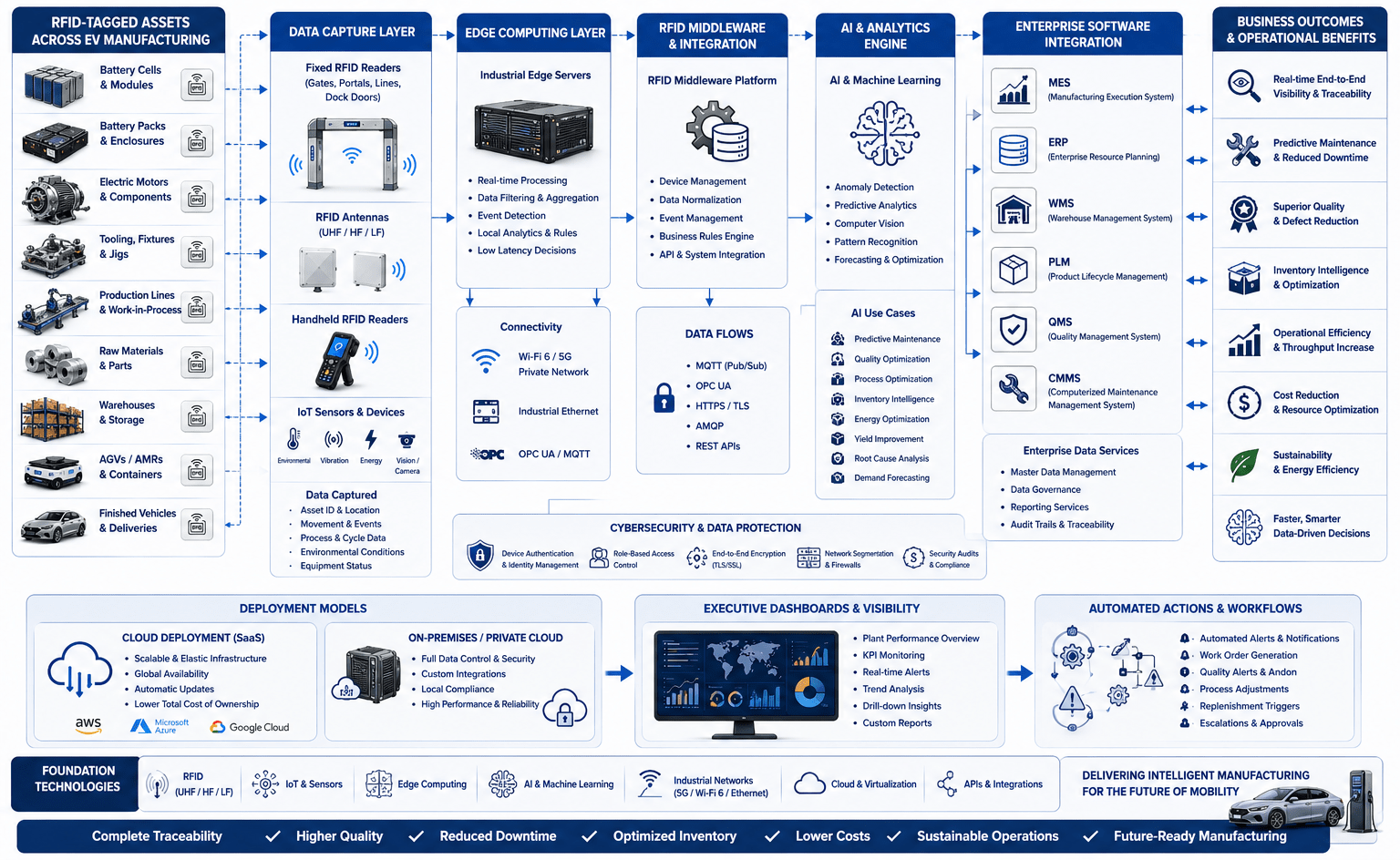
This solution overview diagram illustrates the complete AI and RFID workflow for Electric Vehicle (EV) manufacturing, connecting RFID-tagged assets, battery cells, electric motors, assembly tooling, AGVs, conveyor systems, warehouse operations, and robotic production cells with edge computing, RFID middleware, and an AI analytics engine. The solution integrates with MES, ERP, WMS, PLM, QMS, and CAMS while incorporating cybersecurity controls and cloud or private server deployments to deliver predictive maintenance, quality optimization, inventory intelligence, executive dashboards, and AI-assisted production decisions. The visual demonstrates how AI and RFID provide end-to-end traceability, real-time operational visibility, secure enterprise integration, and continuous manufacturing optimization across the EV production lifecycle.
Building the Future of Industrial AI and IoT with Aperture Venture Studio and GAO RFID Inc.
For more than three decades, GAO Group of Companies has invested extensively in industrial RFID, BLE, IoT, and intelligent identification technologies. As generative AI has demonstrated measurable value across advanced manufacturing, we have expanded our work in AI and IoT while establishing Aperture Venture Studio to accelerate the development and growth of intelligent industrial solutions for sectors such as Electric Vehicle manufacturing. Aperture has attracted leading AI and IoT experts, experienced business executives, respected investors, and industry partners. Through initiatives including Aperture Ventures Summit and TekSummit, we continue fostering vibrant technical communities focused on AI and IoT innovation. We welcome advisors, employees, investors, and customers who share our vision for advancing intelligent industrial technologies.