
AI-Powered RFID Solutions for PCB Manufacturing: Intelligent Traceability, Quality Control, and Smart Electronics Production
AI-Driven PCB Manufacturing with RFID for Intelligent Electronics Production
Printed Circuit Board (PCB) manufacturing has evolved into one of the most sophisticated segments of electronics manufacturing, where microscopic defects, complex multilayer board designs, high-speed production lines, and stringent quality requirements demand exceptional manufacturing precision. Artificial Intelligence (AI) combined with RFID technologies including UHF RFID, HF RFID, and LF RFID enables manufacturers to transform traditional PCB production into intelligent, data-driven manufacturing systems capable of real-time decision making, predictive analytics, automated traceability, and continuous process optimization.
Rather than serving only as an identification technology, RFID acts as the primary data acquisition layer that continuously captures manufacturing events throughout PCB fabrication, assembly, inspection, testing, packaging, and logistics. AI analyzes these large volumes of manufacturing data to identify hidden process variations, predict equipment failures, optimize production scheduling, improve first-pass yield, reduce scrap rates, and strengthen quality assurance.
PCB manufacturers producing automotive electronics, aerospace electronics, medical devices, industrial control systems, telecommunications equipment, consumer electronics, semiconductor substrates, and defense electronics increasingly deploy AI-enabled RFID systems to improve production visibility while maintaining complete digital traceability across every manufacturing stage.
For more than three decades, GAO has supplied RFID and Industrial IoT hardware solutions supporting manufacturers, system integrators, research institutions, Fortune 500 organizations, and government agencies throughout North America. Headquartered in New York City and Toronto, Canada, GAO combines extensive engineering experience with comprehensive technical support to help organizations implement reliable RFID-based manufacturing intelligence solutions.
AI-Enabled RFID PCB Manufacturing Workflow for Intelligent Traceability and Smart Factory Operations
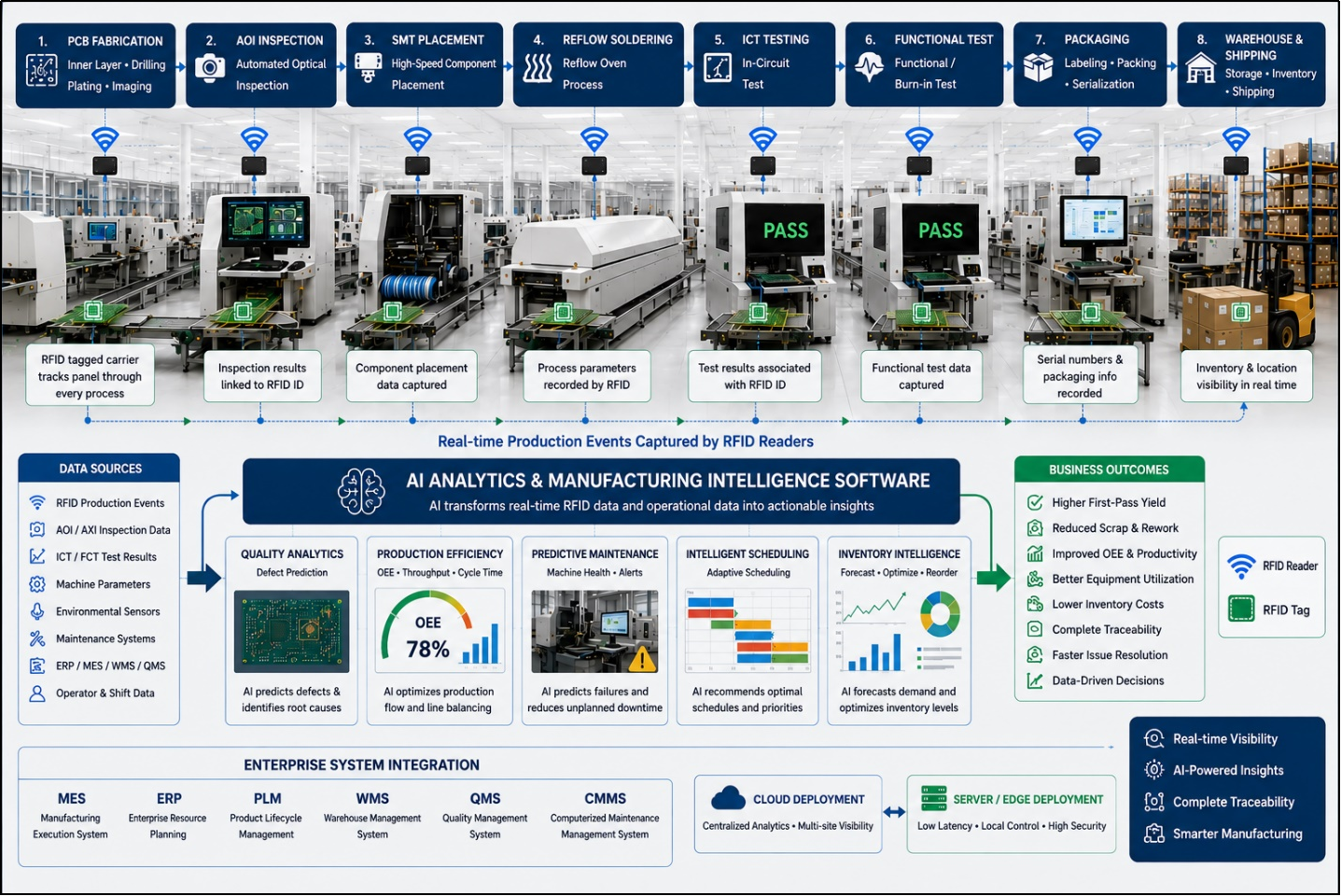
This visual illustrates how AI-powered RFID technology enables end-to-end visibility across the PCB manufacturing lifecycle, from PCB fabrication and AOI inspection through SMT placement, reflow soldering, ICT testing, functional testing, packaging, warehousing, and shipping. RFID readers continuously capture production events while AI analyzes quality, production efficiency, predictive maintenance, inventory, and scheduling data. The diagram also highlights integration with enterprise systems and cloud or edge deployments to support intelligent decision-making, complete traceability, and improved manufacturing performance.
Understanding AI-Enabled RFID Systems in PCB Manufacturing
PCB manufacturing consists of numerous precision manufacturing processes including laminate preparation, drilling, electroless copper deposition, electroplating, photo imaging, etching, solder mask application, surface finishing, electrical testing, SMT assembly, inspection, conformal coating, and final validation. Every stage generates valuable production data that can be transformed into operational intelligence.
AI-powered RFID systems combine automatic identification with intelligent analytics to provide continuous visibility throughout PCB manufacturing.
Unlike barcode systems that require line-of-sight scanning, RFID enables non-contact identification of production carriers, PCB panels, work-in-process (WIP), tooling, fixtures, reusable containers, testing equipment, and finished assemblies while production continues uninterrupted.
AI enhances RFID-generated operational data by learning manufacturing patterns across thousands or millions of production cycles. Machine learning models identify quality deviations before defects become widespread, optimize process parameters, recommend preventive maintenance, forecast production bottlenecks, and support engineering teams with data-driven recommendations.
Within PCB manufacturing, AI and RFID support several critical objectives:
- End-to-end PCB traceability
- Real-time work-in-process visibility
- Automated production genealogy
- Intelligent production scheduling
- AI-assisted defect prediction
- Dynamic equipment utilization
- Smart inventory optimization
- Predictive maintenance
- Closed-loop manufacturing intelligence
- Regulatory compliance documentation
- Manufacturing execution optimization
- Digital quality assurance
These capabilities significantly improve manufacturing consistency while reducing operational risk.
Why AI-Powered RFID Matters for Modern PCB Manufacturing
PCB production environments operate under increasingly demanding requirements driven by miniaturization, higher layer counts, fine-pitch components, lead-free soldering, high-density interconnect (HDI) technologies, and strict reliability standards.
Several operational challenges make intelligent manufacturing particularly valuable.
Product Complexity
Modern multilayer PCBs often contain hundreds or thousands of components requiring precise manufacturing history throughout fabrication and assembly.
High Production Volume
Electronics manufacturers may process tens of thousands of PCB panels every day, making manual tracking impractical.
Strict Quality Requirements
Industries including aerospace, automotive, healthcare, telecommunications, and defense require complete manufacturing genealogy for every PCB assembly.
Equipment Downtime
Unexpected failures in drilling machines, imaging equipment, SMT placement systems, AOI stations, reflow ovens, or flying probe testers can disrupt entire production schedules.
Material Traceability
Copper laminates, prepregs, solder paste, flux, electronic components, chemicals, plating solutions, and conformal coatings require accurate tracking throughout manufacturing.
Process Optimization
Small deviations in drilling accuracy, copper thickness, solder paste deposition, stencil alignment, or reflow profiles may significantly reduce production yield.
AI continuously analyzes RFID-generated production events to detect these issues much earlier than conventional statistical monitoring methods.
This combination enables manufacturers to establish continuous visibility across production while reducing manual data collection and improving operational consistency.
AI-Enabled RFID Solutions for PCB Manufacturing Challenges and Smart Factory Optimization
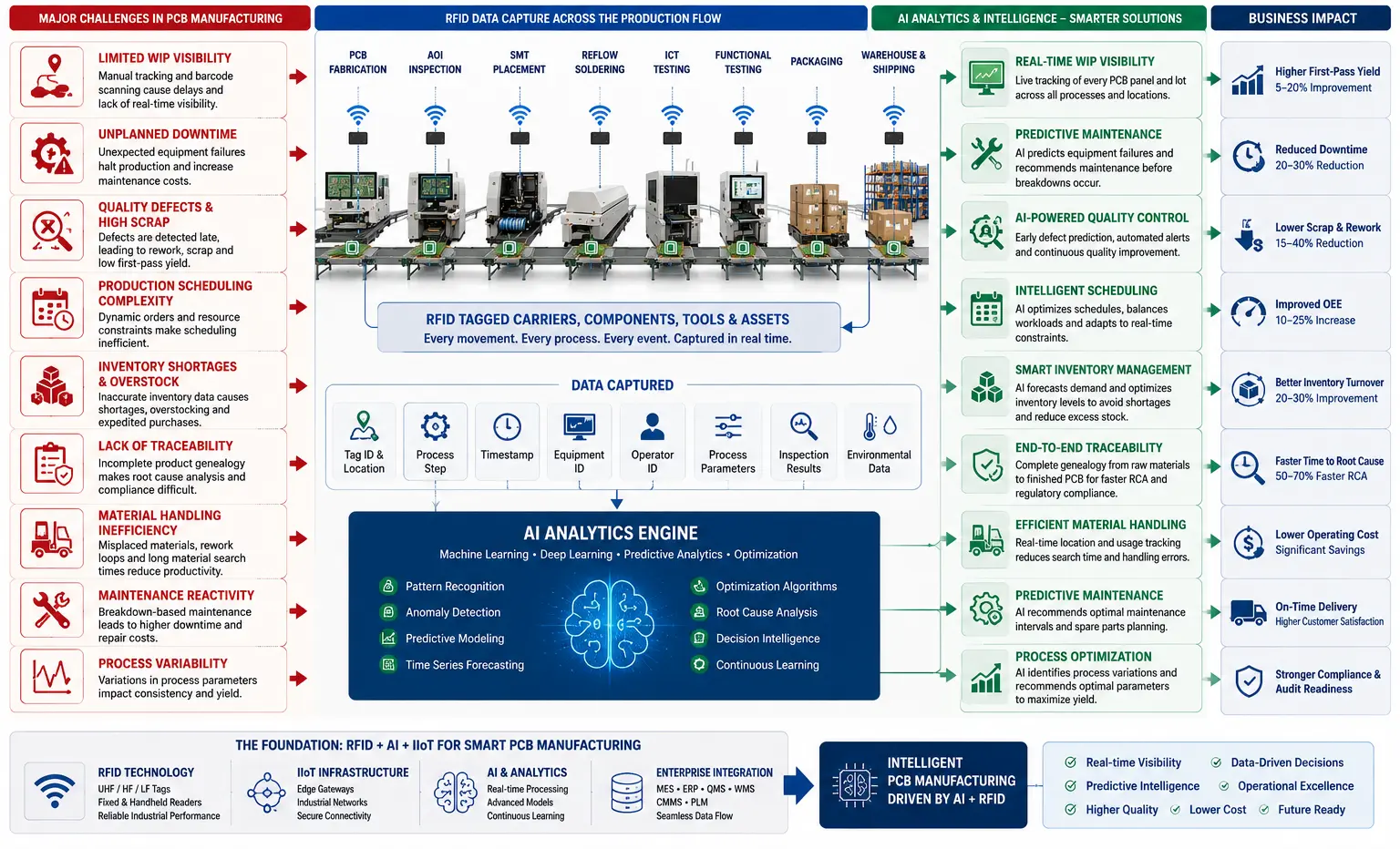
This infographic illustrates the major operational challenges encountered in PCB manufacturing and demonstrates how AI-enabled RFID technology transforms production through real-time data capture, intelligent analytics, and automated decision support. It shows how RFID tracking across fabrication, inspection, assembly, testing, packaging, and warehousing feeds AI models that improve work-in-process visibility, predictive maintenance, quality control, production scheduling, inventory management, and process optimization. The visual also highlights measurable business outcomes, including higher first-pass yield, reduced downtime, improved traceability, lower operating costs, and enhanced manufacturing efficiency.
AI-Powered RFID Applications Across PCB Manufacturing
AI-supported RFID systems deliver measurable improvements throughout PCB fabrication and assembly operations.
Intelligent Work-in-Process Tracking
RFID tags attached to production carriers automatically record every manufacturing operation including drilling, plating, lamination, imaging, etching, solder mask application, AOI inspection, SMT placement, reflow soldering, ICT testing, and packaging.
AI evaluates production flow in real time to identify congestion, optimize routing, and balance workloads between manufacturing cells.
Automated PCB Genealogy
Every PCB receives a complete manufacturing history linking:
- Raw material batches
- Copper laminate lots
- Drilling programs
- Imaging parameters
- Plating records
- AOI inspection results
- X-ray inspection records
- ICT measurements
- Functional test results
- Rework history
- Operator activities
- Environmental conditions
This digital genealogy supports warranty investigations, product recalls, regulatory compliance, and customer quality audits.
AI-Based Quality Prediction
Machine learning models correlate RFID production history with inspection outcomes.
AI identifies subtle relationships between:
- Machine settings
- Material batches
- Temperature profiles
- Humidity variations
- Process timing
- Production shifts
- Equipment calibration
- Maintenance history
These insights help manufacturing engineers reduce recurring defects before they impact production yield.
Smart Component Traceability
RFID enables automated tracking of reels, trays, moisture-sensitive devices (MSDs), BGAs, ICs, connectors, passive components, and semiconductor packages throughout SMT assembly.
AI predicts component shortages while recommending optimized replenishment schedules.
Intelligent Production Scheduling
Production priorities continuously change based on customer orders, equipment availability, engineering changes, and material constraints.
AI evaluates RFID production data to dynamically schedule manufacturing resources while minimizing bottlenecks and improving throughput.
Operational Workflow of AI-Enabled RFID Systems in PCB Manufacturing
Successful deployment requires coordinated interaction between identification technologies, Industrial IoT infrastructure, manufacturing software, AI analytics, and production automation.
Manufacturing Data Acquisition
RFID readers positioned throughout fabrication and assembly lines automatically capture:
- PCB carrier identity
- Workstation location
- Timestamp
- Operator assignment
- Equipment identification
- Production batch
- Manufacturing recipe
- Process completion
- Environmental sensor readings
- Tool utilization
- Inspection outcomes
Additional Industrial IoT sensors collect complementary operational information including:
- Temperature
- Humidity
- Vibration
- Power consumption
- Air pressure
- Chemical concentrations
- Machine cycle times
- Conveyor speed
- Reflow oven profiles
- Vacuum pressure
Industrial Communication Infrastructure
Captured RFID events are transmitted through industrial communication networks supporting deterministic manufacturing environments.
Common communication technologies include:
- Industrial Ethernet
- EtherNet/IP
- PROFINET
- Modbus TCP
- OPC UA
- MQTT
- REST APIs
- HTTPS
- Wi-Fi 6
- Private 5G
- Gigabit Ethernet
- Fiber optic backbone networks
Edge gateways aggregate RFID data before securely forwarding production information to local manufacturing servers or cloud-hosted software.
Edge Computing
Edge computing reduces latency by performing immediate processing close to manufacturing equipment.
Edge software performs:
- RFID event filtering
- Duplicate removal
- Device authentication
- Temporary buffering
- Local analytics
- Equipment synchronization
- AI inference
- Alarm generation
Critical production decisions remain operational even if external network connectivity becomes temporarily unavailable.
Layered AI-Enabled RFID Data Flow System for Intelligent PCB Manufacturing
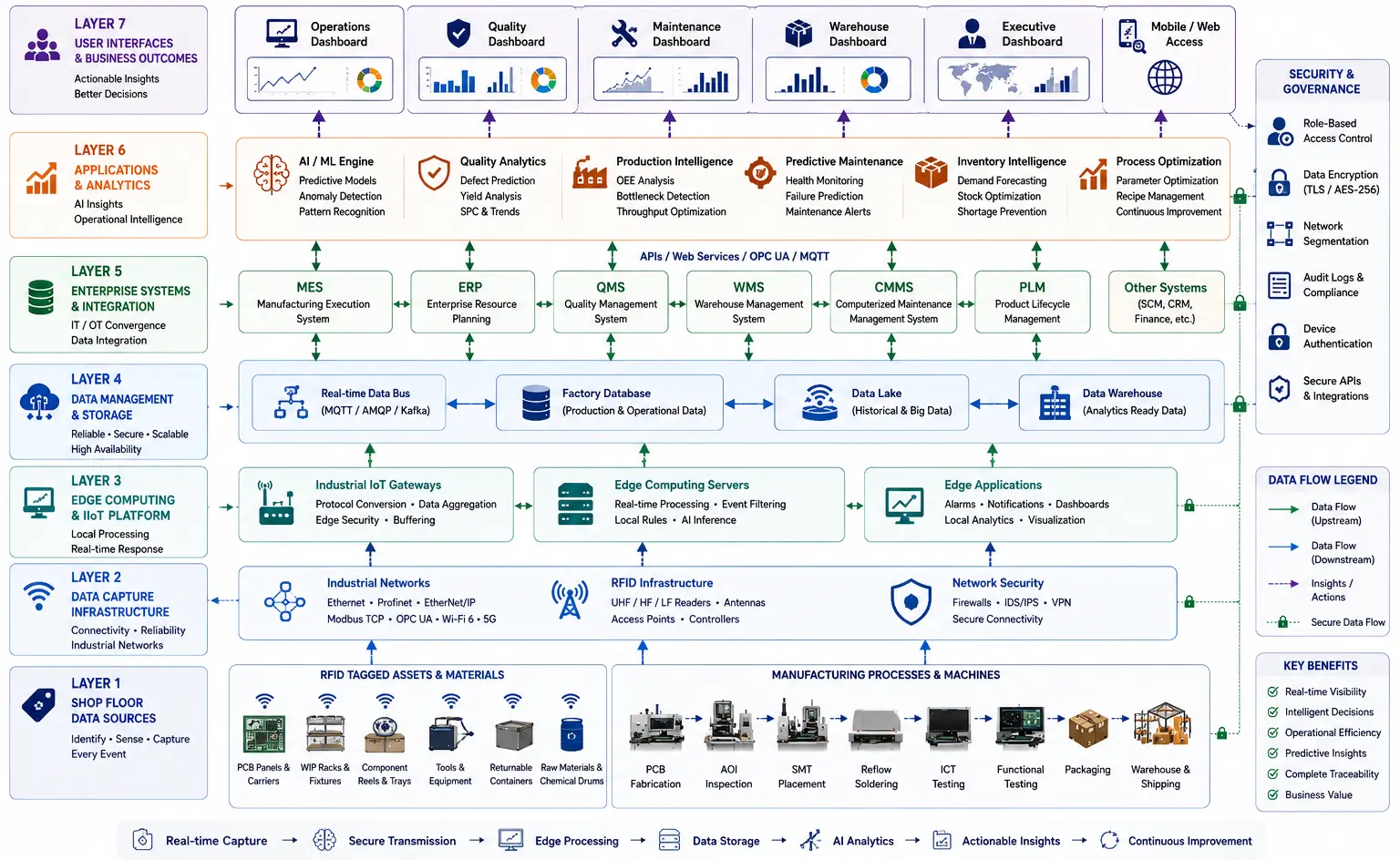
This layered system diagram illustrates how RFID-generated production data flows through a PCB manufacturing environment, from shop floor data capture to AI-driven operational intelligence. It shows the integration of RFID tags, readers, Industrial IoT gateways, edge computing, factory databases, enterprise software, and AI analytics that support real-time quality monitoring, predictive maintenance, inventory management, and executive decision-making. The visual emphasizes secure data movement, interoperability, and end-to-end manufacturing visibility across the entire PCB production lifecycle.
Technology Components Supporting AI-Powered RFID Solutions for PCB Manufacturing
Successful AI-driven PCB manufacturing depends on coordinated operation between RFID hardware, Industrial IoT devices, AI software, manufacturing applications, secure communication infrastructure, and production control systems. Every component contributes to reliable manufacturing visibility, intelligent analytics, and process optimization.
RFID Technologies Used in PCB Manufacturing
Different RFID frequencies serve different operational requirements throughout PCB production.
UHF RFID
Ultra High Frequency RFID provides long read distances and supports rapid identification of multiple tagged assets simultaneously. UHF RFID is commonly deployed for:
- Work-in-process carrier tracking
- Warehouse inventory management
- Finished PCB logistics
- Returnable transport item identification
- Pallet and container management
- Production lot tracking
HF RFID
High Frequency RFID offers stable performance around metal-rich production environments and is widely used for:
- PCB fixture identification
- Manufacturing tooling management
- Test fixture tracking
- Operator authentication
- Production workstation identification
- Electronic work instruction validation
LF RFID
Low Frequency RFID provides reliable short-range identification in demanding industrial environments and is suitable for:
- Equipment access control
- Maintenance tool identification
- Asset authentication
- Calibration management
- Critical spare parts tracking
RFID Hardware Components
Typical deployments include:
- Fixed RFID readers installed along conveyor systems
- Embedded readers integrated into SMT production equipment
- Handheld RFID readers for inventory verification
- RFID antennas optimized for dense manufacturing environments
- Industrial RFID printers and encoders
- Rugged RFID tags for reusable PCB carriers
- High-temperature RFID tags for process fixtures
- Metal-mount RFID tags for tooling and assets
Each hardware component is selected based on reading distance, environmental conditions, tag density, electromagnetic interference, and production speed.
AI Software, Manufacturing Intelligence, and RFID Data Processing for PCB Manufacturing
RFID hardware continuously captures production events, but meaningful operational improvements depend on software capable of transforming those events into manufacturing intelligence. AI software aggregates RFID transactions with machine telemetry, inspection results, production recipes, maintenance records, and environmental measurements to build a continuously updated digital representation of PCB manufacturing operations.
Modern PCB manufacturing environments typically combine supervised learning, unsupervised learning, reinforcement learning, computer vision, statistical process control, and predictive analytics. These AI methods analyze historical and live production data to identify hidden relationships between process variables and manufacturing outcomes.
Common AI models deployed within PCB manufacturing include:
- Predictive maintenance models for drilling machines, imaging systems, reflow ovens, AOI equipment, X-ray inspection systems, and flying probe testers
- Classification models for defect prediction
- Regression models for process parameter optimization
- Anomaly detection models for identifying abnormal production behavior
- Computer vision models for solder joint inspection and component placement verification
- Time-series forecasting for production planning
- Inventory forecasting models for electronic components and raw materials
- Scheduling optimization algorithms for balancing manufacturing resources
Unlike traditional rule-based automation, AI continuously improves as additional RFID events and manufacturing records become available, allowing production engineers to refine process performance using data rather than assumptions.
GAO has supported manufacturers implementing RFID-based data collection systems that provide the reliable operational data required for advanced AI analysis, helping organizations establish trustworthy production visibility before deploying higher-level analytics.
Manufacturing Data Correlation
AI combines RFID-generated identification data with numerous operational data sources to produce a complete manufacturing intelligence system.
Typical integrated data sources include:
- Automated Optical Inspection (AOI)
- Automated X-ray Inspection (AXI)
- In-Circuit Test (ICT)
- Functional Test (FCT)
- Flying Probe Test
- Solder Paste Inspection (SPI)
- Surface Mount Technology (SMT) placement systems
- CNC drilling machines
- Laser Direct Imaging (LDI)
- Electroplating systems
- Environmental monitoring sensors
- Energy monitoring systems
- Operator terminals
- Maintenance software
- Calibration records
- Laboratory measurements
Correlating these independent datasets enables AI to identify manufacturing conditions that contribute to recurring defects, throughput reductions, excessive rework, or abnormal equipment behavior.
Enterprise Software Integration
AI-powered RFID solutions deliver the greatest operational value when integrated with existing manufacturing software rather than operating independently. PCB manufacturers typically connect RFID-generated production events with multiple operational systems to create a unified information flow across production, quality, inventory, maintenance, and business operations.
Manufacturing Execution System (MES)
The Manufacturing Execution System coordinates production activities across PCB fabrication and SMT assembly operations.
RFID automatically updates MES software with:
- Work order progress
- Production status
- Equipment utilization
- Operator assignments
- Material consumption
- Production genealogy
- Batch completion
- Inspection status
- Process exceptions
AI analyzes MES data to recommend production sequence adjustments, optimize workstation utilization, and reduce cycle time variability.
Enterprise Resource Planning (ERP)
ERP software manages purchasing, inventory, finance, customer orders, and production planning.
RFID provides accurate inventory visibility for:
- Copper-clad laminates
- Prepreg materials
- Solder paste
- Electronic components
- Chemicals
- Test fixtures
- Production tooling
- Spare parts
- Finished PCB assemblies
AI forecasts future material requirements by analyzing production schedules, historical consumption, supplier lead times, and demand variability.
Product Lifecycle Management (PLM)
Engineering changes frequently occur during PCB production.
RFID-linked PLM integration ensures manufacturing personnel always receive the correct:
- PCB revision
- Assembly instructions
- Bill of Materials (BOM)
- Process documentation
- Test specifications
- Compliance documentation
AI helps evaluate how engineering changes affect production efficiency and product quality.
Warehouse Management System (WMS)
Warehouse software receives RFID events automatically when materials enter, move within, or leave storage locations.
AI improves warehouse operations by recommending:
- Optimal storage allocation
- Inventory replenishment timing
- Picking sequence optimization
- Material rotation
- Safety stock adjustments
- Warehouse labor allocation
Quality Management System (QMS)
Quality software records inspection outcomes throughout PCB manufacturing.
RFID links quality records directly to each PCB, enabling AI to identify recurring defect patterns associated with:
- Specific suppliers
- Manufacturing equipment
- Production shifts
- Environmental conditions
- Material batches
- Machine calibration intervals
Cloud Version and Server Version Deployment
PCB manufacturers select deployment models based on production scale, cybersecurity requirements, regulatory obligations, network availability, latency requirements, and internal IT capabilities. Both cloud-hosted and privately managed server deployments provide substantial operational benefits when designed appropriately.
Cloud Version
The Cloud Version hosts RFID middleware, AI analytics software, reporting dashboards, and long-term data storage within a managed cloud environment. Production events captured by RFID readers are securely transmitted through encrypted gateways to cloud services, where AI models process operational data and deliver insights to authorized users through web-based dashboards.
Cloud deployment is particularly suitable for organizations operating multiple PCB manufacturing sites, geographically distributed facilities, or contract manufacturing operations that require centralized visibility. It enables rapid software updates, elastic computing resources, simplified disaster recovery, and scalable storage for large historical datasets. Cloud-hosted AI models can also be retrained more efficiently using aggregated production data collected from multiple facilities.
Typical cloud capabilities include:
- Centralized production monitoring
- Multi-site manufacturing visibility
- AI model training using historical production records
- Predictive maintenance dashboards
- Global inventory reporting
- Supplier performance analysis
- Customer quality reporting
- Executive performance dashboards
- Secure remote engineering access
- Automated software updates
Cloud deployments generally require reliable broadband connectivity, secure identity management, encrypted communications, and clearly defined data governance policies.
Server Version
The Server Version deploys RFID middleware, AI software, databases, and reporting applications on customer-managed servers located within factory data centers, edge computing environments, private cloud infrastructure, or other privately hosted enterprise server environments. This deployment model provides organizations with greater control over system configuration, cybersecurity policies, software updates, and sensitive manufacturing data.
Server deployments are often preferred by PCB manufacturers producing aerospace electronics, defense systems, medical devices, automotive safety electronics, or other products subject to strict regulatory and intellectual property requirements. Local processing minimizes latency, supports continuous operation during external network disruptions, and simplifies compliance with internal security policies.
Typical Server Version capabilities include:
- Local AI inference
- High-speed production monitoring
- Low-latency manufacturing decisions
- Factory-controlled software updates
- Internal database management
- Secure integration with production equipment
- Private reporting dashboards
- Offline operational capability
- Custom integration with legacy manufacturing software
- Direct connection to factory control systems
Organizations with experienced information technology teams frequently choose Server Version deployments when production continuity, data sovereignty, and extensive customization are primary design considerations.
Hybrid Deployment
Many PCB manufacturers implement hybrid deployments that combine cloud and privately managed server resources. Time-critical production analytics, RFID event processing, and equipment synchronization remain within local manufacturing facilities, while historical analysis, enterprise reporting, AI model retraining, and long-term data storage are managed through cloud infrastructure.
Hybrid deployments balance operational resilience with enterprise-wide visibility and are particularly effective for organizations operating multiple production sites with varying connectivity and compliance requirements.
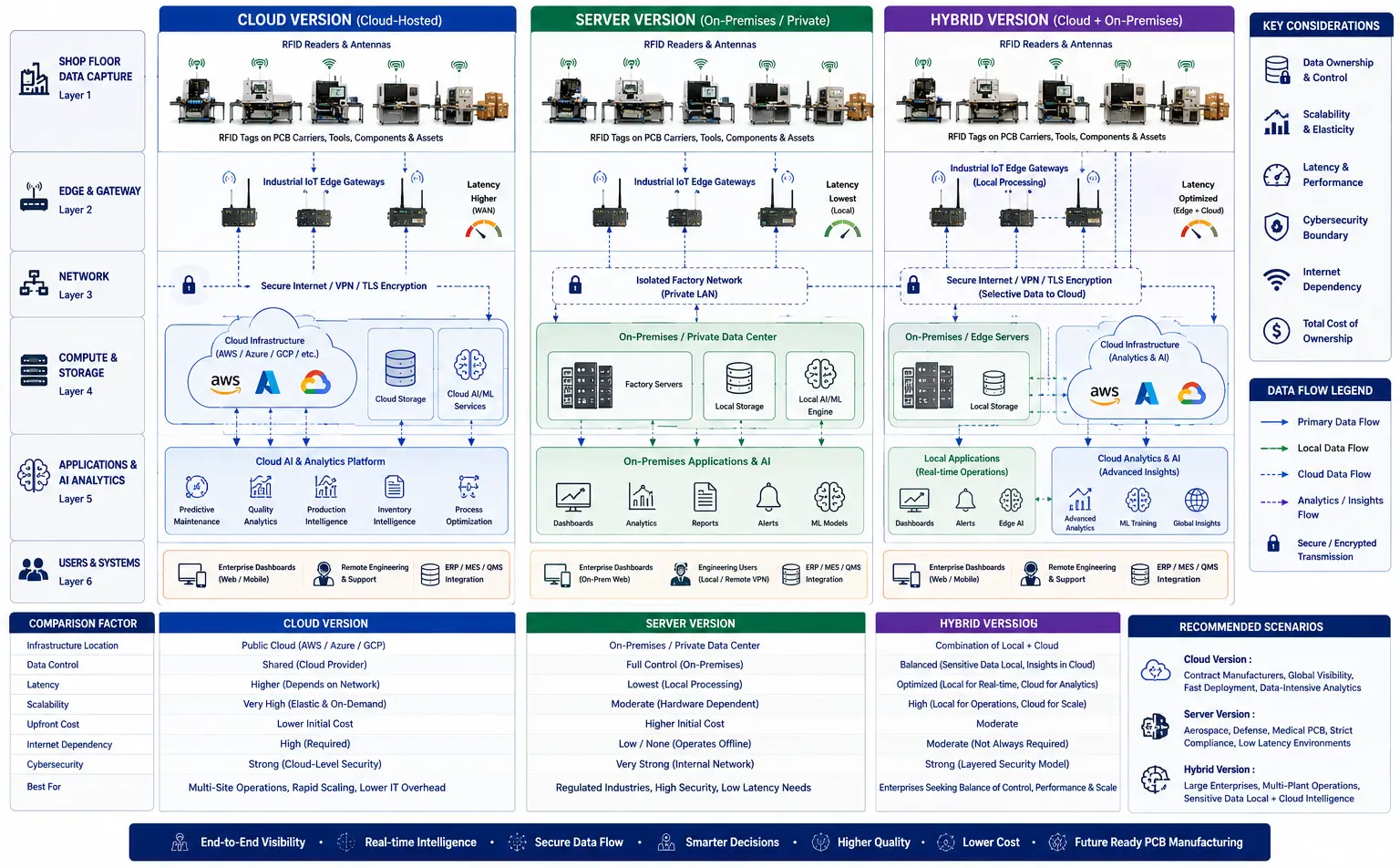
Cloud vs. Server vs. Hybrid AI-Enabled RFID Deployment Frameworks for PCB Manufacturing
Cybersecurity and Data Protection
PCB manufacturing systems increasingly connect production equipment, Industrial IoT devices, RFID readers, engineering workstations, and enterprise software. Strong cybersecurity practices are therefore essential to protect production continuity, intellectual property, and sensitive manufacturing records.
A defense-in-depth strategy should secure every layer of the solution, from RFID endpoints to AI software and enterprise databases.
Key security mechanisms include:
- Mutual authentication between RFID readers and middleware
- Role-based access control (RBAC) for operators, engineers, and administrators
- Multi-factor authentication (MFA) for remote access
- Encryption of RFID data in transit using TLS
- Encryption of production records at rest using AES-256
- Secure VPN connectivity for remote engineering support
- Digital certificates and Public Key Infrastructure (PKI)
- Network segmentation separating production networks from corporate IT systems
- Intrusion detection and intrusion prevention systems (IDS/IPS)
- Security Information and Event Management (SIEM) for centralized monitoring
- Continuous vulnerability assessment and patch management
- Secure API authentication using OAuth 2.0 or OpenID Connect
- Audit logging for production events, engineering changes, and user activities
- Backup, disaster recovery, and ransomware resilience planning
Compliance with widely recognized cybersecurity standards strengthens overall operational resilience. Commonly referenced standards and frameworks include ISO/IEC 27001 for information security management, IEC 62443 for industrial automation and control system security, NIST Cybersecurity Framework, and Zero Trust security principles.
Through decades of supplying RFID and Industrial IoT hardware to customers across North America, GAO has emphasized secure deployment practices, stringent quality assurance, and expert technical support to help organizations implement dependable manufacturing systems while protecting operational data and critical production assets.
Technical Capabilities and Operational Value of AI-Powered RFID in PCB Manufacturing
Combining AI with RFID transforms PCB manufacturing from event-based tracking into continuous operational intelligence. RFID provides accurate, real-time identification of materials, production carriers, tooling, equipment, and finished assemblies, while AI interprets this operational data to optimize manufacturing performance, quality, and resource utilization.
Intelligent Production Visibility
AI continuously analyzes RFID events from fabrication and assembly processes to provide complete visibility into production status. Manufacturing engineers can monitor work-in-process (WIP), identify bottlenecks, evaluate machine utilization, and track production progress without manual intervention.
Key capabilities include:
- Real-time WIP monitoring
- Automated production status updates
- Dynamic production scheduling
- Bottleneck identification
- Line balancing recommendations
- Manufacturing cycle time analysis
Predictive Quality Management
PCB manufacturing generates large volumes of inspection data from AOI, AXI, ICT, flying probe testing, and functional testing. AI correlates these inspection results with RFID-based production histories to identify conditions that contribute to recurring defects.
Examples include:
- Predicting solder bridging before defects increase
- Identifying drill wear affecting hole quality
- Detecting plating process variations
- Monitoring stencil degradation
- Optimizing reflow temperature profiles
- Correlating humidity with moisture-sensitive component failures
These predictive capabilities enable corrective actions before quality issues affect large production batches.
Intelligent Asset Management
RFID enables continuous tracking of production assets including:
- SMT feeders
- Reflow fixtures
- Test fixtures
- PCB carriers
- Calibration equipment
- Maintenance tools
- Returnable transport containers
AI evaluates asset utilization patterns to improve equipment availability, reduce idle time, and optimize preventive maintenance schedules.
Inventory Intelligence
AI enhances RFID-enabled inventory management by forecasting demand for raw materials and electronic components while considering:
- Customer orders
- Production schedules
- Historical consumption
- Supplier lead times
- Seasonal demand
- Safety stock policies
This reduces inventory carrying costs while minimizing production interruptions caused by material shortages.
Energy and Resource Optimization
RFID-generated production data combined with Industrial IoT sensor measurements enables AI to identify opportunities for reducing:
- Electricity consumption
- Compressed air usage
- Nitrogen consumption
- Chemical waste
- Water usage
- Production scrap
These improvements contribute to lower operating costs and more sustainable PCB manufacturing.
Business Benefits and Performance Improvements
Organizations implementing AI-enabled RFID solutions within PCB manufacturing commonly realize measurable operational improvements across production, quality assurance, inventory control, maintenance, and supply chain management.
Expected benefits include:
- Improved first-pass yield through early defect prediction
- Reduced scrap and rework costs
- Increased overall equipment effectiveness (OEE)
- Faster work-in-process tracking
- Improved production throughput
- Higher inventory accuracy
- Better utilization of manufacturing equipment
- Reduced unplanned downtime
- Improved component traceability
- Shorter product recall investigations
- Faster engineering change implementation
- Reduced manual data entry
- More accurate production planning
- Improved supplier performance analysis
- Enhanced customer quality reporting
- Better compliance documentation
Although performance improvements vary by production environment, AI-driven RFID systems consistently provide greater operational visibility and enable more informed decision making than manual or barcode-based tracking methods.
Scalability and Future Expansion
PCB manufacturing facilities frequently expand production capacity, introduce new product families, or adopt advanced manufacturing technologies. AI-enabled RFID systems should therefore be designed with scalability in mind.
Key design considerations include:
- Support for multiple production lines and facilities
- Flexible RFID reader deployment
- Standardized communication interfaces
- Modular software components
- Expandable database capacity
- AI model retraining with new production data
- Integration with future manufacturing equipment
- Support for additional RFID tags and sensors
Emerging technologies such as digital twins, collaborative robotics, autonomous material handling, edge AI, and advanced analytics can be incorporated into existing RFID-based manufacturing systems with minimal disruption when open standards and interoperable interfaces are used.
Engineering Best Practices for Successful Deployment
Successful implementation requires careful planning and collaboration among manufacturing engineers, quality teams, IT personnel, automation specialists, and system integrators.
Recommended engineering practices include:
- Define traceability requirements before selecting RFID hardware
- Perform RF site surveys to identify potential interference sources
- Select RFID tags appropriate for temperature, chemicals, and metal-rich environments
- Validate read accuracy at production speeds
- Standardize tag placement on PCB carriers and tooling
- Integrate RFID events with existing MES, ERP, QMS, and WMS software
- Establish data governance policies for AI model training
- Implement role-based cybersecurity controls
- Conduct factory acceptance testing (FAT) and site acceptance testing (SAT)
- Continuously monitor AI model performance and retrain when production conditions change
- Schedule periodic calibration of RFID readers and antennas
- Maintain comprehensive documentation for regulatory compliance and quality audits
Organizations should begin with clearly defined business objectives, measurable KPIs, and phased deployment plans to minimize implementation risk while maximizing operational value.
AI-Enabled RFID Implementation Roadmap for PCB Manufacturing
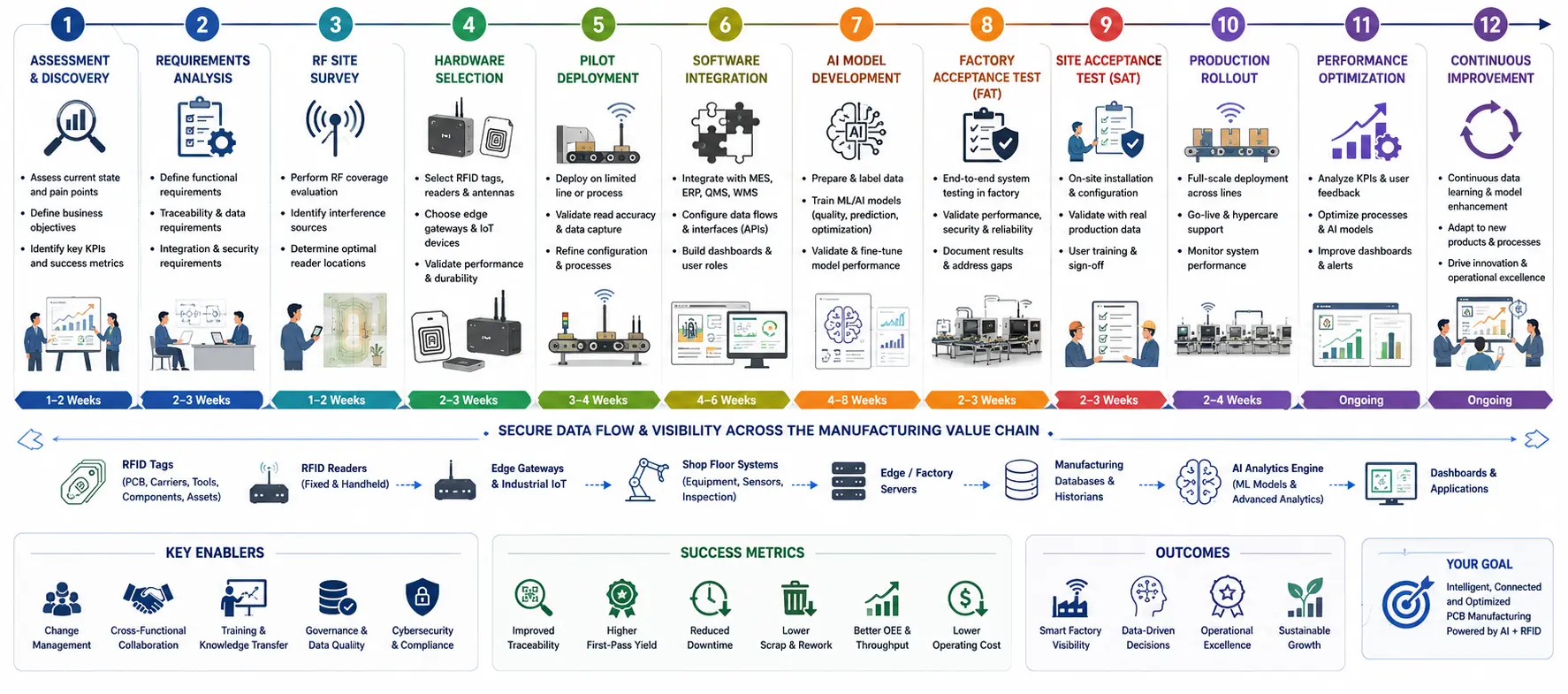
This deployment roadmap illustrates a phased implementation strategy for AI-enabled RFID solutions in PCB manufacturing, guiding organizations from initial assessment and RF site surveys through hardware selection, software integration, AI model development, validation testing, and full production rollout. It highlights the sequence of technical activities, key stakeholders, supporting technologies, and continuous optimization practices required for successful deployment. The visual demonstrates how a structured implementation approach reduces project risk while maximizing traceability, operational efficiency, and long-term manufacturing performance.
Advancing PCB Manufacturing with AI-Powered RFID Intelligence
AI-powered RFID solutions are reshaping PCB manufacturing by combining automatic identification, intelligent analytics, and real-time operational visibility into a unified manufacturing intelligence system. RFID captures accurate production data throughout fabrication, SMT assembly, inspection, testing, and logistics, while AI transforms these data into actionable insights that improve quality, productivity, maintenance, inventory management, and production planning.
Successful implementation requires careful selection of RFID technologies, secure communication infrastructure, integration with manufacturing software, robust cybersecurity practices, and continuous optimization of AI models. Organizations adopting these technologies are better positioned to improve first-pass yield, strengthen product traceability, reduce operational costs, and support increasingly complex PCB manufacturing requirements.
As one of the world’s leading B2B suppliers of RFID and BLE technologies, GAO continues to support manufacturers with high-quality RFID hardware, Industrial IoT solutions, engineering expertise, and responsive technical assistance. Working closely with system integrators, electronics manufacturers, research organizations, and industrial customers, we help organizations implement reliable RFID-enabled manufacturing systems that support long-term operational excellence and digital transformation.
Building the Future of Industrial AI and IoT with Aperture Venture Studio and GAO RFID Inc.
For more than three decades, GAO Group, comprising GAO RFID Inc., GAO Research Inc., and GAO Tek Inc., has invested extensively in research and development of industrial RFID, BLE, and Industrial IoT technologies. Building on our experience supporting PCB manufacturing and other advanced electronics industries, we continue advancing AI-enabled RFID solutions that improve traceability, manufacturing intelligence, quality assurance, and operational efficiency. To further accelerate industrial innovation, we established Aperture Venture Studio to foster the development, commercialization, and adoption of advanced AI and Industrial IoT technologies across manufacturing and other technology-driven sectors.
Aperture has attracted distinguished AI researchers, Industrial IoT engineers, experienced business leaders, strategic investors, and leading technology organizations. Through initiatives such as the Aperture Ventures Summit and TekSummit, we encourage collaboration, technical knowledge sharing, and discussion of emerging AI and Industrial IoT applications. Together, these initiatives have strengthened vibrant technical communities focused on advancing intelligent manufacturing and digital transformation.
We welcome opportunities to collaborate with:
- Advisors, technical experts, co-founders, and talented professionals
- Investors interested in advancing Industrial AI and IoT innovation
- Customers seeking trusted RFID, BLE, AI, and Industrial IoT solutions backed by GAO’s engineering expertise