
AI-Powered Poultry Production Using BLE Sensing, Intelligent Analytics, and Smart Farm Monitoring
How AI and BLE Are Transforming Modern Poultry Production
Artificial intelligence combined with Bluetooth Low Energy (BLE) technologies is transforming poultry production by enabling continuous flock monitoring, intelligent environmental management, predictive disease detection, feed optimization, and automated operational decision making. BLE gateways, BLE beacons, and BLE sensors provide continuous visibility into poultry houses, hatcheries, breeder farms, feed storage facilities, egg production operations, and processing support areas while AI converts this large volume of operational data into actionable insights.
Modern poultry operations generate massive amounts of information from environmental sensors, ventilation systems, feeders, drinkers, weighing systems, egg collection equipment, lighting controls, and animal health observations. AI continuously analyzes these data streams to identify abnormal patterns, forecast production outcomes, optimize flock performance, and support farm managers with faster, data-driven decisions.
For poultry producers operating multiple houses or geographically distributed farms, BLE provides a practical, energy-efficient wireless sensing solution that simplifies deployment while reducing maintenance requirements. Combined with AI, edge computing, enterprise software, and secure cloud or privately hosted server deployments, poultry production becomes increasingly data-driven, resilient, sustainable, and operationally efficient.
GAO has supported organizations across North America by supplying BLE, RFID, and Industrial IoT hardware that enables reliable wireless monitoring, asset visibility, environmental sensing, and intelligent automation across demanding agricultural environments.
AI-Enabled BLE Smart Poultry Production System with Real-Time Farm Monitoring and Predictive Analytics
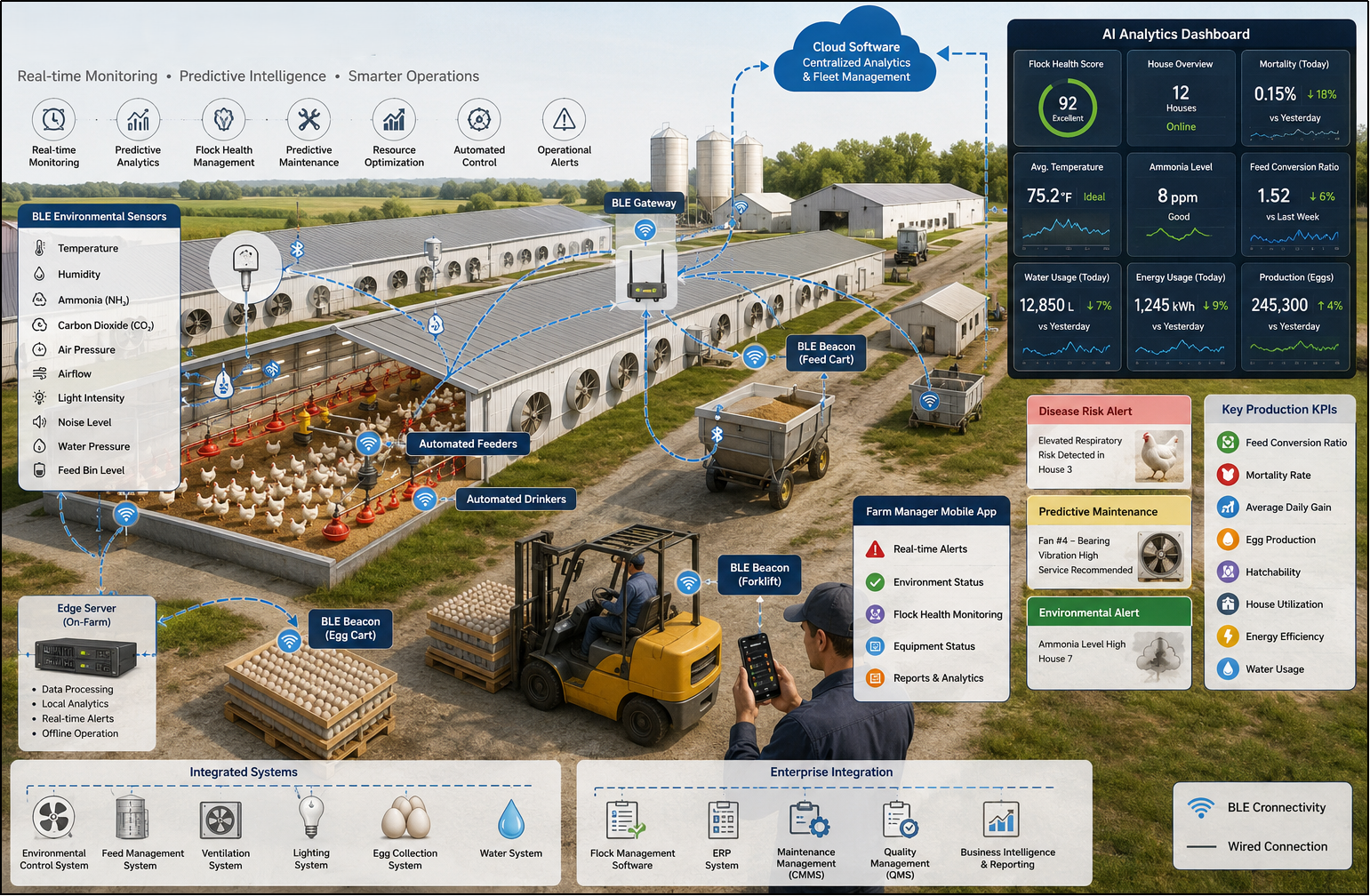
This illustration presents an enterprise poultry production facility where BLE environmental sensors, BLE gateways, and BLE beacons continuously collect operational data for AI-driven monitoring and decision-making. The visual demonstrates how real-time environmental sensing, predictive maintenance, flock health analytics, and cloud and edge computing work together to optimize poultry house performance, improve bird welfare, reduce operational risks, and support data-driven farm management.
Understanding AI-Driven BLE Monitoring in Poultry Production
Poultry production depends on maintaining highly controlled biological and environmental conditions throughout every stage of bird growth. Small deviations in temperature, humidity, ammonia concentration, ventilation performance, water availability, feed delivery, lighting schedules, or stocking density can rapidly influence bird welfare, mortality, feed conversion ratio, egg production, and overall profitability.
BLE technologies create an extensive wireless sensing network throughout poultry facilities. Compact BLE sensors continuously collect operational information while BLE gateways aggregate this information for local processing or transmission to centralized software. AI analyzes historical and real-time operational data to identify trends, detect anomalies, predict failures, recommend corrective actions, and automate selected operational decisions.
Rather than relying solely on manual inspections, poultry managers receive continuous intelligence regarding flock health, environmental stability, equipment utilization, and production performance. This shift enables earlier intervention before production losses occur.
The relationship between AI and BLE is complementary.
- BLE provides low-power wireless communication for distributed sensing.
- BLE gateways securely aggregate sensor information.
- BLE beacons identify mobile equipment, personnel, or production assets.
- AI transforms collected operational data into predictive intelligence.
- Farm management software converts AI recommendations into operational workflows.
- Automated control systems implement environmental adjustments with minimal human intervention.
The result is improved flock welfare, lower mortality, optimized resource utilization, and higher operational consistency.
AI Applications Across Poultry Production Operations
Artificial intelligence supported by BLE technologies delivers measurable value throughout nearly every poultry production activity.
Broiler Production
AI continuously evaluates:
- Bird activity levels
- Feed intake behavior
- Water consumption
- Growth consistency
- Environmental comfort
- Heat stress indicators
- Mortality patterns
- Ventilation efficiency
BLE environmental sensors positioned throughout poultry houses provide localized measurements instead of relying on only a few centralized sensors, allowing AI to identify microclimate variations before they affect flock performance.
Layer Operations
AI supports commercial egg production by monitoring:
- Egg production rates
- Nest occupancy
- Environmental stability
- Lighting consistency
- Feed conversion
- Bird movement
- Egg collection equipment
- Conveyor performance
BLE beacons installed on movable production equipment assist maintenance teams by improving equipment location tracking across large production facilities.
Breeder Farms
Breeder operations require extremely consistent environmental management.
AI analyzes:
- Fertility indicators
- Feed allocation
- Male-to-female activity
- Weight uniformity
- Environmental compliance
- Lighting schedules
- Air quality trends
BLE sensing enables highly granular environmental monitoring without extensive wiring infrastructure.
Hatcheries
Hatcheries rely on tightly controlled incubation conditions.
AI evaluates:
- Incubator temperatures
- Relative humidity
- Air circulation
- Egg turning cycles
- Hatch timing
- Equipment health
- Incubation consistency
BLE sensors provide continuous monitoring throughout incubators, hatchers, and chick holding areas while AI predicts hatch performance and identifies equipment deviations before hatch quality declines.
Feed Storage and Feed Mills
Feed quality directly affects flock performance.
AI analyzes:
- Storage temperatures
- Moisture levels
- Inventory movement
- Bin utilization
- Feed delivery timing
- Equipment performance
BLE sensors continuously monitor feed bins, storage facilities, augers, conveyors, and loading systems.
Poultry Processing Support Operations
Although this solution focuses primarily on poultry production, AI-supported BLE monitoring also benefits supporting operations including:
- Cold storage monitoring
- Equipment maintenance
- Utility monitoring
- Production logistics
- Environmental compliance
- Warehouse asset tracking
- Worker safety
GAO has supplied BLE hardware supporting similar monitoring requirements across numerous industrial and agricultural environments where reliable wireless sensing and asset visibility are essential.
AI-Driven BLE Workflow for Smart Poultry Production and End-to-End Farm Operations
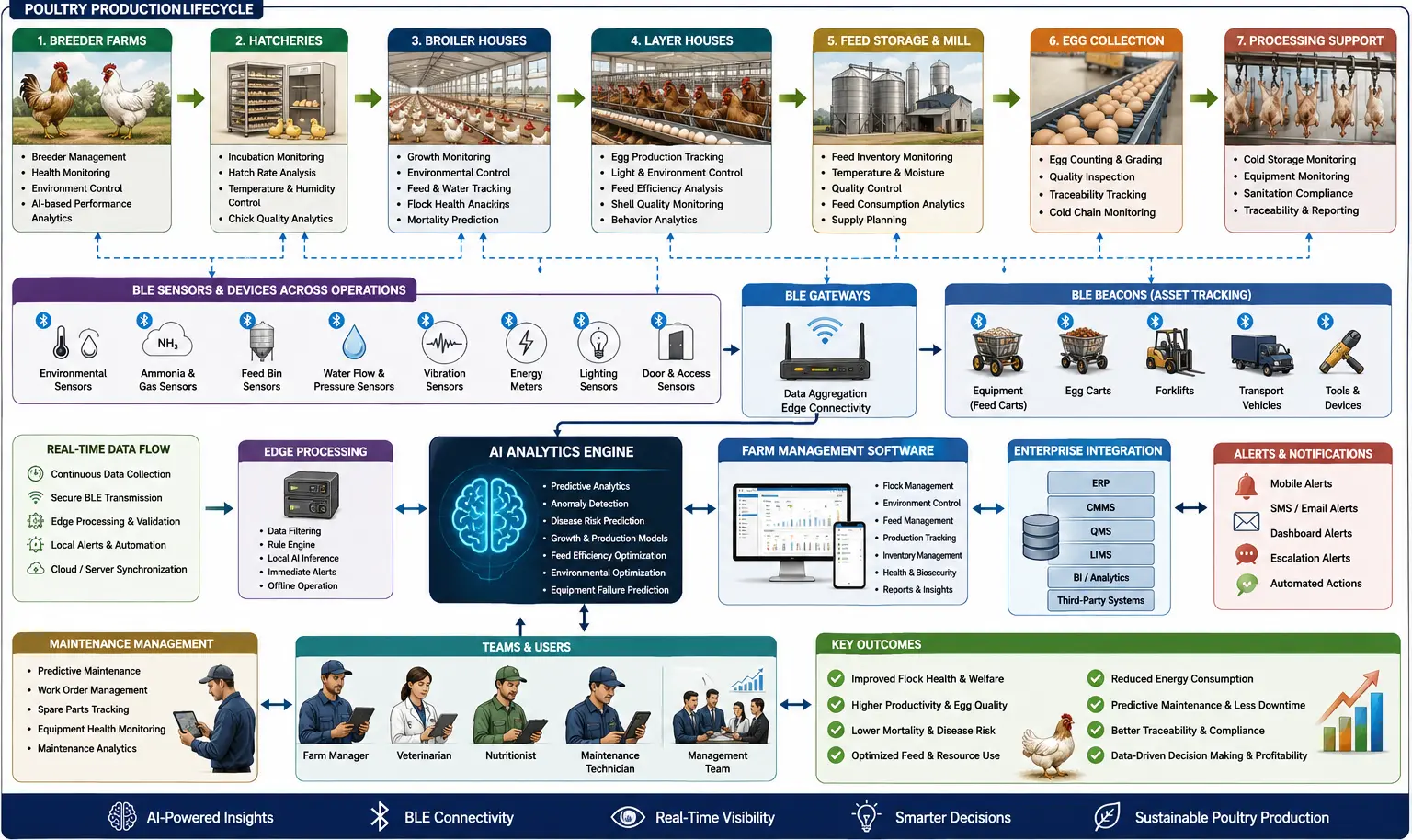
This workflow diagram illustrates the complete poultry production lifecycle, from breeder farms and hatcheries to broiler houses, layer operations, egg collection, feed management, and processing support. It demonstrates how BLE sensors, BLE gateways, and BLE beacons continuously collect operational data that AI analyzes to optimize flock health, environmental conditions, predictive maintenance, resource utilization, and enterprise decision-making through integrated farm management software and operational dashboards.
Operational Challenges Solved by AI-Enabled BLE Solutions
Poultry production presents unique operational challenges because biological systems respond rapidly to environmental changes. Traditional monitoring methods often identify problems only after production losses have already occurred.
AI supported by BLE sensing helps address many common operational bottlenecks.
Environmental Variability
Large poultry houses frequently develop localized temperature differences, humidity fluctuations, and ventilation inconsistencies.
BLE environmental sensors distributed throughout each poultry house allow AI to identify localized environmental deviations and recommend corrective ventilation or heating adjustments before bird stress develops.
Disease Detection Delays
Respiratory illnesses, avian influenza concerns, coccidiosis, bacterial infections, and flock stress frequently produce subtle behavioral changes before clinical symptoms become obvious.
AI combines information from:
- Environmental sensors
- Activity monitoring
- Water consumption
- Feed intake
- Mortality trends
- Ventilation performance
This enables earlier anomaly detection compared with manual inspections alone.
Feed Inefficiency
Feed represents one of the highest operational expenses in poultry production.
AI evaluates:
- Feed conversion ratio
- Feeding schedules
- Bird growth
- Feed delivery timing
- Storage conditions
BLE sensors monitor feed inventories while AI predicts replenishment requirements and identifies abnormal feed usage patterns.
Equipment Downtime
Critical equipment failures may include:
- Tunnel ventilation fans
- Heaters
- Cooling pads
- Water pumps
- Feed augers
- Egg conveyors
- Lighting controllers
BLE vibration sensors and equipment monitoring devices provide operational health information enabling AI-based predictive maintenance before failures interrupt production.
Labor Efficiency
Routine manual inspections consume considerable labor resources.
BLE-enabled monitoring automates many repetitive observation tasks while AI prioritizes only those events requiring human attention, allowing farm personnel to focus on higher-value operational activities.
Energy Consumption
Heating, cooling, and ventilation systems account for significant operational expenses.
AI continuously balances:
- Bird comfort
- Ventilation
- Heating
- Air quality
- Humidity
- Energy usage
This improves sustainability while maintaining production objectives.
Traditional vs. AI-Enabled BLE Monitoring for Smart Poultry Production
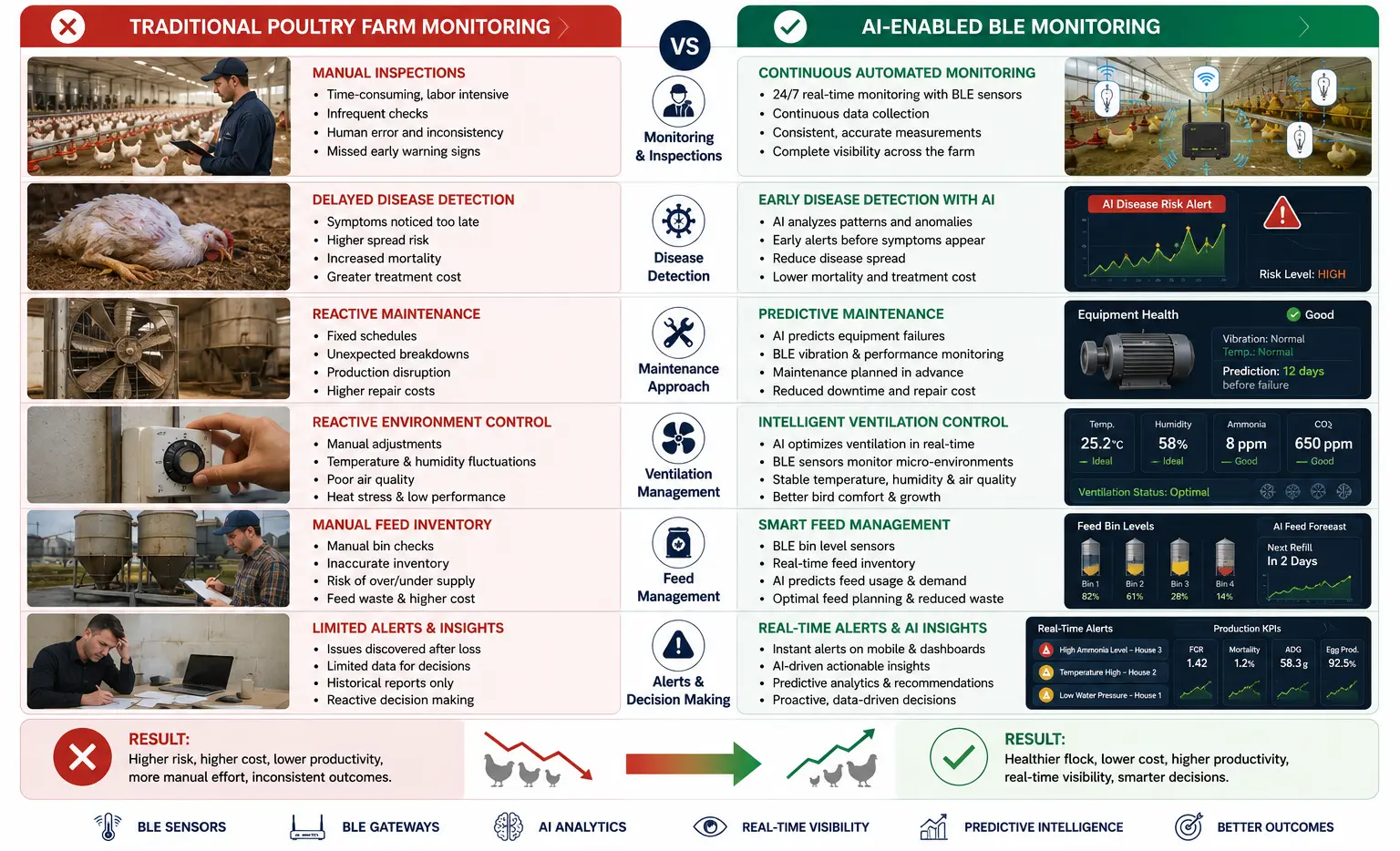
This comparison infographic contrasts conventional poultry production monitoring with an AI-enabled BLE solution across key operational areas, including flock inspections, disease detection, maintenance, ventilation, feed management, and decision-making. It demonstrates how BLE sensors, BLE gateways, and AI analytics provide continuous monitoring, predictive insights, automated alerts, and real-time operational visibility, helping poultry producers improve bird welfare, reduce downtime, optimize resources, and increase productivity.
End-to-End AI and BLE Workflow for Poultry Production
Successful poultry intelligence systems depend on coordinated information flow from sensing through automated operational decisions.
Environmental and Operational Data Acquisition
BLE sensors installed throughout poultry facilities continuously collect information including:
- Temperature
- Relative humidity
- Carbon dioxide
- Ammonia concentration
- Air velocity
- Static pressure
- Feed bin levels
- Water pressure
- Water consumption
- Light intensity
- Equipment vibration
- Motor operating status
- Bird weight
- Environmental alarms
BLE beacons identify movable assets including vaccination carts, portable weighing equipment, maintenance tools, mobile ventilation equipment, sanitation equipment, and transport containers.
BLE Communication Layer
BLE gateways securely receive sensor information using Bluetooth Low Energy communication.
Depending on farm size and facility layout, gateways may forward data through:
- Ethernet
- Wi-Fi
- Private LTE
- 5G
- Fiber networks
- Industrial VPN connections
Multiple gateways provide communication redundancy across geographically distributed poultry facilities.
Edge Intelligence
Local edge servers perform immediate processing including:
- Sensor validation
- Data filtering
- Threshold analysis
- Local AI inference
- Alarm generation
- Equipment diagnostics
- Temporary storage
Edge processing reduces latency for time-sensitive environmental control functions while maintaining production continuity during temporary internet outages.
Enterprise Data Integration
Operational information is integrated with poultry management software including:
- Flock management systems
- Hatchery management software
- Environmental control software
- Feed management systems
- Maintenance management software
- ERP software
- Laboratory information systems
- Quality management systems
- Business intelligence dashboards
Data normalization enables AI models to evaluate operational relationships across biological performance, environmental conditions, equipment health, production planning, and resource utilization.
AI and BLE Data Flow for Smart Poultry Production Operations
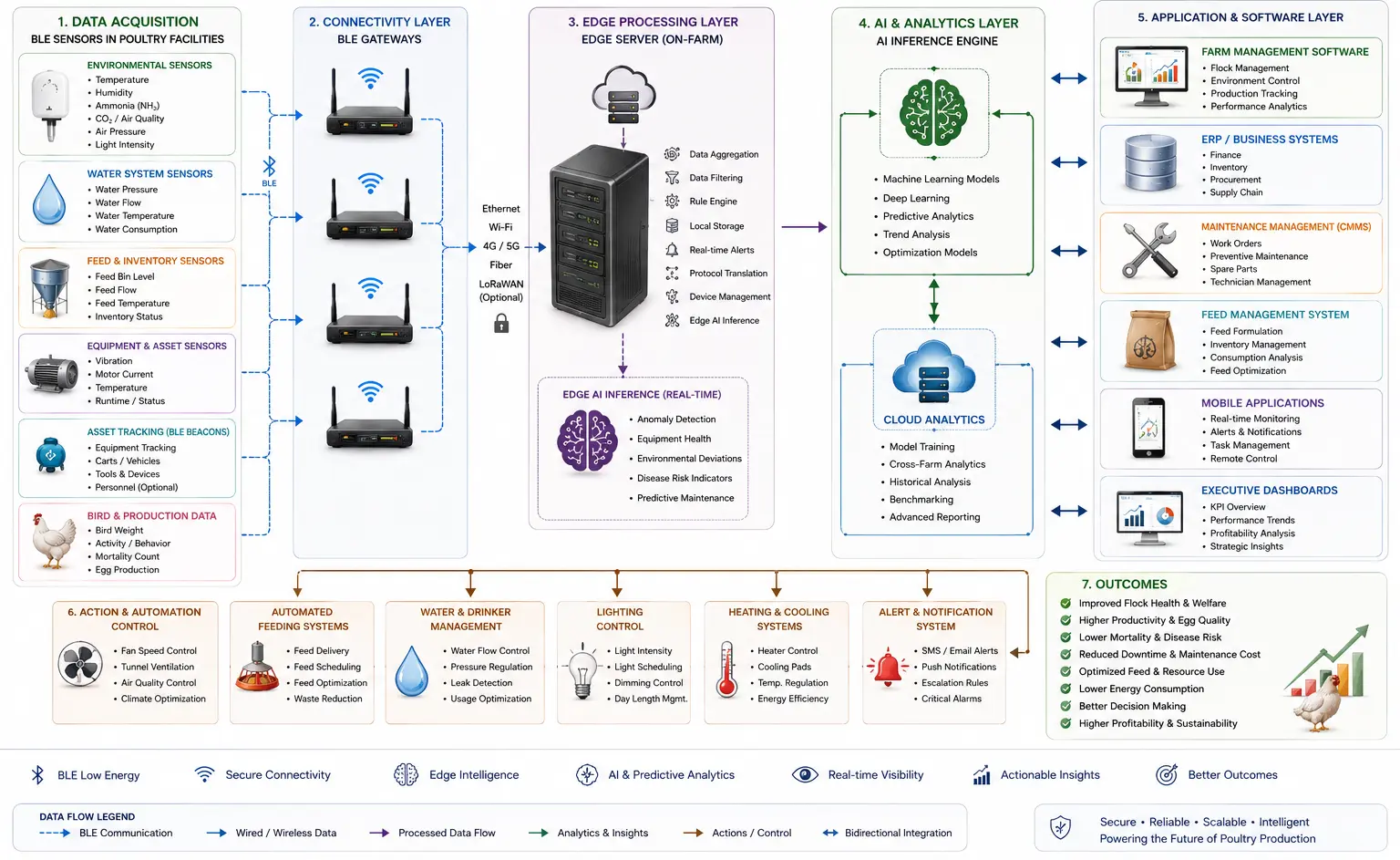
This flow diagram illustrates the complete operational data journey in an AI-enabled poultry production system, beginning with BLE environmental sensors and BLE gateways and progressing through edge processing, AI inference, cloud analytics, and integrated farm management software. It shows how real-time data supports automated ventilation control, feed management, predictive maintenance, mobile alerts, ERP integration, and executive dashboards to improve flock health, operational efficiency, and production performance.
BLE Infrastructure, AI Software, Communication Technologies, and Deployment Models for Poultry Production
A successful AI-enabled poultry production solution depends on reliable wireless sensing, intelligent analytics, secure communications, and integration with operational software. BLE technologies serve as the data acquisition layer while AI converts raw operational measurements into actionable intelligence. Selecting the appropriate hardware, software, deployment model, and communication infrastructure depends on farm size, environmental conditions, regulatory requirements, cybersecurity policies, and business objectives.
BLE Hardware Components
BLE Environmental Sensors
BLE environmental sensors continuously monitor conditions affecting bird welfare and production performance.
Typical measurements include:
- Air temperature
- Relative humidity
- Ammonia concentration
- Carbon dioxide concentration
- Hydrogen sulfide
- Differential air pressure
- Airflow velocity
- Light intensity
- Noise levels
- Water temperature
- Feed bin levels
- Water pressure
- Water flow
- Motor vibration
- Electrical current
- Equipment operating temperature
Battery-powered BLE sensors can operate for several years because Bluetooth Low Energy minimizes power consumption while maintaining reliable communications. Sensor placement should account for bird height, airflow patterns, ventilation zones, and localized environmental variations rather than relying solely on centrally located measurements.
BLE Gateways
BLE gateways aggregate information from hundreds or thousands of distributed sensors before forwarding data to edge servers or centralized software.
Typical gateway capabilities include:
- Multi-device BLE communication
- Local data buffering
- Protocol translation
- Device authentication
- Secure encrypted communications
- Edge analytics support
- Firmware management
- Remote diagnostics
High-density poultry houses often require multiple overlapping gateways to ensure complete wireless coverage and communication redundancy. Gateway placement should consider building materials, ventilation equipment, electrical interference, and sensor density.
BLE Beacons
BLE beacons assist with identifying and locating movable operational assets such as:
- Poultry transport cages
- Vaccination equipment
- Portable weighing systems
- Maintenance toolkits
- Feed carts
- Mobile sanitation equipment
- Egg transport carts
- Utility vehicles
- Environmental inspection devices
Location-aware software improves asset utilization while reducing time spent locating equipment across multiple poultry houses.
Artificial Intelligence Software
Artificial intelligence processes operational information using several complementary analytical methods.
Machine Learning
Machine learning models evaluate historical production information to identify relationships between environmental conditions and flock performance.
Common applications include:
- Feed conversion prediction
- Mortality forecasting
- Growth modeling
- Egg production forecasting
- Hatch rate prediction
- Environmental optimization
- Energy consumption forecasting
Deep Learning
Deep learning analyzes complex datasets including images, video, acoustic recordings, and multivariable sensor streams.
Typical applications include:
- Bird behavior analysis
- Activity recognition
- Visual health assessment
- Feather condition analysis
- Crowd density monitoring
- Lameness detection
- Egg quality inspection
Computer Vision
Video cameras combined with AI identify subtle behavioral changes including:
- Reduced movement
- Abnormal clustering
- Feeding abnormalities
- Drinking behavior
- Heat stress indicators
- Aggressive behavior
- Bird distribution
Computer vision complements BLE sensor information by providing behavioral observations that environmental measurements alone cannot capture.
Predictive Analytics
Predictive models estimate future operational outcomes using continuously updated datasets.
Examples include:
- Ventilation equipment failure prediction
- Feed inventory forecasting
- Disease risk assessment
- Environmental deviation prediction
- Production scheduling
- Maintenance planning
Anomaly Detection
Unsupervised AI continuously identifies unusual operational conditions without requiring predefined failure rules.
Examples include:
- Unexpected ammonia increases
- Sudden feed consumption changes
- Water leakage
- Ventilation degradation
- Sensor failures
- Equipment abnormalities
- Abnormal mortality trends
Communication Technologies
BLE forms the local wireless sensing layer, while additional communication technologies transport information throughout the poultry production system.
Common communication technologies include:
- Bluetooth Low Energy
- Ethernet
- Wi-Fi
- Private LTE
- 5G
- Fiber Ethernet
- MQTT
- HTTPS
- REST APIs
- OPC UA
- Modbus TCP
- BACnet where environmental control equipment requires building automation integration
Communication technology selection depends on farm layout, bandwidth requirements, cybersecurity policies, and existing infrastructure.
Enterprise Software Integration
Operational intelligence becomes more valuable when integrated with existing business software.
Typical integrations include:
- Poultry flock management software
- Hatchery management systems
- Feed management software
- Environmental control systems
- Computerized Maintenance Management Systems (CMMS)
- Enterprise Resource Planning (ERP)
- Manufacturing Execution Systems supporting feed production
- Laboratory Information Management Systems (LIMS)
- Quality Management Systems (QMS)
- Geographic Information Systems (GIS)
- Business intelligence dashboards
Rather than creating isolated data silos, integration enables a unified operational view spanning production, maintenance, logistics, quality, and business performance.
Cloud Version
Cloud-hosted deployments are appropriate for organizations operating multiple farms across different geographic regions.
Advantages include:
- Centralized fleet management
- Simplified software updates
- Elastic computing resources
- AI model retraining
- Cross-site benchmarking
- Disaster recovery
- Remote technical support
- Executive reporting
Cloud deployments are especially valuable for agricultural organizations managing breeder farms, hatcheries, broiler operations, and layer farms from centralized operations centers.
Server Version
Many poultry organizations prefer customer-managed server deployments hosted within private data centers, regional operations centers, or edge computing facilities.
Server deployments offer:
- Greater operational control
- Reduced dependence on internet connectivity
- Lower latency
- Enhanced data governance
- Support for private security policies
- Integration with existing enterprise infrastructure
Edge servers located near poultry houses also support real-time environmental control even during temporary communication outages.
GAO regularly supports organizations deploying both cloud-hosted and privately managed server solutions depending on operational requirements, cybersecurity policies, and integration needs.
Layered AI-Enabled BLE Solution for Smart Poultry Farm Management and Enterprise Operations
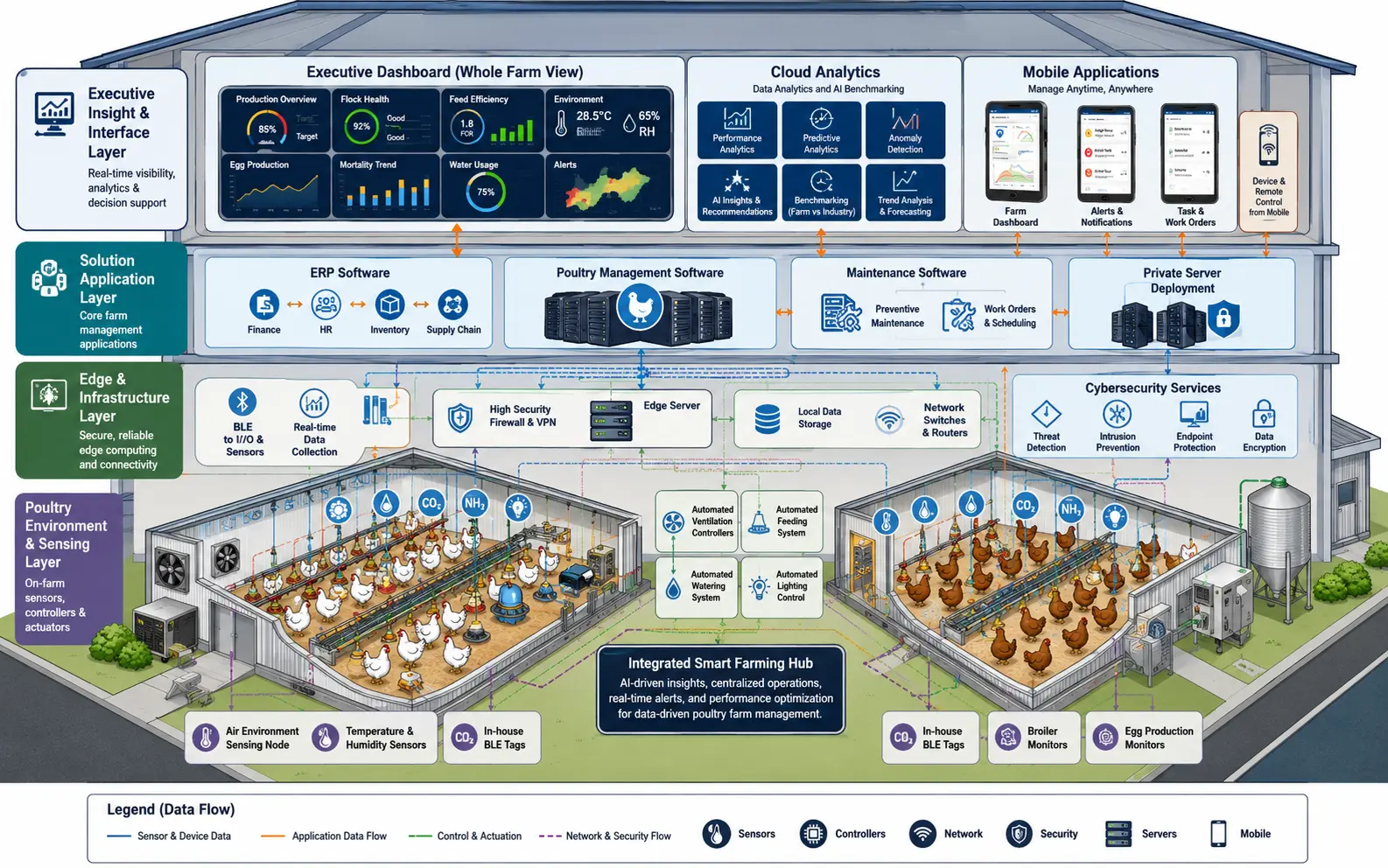
This layered solution diagram illustrates a comprehensive AI-enabled BLE system for smart poultry production, connecting on-farm environmental sensing with edge computing, cybersecurity, enterprise software, and executive decision support. It demonstrates how BLE sensors, edge infrastructure, AI analytics, poultry management software, ERP integration, mobile applications, and automated environmental controls work together to optimize flock health, production efficiency, predictive maintenance, and real-time operational management across modern poultry farms.
Technical Capabilities and Business Benefits of AI-Driven BLE Monitoring
AI supported by BLE sensing delivers measurable operational improvements throughout poultry production by enabling continuous situational awareness, predictive intelligence, and faster operational responses.
Improved Flock Health
Continuous monitoring of environmental conditions and flock behavior enables earlier identification of health risks. AI detects subtle deviations that may indicate respiratory disease, heat stress, dehydration, poor ventilation, or abnormal bird activity before widespread production losses occur.
Better Environmental Control
Localized BLE sensing provides greater visibility into microclimate variations within poultry houses. AI recommends ventilation, heating, cooling, and humidity adjustments that improve bird comfort while maintaining production targets.
Higher Feed Efficiency
Feed represents one of the largest production costs. AI analyzes feed consumption, growth trends, and environmental influences to improve feed conversion ratio while reducing waste and optimizing feeding schedules.
Reduced Equipment Downtime
Predictive maintenance supported by BLE vibration sensors, motor monitoring, and equipment diagnostics helps maintenance teams schedule repairs before critical failures affect flock welfare or production continuity.
Increased Labor Productivity
Routine inspections become more targeted because AI prioritizes operational exceptions rather than requiring personnel to manually inspect every poultry house with the same frequency. This allows farm managers and technicians to focus on corrective actions and preventive management.
Enhanced Biosecurity
BLE-enabled asset identification and personnel tracking can strengthen biosecurity procedures by improving visibility into equipment movement, sanitation workflows, and access control across poultry facilities. When integrated with AI, unusual movement patterns or deviations from established protocols can trigger alerts for further investigation.
Improved Sustainability
AI optimizes ventilation, heating, lighting, and water usage while maintaining bird welfare. These improvements contribute to reduced energy consumption, lower greenhouse gas emissions, and more efficient resource utilization.
Scalability Across Multi-Site Operations
Standardized BLE sensing and centralized AI software enable consistent monitoring across breeder farms, hatcheries, broiler houses, and layer operations. Performance comparisons between facilities support continuous improvement initiatives and operational benchmarking.
Engineering Best Practices and Implementation Recommendations
Successful deployment of AI-enabled BLE solutions requires careful planning beyond hardware installation. Engineering considerations should reflect the biological, environmental, and operational characteristics of poultry production.
Recommended practices include:
- Conduct wireless site surveys before installing BLE gateways to account for building materials, equipment layout, and potential radio interference.
- Position environmental sensors within representative bird zones rather than only at central control locations.
- Validate sensor calibration regularly, particularly for ammonia, carbon dioxide, and humidity measurements.
- Design redundant gateway coverage for critical poultry houses to improve communication resilience.
- Use edge computing for latency-sensitive environmental control and alarm processing.
- Encrypt communications between BLE gateways, edge servers, and centralized software using current industry security practices.
- Implement role-based access control and multifactor authentication for operational software.
- Integrate operational data with flock management, maintenance, and quality systems to improve decision making.
- Establish AI model validation procedures using production data from different seasons, bird breeds, and housing configurations.
- Continuously monitor key performance indicators such as feed conversion ratio, mortality, average daily gain, hatchability, egg production, and energy consumption to assess solution effectiveness.
Organizations planning phased deployments often begin with environmental monitoring and predictive maintenance before expanding to advanced AI applications such as computer vision, behavioral analytics, and automated decision support.
Advancing Poultry Production with AI-Driven BLE Intelligence
AI-powered poultry production supported by BLE gateways, BLE sensors, and BLE beacons enables producers to move from reactive management toward predictive, data-driven operations. Continuous environmental monitoring, intelligent analytics, predictive maintenance, and integrated operational software improve flock health, production consistency, resource utilization, and overall operational resilience.
BLE provides an energy-efficient wireless sensing foundation, while AI transforms operational measurements into actionable recommendations that help poultry managers respond more quickly to changing conditions. Whether deployed through cloud-hosted software for geographically distributed farms or customer-managed server environments for greater operational control, these solutions support scalable and secure modernization of poultry production.
Drawing on decades of experience supporting industrial wireless technologies, GAO provides BLE hardware, RFID solutions, and technical expertise that help poultry organizations implement reliable monitoring systems aligned with operational goals, regulatory expectations, and long-term digital transformation strategies.
Building the Future of Industrial AI and IoT with Aperture Venture Studio and GAO RFID Inc.
For more than three decades, GAO Group of Companies has invested extensively in research and development for industrial BLE, RFID, and IoT technologies. As artificial intelligence has become increasingly valuable for operational intelligence, predictive analytics, and automation in poultry production and other agricultural applications, we have expanded our AI and IoT initiatives and established Aperture Venture Studio to accelerate the development and adoption of advanced industrial AI and IoT solutions across multiple sectors. Aperture has brought together leading AI specialists, IoT engineers, operational executives, investors, and technology organizations while fostering collaboration through the Aperture Ventures Summit and TekSummit. Together, these initiatives have strengthened technical communities and industry collaboration. We welcome advisors, co-founders or employees, investors, and customers who share our vision for advancing industrial AI and IoT innovation.