
AI and RFID for Display Manufacturing in Electronic Manufacturing Industries
AI-Driven Display Manufacturing with RFID Improves Production Visibility, Quality, and Factory Intelligence
Display manufacturing requires exceptional precision because even microscopic contamination, process variation, or material handling errors can reduce panel yield, increase production costs, or delay customer deliveries. Modern LCD, OLED, Mini-LED, MicroLED, quantum dot, and flexible display production involves thousands of process steps distributed across cleanrooms, automated transport systems, inspection stations, testing laboratories, warehouses, and shipping facilities. Maintaining complete visibility of glass substrates, production carriers, process tools, work-in-progress inventory, and finished display modules has therefore become a critical manufacturing objective.
Artificial Intelligence combined with RFID-enabled identification allows display manufacturers to transform production data into actionable operational intelligence. RFID provides automatic identification and traceability throughout production while AI analyzes manufacturing events, equipment performance, environmental conditions, process history, and inspection results to optimize yield, predict production issues, improve scheduling, and automate operational decisions. Together these technologies support intelligent display manufacturing by connecting physical production assets with AI-driven software that continuously improves manufacturing efficiency, quality, and factory performance.
Organizations throughout North America increasingly rely on suppliers such as GAO, whose RFID hardware and industrial IoT technologies have supported electronics manufacturers, research laboratories, government organizations, and industrial customers for decades across demanding production environments.
Understanding AI-Powered RFID Solutions in Display Manufacturing
Display manufacturing is among the most sophisticated segments of the electronics manufacturing industry. Production combines semiconductor fabrication techniques, precision materials engineering, optical inspection, robotics, automated material handling, cleanroom operations, and advanced quality assurance. Every production stage generates operational data that can be analyzed to improve throughput and reduce manufacturing variability.
Rather than relying solely on barcode scans or manual production records, RFID enables automatic identification of:
- Glass mother sheets
- TFT substrates
- OLED evaporation carriers
- Production cassettes
- FOUPs and transport containers
- Manufacturing lots
- Work-in-progress inventory
- Material reels
- Chemical containers
- Maintenance equipment
- Test fixtures
- Packaging pallets
- Returnable transport assets
- Finished display assemblies
Artificial Intelligence converts these identification events into operational intelligence. Machine learning models identify process bottlenecks, forecast production delays, detect abnormal equipment behavior, correlate manufacturing parameters with display yield, and recommend corrective actions before significant losses occur.
Unlike isolated automation projects, AI-enabled RFID systems connect production operations with Manufacturing Execution Systems (MES), Enterprise Resource Planning (ERP), Quality Management Systems (QMS), Warehouse Management Systems (WMS), Product Lifecycle Management (PLM), Statistical Process Control (SPC), Automated Material Handling Systems (AMHS), and industrial analytics software to improve decision-making across the entire display production lifecycle.
Operational Challenges Driving AI Adoption in Display Manufacturing
Display fabrication facilities operate under strict process tolerances where even small production deviations can significantly reduce panel quality. AI-supported RFID data helps manufacturers overcome many operational challenges unique to display manufacturing.
Complex Multi-Step Production
Large display fabrication lines include hundreds of sequential manufacturing operations spanning glass preparation, thin-film transistor fabrication, photolithography, deposition, etching, cleaning, OLED material processing, encapsulation, module assembly, electrical testing, optical inspection, packaging, and distribution.
AI correlates RFID production history across every manufacturing stage to identify where yield degradation originates.
Work-in-Progress Visibility
Thousands of production lots move simultaneously between cleanroom processing equipment.
Operational teams frequently need immediate visibility into:
- Current lot location
- Processing status
- Queue time
- Remaining production steps
- Equipment assignment
- Process history
- Operator activities
- Quality inspection status
RFID automatically captures these production movements without interrupting manufacturing operations.
High Capital Equipment Utilization
Display fabs depend upon extremely expensive production equipment including:
- PECVD systems
- CVD tools
- Sputtering equipment
- Lithography systems
- Laser repair systems
- OLED evaporation chambers
- AOI inspection systems
- Bonding machines
- Cell assembly equipment
- Lamination systems
AI analyzes RFID equipment usage together with maintenance history to maximize utilization while minimizing unexpected downtime.
Yield Optimization
Small manufacturing deviations can create:
- Dead pixels
- Mura defects
- Line defects
- Color non-uniformity
- Particle contamination
- Glass scratches
- Alignment errors
- Electrical failures
- Encapsulation defects
- Brightness inconsistency
AI continuously analyzes RFID traceability records together with inspection data to determine which production variables most influence yield.
End-to-End Material Traceability
Display manufacturers must maintain complete genealogy for:
- Glass suppliers
- Polarizers
- Driver ICs
- Backlight units
- OLED materials
- Adhesives
- Flexible substrates
- Cover glass
- Color filters
- Packaging materials
RFID creates a digital production history that AI software uses for supplier quality analysis, warranty investigations, root-cause analysis, and recall management when necessary.
AI-Driven RFID Display Manufacturing Workflow for Intelligent LCD, OLED, Mini-LED, and MicroLED Production
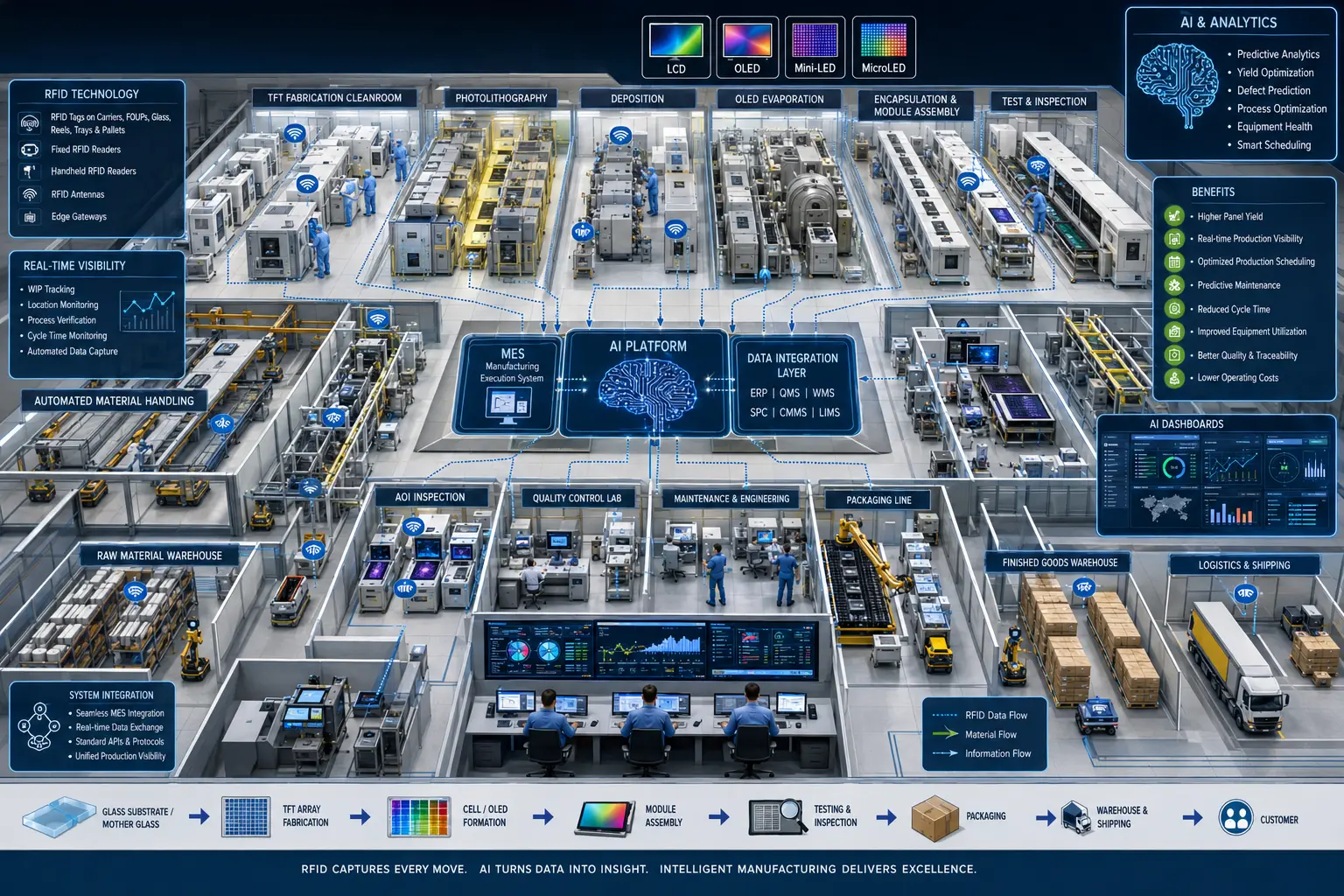
This illustration depicts a modern display manufacturing facility where RFID automatically tracks materials, work-in-progress assets, and finished display panels across TFT fabrication, photolithography, OLED processing, inspection, packaging, and logistics. AI analyzes RFID-generated production data alongside manufacturing systems such as MES, ERP, WMS, QMS, and SPC to improve production visibility, yield optimization, predictive maintenance, scheduling, and quality management throughout the display manufacturing process.
AI Applications Enabled by RFID Across Display Manufacturing
Artificial Intelligence delivers the greatest operational value when RFID continuously captures production events throughout display manufacturing.
AI Production Scheduling
Machine learning continuously evaluates:
- Production queues
- Equipment availability
- Material inventory
- Tool maintenance schedules
- Delivery priorities
- Manufacturing constraints
Scheduling recommendations automatically adapt to changing factory conditions.
AI Work-in-Progress Tracking
RFID readers installed throughout production automatically identify every lot movement.
AI software predicts:
- Production delays
- Queue congestion
- Lot aging
- Transport bottlenecks
- Material shortages
- Cycle time deviations
Operations managers receive recommendations before bottlenecks affect production output.
AI Yield Prediction
Historical RFID production records combined with inspection data enable predictive models that estimate final panel quality before manufacturing completes.
Engineers can identify high-risk lots earlier and intervene before additional processing costs accumulate.
AI Predictive Maintenance
Production equipment continuously generates operational events.
Combining RFID-based maintenance records with sensor information allows AI to predict:
- Vacuum pump degradation
- Robot wear
- Conveyor failures
- Inspection equipment drift
- Cooling system issues
- Process chamber maintenance requirements
Maintenance activities become proactive rather than reactive.
AI Material Flow Optimization
Large display fabs transport thousands of carriers every day.
AI evaluates:
- Transport frequency
- Carrier utilization
- Queue length
- Travel distance
- Storage occupancy
- Automated transport efficiency
The resulting recommendations reduce unnecessary movement while improving production throughput.
AI Quality Intelligence
Inspection systems produce enormous quantities of defect information.
AI combines:
- RFID production genealogy
- Process parameters
- Inspection images
- Environmental measurements
- Equipment history
- Operator activities
Patterns become visible that would otherwise remain hidden using traditional statistical analysis.
AI-Driven RFID Workflow for Intelligent Display Manufacturing and Production Optimization
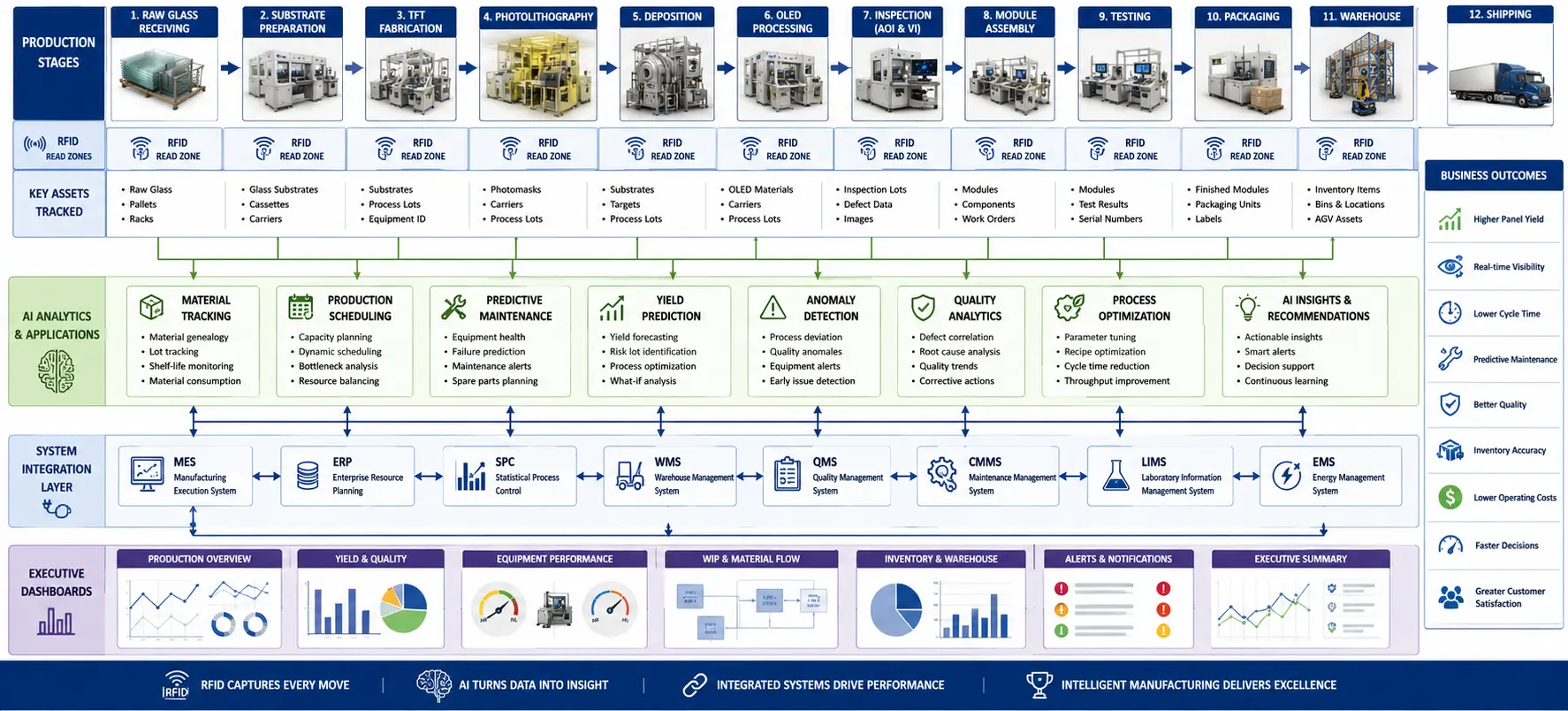
This workflow diagram illustrates how RFID data is captured throughout the display manufacturing lifecycle, from raw glass receiving and TFT fabrication to OLED processing, inspection, module assembly, packaging, warehousing, and shipping. AI analyzes RFID-generated production data alongside MES, ERP, SPC, WMS, and QMS systems to enable predictive maintenance, yield optimization, production scheduling, quality analytics, anomaly detection, and executive decision support for LCD, OLED, Mini-LED, and MicroLED manufacturing.
End-to-End Operational Workflow for AI-Driven Display Manufacturing with RFID
Display manufacturing produces enormous volumes of operational data from fabrication tools, inspection systems, cleanroom automation, and material handling equipment. RFID serves as the automatic identification layer, while Artificial Intelligence transforms manufacturing events into operational decisions that improve production performance, product quality, and resource utilization.
Production Material Identification and Data Capture
Production begins with the receipt and verification of manufacturing materials. RFID tags are assigned or associated with critical production assets and materials so that every movement and process event can be recorded automatically.
Typical RFID-identified assets include:
- Mother glass substrates
- TFT glass panels
- OLED carriers
- Quartz boats
- Production cassettes
- FOUPs (Front Opening Unified Pods)
- Process trays
- Vacuum chamber fixtures
- Chemical containers
- Material reels
- Driver IC reels
- Polarizer rolls
- Backlight assemblies
- Returnable logistics containers
- Finished display modules
Fixed RFID readers, tunnel readers, handheld readers, and industrial RFID antennas capture identification events at receiving docks, cleanroom transfer points, automated storage systems, production equipment, quality laboratories, and shipping stations.
Unlike manual barcode scanning, RFID enables multiple tagged assets to be identified simultaneously without direct line of sight, supporting continuous production flow while minimizing operator intervention.
Secure Industrial Communication
Once RFID events are captured, production data is securely transmitted to manufacturing software using industrial communication technologies.
Common communication methods include:
- Industrial Ethernet
- OPC UA
- MQTT
- REST APIs
- HTTPS
- TCP/IP
- Wi-Fi 6
- Private 5G
- Fiber-optic industrial networks
These communication layers connect RFID readers with production servers, edge computing devices, Manufacturing Execution Systems (MES), Warehouse Management Systems (WMS), Enterprise Resource Planning (ERP), and industrial AI software.
Reliable communication becomes especially important in Gen 8.5, Gen 10.5, and larger display fabrication facilities where thousands of RFID events occur every minute.
Edge Processing for Real-Time Manufacturing Decisions
Many production decisions cannot wait for cloud processing.
Edge servers located near production lines perform immediate processing of RFID events to support low-latency manufacturing operations.
Typical edge functions include:
- RFID event filtering
- Duplicate read elimination
- Production lot validation
- Process authorization
- Equipment routing verification
- Production queue updates
- Local AI inference
- Alarm generation
- Temporary data buffering
- Communication failover
Edge AI software enables production engineers to respond within milliseconds when abnormal manufacturing conditions are detected.
AI Analytics and Manufacturing Intelligence
After RFID events are validated, AI software combines identification history with production information collected from numerous factory systems.
Typical AI data sources include:
- Automated Optical Inspection (AOI)
- Statistical Process Control (SPC)
- Environmental monitoring systems
- Equipment sensor data
- Cleanroom monitoring
- Process recipes
- Operator activity logs
- Yield management software
- Manufacturing schedules
- Maintenance records
Artificial Intelligence continuously evaluates relationships between production history and manufacturing outcomes to identify operational improvements that conventional reporting tools often miss.
Typical AI capabilities include:
- Yield prediction
- Defect clustering
- Process drift detection
- Tool performance analysis
- Material consumption forecasting
- Equipment utilization optimization
- Production bottleneck prediction
- Root-cause correlation
- Lot prioritization
- Dynamic production scheduling
Rather than simply displaying historical production reports, AI recommends actions that improve ongoing manufacturing performance.
Enterprise Software Integration
Display manufacturers rarely operate AI software independently. Instead, production intelligence becomes part of existing manufacturing systems that coordinate operations across fabrication, assembly, logistics, and quality assurance.
Typical software integration includes:
| Manufacturing System | AI-Enabled RFID Contribution in Display Manufacturing |
| Manufacturing Execution System (MES) | Uses RFID-based identification of glass substrates, production cassettes, FOUPs, and work-in-progress lots to validate process routing, enforce recipe execution, monitor queue times, and optimize AI-driven production scheduling throughout TFT, OLED, and module assembly operations. |
| Enterprise Resource Planning (ERP) | Synchronizes RFID-verified consumption of display glass, OLED materials, polarizers, driver ICs, color filters, adhesives, and packaging materials with procurement, production planning, inventory replenishment, supplier management, and financial reporting while AI forecasts future material demand. |
| Warehouse Management System (WMS) | Tracks RFID-tagged raw materials, spare parts, cleanroom consumables, production carriers, finished display panels, and returnable transport assets while AI optimizes storage allocation, inventory turnover, automated retrieval, and warehouse replenishment. |
| Quality Management System (QMS) | Correlates RFID production genealogy with AOI inspection results, mura analysis, dead-pixel detection, electrical testing, optical measurements, and customer quality records, allowing AI to identify recurring defect patterns and recommend corrective actions. |
| Product Lifecycle Management (PLM) | Connects RFID-traceable production history with engineering change orders, panel revisions, display specifications, bill of materials, process recipes, and design revisions so AI can evaluate the manufacturing impact of engineering modifications across display product generations. |
| Statistical Process Control (SPC) | Combines RFID production history with process capability data, equipment parameters, film thickness measurements, deposition conditions, alignment accuracy, and defect statistics so AI detects process drift, predicts yield degradation, and recommends process optimization. |
| Computerized Maintenance Management System (CMMS) | Associates RFID-identified manufacturing equipment, maintenance tools, spare parts, and service records with AI models that predict failures of sputtering systems, PECVD tools, lithography equipment, OLED evaporation chambers, robots, conveyors, and inspection systems before production interruptions occur. |
| Laboratory Information Management System (LIMS) | Links RFID-tagged material samples, chemical batches, process qualification samples, contamination analysis, reliability testing, and laboratory measurements with AI models that evaluate process consistency and material performance across display manufacturing operations. |
| Energy Management System (EMS) | Uses RFID-identified production lots together with energy consumption from cleanrooms, vacuum pumps, chillers, compressed air systems, process tools, and utility infrastructure so AI identifies opportunities to reduce energy usage while maintaining production throughput and panel quality. |
| Automated Material Handling System (AMHS) | Coordinates RFID identification of FOUPs, glass carriers, production cassettes, overhead transport vehicles (OHT), conveyors, stockers, and buffer stations while AI optimizes routing, minimizes transport delays, balances equipment loading, and reduces work-in-progress congestion. |
| Automated Optical Inspection (AOI) System | Combines RFID lot identification with high-resolution inspection images, defect maps, pixel analysis, mura detection, particle inspection, and dimensional measurements so AI correlates defect trends with upstream manufacturing conditions and identifies root causes more quickly. |
| Manufacturing Intelligence & AI Analytics Software | Aggregates RFID traceability, MES transactions, AOI results, SPC measurements, equipment telemetry, maintenance history, environmental monitoring, and production KPIs into AI-driven dashboards that provide yield prediction, bottleneck analysis, production forecasting, equipment utilization optimization, and executive decision support specifically for display manufacturing. |
GAO has supplied RFID hardware and industrial identification technologies that integrate with many of these manufacturing environments, enabling organizations to modernize operations while preserving investments in existing production software.
AI-Powered RFID Deployment Workflow for Intelligent Display Manufacturing
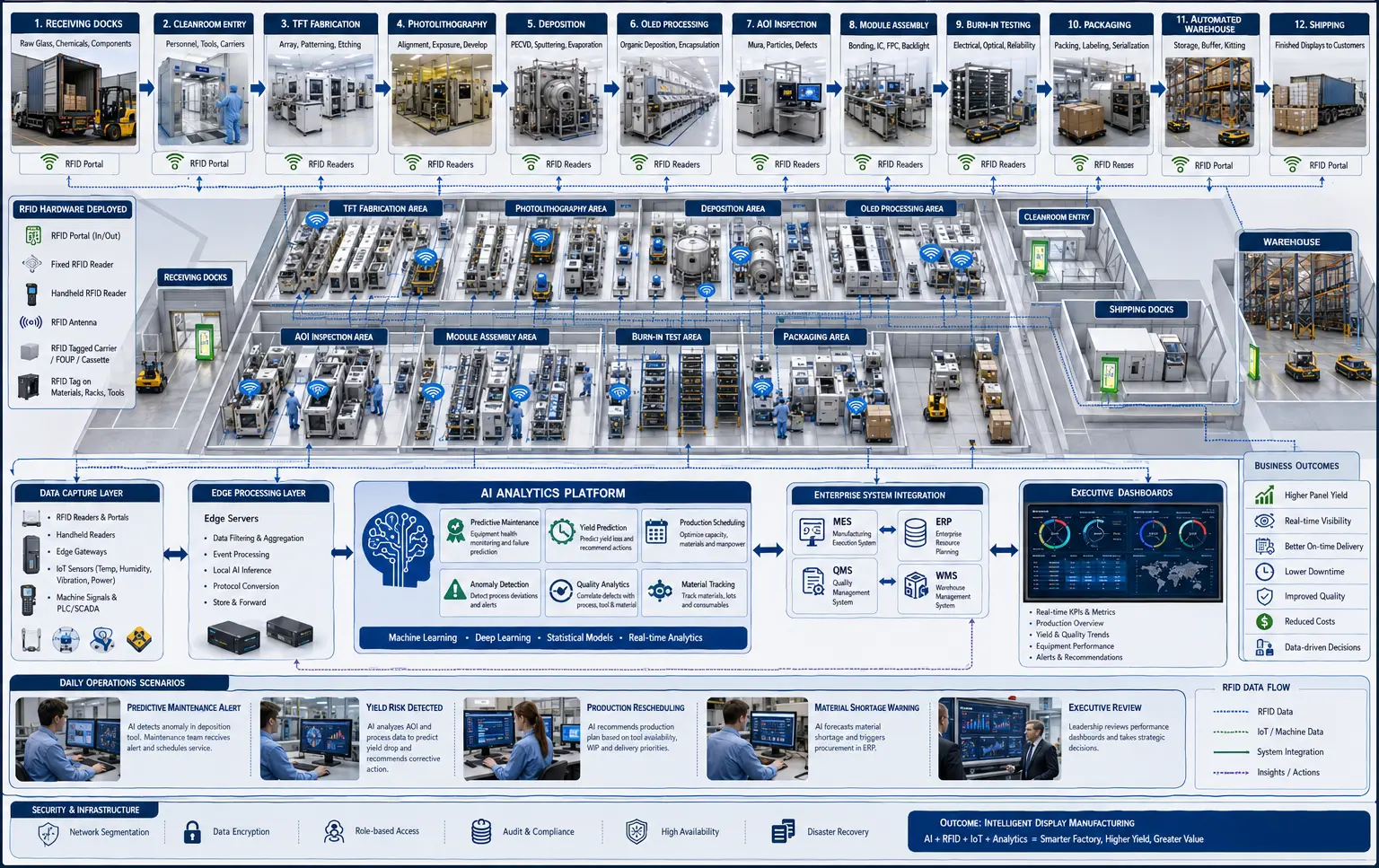
This deployment workflow diagram illustrates how RFID hardware is integrated across a modern display manufacturing facility, from receiving and cleanroom entry through TFT fabrication, OLED processing, AOI inspection, module assembly, testing, packaging, warehousing, and shipping. RFID-generated production data is processed by edge servers and AI analytics software before integrating with MES, ERP, QMS, WMS, and SPC systems to enable predictive maintenance, production scheduling, quality analytics, work-in-progress visibility, and executive decision support.
RFID Infrastructure, AI Software, and Deployment Models for Display Manufacturing
Successful AI-driven display manufacturing depends on selecting RFID hardware, industrial software, computing resources, and deployment models that align with production scale, cleanroom requirements, cybersecurity policies, and operational objectives.
Rather than functioning as isolated components, these technologies work together as an integrated production intelligence solution that captures manufacturing events, analyzes operational performance, and supports automated decision-making.
RFID Hardware Supporting Display Manufacturing
RFID hardware deployed throughout display fabrication facilities must operate reliably in cleanroom environments while supporting continuous production.
Typical hardware includes:
- UHF RFID readers for production logistics, warehouse operations, and pallet tracking
- HF RFID readers for workstation identification, process control, and tool verification
- LF RFID readers for specialized manufacturing assets requiring short-range identification
- Industrial RFID antennas positioned along automated conveyor systems
- Cleanroom-compatible RFID tags designed for reusable production carriers
- High-temperature RFID tags for process fixtures exposed to elevated temperatures
- Chemical-resistant RFID tags for containers used in wet processing areas
- Rugged handheld RFID readers for maintenance personnel and inventory audits
- RFID printer-encoders for production lot identification
- RFID-enabled smart cabinets for controlled storage of high-value manufacturing components
Hardware selection depends on read distance, environmental conditions, substrate materials, production speed, and equipment layout.
AI Software Supporting Display Production
Artificial Intelligence software transforms RFID-generated production events into actionable operational insights.
Common AI technologies include:
- Machine learning for production forecasting
- Deep learning for defect classification
- Computer vision for panel inspection
- Predictive analytics for equipment maintenance
- Reinforcement learning for production optimization
- Anomaly detection for process deviation identification
- Time-series forecasting for throughput prediction
- Natural language processing for maintenance report analysis
- Generative AI for operational summaries and engineering knowledge retrieval
Instead of replacing existing manufacturing software, these AI capabilities enhance decision-making by using RFID traceability and production data to recommend corrective actions, optimize schedules, and improve overall display manufacturing performance.
Cloud and Server Deployment Models for AI-Driven Display Manufacturing
Selecting the appropriate deployment model is a strategic engineering decision that affects latency, cybersecurity, regulatory compliance, production resilience, scalability, and long-term operational costs. Display manufacturing facilities typically generate millions of RFID events, inspection images, machine logs, and process measurements every day. AI software must process this information efficiently while supporting continuous manufacturing operations.
Many organizations adopt hybrid deployments where low-latency production decisions remain close to manufacturing equipment while computationally intensive analytics execute in centralized computing environments.
Cloud Deployment
Cloud-hosted AI software is well suited for organizations operating multiple display fabrication facilities, geographically distributed warehouses, supplier networks, or centralized manufacturing operations.
Typical cloud deployment characteristics include:
- Centralized AI model management
- Multi-factory production monitoring
- Cross-site yield benchmarking
- Long-term manufacturing analytics
- Fleet-wide RFID device management
- Enterprise dashboard consolidation
- Central software updates
- AI model retraining using historical production data
- Disaster recovery and high availability
- Integration with enterprise collaboration tools
Cloud deployments simplify enterprise-wide visibility because production data from multiple display factories can be analyzed using consistent AI models. Corporate engineering teams can compare production efficiency, equipment utilization, defect trends, and operational KPIs across facilities without requiring independent software installations at every location.
Cloud deployments are generally preferred when organizations require:
- Global manufacturing visibility
- Supplier collaboration
- Multi-site production planning
- Long-term predictive analytics
- Executive reporting
- Centralized AI lifecycle management
- Enterprise business intelligence
Server Deployment
Many display manufacturers prefer privately managed server deployments because fabrication environments require deterministic response times, strict cybersecurity controls, and continuous operation even when external connectivity becomes unavailable.
Server deployments may operate within:
- Factory data centers
- Private cloud environments
- Regional manufacturing computing centers
- Edge server clusters
- Customer-managed virtual infrastructure
- High-availability production server rooms
Unlike public cloud systems, privately managed servers allow manufacturers to maintain complete control over production information, process recipes, intellectual property, engineering documentation, and sensitive manufacturing data.
Server deployments are commonly selected for:
- High-volume display fabrication
- Mission-critical production lines
- Low-latency equipment coordination
- Intellectual property protection
- Strict customer confidentiality
- Export-controlled manufacturing
- Highly regulated production environments
Production continues even if internet connectivity is interrupted because AI inference, RFID event processing, and manufacturing software remain operational within the factory.
This approach minimizes production latency while providing corporate engineering teams with enterprise-wide manufacturing visibility.
GAO supports organizations deploying RFID solutions across cloud-managed environments, privately hosted servers, and hybrid manufacturing infrastructures, allowing customers to select the model that best aligns with operational objectives and IT governance.
Cybersecurity and Supporting Infrastructure
AI-driven display manufacturing systems depend on secure communication between RFID hardware, industrial controllers, AI software, production databases, and enterprise applications. Because production information often contains proprietary process knowledge and customer product data, cybersecurity must be incorporated throughout the deployment lifecycle rather than added after implementation.
Key security mechanisms include:
- Mutual authentication between RFID readers and management software
- TLS-encrypted communication for data in transit
- AES encryption for stored production records
- Role-based access control (RBAC) for engineering, maintenance, quality, and operations personnel
- Multi-factor authentication (MFA) for administrative users
- Network segmentation separating production systems from corporate IT
- Secure API authentication using OAuth or token-based mechanisms
- Continuous vulnerability assessment and patch management
- Security Information and Event Management (SIEM) integration for real-time monitoring
- Comprehensive audit logging for RFID events, configuration changes, and AI recommendations
Supporting infrastructure also plays a critical role in maintaining reliable operations. Typical components include redundant industrial Ethernet networks, private 5G or Wi-Fi 6 connectivity for mobile devices, synchronized time servers for accurate event sequencing, high-availability databases, redundant storage systems, backup power supplies, and environmental monitoring within server rooms.
Together, these measures help protect production continuity, safeguard intellectual property, and ensure that AI recommendations are based on trustworthy, tamper-resistant operational data.
Technical Capabilities of AI-Powered RFID Solutions in Display Manufacturing
Artificial Intelligence combined with RFID enables display manufacturers to move beyond simple asset identification toward continuous operational optimization. Rather than treating production events as isolated transactions, AI evaluates relationships across manufacturing history, equipment behavior, inspection results, and process conditions to generate meaningful operational intelligence.
Key technical capabilities include:
- Continuous work-in-progress visibility across fabrication, assembly, testing, and logistics
- Automated production genealogy linking materials, equipment, operators, and finished display panels
- Predictive yield analysis based on historical process data and RFID traceability
- Intelligent production scheduling that adapts to equipment availability and manufacturing priorities
- Early detection of bottlenecks affecting cleanroom throughput
- Automated verification of process routing to reduce manufacturing errors
- Predictive maintenance recommendations derived from equipment utilization and service history
- Dynamic material flow optimization for automated transport systems
- Real-time inventory visibility for raw materials, consumables, and finished goods
- AI-assisted quality analysis correlating inspection outcomes with upstream manufacturing events
- Capacity forecasting using historical production trends and current factory conditions
- Executive dashboards presenting actionable manufacturing KPIs rather than static reports
These capabilities improve decision-making at every level of display manufacturing, from production operators and maintenance engineers to quality managers and executive leadership.
Business Benefits of AI-Driven Display Manufacturing Using RFID
Display manufacturing organizations are under constant pressure to increase panel yield, shorten production cycles, reduce manufacturing costs, and maintain exceptional product quality. AI-enabled manufacturing intelligence supported by RFID provides measurable operational improvements by transforming production data into timely, evidence-based decisions.
Unlike traditional reporting systems that present historical information, AI continuously evaluates manufacturing conditions and recommends corrective actions while production is still in progress. RFID provides the trusted production genealogy required for these AI models, ensuring every recommendation is based on accurate identification of materials, production lots, equipment, and process history.
Higher Display Panel Yield
Yield improvement remains one of the most valuable outcomes for display manufacturers because even a small percentage increase can translate into significant annual savings.
AI improves yield by:
- Correlating production genealogy with inspection results
- Detecting recurring process deviations before defects propagate
- Identifying equipment responsible for abnormal defect patterns
- Predicting high-risk production lots before downstream processing
- Recommending process adjustments based on historical manufacturing performance
RFID ensures that every substrate, carrier, and production lot maintains a complete digital history, enabling AI to perform highly accurate root-cause analysis across thousands of manufacturing events.
Reduced Manufacturing Cycle Time
Long production cycles increase work-in-progress inventory, consume additional factory resources, and delay customer deliveries.
AI analyzes RFID movement history to identify:
- Queue congestion
- Equipment waiting time
- Material transport inefficiencies
- Unbalanced production scheduling
- Excessive intermediate storage
- Delays caused by maintenance activities
Engineering teams can optimize production flow using AI recommendations that reduce unnecessary movement while improving equipment utilization.
Improved Equipment Availability
Display fabrication depends on highly specialized production equipment with substantial capital investment.
AI evaluates:
- RFID maintenance history
- Equipment operating hours
- Process utilization
- Spare parts consumption
- Historical failure trends
- Maintenance response time
Predictive maintenance scheduling reduces unexpected downtime while extending equipment service life and improving production continuity.
Better Material Traceability
Complete traceability is increasingly important for customer quality requirements, supplier management, warranty investigations, and regulatory documentation.
RFID automatically records:
- Supplier information
- Material receipt
- Storage location
- Production consumption
- Process routing
- Quality inspections
- Final assembly
- Packaging
- Shipment history
AI uses this information to identify supplier performance trends, recurring material issues, and opportunities to improve procurement decisions.
Improved Production Planning
Production planning becomes significantly more accurate when AI has access to continuously updated manufacturing information.
AI forecasts:
- Production completion dates
- Material shortages
- Equipment capacity
- Labor requirements
- Factory utilization
- Delivery performance
Production managers can make scheduling decisions using current factory conditions instead of relying solely on historical averages.
Faster Engineering Decisions
Large display fabrication facilities generate enormous volumes of operational information every day.
AI summarizes:
- Yield trends
- Process deviations
- Equipment abnormalities
- Quality alerts
- Inventory status
- Production bottlenecks
Instead of manually reviewing multiple reports, engineers receive prioritized recommendations supported by production evidence.
Performance Improvements Across Display Manufacturing Operations
The combination of AI and RFID delivers measurable operational improvements across nearly every stage of display manufacturing. While results vary depending on production processes, equipment maturity, and implementation scope, organizations commonly target improvements in the following areas:
| Operational Area | AI-Enabled RFID Improvement in Display Manufacturing |
| Work-in-Progress (WIP) Visibility | Provides continuous tracking of RFID-tagged glass substrates, production cassettes, FOUPs, OLED carriers, and display modules across TFT fabrication, photolithography, deposition, inspection, assembly, and testing, enabling AI to identify bottlenecks, excessive queue times, and stalled production lots. |
| Production Genealogy & Traceability | Creates complete digital genealogy linking mother glass, TFT arrays, OLED materials, color filters, polarizers, driver ICs, process equipment, operators, inspection results, and finished display panels, allowing AI to perform rapid root-cause analysis and quality investigations. |
| Inventory Accuracy | Automatically tracks RFID-tagged display glass, OLED organic materials, driver IC reels, adhesives, cleanroom consumables, spare parts, and finished display modules, enabling AI to forecast material demand, reduce inventory discrepancies, and prevent production shortages. |
| Equipment Utilization | Uses RFID maintenance records together with AI analysis of production schedules, operating hours, and equipment health to maximize utilization of PECVD systems, sputtering tools, lithography equipment, OLED evaporation chambers, AOI systems, bonding machines, and automated transport systems. |
| Production Scheduling | AI dynamically adjusts production sequencing based on RFID-verified material availability, equipment readiness, WIP status, process priorities, and customer delivery schedules, reducing idle time and improving manufacturing throughput. |
| Quality Assurance & Yield Optimization | Combines RFID production history with AOI inspection images, mura analysis, dead-pixel testing, electrical measurements, optical inspection, and SPC data so AI can identify defect trends, predict yield loss, and recommend corrective actions before downstream processing. |
| Predictive Maintenance | Correlates RFID-tagged maintenance activities, spare part usage, equipment utilization, and sensor telemetry so AI predicts failures of vacuum pumps, robotic handlers, conveyors, chillers, process chambers, and inspection systems, minimizing unplanned downtime. |
| Material Flow Optimization | Monitors RFID-tagged production carriers, FOUPs, automated guided vehicles (AGVs), overhead transport (OHT) systems, stockers, and buffer stations while AI optimizes routing, minimizes transport delays, balances production loads, and reduces cleanroom congestion. |
| Manufacturing Performance Intelligence | Consolidates RFID events, MES transactions, SPC measurements, equipment telemetry, AOI inspection results, and production KPIs into AI dashboards that provide real-time visibility of panel yield, throughput, cycle time, equipment efficiency, and WIP aging across display fabrication lines. |
| Operational Decision Support | AI analyzes RFID production genealogy, process history, equipment performance, inspection data, and inventory status to recommend production rerouting, maintenance scheduling, material replenishment, quality interventions, and capacity adjustments, enabling faster engineering and operations decisions. |
These improvements contribute to lower operating costs, more consistent display quality, higher customer satisfaction, and improved responsiveness to changing production demands.
Engineering Recommendations for Successful Implementation
Successful deployment of AI-enabled RFID solutions in display manufacturing requires careful planning across production engineering, information technology, quality assurance, maintenance, and operations. The following practices help maximize long-term value while minimizing implementation risk.
Establish Clear Operational Objectives
Define measurable goals before deployment, such as:
- Improving display panel yield
- Increasing equipment utilization
- Reducing production cycle time
- Enhancing work-in-progress visibility
- Strengthening material traceability
- Lowering maintenance costs
- Improving inventory accuracy
Well-defined objectives allow AI models to be trained against meaningful manufacturing outcomes.
Select RFID Hardware Based on Manufacturing Conditions
Different production environments require different RFID technologies and tag designs.
Engineering teams should evaluate:
- Read range requirements
- Tag mounting locations
- Cleanroom compatibility
- High-temperature exposure
- Chemical resistance
- Metal interference
- Reader placement
- Conveyor speeds
- Asset lifecycle
- Maintenance accessibility
Proper hardware selection reduces read failures and improves long-term reliability.
Integrate AI with Existing Manufacturing Systems
Organizations achieve greater value when AI complements existing production software rather than replacing it.
Recommended integrations include:
- Manufacturing Execution Systems (MES)
- Enterprise Resource Planning (ERP)
- Quality Management Systems (QMS)
- Warehouse Management Systems (WMS)
- Statistical Process Control (SPC)
- Computerized Maintenance Management Systems (CMMS)
- Laboratory Information Management Systems (LIMS)
Integration allows AI recommendations to become part of established production workflows.
Start with High-Value Manufacturing Processes
Many organizations begin implementation in areas where measurable benefits can be demonstrated quickly.
Common starting points include:
- Work-in-progress tracking
- Production genealogy
- Equipment maintenance
- Material inventory
- Automated warehouse operations
- High-value asset management
- Quality inspection traceability
After initial success, additional manufacturing processes can be incorporated using the same RFID infrastructure and AI software.
Continuously Improve AI Models
Manufacturing processes evolve through equipment upgrades, product introductions, and process optimization initiatives.
AI models should therefore be reviewed regularly by:
- Production engineers
- Quality specialists
- Data scientists
- Maintenance teams
- Manufacturing managers
Continuous refinement helps maintain prediction accuracy as operating conditions change.
GAO has supported manufacturers across North America by supplying industrial RFID hardware, readers, tags, antennas, and related identification systems that integrate with modern manufacturing software. Drawing on experience serving Fortune 500 companies, research institutions, and government organizations, we help customers build reliable RFID foundations that enable advanced AI applications while aligning with existing production processes and quality objectives.
Business Value and Benefits of AI-Enabled RFID in Display Manufacturing
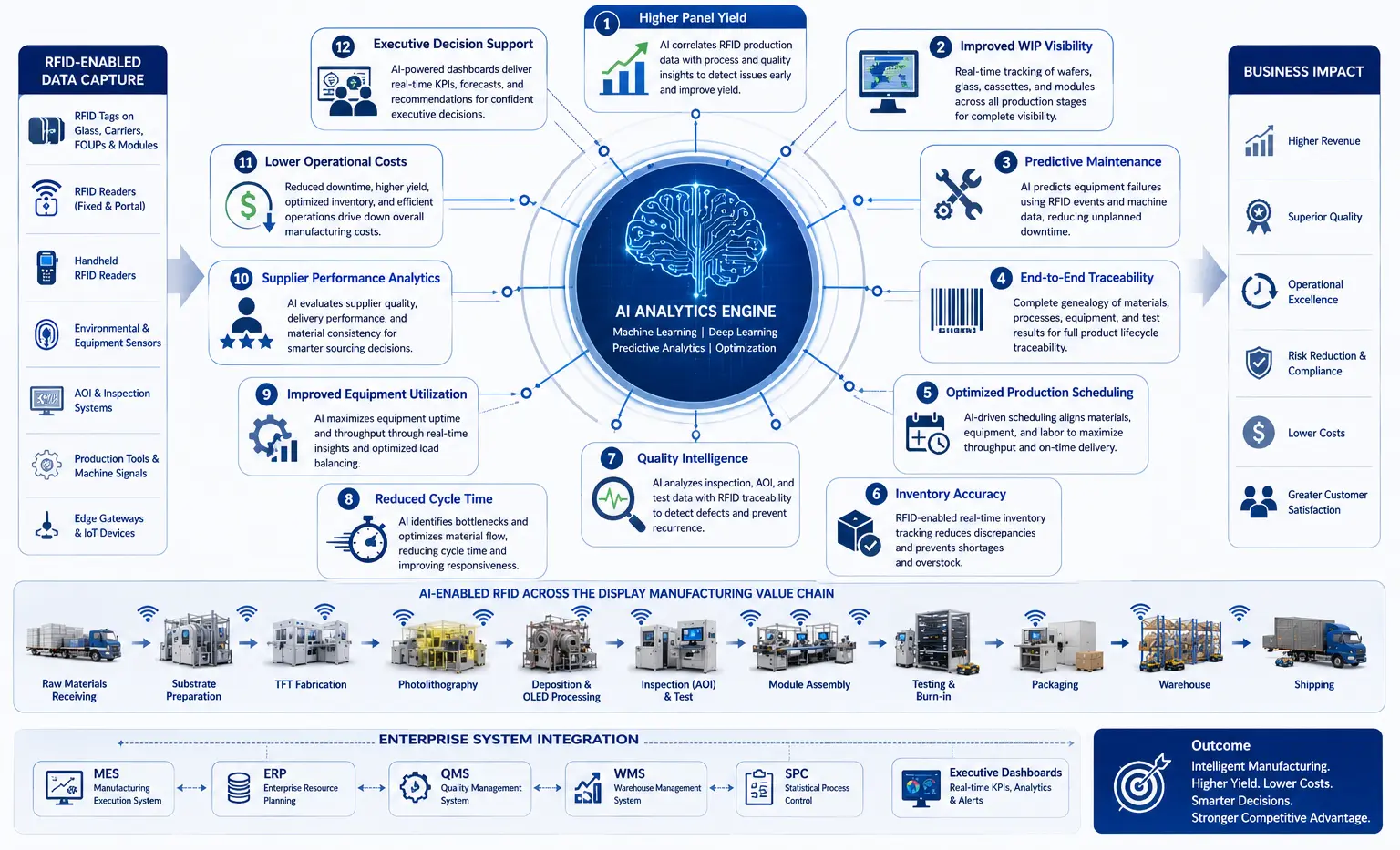
This infographic highlights the operational, technical, and business benefits of AI-enabled RFID across the display manufacturing lifecycle. It illustrates how RFID-generated production data is transformed by AI into actionable insights that improve panel yield, work-in-progress visibility, predictive maintenance, quality intelligence, production scheduling, inventory accuracy, and executive decision-making through integration with core manufacturing systems.
Advancing Intelligent Display Manufacturing with AI-Enabled RFID
Display manufacturing continues to evolve toward highly automated, data-driven production where operational decisions are increasingly guided by real-time manufacturing intelligence rather than historical reports. AI supported by RFID enables manufacturers to identify production assets automatically, maintain complete product genealogy, optimize material movement, predict equipment issues, improve yield, and enhance quality throughout LCD, OLED, Mini-LED, MicroLED, and emerging display technologies.
Successful implementations depend on more than deploying RFID hardware or AI software independently. Long-term value is achieved by integrating automatic identification, industrial communication, AI analytics, manufacturing software, and operational expertise into a unified production intelligence solution. Organizations that begin with clearly defined business objectives, deploy RFID strategically across high-value manufacturing processes, integrate AI with existing production systems, and continuously refine predictive models are better positioned to improve manufacturing efficiency, product quality, and operational resilience.
GAO has helped organizations across the U.S. and Canada modernize manufacturing operations by supplying industrial RFID readers, tags, antennas, handheld readers, and related identification systems that integrate with AI-driven manufacturing software. Headquartered in New York City and Toronto, Canada, GAO is recognized among the world’s leading B2B and B2G suppliers of RFID and BLE technologies. Supported by decades of investment in research and development, rigorous quality assurance, and experienced engineering teams providing both remote and on-site technical assistance, we help manufacturers deploy reliable RFID solutions that support intelligent production, digital traceability, and continuous operational improvement.
Building the Future of Industrial AI and IoT with Aperture Venture Studio and GAO RFID Inc.n
For more than three decades, GAO Group of Companies has invested extensively in the research and development of industrial RFID, BLE, and IoT technologies that support demanding manufacturing and industrial applications. As Artificial Intelligence has become an increasingly valuable tool for production optimization and operational intelligence, we have expanded our focus on AI-enabled RFID and Industrial AI solutions for sectors such as display manufacturing, helping organizations improve traceability, production visibility, quality management, and manufacturing efficiency. To accelerate innovation in these areas, we established Aperture Venture Studio to advance, commercialize, and scale practical AI and IoT technologies across diverse industries.
Aperture has brought together leading AI researchers, IoT specialists, experienced technology executives, strategic investors, and industry collaborators to accelerate the development of intelligent industrial solutions. Through initiatives including the Aperture Ventures Summit and TekSummit, we continue to foster technical collaboration, share practical engineering knowledge, and explore emerging applications of AI, RFID, BLE, and connected industrial systems.
These ongoing efforts have strengthened a broad technical community dedicated to advancing Industrial AI and IoT innovation. We welcome opportunities to collaborate with organizations and professionals who are shaping the future of intelligent manufacturing and connected operations, including:
- Advisors, technical experts, and engineering professionals
- Investors interested in industrial AI and IoT innovation
- Manufacturers and organizations seeking RFID, AI, and IoT technologies, products, systems, and technical expertise
The Future of AI-Enabled RFID Display Manufacturing with Intelligent Factory Automation
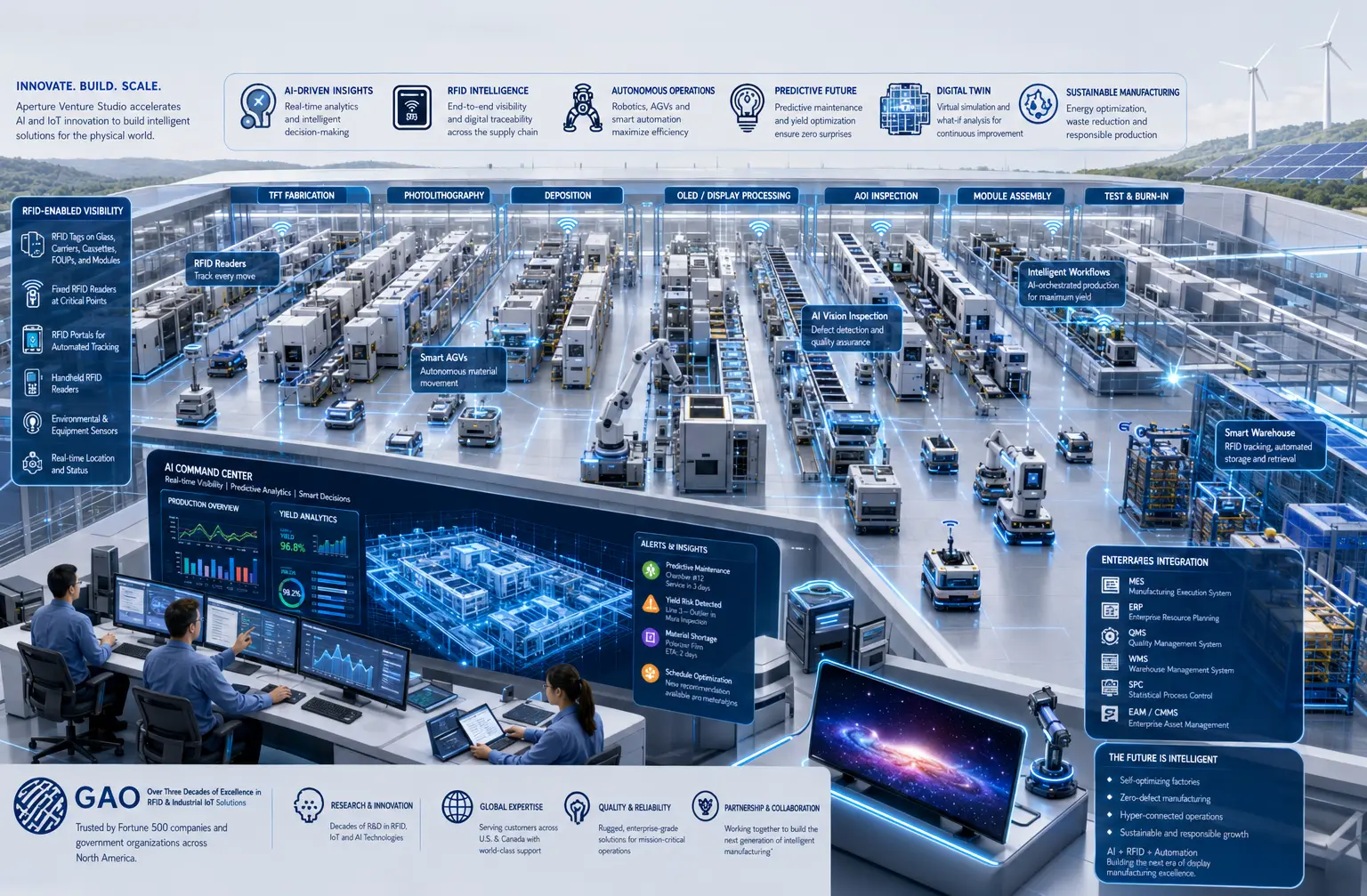
This illustration presents a future-ready display manufacturing facility where AI, RFID, robotics, digital twins, and connected industrial systems work together to create autonomous, data-driven production. Intelligent material handling, AI-powered quality inspection, predictive maintenance, smart warehousing, and executive analytics demonstrate how next-generation display manufacturing improves yield, operational efficiency, sustainability, and end-to-end production visibility while highlighting innovation supported by Aperture Venture Studio and GAO.