
AI and BLE for Industrial Packaging
AI-Powered BLE Solutions for Industrial Packaging
Industrial packaging operations require continuous visibility into packaging materials, mobile assets, production equipment, work-in-progress, operators, and logistics activities. Artificial Intelligence (AI) combined with Bluetooth Low Energy (BLE) technologies enables packaging facilities to transform real-time location and sensor data into actionable operational intelligence. BLE beacons, gateways, wearable tags, environmental sensors, and connected packaging equipment continuously generate operational data that AI models analyze to improve production efficiency, reduce downtime, optimize material movement, enhance workforce safety, and strengthen packaging traceability.
Modern AIoT solutions integrate AI with connected sensors, industrial software, edge computing, and manufacturing systems to create intelligent packaging operations capable of responding automatically to changing production conditions. Rather than simply collecting location data, AI continuously identifies patterns, predicts operational issues, recommends corrective actions, and supports data-driven decision making across packaging lines.
Packaging manufacturers increasingly deploy AI-powered BLE systems to improve Overall Equipment Effectiveness (OEE), reduce packaging material waste, optimize labor utilization, accelerate changeovers, improve pallet handling, monitor environmental conditions, and maintain continuous visibility of production assets throughout packaging facilities.
GAO has supported industrial organizations throughout North America for decades by supplying BLE, RFID, and industrial IoT hardware products and systems that enable intelligent manufacturing, packaging automation, and real-time operational visibility.
Why AI is Transforming Industrial Packaging with BLE Technologies
Industrial packaging has evolved from isolated production lines into highly connected manufacturing environments where equipment, operators, packaging materials, returnable containers, pallets, forklifts, automated guided vehicles (AGVs), autonomous mobile robots (AMRs), and warehouse systems continuously exchange operational information.
Traditional packaging monitoring methods rely heavily on manual inspections, barcode scanning, operator reporting, and scheduled maintenance. These approaches often provide delayed information and limited operational context, making it difficult to respond quickly to production bottlenecks or equipment failures.
BLE technologies provide continuous awareness of people, assets, equipment, and environmental conditions without requiring expensive infrastructure or high power consumption. Artificial intelligence transforms this continuous stream of operational data into meaningful recommendations by detecting inefficiencies, predicting equipment failures, identifying abnormal production behavior, optimizing packaging workflows, and improving production scheduling.
Within industrial packaging facilities, AI is commonly applied to:
- Packaging asset tracking
- Packaging material inventory optimization
- Workforce location intelligence
- Mobile equipment utilization
- Production line balancing
- Packaging machine health monitoring
- Operator safety monitoring
- Work-in-progress visibility
- Environmental monitoring
- Packaging process optimization
- Production bottleneck prediction
- Automated maintenance planning
- Quality assurance analytics
- Packaging traceability
- Warehouse staging optimization
BLE serves as the sensing and communication layer that enables AI software to maintain continuous awareness of operational activities across packaging operations.
AI-Powered BLE Connectivity and Operational Intelligence for Industrial Packaging
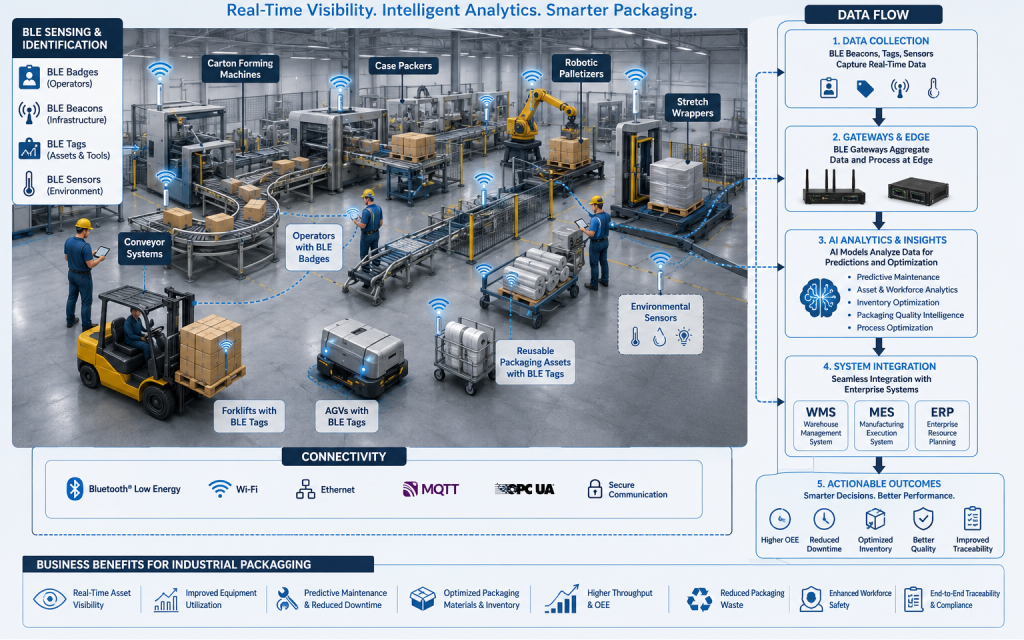
Shows how AI and Bluetooth Low Energy (BLE) technologies create an intelligent industrial packaging environment by connecting packaging equipment, mobile assets, operators, and environmental sensors. BLE gateways collect real-time operational data that AI analyzes to optimize production, predict equipment maintenance needs, improve asset utilization, enhance workforce safety, and integrate with warehouse management (WMS), manufacturing execution (MES), and enterprise resource planning (ERP) systems for end-to-end operational visibility
Core Concepts of AI-Powered BLE Systems for Industrial Packaging
Industrial packaging facilities generate thousands of operational events every minute. Every pallet movement, packaging material transfer, operator interaction, machine cycle, conveyor stop, quality inspection, and warehouse transaction creates information that contributes to production performance.
BLE technologies provide a low-power wireless sensing method capable of tracking assets, personnel, tools, mobile equipment, and environmental conditions throughout packaging operations. BLE tags periodically transmit identification and sensor information that nearby gateways collect for processing.
Artificial intelligence enhances this information by learning operational behavior instead of merely displaying location data. Machine learning models identify trends, recognize abnormal events, forecast future conditions, and recommend corrective actions before production efficiency deteriorates.
A complete AIoT solution for industrial packaging generally combines:
- BLE beacons
- BLE gateways
- BLE wearable tags
- Environmental BLE sensors
- Edge computing devices
- AI analytics software
- Manufacturing Execution Systems (MES)
- Warehouse Management Systems (WMS)
- Enterprise Resource Planning (ERP)
- Quality Management Systems (QMS)
- Computerized Maintenance Management Systems (CMMS)
- Industrial databases
- Industrial dashboards
- Mobile operator applications
- API integration services
Each component contributes to transforming raw operational events into intelligent packaging decisions.
Unlike conventional automation systems that execute predefined logic, AI continuously improves operational decisions by learning from historical production data, equipment behavior, workforce movement, and packaging throughput.
AI Applications Across Industrial Packaging Operations
Industrial packaging facilities contain numerous interconnected processes where AI-powered BLE solutions provide measurable operational improvements.
Packaging Material Management
Packaging operations consume corrugated cartons, shrink film, labels, adhesives, corner boards, stretch wrap, pallets, returnable containers, separators, protective packaging, and dunnage throughout production.
BLE-tagged material carts, packaging inventory racks, and replenishment vehicles allow AI software to monitor inventory movement continuously. Predictive models estimate material consumption, identify replenishment requirements, reduce stock shortages, and minimize excess inventory.
Typical applications include:
- Stretch film consumption monitoring
- Carton inventory optimization
- Label inventory management
- Packaging material replenishment
- Returnable container tracking
- Packaging component utilization analysis
Packaging Equipment Monitoring
Industrial packaging equipment represents significant capital investment and directly affects production throughput.
AI analyzes operational information collected from BLE-enabled equipment, PLCs, machine sensors, vibration monitors, and maintenance systems to identify abnormal machine behavior before failures occur.
Common equipment includes:
- Carton erectors
- Case sealers
- Case packers
- Robotic palletizers
- Stretch wrapping machines
- Shrink tunnels
- Print-and-apply labeling systems
- Conveyor systems
- Automatic weighing systems
- Vision inspection stations
- Pallet dispensers
- Pallet conveyors
- Strapping machines
- Bagging machines
AI applications include:
- Predictive maintenance
- Remaining useful life estimation
- Equipment utilization analysis
- Machine availability monitoring
- Energy consumption optimization
- Changeover optimization
- Downtime root cause analysis
Workforce Visibility and Safety
Packaging facilities often involve heavy machinery, robotic cells, automated conveyors, forklift traffic, and restricted operating zones.
BLE-enabled wearable badges provide continuous workforce visibility while respecting configurable privacy policies and operational requirements.
Artificial intelligence analyzes operator movement to improve:
- Labor allocation
- Operator travel distance
- Workstation balancing
- Emergency evacuation coordination
- Restricted zone compliance
- Near-miss detection
- Forklift interaction analysis
- Fatigue pattern recognition
- Shift productivity analysis
Safety managers gain continuous operational awareness without relying solely on manual observations.
Mobile Asset Tracking
Packaging operations depend upon numerous movable assets including:
- Forklifts
- Pallet jacks
- AGVs
- AMRs
- Packaging carts
- Tool cabinets
- Quality inspection carts
- Mobile printers
- Returnable containers
- Reusable pallets
- Battery charging stations
- Maintenance toolkits
BLE tracking allows AI software to optimize fleet utilization, reduce asset search time, minimize idle equipment, and improve production scheduling.
Operational improvements include:
- Asset utilization optimization
- Idle asset identification
- Equipment sharing optimization
- Route optimization
- Automated asset locating
- Utilization forecasting
- Preventive maintenance scheduling
GAO has supplied industrial BLE hardware supporting asset visibility initiatives across manufacturing, logistics, and packaging environments where dependable wireless performance and long operational life are essential.
Packaging Quality Assurance
Packaging quality depends upon multiple operational variables including:
- Carton integrity
- Seal quality
- Label accuracy
- Lot identification
- Print verification
- Barcode readability
- Weight compliance
- Pallet stability
- Stretch wrap consistency
- Environmental conditions
AI combines BLE sensor information with machine vision systems, production databases, quality inspection records, and packaging equipment data to detect conditions that may lead to quality deviations.
Predictive analytics enables packaging engineers to identify quality trends before customer complaints or production losses occur.
AI-Powered BLE Workflow for End-to-End Industrial Packaging Operations
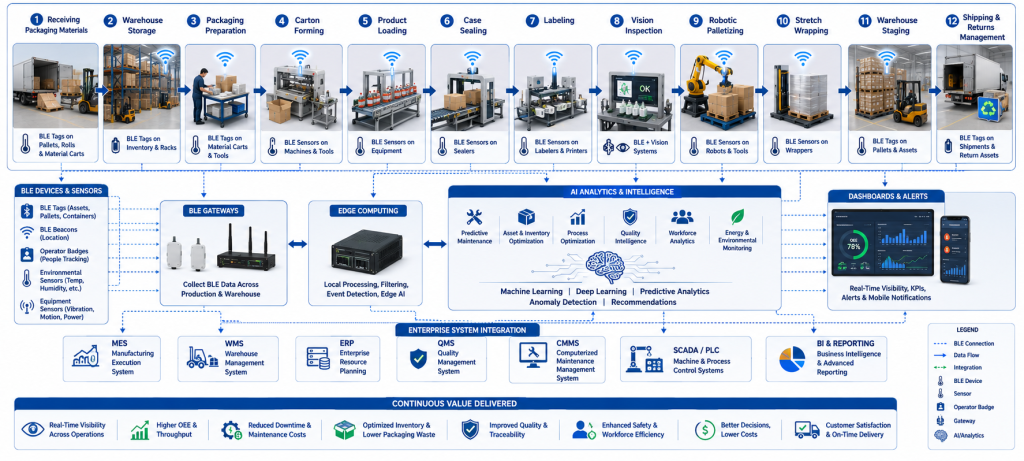
Shows the complete industrial packaging workflow from packaging material receiving and warehouse storage through packaging preparation, carton forming, product loading, case sealing, labeling, vision inspection, robotic palletizing, stretch wrapping, warehouse staging, shipping, and returns management. BLE tags, gateways, operator badges, environmental sensors, and AI analytics continuously collect and analyze operational data while integrating with MES, WMS, ERP, QMS, CMMS, and SCADA systems to improve operational visibility, predictive maintenance, inventory optimization, packaging quality, workforce efficiency, and end-to-end traceability.
Engineering Considerations for Successful AI-Enabled BLE Deployments
Successful industrial packaging deployments require significantly more than installing BLE devices. Long-term reliability depends on careful engineering, disciplined commissioning, and continuous optimization throughout the system lifecycle.
RF Site Survey and Coverage Planning
BLE performance is heavily influenced by the physical characteristics of packaging facilities.
Engineers should evaluate:
- Metal storage racks
- Conveyor layouts
- Packaging machinery
- Warehouse shelving
- Production cell configuration
- Building construction materials
- Forklift traffic
- Radio interference sources
- Ceiling heights
- Gateway mounting locations
Comprehensive RF surveys help determine optimal gateway placement, beacon density, and expected positioning accuracy.
Device Selection Strategy
Selecting the appropriate BLE devices depends on operational requirements rather than using identical hardware throughout the facility.
Selection criteria include:
- Battery longevity
- Environmental protection (IP rating)
- Temperature tolerance
- Mounting configuration
- Sensor functionality
- Beacon transmission interval
- Update frequency
- Ruggedized construction
- Maintenance accessibility
Different assets often require different device types to balance performance, battery life, and total cost of ownership.
Cybersecurity and Data Protection
Industrial packaging facilities increasingly require cybersecurity controls that protect operational technology (OT) and information technology (IT) environments.
Recommended practices include:
- Device authentication
- Encrypted communications
- Secure firmware updates
- Role-based user access
- Multi-factor authentication
- Network segmentation
- Certificate management
- Continuous vulnerability assessment
- Security event logging
- Backup and recovery procedures
Organizations deploying AIoT solutions should align cybersecurity measures with existing corporate governance policies and applicable industrial standards.
Integration Planning
Operational intelligence delivers the greatest value when connected to existing production software rather than operating independently.
Typical integration targets include:
- MES
- ERP
- WMS
- QMS
- CMMS
- SCADA
- PLC networks
- Business Intelligence tools
- Production scheduling systems
- Warehouse automation software
Early integration planning simplifies deployment while improving long-term scalability.
Performance Validation
Commissioning should verify both wireless communication and operational performance.
Validation activities commonly include:
- Gateway coverage verification
- Positioning accuracy testing
- Battery performance testing
- Network throughput validation
- API verification
- AI model accuracy evaluation
- Dashboard verification
- Alarm testing
- Disaster recovery testing
- User acceptance testing
Periodic reassessment ensures continued performance as packaging facilities expand or production layouts change.
Key Performance Indicators for AI-Driven Industrial Packaging
Organizations commonly evaluate AI-powered BLE initiatives using measurable operational and business metrics.
Typical KPIs include:
- Overall Equipment Effectiveness (OEE)
- Packaging line throughput
- Equipment availability
- Mean Time Between Failures (MTBF)
- Mean Time to Repair (MTTR)
- Packaging material utilization
- Packaging waste reduction
- Asset utilization rate
- Asset search time
- Inventory accuracy
- Labor productivity
- Operator travel distance
- Production changeover time
- Packaging cycle time
- Order fulfillment time
- On-time shipment rate
- Forklift utilization
- Safety incident frequency
- Near-miss events
- Environmental compliance
- Packaging quality yield
- First-pass yield
- Barcode readability rate
- Traceability completeness
- Maintenance cost reduction
- Energy consumption per packaged unit
Monitoring these KPIs enables continuous improvement and helps quantify the return on investment from AI-enabled BLE deployments.
Implementation Recommendations and Best Practices
Organizations planning AI-powered BLE deployments in industrial packaging can reduce project risk by following a phased implementation approach.
Recommended practices include:
- Define measurable operational objectives before selecting hardware or software.
- Conduct a detailed RF site survey covering production areas, warehouses, staging zones, and shipping docks.
- Identify high-value assets, critical workflows, and key performance indicators.
- Begin with a pilot deployment on a representative packaging line to validate positioning accuracy, data quality, and AI model performance.
- Integrate BLE-generated data with MES, WMS, ERP, CMMS, and quality systems early in the project to maximize operational value.
- Establish cybersecurity policies for device authentication, encrypted communications, firmware management, and user access.
- Validate AI recommendations against real production outcomes and refine models using operational feedback.
- Implement preventive maintenance schedules for BLE devices, including battery replacement, firmware updates, and calibration where applicable.
- Train operators, maintenance personnel, production supervisors, and IT teams on system operation, troubleshooting, and data interpretation.
- Continuously review KPIs and expand the deployment in phases as measurable improvements are achieved.
These engineering practices help organizations improve scalability, maintain operational reliability, and maximize long-term value from AI-enabled BLE solutions.
Advancing Intelligent Industrial Packaging with AI-Powered BLE Solutions
Industrial packaging is rapidly evolving from reactive production monitoring toward intelligent, data-driven operations that continuously optimize efficiency, quality, and safety. AI transforms the large volume of operational data generated throughout packaging facilities into actionable intelligence, while BLE technologies provide the reliable, low-power sensing and location awareness required to understand the movement of people, materials, mobile assets, and equipment in real time.
Successful implementations require more than deploying wireless devices. Long-term value depends on thoughtful solution design, RF planning, secure communication, edge computing where appropriate, enterprise software integration, continuous AI model refinement, and measurable operational objectives. Organizations that align these technical elements with production workflows can reduce downtime, improve packaging quality, optimize inventory, strengthen workforce safety, and increase overall equipment effectiveness.
GAO has supplied BLE, RFID, and industrial IoT hardware products and systems to organizations across the United States and Canada for decades. Headquartered in New York City and Toronto, Canada, GAO is recognized among the world’s leading B2B and B2G suppliers of BLE and RFID technologies. Through extensive investment in research and development, rigorous quality assurance, and experienced technical support delivered remotely or onsite, we help manufacturers, packaging facilities, system integrators, research organizations, Fortune 500 companies, universities, and government agencies implement dependable industrial AIoT solutions tailored to demanding operational environments.
Organizations evaluating AI-enabled industrial packaging solutions should begin with clearly defined operational goals, prioritize high-value use cases, validate deployments through pilot projects, and expand in stages based on measurable performance improvements. This disciplined engineering approach reduces implementation risk while creating a scalable foundation for continuous operational improvement.
Building the Future of Industrial AI and IoT with Aperture Venture Studio and GAO
For more than three decades, GAO Group of Companies has invested extensively in the research and development of industrial BLE, RFID, and IoT technologies. As generative AI demonstrated its value across industrial packaging and manufacturing applications, we expanded our work in AIoT solutions and established Aperture Venture Studio to accelerate the development, commercialization, and adoption of advanced AI and IoT technologies serving industrial markets.
Aperture has attracted leading AI researchers, IoT specialists, experienced business executives, strategic investors, and technology partners who collaborate to advance practical industrial innovation. We have also developed the highly successful Aperture Ventures Summit and TekSummit, bringing together industry leaders to explore emerging topics in Artificial Intelligence, Industrial IoT, Edge AI, wireless sensing, and intelligent automation. These initiatives have helped cultivate diverse technical communities that promote knowledge sharing and real-world engineering collaboration.
We welcome opportunities to collaborate with:
- Advisors, technical experts, and engineering professionals
- Investors interested in industrial AI and IoT innovation
- Manufacturers, system integrators, solution providers, and organizations seeking trusted BLE, RFID, and AIoT technologies, products, systems, and technical expertise from GAO
AI-Powered BLE Value Chain for Intelligent Industrial Packaging
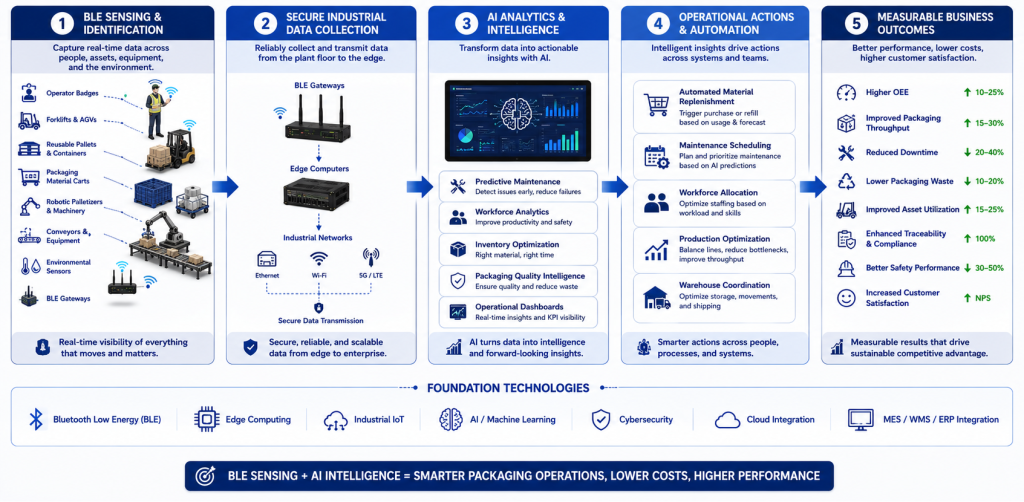
Shows a five-stage value chain illustrating how BLE sensing and AI analytics transform industrial packaging operations into measurable business outcomes. The infographic follows the flow from BLE-enabled asset and workforce sensing through secure data collection, AI-driven analytics, automated operational decisions, and business results such as higher OEE, improved packaging throughput, reduced downtime, lower packaging waste, enhanced asset utilization, stronger traceability, and improved workplace safety through integration with edge computing, MES, WMS, and ERP systems.
Why Organizations Choose GAO for AI-Enabled Industrial Packaging Solutions
Organizations implementing intelligent packaging systems often require a technology partner with practical experience in industrial wireless communications, asset visibility, systems integration, and AIoT deployments. GAO combines decades of experience in BLE, RFID, and industrial IoT with ongoing investments in AI technologies to help customers implement reliable solutions that align with operational objectives.
Our experience supporting manufacturing, logistics, packaging, research institutions, and public-sector organizations has reinforced several engineering principles:
- Begin with operational challenges rather than technology selection.
- Design wireless coverage based on RF site surveys and production layouts.
- Integrate AI-generated insights with existing manufacturing and warehouse software.
- Validate performance using measurable KPIs before expanding deployments.
- Apply cybersecurity and lifecycle management practices from the initial design phase.
- Continuously refine AI models using production data to improve prediction accuracy over time.
This engineering-focused approach helps organizations build dependable AIoT solutions that support long-term operational efficiency, scalability, and resilience across industrial packaging environments.