
AI and RFID for Copper Production in Metals Manufacturing
AI-Driven Copper Production Intelligence Enabled by RFID
Copper production facilities operate in demanding environments where ore movement, concentrate handling, smelting, converting, electrorefining, material logistics, maintenance activities, and finished cathode traceability must remain synchronized despite extreme temperatures, dust, vibration, and continuous operations. Artificial Intelligence combined with RFID enables copper producers to transform operational data into actionable intelligence by automatically identifying materials, assets, tools, work-in-progress, and finished products throughout the production lifecycle. Rather than relying on manual identification or isolated data collection, AI continuously analyzes RFID-generated operational data together with sensor measurements, maintenance records, laboratory analysis, production schedules, and manufacturing execution data to improve productivity, quality, and operational decision-making.
Within copper production, AI-powered RFID solutions improve concentrate traceability, optimize smelter throughput, monitor critical assets, reduce material losses, support predictive maintenance, automate inventory visibility, and strengthen regulatory compliance. These capabilities enable production managers, metallurgical engineers, maintenance teams, warehouse personnel, reliability engineers, and plant executives to make faster, data-driven decisions while improving production efficiency, operational safety, equipment utilization, and finished copper quality. Organizations implementing these solutions also benefit from decades of engineering expertise supplied by GAO, whose RFID and industrial IoT technologies have supported manufacturing, government, research, and Fortune 500 organizations across North America.
AI-Enabled RFID Copper Production Lifecycle for End-to-End Operational Visibility
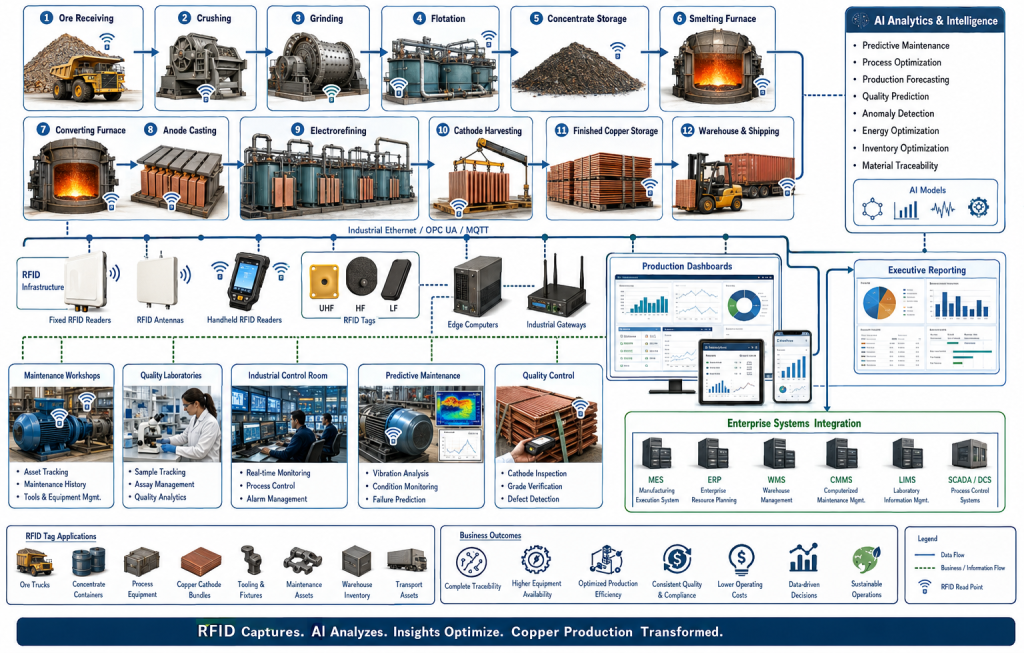
A complete AI-enabled RFID solution across the copper production lifecycle, from ore receiving and mineral processing through smelting, electrorefining, finished copper storage, and shipping. It demonstrates how RFID-generated operational data is combined with AI analytics, industrial networking, enterprise software, and predictive maintenance to improve production visibility, asset traceability, quality control, operational efficiency, and executive decision-making.
Understanding AI-Enabled RFID Solutions for Copper Production
Modern copper production involves thousands of continuously moving materials, production assets, maintenance tools, mobile equipment, process containers, and finished products distributed across concentrators, smelters, electrorefineries, warehouses, laboratories, maintenance facilities, and logistics operations. Maintaining accurate identification throughout these operations is essential for production planning, process optimization, quality assurance, inventory control, maintenance scheduling, environmental reporting, and customer traceability.
RFID provides reliable automatic identification of physical objects, while Artificial Intelligence converts large volumes of operational data into predictive insights, optimization recommendations, anomaly detection, and automated decision support. Together, these technologies form an AIoT solution where connected identification devices continuously supply operational data that AI models transform into practical production intelligence.
Within copper production, AI commonly analyzes information collected from:
- RFID identification events
- Production scheduling systems
- Smelter operating parameters
- Furnace temperature measurements
- Conveyor operating conditions
- Laboratory assay results
- Electrorefining performance
- Maintenance management records
- Warehouse inventory transactions
- Mobile equipment utilization
- Worker activity records
- Industrial environmental monitoring systems
- Energy consumption data
- Quality inspection systems
- Process historian databases
Instead of functioning as an isolated identification technology, RFID becomes an operational data source supporting AI-driven production optimization across multiple production stages.
Copper production organizations increasingly integrate RFID information with:
- Manufacturing Execution Systems (MES)
- Enterprise Resource Planning (ERP)
- Warehouse Management Systems (WMS)
- Computerized Maintenance Management Systems (CMMS)
- Enterprise Asset Management (EAM)
- Laboratory Information Management Systems (LIMS)
- Supervisory Control and Data Acquisition (SCADA)
- Distributed Control Systems (DCS)
- Industrial data historians
- Business Intelligence software
This integrated approach enables plant personnel to correlate production events, equipment condition, maintenance history, material genealogy, quality measurements, and production efficiency from a unified operational perspective.
GAO has supplied RFID hardware and industrial identification solutions that support these types of integrated manufacturing environments where dependable data acquisition is essential for AI-based operational improvements.
AI Applications Across Copper Production Operations
Artificial intelligence supported by RFID delivers measurable operational improvements throughout copper production by improving visibility of materials, production assets, maintenance resources, and finished products while enabling continuous optimization of metallurgical processes.
Copper Ore Receiving and Material Traceability
Copper ore delivered from multiple mining locations often varies in mineral composition, moisture content, sulfur concentration, and impurity levels. RFID tagging of transport containers, railcars, haul trucks, and storage lots enables AI to associate incoming material with geological characteristics, supplier history, laboratory assays, blending strategies, and downstream production performance.
AI identifies relationships between ore characteristics and smelting performance, allowing production planners to optimize blending strategies before material enters processing operations.
Concentrate Storage and Inventory Intelligence
Copper concentrate inventories continuously change as material enters storage silos, blending facilities, and smelter feed systems.
AI analyzes RFID inventory movements together with:
- Storage duration
- Material composition
- Moisture measurements
- Inventory turnover
- Production schedules
- Furnace capacity
- Laboratory analyses
Production managers gain improved inventory visibility while minimizing unnecessary concentrate movement and reducing feed inconsistencies.
Smelting Process Optimization
Copper smelting represents one of the most energy-intensive stages of production.
RFID identifies furnace tools, refractory components, production containers, maintenance equipment, and material batches entering the smelting process. AI combines identification records with operational parameters including:
- Furnace temperature
- Oxygen enrichment
- Feed rate
- Slag composition
- Energy consumption
- Airflow control
- Process stability
- Equipment utilization
Machine learning models recognize operating conditions associated with higher recovery rates, improved furnace utilization, and lower energy consumption while recommending production adjustments before inefficiencies become significant.
Converter Operations and Anode Production
During converting operations, molten matte is processed into blister copper before casting anodes for electrorefining.
RFID supports traceability of:
- Anode molds
- Casting equipment
- Production fixtures
- Ladles
- Transfer containers
- Maintenance tools
- Inspection equipment
AI evaluates production sequences, equipment availability, mold utilization, casting quality, maintenance history, and production bottlenecks to improve throughput while reducing casting defects and unplanned downtime.
Electrorefining Process Intelligence
Electrorefining requires careful monitoring of thousands of copper anodes, starter sheets, cathodes, electrolyte systems, and material handling equipment.
RFID enables identification of:
- Cathode bundles
- Anode inventories
- Electrolytic cells
- Maintenance equipment
- Production carts
- Quality inspection stations
Artificial intelligence evaluates process stability by correlating RFID production records with electrolyte chemistry, electrical performance, impurity removal efficiency, harvesting schedules, and cathode quality.
Production engineers can identify process variations much earlier than traditional reporting methods.
Maintenance and Reliability Management
Copper production facilities contain numerous high-value assets including:
- Ball mills
- SAG mills
- Crushers
- Flotation cells
- Smelting furnaces
- Converters
- Electrorefining systems
- Dust collection systems
- Overhead cranes
- Conveyors
- Pumps
- Compressors
- Heat exchangers
- Industrial transformers
RFID identifies equipment, replacement components, maintenance tools, and technician activities while AI predicts equipment degradation based on maintenance history, equipment utilization, environmental conditions, and production workload.
Maintenance planners receive earlier recommendations for inspections before failures disrupt production schedules.
Finished Copper Traceability
Finished copper cathodes must maintain complete production genealogy throughout storage and shipment.
RFID automatically records:
- Production batch
- Refining line
- Packaging location
- Warehouse movement
- Shipment preparation
- Customer allocation
AI verifies production consistency, identifies shipment anomalies, predicts logistics delays, and supports compliance with customer quality requirements.
AI-Enabled RFID Workflow Across the Copper Production Lifecycle
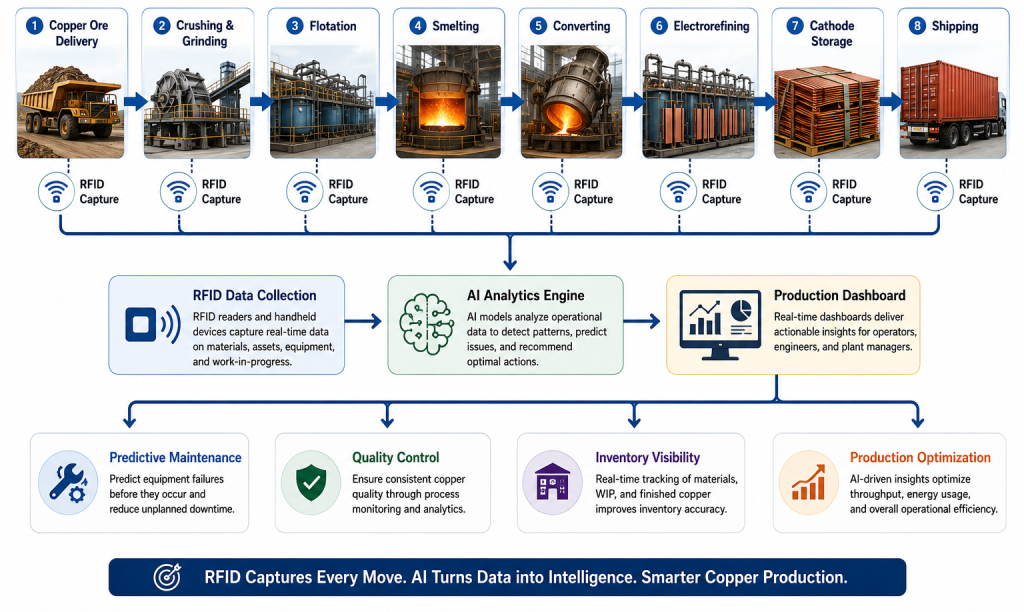
RFID captures operational data at each major stage of copper production, from ore delivery to finished product shipping. AI analyzes the collected data to provide production dashboards and actionable insights for predictive maintenance, quality control, inventory visibility, and production optimization.
Operational Workflow for AI-Driven Copper Production
Copper production generates large volumes of operational data from material movement, process equipment, inspection activities, maintenance operations, laboratories, and logistics. An AI-enabled RFID solution transforms these distributed events into coordinated operational intelligence through a structured workflow.
Automated Data Acquisition
RFID tags are attached to concentrate containers, anode molds, cathode bundles, maintenance tools, mobile assets, forklifts, ladles, pallets, reusable transport racks, inspection fixtures, laboratory samples, and warehouse inventory. Fixed RFID readers are installed at receiving areas, conveyor transfer points, furnace charging stations, casting areas, electrorefining lines, warehouses, maintenance workshops, and shipping docks, while handheld readers support inspections, inventory audits, and maintenance activities. Each read event creates a timestamped digital record that identifies the asset, its location, and its movement through the production process.
Communication and Edge Processing
RFID readers transmit data through industrial communication networks such as Ethernet/IP, PROFINET, Modbus TCP, OPC UA, or MQTT to industrial edge computers. Edge software filters duplicate reads, validates tag integrity, applies business rules, and temporarily stores data during network interruptions. Local AI inference can detect abnormal material movement, unauthorized asset relocation, or process deviations with minimal latency, ensuring timely responses even in areas where connectivity to central servers is intermittent.
Layered AI-Enabled RFID System for Intelligent Copper Production
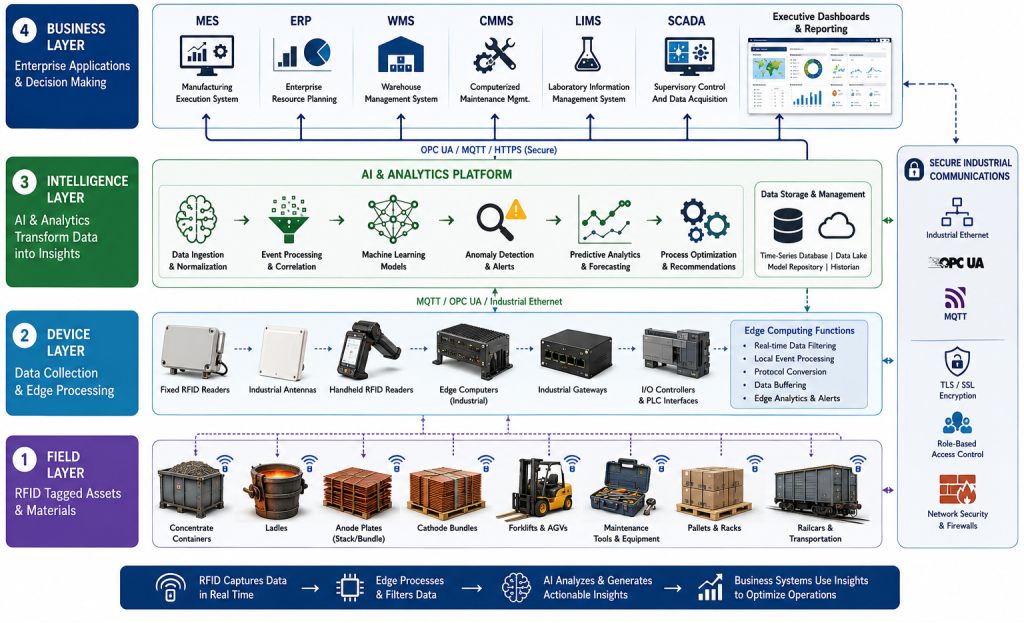
A four-layer system diagram showing how RFID data moves from tagged production assets through RFID readers and edge computing to AI analytics and enterprise business systems. The illustration highlights secure industrial communications and the integration of operational data with MES, ERP, WMS, CMMS, LIMS, SCADA, and executive dashboards to improve visibility and decision-making across copper production.
Technical Capabilities and Business Value
Combining Artificial Intelligence with RFID enables copper producers to move beyond basic asset identification toward continuous operational intelligence that supports production optimization, reliability, safety, and quality.
Key technical capabilities include:
- Automated material genealogy across ore receiving, smelting, refining, warehousing, and shipping
- Continuous visibility of production assets and mobile equipment
- AI-assisted concentrate blending recommendations
- Predictive maintenance based on equipment utilization and maintenance history
- Production bottleneck identification
- Automated inventory reconciliation
- Intelligent warehouse management
- Quality trend analysis across refining operations
- Energy consumption optimization
- Workforce productivity analysis
- Automated compliance documentation
- Production schedule optimization
- Exception management for abnormal material movement
- Digital traceability supporting customer quality requirements
Operational improvements commonly include:
- Reduced material handling delays
- Improved furnace utilization
- Higher equipment availability
- Lower maintenance costs
- Reduced inventory discrepancies
- Faster inventory audits
- Improved production scheduling accuracy
- Better cathode quality consistency
- Lower operational risk
- Faster root cause investigations
- Improved maintenance planning
- Enhanced environmental reporting
Business benefits extend beyond production efficiency.
Organizations implementing AI-supported RFID systems frequently improve supply chain transparency, strengthen customer confidence through complete production traceability, reduce operational uncertainty, and support long-term continuous improvement initiatives.
Engineering experience also demonstrates several practical implementation lessons:
- Begin with clearly defined operational objectives rather than technology selection.
- Conduct RF site surveys to identify interference from metal structures and industrial equipment.
- Select RFID tags specifically designed for metallic and high-temperature environments.
- Validate reader placement through pilot testing before plant-wide deployment.
- Establish standardized asset identification policies across all production areas.
- Integrate RFID information with existing production software rather than creating isolated databases.
- Develop AI models using representative operational data collected over sufficient production cycles.
- Continuously monitor AI model performance as production conditions evolve.
- Implement cybersecurity controls throughout the solution, including device authentication, encrypted communications, role-based access control, and regular software updates.
GAO has supported organizations implementing industrial RFID systems by supplying rugged hardware, identification technologies, and technical expertise suitable for demanding manufacturing environments throughout the United States and Canada.
Key Benefits of AI-Enabled RFID for Copper Production
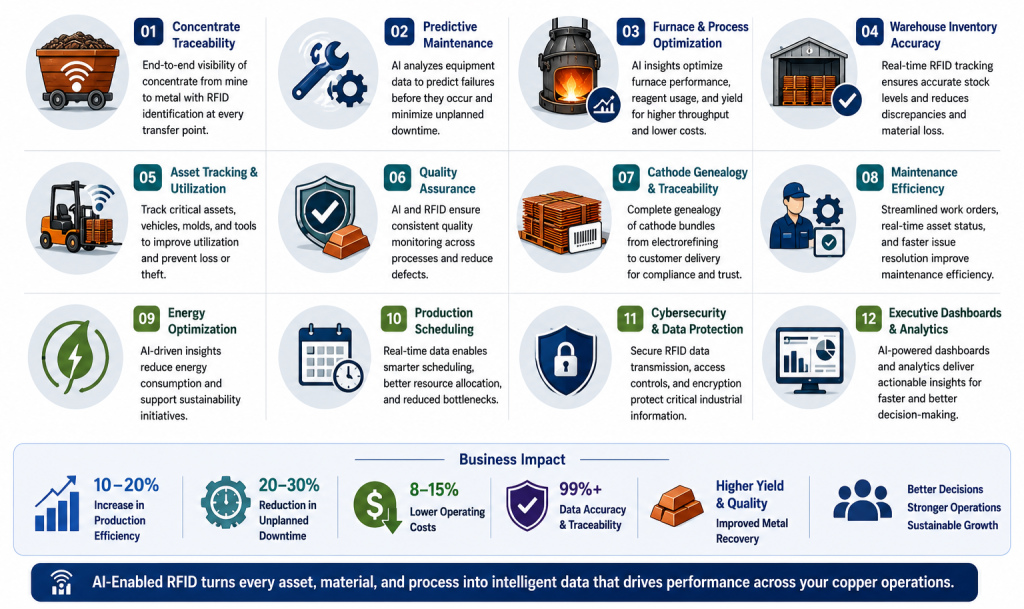
Highlights the operational and business benefits of AI-enabled RFID across copper production, including concentrate traceability, predictive maintenance, furnace optimization, warehouse inventory accuracy, asset tracking, quality assurance, cathode genealogy, energy optimization, production scheduling, cybersecurity, and executive analytics. The infographic demonstrates how AI-driven insights improve operational efficiency, reliability, product quality, and decision-making throughout the copper production lifecycle.
Implementation Recommendations for Copper Production
Successful implementation requires coordinated planning among metallurgical engineers, operations personnel, maintenance teams, automation engineers, information technology specialists, and production management.
Recommended implementation practices include:
- Assess production workflows to identify high-value RFID and AI opportunities.
- Prioritize critical assets, concentrate handling, and finished product traceability.
- Perform comprehensive RF site surveys throughout production facilities.
- Select industrial RFID hardware certified for high-temperature and metal-rich environments.
- Establish standardized asset identification and data governance policies.
- Integrate RFID events with MES, ERP, WMS, CMMS, LIMS, and SCADA software.
- Validate communication reliability across all operational areas.
- Train AI models using representative production and maintenance data.
- Conduct phased commissioning beginning with pilot production lines.
- Measure operational improvements using defined KPIs such as inventory accuracy, equipment availability, production throughput, maintenance response time, energy consumption, and quality performance.
- Continuously refine AI models as operating conditions, ore characteristics, and production schedules change.
Copper production facilities adopting this structured approach are better positioned to achieve sustainable operational improvements while minimizing implementation risk.
AI-Enabled RFID Implementation Roadmap for Copper Production
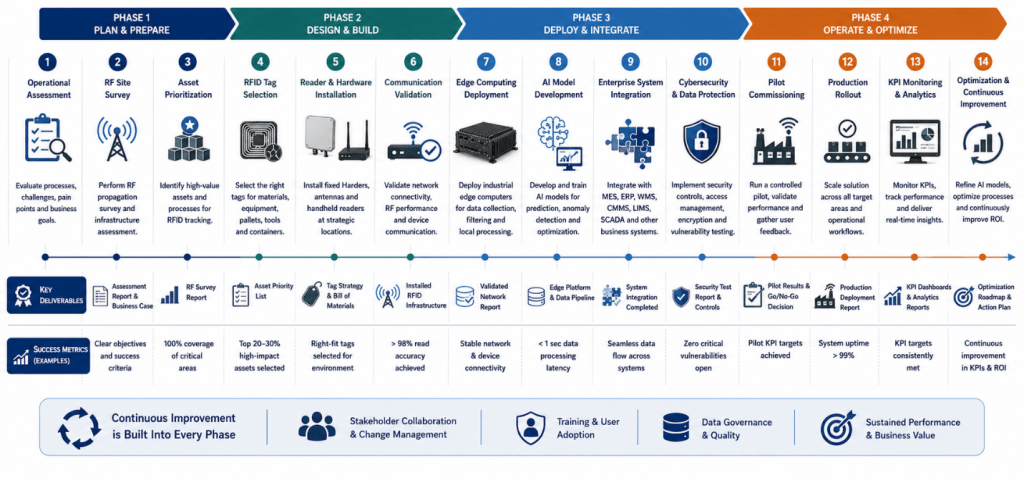
A phased implementation roadmap illustrating the deployment of AI-enabled RFID across copper production, from operational assessment and RFID infrastructure planning to AI model development, enterprise software integration, pilot commissioning, production rollout, KPI monitoring, and continuous improvement. The roadmap highlights key milestones, deliverables, and performance metrics that guide a structured, secure, and scalable implementation.
Advancing Intelligent Copper Production with AI and RFID
Artificial Intelligence supported by RFID enables copper producers to transform operational identification data into measurable production intelligence across ore handling, smelting, electrorefining, maintenance, warehousing, and logistics. Reliable material traceability, predictive maintenance, production optimization, and automated inventory visibility improve operational efficiency while supporting higher product quality and more informed decision-making.
Organizations planning AI-enabled RFID initiatives should emphasize phased implementation, robust systems integration, standardized data management, and continuous performance evaluation to maximize long-term value.
Headquartered in New York City and Toronto, GAO is recognized among the world’s leading B2B suppliers of RFID and BLE technologies. Together with its sister companies, GAO Research and GAO Tek, GAO has served customers across the United States and Canada for more than three decades, including Fortune 500 companies, leading research organizations, universities, and government agencies. Through ongoing investment in research, rigorous quality assurance, and expert remote and onsite technical support, we continue helping manufacturers deploy dependable RFID and AIoT solutions tailored to demanding industrial environments. To learn more about our RFID hardware, engineering expertise, and technical solutions for copper production, contact GAO for technical guidance and product recommendations.
Building the Future of Industrial AI and IoT with Aperture Venture Studio and GAO RFID Inc.
For more than three decades, GAO Group of Companies has invested extensively in research and development of industrial RFID, BLE, and IoT technologies. As Artificial Intelligence has become an increasingly valuable tool for copper production and other industrial manufacturing applications, we have expanded our AI and IoT capabilities while establishing Aperture Venture Studio to accelerate the development and commercialization of advanced AI and IoT solutions serving manufacturing, critical infrastructure, logistics, and other industrial sectors.
Aperture has attracted highly experienced AI researchers, IoT specialists, operational executives, strategic investors, and leading technology organizations. Through initiatives such as the Aperture Ventures Summit and TekSummit, we continue fostering technical collaboration and knowledge sharing across the industrial AI and IoT community. We welcome opportunities to engage with advisors, technical professionals, investors, customers, and industry partners who are interested in advancing intelligent industrial operations through practical AI and IoT innovation.