
AI-Powered Beverage Production Using BLE for Intelligent Food Processing Operations
Server Version for AI-Powered Beverage Production
Organizations that require strict control over operational data, ultra-low latency decision-making, regulatory compliance, or integration with existing production infrastructure often deploy the AI software on privately managed servers instead of relying solely on cloud-hosted services. A Server Version supports deployment on factory edge servers, private data centers, regional enterprise servers, or customer-managed virtual infrastructure while maintaining full ownership of production data.
Server deployments are particularly valuable for beverage manufacturers operating high-speed bottling plants, breweries, dairy beverage facilities, juice processing plants, wineries, distilleries, and contract beverage manufacturing facilities where production cannot depend on continuous Internet connectivity.
Typical Server Version capabilities include:
- Local AI inference for real-time production decisions
- Integration with existing PLCs, SCADA, MES, ERP, CMMS, QMS, LIMS, and WMS software
- High-speed processing of sensor streams from BLE gateways
- Batch genealogy and production history retention
- Local dashboard visualization
- Private data storage
- Automated report generation
- Software redundancy for high availability
- Backup and disaster recovery support
- Controlled software update management
Because AI processing occurs close to production equipment, response times remain predictable during production peaks. Local processing also minimizes network bandwidth requirements by transmitting only summarized production metrics or selected historical datasets to centralized business systems when appropriate.
Many beverage manufacturers adopt a hybrid deployment model where operational AI runs on private servers while historical production analytics, long-term trend analysis, and corporate reporting are synchronized with cloud-hosted software. This approach balances operational resilience with centralized visibility across multiple production facilities.
GAO has supported organizations by supplying industrial BLE hardware that integrates with both cloud-hosted and privately managed software deployments, allowing customers to select the deployment model that best matches their operational, regulatory, and cybersecurity requirements.
Deployment Considerations for AI-Driven Beverage Production
Successful implementation requires careful planning across production, quality, maintenance, information technology, and operations teams. Rather than focusing only on sensor installation, beverage manufacturers should design a complete data acquisition and analytics strategy aligned with production objectives.
Important engineering considerations include:
Sensor Placement
BLE sensors should be installed where operational conditions most influence production quality and equipment reliability.
Typical monitoring locations include:
- Fermentation vessels
- Brewing kettles
- Pasteurizers
- Heat exchangers
- Filling machines
- Bottle conveyors
- Packaging equipment
- Refrigeration systems
- Cold storage rooms
- Ingredient silos
- Water treatment systems
- Air compressors
- Utility rooms
Proper sensor calibration and placement improve data quality and AI prediction accuracy.
Communication Reliability
Reliable BLE communication depends on:
- Gateway positioning
- Radio frequency planning
- Signal strength analysis
- Antenna placement
- Interference assessment
- Network redundancy
- Environmental testing
Production facilities containing stainless steel tanks, refrigeration equipment, and dense machinery require careful wireless planning to minimize signal attenuation.
AI Model Development
AI models should be trained using representative production datasets that include:
- Seasonal production changes
- Equipment maintenance history
- Utility consumption
- Production recipes
- Ingredient variability
- Historical quality measurements
- Production downtime records
- Environmental conditions
Periodic model retraining ensures prediction accuracy as production processes evolve.
Enterprise Integration
Successful deployments connect AI insights with existing operational software rather than creating isolated dashboards.
Common integration objectives include:
- Automatic maintenance work order generation
- Quality investigation workflows
- Inventory updates
- Production scheduling adjustments
- Batch release documentation
- Regulatory reporting
- Utility optimization
- Executive performance reporting
Cybersecurity and Data Protection
Beverage production facilities increasingly operate connected production equipment, making cybersecurity a fundamental engineering requirement.
Recommended security measures include:
- Device authentication
- Role-based access control
- Multi-factor authentication
- TLS encryption
- Secure firmware updates
- Certificate management
- Network segmentation
- Continuous vulnerability assessment
- Security event logging
- Backup validation
- Intrusion monitoring
Industrial cybersecurity should protect both operational technology (OT) and information technology (IT) environments while maintaining production availability.
When AI models influence production decisions, audit trails should record prediction history, operator actions, and system responses to support regulatory investigations and continuous improvement.
Scalability and Interoperability
Modern beverage manufacturers frequently expand production capacity, introduce new product lines, or acquire additional facilities. AI-enabled monitoring solutions should therefore scale without requiring complete redesign.
Scalable deployments support:
- Additional BLE sensors
- New production lines
- Multiple manufacturing plants
- Mobile equipment monitoring
- Warehouse expansion
- Distribution center integration
- New packaging equipment
- Additional AI models
- Expanded reporting capabilities
Interoperability remains equally important.
The solution should exchange information with:
- PLC controllers
- SCADA software
- MES
- ERP
- QMS
- CMMS
- LIMS
- WMS
- Industrial historians
- Business intelligence software
Standards-based communication simplifies future upgrades while reducing vendor lock-in.
Technical Capabilities of AI-Powered Beverage Production
Combining AI with BLE-enabled sensing provides capabilities that extend beyond traditional condition monitoring.
Predictive Maintenance
AI identifies gradual equipment degradation by analyzing vibration, motor temperature, pressure variation, compressor behavior, and production trends.
Benefits include:
- Reduced unplanned downtime
- Longer equipment life
- Better spare parts planning
- Lower emergency maintenance costs
Intelligent Quality Control
Machine learning correlates production variables with laboratory quality measurements to predict quality deviations before defective batches are produced.
Quality improvements include:
- Better flavor consistency
- Improved carbonation control
- Reduced filling variability
- Lower product rejection rates
- Enhanced batch uniformity
Production Optimization
AI evaluates production constraints continuously to improve:
- Line balancing
- Filling efficiency
- Equipment utilization
- Batch scheduling
- Ingredient consumption
- Water utilization
- Energy efficiency
Utility Optimization
Utility systems represent significant operational costs.
AI helps optimize:
- Steam generation
- Refrigeration
- Compressed air
- Water treatment
- Electricity consumption
- Boiler performance
Intelligent Traceability
BLE-enabled asset identification combined with AI supports complete production genealogy from ingredient receiving through finished goods distribution.
Traceability improvements strengthen:
- Recall management
- Regulatory compliance
- Supplier performance evaluation
- Root cause investigations
- Product lifecycle analysis
Operational Improvements and Business Benefits
AI-powered beverage production delivers measurable improvements throughout manufacturing operations by transforming operational data into actionable recommendations.
Operational improvements include:
- Higher Overall Equipment Effectiveness (OEE)
- Lower unplanned downtime
- Faster root cause identification
- Improved batch consistency
- Reduced product giveaway
- Better line utilization
- Shorter maintenance response times
- Improved sanitation scheduling
- Greater inventory visibility
- Better production forecasting
Business benefits include:
- Lower operating costs
- Improved product quality
- Higher customer satisfaction
- Reduced energy consumption
- Lower water usage
- Better regulatory compliance
- Increased production throughput
- Improved asset utilization
- Faster return on technology investments
- Stronger decision support for plant managers
For organizations operating multiple beverage production facilities, AI also enables standardized performance measurement and benchmarking across production sites, helping management identify best practices and replicate operational improvements.
Cloud vs. Server Deployment Comparison for AI-Enabled Beverage Production Using BLE
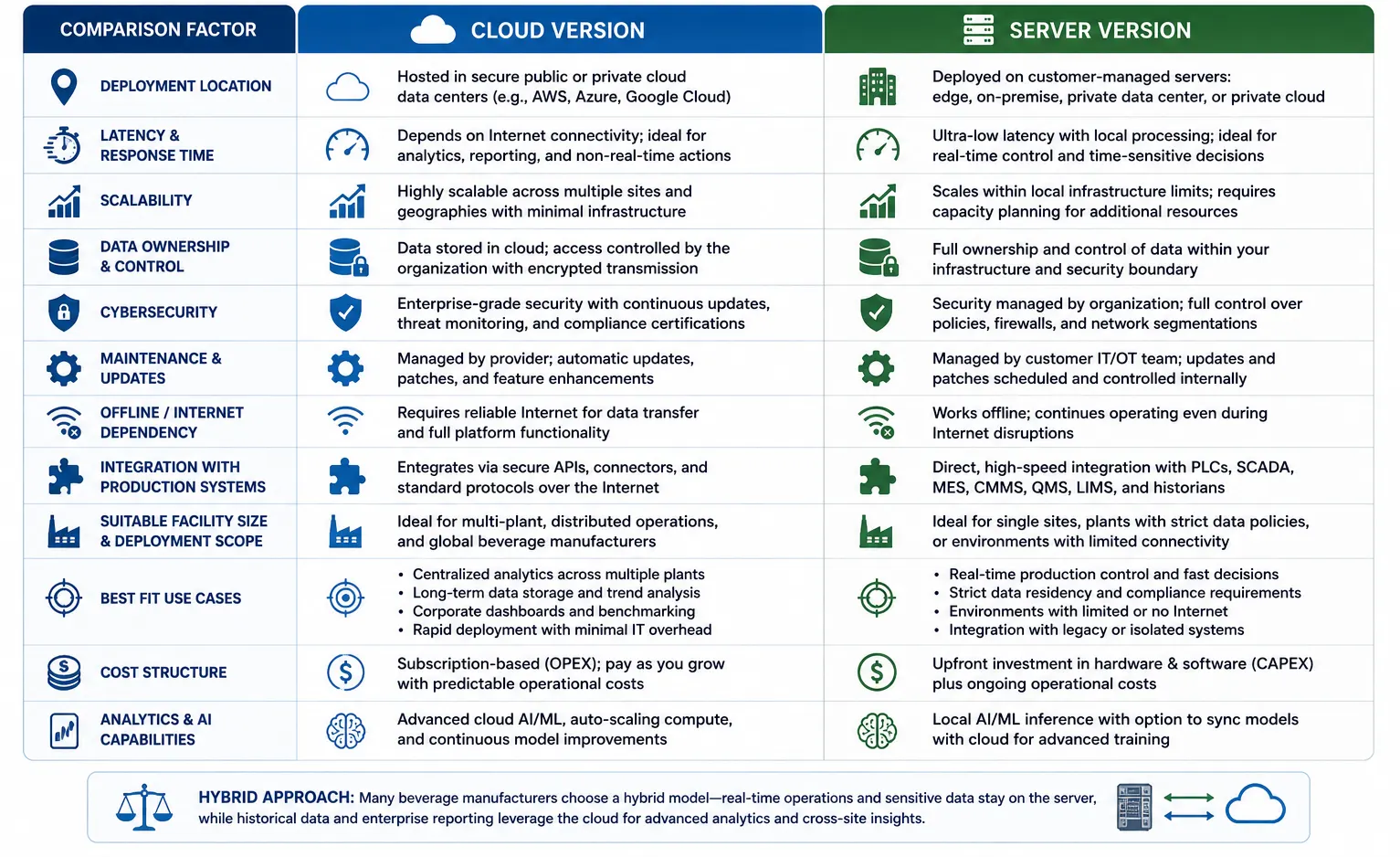
This comparison table illustrates the key differences between Cloud Version and Server Version deployments for AI-enabled beverage production. It compares deployment location, latency, scalability, data ownership, cybersecurity, maintenance responsibility, offline capability, production system integration, facility suitability, cost considerations, AI capabilities, and highlights a hybrid deployment model that combines local real-time processing with cloud-based analytics and enterprise reporting.
How AI Transforms BLE Sensor Data into Operational Intelligence for Beverage Production
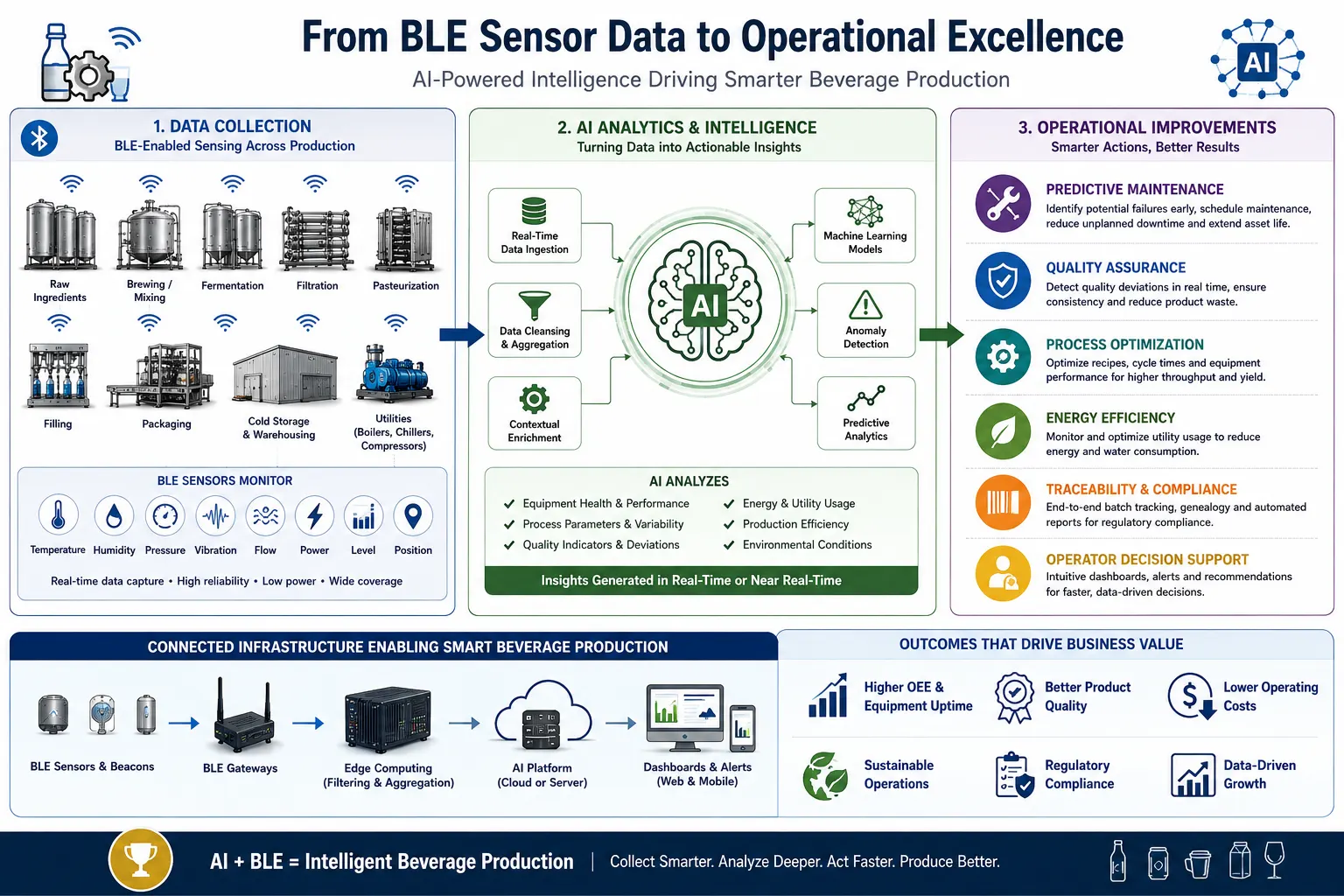
This infographic illustrates how BLE sensors collect real-time production data across beverage manufacturing operations and how AI analyzes equipment health, process parameters, product quality, energy usage, and environmental conditions to generate actionable insights. It also highlights the connected infrastructure supporting the solution and the resulting operational improvements, including predictive maintenance, quality assurance, process optimization, energy efficiency, traceability, operator decision support, higher equipment effectiveness, regulatory compliance, and reduced operating costs.
AI Deployment Decision Tree for BLE-Enabled Beverage Production
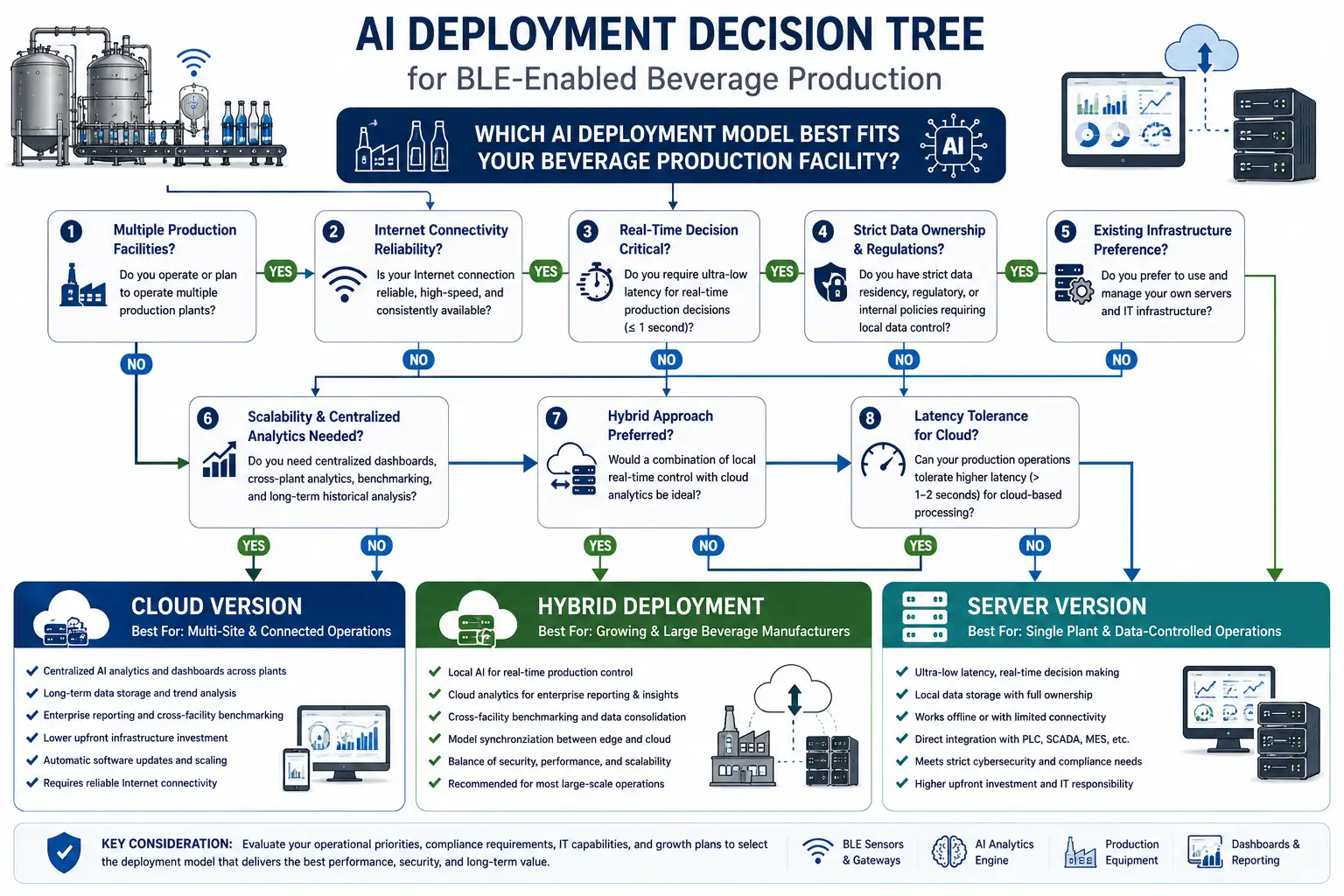
This decision tree helps beverage manufacturers determine whether a Cloud Version, Server Version, or Hybrid deployment is the most appropriate choice for AI-enabled beverage production. It evaluates operational factors such as facility size, latency requirements, data ownership, cybersecurity, connectivity, and scalability to guide technology selection for reliable, efficient, and future-ready manufacturing operations.