
AI-Driven Frozen Food Manufacturing with BLE Systems
AI-Driven Frozen Food Manufacturing and Cold-Chain Optimization
AI-driven frozen food manufacturing uses sensor data, equipment signals, and production records to identify cold-chain risks, protect product quality, and improve line performance before losses occur. BLE gateways, beacons, and sensors provide location, temperature, door-state, motion, and asset-utilization data across receiving docks, blast freezers, packaging rooms, frozen warehouses, and outbound staging areas. AI converts these data streams into actionable decisions, such as escalating a freezer-zone temperature excursion, predicting an evaporator fan failure, prioritizing at-risk pallets for inspection, or rerouting forklift work to prevent dock exposure. For frozen food manufacturers, the value is not merely knowing where an asset is. It is preserving product integrity through every handoff while meeting food safety, traceability, energy, and customer-service requirements. GAO supplies industrial BLE and IoT hardware systems that help production and cold-storage teams build reliable data capture at the point where quality risk begins.
AI-Enabled BLE System for Frozen Food Manufacturing
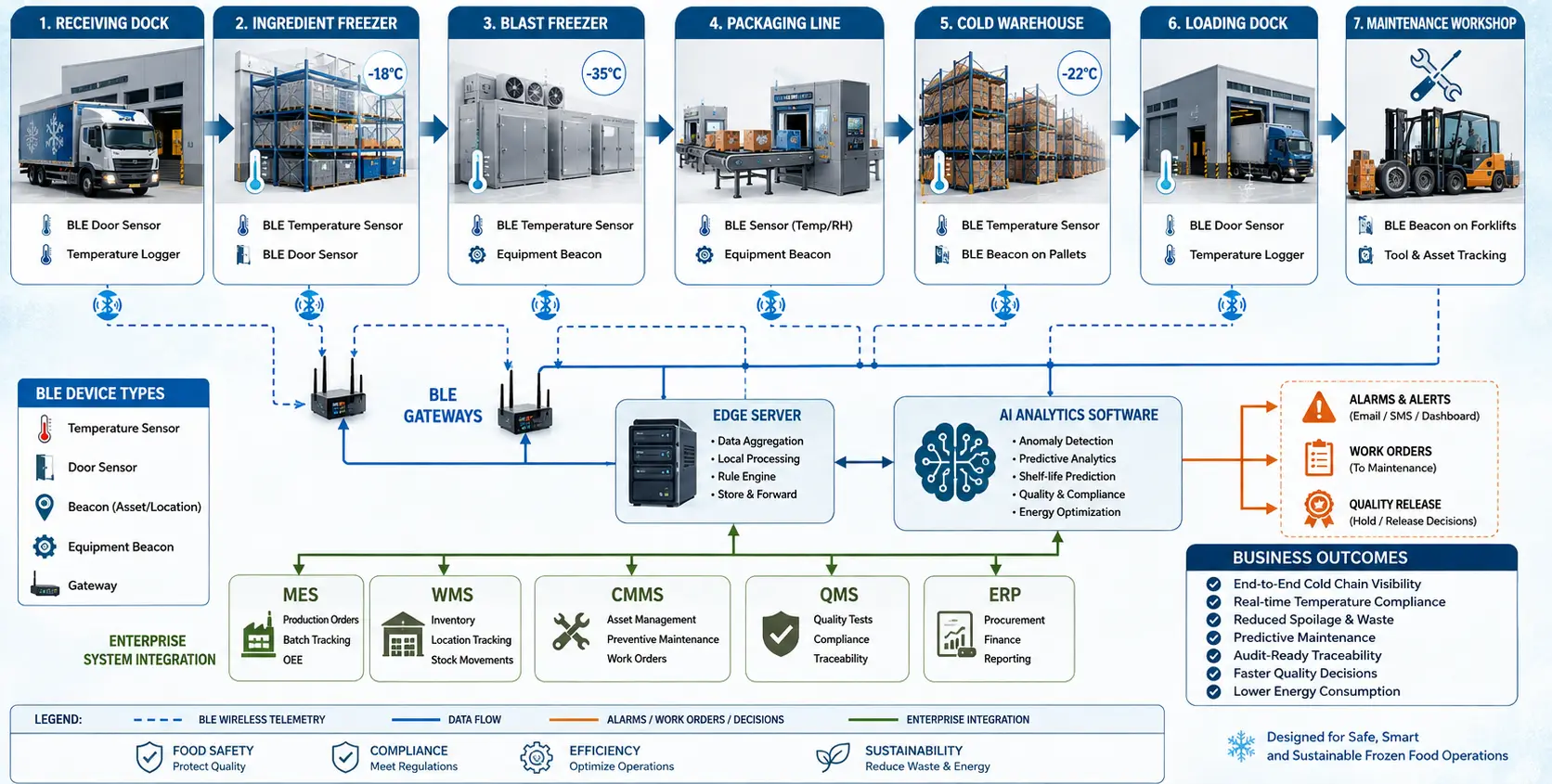
This diagram shows BLE sensors, beacons, gateways, and edge processing across a frozen food facility. AI analytics connects telemetry to MES, WMS, CMMS, ERP, and quality software to support product holds, maintenance work orders, FEFO decisions, and shipment release.
What AI-Enabled BLE Means for Frozen Food Production
Frozen food manufacturing depends on tightly controlled time-temperature conditions, repeatable processing, and documented product genealogy. AIoT combines artificial intelligence with connected sensors, equipment, and factory systems so that raw telemetry becomes a production, maintenance, quality, or logistics decision.
BLE is an enabling data-capture layer rather than the business objective. A frozen food facility may attach BLE sensors to pallet shrouds, freezer doors, refrigerated trailers, mobile carts, and critical cold-storage zones. BLE beacons can identify forklifts, pallet jacks, reusable totes, maintenance tools, and high-value ingredients. Gateways receive these signals and pass normalized events to edge or server software for analysis.
AI methods then correlate those BLE events with process data such as:
- Blast-freezer dwell time, product core-temperature checks, and freezer conveyor speed
- Compressor load, suction pressure, defrost cycles, fan runtime, and refrigeration alarms
- Warehouse location, pallet age, lot number, first-expired-first-out rules, and shipment schedules
- Metal detector, checkweigher, vision inspection, packaging-seal, and label-verification events
- Sanitation schedules, allergen-changeover records, quality holds, and corrective actions
This relationship matters because a 10-minute dock-door exposure does not carry the same risk for every product. AI can evaluate the affected pallet’s product type, package format, target temperature, lot age, destination, remaining freezer dwell time, and historical excursion pattern. The result is a risk-ranked decision rather than a generic temperature alert.
Why Frozen Food Manufacturers Need Contextual AI Decisions
A cold room can remain within its average daily temperature target while still creating localized or short-duration conditions that threaten product quality. Frequent traffic at a loading dock, a blocked evaporator discharge, degraded door gaskets, incorrect freezer staging, or a forklift parked near an open door can produce conditions that aggregate reports overlook.
AI models help food production teams recognize these weak signals. Time-series anomaly detection can flag unusual temperature recovery after a defrost event. Predictive maintenance models can detect a developing refrigeration issue from the relationship among sensor temperature, fan current, compressor cycling, and door-open duration. Computer vision may confirm whether pallets are left outside a designated freezer zone, while BLE location events provide the duration and asset identity needed for traceable corrective action.
GAO has helped organizations supply the BLE hardware and system components needed for these deployments, including rugged sensors, beacons, gateways, readers, and supporting IoT equipment selected for demanding operational environments.
Priority AI Applications Across Frozen Food Manufacturing Operations
Frozen food manufacturing has distinct risk points from raw-material receiving through refrigerated shipment. The following applications focus on the operational decisions that production, quality assurance, maintenance, warehouse, and logistics teams must make daily.
Receiving, Ingredient Storage, and Lot Protection
Frozen vegetables, proteins, dough, fruit purées, and prepared ingredients arrive with supplier documentation, receiving temperatures, lot identifiers, and quality-release requirements. BLE-tagged receiving areas and pallet zones help capture arrival time, dock exposure, hold duration, and transfer completion into the ingredient freezer.
AI can identify inbound loads requiring faster inspection or segregation by combining supplier history, trailer temperature data, receiving congestion, product sensitivity, and measured dock exposure. This supports HACCP-based receiving controls and prevents questionable ingredients from entering a scheduled production run.
Blast Freezing and Product Core-Temperature Control
Blast freezers are a critical control area for frozen entrées, pizza, seafood, bakery products, ice cream novelties, and ready-to-cook foods. Product quality depends on achieving target freezing conditions within validated process limits while avoiding excessive dehydration, package damage, or throughput loss.
AI can analyze freezer-zone telemetry, conveyor speed, fan operation, product loading pattern, recipe, product thickness, and historical core-temperature verification results. The system can recommend a hold, inspection, process adjustment, or maintenance review when actual operating behavior diverges from a validated freezing profile.
Cold Warehouse Inventory and FEFO Execution
Frozen warehouses manage lot rotation, customer-specific allocation, temperature zones, replenishment tasks, and dock staging under time pressure. BLE beacons on forklifts, reusable pallets, cages, and mobile printers can supplement warehouse management system records with physical movement and dwell evidence.
AI-supported inventory management can identify pallets stranded in staging, detect FIFO or FEFO exceptions, predict replenishment congestion, and prioritize put-away or picking work according to product shelf-life risk. A precise location history also speeds root-cause investigation when a customer reports a damaged case, thawing concern, or temperature deviation.
Refrigeration Reliability and Energy Optimization
Refrigeration systems frequently represent one of the largest energy loads in a frozen food facility. Compressor racks, evaporators, condensers, defrost controls, fan motors, variable-frequency drives, insulated doors, and air curtains must work together to maintain stable conditions.
AI maintenance and energy models can distinguish normal production-driven temperature changes from a fault pattern. For example, recurring slow recovery in one freezer zone after door activity may indicate an air curtain issue, ice accumulation, a fan problem, or poor loading discipline. Maintenance teams receive a prioritized inspection task supported by sensor history instead of an unstructured alarm list.
AI-Enabled BLE Architecture for Frozen Food Manufacturing: From Factory Floor Sensing to Operational Decisions
This architecture diagram illustrates how AI-enabled Bluetooth Low Energy (BLE) sensors collect real-time temperature, door status, and asset-location data across a frozen food manufacturing facility. The data flows through BLE gateways and an edge server into AI analytics software, which integrates with MES, WMS, CMMS, ERP, and the Quality Management System (QMS) to automate monitoring, predictive maintenance, compliance, quality-release decisions, and cold-chain operations.
Frozen Food AI Data Flow: From Sensor Event to Business Action
A reliable frozen food AI solution requires more than adding sensors to cold rooms. Each step must preserve time accuracy, asset identity, traceability, and operational context.
Data Capture and Device Commissioning
Deployment begins with a freezer-zone survey, radio coverage validation, hazard analysis, and asset-identification plan. Teams map freezer rooms, dock lanes, racking aisles, blast-freezer tunnels, packaging cells, and refrigeration equipment to logical locations used by the WMS, MES, QMS, and CMMS.
Commissioned BLE devices should carry a controlled device ID, battery-status policy, calibration record where temperature measurement is used for quality evidence, and association to a physical asset or zone. Sensors placed near an evaporator outlet should not be interpreted as representative of pallet core conditions. Placement must reflect the decision being supported.
Communications and Edge Processing
BLE gateways gather advertisements from sensors and beacons, then forward data across segmented Ethernet, industrial Wi-Fi, cellular backup, or other approved factory communications. Gateways should use store-and-forward buffering so a brief network interruption does not create a false gap in excursion records.
Edge software validates timestamps, device health, signal strength, duplicate packets, and impossible movement events before forwarding usable data. Local rules can issue immediate alerts for critical temperature excursions, extended door-open conditions, or absent freezer-zone readings even if the connection to cloud software is unavailable.
Contextualization, Integration, and AI Analysis
Middleware links BLE events to business context: product lot, pallet license plate, storage location, work order, production order, recipe, freezer zone, sanitation status, and shipment load. This prevents AI from treating all temperature events as identical.
Relevant integrations commonly include:
- Manufacturing execution system data for production orders, line status, recipes, and batch records
- Warehouse management software for pallet location, FEFO rules, inventory status, and loading tasks
- Quality management software for HACCP checks, nonconformance records, holds, and corrective actions
- Computerized maintenance management software for refrigeration assets, maintenance history, spare parts, and technician work orders
- ERP software for material master data, supplier records, customer orders, cost allocation, and recall reporting
- SCADA or building management data for compressor, evaporator, defrost, alarm, and energy information
AI models can apply anomaly detection, predictive classification, forecasting, optimization, and natural-language summarization to these combined records. Human review remains essential for disposition decisions, validated process changes, food-safety release, and regulatory documentation.
Business Actions and Closed-Loop Improvement
The final output should be operationally specific. A quality technician may receive a risk-ranked list of pallets requiring inspection. A warehouse supervisor may receive a task to move a staged load back into frozen storage. A refrigeration technician may receive a CMMS work order with the affected zone, anomaly history, and likely failure contributors. Production engineering may evaluate recurring blast-freezer deviations against recipe and line-speed changes.
Every disposition, verification result, and completed work order becomes feedback for improving alert thresholds and AI performance. This feedback loop reduces alarm fatigue and helps differentiate true quality risk from normal process variation.
Cloud vs. Server Deployment Comparison for AI-Enabled BLE Systems in Frozen Food Manufacturing
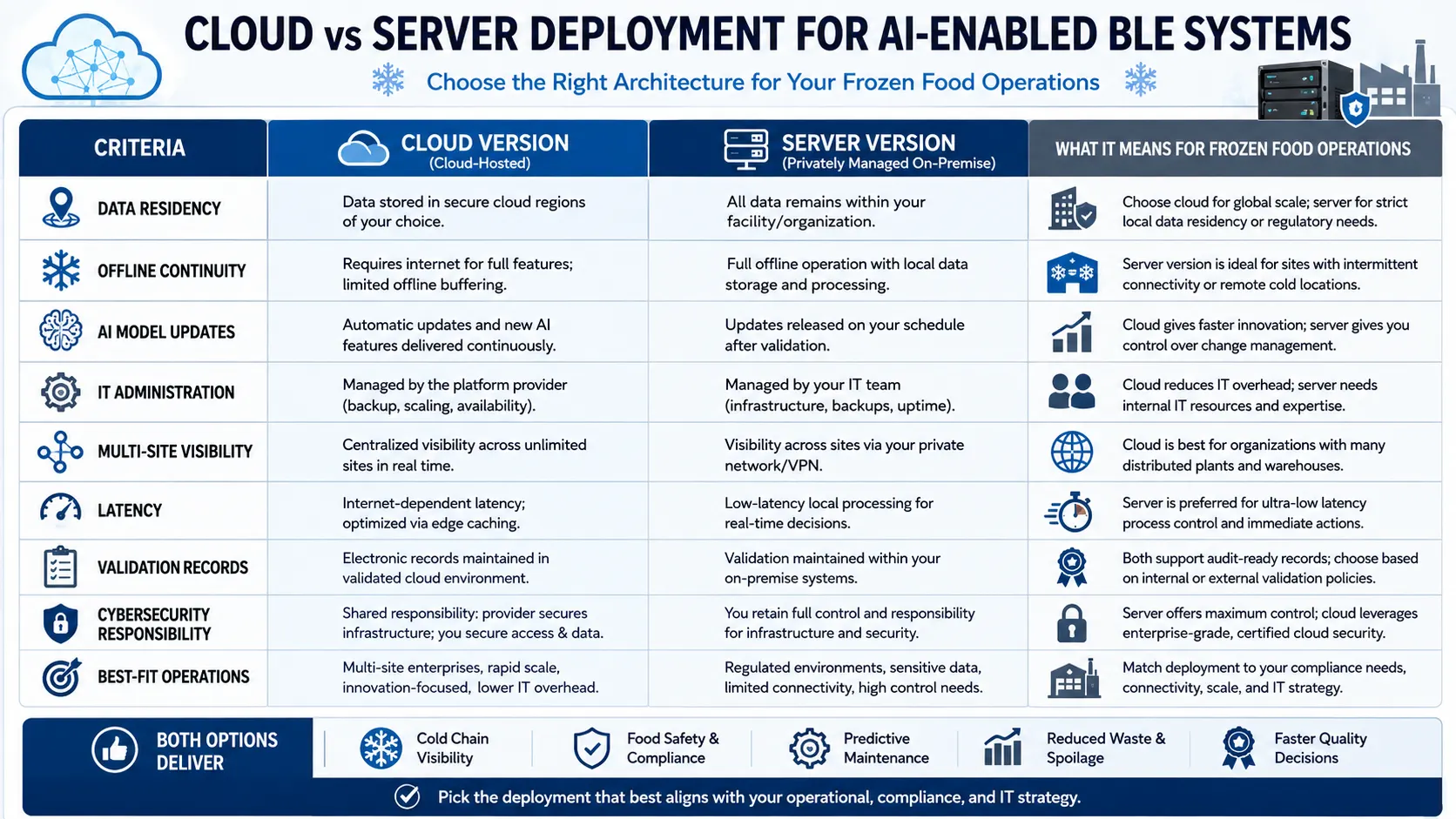
This comparison table helps enterprise decision-makers evaluate cloud-hosted and privately managed server deployments for AI-enabled BLE solutions in frozen food manufacturing. It compares data residency, offline continuity, AI model updates, IT administration, multi-site visibility, latency, validation records, cybersecurity responsibility, and best-fit operational scenarios to support informed deployment decisions.
BLE, AI Software, and Deployment Choices for Frozen Facilities
BLE systems for frozen food manufacturing must function reliably across low temperatures, condensation-prone transitions, metal racking, insulated panels, refrigeration equipment, and busy forklift routes. Hardware selection should follow the use case, required measurement quality, retention expectations, and operational criticality.
BLE temperature sensors support ambient-zone monitoring, pallet exposure analysis, refrigerated staging, and mobile asset monitoring. Door and contact sensors help correlate thermal recovery with loading activity. BLE beacons identify forklifts, pallet jacks, reusable transport items, inspection tools, and selected high-value pallet movements. Gateways provide the collection layer, and their placement should account for freezer-room attenuation, rack shadowing, antenna clearance, power availability, and maintenance access.
Software should include device management, calibration and battery monitoring, rules management, event storage, integration connectors, role-based dashboards, audit logs, and application programming interfaces. AI workloads may run at the edge, in cloud-hosted software, or in privately managed server environments.
Cloud Version for Multi-Site Frozen Food Operations
Cloud Version uses cloud-hosted software managed within cloud infrastructure. This approach suits manufacturers that need centralized visibility across several plants, distribution centers, co-packers, or refrigerated transport nodes. It simplifies cross-site benchmarking, model retraining, fleet-level device monitoring, and consolidated reporting for corporate quality and operations teams.
Cloud Version requires resilient site connectivity, clear data-residency policies, identity federation, segmented gateway communications, encrypted data in transit and at rest, and defined procedures for offline operation. Critical freezer alarms should still have local edge handling so loss of wide-area connectivity does not delay an urgent response.
Server Version for Local Control and Private Hosting
Server Version runs on customer-managed edge servers, private data centers, factory servers, or other privately hosted infrastructure. It is appropriate where a frozen food facility requires local control, low-latency response, restricted external connectivity, or alignment with existing manufacturing-network policies. A server deployment can keep operational telemetry and AI inference close to the blast freezer, warehouse, and refrigeration controls while synchronizing selected records to corporate systems.
Server Version requires internal responsibility for patching, backups, disaster recovery, capacity planning, certificate management, and monitoring. GAO can support hardware and system planning so the chosen deployment reflects freezer conditions, network constraints, quality workflows, and IT governance rather than a one-size-fits-all configuration.
Technical Capabilities, Operational Benefits, and Business Value of AI-Enabled BLE Systems
Combining artificial intelligence with BLE-enabled data collection transforms frozen food manufacturing from reactive monitoring to predictive, data-driven operations. Rather than responding only after a temperature excursion, refrigeration alarm, or quality deviation has occurred, production teams can identify emerging operational risks, prioritize corrective actions, and continuously improve process stability. AI evaluates relationships among temperature history, equipment performance, warehouse activity, production schedules, maintenance records, and quality data to deliver recommendations that are both technically meaningful and operationally relevant.
Continuous Cold-Chain Visibility
Frozen food manufacturers must maintain documented temperature control from receiving through production, storage, distribution, and shipment. BLE sensors provide continuous environmental measurements while AI evaluates temperature trends, exposure duration, product sensitivity, and operational context instead of relying solely on static alarm thresholds.
Benefits include:
- Earlier identification of freezer-zone instability before product quality is affected.
- Reduced product loss resulting from unnoticed temperature excursions.
- Improved verification of HACCP critical control points and preventive controls.
- Faster investigation of cold-chain deviations using synchronized environmental and operational records.
- Enhanced traceability during customer complaints, internal audits, and product recalls.
Predictive Refrigeration Maintenance
Refrigeration equipment represents one of the most critical production assets within frozen food manufacturing. Unexpected failures can interrupt production schedules, damage inventory, increase energy consumption, and compromise regulatory compliance.
AI models evaluate relationships among compressor loading, evaporator performance, defrost frequency, fan operation, refrigeration pressures, ambient temperature, and BLE environmental data to recognize developing equipment issues before failures occur.
Typical predictive maintenance applications include:
- Compressor efficiency degradation.
- Evaporator icing patterns.
- Refrigeration valve abnormalities.
- Condenser performance deterioration.
- Fan motor wear.
- Air curtain effectiveness.
- Freezer door seal degradation.
- Refrigerant system performance anomalies.
Rather than generating large numbers of isolated equipment alarms, AI prioritizes maintenance activities according to operational impact, production schedule, and product risk. Maintenance planners can schedule repairs during planned production downtime while reducing emergency service events.
Smarter Warehouse Operations
Warehouse efficiency directly influences product quality, shipping accuracy, and inventory utilization. BLE beacons attached to forklifts, pallet jacks, reusable containers, and high-value inventory provide continuous movement history throughout frozen storage operations.
AI-assisted warehouse management can:
- Detect excessive pallet dwell time in staging areas.
- Recommend optimal storage locations based on freezer utilization.
- Identify inefficient forklift travel paths.
- Prioritize FEFO inventory movement.
- Predict warehouse congestion during shipping peaks.
- Improve dock scheduling.
- Reduce unnecessary product handling.
These improvements shorten loading cycles while helping preserve frozen product integrity during warehouse movement.
Quality Assurance and Regulatory Compliance
Quality assurance departments require objective evidence supporting every production lot released for shipment. AI-supported BLE monitoring creates a continuous record linking environmental conditions with production events, sanitation activities, inspection results, and product genealogy.
The resulting documentation assists organizations with:
- HACCP verification.
- FDA Food Safety Modernization Act (FSMA) compliance.
- Internal quality audits.
- Customer quality documentation.
- Export certification requirements.
- Root-cause investigations.
- Corrective and preventive action programs.
Instead of manually reviewing thousands of environmental records, quality personnel receive prioritized exceptions supported by complete operational context.
Energy Optimization and Sustainability
Cold storage facilities consume substantial electrical energy for refrigeration, air circulation, and environmental control. AI continuously analyzes equipment utilization together with occupancy patterns, freezer traffic, production scheduling, and environmental conditions to identify opportunities for improving energy efficiency without compromising food safety.
Potential optimization opportunities include:
- Reduced unnecessary compressor cycling.
- Improved defrost scheduling.
- Better freezer loading practices.
- Lower refrigeration energy consumption.
- Improved warehouse traffic coordination.
- Reduced door-open duration.
- Lower product waste resulting from temperature deviations.
These operational improvements contribute to lower operating costs while supporting organizational sustainability objectives.
Engineering Considerations for Successful Deployment
Successful AI-enabled BLE implementation depends on careful engineering rather than sensor quantity alone. Frozen food facilities present unique operational challenges including metal infrastructure, insulated walls, moisture, condensation, freezer temperatures, heavy forklift traffic, and continuously changing inventory locations.
Successful deployments typically include:
- Comprehensive wireless site surveys before installation.
- Environmental validation for freezer operating conditions.
- Battery-life planning based on reporting intervals and operating temperatures.
- Gateway placement that minimizes radio shadowing from storage racks and insulated walls.
- Redundant communications for critical freezer monitoring.
- Time synchronization across sensors, gateways, servers, and business software.
- Secure device authentication and encrypted communications.
- Integration testing with MES, WMS, CMMS, ERP, SCADA, and Quality Management Software.
- Operational acceptance testing before production release.
- Periodic calibration verification for quality-related temperature measurements.
- Ongoing performance monitoring and AI model validation.
Facilities should establish governance procedures defining ownership of sensor maintenance, calibration schedules, cybersecurity updates, AI model review, alarm management, and operational response procedures to ensure long-term system reliability.
AI-Enabled BLE Implementation Roadmap for Frozen Food Manufacturing
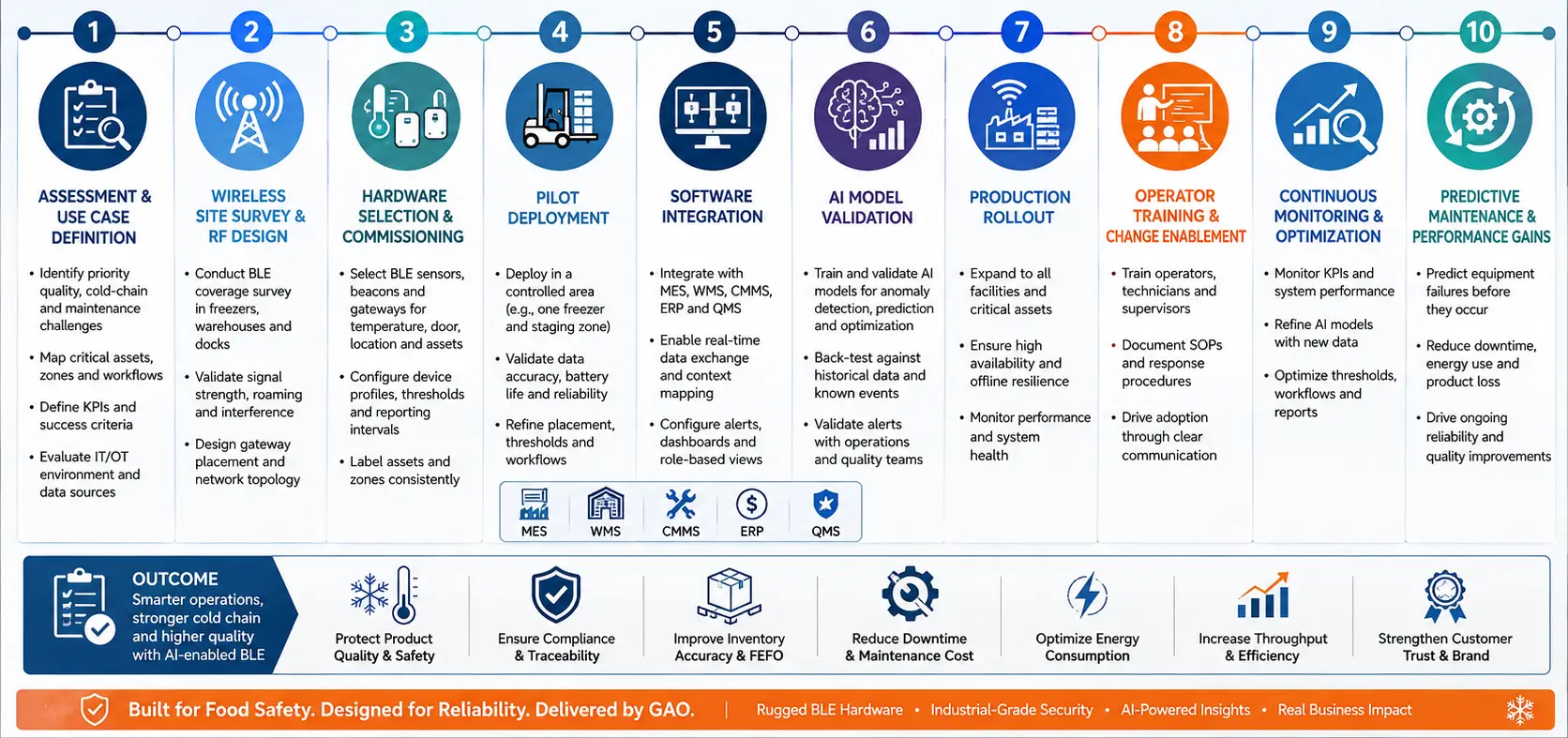
This implementation timeline illustrates a phased approach for deploying AI-enabled BLE solutions in frozen food manufacturing, beginning with assessment and wireless site surveys through hardware commissioning, software integration, AI model validation, production rollout, operator training, continuous optimization, and predictive maintenance. It highlights how structured implementation improves cold-chain visibility, food safety, equipment reliability, inventory accuracy, regulatory compliance, and operational efficiency.
Implementation Recommendations for AI-Enabled BLE in Frozen Food Manufacturing
Successful deployment requires balancing food safety objectives, operational continuity, cybersecurity, and long-term maintainability. Organizations should begin with clearly defined business goals before selecting hardware, AI models, or deployment methods. Pilot implementations within a representative production area provide valuable operational data while minimizing deployment risk.
Recommended implementation practices include:
- Define measurable business objectives such as reducing temperature excursions, improving FEFO compliance, decreasing refrigeration downtime, or lowering product waste.
- Perform comprehensive wireless coverage validation throughout blast freezers, cold warehouses, loading docks, and refrigerated staging areas.
- Select BLE sensors, beacons, and gateways designed for low-temperature, high-humidity, and condensation-prone environments.
- Establish standardized device commissioning, naming conventions, calibration records, and battery replacement procedures.
- Integrate operational data with MES, WMS, ERP, CMMS, QMS, and SCADA software to provide complete business context.
- Validate AI models using historical production data before enabling automated recommendations.
- Define response procedures for temperature excursions, equipment anomalies, inventory exceptions, and quality alerts.
- Conduct periodic cybersecurity reviews, software updates, backup verification, and disaster recovery testing.
- Continuously monitor AI model performance and retrain models as production conditions, recipes, or equipment change.
- Train production, warehouse, maintenance, and quality personnel to interpret AI recommendations consistently and document corrective actions.
Organizations adopting a phased implementation strategy generally achieve faster user acceptance, improved data quality, and more sustainable long-term operational improvements.
AI-Driven Decision Flow for BLE-Enabled Frozen Food Manufacturing
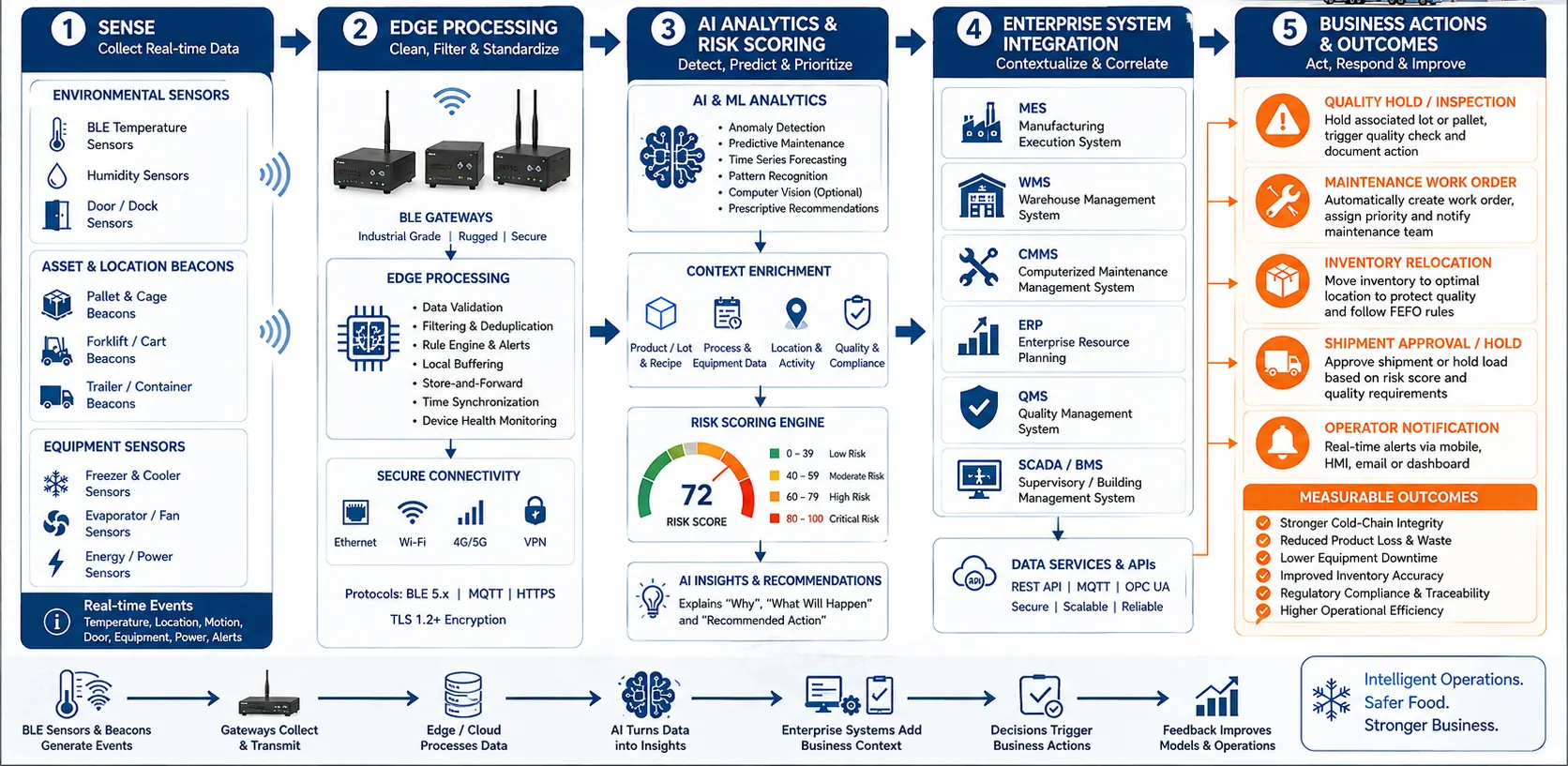
This decision flow diagram illustrates how BLE temperature sensors, door sensors, and asset beacons generate real-time operational data that is processed through edge computing, AI analytics, and enterprise software integration. AI risk scoring transforms sensor events into actionable decisions such as quality holds, maintenance work orders, inventory relocation, shipment approval, and operator notifications, improving cold-chain integrity, traceability, and operational efficiency.
Conclusion
Artificial intelligence supported by BLE sensing technologies enables frozen food manufacturers to move beyond simple environmental monitoring toward predictive operational intelligence. Continuous visibility into product movement, environmental conditions, refrigeration performance, warehouse operations, and production activities allows organizations to identify quality risks before product integrity is compromised.
When integrated with manufacturing execution, warehouse management, maintenance management, quality management, and business planning software, AI provides actionable recommendations that improve operational efficiency while strengthening food safety, traceability, regulatory compliance, and customer confidence. Organizations adopting properly engineered AI-enabled BLE solutions can reduce product loss, improve refrigeration reliability, optimize inventory movement, and make faster, evidence-based operational decisions.
Drawing upon more than three decades of industrial BLE, RFID, and IoT expertise, GAO continues to help manufacturers deploy reliable hardware products and integrated solutions that support demanding frozen food manufacturing environments. Our engineering teams assist organizations with hardware selection, deployment planning, system integration, and technical support to help maximize long-term operational value.
Building the Future of Industrial AI and IoT with Aperture Venture Studio and GAO RFID Inc.
For more than three decades, GAO Group of Companies has invested extensively in research and development of industrial BLE, RFID, and IoT technologies. As artificial intelligence has become increasingly valuable for industrial automation, we have expanded our work in AIoT solutions and established Aperture Venture Studio to accelerate the development and commercialization of advanced AI and IoT innovations for industries such as frozen food manufacturing.
Aperture brings together leading AI researchers, IoT specialists, experienced operational executives, strategic investors, and industry partners to advance practical industrial solutions. Through initiatives such as the Aperture Ventures Summit and TekSummit, we foster technical collaboration and knowledge sharing around emerging AI and IoT technologies.
We invite you to connect with us as:
- Advisors
- Employees
- Investors
- Customers
Together, we can advance intelligent, connected manufacturing systems that improve food safety, operational resilience, and sustainable production across the frozen food industry.
Business Benefits of AI-Enabled BLE Systems in Frozen Food Manufacturing
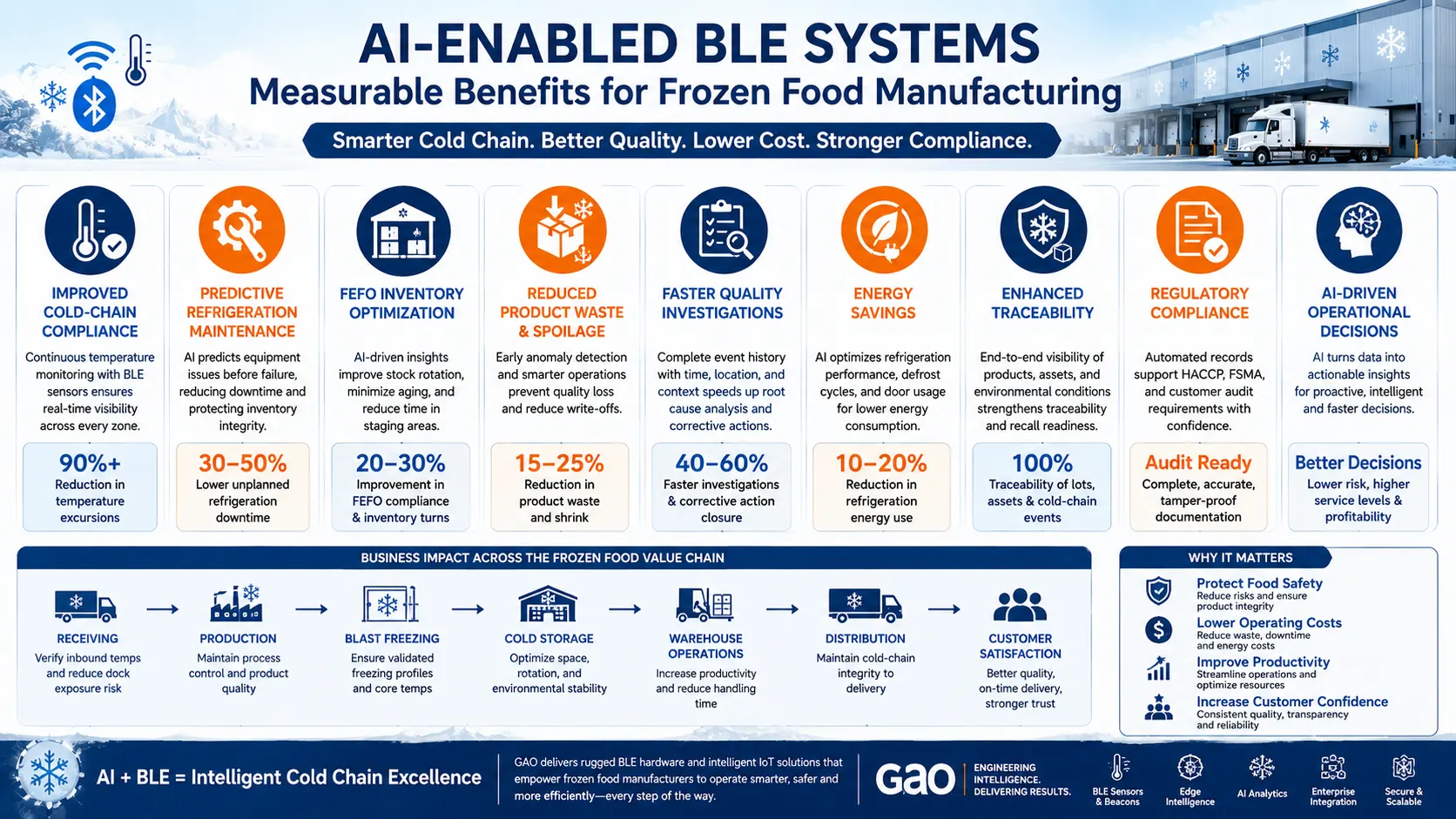
This infographic summarizes the measurable operational benefits of deploying AI-enabled BLE solutions across frozen food manufacturing. It highlights improvements in cold-chain compliance, predictive refrigeration maintenance, FEFO inventory optimization, reduced product waste, faster quality investigations, energy efficiency, enhanced traceability, regulatory compliance, and AI-driven operational decision-making.