
AI and BLE Solutions for Fertilizer Production
AI-Driven Fertilizer Production Using BLE Technology
Modern fertilizer production depends on precise control of raw materials, chemical reactions, environmental conditions, equipment reliability, and strict regulatory compliance. Artificial Intelligence combined with Bluetooth Low Energy (BLE) devices enables fertilizer manufacturers to transform production facilities into intelligent, data-driven operations capable of continuously monitoring assets, predicting failures, optimizing production parameters, and improving product quality.
BLE sensors, BLE gateways, and BLE beacons serve as distributed data acquisition devices throughout fertilizer plants while Artificial Intelligence analyzes operational data to optimize ammonia synthesis, granulation, drying, coating, storage, packaging, and logistics. The result is improved production consistency, reduced energy consumption, enhanced worker safety, minimized downtime, and better utilization of production assets.
GAO has supplied industrial BLE and IoT hardware solutions for organizations requiring reliable monitoring, asset visibility, and industrial automation. Headquartered in New York City and Toronto, Canada, GAO has supported numerous industrial organizations with high-quality BLE technologies backed by extensive engineering expertise developed over more than three decades.
AI-Enabled Fertilizer Production Facility Using BLE Sensors, Gateways, and Predictive Analytics
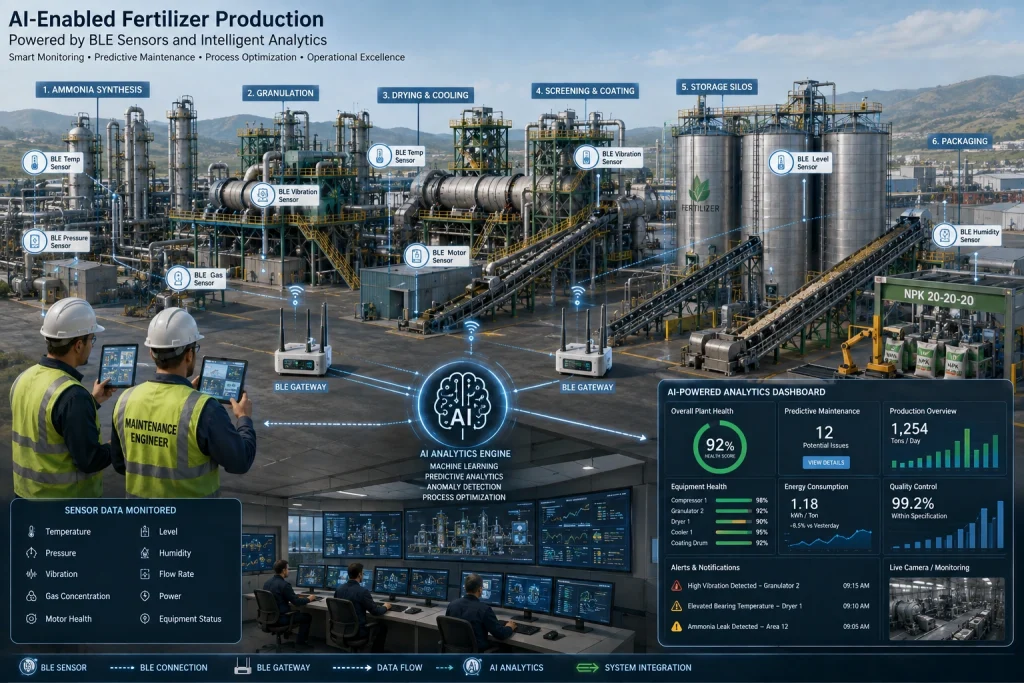
This illustration depicts an AI-enabled fertilizer manufacturing facility where BLE sensors continuously monitor temperature, pressure, vibration, gas concentration, and equipment health across ammonia synthesis, granulation, drying, storage, and packaging operations. BLE gateways securely transmit operational data to AI analytics, enabling predictive maintenance, process optimization, real-time monitoring, and data-driven decision-making throughout the production process.
Understanding AI-Based Fertilizer Production with BLE Technology
Artificial Intelligence for fertilizer production refers to the application of machine learning, predictive analytics, industrial AI, edge intelligence, and process optimization algorithms throughout fertilizer manufacturing operations. BLE technology functions as the distributed sensing and communication layer that continuously collects operational information from production equipment, utilities, warehouses, laboratories, and logistics operations.
Unlike conventional automation systems that primarily execute predefined control logic, AI continuously learns from historical and real-time operational data to recommend or automatically implement process improvements.
Examples include:
- Predicting compressor failures before production interruptions occur.
- Optimizing reactor temperature profiles.
- Improving granule size consistency.
- Detecting abnormal vibration in rotary drums.
- Forecasting catalyst degradation.
- Reducing ammonia leakage risks.
- Optimizing energy consumption.
- Improving preventive maintenance scheduling.
- Predicting product quality deviations.
- Monitoring fertilizer storage conditions.
BLE technology is particularly suitable because many fertilizer production facilities require thousands of distributed monitoring points where installing wired instrumentation may be expensive or operationally disruptive.
Artificial Intelligence of Things (AIoT) combines Artificial Intelligence with IoT devices including BLE sensors, gateways, and connected industrial equipment. AIoT enables fertilizer production systems to continuously monitor operations while generating intelligent recommendations that improve manufacturing efficiency and operational reliability.
GAO has helped industrial organizations deploy BLE-enabled monitoring systems supporting predictive maintenance, industrial sensing, equipment monitoring, and operational visibility across complex manufacturing environments.
Why AI Is Transforming Fertilizer Production
Global fertilizer manufacturers operate under increasing pressure to improve production efficiency while reducing emissions, energy consumption, equipment failures, and operating costs.
Major production facilities process enormous quantities of:
- Ammonia
- Nitrogen
- Phosphate
- Potash
- Urea
- Ammonium nitrate
- NPK blends
- Sulfur
- Process steam
- Cooling water
- Industrial gases
These processes involve high-pressure reactors, rotating machinery, granulation systems, dryers, conveyors, storage silos, and packaging equipment operating continuously.
Traditional process monitoring often depends upon scheduled inspections and isolated automation systems. Artificial Intelligence enables continuous operational optimization by discovering complex relationships among thousands of process variables that human operators cannot easily recognize.
AI-driven fertilizer production supports:
- Process optimization
- Predictive maintenance
- Asset health monitoring
- Energy optimization
- Quality prediction
- Environmental compliance
- Workforce safety
- Production planning
- Supply chain optimization
- Inventory forecasting
Facilities producing urea, diammonium phosphate (DAP), monoammonium phosphate (MAP), ammonium sulfate, calcium ammonium nitrate (CAN), and compound fertilizers increasingly rely on AI-assisted operational decision making to improve competitiveness.
AI-Driven Fertilizer Production Challenges and BLE Sensor Network Optimization Infographic
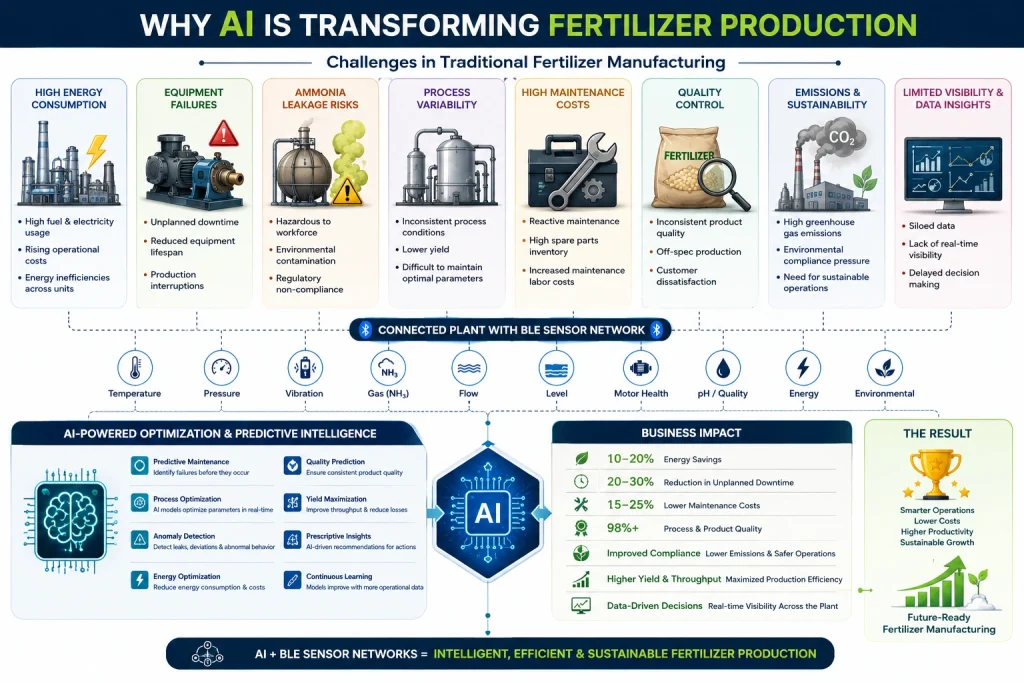
This infographic illustrates the key operational challenges in fertilizer manufacturing and how AI-powered analytics combined with Bluetooth Low Energy (BLE) sensor networks improve production efficiency. It highlights predictive maintenance, energy optimization, emissions reduction, quality control, and real-time process monitoring that enable smarter, safer, and more sustainable fertilizer production.
Fertilizer Production Operations That Benefit Most from AI and BLE
BLE-enabled AI solutions support nearly every operational stage within fertilizer production.
Raw Material Receiving
BLE sensors monitor:
- Raw material storage bins
- Conveyor vibration
- Belt alignment
- Motor temperature
- Hopper levels
- Dust accumulation
Artificial Intelligence predicts material shortages, identifies abnormal unloading behavior, and improves inventory accuracy.
Ammonia Production
AI continuously evaluates:
- Reactor temperatures
- Pressure profiles
- Catalyst performance
- Compressor efficiency
- Hydrogen utilization
- Nitrogen balance
- Heat exchanger performance
BLE monitoring supplements conventional instrumentation for auxiliary equipment health monitoring.
Granulation Operations
Granule quality depends upon:
- Drum speed
- Moisture
- Particle size
- Binder addition
- Material temperature
Machine learning models identify operating conditions producing consistent fertilizer granules while minimizing waste.
Drying and Cooling
BLE temperature sensors monitor:
- Rotary dryers
- Fluidized bed coolers
- Exhaust ducts
- Air handling equipment
Artificial Intelligence optimizes drying cycles while reducing energy usage.
Packaging Operations
BLE asset tracking improves visibility of:
- Packaging machines
- Palletizers
- Forklifts
- Stretch wrappers
- Warehouse inventory
- Finished product movement
AI predicts bottlenecks before shipment delays occur.
Warehouse Management
BLE beacons improve indoor positioning for:
- Fertilizer pallets
- Bulk bags
- Mobile equipment
- Maintenance tools
- Spare parts
- Loading docks
AI analyzes inventory movement patterns to optimize warehouse operations.
Predictive Maintenance
Critical rotating equipment includes:
- Compressors
- Pumps
- Fans
- Gearboxes
- Blowers
- Conveyors
- Crushers
- Bucket elevators
BLE vibration sensors continuously monitor equipment health while AI predicts failures before production losses occur.
GAO supplies industrial BLE monitoring hardware suitable for rotating machinery, environmental sensing, and industrial asset monitoring used throughout manufacturing operations.
Operational Workflow of an AI-Enabled BLE Fertilizer Production System
A modern fertilizer production solution integrates sensing, communication, analytics, enterprise software, and automated operational decision making.
Industrial Data Acquisition
Distributed BLE devices collect operational information from production assets including:
- Temperature
- Humidity
- Pressure
- Vibration
- Current consumption
- Motor health
- Bearing temperature
- Air quality
- Ammonia concentration
- Dust concentration
- Tank levels
- Conveyor operation
- Valve position
Data collection occurs continuously without requiring extensive wired infrastructure.
BLE Communication Layer
BLE gateways aggregate information from hundreds of BLE devices deployed across:
- Process units
- Utility buildings
- Packaging lines
- Warehouses
- Laboratories
- Maintenance workshops
Industrial gateways securely forward operational information using Ethernet, Wi-Fi, cellular, or fiber networks.
Edge Processing
Edge computing servers located near production equipment perform:
- Signal filtering
- Data normalization
- Local anomaly detection
- Event prioritization
- Temporary storage
- Real-time alarms
Edge AI minimizes communication latency for operationally critical applications.
AI Analytics
Artificial Intelligence processes:
- Historical production records
- Sensor streams
- Maintenance history
- Laboratory quality results
- Production schedules
- Environmental monitoring data
- Utility consumption
- Equipment health information
Machine learning algorithms identify hidden relationships affecting production performance.
Typical AI models include:
- Predictive maintenance
- Time-series forecasting
- Process optimization
- Quality prediction
- Remaining useful life estimation
- Anomaly detection
- Root cause analysis
- Energy optimization
Enterprise Software Integration
AI insights integrate with production software including:
- Manufacturing Execution Systems (MES)
- Enterprise Resource Planning (ERP)
- Computerized Maintenance Management Systems (CMMS)
- Supervisory Control and Data Acquisition (SCADA)
- Distributed Control Systems (DCS)
- Laboratory Information Management Systems (LIMS)
- Asset Performance Management (APM)
- Energy Management Systems
This integration enables maintenance planners, production supervisors, reliability engineers, process engineers, and operations managers to act upon AI recommendations using existing operational workflows.
AI Workflow Diagram for Fertilizer Production Using BLE Sensors and Enterprise System Integration
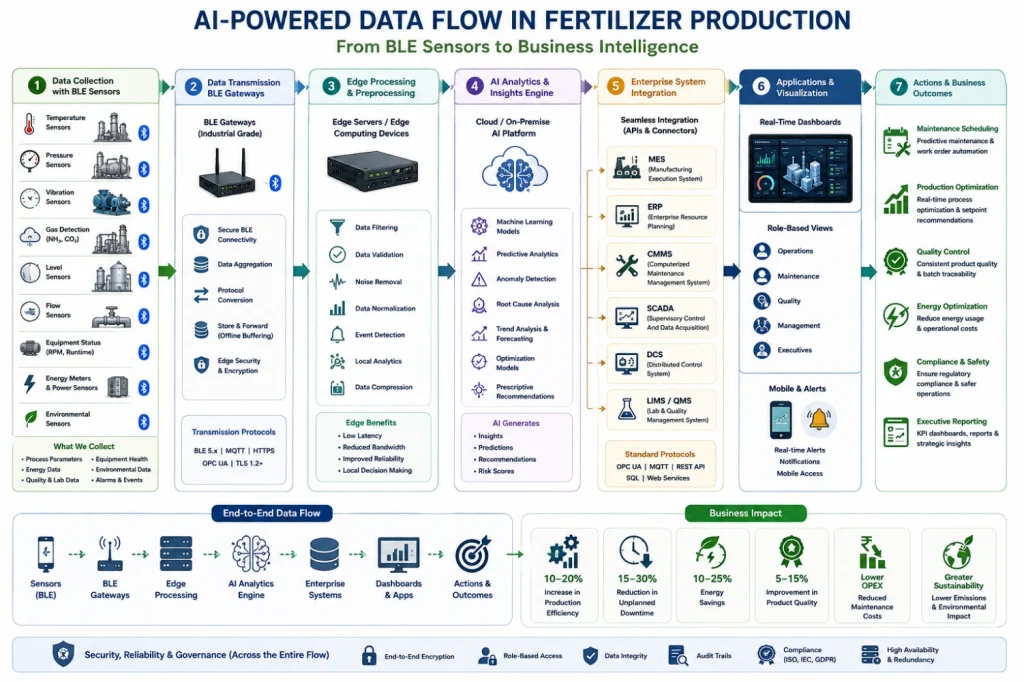
This workflow diagram illustrates the complete AI data pipeline for fertilizer manufacturing, from BLE sensor data collection and edge processing to AI analytics and enterprise system integration. It demonstrates how insights flow into MES, ERP, CMMS, SCADA, DCS, dashboards, maintenance planning, quality control, production optimization, and executive reporting to support real-time operational decision-making.
BLE Infrastructure, AI Software, Communication Technologies, and Deployment Models
BLE technology forms one component of a broader intelligent fertilizer production solution. Successful deployments combine sensing hardware, industrial networking, AI software, cybersecurity, and operational integration to support continuous manufacturing under demanding industrial conditions.
BLE Hardware Components
Industrial BLE devices commonly deployed throughout fertilizer production facilities include:
- BLE environmental sensors for monitoring ambient temperature, humidity, dust concentration, and hazardous gas conditions around granulation units, storage silos, and packaging areas.
- BLE vibration sensors mounted on compressors, pumps, gearboxes, induced draft fans, rotary dryers, and conveyor systems to identify mechanical degradation before failures occur.
- BLE current and energy monitoring devices that capture electrical consumption patterns from motors and auxiliary equipment, allowing AI models to detect abnormal load profiles.
- BLE beacons installed across warehouses, maintenance workshops, and finished goods storage areas to improve indoor location awareness of mobile assets, pallets, forklifts, and maintenance tools.
- Industrial BLE gateways positioned throughout processing units to securely aggregate sensor information and forward operational data to edge servers or centralized software over Ethernet, Wi-Fi, or private cellular networks.
These hardware components are selected according to environmental conditions such as corrosive atmospheres, fertilizer dust, vibration exposure, electromagnetic interference, and hazardous area requirements.
AI Software Components Supporting Fertilizer Production
Artificial Intelligence software converts operational data into actionable recommendations that improve fertilizer production performance. AI applications should be selected based on production objectives, equipment criticality, data availability, and operational maturity rather than deploying AI indiscriminately.
Common AI software functions include:
- Predictive maintenance software for rotating machinery
- Process optimization software
- Production scheduling optimization
- Quality prediction models
- Energy optimization software
- Industrial anomaly detection
- Root cause analysis
- Computer vision for packaging inspection
- Equipment health monitoring
- Industrial digital twin software
- Predictive inventory management
- Maintenance planning optimization
Machine learning techniques commonly deployed include:
- Supervised learning
- Unsupervised learning
- Reinforcement learning for process optimization
- Deep neural networks
- Random Forest
- Gradient Boosting
- Support Vector Machines
- Long Short-Term Memory (LSTM) networks for time-series forecasting
- Autoencoders for anomaly detection
- Bayesian optimization for process tuning
Rather than replacing existing automation systems, AI software complements Distributed Control Systems (DCS), Programmable Logic Controllers (PLC), and Supervisory Control and Data Acquisition (SCADA) by providing predictive intelligence beyond traditional rule-based automation.
Communication Infrastructure
Reliable communications are essential because fertilizer production often operates continuously with limited tolerance for interruptions.
Typical communication technologies include:
- BLE between sensors and gateways
- Industrial Ethernet
- Wi-Fi 6 for maintenance mobility
- Fiber optic backbone
- 5G private industrial networks
- OPC UA
- MQTT
- Modbus TCP
- PROFINET
- EtherNet/IP
- HTTPS
- REST APIs
Engineering teams typically isolate operational technology (OT) networks from information technology (IT) networks while permitting controlled data exchange through secure gateways.
Cloud Version
A cloud-hosted deployment is appropriate when fertilizer manufacturers require:
- Multi-site production visibility
- Centralized AI model management
- Enterprise-wide reporting
- Fleet-wide predictive maintenance
- Remote engineering access
- Cloud-based disaster recovery
- Simplified software updates
- Scalable computing resources
Cloud deployments reduce local server maintenance while enabling data scientists and reliability engineers to continuously improve AI models using production data collected across multiple fertilizer plants.
Server Version
Many fertilizer manufacturers prefer privately managed server deployments because of operational, cybersecurity, or regulatory requirements.
Server-based deployments are well suited for:
- High-speed production environments
- Facilities with strict cybersecurity policies
- Sites requiring low-latency decision making
- Plants operating with intermittent Internet connectivity
- Facilities maintaining proprietary production recipes
- Private data centers
- Edge server installations within production sites
A server deployment keeps operational data under customer control while still supporting advanced AI analytics.
GAO assists customers by supplying industrial BLE hardware that integrates with both cloud-hosted software and privately managed server environments.
Security Considerations
Cybersecurity should be incorporated throughout the solution lifecycle rather than added after deployment.
Recommended practices include:
- Device authentication
- Mutual certificate validation
- BLE encryption
- Secure firmware updates
- Role-based access control
- Network segmentation
- Multi-factor authentication
- Continuous vulnerability monitoring
- Security Information and Event Management (SIEM)
- Zero Trust security principles
- Audit logging
- Backup and disaster recovery planning
Security testing should include penetration testing, gateway validation, firmware integrity verification, and regular software updates.
AI-Powered BLE Infrastructure Block Diagram for Smart Fertilizer Manufacturing
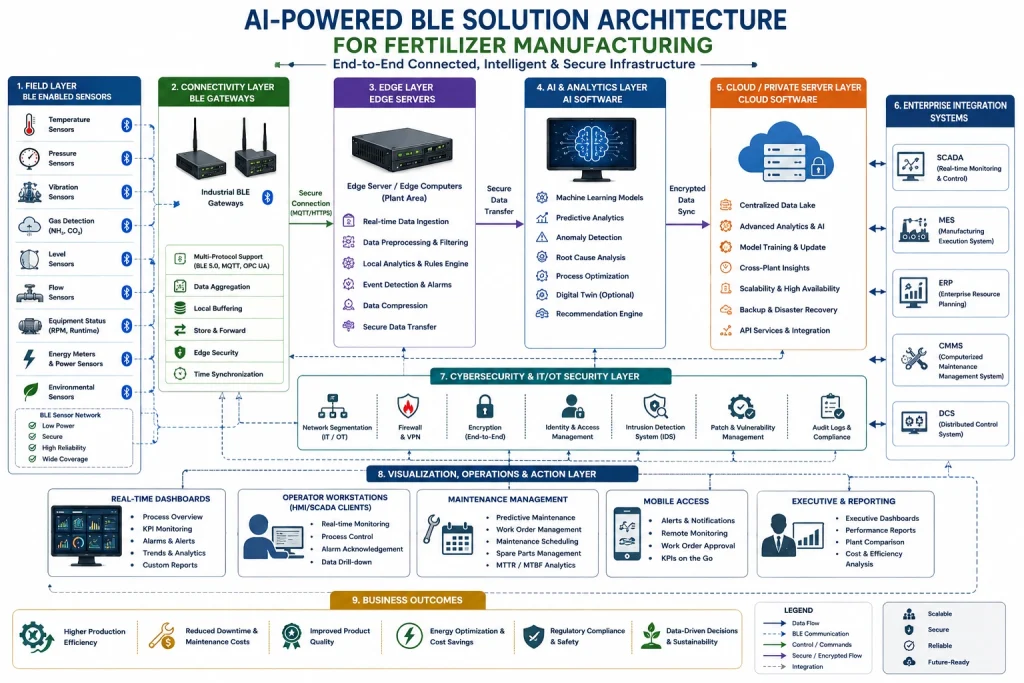
This block diagram presents the complete AI-enabled infrastructure for fertilizer manufacturing, illustrating how BLE sensors, gateways, edge servers, AI platforms, cloud or private servers, and enterprise systems work together. It highlights secure integration with SCADA, MES, ERP, CMMS, operator workstations, dashboards, and cybersecurity controls to enable predictive maintenance, production optimization, and real-time operational visibility.
Technical Capabilities and Operational Improvements
Combining Artificial Intelligence with BLE-enabled industrial monitoring delivers measurable improvements across fertilizer production.
Improved Equipment Reliability
Continuous vibration, temperature, and electrical monitoring enables AI models to identify developing mechanical problems before failures interrupt production.
Benefits include:
- Reduced unplanned downtime
- Lower maintenance costs
- Improved equipment availability
- Longer equipment service life
Better Product Quality
AI continuously evaluates production variables affecting fertilizer quality, including:
- Granule size distribution
- Moisture content
- Product density
- Coating consistency
- Chemical composition
Predictive models recommend adjustments before quality deviations occur, reducing off-specification production.
Energy Optimization
Energy represents a significant operating expense in fertilizer manufacturing.
AI identifies opportunities to improve:
- Steam utilization
- Compressor efficiency
- Dryer operation
- Heat recovery
- Motor loading
- Utility scheduling
Reducing unnecessary energy consumption lowers operating costs while supporting sustainability objectives.
Enhanced Worker Safety
BLE-enabled environmental monitoring supports continuous measurement of:
- Ammonia concentration
- Hazardous gases
- Temperature extremes
- Dust accumulation
- Confined space conditions
AI prioritizes abnormal events, allowing safety personnel to respond more rapidly.
Improved Maintenance Planning
Predictive maintenance enables maintenance teams to schedule repairs based on equipment condition rather than fixed maintenance intervals.
Advantages include:
- Better spare parts planning
- Reduced emergency maintenance
- Improved workforce utilization
- Shorter repair durations
Production Optimization
Artificial Intelligence analyzes thousands of production variables simultaneously to optimize:
- Throughput
- Yield
- Raw material utilization
- Production scheduling
- Process stability
- Equipment loading
This improves overall operational efficiency without compromising product quality.
Scalability
BLE monitoring networks can expand gradually as production requirements evolve.
Organizations may begin with monitoring critical assets before extending coverage across:
- Utilities
- Warehouses
- Packaging
- Logistics
- Maintenance operations
- Laboratory facilities
This phased deployment reduces implementation risk while providing measurable operational value.
Engineering Best Practices and Implementation Recommendations
Successful AI-enabled fertilizer production projects require careful planning beyond technology selection.
Recommended practices include:
- Define measurable business objectives before selecting AI models.
- Identify high-value production assets using criticality analysis.
- Validate sensor placement through engineering site surveys.
- Establish reliable communication coverage across all production areas.
- Standardize industrial communication protocols where practical.
- Integrate AI recommendations with existing operational procedures.
- Maintain data quality through sensor calibration and preventive maintenance.
- Develop governance procedures for AI model validation and retraining.
- Train operators, maintenance personnel, and process engineers to interpret AI recommendations.
- Perform pilot deployments before expanding plant-wide implementations.
- Monitor key performance indicators continuously to measure project success.
Typical fertilizer production KPIs include:
- Overall Equipment Effectiveness (OEE)
- Mean Time Between Failures (MTBF)
- Mean Time To Repair (MTTR)
- Production throughput
- Product quality yield
- Specific energy consumption
- Ammonia utilization efficiency
- Equipment availability
- Maintenance cost per ton
- Inventory accuracy
- Packaging efficiency
- Safety incident frequency
- Environmental compliance rate
GAO’s engineering teams have supported organizations across the United States and Canada by supplying industrial BLE and IoT hardware that integrates with modern manufacturing software while meeting demanding industrial reliability requirements. Headquartered in New York City and Toronto, Canada, GAO is recognized among the world’s leading B2B and B2G suppliers of BLE and RFID technologies. Together with GAO Research Inc. and GAO Tek Inc., GAO has served Fortune 500 companies, research institutions, universities, and government agencies for more than three decades through extensive investment in research and development, rigorous quality assurance, and expert remote and onsite technical support.
Traditional vs AI-Enabled Fertilizer Manufacturing Comparison Table
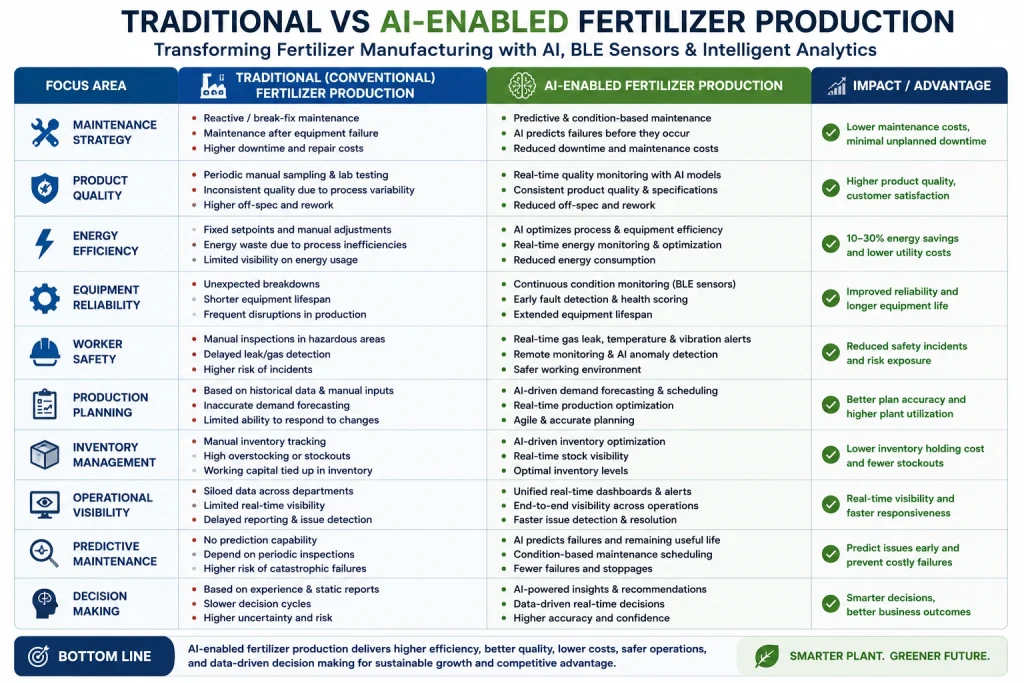
This comparison table contrasts conventional fertilizer manufacturing with AI-enabled production across key operational areas, including maintenance, product quality, energy efficiency, equipment reliability, worker safety, production planning, inventory management, operational visibility, predictive maintenance, and decision-making. It demonstrates how AI, BLE sensor networks, and real-time analytics improve efficiency, reduce costs, and enhance overall plant performance.
AI Deployment Decision Tree for Fertilizer Manufacturing: Cloud vs Private Server Infrastructure
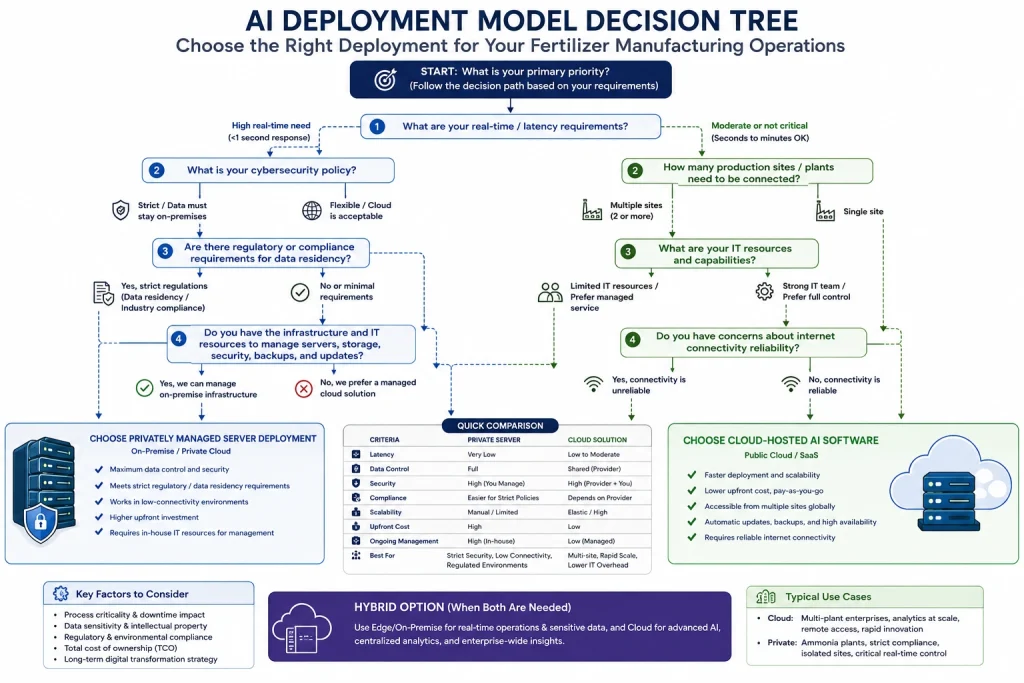
This interactive decision tree helps fertilizer manufacturers determine the most suitable AI deployment model based on latency requirements, cybersecurity policies, regulatory compliance, production scale, IT capabilities, and operational constraints. It guides engineering teams in selecting cloud-hosted AI, privately managed servers, or hybrid architectures for secure and efficient industrial operations.
Advancing Intelligent Fertilizer Production with GAO
Artificial Intelligence supported by BLE sensors, gateways, and beacons is enabling fertilizer manufacturers to improve equipment reliability, optimize production processes, reduce operational costs, strengthen worker safety, and enhance product quality. Successful implementations combine reliable industrial sensing, secure communications, robust AI software, disciplined engineering practices, and integration with existing manufacturing systems.
Organizations planning AI-enabled fertilizer production should prioritize clearly defined business objectives, scalable deployments, cybersecurity, high-quality operational data, and continuous performance improvement. GAO continues to support industrial customers by providing dependable BLE hardware products and IoT solutions backed by decades of engineering experience, helping organizations build reliable and intelligent manufacturing systems that deliver measurable operational value.
Building the Future of Industrial AI and IoT with Aperture Venture Studio and GAO
For more than three decades, GAO Group of Companies has invested extensively in research and development of industrial BLE, RFID, and IoT technologies. As generative AI has demonstrated substantial value in industrial manufacturing, we have expanded our work in AI-driven IoT solutions, including BLE and RFID technologies, and established Aperture Venture Studio to accelerate the development and growth of advanced AI and IoT solutions for manufacturing and other industrial sectors.
Aperture has attracted experienced AI researchers, IoT engineers, technology executives, investors, and industry leaders committed to advancing practical industrial innovation. Through initiatives such as the Aperture Ventures Summit and TekSummit, we foster collaboration on emerging AI and IoT technologies while strengthening technical communities and knowledge sharing. We welcome opportunities to engage with:
- Advisors, co-founders, and employees
- Investors
- Customers seeking advanced AI and industrial IoT solutions