
AI for Warehousing Complexes: Smarter Operations with BLE Tracking
How AI Improves Warehousing Complex Operations
AI for warehousing complexes combines machine learning, analytics, connected sensors, and operational data to improve how pallets, totes, forklifts, inventory, dock activities, and labor are managed. BLE gateways, BLE beacons, and BLE sensors provide the location, movement, and environmental data needed by AI-driven warehouse management applications.
For warehousing complexes, the practical value comes from connecting physical operations with continuously updated operational data. A BLE beacon attached to a pallet can provide location events, while BLE temperature sensors can add cold-chain conditions. AI software can then identify unusual dwell times, predict replenishment requirements, recommend storage locations, or highlight labor bottlenecks. This approach supports warehouse asset tracking, inventory management, dock coordination, order fulfillment, and maintenance without requiring every operational decision to depend on manual scans or radio communication.
The resulting solution can connect BLE data with warehouse management systems (WMS), warehouse execution systems (WES), transportation management systems (TMS), enterprise resource planning (ERP) software, dashboards, and operational alerts.
AIoT + BLE Warehouse Architecture for Real-Time Visibility and Smarter Operations
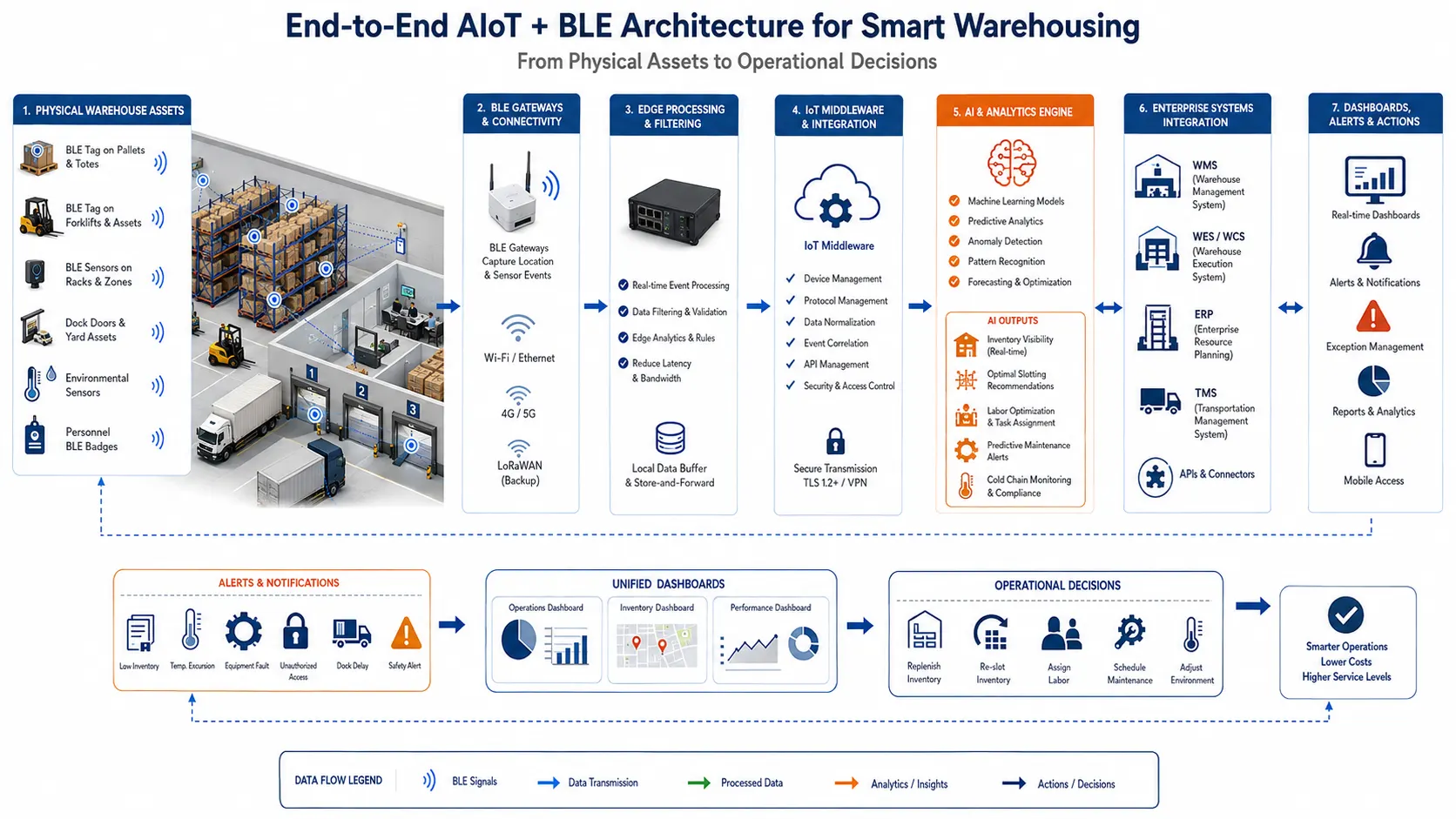
This enterprise diagram shows how BLE-tagged warehouse assets and sensors send data through gateways, edge processing, middleware, and AI analytics to enterprise systems, dashboards, alerts, and operational decisions. The solution supports inventory visibility, optimal slotting, labor optimization, predictive maintenance, and cold-chain monitoring to improve warehouse efficiency and service levels.
What AI Means for Warehousing Complexes
AI in warehousing complexes is most useful when it converts operational events into decisions that warehouse personnel can act upon. Rather than treating AI as a standalone software capability, the engineering objective is to establish a reliable chain from physical activity to data capture, analysis, recommendation, and operational response.
Typical data sources include:
- BLE beacon location events from pallets, totes, forklifts, carts, and other mobile assets
- BLE temperature and environmental measurements for refrigerated and controlled areas
- BLE gateway detections at dock doors, storage zones, staging areas, and production interfaces
- WMS inventory transactions and location records
- WES task assignments and fulfillment events
- TMS shipment, carrier, and dock scheduling information
- ERP purchase orders, inventory records, and material requirements
- Equipment telemetry and maintenance records
- Labor activity, pick rates, task queues, and shift information
- Historical dwell time, travel distance, replenishment, and order fulfillment data
AI models can use these inputs to detect patterns that are difficult to identify from isolated transactions. For example, repeated pallet dwell time at a receiving dock may indicate a receiving bottleneck. A recurring concentration of picker travel in one zone may indicate an inefficient slotting arrangement. Repeated temperature excursions in a cold-chain area may indicate equipment, door, handling, or process problems that require investigation.
The quality of these recommendations depends heavily on the quality and context of the underlying data. BLE deployment therefore needs to be designed around warehouse workflows rather than simply installing beacons throughout a facility.
Where AI Creates Operational Value in Warehousing Complexes
AI Warehouse Asset Tracking
Warehousing complexes contain thousands of movable and semi-movable assets. Pallets, reusable totes, roll cages, forklifts, carts, containers, tools, and material-handling equipment can move between receiving, storage, replenishment, picking, staging, and shipping areas.
BLE tracking can provide location events without requiring workers to scan every movement manually. AI can use those events to identify abnormal dwell times, repeated movement patterns, congestion, and asset utilization.
The engineering priority is not merely determining an object’s approximate location. The system should establish meaningful operational zones such as receiving docks, reserve storage, forward pick areas, cross-dock lanes, staging zones, and outbound doors. Zone definitions allow AI models to interpret movement in relation to warehouse processes.
AI Inventory Visibility and Replenishment
Inventory accuracy is affected by misplaced pallets, delayed transactions, incorrect locations, damaged labels, and differences between physical inventory and WMS records. Continuous BLE observations can provide an additional source of physical-location evidence.
AI can correlate these observations with WMS transactions to identify potential discrepancies. For example, if a pallet remains physically associated with a staging area after a WMS transaction indicates movement to reserve storage, the system can flag the discrepancy for investigation.
AI-assisted replenishment can also consider order velocity, available inventory, storage locations, travel distances, and current task queues when recommending replenishment priorities.
AI Slotting and Warehouse Layout Optimization
Slotting decisions influence picker travel, replenishment frequency, congestion, and order cycle time. Traditional slotting processes often rely on periodic analysis of SKU velocity and warehouse constraints.
A more data-driven approach combines historical order patterns with observed pallet and tote movement. AI can evaluate SKU velocity, order affinity, storage capacity, equipment restrictions, and movement patterns to recommend changes to pick locations.
The recommendation should remain subject to operational constraints. Fire protection requirements, rack load limits, hazardous-material segregation, temperature zones, aisle widths, equipment access, and inventory handling rules should not be overridden by a purely statistical optimization model.
AI Labor and Workflow Optimization
Warehouse labor requirements change throughout a shift as receiving, picking, replenishment, packing, and shipping workloads fluctuate. BLE movement data can provide additional context about where workers and mobile equipment are operating, subject to the organization’s privacy and workforce policies.
AI can combine task queues, order priorities, equipment availability, congestion, and historical productivity patterns to identify workload imbalances. Rather than automatically directing workers without operational controls, a practical deployment can provide supervisors with recommendations for task reassignment, replenishment prioritization, or staffing adjustments.
AI Cold-Chain Monitoring
Cold-chain warehousing introduces an additional requirement because inventory condition can be as important as inventory location. BLE temperature sensors can associate environmental measurements with specific pallets, totes, storage zones, or other tracked items.
AI can analyze temperature trends alongside location and handling events. This can help distinguish an isolated sensor event from a recurring condition associated with a particular dock, storage zone, door cycle, handling process, or equipment problem.
For regulated or sensitive products, sensor calibration, measurement intervals, data retention, alert thresholds, auditability, and validation procedures should be established before production deployment.
AIoT Cold-Chain Monitoring for Real-Time Warehouse Temperature and Asset Visibility
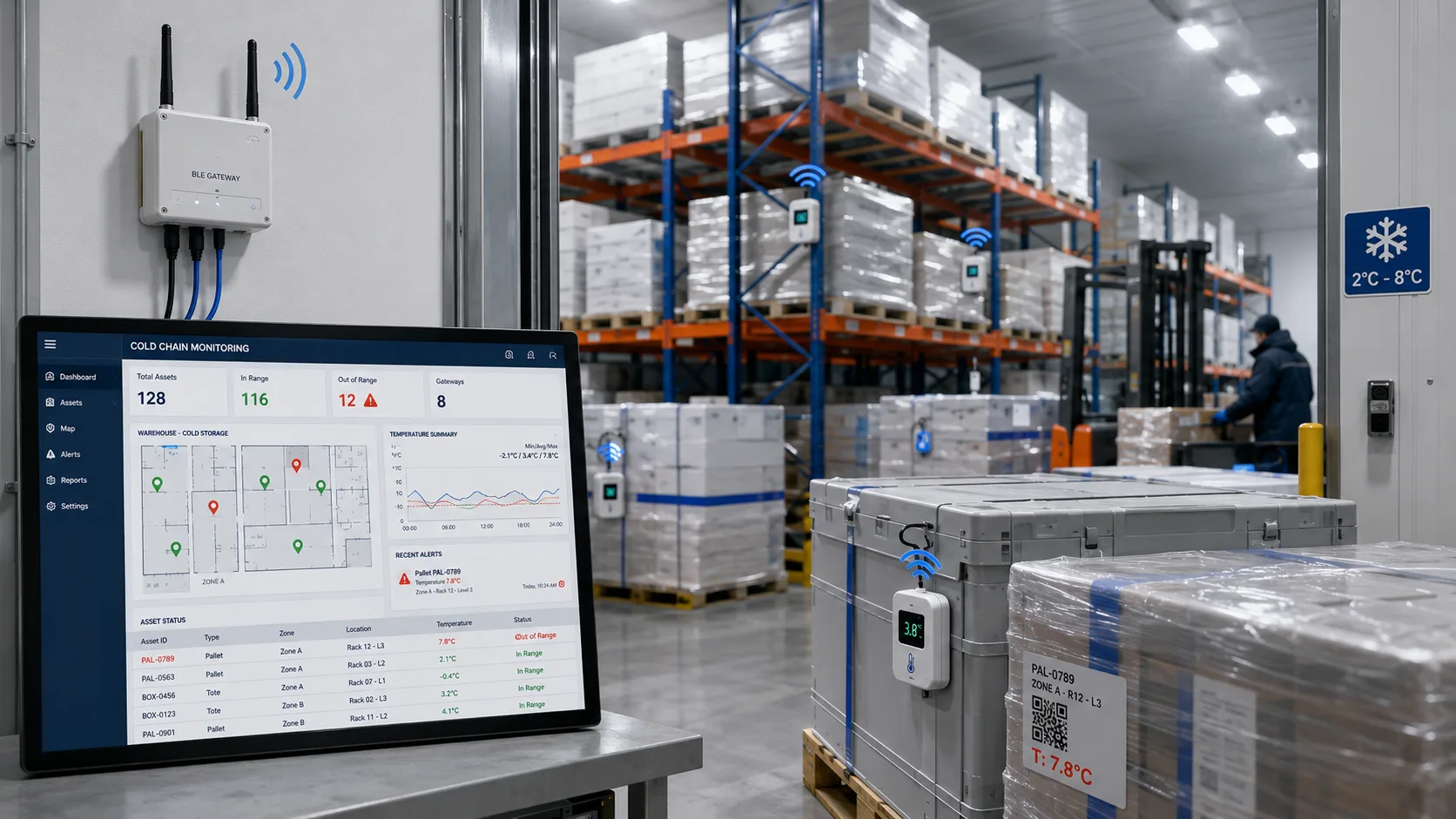
This realistic cold-chain warehouse visual shows BLE-enabled pallets, containers, temperature sensors, and gateways supporting continuous location and environmental monitoring. A monitoring dashboard combines pallet location, temperature status, and out-of-range alerts to help warehouse teams protect temperature-sensitive inventory.
The Warehousing Complex Workflow From BLE Data to AI Decisions
A production solution typically follows a chain that begins with physical warehouse activity and ends with a human or automated operational response.
Physical event → BLE detection → Gateway collection → Data processing → Operational software → AI analysis → Recommendation or alert → Warehouse action → Performance feedback
Data Acquisition
BLE beacons are attached to selected assets, while BLE sensors can provide temperature or other environmental measurements. Gateway placement determines which physical areas can reliably detect those devices.
Gateway density should be based on the required positioning accuracy and warehouse conditions rather than simply using a fixed gateway-to-area ratio. Metal racks, refrigerated rooms, high ceilings, loading doors, machinery, dense inventory, and changing warehouse layouts can influence radio performance.
Communication and Edge Processing
BLE gateways receive advertising packets and sensor information from nearby devices. The gateway can filter, timestamp, normalize, and forward relevant events to downstream software.
The communication path between gateways and backend systems can use Ethernet, Wi-Fi, cellular connectivity, or another appropriate IP network depending on the warehouse environment.
Where low latency or network resilience is important, selected processing functions can occur near the warehouse rather than sending every raw event directly to a remote service.
Middleware and Enterprise Integration
Middleware provides the translation layer between BLE events and business applications. It can normalize device identifiers, map beacon IDs to assets, associate gateway detections with warehouse zones, manage device status, and expose data through APIs or integration interfaces.
Integration with a WMS is particularly important because a physical location observation has limited operational meaning without inventory and workflow context.
For example, the system should be able to associate a BLE identifier with a pallet or tote and then relate that asset to an inventory record, storage location, order, or shipment where appropriate.
AI Analytics and Operational Actions
AI processing can use historical and real-time data to identify patterns, generate predictions, and recommend actions. Depending on the application, techniques can include anomaly detection, time-series forecasting, classification, optimization, clustering, and machine learning models.
The output should be operationally interpretable. A warehouse supervisor is more likely to act on a recommendation such as “three outbound pallets have exceeded the expected staging dwell time” than on an unexplained model score.
GAO’s experience supplying BLE, RFID, and IoT hardware products and systems provides a practical foundation for deployments where device data must ultimately support physical warehouse processes rather than remain isolated sensor information.
BLE Warehouse Workflow: From Real-Time Pallet Movement to AI-Powered Decisions
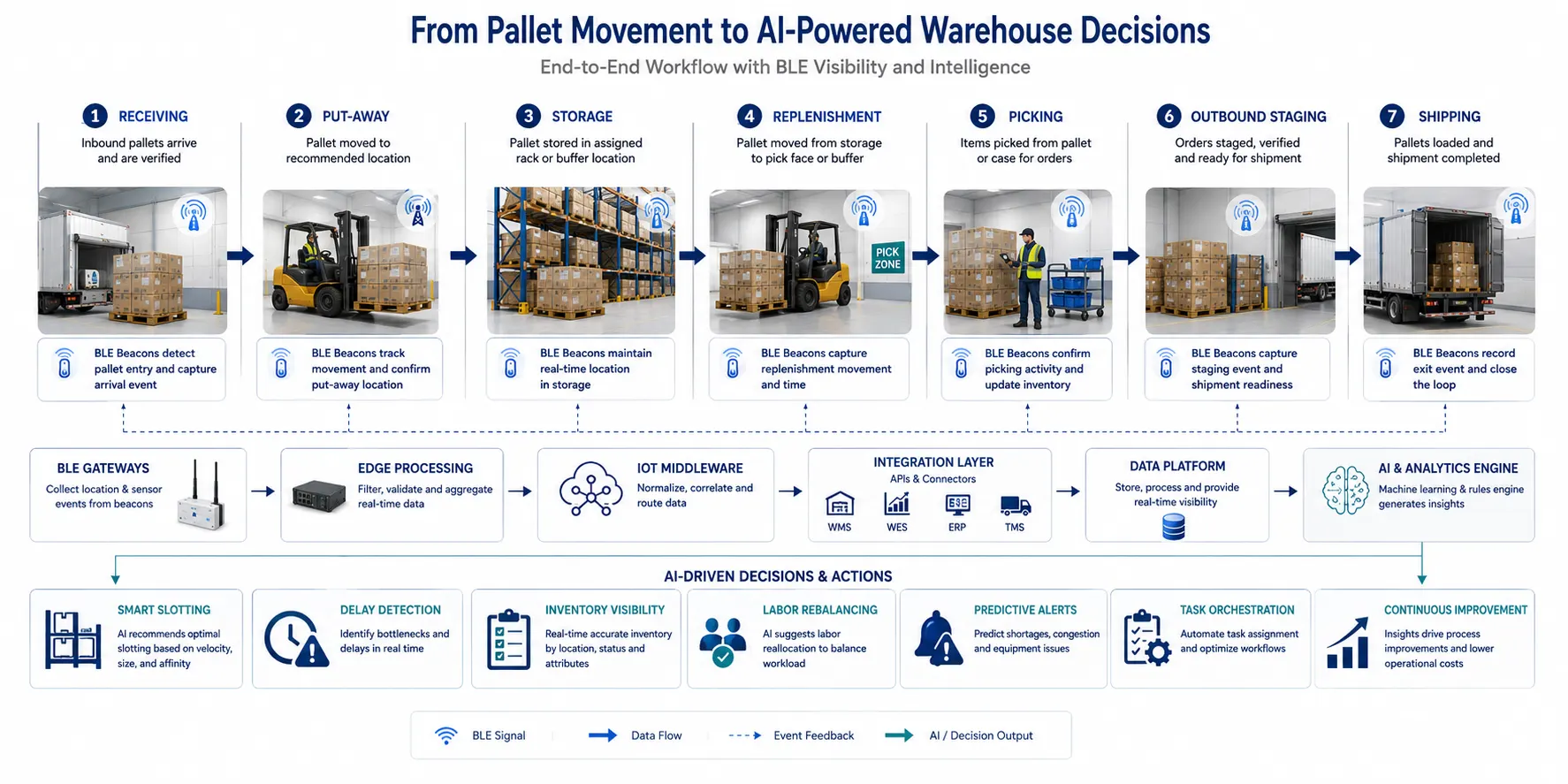
This workflow diagram follows pallet movement from receiving and put-away through storage, replenishment, picking, outbound staging, and shipping. BLE beacons and gateways capture movement events, while edge processing, middleware, WMS/WES integration, and AI analytics convert real-time data into inventory visibility, smart slotting, delay detection, labor rebalancing, and operational actions.
BLE Hardware, Software, and Deployment Options for Warehousing Complexes
BLE is the enabling connectivity layer for many AI warehouse applications, but the complete solution depends on how hardware, networking, software, data processing, and enterprise systems are engineered together.
BLE Beacons and Sensors
BLE beacons provide a practical identification mechanism for mobile warehouse assets. A beacon attached to a pallet, tote, cart, forklift, or container can transmit an identifier that nearby gateways detect.
BLE sensors extend this capability by transmitting measurements such as temperature. This is particularly relevant to refrigerated storage, pharmaceutical distribution, food logistics, and other warehouse environments where product condition must be monitored alongside location.
Battery life should be evaluated against advertising interval, transmit power, sensor sampling frequency, environmental temperature, and maintenance accessibility. Cold environments can affect battery performance, making battery specifications based only on nominal room-temperature conditions insufficient for some deployments.
BLE Gateways and Warehouse Network Design
Gateways collect BLE transmissions and forward relevant information to the software layer. Placement should account for rack geometry, dock doors, wall construction, interference, ceiling height, forklift movement, and the desired location accuracy.
A warehouse requiring simple zone detection can use a different gateway density from one requiring more precise location estimation. A proof of concept should therefore validate actual radio performance under representative operating conditions before a facility-wide rollout.
Cloud Version
A cloud-hosted deployment sends gateway data to remotely hosted software where device management, data processing, AI analytics, dashboards, APIs, and related services can be operated.
This model can be appropriate for warehousing organizations managing multiple facilities that need centralized visibility and standardized software management. It can also reduce the amount of customer-managed server infrastructure required at individual facilities.
Connectivity resilience remains important. Warehouses with unreliable WAN connectivity should define local buffering, event retry, and outage-handling behavior so that temporary network failures do not silently create gaps in operational records.
Server Version
A Server Version places the software on customer-managed servers, private data centers, edge servers, factory or warehouse servers, or other privately hosted infrastructure. It is not limited to a traditional on-premises server room.
This approach can be appropriate when data must remain within a controlled network, when integration with internal systems requires local connectivity, or when organizational cybersecurity and data-governance requirements favor private hosting.
The trade-off is greater responsibility for server provisioning, patching, backups, monitoring, high availability, and software lifecycle management.
Security and Integration Considerations
Security should cover the complete path from BLE devices to warehouse applications. Relevant controls can include device identity management, gateway authentication, encrypted IP communications, network segmentation, API authentication, role-based access control, logging, software patching, credential management, and controlled administrative access.
BLE itself should not be treated as the complete cybersecurity boundary. The larger risk surface includes gateways, IP networks, middleware, APIs, databases, cloud or private servers, WMS integrations, dashboards, and administrator accounts.
For warehousing complexes, integration testing should also verify that duplicate events, delayed packets, gateway outages, clock differences, device battery failures, and temporary network interruptions do not produce misleading inventory or location decisions.
Technical and Operational Benefits of AI for Warehousing Complexes
The strongest results from AI-enabled warehousing come from connecting operational data with decisions that affect throughput, inventory accuracy, labor utilization, equipment availability, and customer service. BLE provides an additional stream of physical-world observations, while AI converts those observations into patterns, predictions, and recommendations.
Better Inventory Visibility
Continuous location observations can supplement transactional WMS data by providing evidence of where selected pallets, totes, containers, and other tagged assets are physically located.
This can help warehouse teams identify:
- Pallets detected in unexpected zones
- Inventory remaining in staging areas beyond expected dwell times
- Totes or containers associated with the wrong operational area
- Assets that have not moved according to the expected workflow
- Repeated discrepancies between physical observations and system records
AI can prioritize exceptions instead of requiring personnel to investigate every inventory record manually.
Reduced Warehouse Dwell Time
Dwell time is particularly important at receiving docks, inspection areas, staging lanes, cross-dock zones, and outbound shipping areas. AI can establish expected dwell-time patterns using historical warehouse events and identify deviations.
For example, a pallet that remains at receiving substantially longer than comparable pallets can trigger an operational alert. The system can associate the event with receiving workload, dock utilization, inventory type, shift conditions, or downstream capacity to help supervisors determine the likely cause.
The objective is not simply to generate more alerts. Alert thresholds should be designed around actionable exceptions to avoid overwhelming warehouse personnel with low-value notifications.
More Effective Slotting
AI-supported slotting can evaluate SKU velocity, order frequency, product affinity, storage constraints, observed travel patterns, replenishment activity, and available locations.
A useful recommendation might identify a high-frequency SKU that would benefit from a forward pick location closer to the relevant packing or shipping operation. The recommendation should then be evaluated against rack capacity, product handling requirements, safety restrictions, replenishment workload, and warehouse operating rules.
Improved Labor Allocation
AI can identify relationships between workload, task queues, warehouse zones, equipment availability, and historical operating patterns.
For example, if picking demand increases while replenishment tasks accumulate in another zone, supervisors can receive a recommendation to rebalance available labor. BLE movement observations can provide additional context about congestion and asset availability, although workforce monitoring should always follow applicable organizational privacy policies and employment requirements.
Better Material-Handling Equipment Utilization
Forklifts and other mobile equipment can represent a significant operational resource. BLE tracking can provide information about equipment location and utilization patterns.
AI can analyze equipment movement and task history to identify underutilized assets, recurring congestion points, or unusual movement patterns. Maintenance teams can also combine location information with equipment service records and other available telemetry to improve maintenance planning.
Engineering Considerations for Deploying AI in Warehousing Complexes
A successful deployment requires more than selecting BLE devices and an AI application. Warehouse conditions change continuously, so the solution should be designed to remain useful when inventory moves, racks are reconfigured, gateways become unavailable, or network connectivity is temporarily interrupted.
Location Accuracy and Zone Definition
The required positioning accuracy should be established before selecting the number and placement of gateways.
A warehouse may only need zone-level information for pallet tracking. Another application may require more granular positioning around dock doors or automated material-handling equipment.
A site survey should evaluate:
- Rack construction and density
- Ceiling height
- Dock-door configuration
- Refrigerated areas
- Metal structures and equipment
- Gateway mounting positions
- Expected beacon transmission behavior
- Areas requiring higher location confidence
- Network and power availability
- Future warehouse layout changes
Testing should occur under representative operating conditions rather than only in an empty warehouse.
Data Quality and Event Normalization
AI models are highly dependent on reliable input data. Duplicate BLE observations, missing gateway events, incorrect asset mappings, inconsistent timestamps, and stale device registrations can reduce the quality of downstream analytics.
Middleware should therefore normalize events before AI processing. Important fields can include asset identifier, gateway identifier, zone, timestamp, event type, sensor value, confidence information, and relevant WMS or WES identifiers.
A practical implementation should also establish rules for handling missing data rather than silently treating missing observations as proof that an asset has moved.
AI Model Selection
The appropriate AI method depends on the operational question.
- Anomaly detectioncan identify unusual dwell times, movement patterns, or temperature behavior.
- Time-series forecastingcan support inventory demand, workload, or temperature trend analysis.
- Classification modelscan categorize operational conditions or exception types.
- Optimization methodscan support slotting, task allocation, and resource planning.
- Clusteringcan identify recurring movement or warehouse usage patterns.
- Predictive modelscan estimate likely delays, replenishment requirements, or equipment-related events.
AI should not be selected simply because a use case can technically use machine learning. A deterministic rule may be more appropriate when the condition is simple, well-defined, and safety-critical.
Testing, Commissioning, and Acceptance
Warehouse AI deployments should be validated in stages.
Initial commissioning should confirm beacon identity, sensor measurements, gateway connectivity, network communication, event timestamps, and asset-to-device mappings.
Integration testing should then verify that events correctly reach WMS, WES, TMS, ERP, dashboards, and alerting systems.
Operational acceptance testing should use representative warehouse scenarios such as:
- Receiving a tagged pallet
- Moving the pallet to reserve storage
- Replenishing a forward pick location
- Picking and staging an order
- Moving the order to an outbound dock
- Temporarily losing gateway connectivity
- Replacing a beacon battery
- Detecting an unexpected dwell condition
- Generating a temperature exception
Acceptance criteria should define measurable thresholds for event delivery, location accuracy, data completeness, alert latency, system availability, and integration reliability.
AI-Enabled BLE Warehousing Deployment Lifecycle for Faster, Validated Multi-Site Scaling
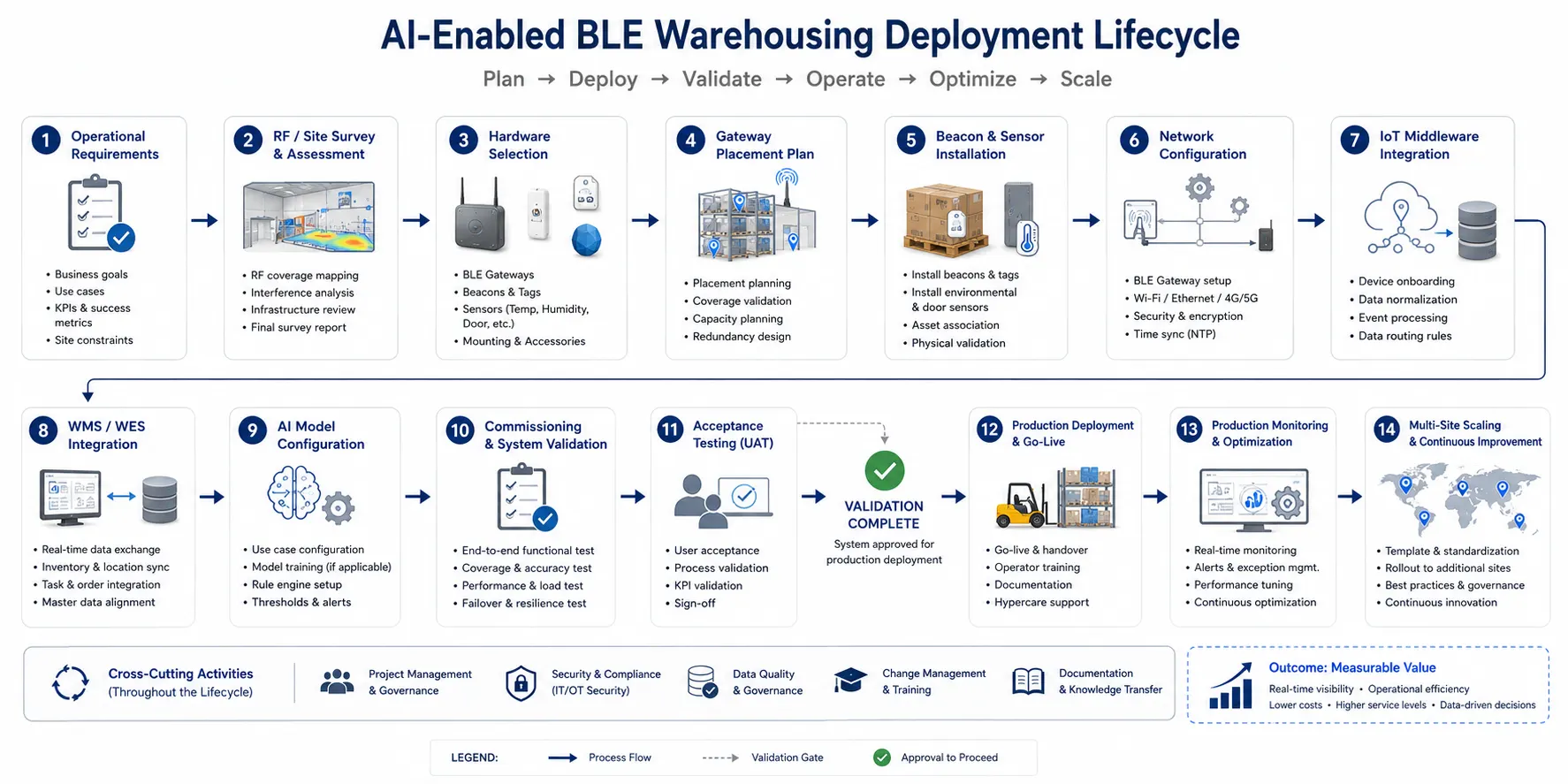
This deployment lifecycle diagram maps the implementation of an AI-enabled BLE warehousing system from operational requirements and RF site surveys through hardware selection, gateway placement, sensor installation, integrations, and AI configuration. It highlights commissioning and acceptance testing as a validation gate before production deployment, followed by monitoring, continuous optimization, and multi-site scaling.
Scaling AI and BLE Across Multiple Warehousing Facilities
Multi-site deployments introduce additional requirements because facilities rarely have identical layouts, operating processes, network configurations, or inventory profiles.
A scalable implementation should standardize device identity, asset naming, warehouse zones, event formats, APIs, security controls, and operational KPIs while allowing individual facilities to retain site-specific configuration.
GAO can support organizations evaluating BLE, RFID, and IoT hardware products and systems for different warehouse environments, including deployments where requirements vary between distribution centers, cold-chain facilities, storage buildings, and high-throughput fulfillment operations.
Standardize the Data Model, Not Every Physical Installation
A common mistake is attempting to make every facility physically identical. Warehouse construction, rack layouts, dock configurations, and operational processes differ considerably.
A better approach is to standardize the logical data model and integration interfaces while configuring gateway locations, detection zones, beacon assignments, and workflows for each facility.
This makes it easier to compare KPIs across locations without forcing every warehouse to operate identically.
Monitor the System as an Operational Utility
After commissioning, organizations should monitor both warehouse performance and technology performance.
Useful technology KPIs include:
- Gateway availability
- BLE event delivery rate
- Sensor reporting completeness
- Battery health
- Asset-to-device mapping accuracy
- API availability
- Data latency
- Alert delivery time
- Integration errors
Warehouse KPIs can include inventory accuracy, dock dwell time, order cycle time, picking productivity, replenishment response time, equipment utilization, staging dwell time, and temperature excursion frequency.
The two groups should be analyzed together. A deterioration in warehouse visibility may result from an operational problem, a device problem, a network problem, or an integration problem.
Practical Implementation Recommendations for Warehousing Complexes
Organizations considering AI-enabled BLE tracking should begin with an operational problem rather than a technology specification.
A practical deployment sequence is:
- Identify the warehouse workflows where missing location or condition data causes measurable operational problems.
- Define the assets, zones, events, and KPIs that must be observed.
- Determine whether zone-level or more precise positioning is required.
- Perform an RF and physical site survey before finalizing gateway locations.
- Select beacon and sensor configurations according to battery, environment, reporting frequency, and maintenance requirements.
- Integrate device data with WMS, WES, TMS, ERP, or other relevant systems.
- Establish data-quality rules and exception handling before training or deploying AI models.
- Start with a controlled operational area and validate the complete workflow.
- Measure business and technology KPIs against a documented baseline.
- Refine alert thresholds and AI recommendations using actual warehouse operating data.
- Establish cybersecurity, device lifecycle, software maintenance, backup, and support procedures.
- Expand to additional zones or facilities only after the initial workflow demonstrates reliable operational value.
The most important engineering principle is to avoid treating AI as a replacement for warehouse process knowledge. AI recommendations are valuable when they are grounded in accurate asset data, validated workflows, appropriate constraints, and clear operational ownership.
Key Takeaways for AI-Enabled Warehousing Complexes
AI can improve warehousing complex operations by turning location, inventory, environmental, equipment, and workflow data into actionable recommendations. BLE beacons, gateways, and sensors can provide an important physical-data layer for applications such as asset tracking, inventory visibility, cold-chain monitoring, slotting, dwell-time analysis, labor planning, and equipment utilization.
The most effective implementations connect this data with WMS, WES, TMS, ERP, and other operational systems rather than operating as isolated tracking applications.
Cloud and Server deployment models can both be appropriate. The choice should reflect connectivity, cybersecurity, data governance, integration, IT operations, scalability, and site-specific requirements.
Organizations should validate radio performance, data quality, integration reliability, AI model usefulness, and operational KPIs before expanding a deployment.
GAO provides BLE, RFID, and IoT hardware products and systems for organizations requiring practical connectivity between physical assets and digital operational processes. GAO’s sister companies, GAO Research Inc. and GAO Tek Inc., together form GAO Group, with operations based in New York City and Toronto, Canada. For more than three decades, the group has served customers across the U.S. and Canada, including Fortune 500 companies, R&D organizations, universities, and government agencies, supported by substantial R&D investment, quality assurance processes, and remote or onsite technical support.
I’ll create the AI warehouse decision map as specified, then provide the visual title, short description, and compliant alt text based on the completed visual.
AI Warehouse Decision Map for Turning Real-Time Data into Measurable Operational Improvements
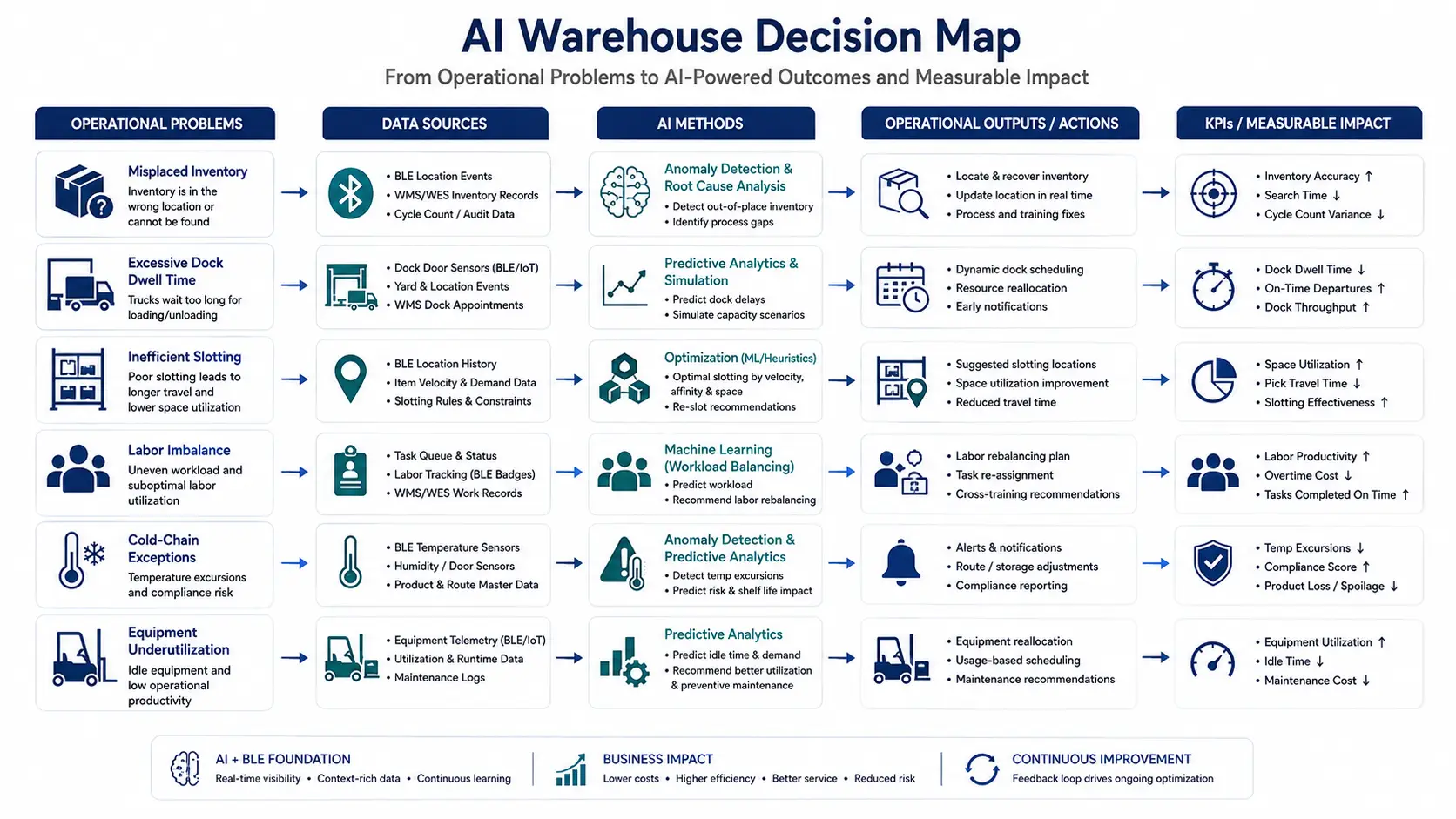
This decision map connects common warehouse problems—including misplaced inventory, dock dwell time, inefficient slotting, labor imbalance, cold-chain exceptions, and equipment underutilization—to relevant data sources and AI methods. It shows how anomaly detection, predictive analytics, machine learning, and optimization generate operational actions and measurable KPIs.
Building the Future of Industrial AI and IoT with Aperture Venture Studio and GAO RFID Inc.
For more than three decades, GAO Group of Companies has invested heavily in R&D for industrial BLE, RFID, and IoT. As AI became increasingly useful for industrial applications, we expanded our work across AI-enabled IoT solutions, including connected systems for warehouse operations. We have also founded Aperture Venture Studio to help develop and scale AI and IoT initiatives relevant to industrial applications such as warehousing, asset visibility, and operational intelligence.
Aperture brings together AI and IoT technical experts, operational leaders, investors, and technology companies. We have also developed the Aperture Ventures Summit and TekSummit to facilitate discussion of advanced AI and IoT technologies.
GAO RFID Inc., headquartered in New York City and Toronto, Canada, is ranked among the top 10 leading B2B and B2G BLE and RFID suppliers globally. We welcome participation as advisors, co-founders or employees, investors, or customers.