
AI-Driven BLE Systems for Edge Computing Facilities
AI-driven monitoring supported by Bluetooth Low Energy, or BLE, gives edge computing facility operators continuous visibility into equipment condition, environmental risk, asset location, technician activity, and infrastructure performance. BLE sensors, beacons, and gateways collect localized operational data, while edge AI models convert that data into anomaly alerts, maintenance recommendations, security events, and automated facility actions.
This approach is particularly valuable in distributed edge sites where traditional data center staffing, wired instrumentation, and centralized monitoring may be limited. Micro data centers, telecom shelters, modular edge facilities, network points of presence, content delivery nodes, and industrial edge rooms must maintain availability despite constrained space, variable cooling conditions, intermittent connectivity, and limited onsite support.
GAO supplies BLE and IoT hardware products and systems that can support equipment tracking, environmental sensing, workflow monitoring, and AI-enabled operational intelligence across distributed edge computing locations.
AI-Enabled BLE Monitoring in Edge Computing Facilities
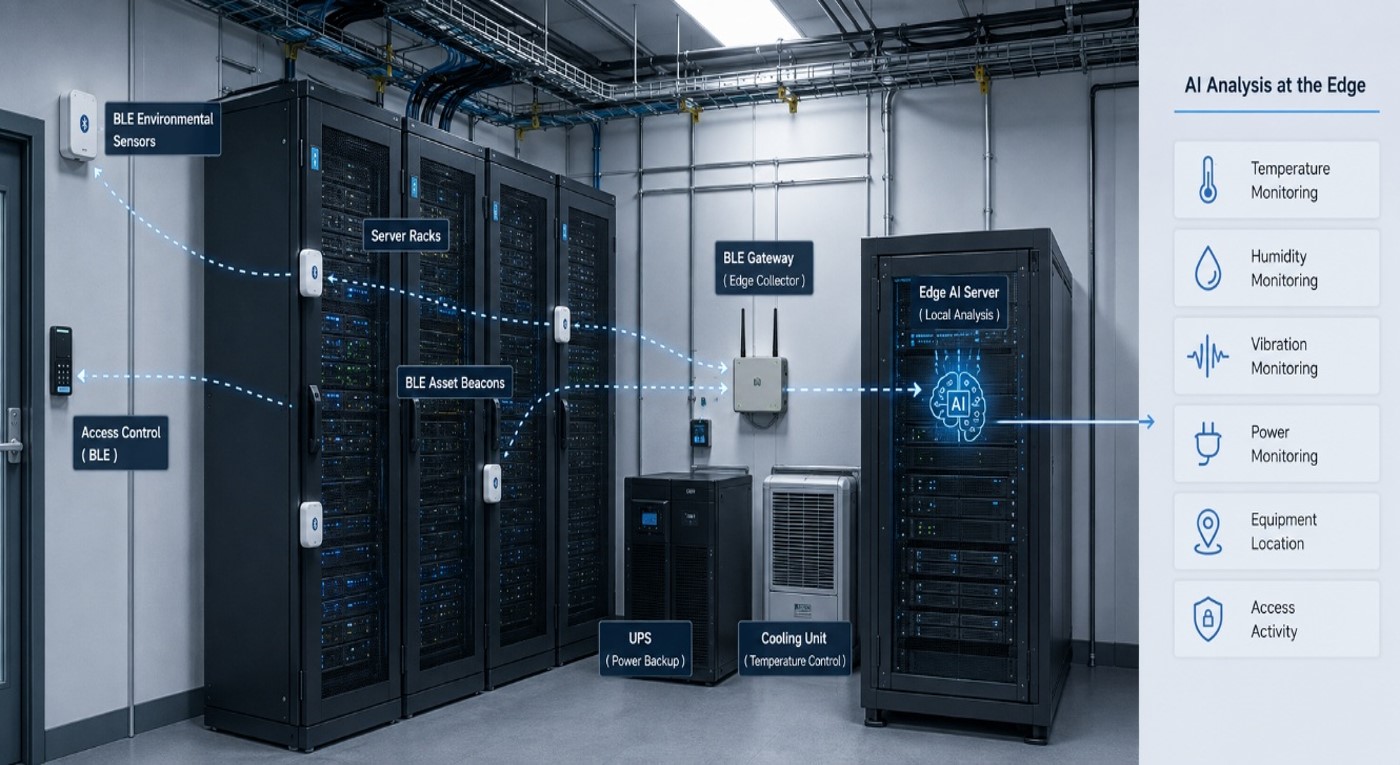
This visual shows how BLE environmental sensors, asset beacons, access-control devices, and an industrial BLE gateway transmit operational data to a local edge AI server. The system analyzes temperature, humidity, vibration, power status, equipment location, and access activity to support real-time facility monitoring and faster operational decisions.
How AI-Enabled BLE Monitoring Supports Edge Infrastructure
Edge computing facilities place compute, storage, and networking resources close to users, machines, telecommunications networks, or data sources. ETSI describes multi-access edge computing as providing cloud-computing capabilities and an IT service environment near the network edge, with low latency, high bandwidth, and access to local network information.
Unlike hyperscale data centers, many edge locations operate inside telecommunications cabinets, retail sites, hospitals, factories, transportation facilities, commercial buildings, remote offices, or outdoor enclosures. These sites may have only a few racks, limited cooling redundancy, restricted floor space, and little or no permanent technical staff.
AI-enabled BLE monitoring addresses these conditions by combining:
- Battery-powered BLE sensors for temperature, humidity, vibration, door state, water leakage, air pressure, current, and equipment condition
- BLE beacons or tags attached to servers, network appliances, removable drives, tools, spare components, and technician credentials
- BLE gateways that collect nearby broadcasts and forward normalized data through Ethernet, Wi-Fi, cellular, or private network connections
- Edge servers that perform local filtering, inference, alerting, and automation
- Cloud or privately hosted server software for cross-site analytics, reporting, device administration, and integration
- AI models that identify abnormal behavior, predict failures, prioritize alarms, and recommend operational actions
BLE does not replace building management systems, DCIM software, wired sensors, SNMP, Modbus, BACnet, power meters, or network telemetry. It extends those systems by providing flexible, low-power sensing and location data in places where additional cabling would be expensive, disruptive, or impractical.
Operational Challenges Across Distributed Edge Computing Sites
Edge computing operators must deliver reliable services from facilities that are smaller, more numerous, and more geographically dispersed than traditional data centers. Uptime Institute characterizes edge computing as distributing computing and storage capabilities to locations such as factory floors, carrier points of presence, cell towers, and smart buildings.
Thermal Risk in High-Density Enclosures
Compact edge rooms can experience rapid temperature escalation when a cooling fan fails, an air filter becomes blocked, a cabinet door is left open, or rack airflow is obstructed. Average room temperature alone may not reveal a developing rack-level hotspot.
BLE temperature sensors placed at rack inlets, outlets, top-of-rack switches, UPS cabinets, and cooling return paths give AI models more granular thermal data. The software can distinguish a facility-wide cooling problem from a localized airflow restriction and prioritize the affected rack.
Limited Onsite Staffing
Many edge facilities rely on remote operations teams and dispatched field technicians. Manual inspections may occur weekly or monthly rather than continuously.
AI-supported condition monitoring allows operators to identify probable fan degradation, battery deterioration, abnormal vibration, repeated door openings, or rising humidity before assigning a technician. Work orders can include the suspected fault, affected asset, recent sensor history, required tools, and recommended replacement parts.
Asset Visibility and Configuration Control
Servers, routers, power supplies, storage devices, removable media, and spare components may be moved between racks or edge locations during maintenance. Incomplete asset records can create audit gaps, delayed repairs, security concerns, and incorrect capacity data.
BLE asset beacons can support zone-level or room-level location updates. AI reconciliation compares observed beacon locations with the configuration management database, work orders, receiving records, and approved change requests.
Intermittent Backhaul Connectivity
Remote edge sites may rely on cellular, microwave, satellite, or constrained wide-area links. Sending every raw sensor reading to a central cloud service increases bandwidth usage and creates monitoring gaps when connectivity is unavailable.
Local processing allows the edge server to buffer readings, run inference, trigger critical alarms, and continue selected control actions even when the central connection is degraded.
Alarm Overload
Edge sites generate events from cooling systems, UPS units, power distribution equipment, access controls, environmental sensors, servers, and network devices. Static thresholds often produce duplicate or low-priority alarms.
AI models can correlate signals across these sources. A rising rack outlet temperature, declining fan speed, higher server power draw, and reduced airflow can be grouped into one probable cooling incident rather than four unrelated alerts.
High-Value AI Applications for Edge Computing Facilities
AI Environmental Monitoring
BLE sensors measure localized temperature, relative humidity, differential pressure, water presence, vibration, and enclosure state. Edge AI models establish normal operating ranges by rack, time of day, workload pattern, and cooling state.
The system can detect:
- Rack inlet temperature drift
- Hot-air recirculation
- Abnormal humidity near outside-air cooling systems
- Water leakage below cooling or plumbing routes
- Cabinet vibration caused by loose fans or mechanical equipment
- Repeated thermal cycling that may shorten component life
- Open doors that disrupt designed airflow
AI-generated alerts should include the affected zone, deviation magnitude, confidence level, related telemetry, and recommended response.
Predictive Maintenance for Power and Cooling Assets
UPS batteries, cooling fans, compressors, pumps, power supplies, and rack-mounted equipment often show measurable changes before failure. Vibration, temperature, operating cycles, electrical load, and alarm history can provide early indicators.
Machine-learning models can estimate degradation risk by combining BLE sensor data with maintenance records, manufacturer specifications, runtime hours, SNMP telemetry, and environmental conditions. Maintenance teams can then schedule intervention according to risk rather than relying only on fixed service intervals.
AI Asset Tracking and Inventory Reconciliation
BLE beacons attached to portable or high-value assets periodically transmit identifiers. Gateways map those transmissions to facility zones or gateway coverage areas.
AI-assisted reconciliation can identify:
- Assets detected in an unapproved rack or room
- Equipment removed without a matching change record
- Spare parts stored outside designated inventory zones
- Assets that have not been detected within an expected period
- Duplicate, retired, or incorrectly assigned identifiers
- Tools left inside secure equipment areas
- Configuration records that conflict with observed location data
GAO can provide BLE beacons, BLE gateways, and supporting IoT hardware for asset visibility systems deployed across distributed technology sites.
Technician Safety and Workflow Verification
Authorized personnel can carry BLE identity badges or temporary work tags. Their presence can be correlated with maintenance windows, access-control events, equipment alarms, and work orders.
The system can verify whether technicians entered the correct room, reached the affected rack, remained onsite for the expected service duration, and removed tools before closing the task. Privacy controls should restrict tracking to legitimate operational purposes, defined locations, approved retention periods, and role-based access.
AI-Assisted Physical Security
BLE should complement rather than replace physical access control. Beacons, door sensors, gateway observations, video analytics, and access logs can be correlated to detect suspicious combinations.
Examples include:
- A rack door opens without an authorized badge nearby
- An asset begins moving outside an approved maintenance window
- A technician credential appears in two distant zones within an impossible interval
- A removable storage device leaves a controlled area
- Repeated access occurs near a high-priority network cabinet
- A maintenance visit continues after the approved work window
Security personnel should review high-impact AI findings before taking consequential action.
Capacity and Energy Optimization
Sensor data can be combined with server utilization, rack power, cooling load, network traffic, and workload scheduling information. AI models can identify underused equipment, uneven rack loading, inefficient cooling patterns, and avoidable energy consumption.
Power usage effectiveness, rack power density, cooling utilization, server utilization, and energy per unit of compute can be tracked across locations. Uptime Institute reports that data center PUE values vary significantly by facility scale and operating condition, reinforcing the need to compare like-for-like edge facilities rather than applying one universal benchmark.
AI Applications Matrix for BLE-Enabled Edge Computing Facilities
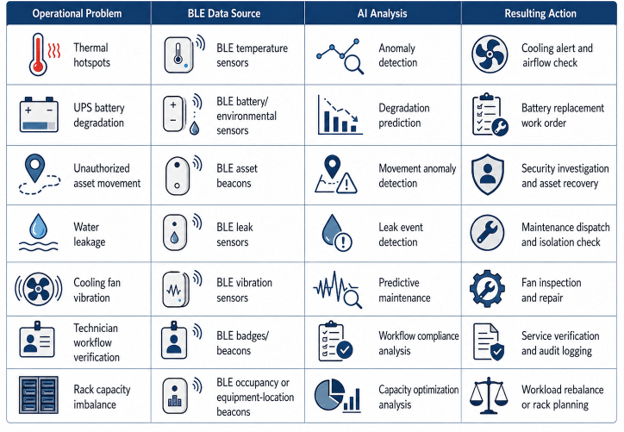
This matrix connects seven common edge facility challenges with their relevant BLE data sources, AI analysis methods, and operational responses. It shows how sensor and beacon data can support thermal management, predictive maintenance, asset security, leak detection, technician verification, and rack capacity planning.
Data-to-Decision Workflow for Edge Computing Operations
Sensor and Beacon Data Acquisition
BLE sensors and beacons transmit advertising packets or establish connections when configuration, acknowledgement, or higher-volume data exchange is required. Sensor selection should consider measurement range, calibration, enclosure rating, battery life, transmission interval, mounting method, and radio behavior inside metal-rich rack environments.
Gateway Collection and Radio Management
BLE gateways scan nearby devices, apply device allowlists, timestamp observations, and forward telemetry to local software. Gateway placement requires a site survey because racks, cable trays, reinforced walls, power equipment, and closed metal cabinets can attenuate or reflect radio signals.
Critical areas should use overlapping gateway coverage. This supports redundancy and allows the software to compare received signal strength across gateways for approximate zone determination.
Edge Processing and Data Normalization
A local edge server or gateway application validates identifiers, removes duplicate observations, checks data freshness, applies calibration values, and converts device-specific payloads into a consistent schema.
Local rules can immediately detect severe temperature, water, smoke-interface, access, or power conditions. AI inference can classify anomalies without waiting for a cloud connection.
AI Analysis and Event Correlation
Machine-learning methods may include:
- Time-series anomaly detection for environmental and power behavior
- Classification models for equipment condition
- Regression models for remaining useful life estimates
- Clustering for unusual operating patterns
- Computer vision for visual equipment and access verification
- Graph analytics for relationships among assets, racks, technicians, alarms, and change records
- Natural-language models for summarizing incidents and maintenance histories
AI Risk Management Framework principles should guide model governance, including validation, human oversight, performance monitoring, documentation, and management of harmful or unreliable outputs. NIST developed the AI RMF to help organizations manage risks associated with AI systems.
Integration With Operational Software
Normalized events can be integrated with:
- Data center infrastructure management software
- Building management systems
- Configuration management databases
- IT service management and ticketing tools
- Network management systems
- Security information and event management software
- Identity and access management systems
- Computerized maintenance management software
- Energy management and sustainability reporting systems
- Enterprise resource planning and procurement systems
Integration should use authenticated APIs, message brokers, webhooks, database connectors, or industrial protocols appropriate to the environment.
Automated and Human-Approved Actions
Low-risk actions can be automated when control boundaries are clearly defined. Examples include creating a work order, increasing data collection frequency, capturing an equipment snapshot, escalating an alarm, or notifying the responsible technician.
Higher-risk actions, such as shutting down computing equipment, changing cooling setpoints, isolating network segments, or denying facility access, should normally require approval or rigorously tested policy controls.
End-to-End BLE Data Workflow for AI-Enabled Edge Computing Facilities
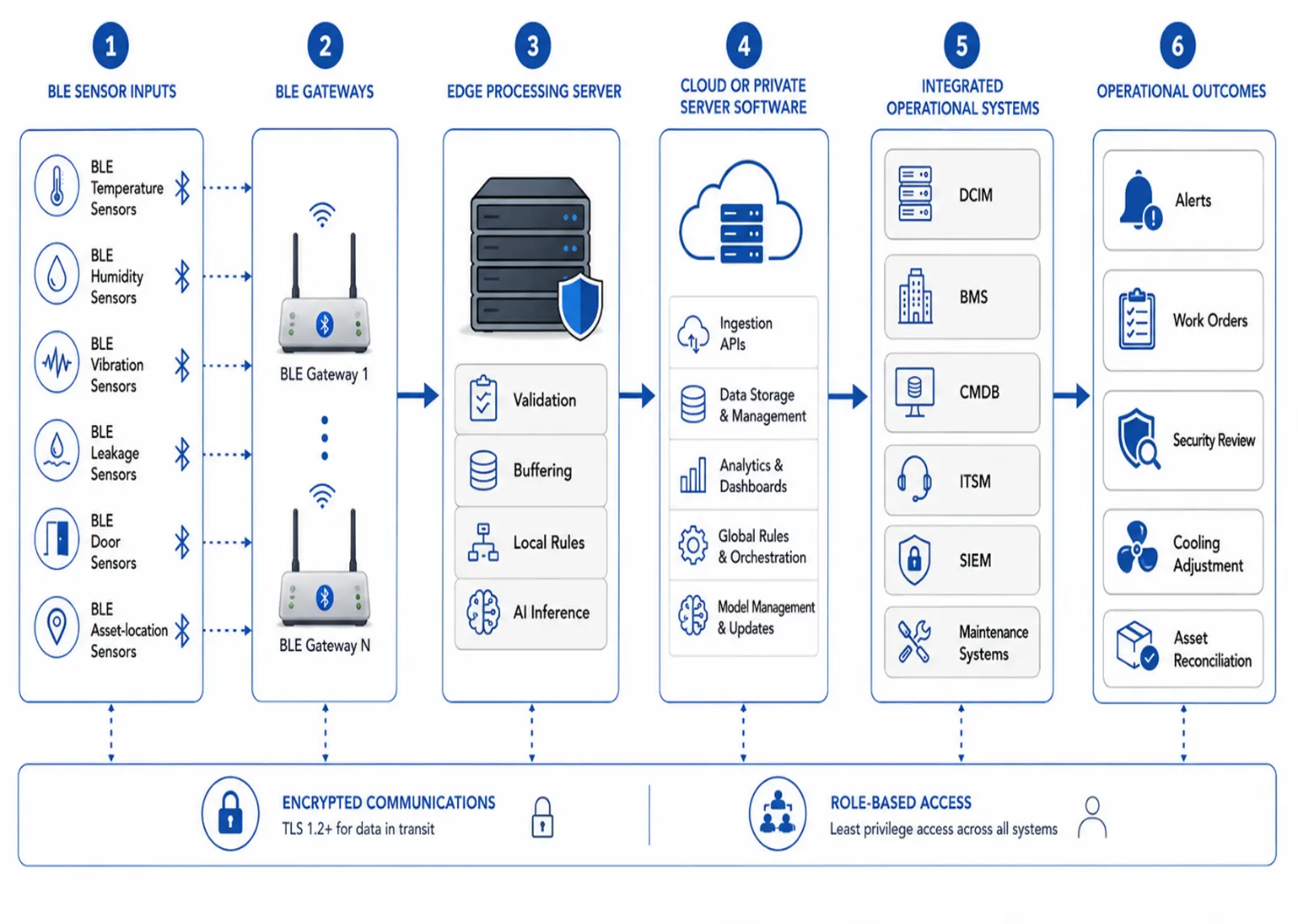
This workflow diagram shows how BLE temperature, humidity, vibration, leakage, door, and asset-location data moves through gateways, edge processing, and cloud or private server software. The data is integrated with DCIM, BMS, CMDB, ITSM, SIEM, and maintenance systems to generate alerts, work orders, security reviews, cooling adjustments, and asset reconciliation.
BLE, AI, Software, and Supporting Infrastructure
BLE sensing systems for edge computing facilities consist of several coordinated hardware and software layers. The current Bluetooth specifications define the technical requirements needed for interoperable Bluetooth devices, although deployed products should be evaluated by supported features rather than specification number alone.
BLE Sensors and Beacons
BLE sensors measure operating and environmental conditions. BLE beacons provide identifiers and periodic location signals. Devices should support secure provisioning, configurable transmission intervals, battery status reporting, tamper detection where required, and firmware maintenance.
Metal enclosures and electromagnetic conditions inside equipment rooms require practical radio validation. A beacon that performs well in an open office may behave differently when mounted behind a server, inside a rack door, or near power distribution equipment.
BLE Gateways
Gateways bridge short-range BLE communications with IP networks. Relevant features include:
- Concurrent scanning capacity
- Ethernet, Wi-Fi, or cellular backhaul
- Local buffering
- Device filtering
- Secure boot
- Signed firmware
- Remote configuration
- Certificate-based authentication
- Health monitoring
- Time synchronization
- Environmental and enclosure suitability
Gateway compute capacity should match the intended workload. Basic collection requires modest resources, while local AI inference, protocol conversion, and multi-system integration require greater processing and memory.
Edge Servers and AI Accelerators
Edge servers host data processing, inference, event correlation, and local automation. CPU-based inference may be sufficient for time-series and tabular models. Computer vision or larger models may require GPUs, neural processing units, or other accelerators.
Resource allocation should protect critical facility functions from AI workload contention. Container limits, service priorities, watchdog processes, and separate management networks reduce the risk that analytics software affects operational monitoring.
Cloud Version
A cloud-hosted version is appropriate when the operator manages many geographically distributed sites and requires centralized device administration, fleet analytics, model updates, cross-site benchmarking, and remote access.
Cloud deployment advantages include centralized scalability, simplified software maintenance, shared reporting, and easier aggregation of large historical datasets. Design requirements include resilient buffering, encrypted transmission, tenant isolation, regional data controls, and continued local operation during backhaul interruption.
Server Version
A server version runs on an edge server, customer-managed server, private cloud, colocation environment, or privately hosted data center. It is suitable for regulated operations, restricted networks, data-sovereignty requirements, low-latency control, and sites that cannot depend on continuous internet access.
Server deployments require customer-managed backup, patching, high availability, capacity planning, monitoring, and disaster recovery. A hybrid model can retain critical inference and automation locally while sending approved summaries to a central service.
Communication and Integration Protocols
The complete solution may use:
- Bluetooth Low Energy for local sensor and beacon communications
- Ethernet or Wi-Fi for gateway connectivity
- LTE, 5G, microwave, or satellite for remote backhaul
- MQTT or AMQP for telemetry transport
- HTTPS and REST APIs for software integration
- SNMP for network and equipment monitoring
- Modbus TCP or BACnet/IP for facility systems
- Syslog for operational and security events
- Network Time Protocol or Precision Time Protocol for event correlation
Protocol selection should reflect latency, reliability, interoperability, security, and bandwidth requirements.
Cybersecurity Controls
NIST’s IoT cybersecurity program supports the development and application of standards and guidance for securing IoT devices and the environments in which they operate.
Recommended controls include:
- Unique device identities
- Removal of default credentials
- Mutual authentication
- Encryption in transit
- Signed firmware and secure boot
- Role-based access control
- Network segmentation
- Certificate rotation
- Vulnerability and patch management
- Device inventory and lifecycle records
- Security event logging
- Data minimization
- Tested recovery procedures
- Controlled commissioning and decommissioning
BLE payloads should avoid exposing sensitive asset or user information. Rotating identifiers, application-layer encryption, filtered gateway forwarding, and restricted administrative access may be necessary for higher-security deployments.
Deployment Design and Engineering Considerations
Conduct a Facility and Radio Survey
Document rack layouts, wall materials, cooling paths, power equipment, wireless interference, network availability, and restricted zones. Test gateway coverage with representative sensors mounted in their intended positions.
Define Operational Outcomes Before Selecting Devices
Sensor deployment should begin with specific decisions the organization needs to improve. Examples include reducing thermal incidents, shortening mean time to repair, controlling asset movement, detecting leakage earlier, or optimizing maintenance dispatch.
Device count alone is not a success metric.
Establish a Data Model
Define consistent names for sites, rooms, racks, assets, sensor types, units, alarm states, work orders, and responsible teams. A stable asset hierarchy makes cross-site analysis and integration more reliable.
Use Risk-Based Sampling Intervals
Faster transmission improves responsiveness but increases battery consumption, radio traffic, storage, and processing demand. Critical thermal or leakage sensors may require shorter intervals than inventory beacons or low-risk environmental devices.
Adaptive sampling can increase frequency when values begin changing abnormally.
Validate AI Models Under Site-Specific Conditions
Models should be tested using seasonal temperatures, workload cycles, maintenance periods, network outages, equipment replacements, and sensor failures. A model trained on a climate-controlled urban facility may not transfer directly to an outdoor telecom shelter or industrial edge room.
Design for Failure
Gateways, sensors, networks, power sources, software services, and AI models can fail. The solution should detect stale data, missing devices, abnormal battery discharge, gateway loss, time drift, and model degradation.
Critical alarms should not depend exclusively on AI. Deterministic safety thresholds remain necessary for conditions requiring immediate action.
Plan the Device Lifecycle
Commissioning procedures should cover device identity, ownership, firmware, calibration, mounting position, battery type, expected service life, and removal. Decommissioned devices must be deleted from allowlists, certificates revoked, and associated records updated.
Performance Indicators for AI-Enabled Edge Facility Monitoring
Technical and operational KPIs should be established before commissioning.
Availability and Incident Metrics
- Edge service availability
- Site uptime
- Number of critical environmental events
- Mean time to detect
- Mean time to acknowledge
- Mean time to repair
- Repeat incident rate
- Percentage of incidents detected before service impact
Environmental and Energy Metrics
- Rack inlet temperature compliance
- Hotspot duration
- Humidity compliance
- Cooling energy consumption
- Power usage effectiveness where applicable
- Rack power density
- Energy per compute workload
- Cooling alarm frequency
Asset and Security Metrics
- Asset inventory accuracy
- Unauthorized movement events
- Missing asset rate
- Time required to locate equipment
- Unresolved access anomalies
- Percentage of changes reconciled automatically
- Tool and spare-part recovery rate
Sensor and Gateway Health Metrics
- Device reporting availability
- Packet reception rate
- Gateway coverage redundancy
- Battery replacement rate
- Sensor calibration exceptions
- Stale-data events
- Firmware compliance
- Average device commissioning time
AI Model Metrics
- Precision and recall for actionable incidents
- False-positive rate
- False-negative rate
- Detection lead time
- Model drift indicators
- Percentage of recommendations accepted
- Human override rate
- Prediction confidence by event type
KPIs should be segmented by site class, environmental condition, equipment type, and operational criticality. Comparing a climate-controlled metropolitan node with a remote outdoor enclosure without contextual normalization can produce misleading conclusions.
Technical Benefits and Business Value
Earlier Detection of Infrastructure Risk
Distributed sensing gives operators visibility closer to the affected equipment. AI identifies relationships and trends that isolated threshold alarms may miss, allowing teams to intervene before service degradation.
Lower Field-Service Costs
Remote diagnosis helps determine whether an incident requires immediate dispatch, scheduled maintenance, remote remediation, or continued observation. Better diagnosis also improves first-visit resolution by identifying likely parts and tools.
Improved Operational Resilience
Local inference and buffering allow monitoring to continue during central network disruption. This is important for remote sites where backhaul quality may vary.
More Accurate Asset Records
Automated beacon observations reduce dependence on manual spreadsheets and periodic inventories. Reconciliation with change and maintenance records improves configuration accuracy.
Scalable Multi-Site Operations
Standardized devices, data schemas, models, and workflows allow a central team to supervise many edge locations without applying identical thresholds to every facility.
Stronger Security Context
Combining asset movement, access activity, door state, technician presence, and maintenance records produces more useful security evidence than reviewing each source separately.
Better Maintenance Prioritization
Risk scoring directs limited maintenance resources toward equipment with the highest probability and consequence of failure. Lower-risk tasks can be scheduled during planned visits.
GAO has helped organizations implement connected monitoring and identification systems by supplying BLE, RFID, and related IoT hardware products and systems. Headquartered in New York City and Toronto, Canada, GAO is ranked among the leading global B2B and B2G suppliers of BLE and RFID technologies.
AI-Enabled BLE Operations Dashboard for Edge Computing Facilities
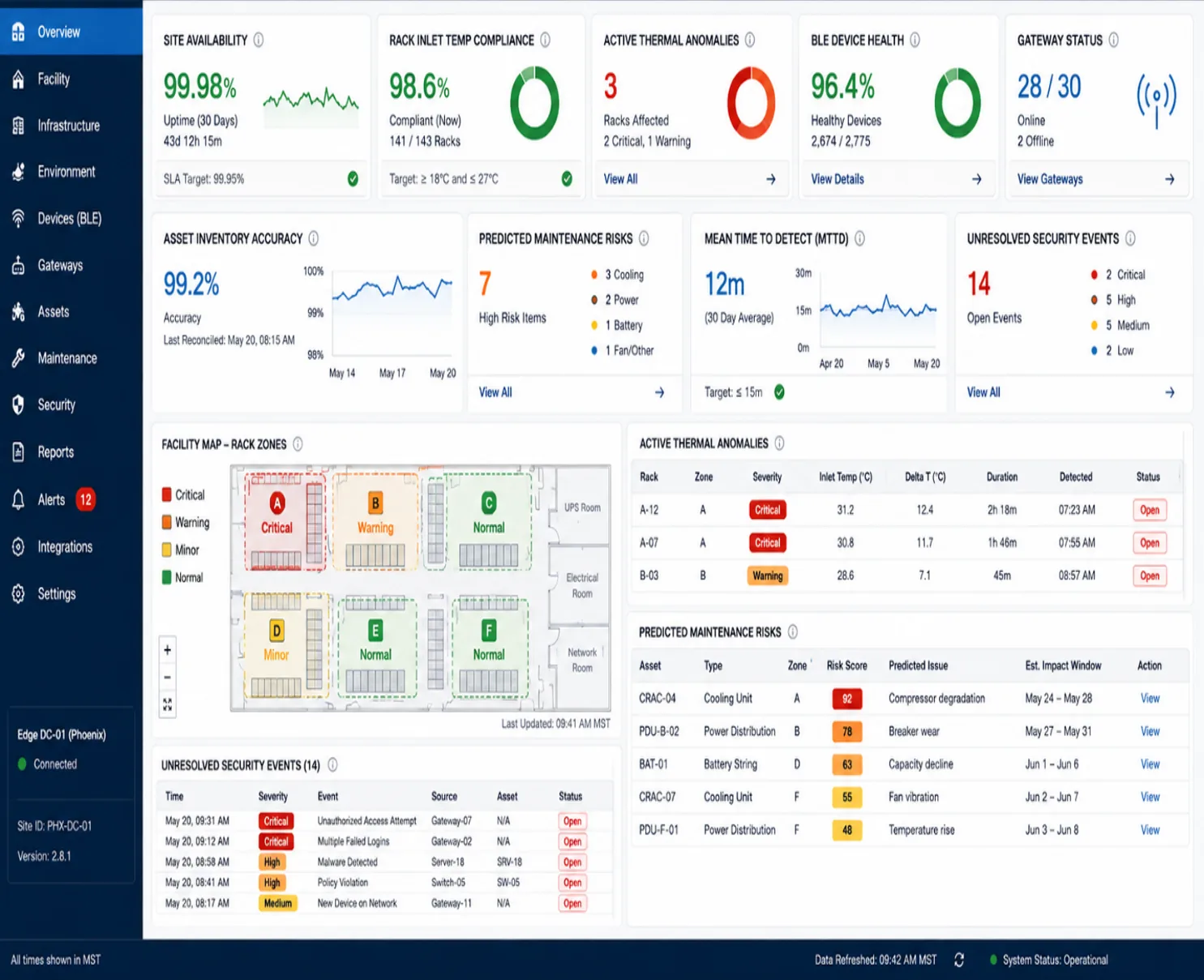
This dashboard presents the operational information used to manage an edge computing facility, including availability, rack temperature compliance, BLE device health, gateway status, asset accuracy, maintenance risks, detection time, and security events. The facility map and severity indicators help teams identify affected rack zones and prioritize technical response.
Recommended Implementation Roadmap
Define the Use Case and Baseline
Select one or two high-value problems, document current incident rates, labor effort, downtime, and data quality, and establish measurable acceptance criteria.
Pilot a Representative Edge Site
Choose a site that reflects typical rack density, radio conditions, cooling arrangements, security controls, and connectivity constraints. Avoid selecting only the easiest facility.
Install and Commission the Devices
Record device identities, firmware, placement, calibration, ownership, expected battery life, and gateway relationships. Validate readings against reference instruments.
Integrate Operational Systems
Connect the solution to the CMDB, ITSM, DCIM, BMS, SIEM, or maintenance software needed to convert findings into accountable actions.
Train and Validate the AI Models
Use normal and abnormal operational periods. Test model performance across workload changes, maintenance events, sensor faults, and network interruptions.
Run a Controlled Parallel Period
Compare AI-generated findings with existing alarms and technician observations. Track missed incidents, duplicate alerts, false positives, and operator feedback.
Establish Governance
Assign responsibility for model approval, threshold changes, security, device administration, incident response, privacy, maintenance, and audit evidence.
Expand Through Standardized Site Profiles
Create profiles for indoor micro data centers, outdoor telecommunications shelters, retail edge rooms, industrial edge cabinets, healthcare edge nodes, and other recurring facility types.
Building Reliable AI-Enabled Edge Operations With GAO
AI-driven monitoring supported by BLE can help edge computing operators manage thermal risk, equipment condition, asset movement, technician workflows, physical security, and distributed maintenance. The strongest implementations combine flexible wireless sensing with local processing, reliable system integration, deterministic safety controls, cybersecurity, and documented human oversight.
Success depends less on deploying the largest number of sensors and more on collecting the right data at the right locations, connecting findings to operational workflows, and validating results under real facility conditions.
GAO provides BLE gateways, BLE beacons, BLE sensors, RFID products, and supporting IoT systems for organizations developing connected monitoring and asset visibility solutions. Our technical teams can assist with product selection, deployment planning, integration requirements, and remote or onsite support.
For three decades, GAO and its sister companies have served customers across the United States and Canada, including Fortune 500 companies, leading research organizations, universities, and government agencies. GAO maintains extensive product research and development, quality assurance, and technical support capabilities.
Building the Future of Industrial AI and IoT with Aperture Venture Studio and GAO
For more than three decades, GAO has invested heavily in research and development for industrial BLE, RFID, and IoT technologies. As generative AI and edge intelligence have become practical for infrastructure monitoring, we have expanded our work on AIoT systems that connect sensors, equipment, operational software, and AI-driven decision support.
Aperture Venture Studio supports the development and scaling of advanced AI and IoT solutions relevant to edge computing, digital communications, and connected infrastructure. Aperture brings together AI and IoT specialists, operational executives, investors, and established companies. Aperture Ventures Summit and TekSummit further support technical discussion and collaboration across AI and IoT communities.
We welcome participation from:
- Advisors, co-founders, or employees
- Investors
- Customers