
AI and BLE for Insurance Operations
How AI and BLE Improve Insurance Operations
AI and Bluetooth Low Energy (BLE) technologies can give insurance operations teams more reliable visibility into physical assets, workspaces, inventory, field activities, and operational events that are difficult to capture through conventional insurance systems alone. BLE beacons, BLE sensors, and BLE gateways can collect location, environmental, equipment, occupancy, and condition data, while AI analyzes those data streams for anomaly detection, risk assessment, workflow optimization, claims support, and predictive maintenance. For insurers, brokers, loss-control teams, claims organizations, and insurance service providers, the combination of AI and BLE can connect physical evidence with policy administration, claims management, underwriting, risk engineering, and customer-service processes. The practical value comes from linking trustworthy field data to specific insurance decisions rather than deploying sensors simply for visibility. GAO supplies BLE hardware products and IoT systems that can support these insurance operations use cases, including BLE beacons, sensors, and gateways.
AI, BLE, and the Physical Data Layer of Insurance Operations
Insurance operations depend heavily on information generated outside the core insurance application. Property conditions, equipment status, temperature, humidity, occupancy, asset location, maintenance activity, and incident evidence can influence underwriting, loss prevention, claims handling, and risk engineering. BLE provides a low-power method for collecting and transmitting selected physical-world observations to software systems.
A typical AI and BLE solution combines several technical layers:
- BLE sensorscapture measurements such as temperature, humidity, vibration, motion, door status, water presence, or other condition indicators relevant to insured assets.
- BLE beaconsprovide identifiers and location references for movable equipment, documents, inspection kits, high-value assets, and other tagged objects.
- BLE gatewaysreceive nearby BLE advertisements or sensor messages and forward normalized data to local servers or cloud-hosted software.
- AI modelsanalyze historical and real-time observations to identify anomalies, classify events, estimate risk, prioritize inspections, and support operational decisions.
- Insurance softwareconsumes relevant outputs through APIs, middleware, files, or event-driven integrations with claims, policy, CRM, risk-engineering, asset-management, and reporting systems.
BLE is particularly useful where sensor nodes need long battery life, low installation complexity, and short-range communication to a gateway. It is not a substitute for every wide-area communication technology. Large facilities, distributed commercial properties, or mobile field operations may require BLE combined with cellular, Wi-Fi, LoRaWAN, Ethernet, or other connectivity methods.
AI adds another layer of value because raw BLE telemetry is rarely sufficient for an insurance decision. A temperature reading becomes more useful when correlated with building type, insured asset, historical operating conditions, weather, maintenance records, inspection findings, and claims history. Similarly, an asset-location event becomes operationally significant when the system understands whether the asset should be at a particular site and whether its movement corresponds with an approved workflow.
For insurance operations, the engineering objective should therefore be decision-quality data, not simply more sensor data.
AI and BLE Data Flow for Insurance Operations: From Physical Risk Data to AI Insights
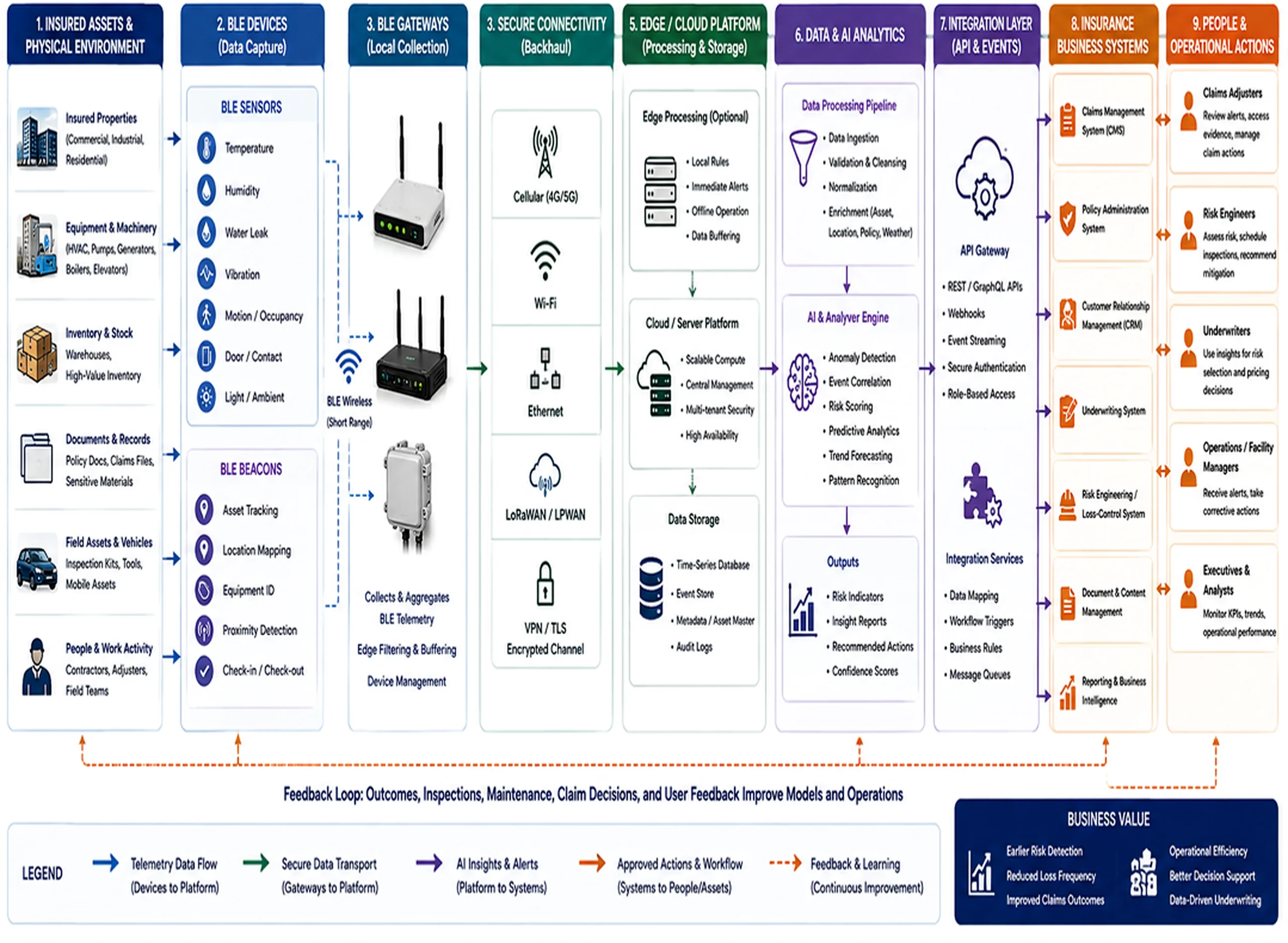
The completed technical diagram shows how data from insured properties, equipment, documents, and field assets moves through BLE sensors and beacons, gateways, secure connectivity, edge or cloud/server processing, AI analytics, and integration services. It highlights how validated telemetry becomes risk indicators, alerts, and recommendations that support claims, underwriting, risk engineering, and facility operations, with feedback returning to improve models and workflows.
Priority AI and BLE Applications in Insurance Operations
The strongest applications are those where physical-world information can improve an existing insurance workflow, reduce manual evidence collection, or provide earlier visibility into a developing risk.
Property Risk Monitoring and Loss Prevention
BLE environmental sensors can monitor conditions associated with property damage, including temperature, humidity, water presence, equipment vibration, and unauthorized access indicators. AI can establish operating baselines and identify deviations that warrant inspection or intervention.
For commercial property insurance, this can support loss-control programs by providing additional evidence between scheduled inspections. A risk engineer may receive an alert when environmental conditions persist outside an expected range, while the insurer can retain relevant event history for later analysis.
The engineering challenge is avoiding false alerts. A model should consider sensor calibration, sampling intervals, seasonal patterns, building characteristics, and maintenance conditions rather than treating every threshold crossing as an insurance event.
Claims Evidence and Incident Investigation
BLE devices can provide time-stamped operational observations that complement photographs, inspection reports, access records, equipment logs, and other claims evidence. AI can organize these observations and identify unusual sequences or changes around an incident.
For example, environmental telemetry from an insured commercial facility could help establish the sequence of conditions surrounding a suspected equipment or water-related incident. The BLE data should be treated as one evidence source within the claims process, with appropriate validation, retention, access controls, and human review.
Asset Tracking for Insurance Operations
BLE beacons can identify and locate inspection equipment, claims equipment, mobile devices, high-value operational assets, and other tagged items. Gateways installed at offices, warehouses, commercial facilities, or temporary claims locations can provide location events.
AI can identify unusual movement patterns, prolonged inactivity, missing assets, or operational bottlenecks. This can improve utilization and reduce time spent searching for equipment, particularly where claims and inspection teams operate across multiple locations.
Risk Engineering and Field Inspections
Risk engineers and loss-control personnel frequently need to combine site observations with historical information. BLE sensors can provide continuous measurements between physical inspections, while AI can prioritize locations requiring human attention.
A risk-engineering workflow can combine sensor telemetry with property characteristics, inspection findings, maintenance records, prior incidents, and environmental information. The resulting risk indicators can help determine which sites should receive earlier inspection or additional investigation.
Insurance Facility and Workplace Monitoring
BLE occupancy, motion, environmental, and equipment sensors can support monitoring of insurer offices, document-storage areas, claims centers, laboratories, and other operational facilities. AI can identify abnormal environmental conditions, equipment behavior, or space utilization patterns.
These applications should be designed around an explicit business workflow. Monitoring without a defined response process creates data volume without operational value.
Underwriting and Risk Assessment Support
BLE telemetry can supplement underwriting information where continuous physical observations are appropriate and permitted. Historical condition data may help characterize operational patterns, equipment exposure, or risk-control performance.
AI can transform validated telemetry into trend indicators or risk features for authorized underwriting workflows. Such outputs should remain explainable, auditable, and subject to the insurer’s underwriting policies and applicable regulatory requirements.
The Insurance Operations Workflow from BLE Telemetry to AI Decision
A production AI and BLE solution should be designed as an operational chain rather than as an isolated sensor deployment.
The workflow begins with data acquisition. BLE sensors measure relevant physical conditions, while BLE beacons identify tagged assets or provide location references. Sensor configuration should account for measurement accuracy, battery life, environmental conditions, sampling frequency, installation position, and maintenance requirements.
BLE gateways provide the collection point for local devices. Depending on the facility and deployment model, gateways can forward data using Ethernet, Wi-Fi, cellular, or another suitable backhaul connection. Gateway placement requires consideration of BLE range, building materials, interference, device density, battery-powered sensor behavior, and physical accessibility for maintenance.
The next stage is data validation and normalization. The system should identify missing readings, duplicate events, implausible values, timestamp inconsistencies, sensor faults, and connectivity interruptions before analytics consume the data. Device identity, asset identity, location, and insurance-relevant metadata should remain consistent across the data pipeline.
Validated telemetry can then be processed at an edge server or cloud/server environment. Edge processing is useful when immediate local decisions are required or when connectivity is intermittent. Cloud-hosted processing can support centralized analytics across geographically distributed insurance operations, while privately hosted servers can be appropriate where data-control, integration, or organizational requirements favor customer-managed infrastructure.
AI services can perform inference, anomaly detection, classification, forecasting, clustering, or risk prioritization depending on the use case. The output might be an alert, inspection priority, equipment anomaly, environmental-risk indicator, asset exception, or recommendation for human review.
The final stage is the insurance business action. Outputs can be presented through dashboards or integrated into claims management, underwriting systems, CRM software, policy administration, risk-engineering applications, work-order systems, or reporting tools. Where actions have material claims, underwriting, compliance, or customer implications, human approval should remain an explicit control point.
This closed-loop approach also creates a feedback mechanism. Approved outcomes, inspection results, confirmed incidents, false positives, maintenance records, and claims decisions can become additional training or evaluation data, subject to applicable data governance requirements.
Engineering Priorities for an Insurance-Grade AI and BLE Solution
Successful insurance deployments require more than selecting BLE hardware and connecting it to an AI service. GAO’s experience supplying BLE and IoT hardware and systems makes device selection, gateway coverage, interoperability, data quality, and deployment support important considerations during solution planning.
Key engineering priorities include:
- Measurement quality:Select sensors according to the required accuracy, environmental range, calibration approach, sampling frequency, and battery-life requirements.
- BLE coverage:Validate gateway placement through a field survey rather than relying only on nominal radio range.
- Device identity:Maintain reliable mappings between BLE identifiers, insured assets, locations, policies, and operational records.
- Data quality:Establish validation rules before AI models consume telemetry.
- Interoperability:Use documented APIs, standard data formats, and middleware interfaces for claims, underwriting, CRM, and related insurance systems.
- Security:Apply device authentication, authorization, encrypted transport, credential management, secure gateway configuration, logging, and controlled software updates.
- Human oversight:Define which AI outputs can trigger automated workflows and which require claims, underwriting, risk, or operations personnel to approve an action.
- Lifecycle management:Plan for battery replacement, sensor calibration, gateway maintenance, firmware updates, device retirement, model drift, and changing insurance workflows.
BLE Hardware, Software, and AI Components for Insurance Operations
A production AI and BLE solution for insurance operations typically combines sensing devices, BLE gateways, communications infrastructure, data services, AI software, and integrations with existing insurance applications. Component selection should follow the operational requirement rather than treating BLE hardware or AI software as an isolated technology purchase.
BLE Sensors and Beacons
BLE sensors can measure environmental and equipment conditions relevant to insured properties and operational facilities. Depending on the application, devices may capture temperature, humidity, vibration, motion, water presence, door or contact status, light conditions, or other supported measurements.
BLE beacons serve a different function. They generally transmit an identifier that allows a gateway or receiving system to determine the presence or approximate location of a tagged asset. Insurance organizations can use beacons for inspection equipment, claims equipment, mobile assets, facility resources, and other items that require location visibility.
Device selection should consider:
- Battery chemistry and expected service interval
- Measurement accuracy and calibration requirements
- BLE advertising interval and transmission power
- Operating temperature and environmental protection
- Sensor enclosure and installation method
- Local storage or buffering requirements
- Firmware update capabilities
- Device authentication and identifier management
- Gateway compatibility
- Replacement and maintenance procedures
GAO provides BLE sensors and beacons that can be incorporated into broader IoT solutions where the device characteristics match the operational requirement.
BLE Gateways
BLE gateways form the bridge between local BLE devices and the insurance organization’s data-processing environment. Gateway selection should account for the number of nearby BLE devices, radio conditions, physical layout, backhaul connectivity, local processing requirements, and installation constraints.
A gateway may use Ethernet, Wi-Fi, cellular, or another backhaul method to transmit data. Some deployments can also use local processing to filter, buffer, normalize, or validate events before transmission.
Gateway engineering should include a site survey. Concrete walls, metal equipment, mechanical rooms, elevators, building layouts, radio interference, and sensor placement can materially affect BLE coverage. A nominal communication range from a device specification should therefore not be treated as a substitute for field validation.
Data, AI, and Integration Software
The software layer receives gateway telemetry, validates records, associates device identifiers with insurance-relevant assets, stores historical observations, and exposes data to analytics and operational applications.
AI methods can include:
- Anomaly detection for unusual environmental or equipment conditions
- Classification for event categorization
- Time-series forecasting for condition trends
- Predictive maintenance models for equipment behavior
- Risk prioritization for inspection and loss-control activities
- Clustering for identifying operational patterns
- Computer vision where visual inspection data are incorporated alongside BLE telemetry
- Natural-language processing for organizing inspection notes, claims documentation, and related unstructured information
AI should not automatically be treated as the decision-maker. A model can identify an unusual condition or prioritize an inspection, while an authorized insurance professional determines whether the result requires a claims action, risk-control intervention, underwriting review, or no action.
Cloud Version and Server Version for Insurance Operations
Deployment decisions affect connectivity, data control, scalability, maintenance responsibility, integration, and operational resilience. Insurance organizations with geographically distributed properties may favor centralized cloud-hosted processing, while organizations with strict data-control requirements or specialized integration environments may prefer privately hosted infrastructure. A hybrid design can combine the two.
Cloud Version
A cloud-hosted deployment places the AI and IoT software within managed cloud infrastructure. BLE gateways transmit validated telemetry to cloud services, where data storage, AI inference, dashboards, reporting, and integrations can be centrally managed.
Cloud deployment is particularly useful when an insurer needs to manage large numbers of locations, properties, gateways, and sensor deployments from a common software environment. Centralized infrastructure can simplify software updates, model deployment, analytics, remote monitoring, and multi-location reporting.
Cloud deployment can support:
- Centralized management of distributed BLE gateways
- Elastic computing for AI training and inference workloads
- Centralized time-series and event storage
- Remote access for authorized claims, risk, and operations personnel
- API connectivity to insurance applications
- Centralized dashboards and alert management
- Automated software and model deployment
- Cross-location analytics and benchmarking
The main engineering dependency is network connectivity. Local gateway buffering and edge processing can reduce the effect of temporary connectivity interruptions, but applications requiring continuous cloud access should not assume that every insured location has reliable broadband or cellular service.
Server Version
A Server Version places the software on privately hosted infrastructure such as an insurer-managed server, private data center, customer-controlled facility, or edge server. This model can provide greater control over data handling, network access, software configuration, and integration with existing privately hosted applications.
Server deployment can be appropriate when an insurance organization requires:
- Local processing or offline operation
- Greater control over data storage and retention
- Integration with privately hosted claims or underwriting applications
- Custom network segmentation
- Local AI inference
- Controlled software update procedures
- Specialized infrastructure or security requirements
The trade-off is operational responsibility. The organization may need to manage servers, operating systems, storage, backups, cybersecurity controls, software updates, gateway connectivity, monitoring, and capacity planning.
Hybrid Field-Edge and Cloud/Server Design
A hybrid design can place time-sensitive processing close to BLE gateways while sending selected data to centralized cloud or private server infrastructure. Edge processing can validate telemetry, detect immediate anomalies, buffer events, and continue operating during temporary connectivity loss.
Centralized infrastructure can then perform historical analytics, model training, fleet-level analysis, reporting, and cross-location management.
Security, Privacy, and Data Governance
Insurance operations can involve sensitive policy, claims, customer, property, and operational information. BLE telemetry may not contain all of this information directly, but device identifiers and location or condition records can become sensitive when associated with identifiable assets, facilities, employees, customers, or claims.
Security should therefore cover the complete data path from BLE device to business application.
Key controls include:
- Device identity management and controlled provisioning
- Gateway authentication and authorization
- Encrypted communications between gateways and backend systems
- Network segmentation for IoT devices
- Credential rotation and secure secret management
- Firmware and software update controls
- Role-based access to operational data
- Audit logging for administrative and business actions
- Data retention and deletion policies
- Backup and recovery procedures
- Monitoring for unusual device or gateway behavior
- Controlled access to AI training datasets
- Model version tracking and change management
Insurance organizations should also define which data are retained, who can access them, how long they are retained, and how telemetry is associated with policy, property, claims, or customer records.
AI governance is equally important. Models should have identifiable versions, documented input variables, validation procedures, performance monitoring, and an established process for investigating unexpected results. Human approval is particularly important where an AI output could materially affect claims handling, underwriting decisions, customer interactions, or risk-management actions.
AI and BLE Security Architecture for Insurance Operations
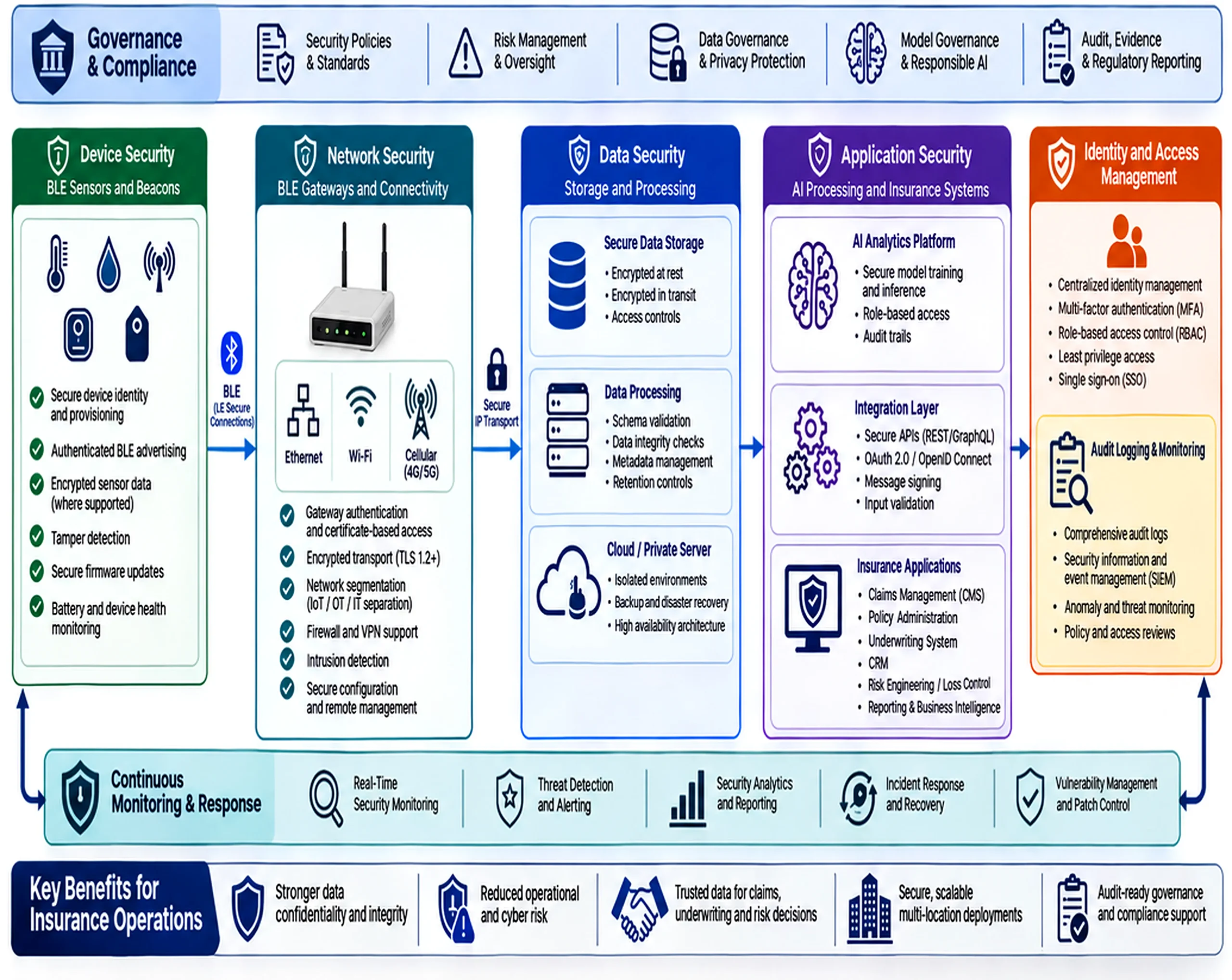
The completed security architecture diagram shows layered protection for BLE sensors and beacons, gateways, networks, data platforms, AI analytics, insurance applications, and user access. It highlights governance, encryption, identity management, network segmentation, audit logging, monitoring, incident response, and AI governance as cross-cutting controls that protect insurance data and operational decisions.
AI Capabilities and Operational Benefits
Combining AI with BLE changes the operational value of sensor data by moving beyond simple monitoring toward prioritization and decision support.
Earlier Risk Detection
Continuous BLE measurements can reveal changes between scheduled inspections. AI can distinguish persistent or unusual patterns from normal variation and generate alerts for appropriate personnel.
More Efficient Claims Operations
Time-stamped sensor observations can provide additional evidence for claims investigation. Automated data organization can reduce manual review effort when large volumes of operational telemetry are available.
Better Risk-Engineering Prioritization
AI can rank locations, assets, or conditions according to defined risk indicators. Risk engineers can use those priorities to focus inspection resources where the available evidence indicates greater attention may be warranted.
Predictive Equipment Monitoring
Vibration, temperature, operating-state, or other supported BLE measurements can provide inputs to equipment-condition models. Predictive methods can identify changes that justify maintenance investigation before a conventional failure occurs.
Improved Asset Utilization
BLE beaconing can provide visibility into asset presence and movement. AI can analyze location histories to identify underused equipment, unusual movement, or recurring operational delays.
Scalable Multi-Location Operations
Centralized cloud or private-server processing can consolidate telemetry from multiple offices, facilities, insured properties, or field operations. This allows insurance organizations to establish consistent monitoring and analytics processes while retaining location-specific rules where necessary.
Insurance Operations KPIs for AI and BLE Deployments
A technology deployment should be evaluated using operational measures rather than device counts alone. Appropriate KPIs depend on the selected insurance workflow and baseline conditions.
Potential measures include:
| KPI area | Example measure | Why it matters |
| Sensor reliability | Data completeness and device availability | Shows whether telemetry is dependable |
| Gateway performance | Gateway connectivity and message delivery | Indicates communication health |
| Alert quality | Valid alert rate and false-positive rate | Measures practical AI usefulness |
| Claims operations | Time required to review relevant evidence | Shows workflow impact |
| Risk engineering | Inspection prioritization effectiveness | Measures whether analytics improve field focus |
| Equipment monitoring | Confirmed anomaly detection | Evaluates predictive condition monitoring |
| Asset operations | Asset location and recovery performance | Measures BLE tracking value |
| AI performance | Model precision, recall, or other task-specific metrics | Tracks model quality |
| Operations | Response time from alert to approved action | Measures closed-loop execution |
| Data governance | Data-quality exceptions and audit completeness | Supports reliable and controlled operation |
Baseline measurements should be established before the pilot begins. KPI targets should be specific to the insurer’s workflow, asset population, operating environment, and available historical data rather than copied from generic technology benchmarks.
Deployment Path for AI and BLE Insurance Operations
A controlled deployment reduces technical and operational risk. The first stage should define the insurance workflow and the decision the system is expected to improve. A sensor should not be selected until the required measurement, accuracy, location, sampling frequency, and response process are understood.
The field survey should then document building conditions, BLE coverage, gateway locations, available power, backhaul connectivity, asset density, environmental conditions, and maintenance access.
Sensor and gateway installation should be followed by commissioning. Device identities, timestamps, measurement behavior, gateway connectivity, and data transmission should be verified before AI development depends on the resulting data.
Data validation should establish whether the telemetry is sufficiently complete and reliable for the intended model. AI development should then use representative historical or pilot data, with clear separation between training, validation, and evaluation activities where the available dataset supports that approach.
Integration testing should verify the complete path from BLE device through gateway, data processing, AI inference, alert generation, human review, and downstream insurance application. A controlled pilot should follow before broader deployment.
AI and BLE Insurance Operations Deployment Lifecycle: From Use Case to Continuous Monitoring
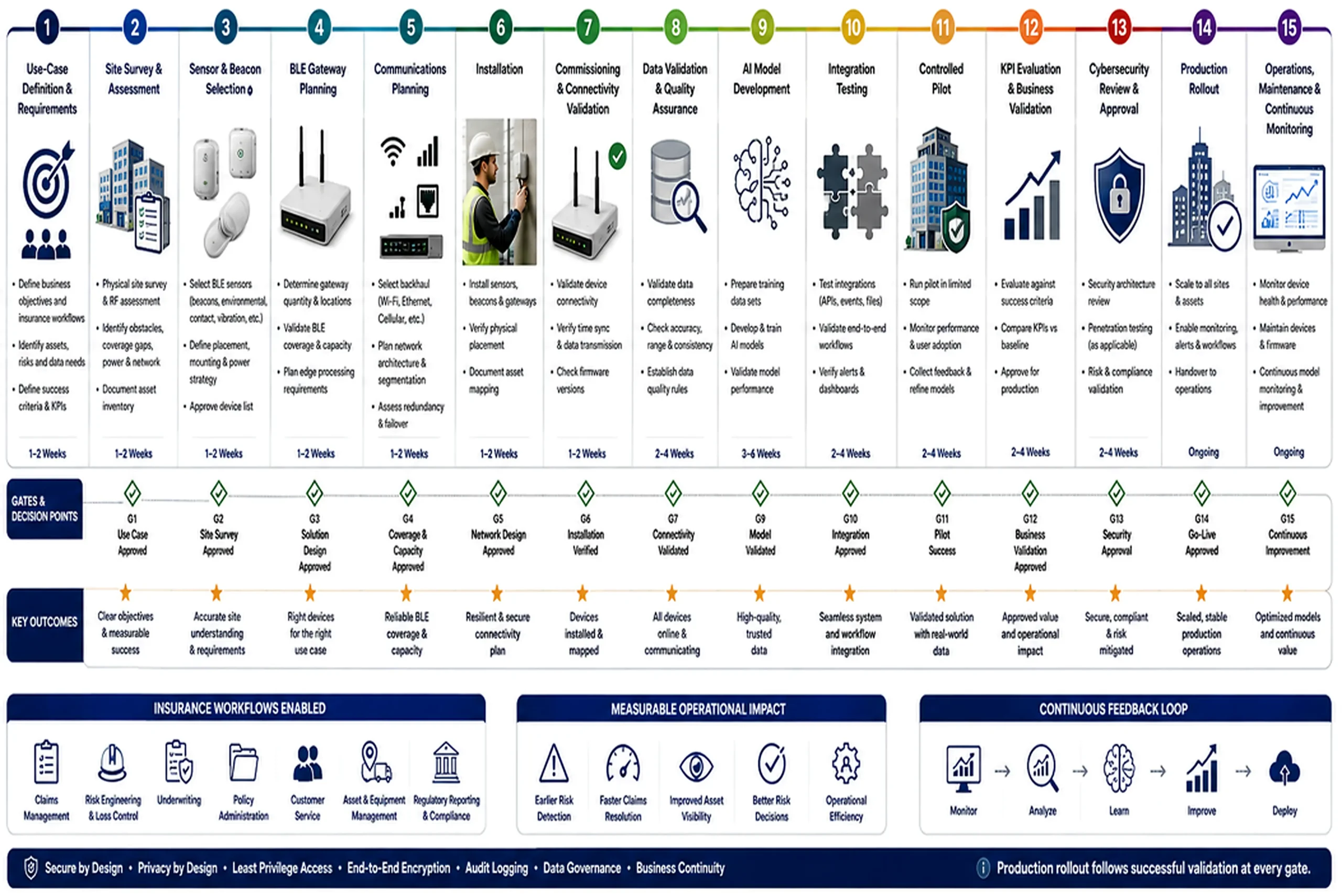
The completed lifecycle timeline maps the 15-stage path from insurance use-case definition and site assessment through BLE selection, gateway planning, installation, data validation, AI development, integration testing, piloting, KPI evaluation, cybersecurity review, production rollout, and continuous monitoring. Decision gates and key outcomes emphasize measurable validation at each stage before scaling the solution into production.
Practical Recommendations for Insurance Technology Managers
Insurance organizations considering AI and BLE should begin with a clearly defined operational problem rather than a device inventory exercise.
- Select use cases where continuous physical-world information can materially improve a defined insurance workflow.
- Conduct a site survey before finalizing BLE gateway quantities and locations.
- Validate sensor accuracy, battery behavior, environmental suitability, and maintenance requirements.
- Establish data-quality rules before developing AI models.
- Define human approval requirements for claims, underwriting, risk, and customer-impacting decisions.
- Select cloud, private-server, or hybrid deployment according to connectivity, data-control, integration, and operational requirements.
- Integrate AI outputs into existing insurance workflows instead of creating an isolated monitoring application.
- Establish cybersecurity, identity, access, audit, retention, and update procedures before production rollout.
- Measure business and operational KPIs against a documented baseline.
- Monitor model performance after deployment and investigate model drift, changing operating conditions, and changes in sensor behavior.
- Plan the complete lifecycle for devices, gateways, software, AI models, integrations, and operational procedures.
- Use a controlled pilot to validate technical performance and user adoption before expanding across additional properties or insurance operations.
GAO’s three decades of R&D and product development in BLE, RFID, and IoT support practical hardware and system considerations across these deployment stages. GAO serves customers in the United States and Canada, including Fortune 500 companies, research and development organizations, universities, and government agencies, with remote and onsite technical support.
Key Takeaways for AI and BLE in Insurance Operations
AI and BLE can provide insurance operations with a practical connection between physical conditions and digital insurance workflows. BLE sensors and beacons collect property, equipment, environmental, and asset information, while gateways transport that information into AI and software systems for validation, analysis, alerting, and decision support.
The strongest deployments focus on measurable workflows such as loss prevention, claims evidence, risk engineering, asset management, facility monitoring, and equipment condition assessment. Success depends on field-tested BLE coverage, reliable data, secure communications, appropriate AI governance, integration with insurance software, and clearly defined human decision points.
GAO provides BLE, RFID, and IoT hardware products and systems that can form part of these solutions. Organizations evaluating AI and BLE for insurance operations can use a staged pilot to validate the technology against actual operational requirements before scaling deployment.
Building the Future of Industrial AI and IoT with Aperture Venture Studio and GAO RFID Inc.
For more than three decades, GAO Group of Companies has invested heavily in R&D for industrial BLE, RFID, and IoT technologies. That experience now supports work connecting AI and IoT capabilities, including BLE and RFID, with practical insurance operations such as risk monitoring, asset visibility, claims support, and loss prevention. We have also established Aperture Venture Studio to advance AI and IoT solutions relevant to these applications.
Aperture brings together technical experts, operational leaders, investors, and industry participants. GAO also supports technical communities through Aperture Ventures Summit and TekSummit, helping advance discussion around practical AI and IoT applications.
GAO, headquartered in New York City and Toronto, Canada, is among the world’s leading B2B and B2G BLE and RFID suppliers. GAO and its sister companies, GAO Research Inc. and GAO Tek Inc., form GAO Group. We welcome advisors, co-founders or employees, investors, and customers to participate in this growing AI and IoT community.