
AI and BLE Solutions for Broadband Providers
AI Powered BLE Solutions Transforming Broadband Provider Operations
Broadband providers operate highly distributed communication infrastructure consisting of central offices, headends, remote cabinets, fiber distribution hubs, wireless backhaul sites, customer premises equipment (CPE), field service fleets, warehouses, and thousands of geographically dispersed network assets. Managing these assets efficiently while maintaining network uptime, service quality, and customer satisfaction requires continuous operational visibility.
Artificial intelligence supported by Bluetooth Low Energy (BLE) gateways, BLE beacons, and BLE sensors enables broadband providers to improve asset visibility, automate operational intelligence, predict equipment failures, optimize field operations, and strengthen network reliability. BLE devices collect location and environmental data from network assets while AI continuously analyzes operational patterns, identifies anomalies, predicts maintenance requirements, and recommends corrective actions before service degradation occurs.
Rather than functioning as isolated technologies, AI and BLE become integrated components within broadband operational support systems, network management software, customer service workflows, maintenance systems, and engineering operations. This combination enables broadband providers to improve network availability, reduce operational costs, accelerate service restoration, and support large-scale fiber, cable, wireless, and hybrid broadband deployments.
GAO has supported organizations across North America by supplying BLE, RFID, and IoT hardware products and systems that help improve operational visibility, infrastructure management, and intelligent automation across demanding communication environments.
Understanding AI Enabled BLE Solutions for Broadband Networks
Broadband service providers manage one of the largest distributed infrastructures within the digital communications sector. Every network includes optical line terminals, passive optical networks, DOCSIS equipment, fiber splice closures, street cabinets, routers, switches, Wi-Fi access points, customer gateways, power systems, backup batteries, cooling equipment, and thousands of maintenance assets deployed across wide geographic regions.
BLE technology enables inexpensive, low-power monitoring and tracking of these distributed resources.
BLE components commonly include:
- BLE Beacons for indoor asset positioning
- BLE Sensors for environmental monitoring
- BLE Gateways for local data collection and forwarding
- Edge computing devices
- AI analytics software
- Network management software
- OSS and BSS integration
- Cloud or privately hosted server software
Artificial intelligence converts raw BLE telemetry into operational intelligence. Machine learning algorithms identify abnormal equipment behaviour, estimate hardware life expectancy, detect maintenance trends, optimize technician dispatching, and improve resource allocation across broadband infrastructure.
This approach supports numerous broadband operations including:
- Fiber network asset tracking
- Remote cabinet monitoring
- Battery health monitoring
- Field technician productivity
- Customer equipment management
- Warehouse inventory optimization
- Environmental monitoring
- Predictive maintenance
- Service assurance
- Infrastructure lifecycle management
Because BLE devices consume very little power, they can operate for years without battery replacement, making them particularly suitable for broadband deployments where thousands of assets require continuous monitoring.
AI Enabled BLE Applications Across Broadband Provider Operations
Broadband providers operate numerous interconnected business functions. AI supported by BLE technology improves each operational area through intelligent automation and continuous situational awareness.
Network Asset Tracking
Fiber distribution hubs, optical splitters, routers, switches, backup generators, portable testing equipment, and installation tools frequently move between warehouses, field vehicles, repair centers, and customer locations.
BLE beacons combined with AI location analytics automatically monitor asset movement, reducing equipment loss while improving inventory accuracy.
Operational improvements include:
- Real-time equipment location
- Automated inventory reconciliation
- Technician tool tracking
- Warehouse optimization
- Reduced equipment search time
- Improved capital asset utilization
AI-Enabled BLE Asset Tracking Workflow for Broadband Provider Infrastructure
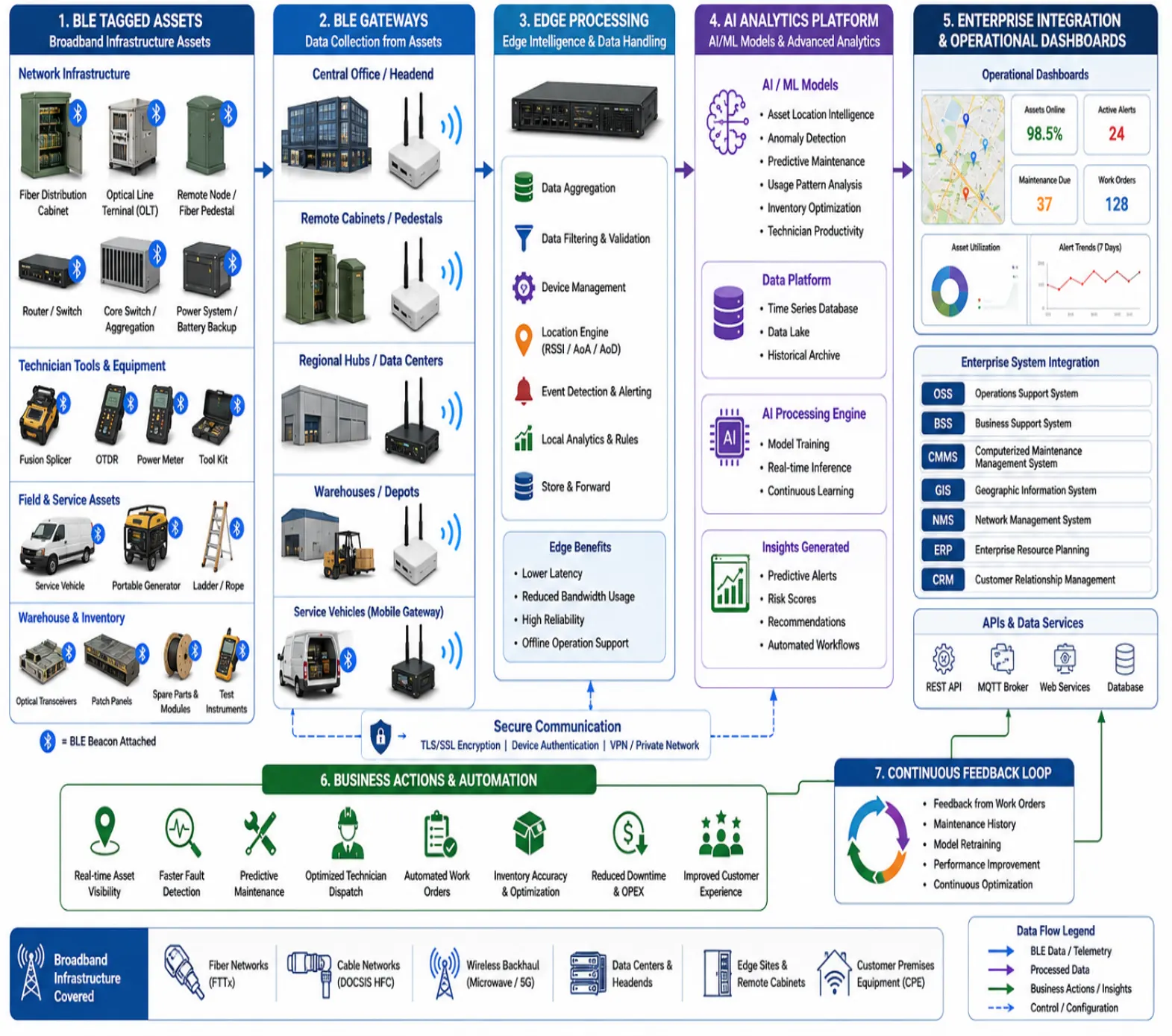
This workflow diagram illustrates how BLE beacons attached to broadband network assets, including fiber distribution cabinets, optical line terminals (OLTs), routers, switches, technician tools, and warehouse inventory, transmit real-time data through BLE gateways to edge processing systems. AI analytics transform the collected telemetry into actionable insights that integrate with OSS, CMMS, GIS, ERP, CRM, and network management systems, enabling predictive maintenance, asset visibility, optimized technician dispatch, and improved broadband network operations.
Predictive Maintenance for Broadband Infrastructure
Unexpected failures within broadband infrastructure directly affect subscriber experience, service level agreements, and operational costs.
BLE sensors continuously monitor equipment including:
- Cabinet temperature
- Battery voltage
- Power consumption
- Door access
- Humidity
- Vibration
- Cooling system performance
Artificial intelligence correlates sensor measurements with historical maintenance records, equipment age, environmental conditions, and failure history to identify degradation before service interruptions occur.
Examples include:
- Detecting battery degradation months before failure
- Identifying overheating fiber cabinets
- Predicting cooling fan failures
- Monitoring generator health
- Detecting excessive cabinet vibration
- Identifying abnormal power consumption
Rather than following fixed maintenance schedules, broadband providers perform condition-based maintenance that minimizes unnecessary site visits while reducing emergency repairs.
Technician Workforce Optimization
Broadband field operations involve installation technicians, fiber splicing teams, maintenance engineers, construction contractors, warehouse personnel, and network operations engineers.
BLE-enabled location awareness combined with AI scheduling software improves workforce efficiency through:
- Intelligent technician dispatching
- Tool availability verification
- Route optimization
- Work order prioritization
- Spare parts allocation
- Travel time reduction
Machine learning continuously evaluates historical repair durations, technician skill levels, traffic conditions, equipment availability, and service priority to recommend the most efficient workforce assignments.
Customer Premises Equipment Management
Broadband providers deploy millions of customer premises devices including:
- Wi-Fi gateways
- Cable modems
- Fiber ONTs
- Mesh networking devices
- Smart extenders
- Home networking equipment
BLE assists technicians during installation while AI analyzes device performance, environmental conditions, installation quality, and customer usage patterns.
Operational benefits include:
- Faster installations
- Improved provisioning accuracy
- Remote diagnostics
- Automated configuration validation
- Reduced repeat service calls
- Improved customer satisfaction
Warehouse and Spare Parts Management
Broadband operators maintain extensive inventories of:
- Optical transceivers
- Fiber patch panels
- GPON modules
- DOCSIS equipment
- Network switches
- Optical testing instruments
- Power supplies
- UPS batteries
- Connectors
- Fiber splicing tools
BLE asset tracking automatically records inventory movement while AI forecasts future spare parts demand based on installation projects, historical consumption, seasonal maintenance trends, and network expansion plans.
Warehouse managers benefit from:
- Reduced inventory shortages
- Lower excess stock
- Faster order fulfillment
- Automated replenishment recommendations
- Improved inventory accuracy
AI-Driven BLE Inventory Optimization for Broadband Provider Warehouses
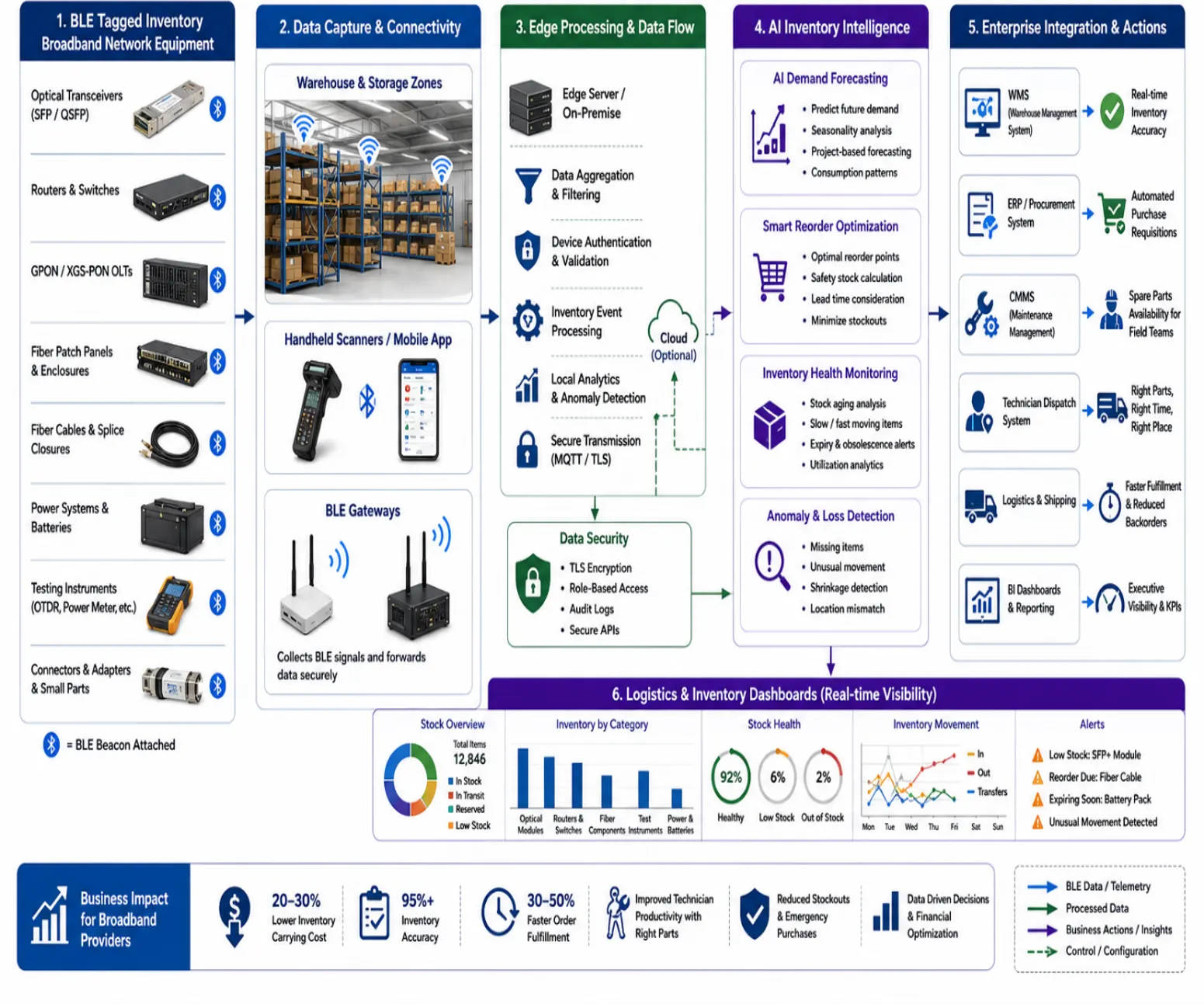
This infographic illustrates how BLE-tagged broadband network equipment is tracked throughout warehouse operations using handheld scanners, BLE gateways, and edge processing. AI analyzes inventory movement, demand patterns, and stock levels to optimize forecasting, automate replenishment, improve technician dispatch, and integrate with warehouse management, procurement, maintenance, and logistics software. The key takeaway is that combining BLE technology with AI enables broadband providers to achieve real-time inventory visibility, higher inventory accuracy, reduced stockouts, and more efficient warehouse operations.
Operational Workflow for AI Enabled BLE Systems in Broadband Providers
Successful deployment requires coordinated integration across communication infrastructure, software systems, field operations, AI analytics, and network management.
The operational workflow generally includes the following stages.
Data Acquisition
BLE beacons and BLE sensors collect operational information from distributed broadband assets including:
- Equipment identification
- Asset location
- Environmental measurements
- Equipment status
- Motion detection
- Access events
- Battery health
- Power measurements
Gateways aggregate nearby BLE transmissions while minimizing communication latency and preserving battery life.
Edge Data Processing
Edge servers positioned within regional network facilities perform initial processing before forwarding information to centralized software.
Edge processing performs:
- Data filtering
- Signal validation
- Device authentication
- Temporary storage
- Event prioritization
- Local anomaly detection
Processing locally reduces unnecessary bandwidth consumption while enabling rapid operational response.
Secure Communication
Communication commonly uses technologies including:
- Ethernet
- Fiber backhaul
- Wi-Fi
- LTE
- 5G
- MPLS
- VPN
- MQTT
- HTTPS
- TLS encrypted communications
Security controls ensure only authorized devices participate within the monitoring system.
AI Analytics
Artificial intelligence processes operational information using multiple analytical techniques including:
- Predictive analytics
- Time-series forecasting
- Classification models
- Regression analysis
- Deep learning
- Reinforcement learning
- Graph analytics
- Anomaly detection
- Pattern recognition
These analytical models identify abnormal operating conditions while estimating future maintenance requirements.
Enterprise Software Integration
Operational intelligence becomes valuable only after integration with existing broadband software.
Common integrations include:
- Operational Support Systems (OSS)
- Business Support Systems (BSS)
- Geographic Information Systems (GIS)
- Computerized Maintenance Management Systems (CMMS)
- Enterprise Resource Planning (ERP)
- Customer Relationship Management (CRM)
- Workforce Management software
- Network Management Systems (NMS)
- Service Assurance software
- Trouble Ticket Management systems
GAO supplies BLE and IoT hardware that integrates with many commonly deployed broadband software environments, helping communication providers modernize monitoring and asset visibility while leveraging existing operational investments.
The layered system diagram has been created, illustrating the complete operational flow from BLE devices through edge computing, AI analytics, enterprise software integration, and business decision support for broadband providers.
AI-Driven BLE Operational Workflow and Enterprise System Integration for Broadband Providers
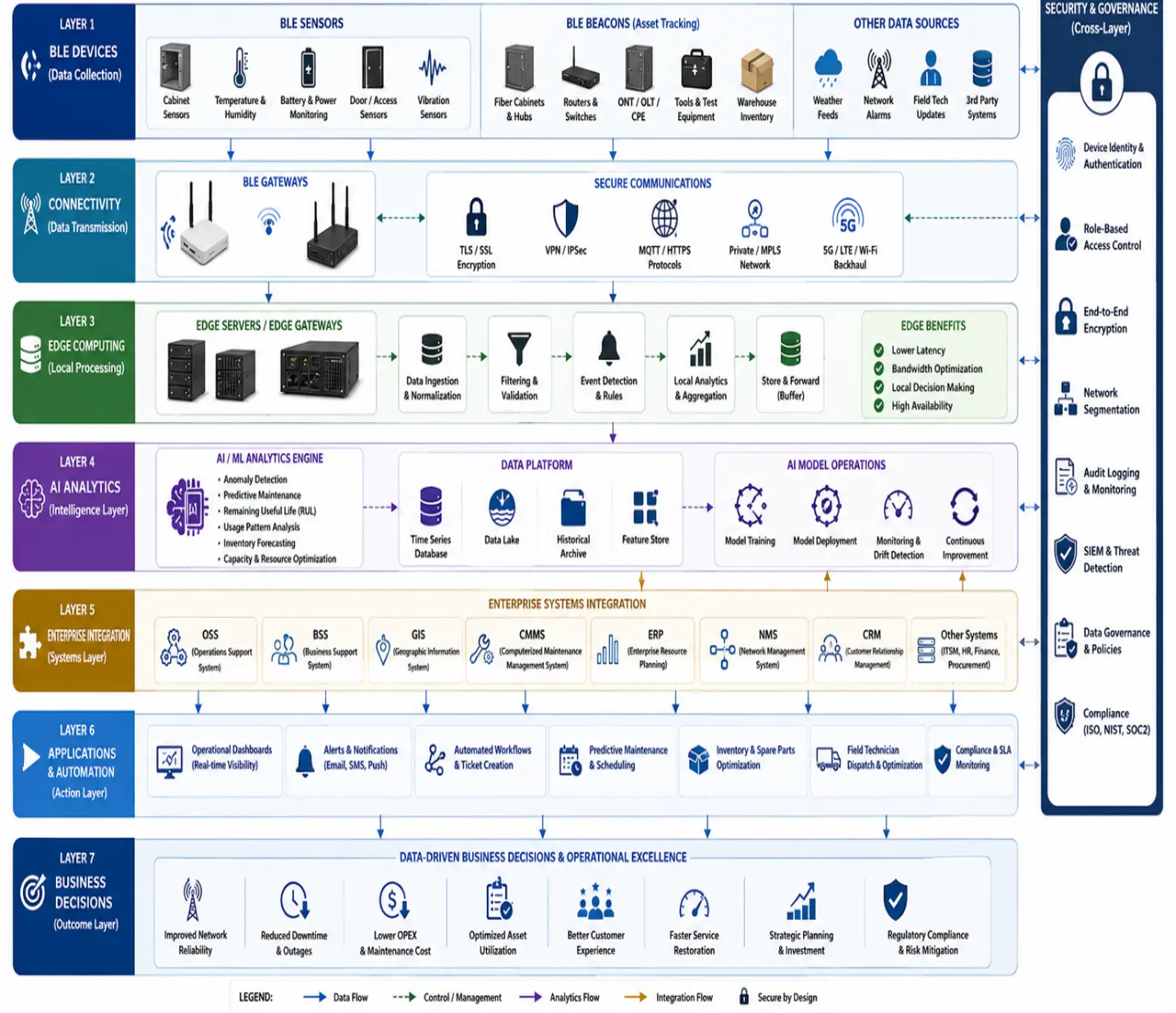
This layered system diagram illustrates the end-to-end operational workflow of an AI-enabled BLE solution for broadband providers. It shows how data collected from BLE sensors, beacons, and gateways flows through secure communications, edge computing, AI analytics, enterprise software integration, and operational dashboards to support predictive maintenance, automated workflows, network management, and data-driven business decisions. The diagram highlights the relationship between operational technology, AI intelligence, and enterprise systems for improving broadband network reliability and operational efficiency.
BLE Infrastructure, AI Software, Communication Standards, and Deployment Considerations for Broadband Providers
Deploying AI enabled BLE solutions within broadband environments requires careful selection of hardware, communications infrastructure, software components, cybersecurity controls, and deployment models. Broadband operators typically support geographically dispersed assets across urban, suburban, and rural service areas, making scalability, interoperability, and resilience critical design objectives.
BLE Hardware Components
A broadband BLE solution typically consists of several complementary hardware elements, each serving a specific operational purpose.
- BLE Beacons:Attached to fiber splice enclosures, optical test instruments, portable generators, ladders, technician toolkits, and other movable assets to provide unique identification and location awareness.
- BLE Sensors:Installed in street cabinets, remote nodes, battery enclosures, and environmental control systems to monitor temperature, humidity, vibration, cabinet door status, and power conditions.
- BLE Gateways:Collect data from nearby BLE devices and forward it securely to edge servers or centralized software over IP networks. Broadband providers often install gateways in central offices, headends, regional hubs, and large equipment rooms.
Supporting Networking Infrastructure
Reliable BLE deployments within broadband environments depend on robust networking infrastructure that connects distributed field devices with operational software. Broadband providers typically use existing communication assets wherever practical, reducing additional deployment costs while improving operational visibility.
Supporting infrastructure commonly includes:
- Fibre optic backhaul networks
- Metro Ethernet services
- DOCSIS access networks
- GPON, XGS-PON, and EPON fibre networks
- Enterprise Wi-Fi
- LTE and 5G connectivity for remote locations
- SD-WAN for branch connectivity
- Edge computing servers
- Redundant power systems
- Network time synchronization
- DNS, DHCP, and authentication services
BLE traffic normally represents only a small portion of network bandwidth, making it suitable for continuous monitoring across thousands of distributed assets.
AI Software Components
Artificial intelligence transforms BLE telemetry into actionable operational intelligence through multiple software layers.
Typical software components include:
- Device management software
- Data collection services
- Stream processing engines
- Machine learning pipelines
- Predictive maintenance software
- Asset management software
- Network analytics software
- Dashboard and reporting software
- Alert management systems
- API integration services
AI models frequently deployed include:
- Time series forecasting
- Predictive maintenance models
- Random Forest classification
- Gradient Boosting algorithms
- Neural networks
- Autoencoders for anomaly detection
- Clustering algorithms
- Reinforcement learning for operational optimisation
- Computer vision where visual inspections complement BLE sensor data
- Large language models for operational knowledge retrieval and maintenance assistance
Rather than replacing existing broadband software, these AI capabilities extend operational intelligence by continuously analysing BLE data alongside historical operational records.
Cloud Version and Server Version Deployments
Broadband providers typically select deployment models based on operational scale, cybersecurity policies, regulatory requirements, and existing IT investments.
Cloud Version
Cloud-hosted software is managed within public or private cloud infrastructure and is appropriate for organisations seeking rapid deployment, elastic scalability, and simplified software maintenance.
Typical characteristics include:
- Centralised monitoring across multiple regions
- Automatic software updates
- High availability through geographically distributed cloud resources
- AI model training using large operational datasets
- Remote access for authorised engineering teams
- Integration with cloud analytics and reporting tools
Cloud deployments are well suited for broadband providers operating nationwide networks with geographically dispersed assets requiring centralised visibility.
Server Version
Server deployments place software on customer-managed servers located within private data centres, regional network facilities, edge computing locations, or other privately hosted enterprise environments.
Typical advantages include:
- Greater control over operational data
- Lower latency for local analytics
- Integration with existing private network infrastructure
- Support for highly regulated operational environments
- Independent software lifecycle management
- Flexible deployment within hybrid IT environments
Large broadband operators frequently implement hybrid deployments where AI inference occurs at regional edge servers while long-term analytics and historical reporting remain centralised.
Communication Protocols
AI-enabled BLE systems commonly integrate with multiple communication protocols throughout broadband operations.
Relevant protocols include:
- Bluetooth Low Energy
- MQTT
- HTTPS
- TLS
- TCP/IP
- UDP
- REST APIs
- WebSocket
- SNMP
- OPC UA where industrial facilities are involved
- Modbus for facility monitoring
- Syslog
- IPv6
- Ethernet
- IEEE 802.11 Wi-Fi
Selecting interoperable communication protocols simplifies integration with existing operational support systems while supporting future network expansion.
Cybersecurity Considerations
Broadband providers manage critical communication infrastructure and therefore require strong cybersecurity throughout BLE deployments.
Recommended security mechanisms include:
- Mutual device authentication
- Certificate-based identity management
- Role-based access control
- Multi-factor authentication
- End-to-end encryption
- Secure boot
- Firmware signing
- Hardware root of trust
- Network segmentation
- Security Information and Event Management (SIEM)
- Continuous vulnerability assessment
- Security event logging
- AI-assisted threat detection
- Zero Trust security principles
Machine learning also contributes to cybersecurity by detecting unusual access patterns, identifying compromised devices, recognising abnormal communication behaviour, and supporting incident response teams with prioritised alerts.
GAO has invested extensively in research and development of BLE, RFID, and IoT hardware products and systems, supported by rigorous quality assurance processes and expert technical support delivered remotely or on site across the United States and Canada.
Cybersecurity Architecture for AI-Enabled BLE Deployments
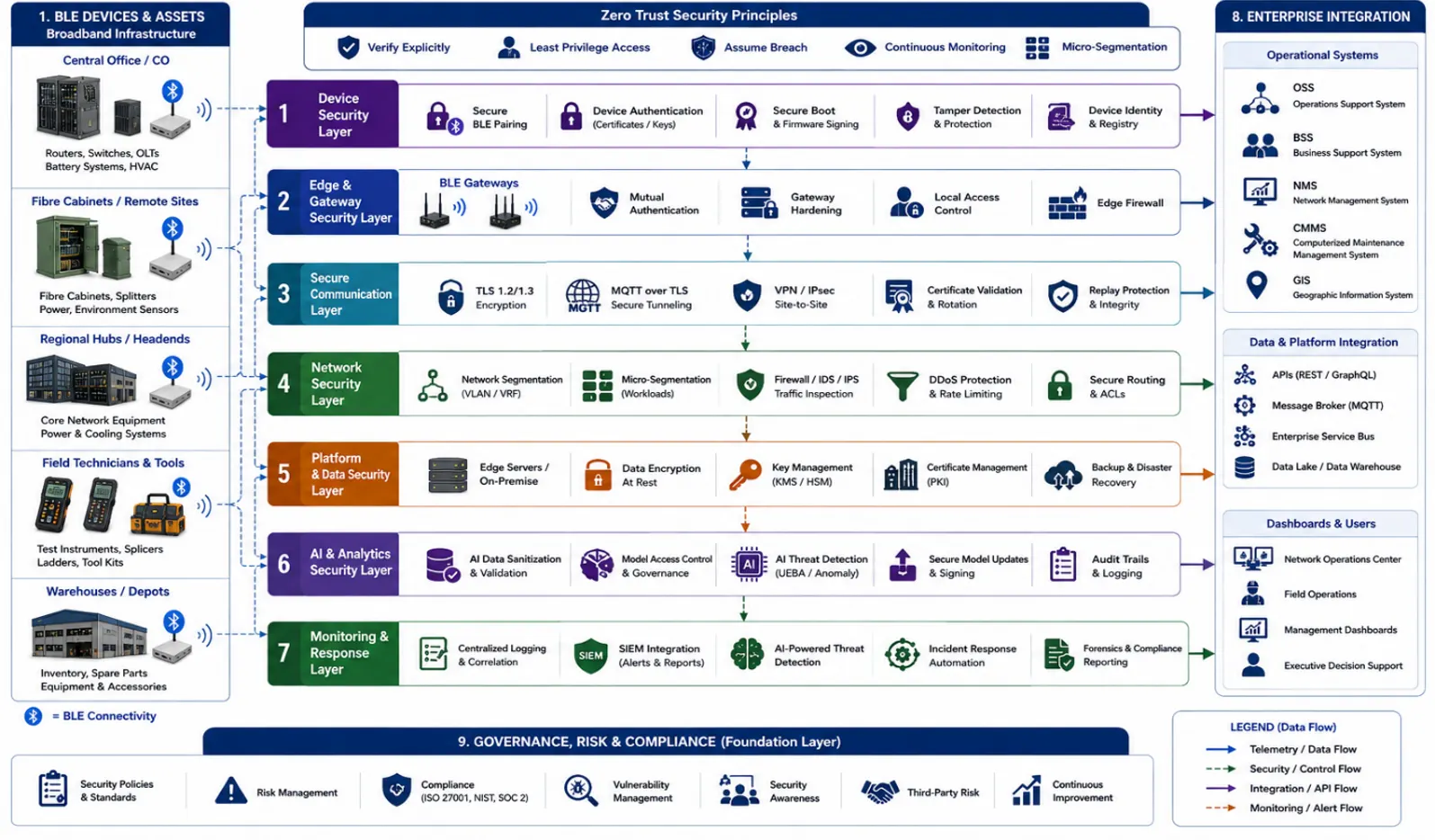
This layered cybersecurity block diagram illustrates how AI-enabled BLE deployments for broadband providers are protected through multiple security layers, including device authentication, certificate management, encrypted communications, network segmentation, edge security, AI-powered threat detection, SIEM monitoring, and governance controls. It demonstrates the secure flow of telemetry from BLE sensors, beacons, and gateways through enterprise systems such as OSS, BSS, CMMS, GIS, and NMS to operational dashboards. The key takeaway is that a defense-in-depth approach enables secure, resilient, and compliant broadband operations while supporting AI-driven decision making.
Technical Capabilities and Business Benefits of AI Enabled BLE for Broadband Providers
AI powered by BLE technology provides measurable operational improvements across broadband provider environments by combining real-time sensing with intelligent analytics.
Improved Network Asset Visibility
BLE beacons continuously report the location of movable assets, allowing engineering teams to locate equipment quickly, reduce losses, and improve utilisation of high-value tools and network components.
Faster Fault Detection
AI continuously analyses sensor data to identify abnormal environmental conditions, power anomalies, and equipment degradation before customer services are affected.
Predictive Maintenance
Rather than relying solely on calendar-based maintenance schedules, AI estimates remaining equipment life and recommends maintenance based on actual operating conditions.
Benefits include:
- Reduced unplanned outages
- Lower maintenance costs
- Improved technician productivity
- Better spare parts planning
Enhanced Service Reliability
Continuous monitoring enables broadband providers to improve:
- Network uptime
- Mean Time to Detect (MTTD)
- Mean Time to Repair (MTTR)
- Service availability
- SLA compliance
Improved Workforce Efficiency
AI analyses technician schedules, travel times, historical repair performance, and asset availability to optimise dispatching and reduce unnecessary field visits.
Better Customer Experience
Improved operational intelligence supports:
- Faster installations
- Quicker service restoration
- More accurate appointment scheduling
- Fewer repeat maintenance visits
- Higher customer satisfaction
Scalable Infrastructure Management
BLE devices consume minimal power while supporting thousands of monitored assets across extensive broadband service areas, making the solution suitable for long-term infrastructure growth.
Data Driven Decision Making
Historical operational information enables management teams to:
- Prioritise capital investments
- Optimise maintenance budgets
- Forecast equipment replacement
- Improve inventory planning
- Measure operational performance
Engineering Best Practices
Broadband providers should consider the following practices when implementing AI-enabled BLE solutions:
- Conduct comprehensive asset inventories before deployment.
- Standardise BLE beacon and sensor identifiers across operational regions.
- Validate RF coverage in central offices, headends, cabinets, and warehouses.
- Implement phased rollouts with pilot projects before full-scale deployment.
- Integrate AI analytics with existing OSS, BSS, CMMS, ERP, GIS, and NMS software.
- Continuously retrain AI models using operational and maintenance data.
- Establish lifecycle management procedures for firmware updates and battery replacement.
- Perform routine cybersecurity assessments and penetration testing.
- Define measurable operational KPIs before implementation.
- Train field technicians and network engineers on BLE device installation and maintenance.
GAO, headquartered in New York City and Toronto, Canada, is recognised among the world’s leading B2B and B2G suppliers of BLE and RFID technologies. Through decades of serving Fortune 500 companies, leading research organisations, universities, and government agencies across the United States and Canada, we have helped organisations deploy dependable hardware products and systems supporting intelligent operational visibility.
Implementation Recommendations for Broadband Providers
Broadband providers planning AI-enabled BLE deployments should adopt a structured implementation strategy that balances technical performance, operational continuity, and long-term scalability.
Recommended implementation steps include:
- Define measurable business objectives aligned with network operations and customer service goals.
- Identify high-value assets suitable for BLE tagging and environmental monitoring.
- Assess RF coverage and gateway placement across central offices, remote cabinets, warehouses, and field locations.
- Integrate BLE data with existing OSS, BSS, GIS, CMMS, ERP, CRM, and NMS software.
- Establish cybersecurity policies covering device identity, encryption, access control, and firmware management.
- Develop AI models using representative operational and maintenance datasets.
- Validate solution performance through controlled pilot deployments before network-wide implementation.
- Continuously monitor KPIs and refine AI models as infrastructure and operating conditions evolve.
AI Enabled BLE is Shaping the Future of Broadband Operations
Artificial intelligence supported by BLE gateways, BLE beacons, and BLE sensors enables broadband providers to move beyond reactive operations toward predictive, data-driven network management. Combining intelligent sensing with AI analytics improves asset visibility, maintenance planning, workforce efficiency, inventory control, service assurance, and customer satisfaction while supporting scalable growth across fibre, cable, and wireless broadband infrastructure.
Successful implementation depends on selecting appropriate hardware, integrating operational software, applying robust cybersecurity controls, and deploying AI models that reflect real-world operating conditions. Organisations that invest in these capabilities can improve network resilience, optimise operational costs, and strengthen long-term service reliability.
For organisations seeking dependable BLE, RFID, and IoT hardware products and systems, GAO provides extensive engineering expertise, technical support, and decades of experience helping communication providers modernise operational intelligence through practical, standards-based solutions.
Building the Future of Industrial AI and IoT with Aperture Venture Studio and GAO
For more than three decades, GAO Group of Companies has invested heavily in research and development of industrial BLE, RFID, and IoT technologies. As generative AI has demonstrated significant value for broadband infrastructure management and intelligent communications, we have expanded our AI and IoT capabilities and established Aperture Venture Studio to accelerate the development and adoption of advanced AI and IoT solutions across communications and other industries. Aperture has attracted leading AI and IoT experts, experienced operational executives, influential investors, and established technology companies. Through initiatives such as the Aperture Ventures Summit and TekSummit, we continue to foster strong technical communities and collaborative innovation. We welcome advisors, employees, investors, and customers who wish to help advance the future of intelligent connectivity and industrial AI.