
AI and BLE for Mobility Systems Manufacturing
AI-Driven Mobility Systems Manufacturing with BLE Tracking and IoT
Artificial Intelligence of Things (AIoT) is changing how mobility systems manufacturers monitor production assets, control material flow, maintain equipment, and manage quality across complex manufacturing operations. In mobility systems manufacturing, AI can combine data from BLE beacons, BLE gateways, BLE sensors, production equipment, manufacturing execution systems (MES), enterprise resource planning (ERP) software, warehouse management systems (WMS), and quality databases to identify conditions that are difficult to detect through manual processes alone. BLE provides a practical wireless identification and sensing layer for components, tools, work-in-process (WIP), containers, and mobile equipment, while AI converts collected operational data into predictions, anomaly alerts, and process recommendations. For manufacturers producing vehicle electronics, powertrain components, chassis systems, seating systems, braking components, steering systems, battery-related assemblies, and other mobility equipment, this combination can improve production visibility, asset utilization, traceability, maintenance planning, and response to manufacturing exceptions.
AI and BLE-Enabled Mobility Manufacturing: Smart Factory Architecture and Use Cases
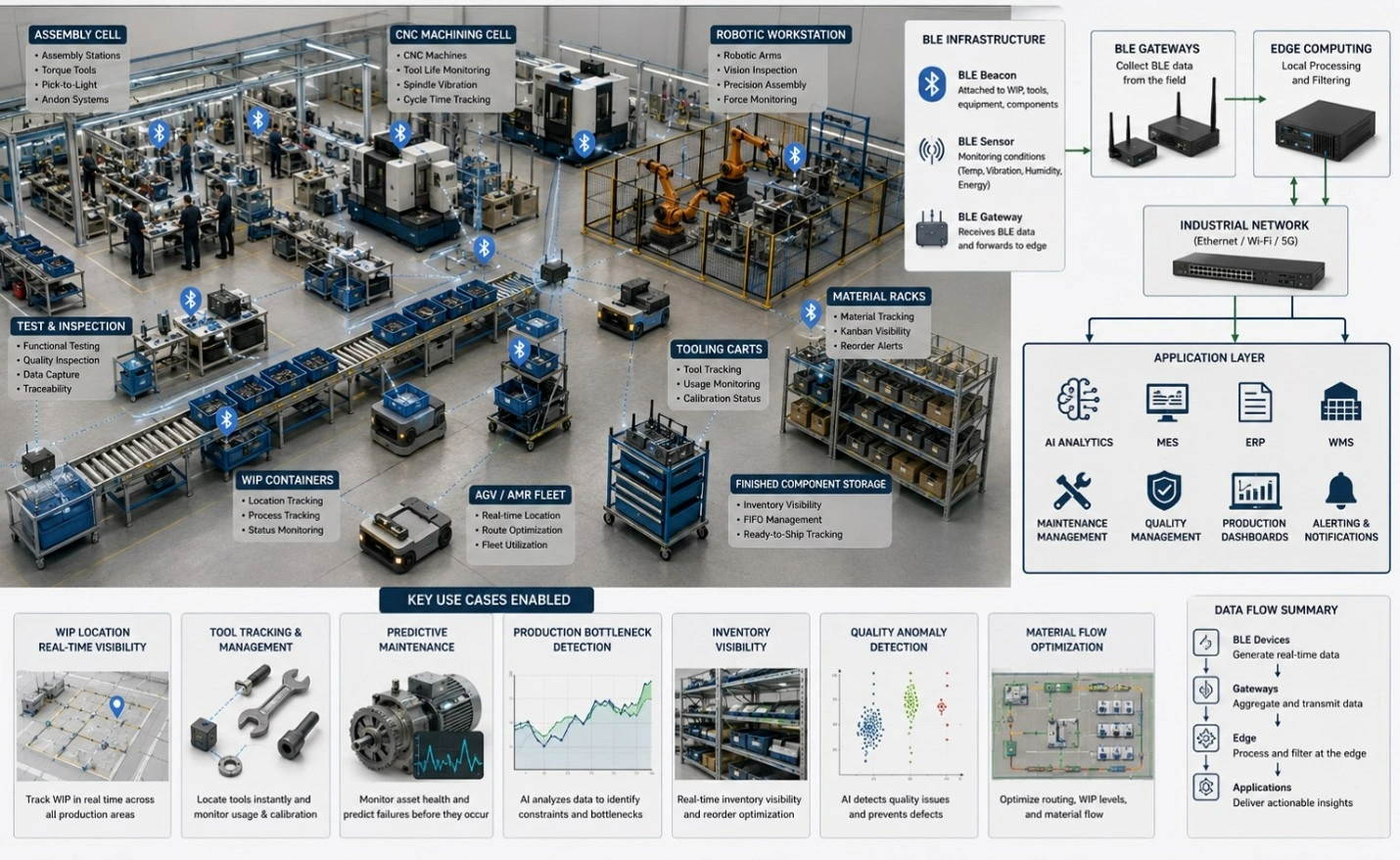
This visual illustrates how BLE beacons and sensors connect mobility manufacturing assets—including WIP containers, tools, machinery, AGVs/AMRs, and material racks—to BLE gateways, edge computing, industrial networks, and enterprise systems. It highlights key applications such as real-time WIP tracking, tool management, predictive maintenance, bottleneck detection, inventory visibility, quality anomaly detection, and material-flow optimization.
What AIoT Means for Mobility Systems Manufacturing
AIoT combines artificial intelligence with connected devices, sensors, equipment, and industrial systems. For mobility systems manufacturing, the practical objective is not simply to connect more production assets. The objective is to convert operational data into timely decisions affecting production, maintenance, material handling, quality, and traceability.
BLE contributes an identification and sensing mechanism that is particularly useful where mobility is important. A BLE beacon can identify a tooling cart, WIP container, fixture, test unit, or mobile production asset, while BLE sensors can report selected environmental or equipment conditions. BLE gateways collect nearby transmissions and forward relevant data to software for processing.
AI adds another layer of interpretation. Instead of treating every BLE event as an isolated location record, an AI-enabled manufacturing system can correlate asset movement with production schedules, work orders, machine states, maintenance history, quality results, and material consumption. This enables applications such as:
- Predicting when manufacturing equipment may require maintenance based on operating patterns and historical failures.
- Detecting abnormal movement or dwell times for WIP containers between manufacturing cells.
- Identifying production bottlenecks by analyzing movement and cycle-time patterns.
- Forecasting tooling requirements from production schedules and historical tool utilization.
- Detecting unusual environmental conditions around sensitive components or manufacturing areas.
- Correlating component genealogy, process events, and inspection results for quality investigations.
- Identifying discrepancies between planned and actual material movement.
- Improving utilization of fixtures, gauges, test equipment, and specialized tooling.
The distinction between simple tracking and AI-enabled manufacturing intelligence is important. BLE can establish that an identified object was detected near a particular gateway. AI can use that event together with manufacturing context to determine whether the object’s location, dwell time, sequence, or movement pattern indicates a production exception.
Where AI Delivers Value Across Mobility Systems Production
Mobility systems manufacturing contains interconnected processes where delays or errors in one operation can affect downstream assembly, testing, shipping, and customer delivery. AI applications therefore need to be connected to specific manufacturing workflows rather than implemented as isolated analytics projects.
WIP Tracking and Production Flow
WIP frequently moves between machining, subassembly, inspection, testing, rework, and final assembly areas. Manual status updates can become inaccurate when containers, carts, fixtures, or components move faster than production records are updated.
BLE beacons attached to selected WIP carriers or production containers provide continuous location events through strategically positioned gateways. AI can analyze these events against expected routing and cycle times. A container that remains near an inspection area longer than its normal process window can become an exception for investigation. Similar analysis can identify recurring congestion around assembly stations, testing cells, or material supermarkets.
GAO supplies BLE hardware and IoT technologies that can support these location-aware manufacturing systems, allowing system designers to select tracking hardware according to the physical layout, detection range, environmental conditions, and required location precision.
Tooling and Fixture Management
Mobility systems plants often depend on specialized fixtures, torque tools, gauges, calibration equipment, dies, molds, test adapters, and assembly tooling. Losing track of these assets can create production delays even when sufficient inventory exists elsewhere in the facility.
BLE beacons can associate a digital identity with mobile tooling and fixtures. Gateway observations establish approximate location and movement history. AI can then analyze utilization frequency, movement patterns, production schedules, and maintenance records to help identify underutilized tools, unusual movement, recurring shortages, or tools that may need inspection.
This approach is especially useful for shared tooling that moves between production cells rather than remaining permanently installed at one workstation.
Predictive Maintenance for Manufacturing Equipment
Production equipment such as CNC machines, robotic cells, presses, conveyors, pumps, compressors, test systems, and automated material-handling equipment can generate large volumes of operational information. AI-based predictive maintenance can use time-series measurements, machine states, maintenance history, alarms, and production context to detect deviations from normal operating behavior.
BLE can supplement this information by identifying mobile maintenance equipment, replacement tooling, inspection devices, or assets associated with a maintenance activity. BLE sensors may also provide additional measurements where a wired industrial sensor installation is impractical.
The strongest implementation normally combines BLE events with existing industrial data rather than attempting to make BLE the sole source of machine-condition information.
Material and Component Visibility
Mobility systems manufacturers manage large numbers of components and subassemblies across receiving, kitting, line-side storage, production, inspection, rework, and finished-goods areas. AI can analyze material movements to identify abnormal consumption patterns, missing containers, unexpected dwell times, or discrepancies between production plans and actual material usage.
BLE-enabled containers can provide location context while ERP, WMS, and MES records provide business context. This combination allows the system to distinguish between a material shortage caused by procurement and one caused by an internal material-flow problem.
Quality and Process Anomaly Detection
Quality problems can originate from incorrect components, process deviations, tooling conditions, environmental changes, incorrect sequencing, or production equipment behavior. AI can correlate quality inspection results with production history, WIP location, machine conditions, tooling identity, and operator or work-center records.
BLE identification can provide another dimension of traceability by establishing which fixture, container, tool, or production asset was associated with a particular manufacturing event. This can shorten root-cause investigations when a quality issue affects a specific production interval or group of components.
AI Applications Across the Mobility Systems Manufacturing Workflow
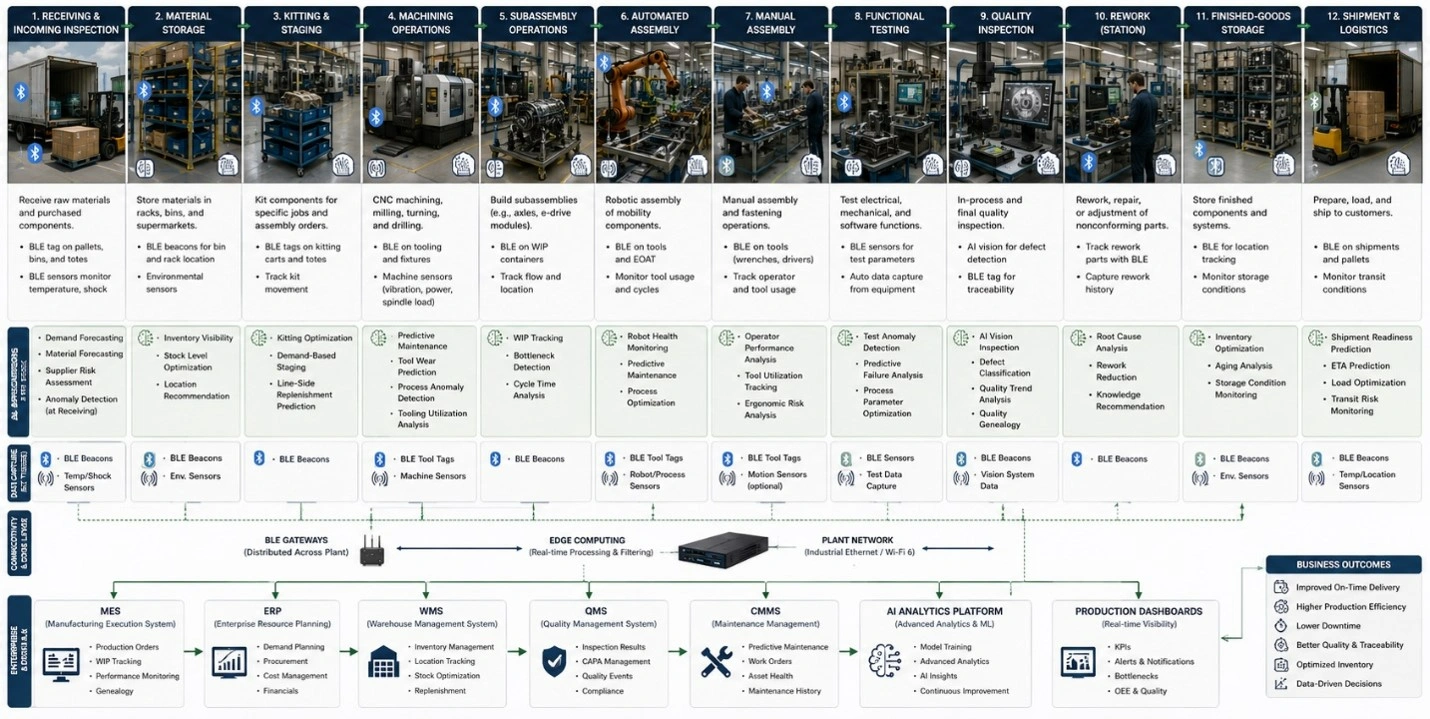
This visual maps the complete mobility manufacturing workflow from receiving and incoming inspection through machining, assembly, testing, quality inspection, rework, storage, and shipment. It shows how BLE identification and sensing feed AI applications such as demand forecasting, WIP tracking, predictive maintenance, computer vision inspection, anomaly detection, quality genealogy, and shipment readiness, while integrating with MES, ERP, WMS, QMS, and maintenance systems.
End-to-End AI and BLE Workflow for Mobility Manufacturing
A production-grade AIoT solution should be designed as an end-to-end information flow rather than as a collection of independent BLE devices. The workflow normally begins with physical events and ends with a manufacturing decision or operational action.
Data Acquisition at Production and Logistics Areas
The first layer contains BLE beacons, BLE sensors, existing industrial sensors, machine controllers, cameras, barcode systems, RFID systems where applicable, and production equipment. BLE beacons can identify movable objects, while sensors can capture selected conditions.
Device selection should reflect the actual manufacturing environment. Metal structures, machinery, electromagnetic interference, production-cell density, gateway placement, and human movement can affect wireless performance. A site survey is therefore important before determining the final gateway density.
BLE Gateway Collection
BLE gateways receive transmissions from nearby beacons and sensors. Gateway placement should correspond to the required location accuracy and physical process rather than simply distributing gateways uniformly across a building.
A manufacturing facility may require different gateway strategies for:
- High-density assembly cells.
- Tool cribs and calibration rooms.
- WIP staging areas.
- Line-side supermarkets.
- Finished-goods warehouses.
- Maintenance workshops.
- Outdoor or semi-enclosed logistics areas.
Gateway data can include device identifiers, timestamps, signal information, sensor readings, and other event attributes supported by the selected hardware.
Edge Processing
Edge computing can filter and normalize gateway data close to the production environment before information reaches centralized software. This is valuable when a factory produces large volumes of repeated location events.
Edge processing can perform tasks such as:
- Removing duplicate or low-value events.
- Applying proximity or zone rules.
- Normalizing sensor measurements.
- Detecting basic threshold conditions.
- Buffering data during network interruptions.
- Preparing data for AI inference.
- Forwarding only relevant events to central software.
For time-sensitive production applications, edge processing can reduce dependency on round trips to a remote service.
Middleware and Data Integration
Middleware provides the connection between device-level events and manufacturing applications. It can translate gateway messages into standardized records and associate device identifiers with business objects such as tools, WIP containers, production orders, fixtures, and equipment.
Integration may involve MQTT, REST APIs, WebSockets, OPC UA, database interfaces, message brokers, or vendor-specific interfaces depending on the existing plant environment.
The data model should preserve relationships between the physical asset and manufacturing context. A useful record may therefore associate a beacon identifier with a tool number, tool type, production cell, maintenance status, calibration status, and applicable work orders.
AI Analytics and Decision Support
AI models can consume normalized data together with historical manufacturing records. Appropriate methods depend on the problem.
- Anomaly detection: identifies unusual movement, cycle times, machine behavior, or sensor conditions.
- Time-series analysis: evaluates changes in equipment and process measurements over time.
- Predictive maintenance models: estimate failure risk or maintenance requirements.
- Forecasting: predicts material demand, tooling requirements, production load, or process conditions.
- Computer vision: analyzes visual defects, assembly conditions, labels, component orientation, and other observable characteristics.
- Classification models: categorize manufacturing events, quality conditions, or operational exceptions.
AI output should be connected to a defined operational response. An alert that does not lead to an actionable workflow can create additional noise rather than operational value.
Manufacturing Action
The final stage may involve an operator notification, maintenance work order, material replenishment request, production schedule adjustment, quality investigation, inspection task, or management dashboard.
For example, an AI model may detect that a particular WIP route consistently exceeds its expected dwell time. The system can identify the affected production cell, compare current conditions with historical patterns, notify the responsible production supervisor, and provide supporting location and process data for investigation.
Technology Components for Mobility Systems Manufacturing
A practical deployment combines BLE hardware with industrial networking, edge computing, AI software, and existing manufacturing applications. Each component should have a clearly defined responsibility.
BLE Beacons
BLE beacons provide digital identities for mobile or semi-mobile manufacturing objects. Typical candidates include:
- WIP containers and totes.
- Tooling carts.
- Fixtures and jigs.
- Portable test equipment.
- Maintenance equipment.
- Material-handling assets.
- Specialized production tools.
- Reusable shipping containers.
Beacon selection should consider battery life, enclosure requirements, mounting method, transmission interval, environmental exposure, and required maintenance frequency.
BLE Sensors
BLE sensors can supplement fixed industrial instrumentation for selected applications. Depending on the manufacturing requirement, sensors may monitor temperature, humidity, motion, vibration, door or contact status, or other supported measurements.
Sensitive applications require validation against the required measurement accuracy and response time. A wireless sensor should not automatically replace a safety-critical or control-critical industrial sensor simply because wireless deployment is easier.
BLE Gateways
BLE gateways collect wireless events and provide connectivity to the local or central software environment. Ethernet, Wi-Fi, cellular, or other network interfaces may be appropriate depending on the facility.
Gateway installation should account for radio coverage, machinery obstruction, mounting height, network availability, power continuity, cybersecurity requirements, and maintenance accessibility.
Edge Servers and AI Computing
Edge servers can host local data processing, event rules, databases, AI inference, and integration services. GPU-equipped systems may be appropriate for computer vision or computationally intensive models, while many event-processing and anomaly-detection applications can operate on comparatively modest industrial computing hardware.
The computing design should be based on workload, latency, data volume, model complexity, availability requirements, and the consequences of network disruption.
MES, ERP, WMS, QMS, and Maintenance Software
AI-generated information becomes more useful when it is connected to the systems already used to operate the manufacturing business.
MES can provide production orders, routing, work-center information, and process states. ERP can provide planning, procurement, inventory, and order information. WMS can provide material and warehouse transactions. Quality management software can provide inspection and nonconformance information. Computerized maintenance management systems (CMMS) or enterprise asset management (EAM) software can provide maintenance history and work-order information.
BLE and AI should therefore be integrated around established manufacturing workflows rather than creating a parallel record of production activity.
End-to-End AI, BLE, Edge Computing, and Manufacturing Software Flow for Mobility Systems
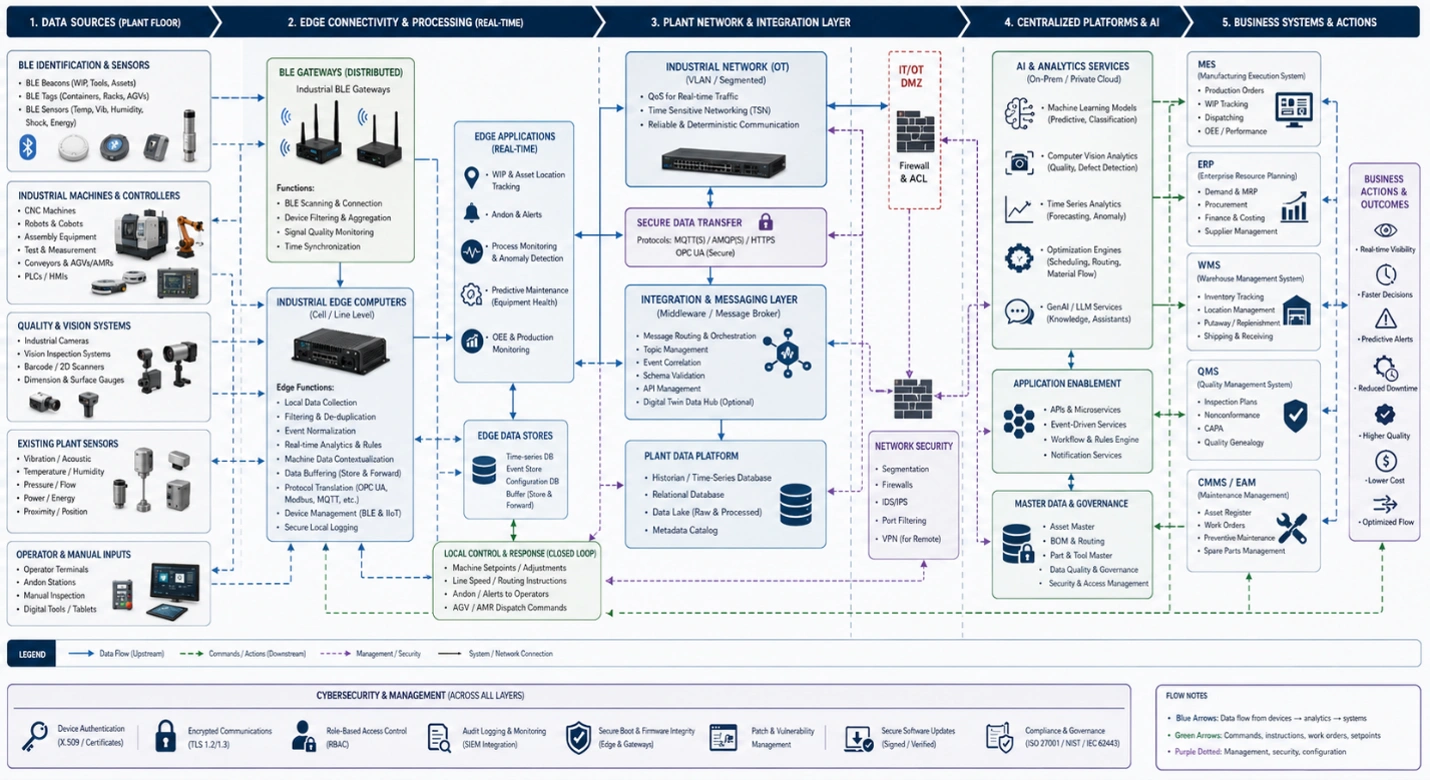
This visual illustrates the complete technical data path from BLE devices, industrial machines, PLCs, cameras, and plant sensors through BLE gateways, edge computing, secure networks, middleware, centralized AI analytics, and manufacturing software. It highlights real-time edge processing, bidirectional operational flows, cybersecurity controls, and how AI insights drive production, quality, maintenance, inventory, and business actions.
Cloud or Server Deployment for Mobility Manufacturing
Mobility systems manufacturers can deploy AI and BLE software through cloud-hosted services, privately managed servers, edge servers, or a hybrid combination. The correct choice depends on production continuity, data governance, network connectivity, latency, integration requirements, cybersecurity policies, and the number of manufacturing sites.
Cloud Version
A cloud-hosted SaaS deployment can centralize data and analytics across multiple manufacturing plants. This model can simplify centralized software maintenance, support cross-site benchmarking, and provide a common environment for enterprise analytics.
Cloud deployment can be appropriate when:
- Multiple plants need shared analytics.
- Manufacturing data can be transmitted outside the plant.
- Internet connectivity is sufficiently reliable.
- Centralized AI model management is important.
- Corporate IT teams prefer managed infrastructure.
- Cross-site production and maintenance analysis is required.
Latency-sensitive functions should still be evaluated separately. A plant should not depend on an external service for an operational function where temporary loss of connectivity could stop or materially disrupt production.
Server Version
Server deployment can place software on factory edge servers, customer-managed servers, private data centers, or other privately hosted infrastructure. This model provides greater control over data location and can support environments with strict network or operational requirements.
A server deployment may be appropriate when:
- Production data must remain within controlled infrastructure.
- Network connectivity to external services is limited.
- Local operation must continue during WAN interruptions.
- Integration with factory systems requires low-latency communication.
- Corporate security policies restrict external data processing.
- The manufacturer already operates industrial computing infrastructure.
Hybrid Deployment
A hybrid design can keep time-sensitive processing close to production while forwarding selected historical data to centralized systems. For example, BLE event filtering, local rules, and AI inference can run at the factory, while aggregated production analytics and multi-site reporting operate centrally.
This approach is often useful for mobility manufacturers operating several facilities with different connectivity and IT requirements. The engineering design should explicitly define which functions remain operational during loss of central connectivity and how buffered events are synchronized afterward.
Engineering Considerations for BLE Deployment
BLE performance in a mobility manufacturing facility depends heavily on physical conditions. A design validated in an office environment should not automatically be transferred to a factory floor.
Important engineering factors include:
- RF propagation: Metal machinery, racks, enclosures, and vehicle components can create reflection, attenuation, and multipath effects.
- Gateway placement: Coverage should be validated through a site survey rather than estimated only from nominal radio range.
- Asset density: Large numbers of beacons transmitting at similar intervals can increase event volume and require appropriate gateway and software capacity.
- Battery management: Battery-powered devices require an explicit replacement or recharge strategy, particularly when mounted on production tooling or containers.
- Mounting: Beacon orientation and mounting location can affect RF performance and durability.
- Environmental protection: Enclosures should match exposure to dust, oils, moisture, vibration, temperature variation, and cleaning procedures.
- Network reliability: Gateways require dependable connectivity and appropriate buffering where production continuity is important.
- Device identity management: Each beacon or sensor should have a controlled association with the physical asset it represents.
- Cybersecurity: Gateway credentials, device communications, software interfaces, and administrative access should be protected according to the plant’s security requirements.
These considerations become particularly important when BLE data is used by AI models. Poor device placement or inconsistent asset associations can introduce data-quality problems that appear to be AI model failures but actually originate in the data-acquisition layer.
BLE Site Survey and Gateway Placement for Mobility Systems Manufacturing
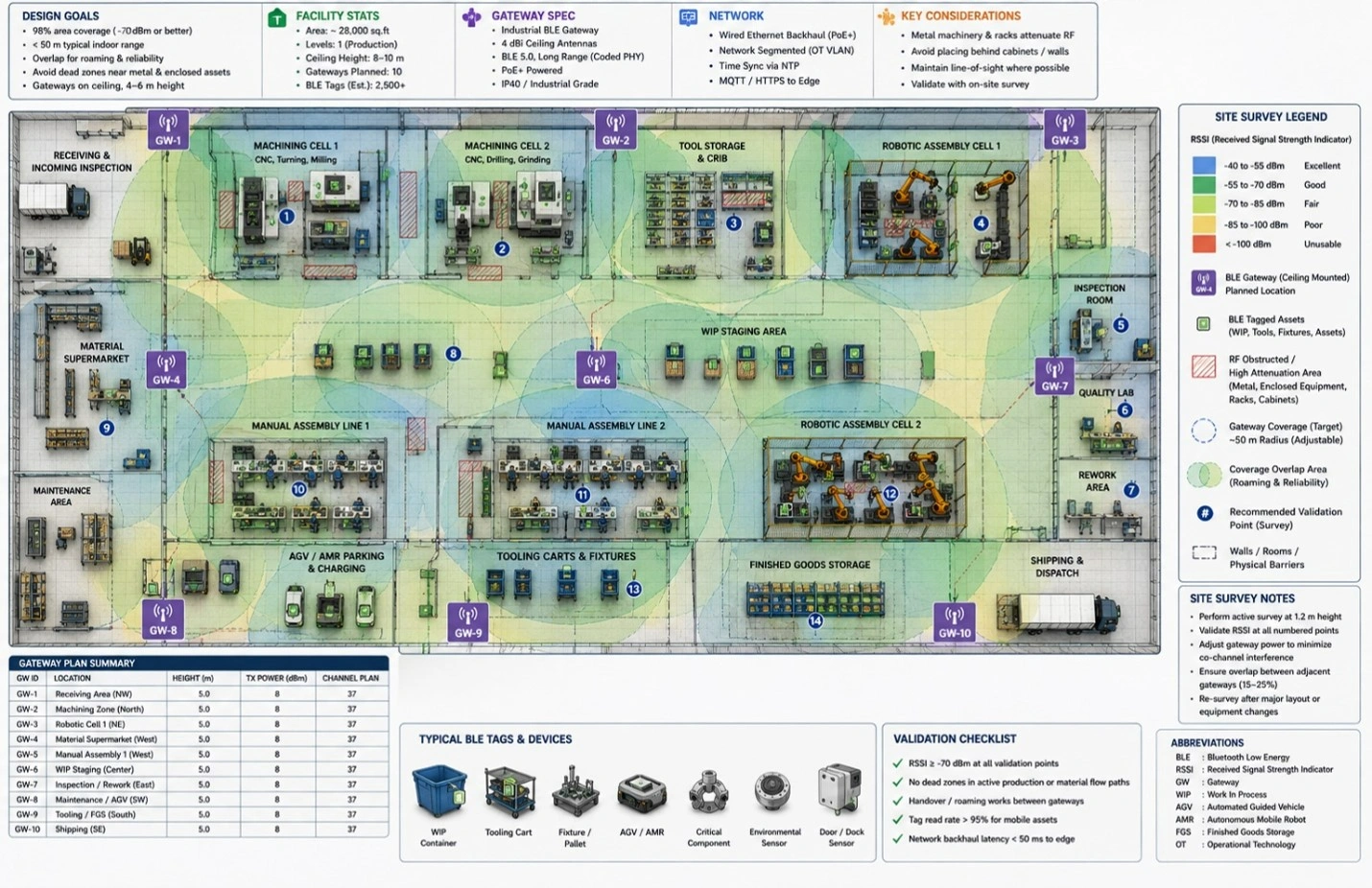
This visual presents a top-down engineering floor plan showing BLE gateway locations, RF coverage zones, overlap areas, dead zones, and validation points across a mobility manufacturing facility. It highlights how machinery, metal racks, enclosed equipment, and production layouts can affect BLE signal propagation and provides practical deployment guidance for reliable asset tracking and sensing.
AI Capabilities That Improve Mobility Systems Manufacturing
AI becomes operationally valuable when manufacturing data is connected to a defined production, maintenance, quality, or logistics decision. For mobility systems manufacturers, the combination of BLE-generated asset context with machine, MES, ERP, WMS, quality, and maintenance data can provide a broader view of factory conditions.
Predictive Maintenance and Equipment Health
Predictive maintenance models can evaluate equipment measurements, operating states, alarms, maintenance history, production schedules, and usage patterns to identify developing problems before they become unplanned downtime events.
BLE can add asset identity and location context to maintenance operations. For example, a manufacturer can identify where a mobile diagnostic device, replacement fixture, maintenance cart, or specialized tool is located while an AI model identifies equipment requiring attention.
The important engineering consideration is model quality. Historical maintenance records should distinguish genuine equipment failures from routine service, operator adjustments, false alarms, and unrelated interventions. Otherwise, the AI model may learn correlations that do not represent actual failure mechanisms.
Production Bottleneck Detection
Production bottlenecks often appear as accumulated WIP, excessive queue time, repeated movement between work centers, or unusually long process cycles. AI can analyze WIP location events together with production orders, machine states, and cycle-time data.
BLE-enabled WIP carriers can provide the location events required to establish actual movement patterns. AI can then compare observed routes with expected production sequences and identify recurring congestion.
For a mobility systems manufacturer, this can help distinguish between a temporary production interruption and a structural constraint caused by insufficient inspection capacity, test-cell availability, machining capacity, material replenishment, or downstream assembly demand.
Tool and Fixture Utilization
AI can analyze historical location and utilization information to determine which fixtures, carts, gauges, and production tools are frequently used, rarely used, repeatedly moved, or unavailable when required.
This information can support tooling capacity planning and reduce unnecessary duplicate purchases. It can also help maintenance teams identify tools whose movement or utilization pattern suggests abnormal use.
BLE provides the physical-asset identity and location information, while AI provides the utilization analysis.
Material Demand and Replenishment Forecasting
AI forecasting can combine production schedules, historical consumption, inventory transactions, WIP levels, supplier information, and manufacturing demand to estimate future material requirements.
BLE-tagged containers can add location information to this process. A container recorded as available in inventory software but repeatedly detected in an unexpected production area represents a different operational condition from a container that is genuinely missing from the facility.
This distinction can improve material-control investigations without requiring manual searches across the entire plant.
Quality Anomaly Detection
AI can identify relationships between manufacturing conditions and quality outcomes that may not be apparent through conventional reporting. Relevant inputs can include inspection measurements, machine states, tooling identity, process parameters, production timestamps, component genealogy, and WIP movement.
A BLE identifier can associate a fixture, container, or mobile production asset with a production interval. When a quality problem is discovered, investigators can use that association to narrow the relevant production history.
This does not eliminate engineering root-cause analysis. Instead, it helps quality engineers focus investigation on the most relevant production conditions.
Operational and Business Benefits of AI-Enabled BLE Systems
The value of AI and BLE in mobility systems manufacturing comes from connecting physical manufacturing activity with digital operational decisions.
Better Production Visibility
Traditional production records may indicate that a work order is active without showing where its physical WIP is located. BLE location events can supplement MES information by providing a physical view of containers, tooling, and mobile assets.
AI can use this information to identify unusual dwell times, unexpected routes, and recurring movement patterns.
Reduced Unplanned Downtime
Predictive maintenance can identify abnormal equipment behavior before a failure develops into a production interruption. When maintenance software is integrated with AI outputs, an anomaly can trigger an inspection or work order rather than remaining as an isolated dashboard notification.
BLE can also improve maintenance execution by helping technicians locate relevant tools, portable equipment, fixtures, or replacement assets.
Faster Quality Investigations
Manufacturing quality investigations often require reconstructing what happened during a particular production period. AI can correlate inspection results with equipment, process, WIP, and tooling data.
BLE-derived location history can provide another traceability dimension, particularly for reusable fixtures, mobile tooling, and WIP carriers.
Higher Asset Utilization
Manufacturers may purchase additional tools or mobile equipment because existing assets cannot be located quickly. Location history can reveal whether an asset is actually unavailable or simply misplaced.
AI-based utilization analysis can identify assets with low utilization, excessive travel, recurring demand peaks, or unusual allocation patterns.
Improved Material Flow
AI can identify material-flow patterns that produce unnecessary travel, long queues, or repeated handling. BLE location data can provide the physical movement information needed to validate these findings.
The result can be better line-side replenishment, more informed supermarket sizing, improved WIP staging, and reduced internal transportation.
Scalable Multi-Plant Analytics
A standardized data model can allow manufacturing organizations to compare selected KPIs across facilities. Local edge processing can handle plant-specific operational requirements while centralized systems can analyze aggregated information.
GAO’s BLE and IoT hardware can serve as part of such deployments where the selected devices, gateway configuration, software interfaces, and environmental requirements are appropriate.
Cybersecurity and Data Reliability
AI-enabled manufacturing systems require more than wireless connectivity. BLE devices, gateways, edge servers, APIs, databases, and enterprise applications create multiple points where unauthorized access or inaccurate data can affect operations.
A practical security design should address:
- Device identity: BLE devices and gateways should have controlled identities and documented ownership.
- Gateway security: Administrative interfaces should use strong authentication and appropriate access restrictions.
- Network segmentation: Industrial networks should be separated from business networks according to the plant’s cybersecurity design.
- Encrypted communications: Data should be protected during transmission wherever supported and required.
- API security: Interfaces between BLE middleware, AI services, MES, ERP, WMS, QMS, and maintenance software should use controlled authentication and authorization.
- Access control: Users should receive only the permissions required for their manufacturing responsibilities.
- Audit logging: Important device, configuration, administrative, and operational events should be recorded.
- Software maintenance: Gateways, edge servers, and supporting software require controlled patching and lifecycle management.
- Data integrity: Device-to-asset mappings should be controlled so that an incorrectly assigned beacon does not corrupt manufacturing records.
- Backup and recovery: Databases, configurations, and AI models should have recovery procedures appropriate to production requirements.
Data quality is equally important. An AI system can produce technically correct predictions from incorrect inputs and still create operationally incorrect recommendations. Manufacturing teams should therefore monitor gateway availability, missing events, duplicate events, sensor drift, battery status, timestamp consistency, and device-to-asset associations.
Cybersecurity and Reliability Architecture for AI and BLE Manufacturing Systems
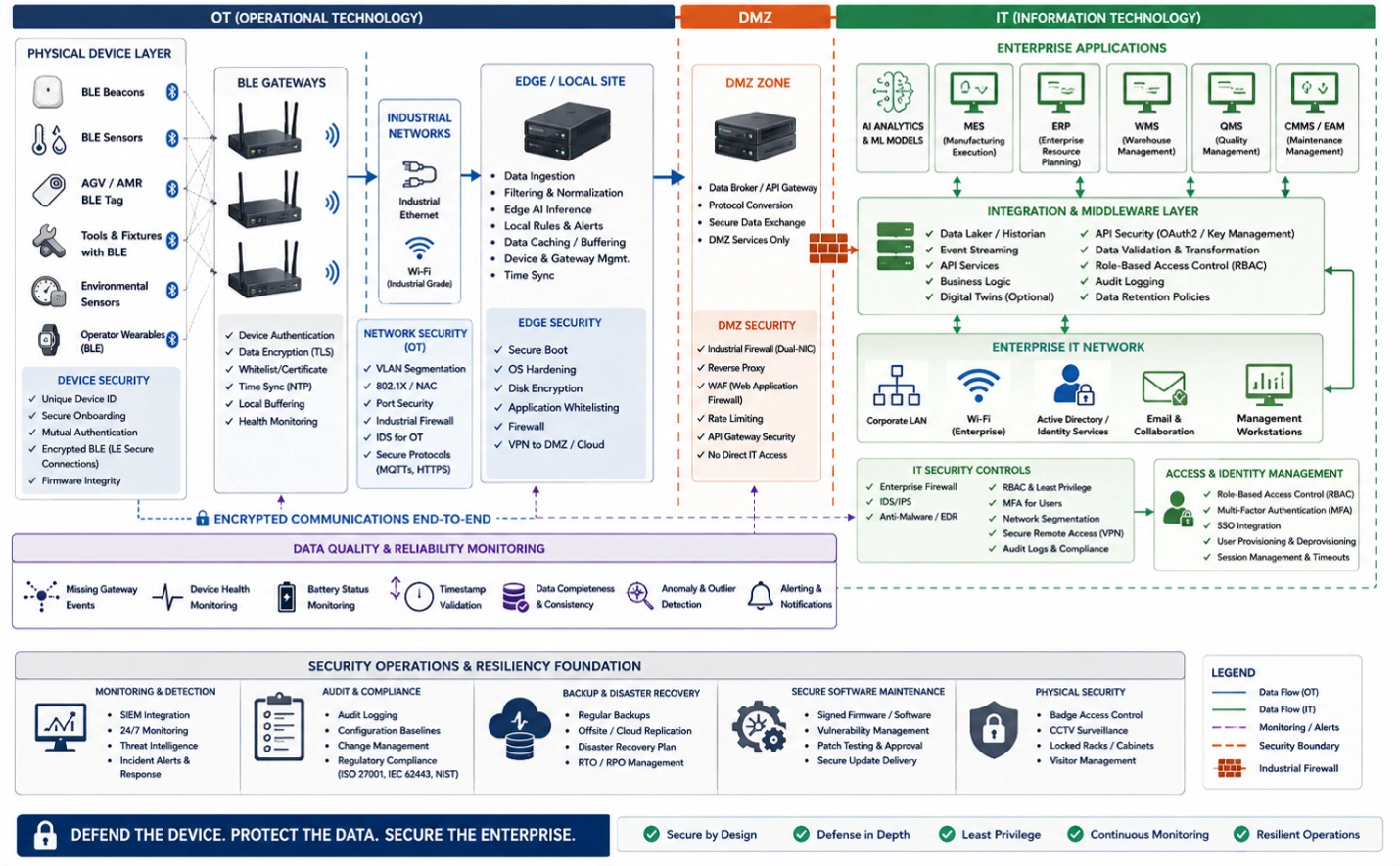
This professional architecture diagram illustrates how BLE devices, gateways, industrial networks, edge servers, DMZ controls, and enterprise systems connect within a secure mobility manufacturing environment. It highlights OT/IT segmentation, encrypted communications, identity and access controls, data-quality monitoring, audit logging, backup and recovery, and secure software maintenance.
KPIs for AI and BLE in Mobility Systems Manufacturing
A successful implementation should be measured using manufacturing outcomes rather than device counts alone. BLE gateway quantity or beacon deployment volume does not demonstrate business value.
Useful KPIs include:
| KPI | Manufacturing Meaning | AI/BLE Contribution |
| WIP dwell time | Time material remains between production stages | BLE location events and AI cycle-time analysis |
| Production cycle time | Actual production duration compared with target | AI time-series and process analysis |
| Unplanned downtime | Production time lost to unexpected equipment failures | Predictive maintenance |
| Mean time to repair | Speed of returning equipment to service | AI alerts and maintenance workflow |
| Tool utilization | Frequency and duration of tooling use | BLE location and utilization analytics |
| WIP location accuracy | Confidence in physical WIP location | BLE gateway observations |
| Material shortage events | Production interruptions caused by unavailable material | Location data plus forecasting |
| Quality escape rate | Defects reaching downstream processes or customers | AI quality analytics |
| Rework rate | Production requiring corrective processing | Process and quality anomaly detection |
| Inspection cycle time | Time required to inspect and release production | AI analysis and workflow optimization |
| Gateway availability | Reliability of BLE data collection | Device monitoring |
| BLE event completeness | Percentage of expected events received | Data-quality monitoring |
| AI alert precision | Percentage of alerts considered operationally useful | Model-performance monitoring |
| False-alert rate | Unnecessary interventions caused by AI | Model validation and tuning |
| Maintenance response time | Time between AI alert and engineering action | AI-to-CMMS integration |
KPI baselines should be established before deployment. A pilot should compare performance against the baseline rather than assuming that additional sensor data automatically produces measurable improvement.
Implementation Roadmap for Mobility Systems Manufacturers
AI and BLE projects should normally begin with a clearly defined manufacturing problem. Starting with hardware procurement can produce a technically functional system without a sufficiently valuable business outcome.
Process Assessment
Identify the production process where visibility or prediction is currently insufficient. Candidate areas include WIP tracking, tooling control, predictive maintenance, material movement, quality traceability, or production bottleneck detection.
Document the existing workflow, systems, manual activities, decision points, and measurable pain points.
Asset and Data Assessment
Determine which assets require identification, which measurements already exist, and which additional data is necessary.
Review:
- Production equipment.
- WIP carriers.
- Fixtures and tooling.
- Material containers.
- Existing sensors.
- PLC and machine data.
- MES and ERP records.
- WMS transactions.
- Quality records.
- Maintenance history.
- Network connectivity.
This prevents unnecessary BLE deployment where an existing data source already provides the required information.
BLE Site Survey
Evaluate production areas, gateway locations, RF propagation, mounting options, network connectivity, power availability, environmental conditions, and expected device density.
The pilot should validate actual wireless performance using representative production equipment and physical assets.
Pilot Deployment
Select a bounded production process with measurable objectives. A useful pilot might track a defined set of WIP carriers, fixtures, or tooling across several work centers.
The pilot should measure data reliability before AI model performance is evaluated.
Data Model and Integration
Define relationships between BLE identifiers and manufacturing objects. Establish interfaces with MES, ERP, WMS, QMS, CMMS/EAM, or other required systems.
The data model should preserve timestamps, asset identities, locations, production context, and relevant event history.
AI Model Development and Validation
Select the AI method according to the manufacturing problem. Train models using representative historical and operational data, then validate their outputs with production and engineering personnel.
For predictive maintenance, validation should include actual failure and maintenance records where available. For anomaly detection, the team should determine which anomalies represent actionable production conditions and which are normal variation.
Cybersecurity and Commissioning
Complete security testing, network validation, access-control configuration, gateway commissioning, edge-server testing, integration testing, and operational acceptance testing.
Manufacturing personnel should verify that alerts, dashboards, and work orders correspond to real operational responsibilities.
KPI Measurement and Optimization
Compare pilot results against the original baseline. Adjust gateway placement, beacon intervals, data filtering, AI thresholds, model parameters, and workflows where necessary.
AI models should also be monitored after deployment because manufacturing processes, equipment, products, and production schedules change over time.
Multi-Site Expansion
Once the system demonstrates measurable value, deployment can expand to additional production lines or plants. Standardized device naming, asset identities, APIs, security controls, data models, and KPI definitions make expansion easier.
However, individual factories should still undergo local validation because building construction, machinery density, production processes, network infrastructure, and operational practices can differ substantially.
AI and BLE Implementation Roadmap for Mobility Systems Manufacturing
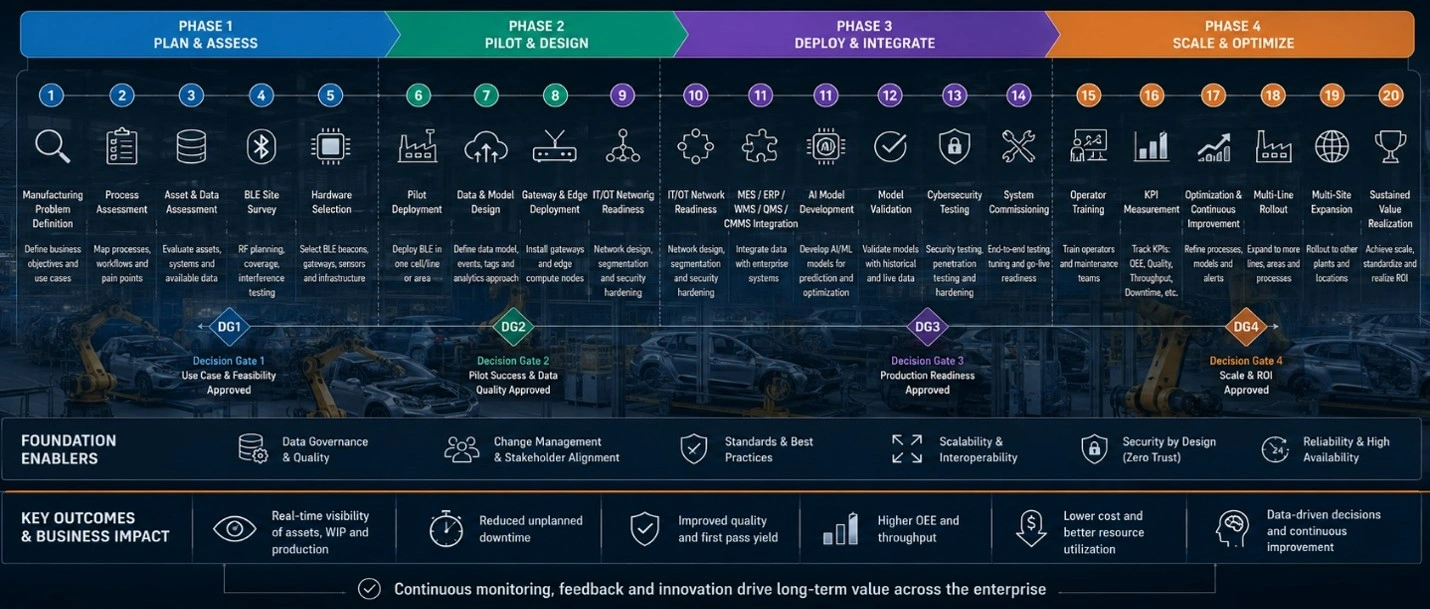
This visual illustrates a complete enterprise roadmap for deploying AI and Bluetooth Low Energy (BLE) across mobility manufacturing operations. It maps the journey from problem definition and site assessment through pilot deployment, systems integration, AI validation, cybersecurity testing, operator training, KPI measurement, optimization, and multi-site scaling, with engineering decision gates at key stages.
Practical Recommendations for Mobility Systems Manufacturing
Several engineering principles can improve the probability of a successful AIoT deployment.
- Start with a measurable production or maintenance problem rather than a device deployment target.
- Use BLE where wireless asset identity, location, or sensing provides information that existing systems cannot provide economically.
- Combine BLE events with MES, ERP, WMS, quality, maintenance, and machine data instead of creating an isolated tracking database.
- Validate RF performance in the real production environment before committing to a full gateway layout.
- Treat device-to-asset mapping as controlled manufacturing master data.
- Use edge processing when latency, network reliability, or data volume makes local processing valuable.
- Keep safety-critical machine control functions separate from AI recommendations unless the complete control system has been engineered and validated for that purpose.
- Establish data-quality KPIs before judging AI performance.
- Involve production engineers, maintenance technicians, quality engineers, IT, OT cybersecurity personnel, and operators during system design.
- Define the human decision associated with every important AI output.
- Monitor model performance after commissioning and establish procedures for retraining or recalibration when production conditions change.
- Select cloud, server, edge, or hybrid deployment according to operational requirements rather than assuming one model fits every manufacturing site.
GAO can support mobility systems manufacturers with BLE, RFID, and IoT hardware products and systems that form part of these deployments. The appropriate combination depends on the required tracking method, sensing requirements, facility conditions, network environment, software integration, and operational objectives.
Moving from Manufacturing Data to Actionable AI
AI-enabled BLE systems can give mobility systems manufacturers a more complete view of WIP, tooling, production equipment, material movement, maintenance activity, and quality conditions. The strongest implementations connect that visibility to existing manufacturing software and clearly defined operational decisions.
A practical deployment should begin with a specific manufacturing problem, validate BLE and data quality in the actual facility, integrate the resulting events with existing systems, and introduce AI only where it can produce a measurable operational improvement. GAO’s BLE, RFID, and IoT products and engineering capabilities can help organizations evaluate suitable hardware and system configurations for these requirements.
Organizations evaluating AI-based production visibility, predictive maintenance, asset tracking, or manufacturing analytics can learn more about GAO’s technology products, systems, and technical support for mobility systems manufacturing applications.
Building the Future of Industrial AI and IoT with Aperture Venture Studio and GAO RFID Inc.
For more than three decades, GAO Group of Companies has invested heavily in R&D for industrial BLE, RFID, and IoT technologies. As AI became increasingly useful in industrial applications, we expanded our work on AIoT solutions that combine connected devices, BLE, RFID, sensors, and intelligent analytics. We have also established Aperture Venture Studio to support the development and scaling of technologies relevant to industrial AI and IoT applications, including mobility systems manufacturing.
Aperture has attracted AI and IoT technical experts, entrepreneurial and operational executives, investors, and leading companies, while the Aperture Ventures Summit and TekSummit provide forums for discussing advanced AI and IoT topics.
GAO RFID Inc., headquartered in New York City and Toronto, Canada, is recognized among the leading global B2B and B2G suppliers of BLE and RFID technologies. Together with GAO Research Inc. and GAO Tek Inc., GAO serves customers across the United States and Canada, including Fortune 500 companies, R&D organizations, universities, and government agencies. Our R&D investment, quality assurance processes, and remote and onsite technical support help customers implement practical connected-device solutions.