
AI and BLE for Powertrain Manufacturing
AI-Driven Powertrain Manufacturing with Connected Production Data
AI is changing powertrain manufacturing by turning production, machine, quality, and asset data into actionable operational intelligence. In engine, transmission, e-axle, battery powertrain, and drivetrain component production, AI can analyze machine conditions, process parameters, inspection results, material movement, and production events to identify anomalies, predict failures, improve quality, and support faster decisions. BLE gateways, beacons, and sensors provide a practical wireless data layer for selected assets and processes, particularly where continuous visibility or flexible sensor deployment is needed. The resulting AIoT solution can connect shop-floor information with manufacturing execution systems (MES), enterprise resource planning (ERP), computerized maintenance management systems (CMMS), quality systems, and analytics software. GAO supplies BLE, RFID, and IoT hardware and systems that can support these connected manufacturing requirements, backed by more than three decades of experience serving organizations in the U.S. and Canada.
AIoT-Enabled Powertrain Manufacturing Data-to-Decision Flow
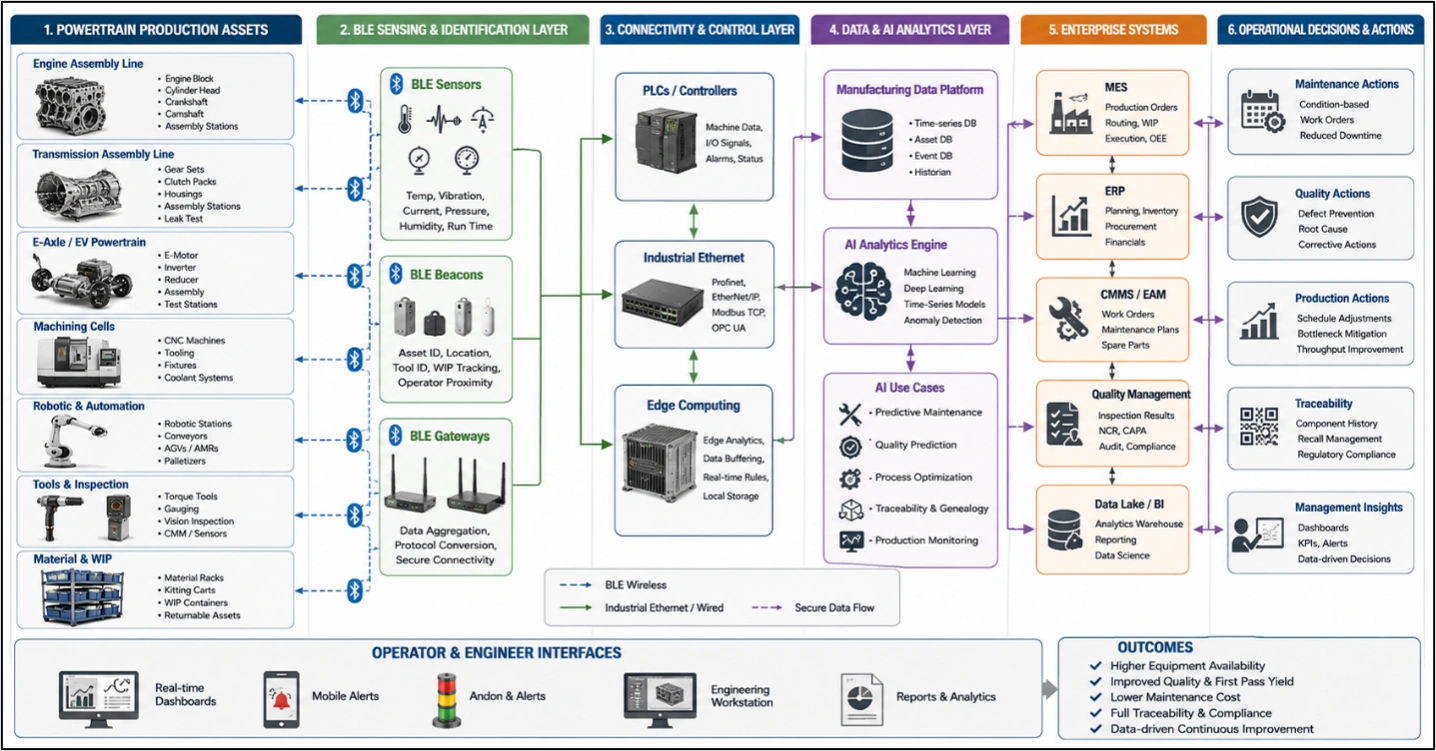
This enterprise infographic illustrates how powertrain manufacturing data moves from engines, transmissions, e-axles, CNC cells, robotics, inspection equipment, and WIP through BLE sensors, beacons, gateways, edge computing, AI analytics, and manufacturing systems. It highlights AI applications including predictive maintenance, quality prediction, anomaly detection, traceability, and production optimization.
What AI Means for Powertrain Manufacturing
Powertrain manufacturing produces highly structured process data because components must meet demanding dimensional, functional, thermal, mechanical, and assembly requirements. Typical operations include metal forming, casting, heat treatment, CNC machining, grinding, washing, balancing, component inspection, subassembly, torque-controlled fastening, final assembly, end-of-line testing, and material handling.
AI becomes valuable when these processes generate enough historical and real-time information to identify relationships that are difficult to detect through conventional monitoring.
From Machine Data to Production Intelligence
AI can combine information from:
- CNC spindle load, vibration, temperature, tool condition, cycle time, and alarm history
- Torque and angle measurements from fastening tools
- Dimensional inspection and coordinate measurement machine results
- End-of-line test measurements
- Furnace temperature and heat-treatment process records
- Hydraulic and pneumatic equipment conditions
- Robot cycle times and fault events
- Production orders, part numbers, work instructions, and routing information
- BLE sensor measurements and asset-location events
- Maintenance history and spare-parts records
- Material movement and work-in-process information
- Quality nonconformance and corrective-action records
Machine learning models can then identify abnormal operating patterns, estimate remaining useful life, classify defects, forecast process drift, or detect relationships between process conditions and quality outcomes.
The important engineering consideration is that AI should not replace deterministic controls. PLC interlocks, machine safety systems, torque limits, process specifications, and established quality controls remain responsible for immediate machine and process control. AI should generally operate as an analytical and decision-support layer unless a validated control application specifically permits automated action.
Why BLE Matters in Powertrain Plants
BLE is useful where powertrain production requires additional sensing or asset visibility without installing extensive new cabling. BLE sensors can collect selected measurements from mobile or difficult-to-wire assets, while BLE beacons can provide identification or location signals. BLE gateways receive wireless information and forward it to edge or server-based software.
This can support use cases such as monitoring mobile tooling, tracking maintenance equipment, identifying production containers, monitoring environmental conditions around sensitive processes, and collecting condition information from selected rotating or auxiliary assets.
GAO’s BLE offering includes gateways and beacons alongside its broader RFID and IoT hardware portfolio, allowing wireless identification and sensing technologies to be considered according to the actual manufacturing requirement rather than forcing one technology into every application.
Powertrain Manufacturing Applications for AI
AI applications should begin with a defined production problem rather than with the selection of a wireless technology. The strongest use cases connect measurable production conditions to a specific operational decision.
Predictive Maintenance for CNC and Production Equipment
CNC machining centers, grinders, presses, pumps, conveyors, compressors, robots, and other production equipment generate operating signals that can indicate developing problems.
AI-based predictive maintenance can analyze:
- Vibration and temperature trends
- Spindle and motor behavior
- Cycle-time changes
- Alarm frequency
- Tool usage
- Lubrication conditions
- Maintenance history
- Machine utilization
- Unplanned downtime events
BLE sensors can supplement existing machine data when additional measurements are required. For example, a wireless vibration or temperature sensor can provide supplementary condition information for equipment where direct PLC integration is impractical.
The AI model can establish normal operating patterns and flag deviations before they develop into a production interruption. Maintenance teams can then investigate the equipment condition, schedule an intervention, and associate the event with the machine’s maintenance history.
AI Quality Prediction for Machined Powertrain Components
Quality prediction is particularly relevant to components such as engine blocks, cylinder heads, transmission housings, gears, shafts, bearings, and other precision-machined parts.
A model can correlate process parameters with inspection outcomes to identify conditions associated with dimensional drift or functional failures.
Relevant inputs may include:
- Cutting parameters
- Tool age
- Spindle load
- Coolant conditions
- Machine temperature
- Part genealogy
- Inspection measurements
- Operator or workstation information
- Process recipe
- Batch information
- Ambient conditions
The purpose is not simply to predict whether a part will pass or fail. A mature implementation can help engineers determine which process variables are contributing to variation and where additional inspection or process intervention may be justified.
Production Traceability and Part Genealogy
Powertrain components often move through multiple manufacturing stages before final assembly. A production-quality investigation may therefore require information from machining, washing, heat treatment, inspection, assembly, and end-of-line testing.
BLE and RFID can contribute to identification and movement visibility, while AI can analyze the resulting production history.
A combined system can associate:
- Component identity
- Production order
- Workstation
- Process timestamp
- Machine
- Tool
- Inspection result
- Operator event
- Material batch
- Rework status
- Final test result
This information creates a more complete production history and can help quality engineers investigate recurring defects or isolate affected production batches.
AI-Based Production Monitoring
Production managers need more than machine availability. They need context around why production performance changes.
AI can evaluate:
- Cycle-time variation
- Throughput
- Machine utilization
- Changeover duration
- Micro-stoppages
- Queue time
- Work-in-process accumulation
- Scrap and rework
- Quality deviations
- Material shortages
A production analytics system can identify patterns that contribute to throughput loss. For example, repeated short interruptions at a machining cell may not appear as major downtime events individually, but their cumulative effect can significantly reduce effective production capacity.
Powertrain Production Workflow from Data Capture to AI Decisions
A practical AIoT implementation typically follows the physical production process while creating a parallel digital information flow.
Shop-Floor Data Acquisition
Data originates from production equipment, sensors, inspection systems, identification technologies, and manufacturing personnel.
Existing PLC and industrial control data should generally be reused where appropriate instead of duplicating measurements unnecessarily. BLE sensors are most useful where they provide information that existing wired control infrastructure does not readily provide.
BLE beacons can identify selected mobile assets or locations, while gateways collect wireless signals within defined production areas.
Wireless and Industrial Communication
A typical powertrain manufacturing environment may contain multiple communication technologies rather than a single network.
Potential communication layers include:
- BLE for selected wireless sensors, beacons, and asset identification
- Industrial Ethernet for fixed equipment and controllers
- Wi-Fi for approved industrial applications
- OPC UA for structured industrial data exchange
- MQTT for lightweight telemetry and event messaging where appropriate
- REST APIs for software integration
- Database interfaces for historical manufacturing information
The communication design should account for radio interference, metal structures, machine enclosures, gateway placement, network segmentation, latency, packet loss, and maintenance access.
Edge Processing and Data Normalization
Edge computing can reduce unnecessary transmission of raw data and provide local preprocessing.
An edge service can:
- Validate sensor messages
- Add timestamps
- Associate device identifiers with production assets
- Filter duplicate readings
- Aggregate high-frequency measurements
- Detect basic threshold events
- Buffer data during temporary network outages
- Forward normalized information to AI or manufacturing software
This is particularly important in powertrain plants where a large number of machines can generate substantial data volumes.
AI Analytics and Operational Decisions
After normalization, data can be analyzed using appropriate AI methods.
Possible methods include:
- Supervised machine learning for quality prediction
- Unsupervised learning for anomaly detection
- Time-series models for equipment condition forecasting
- Classification models for defect categories
- Regression models for process-quality relationships
- Computer vision for surface, assembly, or dimensional inspection
- Natural-language interfaces for maintenance and production information where appropriate
AI outputs should be converted into actionable events rather than presented only as abstract model scores.
For example, a model could generate a maintenance alert associated with a specific CNC machine, identify the abnormal parameter trend, show the affected production window, and provide the maintenance team with supporting evidence.
AI-Driven Powertrain Manufacturing Data-to-Decision Pipeline
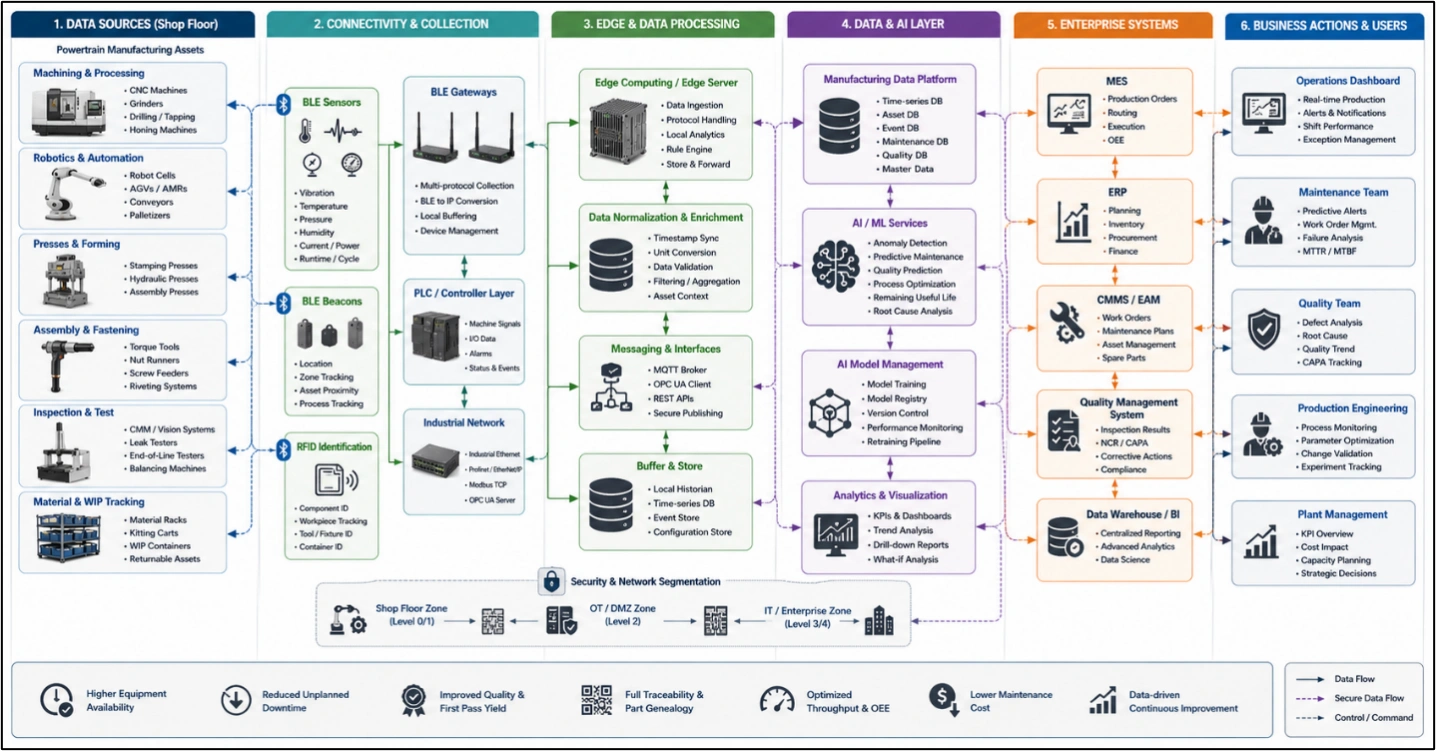
This end-to-end infographic shows how production data from CNC machines, robots, presses, torque tools, inspection equipment, BLE devices, and RFID identification moves through gateways, PLCs, edge processing, AI/ML services, and manufacturing systems. It highlights secure data flow into MES, ERP, CMMS/EAM, quality systems, dashboards, and operational actions.
Integration with Manufacturing Software
AI results become more useful when connected with existing operational software.
Relevant systems may include:
- MES for production execution and genealogy
- ERP for orders, materials, and production planning
- CMMS or EAM for maintenance management
- QMS for quality records and corrective actions
- SCADA and HMI systems for operational monitoring
- Historian databases for time-series production information
- WMS systems for material and component movement
- Business intelligence software for management reporting
The integration approach should preserve the authoritative source of each data element. For example, an AI system may calculate a predictive maintenance score, while the CMMS remains responsible for the official maintenance work order.
Engineering Considerations for BLE Deployment in Powertrain Plants
BLE deployment should be treated as an engineering exercise rather than simply installing gateways throughout a factory.
RF Coverage and Metal-Rich Production Areas
Powertrain plants contain substantial quantities of metal machinery, racks, tooling, conveyors, enclosures, and components. These structures can affect wireless propagation and create reflections or signal attenuation.
A site survey should therefore evaluate:
- Gateway mounting positions
- Sensor locations
- Beacon density
- Required coverage
- Interference sources
- Machine enclosure effects
- Battery replacement access
- Expected device movement
- Required location accuracy
The objective is not maximum signal strength everywhere. The objective is reliable data collection at the points where production decisions depend on the information.
Sensor Selection and Data Quality
A wireless sensor should be selected according to the measurement requirement.
Temperature monitoring, vibration monitoring, humidity measurement, proximity detection, equipment identification, and location estimation have different technical requirements.
Engineers should consider:
- Measurement range
- Accuracy
- Sampling frequency
- Battery life
- Environmental rating
- Mounting method
- Calibration requirements
- Data transmission interval
- Maintenance requirements
- Mechanical vibration and temperature exposure
Poor sensor placement can produce poor AI predictions regardless of how sophisticated the model is.
Cloud Version and Server Version
Powertrain manufacturers can select between cloud-hosted and privately hosted deployments depending on operational, cybersecurity, latency, and data-governance requirements.
A Cloud Version can centralize AI analytics, dashboards, device data, and software services within cloud infrastructure. This can simplify access across multiple manufacturing locations and support centralized model management.
A Server Version can run on factory servers, customer-managed servers, private data centers, edge servers, or other privately hosted infrastructure. This approach can be appropriate where production data must remain within controlled infrastructure or where local processing and integration requirements are strong.
GAO provides both cloud-oriented and non-cloud system approaches across IoT and identification applications, supporting different deployment requirements rather than assuming that every manufacturing environment should use the same software model.
Cybersecurity and OT Segmentation
Powertrain manufacturing systems operate across the boundary between operational technology and information technology. Security controls should therefore account for both production continuity and data protection.
Relevant practices include:
- Network segmentation between production equipment and enterprise IT
- Controlled gateway communication
- Strong authentication and authorization
- Encrypted communications where supported
- Device identity management
- Least-privilege access
- Secure software updates
- Logging and monitoring
- Backup and recovery procedures
- Vulnerability management
- Controlled remote access
NIST’s OT security guidance specifically addresses industrial control environments and emphasizes security approaches that account for the unique performance, reliability, and safety requirements of operational technology.
AI-Enabled Operational Improvements in Powertrain Manufacturing
Combining AI with connected production data can improve how powertrain manufacturers detect abnormal conditions, investigate quality variation, manage equipment, and prioritize production interventions. The value depends on the quality, timing, and context of the underlying data.
Predictive Maintenance and Reduced Unplanned Downtime
AI can move maintenance from primarily calendar-based or reactive activities toward condition-based decision-making.
For CNC machines, robots, conveyors, pumps, compressors, and auxiliary equipment, models can compare current operating behavior with historical patterns. An abnormal vibration trend, increasing motor temperature, repeated alarm sequence, or gradual cycle-time change can trigger an investigation before the equipment reaches a failure condition.
This can help maintenance teams:
- Prioritize machines requiring inspection
- Reduce unnecessary preventive maintenance
- Identify developing equipment problems
- Improve maintenance scheduling
- Reduce production interruptions
- Improve spare-parts planning
- Associate machine conditions with maintenance records
The expected benefit should be measured against actual baseline downtime rather than assumed from the presence of AI.
Improved Quality and Process Stability
Powertrain quality problems can originate from tool wear, thermal variation, incorrect process parameters, material variation, fixture conditions, or equipment degradation.
AI can analyze relationships among process data and inspection results to identify conditions associated with defects. Engineers can use these findings to investigate root causes and determine whether a process requires adjustment.
For example, if dimensional variation increases as a cutting tool approaches the end of its useful condition, a model can identify the relationship and provide an early warning before a larger batch of components becomes affected.
Better Production Visibility
A connected manufacturing system can provide production teams with a more complete view of equipment status, work-in-process movement, cycle times, quality events, and maintenance conditions.
AI can convert this information into prioritized operational insights rather than requiring supervisors to manually review large volumes of production data.
This can support:
- Production bottleneck identification
- Cycle-time analysis
- Capacity planning
- Work-in-process monitoring
- Downtime analysis
- Scrap and rework analysis
- Production schedule adjustments
- Shift-level performance analysis
Scalable Data Collection
BLE can be useful when manufacturers need to add sensing or identification to selected assets without installing new physical network cabling throughout the production area.
A gateway-based design allows multiple wireless devices to communicate with software through defined collection points. As production requirements change, additional sensors or beacons can be introduced where justified by the operational use case.
However, scalability should consider gateway capacity, RF coverage, device density, battery maintenance, network bandwidth, data retention, and AI processing requirements.
AI-Powered Benefits Across Powertrain Operations
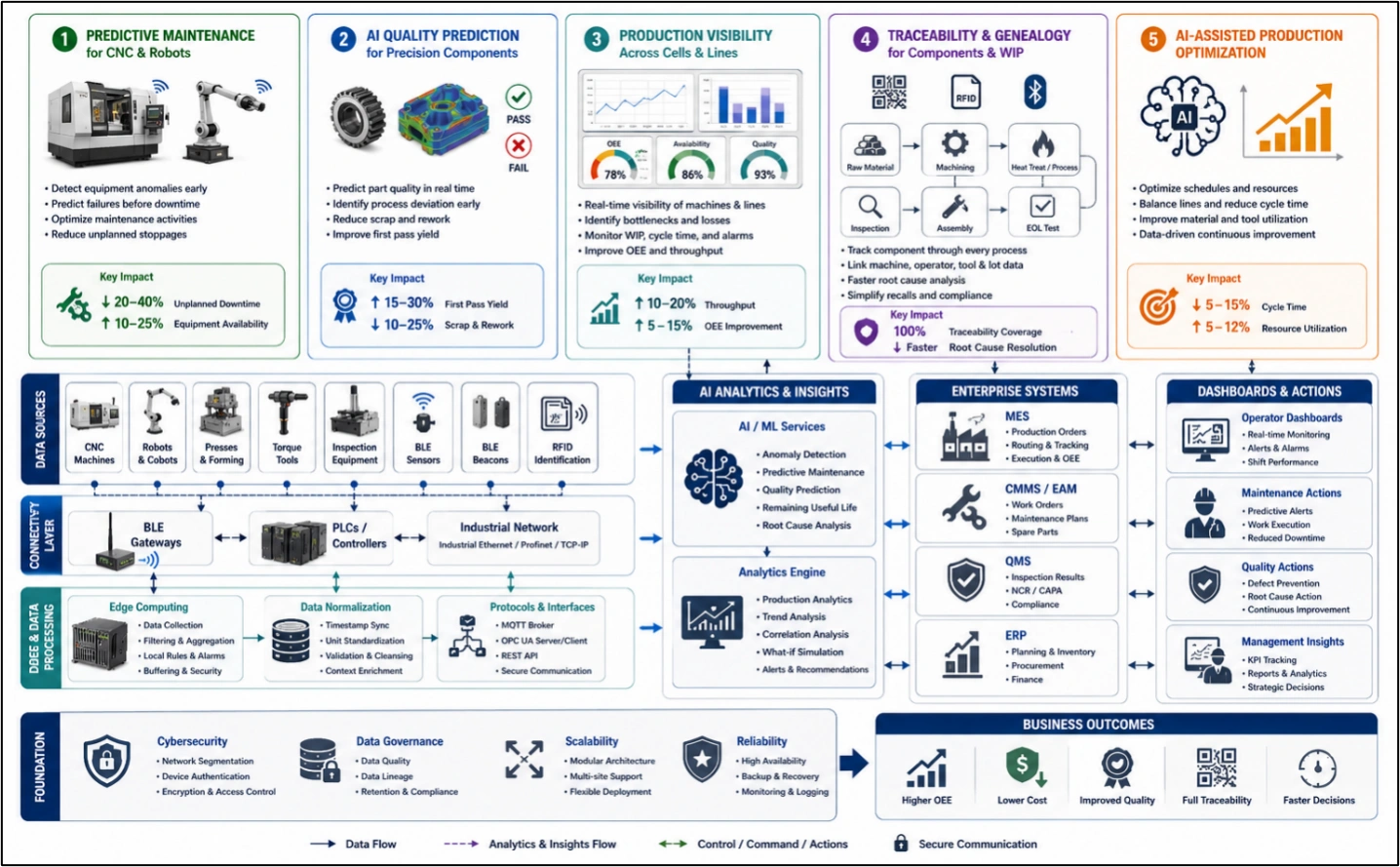
This enterprise infographic illustrates five key AI applications in powertrain manufacturing: predictive maintenance, quality prediction, production visibility, traceability, and production optimization. It shows how BLE sensors, beacons, RFID, gateways, edge processing, AI analytics, MES, CMMS, QMS, ERP, and dashboards support measurable operational improvements.
Key KPIs for AI-Driven Powertrain Manufacturing
AI initiatives should be evaluated using manufacturing KPIs that connect technical performance to production outcomes.
Relevant measures include:
| KPI | Application in Powertrain Manufacturing |
| Overall Equipment Effectiveness (OEE) | Measures availability, performance, and quality |
| Mean Time Between Failures (MTBF) | Evaluates equipment reliability |
| Mean Time to Repair (MTTR) | Measures maintenance response and recovery |
| Unplanned Downtime | Tracks production losses caused by unexpected failures |
| First Pass Yield | Measures components passing without rework |
| Scrap Rate | Tracks rejected components |
| Rework Rate | Measures additional processing caused by quality issues |
| Cycle Time | Evaluates production process efficiency |
| Changeover Time | Measures transition between production configurations |
| Throughput | Measures completed production output |
| Process Capability | Evaluates process consistency against specifications |
| Prediction Accuracy | Evaluates AI model performance |
| False Alert Rate | Measures unnecessary AI-generated interventions |
| Traceability Coverage | Measures how much production history is digitally associated with components |
The most useful KPI structure combines AI performance metrics with manufacturing performance. A predictive-maintenance model with high statistical accuracy has limited operational value if maintenance teams cannot act on its alerts.
AI Models and Data Engineering for Powertrain Processes
Selecting the Right AI Method
There is no single AI model suitable for every powertrain manufacturing application.
Supervised learning is appropriate when historical examples of known outcomes are available. Quality classification and failure prediction are common examples.
Unsupervised learning can identify unusual behavior when labeled failure data is limited. This can be useful for anomaly detection on machines where normal operating behavior is well established.
Time-series analysis is relevant to continuously changing measurements such as vibration, temperature, spindle load, motor current, and cycle time.
Computer vision can support inspection applications involving surfaces, components, assemblies, markings, and dimensional characteristics when suitable cameras and controlled lighting are available.
The model should be selected according to the data characteristics, required response time, explainability requirements, and consequences of an incorrect prediction.
Data Quality Before Model Development
AI performance depends heavily on data quality.
Powertrain manufacturers should establish:
- Consistent equipment identifiers
- Accurate timestamps
- Reliable part and batch identifiers
- Defined units of measurement
- Consistent machine-state definitions
- Correct association between production and inspection records
- Historical maintenance records
- Data validation procedures
- Missing-data handling
- Sensor calibration procedures
A common implementation problem is training a model using data that cannot be reliably associated with the actual component, machine, or production condition. Strong data lineage is therefore as important as model selection.
Interoperability with Powertrain Manufacturing Systems
AI and BLE solutions should operate alongside existing production systems rather than creating isolated data stores.
MES and ERP Integration
MES can provide production orders, routing, workstation information, production status, genealogy, and execution records. ERP systems can provide planning, inventory, purchasing, and order information.
The AI system can consume relevant information from these systems and return analytical results without becoming the master system for every business record.
CMMS, EAM, and Quality Systems
Maintenance predictions can be transferred into CMMS or EAM workflows for inspection and work-order management.
Quality predictions and anomaly information can be associated with QMS processes, allowing quality engineers to investigate nonconformances and corrective actions.
This separation of responsibilities helps prevent duplicated records and makes system ownership clearer.
APIs and Industrial Protocols
Integration may use OPC UA, MQTT, REST APIs, database interfaces, or other approved enterprise integration mechanisms.
The appropriate interface depends on whether the information originates from a PLC, machine controller, edge service, manufacturing application, or enterprise database.
A well-designed integration should define:
- Data ownership
- Data schema
- Device identity
- Timestamp requirements
- Message frequency
- Error handling
- Authentication
- Retention
- API availability
- Failure recovery
Cybersecurity for AI and BLE in Powertrain Manufacturing
Cybersecurity should cover the entire data path from wireless devices to manufacturing applications.
BLE devices should not automatically receive access to sensitive production networks. Gateways can provide a controlled boundary between wireless devices and the industrial network.
Security controls should include:
- Network segmentation
- Device authentication
- Access control
- Encrypted communication where supported
- Secure gateway configuration
- Credential management
- Logging and monitoring
- Firmware and software update procedures
- Vulnerability management
- Backup and recovery
- Controlled remote access
For AI systems, data integrity is particularly important. Manipulated or incorrectly labeled production data can affect model outputs and potentially lead to inappropriate maintenance or quality decisions.
Implementation Lifecycle for Powertrain AI
A successful deployment should progress from a defined production problem to a controlled production rollout.
Planning and Site Assessment
Start by identifying the operational problem.
Examples include excessive CNC downtime, recurring dimensional defects, limited asset visibility, or insufficient production genealogy.
Engineers should then identify:
- Required data sources
- Existing machine interfaces
- Sensor requirements
- BLE coverage requirements
- Gateway locations
- Network connectivity
- AI processing requirements
- Enterprise software interfaces
- Cybersecurity requirements
- KPI baseline
Pilot Deployment
A pilot should normally target a defined production cell rather than an entire factory.
For example, a manufacturer could select a group of CNC machining centers experiencing recurring spindle-related downtime. Sensors, gateways, machine data, maintenance history, and production information can be collected for a controlled period.
The pilot should establish whether the data is sufficient to produce a reliable operational insight before expanding the deployment.
Commissioning and Validation
Commissioning should verify both the technical system and the manufacturing result.
Testing should cover:
- Sensor communication
- Gateway connectivity
- Data timestamps
- Device identification
- Network behavior
- API communication
- Database storage
- AI processing
- Dashboard results
- Alert generation
- MES or CMMS integration
- Cybersecurity controls
- Failure recovery
AI predictions should be validated against real production and maintenance outcomes before being used for important operational decisions.
Production Rollout and Optimization
Once the pilot demonstrates measurable value, the solution can be expanded to additional production cells or plants.
Expansion should include standardized device configurations, documented gateway placement, repeatable commissioning procedures, centralized monitoring, model version control, and defined maintenance responsibilities.
AI models also require ongoing monitoring. Changes in machine configuration, tooling, production recipes, raw materials, or operating conditions can cause model performance to deteriorate over time.
Practical Recommendations for Powertrain Manufacturers
The following engineering principles can help reduce deployment risk:
- Begin with a measurable production problem rather than a technology-first project.
- Reuse existing PLC, MES, inspection, and historian data where it already provides the required information.
- Use BLE sensors where wireless sensing provides a practical advantage over new cabling or direct machine integration.
- Use BLE beacons for appropriate identification or location requirements rather than treating them as universal asset-tracking devices.
- Perform an RF site survey in metal-dense machining and assembly environments.
- Establish reliable asset, machine, component, and timestamp identifiers before training AI models.
- Keep safety-critical machine control separate from experimental AI functions.
- Validate AI predictions against actual maintenance and quality outcomes.
- Integrate AI results into existing MES, CMMS, QMS, or ERP workflows where appropriate.
- Design cybersecurity and network segmentation before production commissioning.
- Select cloud or privately hosted server deployment according to data governance, latency, connectivity, and operational requirements.
- Monitor model accuracy and data drift after deployment.
- Measure business results against a documented pre-deployment baseline.
GAO Solutions for Connected Powertrain Manufacturing
GAO provides BLE, RFID, and IoT hardware products and systems that can support manufacturing applications involving asset identification, wireless sensing, tracking, data collection, and industrial connectivity. Its broader technology portfolio can be evaluated alongside the customer’s existing production equipment and software rather than requiring replacement of established manufacturing infrastructure.
Headquartered in New York City and Toronto, Canada, GAO is ranked among the world’s leading B2B and B2G BLE and RFID suppliers. GAO and its sister companies, GAO Research and GAO Tek, form the GAO Group, with operations based in New York City and Toronto. For three decades, the group has served organizations across the U.S. and Canada, including Fortune 500 companies, R&D organizations, universities, and government agencies.
GAO’s investment in product and system R&D, stringent quality assurance processes, and remote or onsite technical support are relevant when connected manufacturing projects move from technology evaluation into deployment and long-term operation.
Key Takeaways for AI and BLE in Powertrain Manufacturing
AI can help powertrain manufacturers move from isolated production measurements toward data-driven maintenance, quality, traceability, and production decisions. BLE sensors, beacons, and gateways can provide additional wireless data collection where direct wiring or existing machine interfaces do not adequately address the requirement.
The strongest implementations combine reliable data acquisition, edge processing, secure communications, AI analytics, and integration with MES, CMMS, QMS, ERP, and other manufacturing systems.
The practical starting point is a clearly defined manufacturing problem, measurable baseline KPIs, validated data sources, and a controlled pilot. From there, manufacturers can expand the solution according to demonstrated operational value.
GAO can help organizations evaluate BLE, RFID, and IoT hardware and system requirements for connected manufacturing applications. Technical teams can learn more about GAO’s products, engineering capabilities, and support resources through its website.
Powertrain Manufacturing AI Implementation Lifecycle
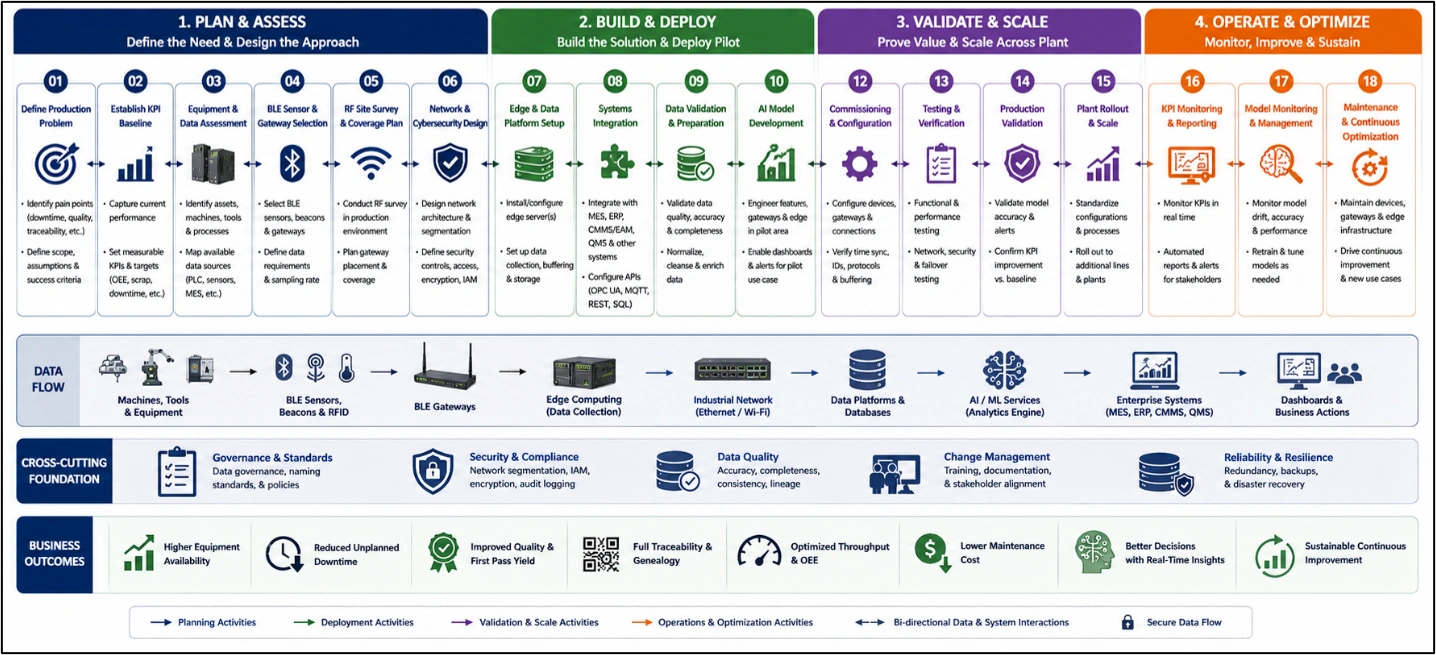
This horizontal workflow illustrates the complete AI implementation lifecycle for powertrain manufacturing, from production problem definition and KPI baselining through deployment, validation, plant rollout, and continuous optimization. It highlights equipment assessment, BLE deployment, cybersecurity, data integration, AI model development, testing, monitoring, and maintenance.
Building the Future of Industrial AI and IoT with Aperture Venture Studio and GAO RFID Inc.
For more than three decades, GAO Group of Companies has invested heavily in R&D for industrial BLE, RFID, and IoT. As generative AI has become increasingly useful for industrial applications, we have continued developing AI and IoT technologies that support connected manufacturing, including BLE and RFID. We have also founded Aperture Venture Studio to advance practical AI and IoT solutions for manufacturing and other industrial applications.
Aperture brings together AI and IoT technical experts, operational executives, investors, and leading companies. We have also developed the Aperture Ventures Summit and TekSummit to discuss advanced AI and IoT topics and encourage technical collaboration.
We welcome you to join us as:
- Advisors, Co-founders, or Employees
- Investors
- Customers