
AI and BLE for Defense Aviation Systems
AI-Driven Aviation Systems for Defense Aviation Operations
AI-driven aviation systems can combine machine learning, edge analytics, connected sensors, and location data to improve how defense aviation organizations monitor aircraft assets, maintenance equipment, ground-support equipment, spare parts, personnel, and mission-critical resources. BLE gateways, BLE beacons, and BLE sensors provide a practical data-acquisition layer for locating assets and collecting operational conditions, while AI converts that data into maintenance alerts, anomaly detection, utilization insights, and operational decisions.
Defense aviation environments require more than simple asset visibility. Aircraft maintenance organizations must account for tooling, components, ground support equipment, flight-line resources, controlled areas, maintenance status, environmental conditions, and rapidly changing operational priorities. AI can correlate these data streams with maintenance management, logistics, inventory, and security systems. The result is a more responsive aviation operations process in which personnel can identify deviations earlier, prioritize work, reduce search time, and make decisions using current operational data.
GAO supplies BLE, RFID, and IoT hardware products and systems that can support these connected aviation use cases, with deployment approaches adaptable to customer-managed infrastructure and cloud-connected environments.
AI-Enabled Defense Aviation Systems Architecture
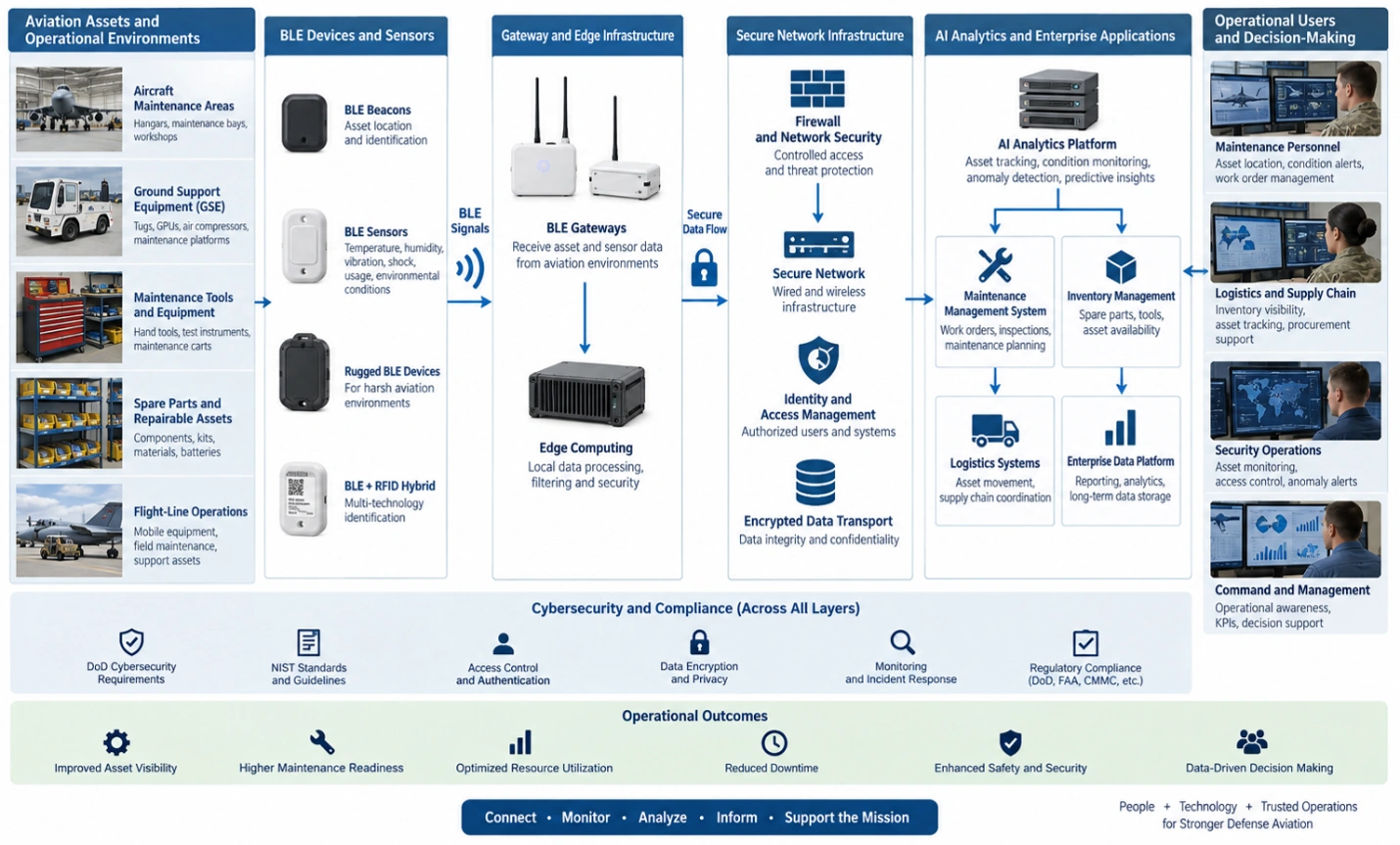
The visual illustrates how aircraft assets, BLE beacons and sensors, gateways, edge computing, secure networks, AI analytics, and enterprise systems connect across defense aviation operations. It highlights the flow of operational data into maintenance, inventory, logistics, security, and decision-making functions.
What AI Means for Modern Defense Aviation Systems
Artificial Intelligence of Things, commonly called AIoT or AI and IoT, combines artificial intelligence with IoT devices, sensors, connected equipment, and industrial systems. For defense aviation, AIoT can connect physical aviation assets with software that detects patterns, estimates operational conditions, identifies anomalies, and supports maintenance and logistics decisions.
The engineering value comes from combining several capabilities rather than treating AI as an isolated software function. BLE devices can provide proximity, identification, movement, and sensor data. Gateways collect information from distributed locations such as maintenance bays, hangars, tool rooms, warehouses, staging areas, and flight-line support zones. Edge computing can process time-sensitive information close to the source, while centralized servers or cloud services can perform broader analytics across multiple facilities.
AI methods can then correlate location, environmental, maintenance, inventory, and utilization data. A maintenance organization, for example, can use historical equipment movements together with sensor readings to identify abnormal operating conditions or unusual asset utilization. A logistics team can analyze component movements and stock records to identify replenishment risks. Security personnel can investigate unexpected movement of tagged equipment through restricted areas.
BLE therefore functions as an enabling communication technology rather than the business objective itself. The operational objective is better aviation asset visibility, maintenance intelligence, logistics control, safety monitoring, and resource utilization.
GAO’s experience supplying BLE and RFID hardware products and systems is relevant where defense aviation organizations need connected physical infrastructure to support these data-driven workflows.
Defense Aviation Applications for AI-Enabled Aviation Systems
AI Aircraft Maintenance and Tool Tracking
Aircraft maintenance depends on the availability and correct location of specialized tooling, test equipment, maintenance kits, ground support equipment, and service components. A missing torque wrench, diagnostic instrument, battery cart, or maintenance kit can delay a work package even when the required aircraft and personnel are available.
BLE beacons can identify mobile equipment, while BLE gateways installed around hangars, workshops, tool rooms, and staging areas provide location observations. AI software can analyze movement patterns and identify abnormal dwell times, repeated search events, or equipment utilization patterns.
Useful operational outcomes include:
- Faster identification of maintenance tools and ground support equipment
- Reduced time spent searching for equipment before maintenance tasks
- Identification of underutilized or frequently misplaced equipment
- Better allocation of shared maintenance resources
- Detection of unusual movement or prolonged absence from an authorized work area
- Improved maintenance planning based on equipment availability
The engineering design should distinguish between approximate zone-level location and higher-precision positioning. A system intended only to determine whether a tool is inside a hangar does not require the same infrastructure as one intended to determine its position within a maintenance bay.
AI-Enabled Ground Support Equipment Monitoring
Ground support equipment such as aircraft tugs, ground power units, air start units, hydraulic service carts, nitrogen systems, maintenance stands, and specialized support equipment can represent significant operational value.
BLE sensors can provide condition data such as temperature, vibration, battery status, or other measurable parameters where the selected sensor supports those measurements. AI models can establish normal operating patterns and flag deviations that may warrant inspection.
This approach can support condition-based maintenance rather than relying exclusively on fixed maintenance intervals. The AI model should not automatically replace engineering inspection procedures. Instead, its output can be treated as an additional evidence source for qualified maintenance personnel.
AI Aviation Inventory and Spare Parts Management
Defense aviation logistics involves high-value components, serialized parts, repairable items, consumables, maintenance kits, and specialized inventory. Location information becomes particularly useful when stock is distributed across warehouses, maintenance shops, aircraft staging areas, and temporary work locations.
BLE can complement RFID and existing barcode systems. RFID is particularly useful for rapid identification of tagged inventory at controlled reading points, while BLE can provide longer-duration location observations for mobile assets and equipment.
AI can combine these data sources with inventory and logistics records to identify:
- Unusual component movement
- Potential stock discrepancies
- Repeated stockout patterns
- Excessive movement between storage and maintenance locations
- Abnormal dwell times for repairable assets
- Maintenance demand patterns that affect spare-parts planning
The strongest results generally come from integrating identification and location data with existing inventory records rather than creating a separate asset database that personnel must maintain manually.
AI Personnel Safety and Restricted-Area Awareness
Defense aviation facilities contain controlled maintenance areas, aircraft servicing zones, equipment movement routes, and locations where personnel access may be restricted according to operational requirements.
BLE-enabled personnel tags can provide proximity or zone-level presence information where authorized and appropriate. AI analytics can identify patterns such as unexpected presence, prolonged presence in designated zones, or personnel-equipment relationships that require review.
Personnel monitoring requires careful governance. Identity data, access records, and location histories should be protected through role-based access controls, data minimization, retention policies, and applicable organizational security requirements.
AI Environmental Monitoring for Aviation Maintenance Areas
Aircraft components, batteries, electronics, lubricants, chemicals, and other maintenance materials may require controlled environmental conditions. BLE sensors can collect temperature, humidity, vibration, or other supported measurements from storage and maintenance environments.
AI can detect trends that are difficult to identify through occasional manual inspections. For example, repeated temperature excursions in a component storage area may indicate a building-control problem rather than a single isolated event.
GAO can supply BLE sensors and related IoT hardware that provide the physical data collection required for such monitoring systems.
AI-Enabled Defense Aviation Monitoring Data-to-Decision Workflow
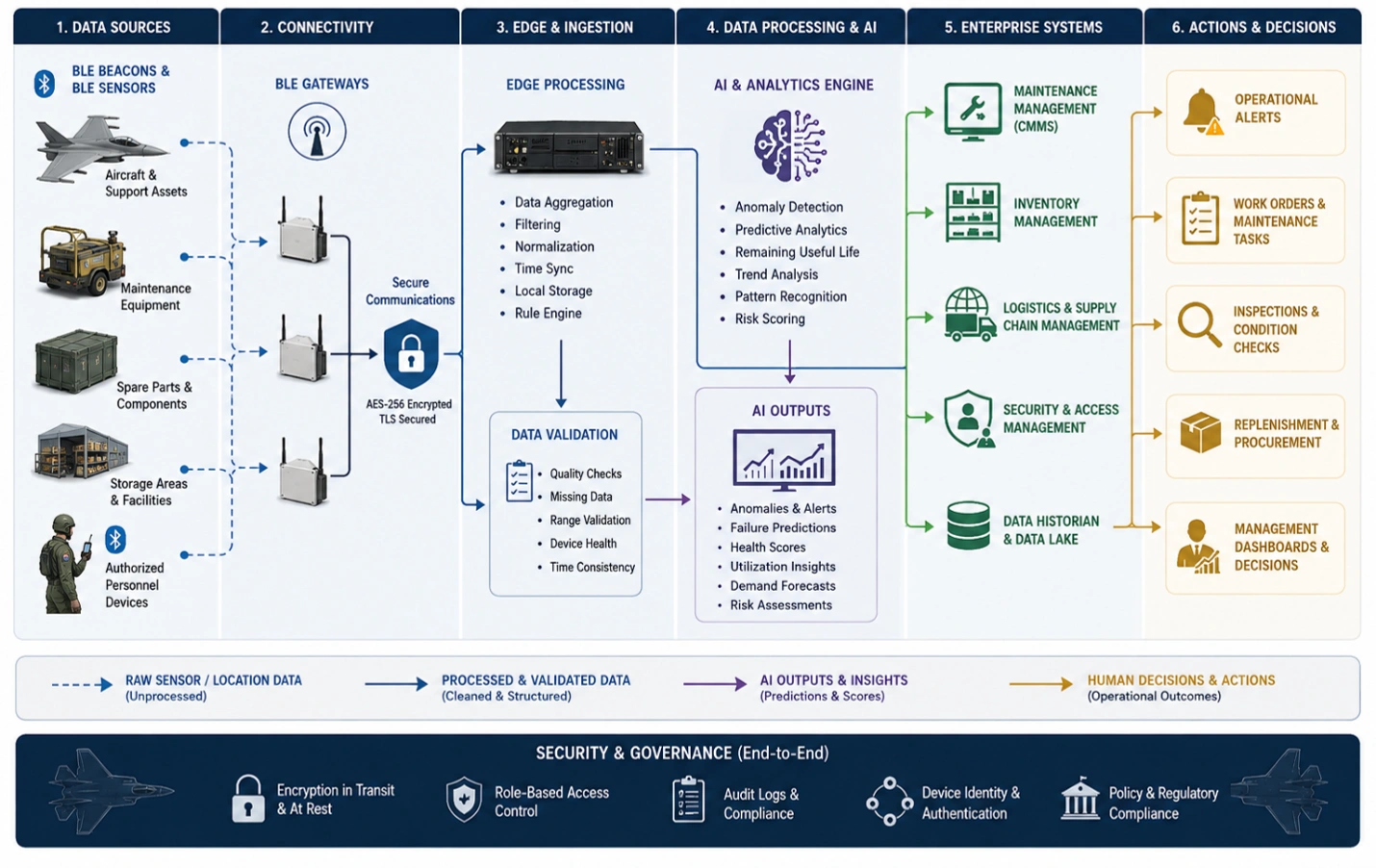
This workflow diagram illustrates how BLE beacons and sensors move aircraft, maintenance, inventory, and personnel data through secure gateways, edge processing, validation, and AI analytics. It shows how AI-generated insights feed maintenance, inventory, logistics, and security systems, leading to alerts, work orders, inspections, replenishment, and management decisions.
Defense Aviation Operational Workflow from Data Capture to AI Decisions
A reliable AI aviation system should be designed around the existing operational workflow rather than around the sensor technology. Data begins with physical events involving aircraft support equipment, maintenance tools, components, inventory, personnel, and facility conditions.
Data Acquisition at the Flight Line and Maintenance Facility
BLE beacons can provide an electronic identity for mobile assets, while BLE sensors can generate measurements from equipment or controlled environments. The selected device should match the operational requirement. A simple location requirement may need only beacon identification, whereas condition monitoring requires a sensor capable of measuring the required physical parameter with suitable accuracy and environmental tolerance.
H3: BLE Gateway Collection and Local Processing
BLE gateways receive advertisements or sensor data from devices within their radio coverage. Gateway placement is an engineering decision influenced by hangar construction, aircraft structures, equipment density, radio interference, required coverage, and the desired location resolution.
Defense aviation facilities may contain large metal structures and moving aircraft that affect radio propagation. A coverage survey should therefore be performed before finalizing gateway locations. Gateway redundancy may also be appropriate for operationally important zones.
Edge Analytics and Data Validation
Edge processing can filter duplicate observations, normalize sensor readings, validate timestamps, and identify basic anomalies before data reaches centralized software. This reduces unnecessary network traffic and can allow selected alerts to continue operating when connectivity to a central server is temporarily unavailable.
AI models running at the edge are particularly useful when response time, network isolation, or data-residency requirements make centralized processing unsuitable.
Centralized AI Analytics
Centralized AI software can correlate observations from multiple gateways, facilities, and operational systems. Machine learning models can identify deviations from established operating patterns, while rules-based logic can enforce explicit operational thresholds.
A practical implementation should separate deterministic safety or compliance rules from probabilistic AI predictions. A temperature limit specified by engineering documentation should remain a defined threshold rather than being delegated entirely to a machine-learning model.
Operational Action and Human Review
AI output becomes valuable when it results in a defined operational action. An anomaly may generate a maintenance inspection, inventory investigation, equipment search request, security review, or management notification.
Human review remains important for high-consequence aviation decisions. AI should provide evidence, prioritization, and context while qualified personnel retain responsibility for maintenance, safety, security, and operational decisions.
AI Alert Decision Tree for Defense Aviation Maintenance, Logistics, and Security
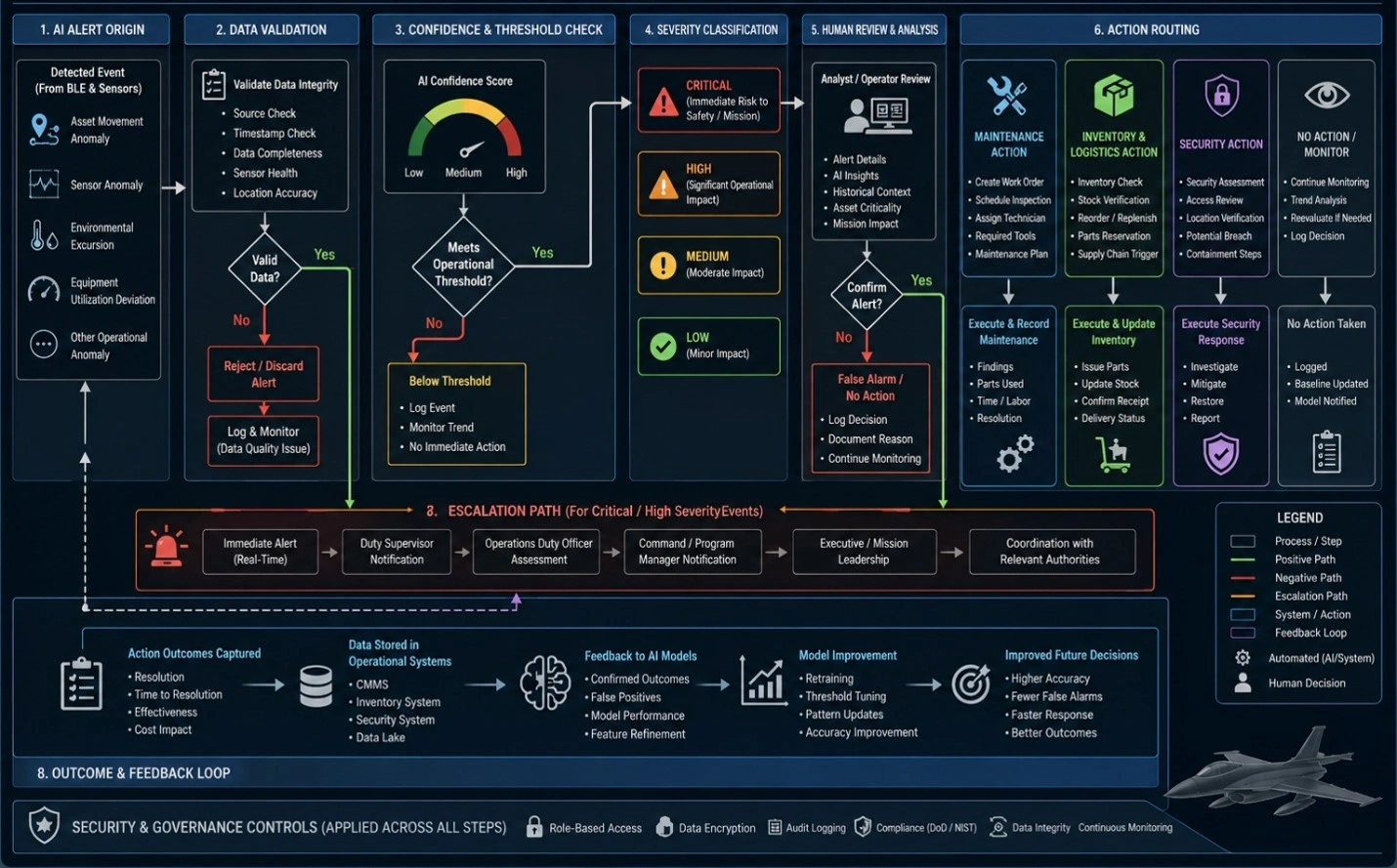
This decision tree shows how AI-generated alerts move through data validation, confidence and threshold checks, severity classification, and human review. It illustrates controlled routing to maintenance, inventory and logistics, security, or no-action outcomes, with escalation for critical events and feedback loops that improve future AI decisions.
Technical Foundation for AI-Enabled Defense Aviation Systems
BLE Beacons, Sensors, and Gateways
BLE beacons provide low-power identification and proximity signaling for assets such as maintenance tools, ground support equipment, containers, carts, and selected mobile resources. BLE sensors extend the system by measuring physical conditions relevant to aviation operations.
BLE gateways act as the collection point between local BLE devices and the broader software environment. Depending on the design, gateways may communicate with servers using Ethernet, Wi-Fi, cellular connectivity, or other IP-based networking methods supported by the deployment.
The technology selection should account for battery life, enclosure requirements, temperature range, radio performance, mounting method, maintenance access, and electromagnetic conditions around aircraft and maintenance equipment.
AI and Machine Learning Methods
Different aviation problems require different analytical methods.
- Anomaly detection can identify equipment behavior that deviates from an established baseline.
- Time-series models can evaluate changing sensor measurements over time.
- Classification models can categorize operational events according to learned patterns.
- Predictive models can estimate maintenance or replenishment risks from historical data.
- Computer vision can complement BLE and sensor data where cameras are authorized and appropriate for tasks such as equipment identification or visual inspection.
- Edge AI can process selected events close to the physical source where low latency or connectivity constraints justify local inference.
- Physical AI may become relevant for autonomous aviation-support equipment where AI interacts directly with physical systems, although such applications require substantially higher assurance and safety controls.
Communication, Middleware, and Enterprise Software
A production deployment normally requires more than BLE devices. Middleware translates device observations into records that operational software can consume. APIs, message brokers, databases, identity services, and integration services may connect the IoT data with computerized maintenance management systems, enterprise asset management software, warehouse management systems, inventory applications, logistics software, access-control systems, and operational dashboards.
Interoperability should be considered during procurement. Organizations should avoid creating a closed data path in which asset information can only be accessed through one application. Well-defined APIs, documented data models, secure authentication, and export mechanisms provide greater flexibility during future system expansion.
Cloud Version and Server Version
A Cloud Version can host AI analytics, databases, dashboards, device management, and integration services within cloud infrastructure. This approach can suit defense aviation organizations that are permitted to use approved cloud environments and require centralized management across geographically distributed facilities.
A Server Version deploys the software on customer-managed edge servers, private data centers, facility servers, or other privately hosted infrastructure. This model can be appropriate where network isolation, data-residency requirements, local processing, cybersecurity policy, or operational continuity favor greater infrastructure control.
The choice should not be made solely on cost. Defense aviation deployments should evaluate network segmentation, information classification, cybersecurity controls, offline operation, latency, update procedures, backup requirements, disaster recovery, integration with existing identity systems, and the organization’s ability to maintain the selected infrastructure.
GAO can provide hardware products and systems that support different IoT deployment requirements, while the final software and infrastructure configuration should be aligned with the customer’s security, network, maintenance, and operational requirements.
Cybersecurity and Resilience Considerations for Defense Aviation
Security must be designed across the complete data path. BLE device security alone is insufficient if gateways, APIs, servers, user accounts, or network connections remain poorly protected.
Important controls include:
- Unique device identities and controlled provisioning
- Encrypted communications where supported by the device and network design
- Network segmentation between IoT infrastructure and sensitive aviation systems
- Role-based access controls for maintenance, logistics, security, and management users
- Strong authentication for administrative access
- Secure gateway configuration and controlled firmware updates
- Audit logging for configuration changes and significant operational events
- Data retention policies appropriate to operational and security requirements
- Backup and recovery procedures for databases and critical configuration
- Monitoring for unauthorized devices, unexpected gateway behavior, and abnormal network traffic
Defense aviation organizations should also evaluate applicable government cybersecurity requirements, contractual security controls, organizational information-classification rules, and relevant aviation maintenance and safety procedures before deployment.
Defense-in-Depth Cybersecurity Architecture for AI-Enabled Defense Aviation IoT
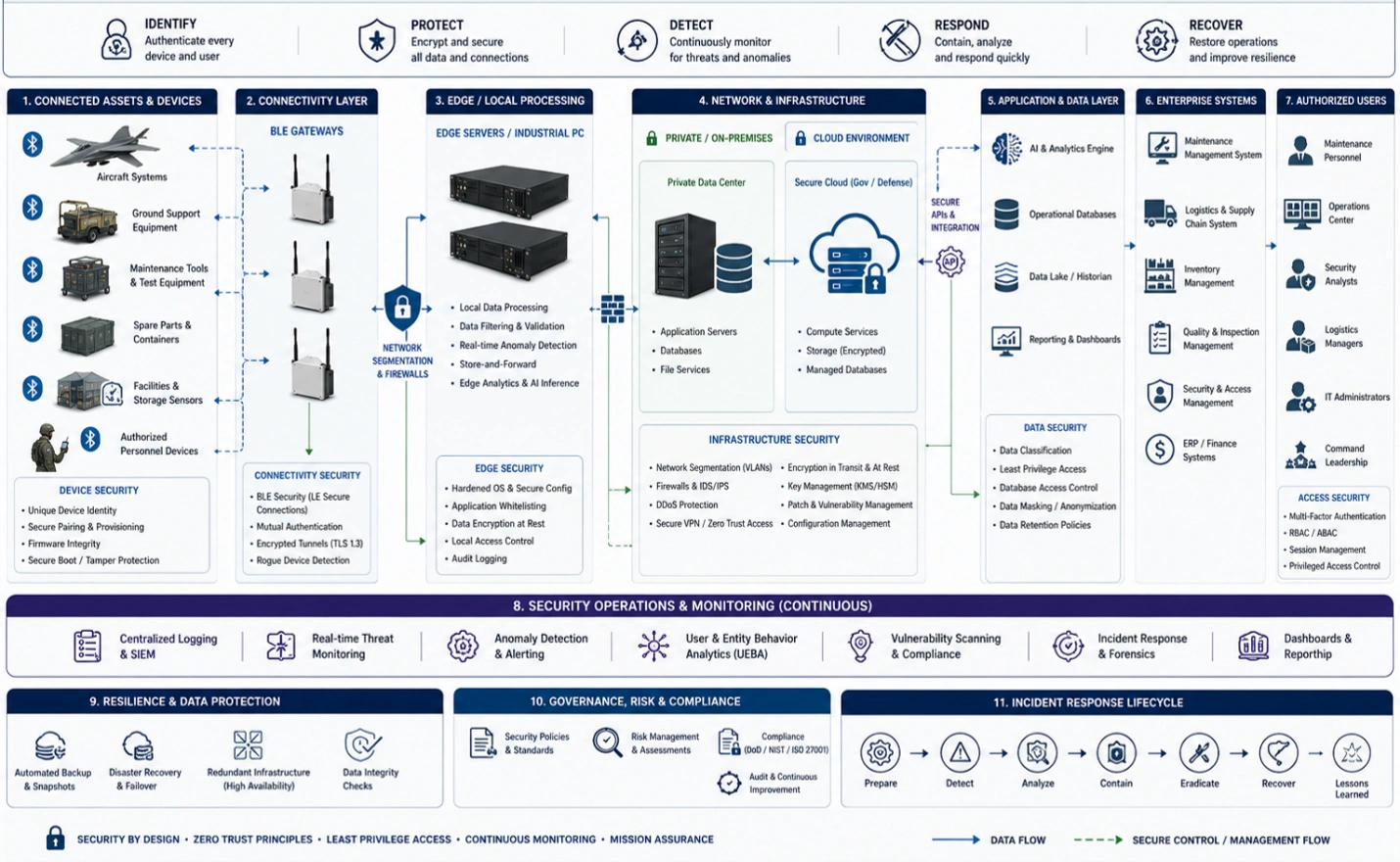
This cybersecurity architecture illustrates layered protection across connected aviation assets, BLE gateways, edge servers, segmented networks, private or cloud infrastructure, AI platforms, enterprise systems, and authorized users. It highlights device security, encryption, access control, continuous monitoring, data protection, resilience, governance, and incident response as coordinated defenses.
Engineering Design Priorities for Defense Aviation BLE Deployments
Aviation environments create several design constraints that should be addressed during planning rather than after commissioning.
BLE radio performance can be affected by aircraft structures, metallic walls, maintenance equipment, enclosed compartments, and changing equipment positions. Gateway density should therefore be determined from measured coverage and required positioning performance rather than a simple distance estimate.
Battery-powered devices also require lifecycle planning. Engineers should consider expected advertising frequency, sensor sampling rate, transmission power, battery chemistry, temperature exposure, maintenance access, and replacement procedures. A device that performs well technically but requires frequent battery replacement can create unnecessary maintenance workload across a large aviation facility.
Commissioning should include device enrollment, asset-to-tag association, gateway coverage verification, timestamp validation, network testing, alert testing, and integration testing with operational software. Acceptance testing should use realistic aviation workflows rather than testing isolated hardware components only.
GAO has served customers in the United States and Canada for three decades, including Fortune 500 companies, leading R&D organizations, universities, and government agencies. Its product and system development is supported by substantial R&D investment, quality assurance processes, and technical support that can be provided remotely or onsite when appropriate.
Technical Capabilities and Operational Improvements
AI-enabled defense aviation systems deliver value when location, condition, maintenance, inventory, and operational data can be converted into timely decisions. The most important capabilities are not simply the ability to collect more data, but the ability to establish reliable relationships between physical aviation assets and the workflows responsible for them.
Predictive Maintenance Support
Historical maintenance records, equipment utilization, sensor measurements, and operating conditions can be analyzed to identify patterns associated with equipment degradation or maintenance requirements.
For example, repeated vibration or temperature deviations from a ground support asset can be correlated with previous inspection outcomes. Rather than treating an AI prediction as a definitive maintenance diagnosis, maintenance personnel can use the prediction to prioritize inspection and determine whether corrective work is necessary.
This approach can help defense aviation organizations move from reactive troubleshooting toward condition-informed maintenance planning.
Real-Time Aviation Asset Visibility
AI can turn large volumes of location observations into operationally useful information. Instead of asking personnel to manually search several maintenance areas for a missing item, software can provide the latest known zone, movement history, and confidence level associated with an asset.
Useful assets include:
- Aircraft maintenance tools
- Ground support equipment
- Maintenance carts
- Test instruments
- Spare components
- Repairable assets
- Maintenance kits
- Battery and charging equipment
- Specialized service equipment
Location intelligence is particularly valuable when assets are shared between maintenance teams and frequently move between hangars, workshops, warehouses, and flight-line areas.
Anomaly Detection for Aviation Operations
Rules-based alerts are useful for clearly defined conditions, but machine learning can identify more complex patterns.
An AI system could flag an unusually long dwell time for a repairable component, repeated movement of equipment between two locations, an unexpected change in environmental conditions, or sensor behavior that differs significantly from historical operating patterns.
The quality of anomaly detection depends heavily on data quality. Missing timestamps, incorrectly associated asset identities, gateway outages, battery failures, and inconsistent maintenance records can produce false alerts. Data validation should therefore be treated as part of the AI solution rather than as an afterthought.
Maintenance Workflow Optimization
AI can help maintenance planners prioritize resources by considering equipment availability, historical utilization, open maintenance activities, component availability, and operational schedules.
A useful system does not simply generate a priority score. It should provide enough context for a maintenance planner to understand why an activity has been prioritized.
For example, a maintenance recommendation could combine:
- Asset identity
- Current location
- Sensor condition
- Last inspection
- Previous fault history
- Current maintenance status
- Required tooling
- Available replacement components
- Assigned maintenance personnel
- Operational priority
This contextual approach can reduce unnecessary manual coordination while keeping qualified personnel involved in consequential decisions.
Inventory and Logistics Intelligence
AI-supported inventory management can identify consumption trends and potential shortages before they disrupt aircraft maintenance. BLE location observations can supplement RFID, barcode, and warehouse transaction records where continuous or zone-level visibility is useful.
The system can distinguish between an item that is genuinely unavailable and an item that is physically present but located outside its expected storage or maintenance zone. This distinction is operationally important because a stock discrepancy and a procurement requirement require different responses.
Improved Resource Utilization
Defense aviation organizations often maintain expensive specialized equipment that may be shared among multiple maintenance teams. AI can analyze usage frequency, location histories, idle periods, and demand patterns to identify assets that are consistently underused or repeatedly requested.
The resulting information can support decisions about equipment allocation, maintenance scheduling, additional procurement, and resource positioning.
Key KPIs for AI-Enabled Defense Aviation Systems
Performance measurement should connect technology metrics with actual aviation maintenance and logistics outcomes. A deployment should establish a baseline before automation so that improvements can be measured objectively.
| KPI | What It Measures | Why It Matters |
| Asset location accuracy | Accuracy of reported equipment location | Determines whether personnel can rely on asset visibility |
| Tool search time | Time required to locate maintenance equipment | Directly affects maintenance productivity |
| Ground support equipment utilization | Percentage of available time equipment is productively used | Identifies underused or overloaded resources |
| Asset availability | Percentage of required assets available when needed | Supports maintenance readiness |
| Maintenance response time | Time from alert to qualified inspection or action | Measures operational responsiveness |
| Mean time to repair | Average time required to restore equipment | Indicates maintenance efficiency |
| False alert rate | Percentage of AI alerts judged non-actionable | Measures AI operational quality |
| Anomaly detection precision | Percentage of flagged anomalies confirmed as relevant | Helps evaluate model usefulness |
| Spare-part availability | Availability of required components | Supports aircraft maintenance continuity |
| Inventory discrepancy rate | Difference between recorded and observed inventory | Indicates inventory control quality |
| Environmental excursion duration | Time assets remain outside specified conditions | Supports component and material protection |
| Gateway availability | Percentage of time gateways remain operational | Indicates data collection reliability |
| Sensor battery life | Operational life between battery changes | Affects maintenance workload |
| Data ingestion latency | Time between field observation and software availability | Important for time-sensitive decisions |
| AI recommendation acceptance | Percentage of recommendations acted upon after review | Indicates practical decision support value |
AI KPIs should be evaluated together with aviation operational measures. A highly accurate model that produces alerts maintenance personnel cannot act upon may have less practical value than a slightly less sophisticated model integrated directly into established maintenance workflows.
Deployment, Commissioning, and Integration Strategy
A defense aviation deployment should progress through controlled engineering stages.
Requirements and Site Assessment
The first stage should identify the assets, workflows, locations, users, and decisions that the system must support. Engineers should document required location granularity, sensor parameters, reporting intervals, expected device density, network availability, cybersecurity requirements, and integration requirements.
A radio-frequency site assessment should examine hangars, maintenance bays, tool rooms, warehouses, flight-line support areas, equipment storage zones, and other relevant locations. Aircraft structures and metallic infrastructure can produce reflections, attenuation, and changing radio conditions, so assumptions based solely on nominal BLE range are insufficient.
Hardware Selection
Device selection should be driven by the aviation workflow.
A beacon intended for a maintenance tool has different requirements from a sensor mounted on ground support equipment. Relevant criteria can include:
- Operating temperature
- Enclosure and environmental protection
- Battery capacity
- Sampling frequency
- Transmission interval
- Mounting method
- Radio performance
- Sensor accuracy
- Maintenance accessibility
- Device identity management
- Firmware update capability
GAO provides BLE beacons, BLE sensors, BLE gateways, RFID products, and related IoT hardware that can be evaluated according to these operational requirements.
Pilot Deployment
A controlled pilot should cover representative aviation workflows rather than merely proving that a BLE device can communicate with a gateway.
A useful pilot might include a maintenance tool room, selected ground support equipment, a storage area, and a maintenance bay. The evaluation should measure location performance, battery behavior, gateway coverage, data latency, alert quality, and integration with the intended software.
System Integration
Integration should connect the IoT data with existing systems wherever practical.
Potential interfaces include:
- Computerized maintenance management systems
- Enterprise asset management systems
- Inventory management software
- Warehouse management systems
- Logistics applications
- Maintenance planning systems
- Access-control systems
- Identity and authentication services
- Security monitoring systems
- Data warehouses and analytics software
API-based integration can reduce duplicate data entry and allow the AI system to use authoritative records maintained by existing aviation applications.
Testing and Acceptance
Testing should include normal operations, abnormal conditions, gateway outages, device battery depletion, network interruptions, duplicate observations, incorrect asset associations, and recovery procedures.
AI testing should also measure false positives, false negatives, confidence thresholds, model drift, and the effect of missing data.
Acceptance criteria should be established before deployment. This prevents a system from being judged solely on demonstrations rather than measurable aviation outcomes.
AI-Enabled BLE & IoT Deployment Lifecycle for Defense Aviation
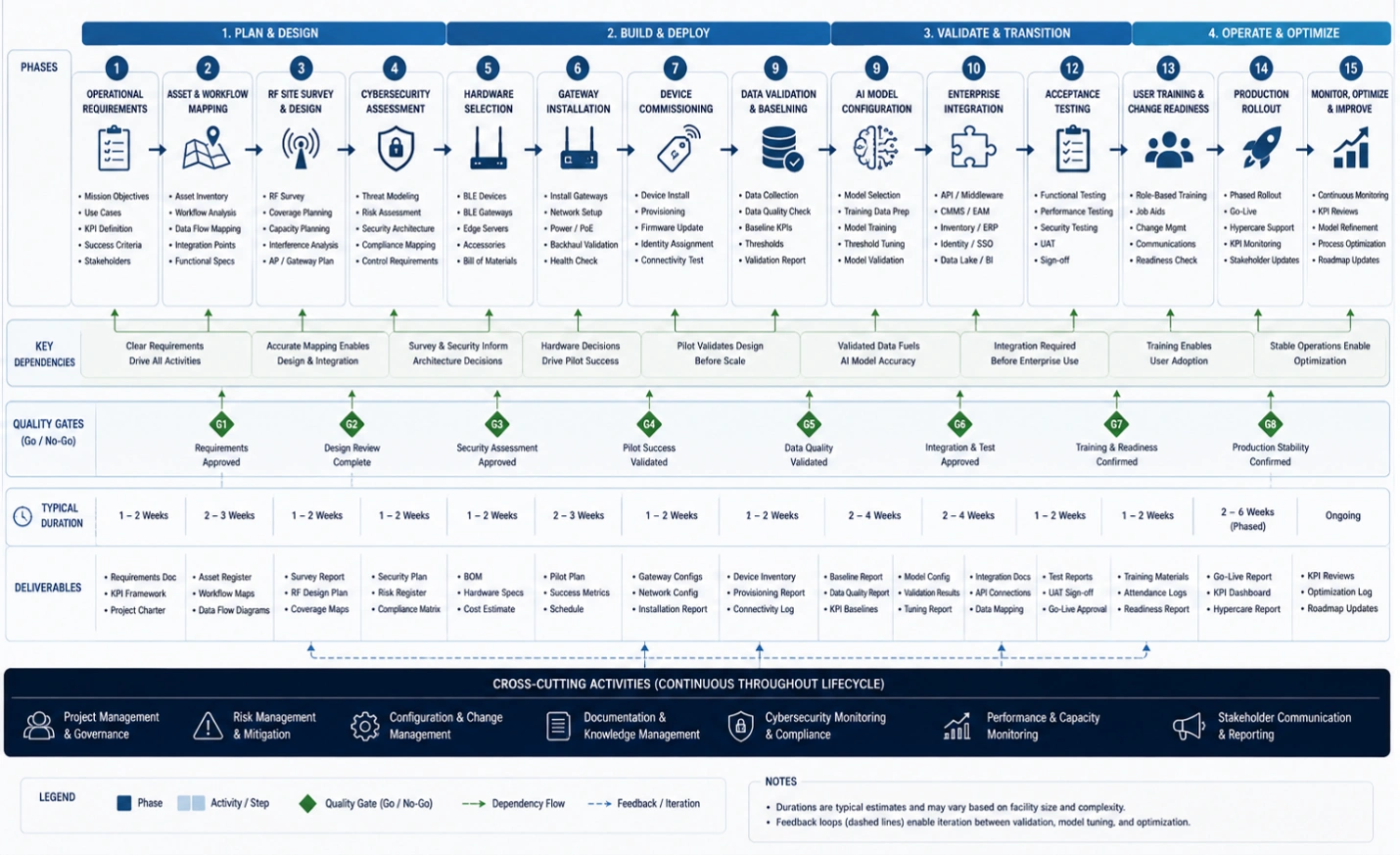
This engineering lifecycle timeline maps the deployment of AI-enabled BLE and IoT systems from operational requirements and site design through hardware deployment, data validation, AI configuration, integration, testing, training, and production rollout. Quality gates, dependencies, deliverables, and continuous optimization activities show how each implementation stage is validated before progressing.
Scalability, Maintenance, and Long-Term Optimization
Scaling a defense aviation IoT system from one maintenance area to multiple facilities changes the engineering requirements. Gateway management, device provisioning, network capacity, database growth, model monitoring, and support processes must all scale with the number of connected assets.
A standardized device naming convention and asset identity model can prevent data fragmentation when additional facilities are connected. Each physical asset should have a controlled relationship between its enterprise asset identifier and its BLE or RFID identifier.
Gateway health should also be monitored continuously. A failed gateway can create an apparent asset-location problem even though the asset itself has not moved. Separating device health, gateway health, network health, and asset movement helps maintenance teams diagnose the real source of an issue.
Battery-powered BLE devices require lifecycle management. Maintenance teams should have visibility into battery state where supported and should establish replacement procedures before large-scale deployment.
AI models require ongoing monitoring as operational conditions change. Changes in equipment usage, facility layout, maintenance procedures, sensor behavior, or asset populations can alter the statistical patterns on which a model was trained. Model performance should therefore be reviewed periodically rather than assuming that an initial model will remain accurate indefinitely.
Standards, Compliance, and Defense Aviation Governance
Technology selection should be evaluated against the specific regulatory, contractual, cybersecurity, and aviation requirements applicable to the deployment location and mission.
Relevant areas for assessment can include:
- FAA requirements where applicable to the operating environment
- U.S. Department of Defense cybersecurity requirements
- NIST cybersecurity guidance
- NIST SP 800-series controls where applicable
- CMMC requirements for covered contractors
- FISMA requirements where applicable to federal systems
- Federal Acquisition Regulation requirements
- Defense Federal Acquisition Regulation Supplement requirements
- DoD security and information-assurance policies
- Organizational aircraft maintenance procedures
- Aviation safety management requirements
- Electromagnetic compatibility requirements
- Radio-frequency spectrum requirements
- Data classification and retention policies
- Supplier cybersecurity requirements
- Access-control and identity-management policies
- Applicable Canadian federal or defense requirements for Canadian deployments
No single technology standard should be assumed to satisfy every defense aviation deployment. Compliance must be mapped to the actual organization, information type, facility, network, and contractual environment.
Practical Recommendations for Defense Aviation Technology Teams
Organizations evaluating AI-enabled aviation asset tracking and monitoring should begin with a clearly defined operational problem.
Recommended engineering practices include:
- Start with a measurable maintenance, logistics, safety, or asset-visibility problem rather than beginning with a sensor purchase.
- Define the required location precision before selecting BLE infrastructure.
- Conduct RF testing in representative hangars and maintenance areas.
- Treat BLE, RFID, barcodes, and existing enterprise records as complementary data sources rather than forcing one identification technology to perform every function.
- Keep deterministic safety and engineering limits separate from probabilistic AI predictions.
- Validate AI outputs against qualified maintenance and logistics personnel before automating consequential actions.
- Design device identity, gateway identity, user identity, and asset identity as separate but connected records.
- Build cybersecurity controls into device provisioning, networking, software integration, and lifecycle management.
- Establish measurable baseline KPIs before production deployment.
- Test failure conditions, not only normal operation.
- Select Cloud Version or Server Version according to security, connectivity, latency, data governance, infrastructure, and support requirements.
- Design APIs and data export capabilities to preserve interoperability with existing aviation software.
- Establish battery, firmware, gateway, and model-maintenance procedures before scaling.
- Use pilot results to refine device placement, alert thresholds, workflows, and user interfaces before broader deployment.
GAO’s three decades of R&D investment across BLE, RFID, and IoT technologies support the development and supply of hardware products and systems for organizations requiring connected asset, sensing, and identification capabilities. GAO has its headquarters in New York City and Toronto, Canada, and is ranked among the world’s top 10 leading B2B and B2G BLE and RFID suppliers, with a lesser degree of B2B2C and B2D activity.
Explore AI and IoT Solutions for Defense Aviation Systems
AI can provide meaningful value to defense aviation when it is connected to reliable operational data and implemented around established maintenance, logistics, safety, and security processes. BLE beacons, BLE sensors, and BLE gateways can provide the physical data layer needed for asset visibility and condition monitoring, while AI and edge analytics turn those observations into actionable information.
For organizations evaluating aviation asset tracking, AI maintenance support, ground support equipment monitoring, inventory intelligence, or environmental sensing, the next step is to define the operational requirement, required data, security constraints, and measurable outcome.
Learn more about GAO’s BLE, RFID, and IoT products and systems to determine which technologies can support your defense aviation requirements.
Why AI-Enabled BLE Systems Matter for Defense Aviation
The principal value of AI-enabled defense aviation systems comes from connecting physical operational events with decisions that maintenance, logistics, safety, and security personnel already need to make. BLE beacons, sensors, and gateways provide useful data from mobile equipment and distributed facilities, while AI can identify patterns, prioritize anomalies, and correlate information across operational systems.
Successful deployments depend on engineering fundamentals: reliable device identification, appropriate RF coverage, validated data, secure communications, interoperable software, measurable KPIs, and human oversight of consequential decisions.
GAO and its sister companies, GAO Research and GAO Tek, form GAO Group, with operations based in New York City and Toronto, Canada. GAO Group has served customers throughout the United States and Canada, including Fortune 500 companies, leading R&D firms, prestigious universities, and U.S. and Canadian government agencies. Its stringent quality assurance processes and technical support capabilities, including remote and onsite support, provide additional resources for organizations implementing connected technology systems.
Defense aviation organizations can evaluate AI-enabled asset tracking, condition monitoring, inventory intelligence, and operational sensing according to their specific facility, security, network, and maintenance requirements. GAO’s BLE, RFID, and IoT hardware products and systems can form part of these solutions where the selected technology meets the operational specification.
Building the Future of Industrial AI and IoT with Aperture Venture Studio and GAO RFID Inc.
For more than three decades, GAO Group of Companies has invested heavily in R&D for industrial BLE, RFID, and IoT. As generative AI has become useful for industrial applications, we have continued developing AI and IoT technologies, including BLE and RFID, while working with Aperture Venture Studio on AI and IoT initiatives relevant to connected industries such as defense aviation systems.
Aperture has attracted AI and IoT technical experts, entrepreneurial and operational executives, influential investors, and leading companies. We have also developed the Aperture Ventures Summit and TekSummit to discuss advanced AI and IoT topics.
These activities have helped build technical communities around industrial AI and IoT.
We welcome you to join us as:
- Advisors, Co-founders, or Employees
- Investors
- Customers