
AI and RFID for Oil & Gas Upstream
AI-Driven Asset Visibility for Oil & Gas Upstream Operations
Artificial intelligence is changing how upstream oil and gas organizations manage drilling assets, wellsite equipment, tubulars, tools, spare parts, inspection records, and field logistics. AI systems can combine operational data with identification events from RFID, sensor networks, maintenance systems, and field applications to identify anomalies, predict equipment requirements, and support faster operational decisions. RFID is particularly useful as an identification and event-capture technology for physical assets moving through yards, warehouses, workshops, staging areas, drilling locations, and maintenance facilities. The resulting AIoT approach connects physical equipment with software intelligence, allowing operators to move beyond manually maintained asset registers and delayed status updates. For upstream operations, the value is not simply knowing where an asset is. The objective is to establish reliable asset identity, custody, movement, maintenance status, inspection history, and operational context so that drilling, production support, maintenance, HSE, procurement, and logistics teams can make decisions from more complete field data.
AI-Enabled RFID Asset Tracking Workflow for Oil & Gas Upstream
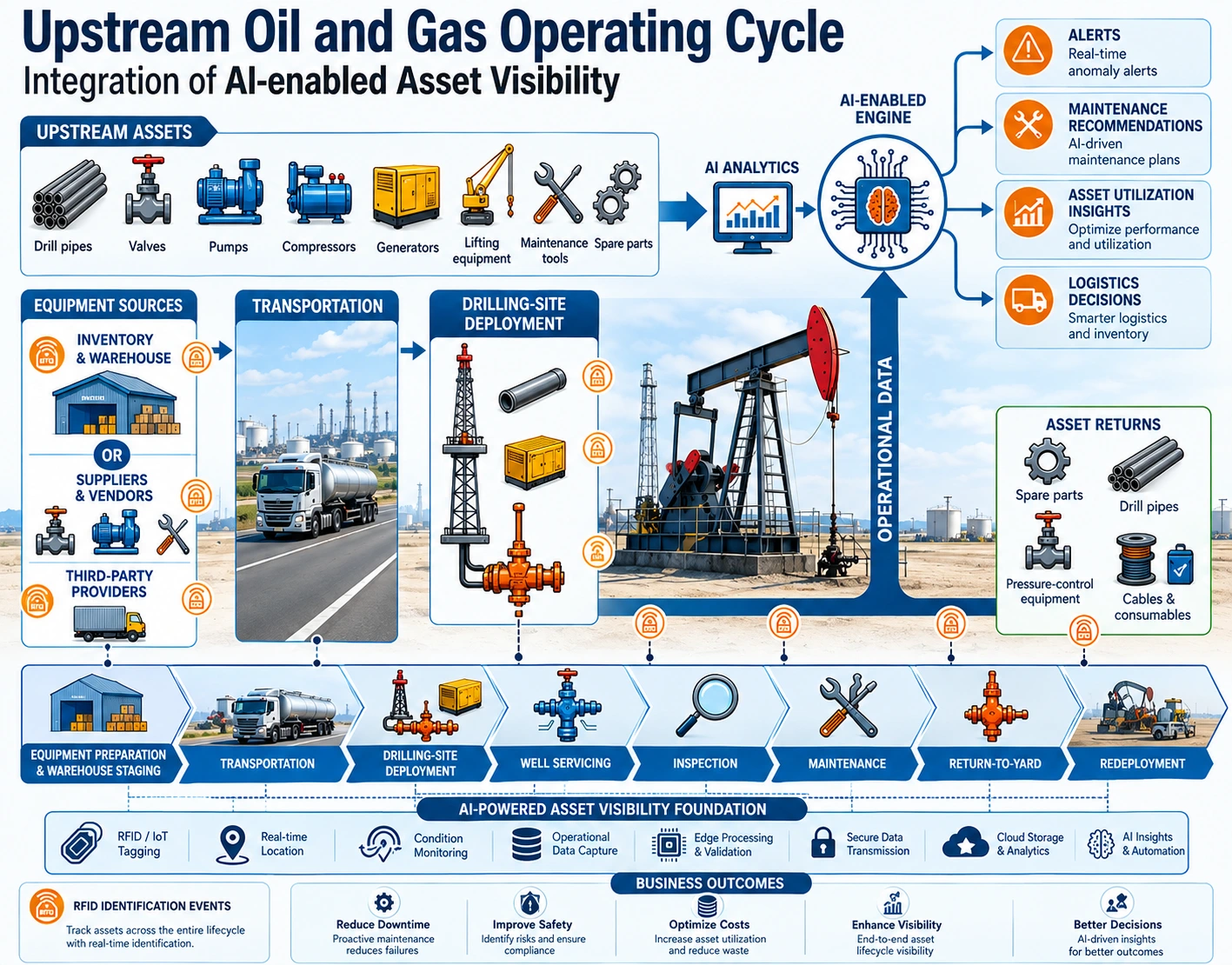
The visual illustrates how RFID-enabled asset identification supports upstream oil and gas operations from equipment staging and field deployment through maintenance, return, and redeployment. AI analytics use asset-event data to support maintenance recommendations, equipment utilization, inventory control, and field logistics.
What AIoT Means for Upstream Oil and Gas
The upstream environment produces heterogeneous data from drilling rigs, wellheads, artificial-lift equipment, rotating machinery, pressure and temperature instrumentation, inspection activities, maintenance work orders, transportation records, and material movements. The challenge is that these data sources often have different identifiers, timestamps, communication methods, and ownership models.
RFID provides a practical identification layer for selected physical assets. UHF RFID is generally suited to longer-range identification and bulk reading of tagged equipment or materials. HF RFID can be appropriate for controlled short-range identification and specific inspection or authentication workflows, while LF RFID can be useful where its frequency characteristics and application constraints make it suitable. The engineering decision should be based on read distance, tag mounting surface, metal interference, environmental exposure, required throughput, hazardous-area requirements, and the physical workflow.
AI then adds interpretation. Instead of treating an RFID event as an isolated “asset seen” record, an upstream system can correlate it with a work order, equipment class, inspection date, location, maintenance history, personnel authorization, transportation movement, or expected operating schedule.
GAO supplies RFID readers, tags, antennas, reader modules, software, and complete RFID systems for industrial applications, giving organizations options for building identification and tracking workflows around their operational requirements. GAO’s public materials identify applications including asset tracking, traceability, access control, and industrial tracking, with headquarters in New York City and Toronto.
Where AI Creates Operational Value in Upstream Operations
Drilling Equipment and Tool Visibility
Drilling operations depend on the availability and condition of specialized equipment and tools. Missing assets can delay mobilization, create unnecessary procurement activity, or complicate maintenance planning. An AI-enabled tracking system can correlate RFID identification events with equipment registers, work orders, inspection records, and planned drilling activities.
Relevant assets can include:
- Drill pipe and tubular handling equipment
- Mud pumps and associated maintenance components
- BOP-related equipment and support components
- Generators and temporary power equipment
- Compressors and air equipment
- Welding and fabrication equipment
- Torque tools and hydraulic tools
- Lifting and rigging equipment
- Field maintenance tools
- Spare parts and critical consumables
The AI layer can identify unusual movement patterns, missing expected assets, duplicate records, prolonged inactivity, or equipment approaching a planned maintenance or inspection milestone.
Oilfield Yards and Equipment Staging
Yards supporting drilling and well-service activities frequently handle equipment entering and leaving multiple work areas. Manual spreadsheets and barcode-only processes can create gaps when equipment is moved rapidly or when field teams work under changing schedules.
RFID event capture can establish automated checkpoints at receiving gates, storage areas, maintenance shops, staging zones, and dispatch points. AI can use these events to identify inventory discrepancies, abnormal dwell time, unexpected movement, and utilization patterns.
Predictive Maintenance Support
Predictive maintenance requires more than sensor readings. Maintenance decisions also depend on equipment identity, operating history, inspection records, service intervals, replacement components, and actual utilization.
An AI system can combine:
- RFID-based equipment identity and movement history
- Vibration, temperature, pressure, or other sensor measurements
- Computerized maintenance management system records
- Inspection and certification information
- Equipment runtime and utilization
- Failure and repair history
- Spare-parts availability
- Field-service records
This enables maintenance teams to distinguish equipment that is merely present from equipment that has an operational history that should influence maintenance decisions.
Field Logistics and Material Control
Upstream logistics involves movement between supply bases, warehouses, fabrication areas, drilling sites, well-service locations, and other field destinations. AI-supported logistics can use asset identification events to improve dispatch visibility and identify exceptions.
For example, an expected equipment package can be compared against RFID events before dispatch. If a critical component is absent, the system can generate an exception before the load leaves the yard rather than discovering the discrepancy at the wellsite.
Upstream Oil & Gas Operational Workflow from RFID Events to AI Decisions
A practical AIoT implementation begins with reliable physical data capture rather than immediately applying complex machine-learning models.
Physical Data Acquisition
RFID tags are attached to suitable equipment, containers, tools, components, or material units according to the physical characteristics of each asset. Tag selection should account for metal surfaces, outdoor exposure, vibration, temperature, chemicals, mechanical abrasion, and required read performance.
Fixed RFID readers can be positioned at controlled transition points such as yard entrances, warehouse doors, maintenance areas, staging points, or equipment check-in/check-out locations. Handheld readers can support field verification, inventory reconciliation, inspection preparation, and exception investigation.
Communication and Edge Processing
Reader events are transmitted to local gateways, industrial computers, or edge servers. The edge layer can normalize device messages, apply filtering, remove duplicate reads, associate reader events with locations, and temporarily store data when network connectivity is intermittent.
This is particularly important for upstream environments where remote drilling or field-service locations may have constrained connectivity. An operational system should not depend on continuous wide-area connectivity merely to establish the identity of an asset at a local checkpoint.
Middleware and Event Processing
Middleware converts raw reader events into operational events such as:
- Asset received
- Asset dispatched
- Asset entered maintenance
- Asset returned from field
- Asset assigned to a work package
- Asset moved between designated zones
- Asset missing from an expected shipment
- Asset detected outside an authorized location
The event layer should maintain a consistent asset identifier and timestamp so that downstream AI models receive structured information instead of raw radio-frequency observations.
Enterprise Software Integration
The resulting events can be integrated with systems such as computerized maintenance management systems, enterprise resource planning software, warehouse management software, drilling applications, inventory databases, document-management systems, and field-service applications.
The most useful integration pattern is usually event-driven. Instead of copying entire databases between applications, the RFID system can publish relevant asset events that other systems consume according to their operational requirements.
AI Analysis and Business Action
AI models can analyze historical asset movements, equipment utilization, maintenance records, sensor readings, and operational schedules. Depending on the use case, organizations can apply anomaly detection, classification, forecasting, predictive maintenance models, optimization algorithms, computer vision, or rules combined with machine learning.
The final output should be operationally actionable. Examples include a maintenance recommendation, missing-equipment alert, inventory exception, inspection reminder, logistics notification, or management dashboard.
RFID Hardware and AI Software for Upstream Deployment
RFID Selection by Field Condition
RFID selection in upstream oil and gas should be driven by the physical workflow rather than by frequency alone. UHF RFID can provide useful read ranges and rapid identification for appropriate tagged assets, while HF and LF technologies can serve more controlled identification requirements.
Tag engineering is especially important around metal equipment. On-metal tags, rugged housings, appropriate antenna selection, mounting orientation, and environmental ratings can significantly influence field performance. A tag that performs well in an office or warehouse may behave differently near steel tubulars, engines, pressure equipment, or dense equipment stacks.
Readers, Antennas, and Handheld Devices
Fixed readers provide automated capture at defined locations. Antennas should be positioned according to the required read zone so that unwanted reads are minimized. Handheld RFID readers are useful when field personnel need to search for an asset, verify equipment before dispatch, or reconcile inventory.
GAO provides UHF, HF, and LF RFID products together with readers, antennas, tags, reader modules, and RFID systems. Its product portfolio also includes industrial RFID equipment intended for different operational environments.
AI, Edge Computing, and Data Services
The AI component can operate centrally or partly at the edge depending on latency, connectivity, data volume, cybersecurity requirements, and operational criticality. Edge inference is useful when an immediate local response is required or when field connectivity is unreliable. Centralized processing is useful for multi-location analytics, historical model training, fleet-level asset utilization analysis, and management reporting.
AI should not automatically control safety-critical oilfield equipment simply because an anomaly has been detected. For safety-related functions, model outputs should be subject to engineered controls, validated logic, human oversight, and applicable functional-safety requirements.
Cloud Version and Server Version
A cloud-hosted version can aggregate asset events from multiple yards, drilling locations, and maintenance facilities and provide centralized analytics, dashboards, model management, and reporting. It is most appropriate when connectivity is dependable and organizations want centralized multi-site visibility.
A server version can run on customer-managed edge servers, private data-center infrastructure, field servers, or other privately hosted computing environments. This approach can be preferable when data sovereignty, network isolation, latency, cybersecurity controls, or limited field connectivity are significant considerations.
A hybrid deployment can place event processing and temporary storage close to the oilfield while forwarding selected operational data to centralized infrastructure for broader analytics. This approach can reduce dependence on continuous connectivity without sacrificing enterprise-level reporting.
Realistic RFID Deployment for Upstream Oil & Gas Operations
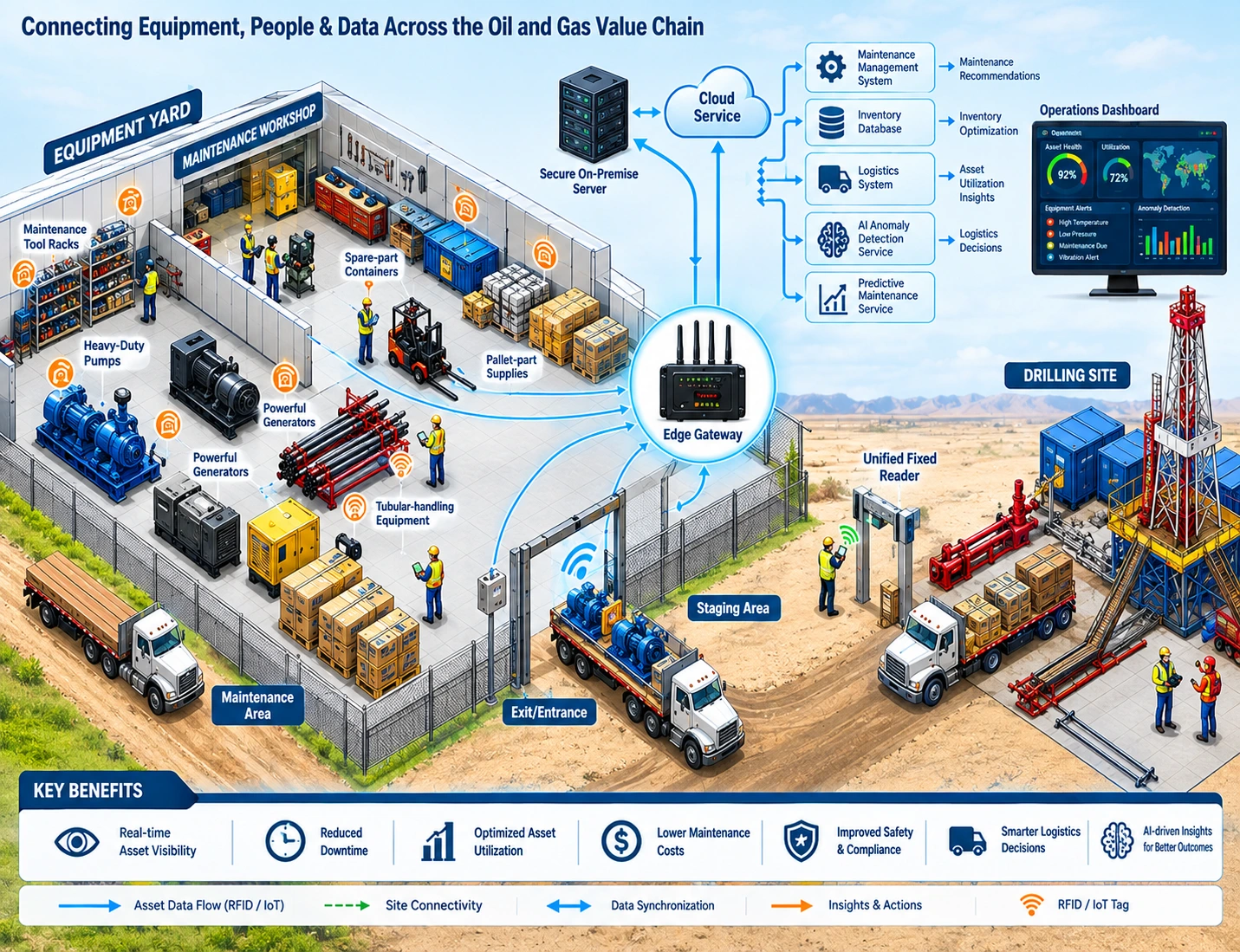
The visual illustrates a realistic upstream deployment where UHF RFID-tagged oilfield equipment moves between an equipment yard and drilling site. Fixed and handheld RFID readers capture asset events, while edge computing, enterprise systems, and AI analytics support inventory control, anomaly detection, predictive maintenance, and field logistics.
Engineering Considerations Before Deployment
An upstream RFID and AI project should begin with an operational problem and measurable acceptance criteria rather than with a decision to install readers everywhere.
Important engineering questions include:
- Which asset classes create the greatest operational or financial impact when unavailable?
- Which movements need automatic capture and which can remain handheld?
- Where are controlled transition points available?
- Which assets have metal, composite, or irregular mounting surfaces?
- What environmental conditions will tags and readers encounter?
- Which field locations have unreliable network connectivity?
- Which maintenance and inventory systems contain the authoritative asset record?
- How will RFID identifiers map to existing equipment IDs?
- What read accuracy is required for each workflow?
- What events should trigger human investigation?
- Which AI decisions require human approval?
- Which data must remain within privately managed infrastructure?
- How will reader firmware, software, tags, gateways, and AI models be maintained over time?
GAO’s published materials describe a long-running focus on RFID hardware, software, systems, quality assurance, and technical support, including support for customers in the U.S. and Canada. GAO is headquartered in New York City and Toronto, and its materials state that GAO, GAO Research, and GAO Tek form the GAO Group.
The next stage of the deployment process is to translate these engineering requirements into measurable KPIs, cybersecurity controls, integration specifications, commissioning tests, and an operational rollout plan.
Measuring AI-Enabled Upstream Asset Operations
A successful deployment should be measured against operational outcomes rather than RFID read counts alone. The KPI framework should connect physical asset visibility with drilling support, maintenance, logistics, inventory control, and field-service performance.
Core Operational KPIs
Useful measurements include:
- Asset location accuracy by operating zone
- Asset identification accuracy at controlled checkpoints
- Missing-equipment incidents before field dispatch
- Equipment search time
- Equipment utilization rate
- Asset dwell time in yards and maintenance areas
- Maintenance compliance
- Mean time between failures
- Mean time to repair
- Unplanned equipment downtime
- Inspection completion rate
- Spare-parts availability
- Inventory record accuracy
- Equipment turnaround time
- Field mobilization time
- Return-to-yard processing time
- Number of unexplained asset movements
- Work orders associated with correctly identified equipment
- AI alert precision and false-positive rate
- Time from anomaly detection to operational response
The KPI baseline should be established before deployment. For example, reducing equipment search time has little value if the organization cannot establish the original search duration, asset classes affected, locations involved, and operational consequences.
Cybersecurity and Data Governance for Oilfield AIoT
Connected identification systems extend the digital footprint of physical oilfield operations. Security therefore needs to cover RFID readers, handheld devices, edge gateways, application servers, cloud connections, APIs, databases, and user identities.
A practical security design should include:
- Unique credentials for readers, gateways, applications, and administrative users
- Role-based access for field technicians, warehouse personnel, maintenance planners, logistics teams, and managers
- Encrypted communication between field devices and servers
- Secure API authentication for CMMS, ERP, inventory, and logistics integrations
- Network segmentation between operational equipment and general business networks
- Controlled firmware and software updates
- Device inventory and configuration management
- Audit logs for asset-event changes and administrative actions
- Data-retention rules based on operational and regulatory requirements
- Backup and recovery procedures for critical asset records
- Monitoring for abnormal device behavior and unauthorized access
AI introduces an additional governance requirement. Organizations should know which data trained or influenced a model, when a model was deployed, which version generated an alert, and whether an operator accepted or rejected the recommendation.
For high-consequence upstream operations, AI should normally support decision-making rather than bypass established engineering controls. A predictive model can recommend inspection or maintenance, while the responsible engineering and operations teams retain authority over safety-critical decisions.
Integration with Upstream Enterprise Systems
AI-enabled asset tracking becomes significantly more useful when asset identity is consistent across operational applications.
A typical integration can connect RFID event processing with:
- Computerized maintenance management systems
- Enterprise resource planning systems
- Warehouse management systems
- Asset management databases
- Field-service management applications
- Procurement systems
- Inspection and certification databases
- Logistics and transportation systems
- Drilling and well-service applications
- Document-management systems
- Industrial IoT data stores
- Operations dashboards
The central engineering problem is usually identity synchronization. A pump may have a manufacturer serial number, internal equipment number, RFID identifier, maintenance-system record, and logistics reference. These identifiers must be mapped consistently.
A master-data strategy should define which application owns each attribute. RFID should normally report physical identification and movement events rather than become an uncontrolled replacement for the organization’s authoritative asset-management database.
GAO can support this type of deployment by supplying RFID hardware and systems that can be incorporated into broader identification, tracking, and IoT workflows. GAO’s customer base has included Fortune 500 companies, research organizations, universities, and government agencies in the United States and Canada, supported by its R&D and technical-support activities.
RFID and Enterprise Software Integration for Oil & Gas Upstream
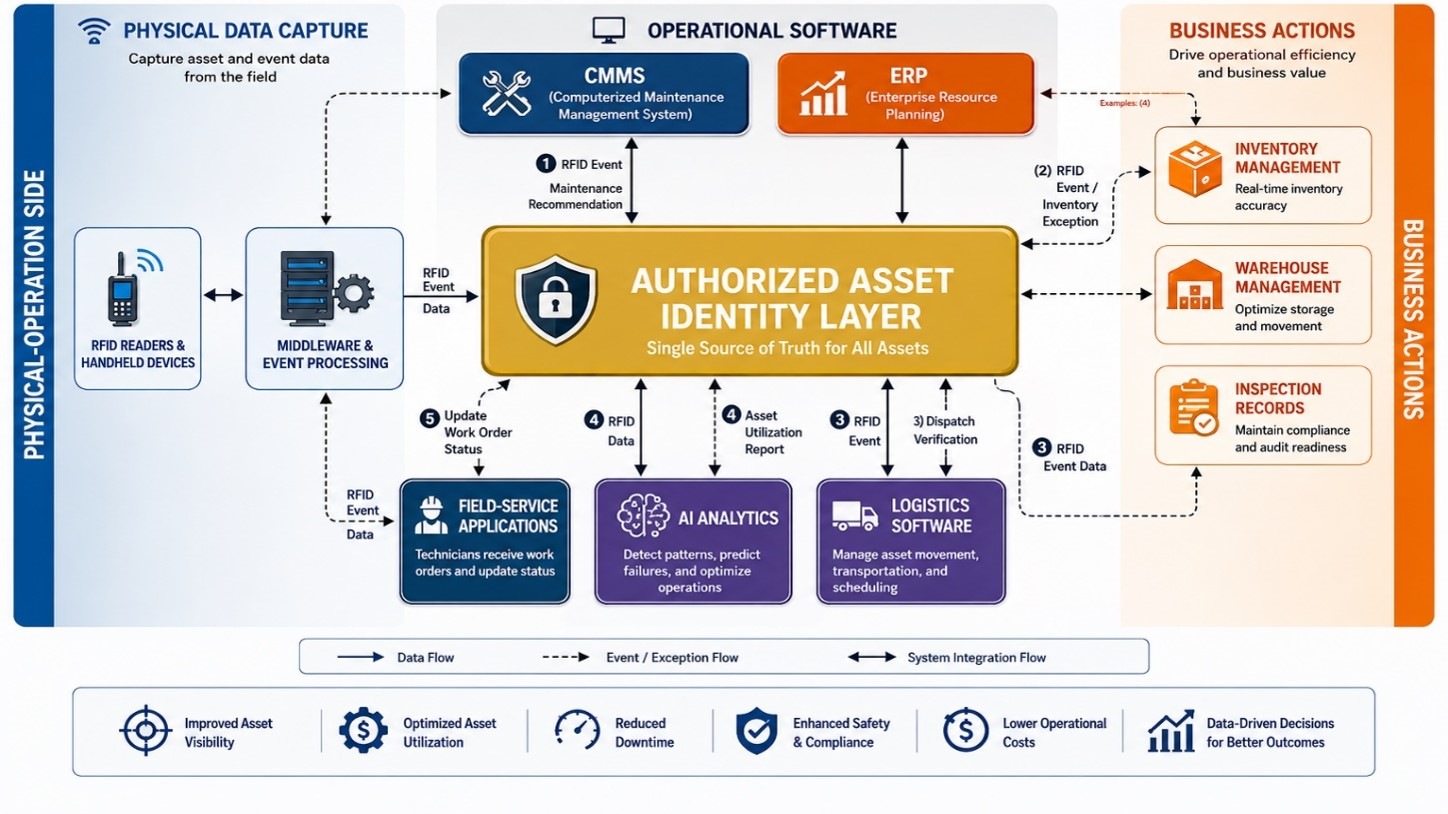
The visual shows how RFID readers and handheld devices connect physical upstream assets with an authoritative asset identity layer and enterprise software. It illustrates data exchange with CMMS, ERP, inventory, warehouse, inspection, logistics, field-service, and AI systems to support maintenance, dispatch, inventory, and asset-utilization decisions.
Deployment, Commissioning, and Testing
Deployment should proceed through controlled engineering stages. A pilot should focus on a limited number of asset classes and operational workflows that produce measurable value.
Site Survey and RFID Engineering
A site survey should document:
- Asset materials and mounting surfaces
- Expected tag orientation
- Reader locations
- Antenna coverage
- Interference sources
- Environmental exposure
- Vehicle and equipment movement
- Network availability
- Power availability
- Hazardous-area constraints
- Required read zones
- Areas where unwanted reads must be suppressed
Metal structures and dense equipment arrangements can create reflections and inconsistent RF behavior. Testing should therefore use representative equipment rather than relying solely on laboratory specifications.
Tagging and Asset Registration
Each selected asset should be physically inspected before tagging. The RFID identifier should then be associated with the organization’s existing asset record.
Tag installation procedures should define mounting location, attachment method, replacement rules, inspection requirements, and responsibility for maintaining tag association.
A damaged or replaced tag should not result in the creation of an unrelated asset record. The system should preserve the historical relationship between the physical asset and its identification records.
Reader Commissioning
Commissioning should test actual operational scenarios rather than simply verifying that a reader detects a tag.
Examples include:
- A truck entering an equipment yard
- Multiple tagged tools passing through a gate
- Equipment moving into a maintenance area
- A technician searching for a tagged asset
- A shipment being prepared for a drilling location
- Returned equipment entering the inspection process
- Assets passing close to neighboring reader zones
Acceptance testing should measure missed reads, unwanted reads, duplicate events, event latency, and correct location association.
AI Model Validation
AI validation requires a different methodology. Historical data should be checked for missing records, inconsistent identifiers, changing operating conditions, and insufficient examples of abnormal events.
Models should be evaluated using metrics appropriate to the use case. An anomaly-detection model, for example, should not be judged only by overall accuracy if the important operational requirement is finding rare equipment exceptions.
Human review should remain part of the validation process. Field personnel can determine whether an apparently abnormal movement represents a genuine operational problem or a legitimate activity that was not represented in the training data.
Operational Trade-Offs in Upstream RFID and AI Deployment
No single deployment configuration is appropriate for every upstream location.
Fixed RFID Versus Handheld RFID
Fixed readers provide continuous automated capture at controlled locations and reduce dependence on manual scanning. However, they require appropriate installation locations, power, communications, and RF engineering.
Handheld readers are more flexible and can be taken into remote work areas. They require personnel interaction and therefore may be less suitable for workflows where automatic event capture is essential.
Many upstream operations benefit from combining both methods. Fixed readers can capture predictable transitions while handheld equipment supports field verification and exception handling.
Cloud Processing Versus Private Server Processing
Cloud infrastructure can simplify centralized analytics across multiple operating locations and facilitate centralized software management. Private server deployment can provide greater control over data location, network isolation, and local processing.
Remote upstream locations may benefit from edge processing regardless of the final deployment model. Local event buffering allows asset operations to continue when communications are temporarily unavailable.
Rules Versus Machine Learning
Not every upstream decision requires machine learning. A simple rule can be more transparent when the requirement is deterministic.
For example, if a particular equipment package must contain a defined set of assets before dispatch, a rules engine can immediately identify missing components.
Machine learning becomes more valuable when the relationship is less deterministic, such as identifying unusual movement patterns, estimating equipment demand, forecasting maintenance requirements, or detecting complex operational anomalies.
A practical implementation should therefore use the simplest analytical method that meets the operational requirement.
AIoT Deployment Decision Tree for Upstream Oil & Gas
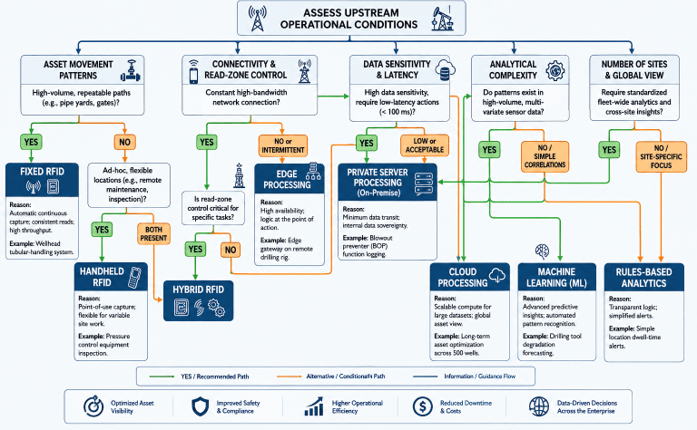
The visual provides an engineering decision path for selecting fixed, handheld, or hybrid RFID based on asset movement and read-zone requirements. It also compares edge, cloud, and private server processing and helps determine when rules-based analytics or machine learning is appropriate for upstream operations.
Scaling from Pilot to Multi-Site Oilfield Operations
A pilot should establish reusable engineering standards before expansion. These standards can cover tag specifications, reader configurations, naming conventions, network requirements, cybersecurity controls, event formats, API interfaces, maintenance procedures, and acceptance tests.
Multi-site deployments should avoid creating isolated asset databases for every location. A common asset identity model allows equipment to retain its history as it moves between yards, drilling locations, workshops, and other operating areas.
Scaling AI also requires monitoring model performance after deployment. Equipment types, operating schedules, field conditions, maintenance practices, and logistics patterns can change. A model that performs well during a pilot may degrade when deployed across different basins or operating environments.
Model monitoring should therefore consider:
- Data-quality changes
- New equipment types
- Seasonal operational patterns
- Changes in asset routing
- Changes in maintenance policy
- False-positive trends
- False-negative incidents
- Model drift
- Changes in RFID event quality
- Human acceptance or rejection of recommendations
Standards, Regulations, and Engineering Compliance
Oil and gas operations operate under extensive regulatory, safety, environmental, electrical, communications, and equipment requirements. RFID and AI systems must therefore be evaluated within the specific jurisdiction and facility classification where they will operate.
Relevant engineering considerations can include hazardous-location requirements, electromagnetic compatibility, radio-frequency regulations, cybersecurity controls, electrical installation practices, equipment certification, functional safety, and organizational HSE procedures.
RFID equipment intended for hazardous or classified areas should not be assumed suitable simply because it is described as industrial. The complete installation, including tag, reader, antenna, power equipment, enclosure, wiring, communications, and mounting method, must be evaluated against applicable requirements.
The same principle applies to AI. A software recommendation does not replace a required inspection, engineering calculation, permit, safety procedure, or regulatory approval.
Practical Implementation Roadmap for Upstream Oil & Gas
A technically sound implementation can follow a staged approach:
- Identify the upstream workflow where missing, delayed, or inaccurate asset information has measurable operational consequences.
- Establish baseline KPIs for equipment search, utilization, inventory accuracy, maintenance compliance, or field mobilization.
- Select representative asset classes and evaluate tag mounting requirements.
- Conduct an RF and site survey at actual yards, workshops, staging areas, and field locations.
- Define the asset identity model and map RFID identifiers to existing equipment records.
- Select fixed readers, handheld readers, antennas, tags, gateways, and edge computers according to the physical workflow.
- Build event-processing rules that convert raw RFID observations into meaningful operational events.
- Integrate the events with maintenance, inventory, logistics, and asset-management systems.
- Establish cybersecurity, access-control, data-retention, and audit requirements.
- Validate the RFID installation using representative equipment and real operating movements.
- Introduce AI only where the operational problem benefits from prediction, anomaly detection, classification, optimization, or other machine-learning techniques.
- Test AI recommendations against historical and field data.
- Keep human review in the loop for decisions with significant operational or safety consequences.
- Measure the pilot against predefined KPIs.
- Standardize successful configurations before expanding to additional sites and asset classes.
- Continuously monitor RFID performance, data quality, software integration, and AI model performance.
GAO Support for Industrial RFID and AIoT Solutions
GAO has spent three decades investing in R&D related to RFID, BLE, IoT products, and systems. Its engineering work spans identification hardware, readers, tags, antennas, software, and integrated solutions that can support asset tracking and industrial data-capture requirements.
GAO, together with GAO Research and GAO Tek, forms the GAO Group, with operations based in New York City and Toronto, Canada. The group has served customers across the United States and Canada, including Fortune 500 organizations, R&D firms, universities, and government agencies. Its published company information emphasizes R&D investment, quality-assurance processes, and technical support delivered remotely or onsite.
For upstream oil and gas organizations evaluating AI-enabled asset visibility, the practical starting point is to define the physical workflow, asset classes, data requirements, and operational KPI before selecting hardware or software. GAO can then help organizations evaluate RFID products and systems appropriate to the identified workflow.
Key Takeaways for AI and RFID in Oil & Gas Upstream
AI-enabled asset management can give upstream oil and gas organizations a more reliable connection between physical equipment and operational decisions. RFID can provide automated or handheld identification events, while AI can interpret those events alongside maintenance, logistics, inventory, inspection, sensor, and operational data.
The strongest deployments are designed around specific workflows such as drilling-equipment control, equipment-yard management, field logistics, maintenance planning, inspection management, and spare-parts availability.
Technical success depends on accurate asset identity, appropriate tag engineering, correctly designed read zones, reliable event processing, secure communications, effective enterprise integration, and measurable AI performance. Cloud, private server, and edge-processing approaches can each be appropriate depending on connectivity, latency, cybersecurity, data-governance, and operational requirements.
Organizations considering implementation should begin with a focused operational problem, establish measurable baseline performance, validate the physical RFID environment, and expand only after the workflow demonstrates measurable value. GAO’s RFID hardware, systems, R&D capabilities, and technical support can provide a foundation for organizations evaluating industrial identification and AIoT solutions.
Building the Future of Industrial AI and IoT with Aperture Venture Studio and GAO RFID Inc.
For more than three decades, GAO Group of Companies has invested heavily in R&D of industrial RFID, BLE, and IoT. As generative AI has become increasingly useful in industrial applications, we have continued developing AI and IoT technologies that can support areas such as upstream oil and gas asset visibility, field logistics, maintenance intelligence, and industrial identification. We have founded Aperture Venture Studio to advance practical AI and IoT solutions for industries where connected physical assets and intelligent software can improve operations.
Aperture has attracted AI and IoT technical experts, entrepreneurial and operational executives, influential investors, and leading companies. We have also developed Aperture Ventures Summit and TekSummit to discuss advanced AI and IoT topics.
Together, these activities contribute to technical communities focused on practical AI and IoT development. We welcome you to join us as:
- Advisors, co-founders, or employees
- Investors
- Customers