
AI and BLE for Grain Processing Facilities
Intelligent Grain Processing with AI and BLE Technology
Artificial Intelligence (AI) combined with Bluetooth Low Energy (BLE) technologies is transforming modern grain processing facilities by enabling continuous monitoring, data-driven decision-making, predictive maintenance, and improved operational efficiency. Rather than relying solely on manual inspections or scheduled maintenance, grain processors can collect real-time operational data from connected assets, analyze production conditions using AI models, and automatically identify abnormalities before they affect product quality, equipment reliability, or regulatory compliance.
Within grain processing facilities, BLE gateways, BLE sensors, and BLE beacons function as enabling technologies that provide AI systems with accurate operational data from mills, silos, conveyors, elevators, dryers, packaging equipment, dust collection systems, and storage areas. AI then converts these continuous data streams into actionable intelligence that improves throughput, minimizes downtime, reduces waste, lowers operating costs, and enhances food safety.
For more than three decades, GAO has supplied BLE, RFID, and industrial IoT hardware products and systems to organizations throughout North America, supporting Fortune 500 companies, research institutions, universities, and government organizations with reliable technologies and engineering expertise.
AI + BLE Enabled Grain Processing Operations Architecture
End-to-end architecture for smart grain processing: BLE sensors monitor equipment and environment, feeding AI analytics for predictive maintenance, quality, and energy optimization.
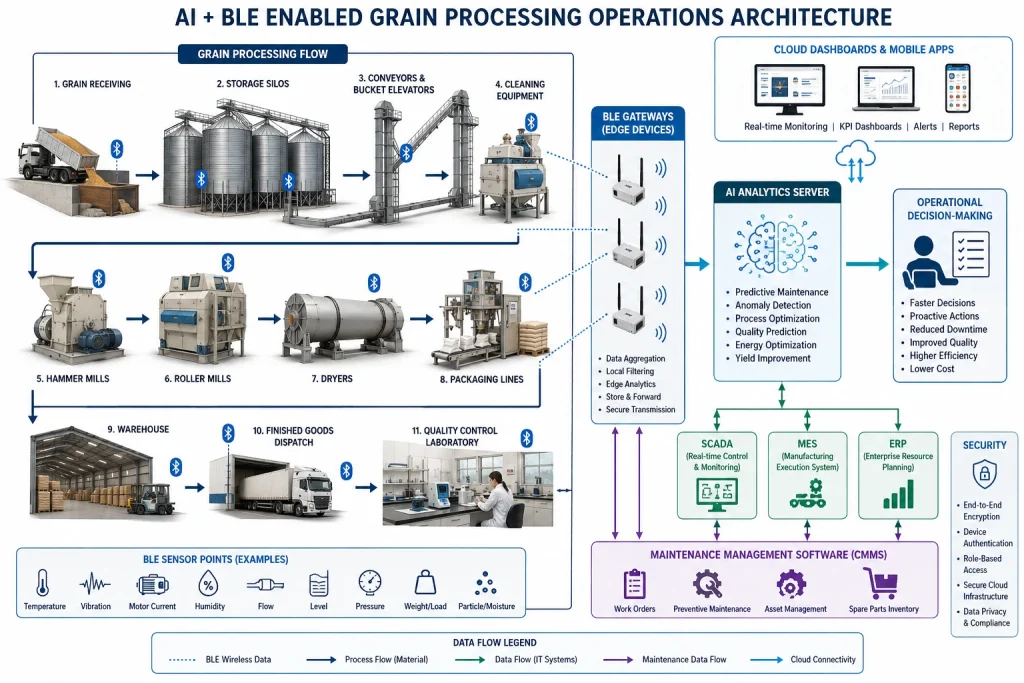
Understanding AI for Grain Processing Facilities
Grain processing facilities operate continuously under demanding production schedules while maintaining strict quality, food safety, equipment reliability, and regulatory requirements. Even small process deviations may reduce flour quality, increase moisture variation, damage processing equipment, create dust explosion hazards, or increase product waste.
Artificial Intelligence improves operational decision-making by continuously learning from production data collected across multiple processing stages. AI algorithms evaluate historical production trends together with live operational information to recognize patterns that are difficult for human operators to detect consistently.
Typical AI applications within grain processing facilities include:
- Predictive maintenance of hammer mills, roller mills, conveyors, bucket elevators, rotary dryers, sifters, and air handling equipment.
- Automated quality prediction for flour consistency, moisture content, particle size, and finished product characteristics.
- Equipment anomaly detection using vibration, temperature, motor current, and bearing condition monitoring.
- AI-assisted production scheduling that balances throughput, maintenance windows, and customer demand.
- Energy optimization for grain dryers, pneumatic conveying systems, dust collection equipment, and compressed air systems.
- Production bottleneck identification across receiving, storage, cleaning, milling, blending, and packaging processes.
- Worker safety monitoring around confined spaces, hazardous equipment, and combustible dust environments.
- Inventory optimization for grain storage bins, finished goods warehouses, and bulk shipping operations.
Unlike traditional automation systems that respond only after predefined alarm thresholds are exceeded, AI continuously adapts to changing operational conditions, improving decision quality over time.
BLE technologies provide an efficient method for collecting operational data from distributed equipment where wired communication may be expensive, impractical, or disruptive to ongoing production.
Why BLE Supports AI in Grain Processing Facilities
BLE serves as an important data acquisition technology rather than the primary business solution. AI depends on reliable operational data, and BLE devices efficiently collect this information from equipment throughout the facility.
BLE sensors may monitor:
- Equipment vibration
- Bearing temperature
- Motor temperature
- Humidity
- Grain moisture
- Storage bin conditions
- Ambient temperature
- Air quality
- Dust concentration
- Energy consumption
- Machine operating hours
- Equipment utilization
- Personnel location
- Mobile equipment movement
BLE beacons assist with:
- Personnel location awareness
- Forklift tracking
- Mobile maintenance equipment identification
- Tool management
- Asset location
- Inspection route verification
- Warehouse navigation
BLE gateways aggregate information from numerous BLE devices and securely transmit data to edge servers or cloud software where AI performs advanced analytics.
Because BLE consumes very little power, many battery-operated sensors can function for years before replacement, reducing maintenance costs while allowing monitoring of rotating equipment and remote assets where wired power is unavailable.
Enterprise Importance of AI-Driven Grain Processing
Food manufacturers continue facing pressure to improve productivity while maintaining strict compliance with food safety regulations, customer specifications, traceability requirements, and sustainability initiatives.
Several operational challenges make AI increasingly valuable within grain processing facilities:
- Variable grain quality between suppliers
- Seasonal moisture fluctuations
- Equipment wear
- Bearing failures
- Conveyor belt degradation
- Dust explosion risks
- Rising energy costs
- Labor shortages
- Product consistency requirements
- Unexpected equipment downtime
- Increasing maintenance expenses
- Regulatory inspections
- Product traceability expectations
AI addresses these challenges by continuously analyzing operational data rather than relying exclusively on periodic inspections.
Instead of simply reporting equipment status, AI estimates future equipment health, predicts maintenance requirements, recommends process adjustments, and identifies production risks before failures occur.
These capabilities improve Overall Equipment Effectiveness (OEE), increase production throughput, reduce unplanned downtime, improve first-pass quality, minimize waste, and support continuous operational improvement.
Organizations implementing intelligent monitoring often experience improvements in maintenance planning because maintenance activities become condition-based rather than calendar-based.
GAO has helped organizations deploy BLE-enabled industrial monitoring solutions that provide the operational visibility necessary for AI-driven analytics across demanding manufacturing and processing environments.
AI-Driven Grain Processing Operational Workflow
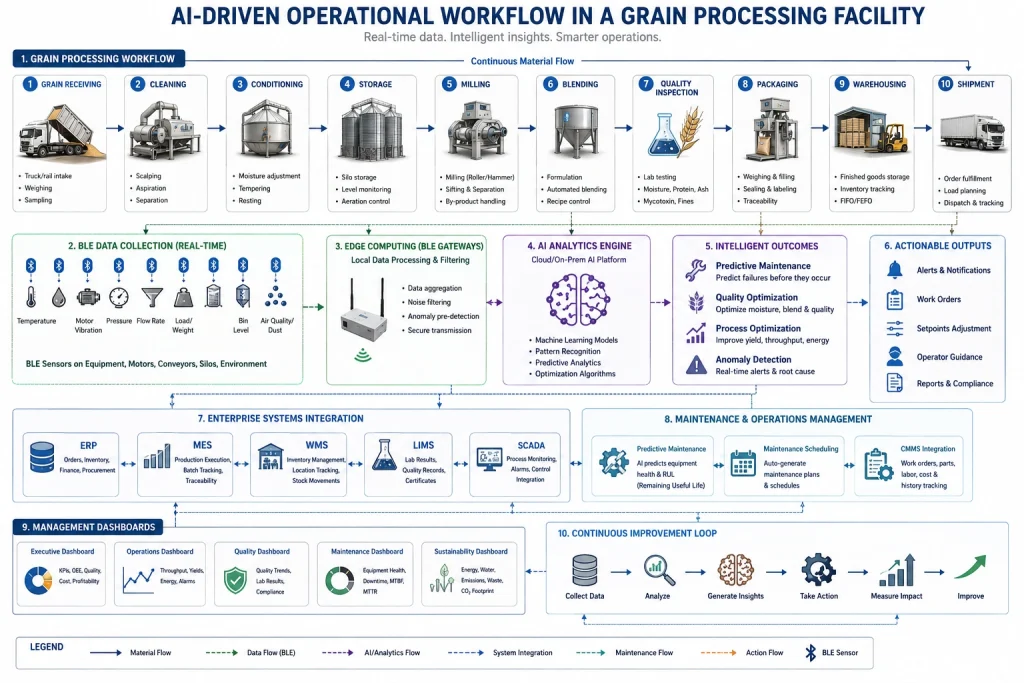
AIoT-enabled grain processing workflow showing real-time BLE data collection, edge computing, AI analytics, enterprise system integration, maintenance management, dashboards, and continuous operational improvement.
AI Applications Across Grain Processing Operations
Artificial intelligence delivers measurable value when integrated throughout the complete grain processing lifecycle rather than being limited to isolated production lines. Modern grain processing facilities generate thousands of operational data points every minute from receiving stations, storage silos, conveying systems, cleaning equipment, milling machines, blending operations, packaging lines, and warehouse logistics. AI converts this continuous operational information into actionable recommendations that improve production efficiency, equipment reliability, food safety, and product consistency.
Grain Receiving and Inspection
Grain receiving is the first critical control point affecting downstream processing quality. AI analyzes information from moisture sensors, temperature measurements, sampling stations, truck scales, laboratory analysis systems, and storage availability to determine the most appropriate handling strategy.
Common AI functions include:
- Moisture classification
- Foreign material identification
- Supplier quality scoring
- Automated unloading prioritization
- Storage bin assignment optimization
- Contamination risk assessment
- Queue optimization for receiving operations
BLE sensors installed around receiving equipment continuously monitor conveyor motors, dump pits, bucket elevators, and unloading systems, allowing AI to identify equipment abnormalities before they interrupt production.
Grain Storage Management
Storage silos present several operational risks including moisture migration, temperature stratification, insect activity, spoilage, mold growth, condensation, and inventory inaccuracies.
AI continuously evaluates:
- Internal silo temperatures
- Relative humidity
- Grain moisture trends
- Aeration effectiveness
- Fan operating efficiency
- Storage duration
- Inventory turnover
- Environmental conditions
Instead of operating aeration fans on fixed schedules, AI recommends the optimal operating periods based on predicted grain condition, outside weather, energy costs, and spoilage risk.
BLE temperature and environmental sensors distributed throughout storage structures provide continuous measurements without extensive wired installations, making large-scale monitoring economically practical.
Grain Cleaning Operations
Cleaning systems remove dust, stones, metal fragments, chaff, and foreign materials before milling.
AI assists by optimizing:
- Separator settings
- Airflow control
- Vibratory screen performance
- Equipment utilization
- Material flow balancing
- Dust collection efficiency
Predictive monitoring also identifies abnormal bearing temperatures, excessive vibration, and motor overload conditions before cleaning equipment experiences mechanical failures.
Milling Operations
Roller mills and hammer mills represent some of the highest-value production assets within grain processing facilities.
AI continuously analyzes:
- Motor loads
- Bearing vibration
- Temperature patterns
- Roll wear
- Product particle size
- Throughput rates
- Power consumption
- Production consistency
Machine learning models recognize subtle operating changes that indicate developing mechanical issues such as bearing deterioration, shaft imbalance, lubrication problems, or roll misalignment.
Maintenance teams can therefore schedule repairs during planned shutdowns rather than responding to unexpected failures.
Packaging and Warehouse Operations
Finished product quality depends upon accurate packaging, palletization, inventory management, and shipping.
AI improves:
- Packaging line efficiency
- Product traceability
- Label verification
- Warehouse inventory accuracy
- Forklift traffic optimization
- Finished goods storage
- Shipment scheduling
BLE beacons attached to mobile equipment assist AI software with warehouse movement analysis, helping reduce congestion while improving logistics efficiency.
Operational Workflow from Data Collection to AI Decision-Making
A successful AI-enabled grain processing solution depends on a structured operational workflow that transforms raw sensor data into actionable operational intelligence.
Step 1 – Data Acquisition
Operational information originates from multiple sources including:
- BLE vibration sensors
- BLE temperature sensors
- BLE humidity sensors
- Energy monitoring devices
- Production counters
- Motor controllers
- Variable Frequency Drives (VFDs)
- PLC systems
- Quality inspection equipment
- Laboratory information systems
- Barcode and RFID systems
- Environmental monitoring equipment
Additional contextual data may be collected from ERP software, Manufacturing Execution Systems (MES), Computerized Maintenance Management Systems (CMMS), and warehouse management software.
Step 2 – Wireless Communication
BLE gateways receive information from nearby BLE devices and securely forward data using Ethernet, Wi-Fi, cellular, or industrial communication networks.
Gateway placement considers:
- Radio coverage
- Equipment density
- Signal interference
- Dust environments
- Metal structures
- Maintenance accessibility
- Network redundancy
Proper gateway placement minimizes communication loss while maintaining reliable data availability for AI analysis.
Step 3 – Edge Processing
Many grain processing facilities perform initial data processing on industrial edge servers.
Typical edge functions include:
- Signal filtering
- Data validation
- Local alarms
- Device authentication
- Temporary storage
- Communication buffering
- Basic analytics
Edge computing reduces latency for time-sensitive applications such as equipment protection while minimizing unnecessary cloud bandwidth consumption.
Step 4 – AI Analytics
Validated operational data enters AI software where multiple analytical techniques are applied.
Typical AI models include:
- Predictive maintenance models
- Time-series forecasting
- Anomaly detection
- Machine learning classification
- Production optimization
- Energy forecasting
- Statistical process control
- Quality prediction algorithms
AI continuously updates recommendations as operating conditions evolve throughout production.
Step 5 – Business Integration
AI insights become operationally valuable only after integration with existing business software.
Common integrations include:
- Enterprise Resource Planning (ERP)
- Manufacturing Execution Systems (MES)
- Computerized Maintenance Management Systems (CMMS)
- Supervisory Control and Data Acquisition (SCADA)
- Laboratory Information Management Systems (LIMS)
- Warehouse Management Systems (WMS)
- Quality Management Systems (QMS)
These integrations enable maintenance scheduling, inventory updates, production adjustments, quality reporting, and management dashboards without requiring manual data entry.
Step 6 – Operational Actions
AI recommendations support daily operational decisions such as:
- Scheduling preventive maintenance
- Adjusting milling parameters
- Optimizing dryer operation
- Increasing aeration efficiency
- Reallocating storage capacity
- Reducing production bottlenecks
- Improving production planning
- Minimizing product waste
Rather than replacing experienced operators, AI provides additional decision support that improves consistency and operational responsiveness.
AI-Enabled Grain Processing Data Flow – Sensors to Business Decisions
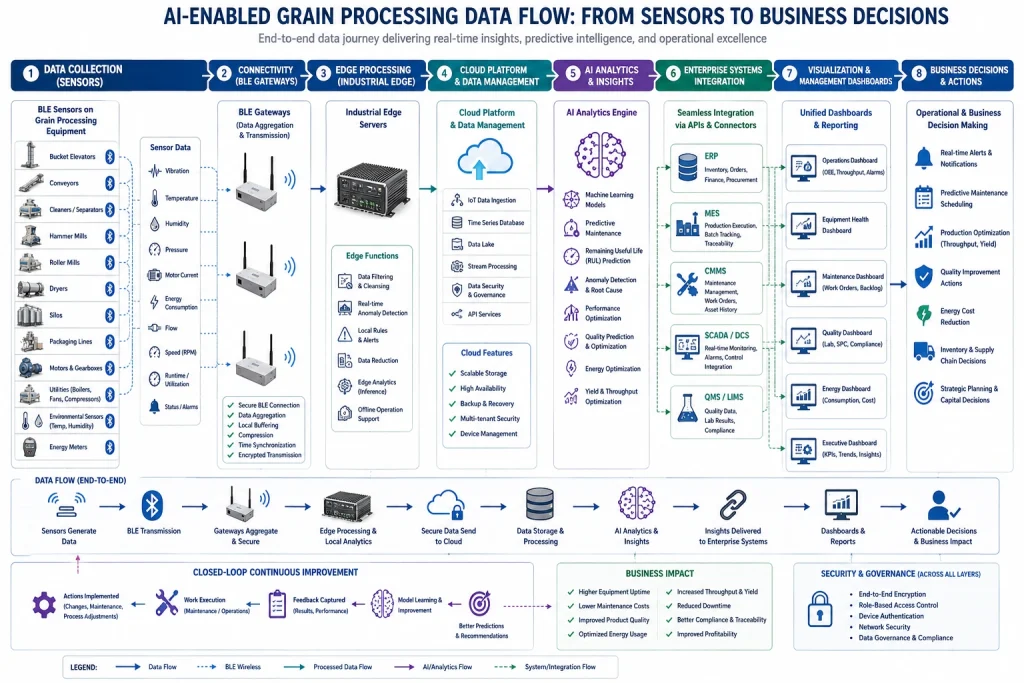
End-to-end data journey from BLE sensors on grain equipment through edge and cloud AI, delivering predictive maintenance, quality optimization, and business intelligence.
AI and BLE Solution Components for Grain Processing Facilities
An effective AI-enabled grain processing solution combines industrial hardware, communications, analytics software, cybersecurity, and business system integration. BLE serves as the low-power data acquisition layer, while AI transforms operational data into predictive insights and optimization recommendations.
BLE Hardware Components
The BLE infrastructure should be selected based on the production environment, equipment density, wireless coverage, maintenance strategy, and environmental conditions.
Typical hardware includes:
- BLE vibration sensors for bearings, gearboxes, conveyors, and milling equipment
- BLE temperature sensors for motors, dryers, storage silos, and electrical panels
- BLE humidity sensors for grain storage and environmental monitoring
- BLE gateways that aggregate data from hundreds of BLE devices
- BLE beacons for personnel, forklifts, maintenance tools, and mobile assets
- Industrial edge gateways with Ethernet, Wi-Fi, or cellular backhaul
- UPS systems to maintain communication during power interruptions
GAO supplies industrial BLE hardware designed for demanding manufacturing and food processing environments, enabling organizations to expand monitoring without extensive wiring or production disruption.
AI Software Components
AI software converts operational measurements into actionable business intelligence through multiple analytical methods.
Common software capabilities include:
- Predictive maintenance
- Remaining useful life estimation
- Equipment anomaly detection
- Production forecasting
- Energy optimization
- Process parameter optimization
- Statistical process control
- Root cause analysis
- Digital dashboards
- Automated alerting
- KPI reporting
- Maintenance recommendations
Machine learning models improve continuously as additional production data becomes available, increasing prediction accuracy over time.
Communication Protocols
BLE is one component of a broader industrial communication strategy.
Common supporting protocols include:
- Bluetooth Low Energy (BLE)
- Ethernet/IP
- Modbus TCP
- Modbus RTU
- PROFINET
- OPC UA
- MQTT
- HTTPS
- REST APIs
- BACnet (for building systems where applicable)
These protocols allow AI software to exchange information with industrial automation systems, supervisory software, and enterprise applications.
Cloud Version
A cloud-hosted deployment is well suited for organizations operating multiple grain processing facilities or requiring centralized reporting across geographically distributed locations.
Typical cloud capabilities include:
- Multi-site monitoring
- Centralized AI model management
- Automatic software updates
- Scalable computing resources
- Enterprise reporting
- Long-term historical data storage
- Remote engineering access
- Disaster recovery
Cloud deployments simplify expansion while reducing local infrastructure requirements.
Server Version
Many grain processors prefer privately managed server deployments because of production latency, cybersecurity policies, regulatory requirements, or existing IT standards.
A server-based deployment typically includes:
- Industrial edge servers
- Customer-managed virtual machines
- Private data centers
- Factory server rooms
- High-availability storage
- Local AI inference
- Local dashboard hosting
- Integration with existing SCADA systems
This approach provides greater control over operational data while supporting low-latency decision-making.
Cybersecurity Considerations
Cybersecurity is essential because operational technology and information technology increasingly share data.
Recommended practices include:
- Device authentication
- Role-based access control
- Encrypted communications
- Secure firmware updates
- Network segmentation
- Multi-factor authentication
- Continuous vulnerability monitoring
- Security logging
- Backup and disaster recovery planning
Food manufacturers should also align cybersecurity practices with applicable corporate governance and regulatory requirements.
AI-Powered BLE Solution Architecture for Grain Processing
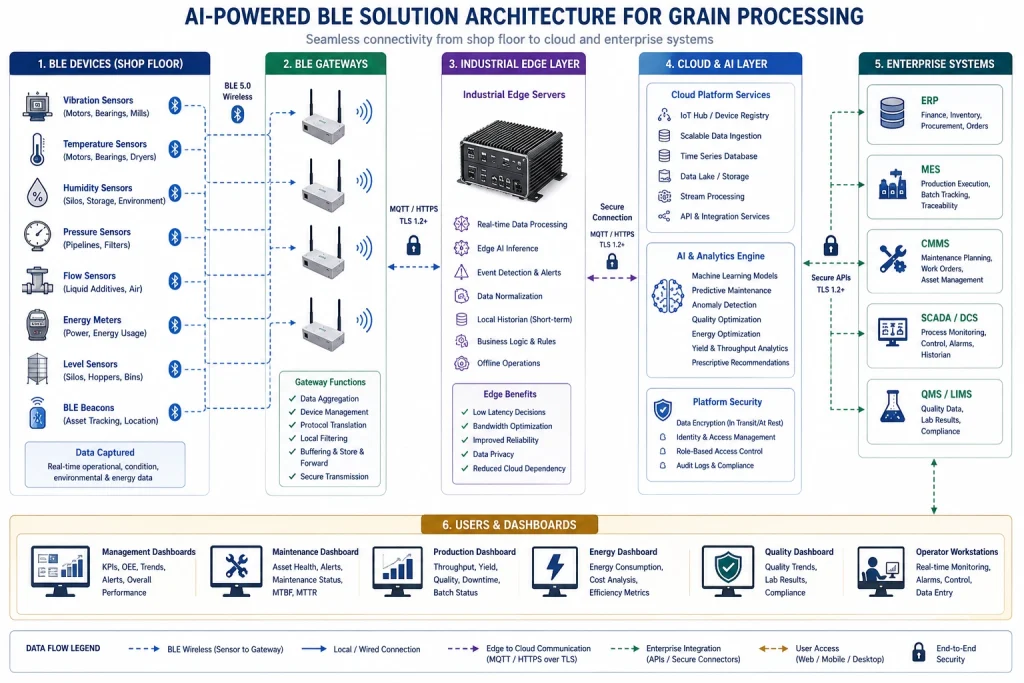
Complete architecture from BLE shop-floor sensors through edge and cloud AI to enterprise systems, delivering predictive maintenance, quality, energy, and yield optimization.
Technical Capabilities and Business Benefits
Combining AI with BLE-enabled monitoring provides measurable operational improvements throughout grain processing facilities.
Equipment Reliability
AI continuously evaluates equipment condition using vibration, temperature, and operational trends, allowing maintenance teams to address developing issues before failures occur.
Benefits include:
- Reduced unplanned downtime
- Longer equipment life
- Lower maintenance costs
- Improved spare parts planning
Product Quality
Continuous monitoring enables AI to identify process variations that could affect flour consistency, moisture content, particle size, or finished product quality.
Benefits include:
- Improved product consistency
- Reduced waste
- Lower rework rates
- Better customer satisfaction
Energy Efficiency
AI analyzes energy consumption across dryers, mills, conveyors, compressors, and HVAC systems to identify optimization opportunities.
Benefits include:
- Lower electricity costs
- Reduced fuel consumption
- Improved equipment utilization
- Lower carbon emissions
Food Safety and Compliance
AI assists quality teams by monitoring environmental conditions, production parameters, and equipment health that influence food safety.
Benefits include:
- Better traceability
- Improved audit readiness
- Enhanced regulatory compliance
- Faster investigation of production events
Workforce Productivity
AI reduces manual inspection requirements by continuously monitoring equipment and highlighting the highest-priority maintenance activities.
Benefits include:
- Faster decision-making
- Improved maintenance scheduling
- Higher technician productivity
- Better resource allocation
Scalability
BLE devices can be added incrementally as facilities expand, enabling phased deployments without major infrastructure changes.
Benefits include:
- Lower implementation risk
- Flexible expansion
- Simplified maintenance
- Improved return on investment
Engineering Best Practices for Deployment
Successful implementations typically include:
- Perform a comprehensive site survey before gateway installation.
- Identify critical production assets for initial monitoring.
- Validate wireless coverage in areas with heavy steel structures and grain silos.
- Integrate AI software with existing ERP, MES, CMMS, SCADA, and quality systems.
- Establish baseline operating conditions before training AI models.
- Validate AI recommendations with maintenance and production teams during commissioning.
- Implement cybersecurity policies for both operational technology and information technology environments.
- Review AI model performance periodically using updated production data.
- Expand deployments in phases to minimize operational disruption.
Organizations that follow structured implementation practices generally achieve higher adoption rates and more reliable long-term results.
Traditional vs. AI-Enabled Grain Processing Operations Comparison
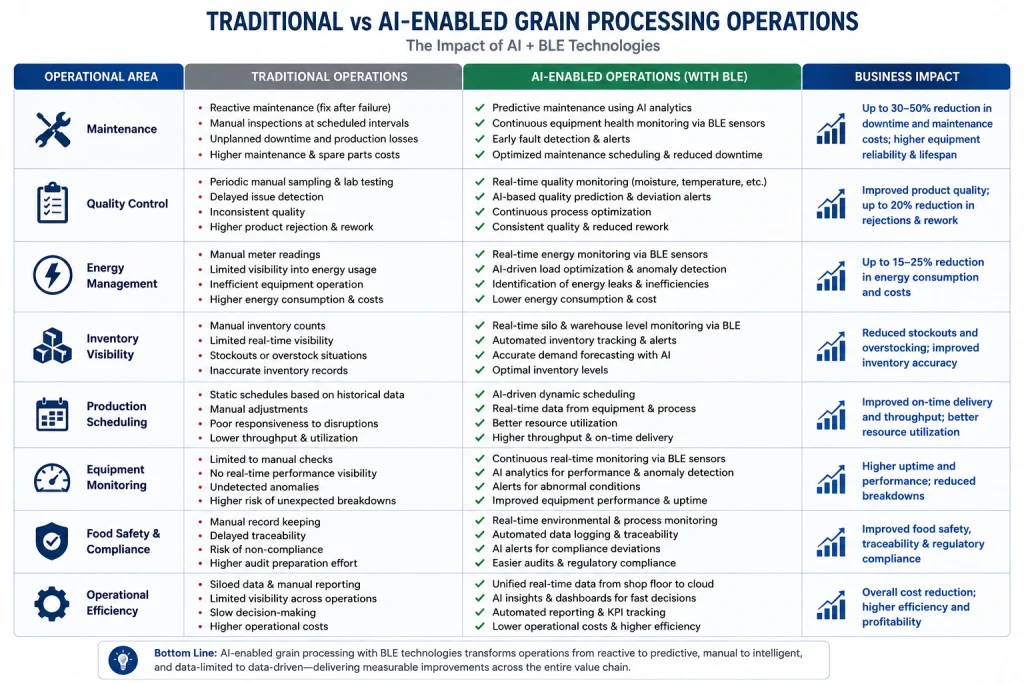
Side-by-side comparison across maintenance, quality, energy, inventory, scheduling, monitoring, compliance, and efficiency – showing 30–50% downtime reduction and 15–25% energy savings.
Conclusion
AI-enabled grain processing supported by BLE technologies enables facilities to transition from reactive operations to predictive and data-driven management. Continuous monitoring of equipment, environmental conditions, production parameters, and mobile assets provides the data foundation required for AI to improve maintenance planning, optimize production, enhance product quality, reduce energy consumption, and strengthen food safety programs.
Successful deployments require careful planning, reliable wireless infrastructure, secure integration with existing industrial software, and collaboration between operations, maintenance, quality assurance, and IT teams. As grain processors continue modernizing their facilities, AI combined with BLE technologies offers a practical path toward higher operational efficiency, improved equipment reliability, and greater resilience.
Headquartered in New York City and Toronto, GAO has supported customers across North America for more than three decades by supplying BLE, RFID, and industrial IoT hardware products and systems backed by rigorous quality assurance and technical expertise. Our experience serving Fortune 500 companies, leading research organizations, universities, and government agencies enables us to help grain processing facilities implement reliable monitoring solutions that support long-term digital transformation.
Building the Future of Industrial AI and IoT with Aperture Venture Studio and GAO RFID Inc.
For more than three decades, GAO Group of Companies has invested heavily in research and development of industrial BLE, RFID, and IoT technologies. As generative AI has demonstrated significant value in industrial applications, we have expanded our work in AI-enabled IoT solutions while establishing Aperture Venture Studio to accelerate the development and commercialization of advanced AI and IoT innovations for industries such as food production and grain processing.
Aperture Venture Studio has brought together experienced AI researchers, IoT engineers, operational leaders, investors, and technology partners to advance practical industrial solutions. Through initiatives such as the Aperture Ventures Summit and TekSummit, we continue to foster technical collaboration and knowledge sharing across the AI and IoT community.
We welcome organizations to engage with us as:
- Technology advisors and industry experts
- Strategic collaborators
- Investors
- Customers seeking advanced AI, BLE, RFID, and industrial IoT solutions
- Engineering partners exploring innovative applications for grain processing and other industrial sectors