
AI and BLE for Workplace Occupancy
AI-Driven Workplace Occupancy with BLE Sensing
AI for workplace occupancy uses data from BLE beacons, BLE sensors, gateways, building systems, and workplace software to determine how people use offices, meeting rooms, work areas, shared spaces, and other facilities. The objective is not simply to count occupants. A properly designed workplace occupancy solution can identify utilization patterns, detect underused or overcrowded spaces, support room and desk management, improve facility operations, and provide data for workplace planning. BLE provides a practical sensing and location layer because low-power devices can detect presence or transmit location-related signals across office environments, while gateways collect that information for processing. AI and machine learning can then convert occupancy observations into forecasts, anomaly detection, utilization trends, and operational recommendations. GAO supplies BLE hardware products and IoT systems that can support workplace occupancy deployments, including BLE beacons, BLE sensors, and BLE gateways for organizations requiring configurable sensing infrastructure.
BLE Workplace Occupancy System Architecture for Smart Office Management
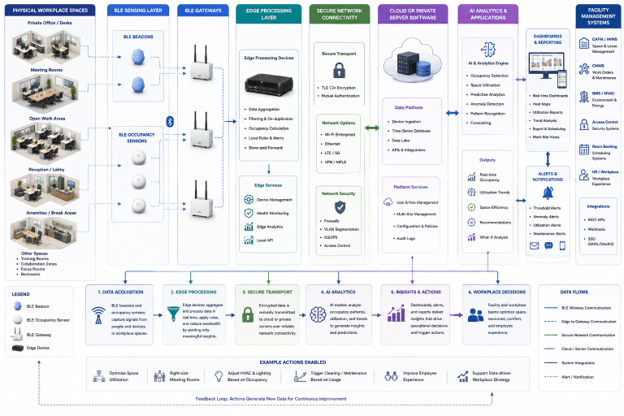
This architecture diagram illustrates how BLE beacons and occupancy sensors capture workplace activity across offices, meeting rooms, open work areas, and shared spaces. Data flows through BLE gateways, edge processing, secure network connectivity, cloud or private-server platforms, and AI analytics to produce dashboards, alerts, and facility-management actions. The visual shows how occupancy insights can support space utilization, HVAC and lighting optimization, maintenance, and workplace planning.
How AI Changes Workplace Occupancy Management
Traditional workplace occupancy monitoring often depends on manual observation, access-control records, periodic facility surveys, or room-booking information. These sources can indicate that a room was reserved or that an employee entered a building, but they do not necessarily show whether a space was actually used throughout the reserved period.
AI improves workplace occupancy management by correlating multiple signals and identifying patterns that are difficult to interpret manually. A meeting room, for example, may be reserved for eight people but used by only three. A desk neighborhood may remain largely vacant during certain days while another area becomes congested. Historical occupancy data can reveal these patterns and support more informed workplace planning.
BLE is the sensing mechanism that helps produce more granular observations. BLE beacons can provide identifiable reference points, while BLE sensors can detect conditions such as occupancy or environmental changes depending on their sensing capabilities. BLE gateways receive nearby BLE transmissions and forward relevant information to software for processing.
AI models can subsequently classify occupancy states, estimate utilization, detect unusual patterns, forecast demand, and identify discrepancies between scheduled and observed workplace use. The resulting information can support facilities teams, workplace experience managers, space planners, security personnel, and operations managers.
GAO’s role in these deployments can include supplying BLE hardware and IoT components that organizations integrate with their own workplace software, analytics applications, building-management systems, and data infrastructure.
Workplace Occupancy Applications and Deployment Scenarios
Workplace occupancy encompasses several distinct operational requirements. A useful deployment begins by defining the decision that occupancy data must support rather than selecting sensors first.
Meeting Room Utilization
Meeting rooms are one of the most common workplace occupancy applications. Room booking systems provide scheduling information, but actual occupancy sensing can identify no-shows, underutilized reservations, extended meetings, and periods of high demand.
AI can analyze historical room utilization to identify recurring patterns. Facilities teams can use these findings to adjust room capacity, scheduling policies, furniture configurations, or room allocation.
Key engineering considerations include:
- Distinguishing room occupancy from simple door activity
- Selecting sensing locations that minimize blind spots
- Handling open doors and adjacent-room signal leakage
- Correlating observed occupancy with room-booking records
- Establishing appropriate occupancy thresholds
- Retaining sufficient historical data for utilization analysis
- Protecting employee privacy when occupancy data can be associated with identifiable devices
Desk and Workstation Utilization
Desk occupancy solutions help organizations understand how shared workstations are used across hybrid-work schedules. BLE sensors can provide occupancy-state information without requiring every workstation to have a complex wired sensing system.
AI can identify workstation utilization patterns by floor, zone, day, time period, or business function. The output can help workplace teams evaluate whether desk neighborhoods are appropriately sized and whether demand is concentrated in particular areas.
Deployment should account for:
- Desk density and physical layout
- Sensor placement
- False occupancy caused by nearby movement
- Cleaning and maintenance activities
- Temporary equipment placed at workstations
- Battery replacement requirements
- Privacy requirements for employee-facing applications
Floor and Zone Occupancy
Floor-level and zone-level occupancy provides a broader operational view. This can be useful when organizations need to monitor occupancy distribution rather than individual desks.
BLE reference points and sensing devices can establish location zones, while gateways collect nearby transmissions. AI software can aggregate observations into occupancy trends and identify areas that consistently experience low or high utilization.
Such information can support HVAC scheduling, cleaning schedules, facility staffing, emergency preparedness, and workplace space planning. The system should distinguish between measured occupancy and inferred occupancy because BLE signals can be affected by building materials, device orientation, radio interference, and changing physical layouts.
Occupancy Forecasting
Historical workplace occupancy data can become an input for demand forecasting. Machine-learning models can evaluate temporal patterns such as day-of-week behavior, recurring schedules, seasonal workplace usage, and historical utilization.
Forecasting can help facilities teams prepare for expected demand before employees arrive. The practical objective is not simply producing a prediction. The prediction should trigger an operational decision, such as preparing a specific floor, adjusting facility services, reviewing meeting-room capacity, or evaluating space requirements.
Occupancy Anomaly Detection
Anomaly detection can identify unusual occupancy behavior that differs from established patterns. Examples include unexpected occupancy outside normal working periods, unusually high utilization in a particular zone, or occupancy levels that conflict with scheduled workplace activity.
AI should not automatically interpret every anomaly as a security event. Occupancy anomalies can result from maintenance personnel, special events, cleaning crews, after-hours work, or changes in employee schedules. Operational workflows should therefore provide appropriate validation before triggering escalation.
Workplace Occupancy AI Use Cases and Facility Management Decisions
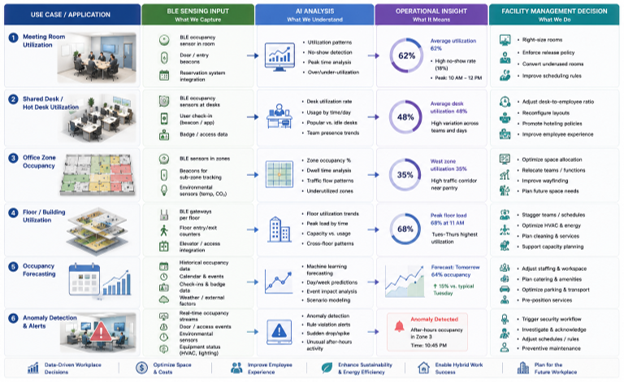
This infographic compares six workplace occupancy applications, including meeting-room utilization, shared-desk utilization, office-zone occupancy, floor utilization, occupancy forecasting, and anomaly detection. It shows how BLE sensing inputs are analyzed by AI to generate operational insights and guide facility-management decisions such as space optimization, scheduling, resource planning, and workplace maintenance.
Workplace Occupancy Data Workflow
A production workplace occupancy solution normally follows a chain from physical sensing to an operational decision. Each stage introduces engineering considerations that affect accuracy, latency, scalability, and data quality.
Data Acquisition
The process begins with occupancy-related observations. Depending on the selected solution, these may originate from BLE occupancy sensors, BLE beacons, employee-associated BLE devices, room devices, or other connected workplace equipment.
Sensor selection should reflect the required measurement. Presence detection, room occupancy, people counting, proximity detection, and location estimation are different requirements and should not automatically be treated as interchangeable.
BLE beacon deployments can establish reference locations or transmit identifiers, while BLE sensors can provide occupancy-related measurements. Gateway placement determines how reliably those transmissions are received.
BLE Communication and Gateway Collection
BLE devices transmit short-range wireless data that can be received by nearby gateways. Gateway density should be determined through a site survey rather than simply applying a fixed gateway-to-room ratio.
Concrete building conditions matter. Reinforced concrete, metal partitions, elevator shafts, glass partitions, equipment cabinets, dense furniture, and changes in floor layout can affect radio performance. Gateway placement should therefore consider signal coverage, mounting height, power availability, network connectivity, maintenance access, and interference.
Gateways can perform initial filtering or normalization before forwarding data to downstream software. This reduces unnecessary traffic and can support lower-latency processing for selected workplace events.
Edge Processing
Edge processing can be useful when workplace occupancy decisions require low latency or when organizations want to reduce the volume of raw sensor data sent to a remote environment.
A gateway or local server can validate packets, remove duplicates, apply basic rules, normalize timestamps, associate signals with predefined zones, and forward structured occupancy events.
Edge processing is particularly useful when network connectivity is intermittent or when an organization has strict requirements regarding local processing of workplace data.
Server or Cloud Processing
Processed occupancy events can be delivered to a cloud-hosted software environment or a privately managed server. The processing layer can maintain device inventories, zone definitions, occupancy states, historical records, user permissions, analytics, and integration interfaces.
Cloud deployment can simplify centralized management across multiple office locations. A private server deployment can be appropriate when workplace data must remain within customer-controlled infrastructure or when existing IT policies favor privately hosted applications.
AI Analytics and Decision Support
AI models operate on normalized occupancy information rather than treating raw BLE packets as business intelligence. Feature engineering can include occupancy duration, utilization percentage, zone transitions, time-of-day patterns, historical baselines, booking status, and occupancy variability.
Possible analytical methods include:
- Classification models for occupancy-state determination
- Time-series models for occupancy forecasting
- Clustering for identifying recurring utilization patterns
- Anomaly-detection models for unusual occupancy behavior
- Rule-based logic for deterministic operational thresholds
- Statistical models for utilization and capacity analysis
Model performance should be measured against a verified operational baseline. A highly complex model is not necessarily better if a simpler method provides sufficiently accurate occupancy decisions with easier maintenance and explainability.
Enterprise Software Integration
The final value comes from connecting occupancy insights to workplace operations. Depending on the organization, integrations may include room-booking software, building-management systems, facilities-management software, access-control systems, workplace applications, dashboards, business intelligence tools, and corporate data warehouses.
APIs, message brokers, webhooks, databases, or other integration methods can transfer normalized occupancy events. Data models should use consistent identifiers for buildings, floors, rooms, zones, sensors, gateways, and occupancy states.
End-to-End BLE Workplace Occupancy Data and AI Workflow
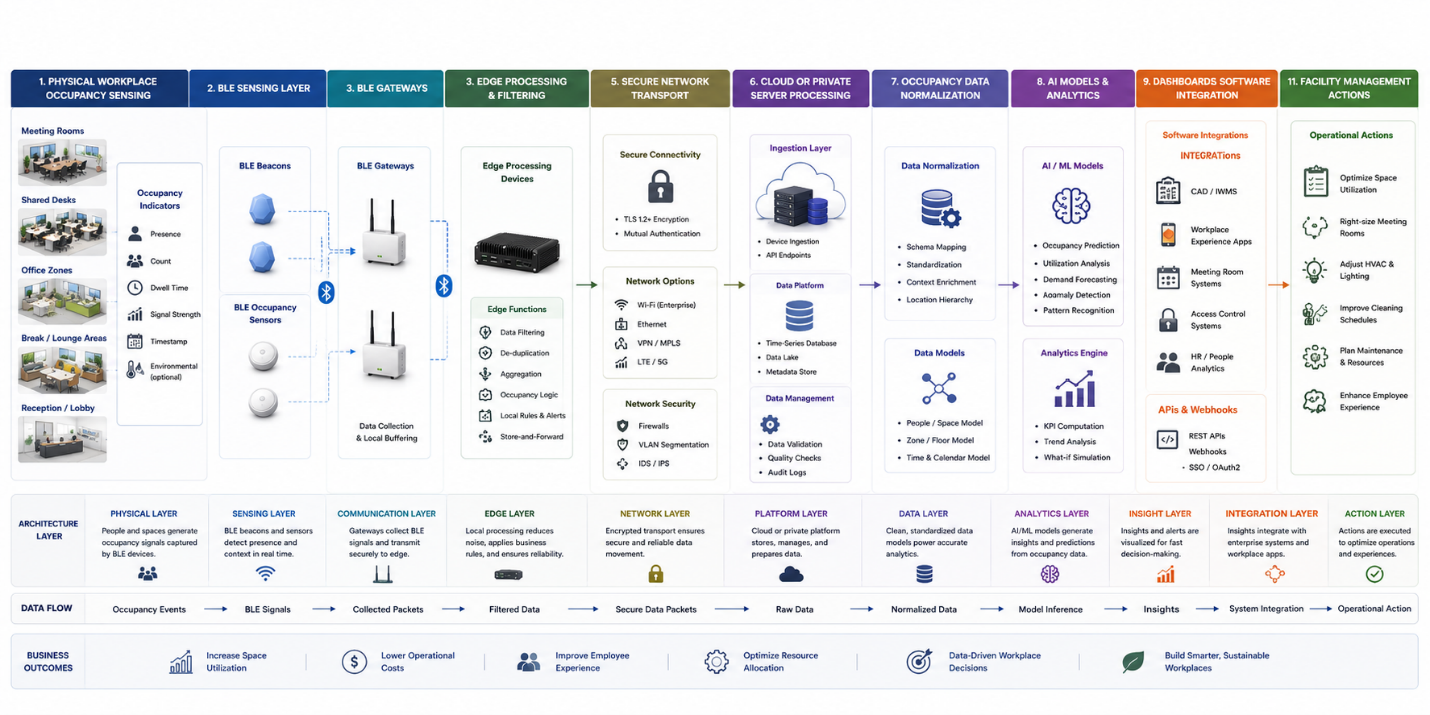
This workflow diagram illustrates the complete path from workplace occupancy sensing through BLE beacons and sensors, gateways, edge filtering, secure network transport, cloud or private-server processing, data normalization, AI analytics, dashboards, software integrations, and facility-management actions. It shows how raw occupancy signals become normalized data, AI-generated insights, and operational decisions for space utilization, HVAC, maintenance, and workplace management.
BLE Hardware and AI Software for Workplace Occupancy
BLE should be selected according to the occupancy measurement requirement rather than treated as a standalone objective. A practical workplace solution may combine several device types.
BLE Beacons
BLE beacons can provide fixed reference points for proximity and location-related applications. Their identifiers allow software to associate received signals with predefined workplace locations.
Beacon deployment requires careful consideration of mounting positions, transmission intervals, radio power, battery life, physical accessibility, and changes to the office layout. Excessive beacon density can increase deployment and maintenance requirements without necessarily improving the quality of the occupancy decision.
BLE Sensors
BLE sensors can provide occupancy-related or environmental observations depending on the selected hardware. Their use can reduce the need to infer every workplace condition from beacon signals alone.
Sensor configuration should reflect the required detection range, expected occupancy behavior, battery requirements, mounting method, and environmental conditions of the office.
BLE Gateways
BLE gateways bridge local wireless sensing and IP-connected software. They can collect transmissions from multiple BLE devices and forward structured information through Ethernet, Wi-Fi, cellular, or another supported network connection, depending on the gateway design.
Gateway commissioning should include device discovery, connectivity validation, time synchronization, signal verification, firmware management, and monitoring of gateway health.
GAO can support workplace occupancy projects with BLE beacons, BLE sensors, BLE gateways, and related IoT hardware selected around the physical deployment requirements rather than generic device specifications.
BLE Workplace Hardware and Occupancy Sensor Deployment Illustration
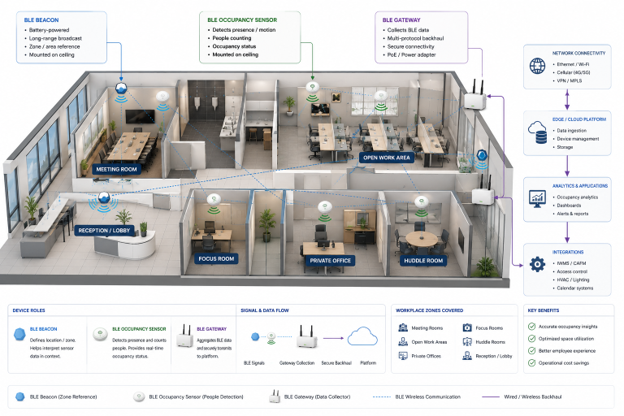
This technical cutaway illustration shows how BLE beacons, occupancy sensors, and gateways are positioned across meeting rooms, open work areas, private offices, focus rooms, and shared workplace zones. It explains device roles, wireless signal collection, gateway connectivity, edge/cloud processing, analytics, and workplace-system integrations.
Cloud and Server Deployment for Workplace Occupancy
Workplace occupancy systems generally require a software deployment model that matches the organization’s IT, privacy, network, and operational requirements.
Cloud Version
A cloud-hosted workplace occupancy solution is appropriate when organizations operate multiple offices and need centralized software management, remote analytics, consolidated reporting, and simplified scaling.
Cloud processing can support centralized device management, historical occupancy analysis, AI model execution, dashboards, API access, and multi-site reporting. Network connectivity and data governance remain important because BLE gateways must securely communicate with the hosted software.
Server Version
A Server Version can run on customer-managed servers, private data centers, edge servers, corporate infrastructure, or other privately hosted environments. This model can be useful when workplace occupancy data needs to remain within controlled infrastructure or when existing IT policies require private hosting.
Private deployment can also support integration with internal databases, identity-management systems, security controls, and existing facilities software. The trade-off is greater responsibility for server capacity, patching, backup, monitoring, disaster recovery, and software lifecycle management.
The appropriate model depends on the number of workplace sites, network design, data-governance requirements, integration constraints, IT operating model, and desired maintenance responsibilities.
AI Analytics, Integration, and Workplace Decision Support
AI-enabled workplace occupancy becomes operationally useful when occupancy observations are converted into measurable workplace decisions. The analytical layer should therefore be designed around the questions facilities and workplace teams need to answer.
For example, a workplace manager may need to determine which meeting rooms are consistently underutilized, whether desk capacity matches actual attendance, or which office zones experience recurring congestion. These questions require more than a real-time occupancy count. They require historical data, contextual information, defined business rules, and analytics that can distinguish normal workplace variation from meaningful changes.
AI can support these decisions through several analytical functions:
- Occupancy classification: Determines whether a room, desk, or zone is vacant, occupied, or operating within a defined occupancy range.
- Utilization analysis: Calculates how frequently and for how long workplace spaces are actually used.
- Demand forecasting: Estimates future occupancy based on historical utilization patterns and recurring workplace schedules.
- Anomaly detection: Identifies occupancy behavior that differs substantially from an established baseline.
- Space utilization clustering: Groups rooms, desks, or zones with similar usage characteristics to support workplace planning.
- Booking-versus-use analysis: Compares scheduled reservations with observed occupancy to identify unused or consistently underused bookings.
- Capacity analysis: Compares observed occupancy against configured room or zone capacity.
- Operational alerts: Generates notifications when defined occupancy thresholds or unusual conditions require attention.
GAO-supported BLE sensing hardware can provide the underlying observations required by these analytical processes. The AI layer, however, should remain independent enough to accept data from complementary workplace systems when additional context improves decision quality.
Integration with Workplace and Building Systems
A workplace occupancy solution rarely operates in isolation. Integration determines whether occupancy information becomes part of an existing operational workflow or remains a separate dashboard that employees must manually interpret.
Common integration targets include:
- Room-booking and scheduling software
- Workplace management software
- Facility-management systems
- Building-management systems
- Access-control systems
- Corporate identity and authentication services
- Business intelligence and reporting software
- Data warehouses and enterprise databases
- Workplace mobile applications
- Notification and incident-management systems
Integration should use a normalized data model. A room should have a consistent identifier across occupancy software, booking records, and facility-management records. The same principle applies to buildings, floors, zones, gateways, sensors, and workplace assets.
APIs can expose occupancy states and utilization metrics to other applications. Message-based integration can be useful for event-driven workflows, such as sending an alert when occupancy exceeds a configured threshold. Batch data transfer can remain appropriate for historical reporting and long-term utilization analysis.
Identity management also deserves attention. Access to detailed occupancy information should follow defined roles because workplace data can become sensitive when combined with employee identifiers, device identifiers, access records, or individual location histories.
Security and Privacy Controls for Workplace Occupancy
Workplace occupancy systems should be designed around data minimization. The system should collect the information required to answer the operational question without unnecessarily creating individual-level tracking data.
A deployment may use aggregated room or zone occupancy rather than retaining identifiable movement histories. Where individual device identifiers are required for a particular location-based application, organizations should establish appropriate retention periods, access controls, anonymization or pseudonymization procedures, and governance policies.
Technical controls can include:
- Encrypted communication between gateways and backend systems
- Authenticated gateway connections
- Role-based access control
- Secure API authentication
- Network segmentation for IoT devices
- Firmware and software update procedures
- Device inventory and lifecycle management
- Audit logging
- Secure credential management
- Data retention policies
- Backup and recovery controls
- Monitoring for unauthorized device or gateway activity
BLE itself should not be treated as the complete security boundary. The overall security posture also depends on gateway configuration, IP networking, backend software, API security, identity management, operating-system controls, and organizational policies.
Privacy design is particularly important when occupancy information can be associated with employees. A technically accurate occupancy system should clearly distinguish space utilization analytics from individual location tracking, because they represent different operational and governance requirements.
Engineering Design and Commissioning Priorities
Successful workplace occupancy deployment depends heavily on physical installation and commissioning. AI cannot compensate for systematically poor sensor coverage or incorrectly configured workplace zones.
A site survey should document floor layouts, room boundaries, wall construction, furniture density, gateway mounting locations, network availability, power sources, expected occupancy patterns, and potential sources of radio interference.
Sensor and gateway placement should then be validated against actual workplace conditions. A theoretical coverage calculation may not reflect signal behavior in a densely furnished office, a conference room with movable partitions, or a floor containing reinforced structural elements.
Commissioning should include:
- Verifying BLE device identifiers and inventory records
- Confirming gateway connectivity
- Testing wireless reception at representative workplace locations
- Validating room and zone boundaries
- Checking timestamps and time synchronization
- Comparing observed occupancy against known conditions
- Measuring false-positive and false-negative occupancy events
- Testing gateway failure and network interruption behavior
- Validating API and software integrations
- Confirming user permissions
- Testing alert thresholds
- Recording installation and configuration parameters
A controlled pilot is generally preferable to deploying hundreds of sensors before the detection method has been validated. A representative group of meeting rooms, shared desks, and workplace zones can expose installation problems and data-quality issues early.
Measuring Workplace Occupancy Performance
Occupancy analytics should be evaluated with operational KPIs rather than relying only on device connectivity statistics.
Relevant measurements include:
| KPI | What It Measures | Why It Matters |
|---|---|---|
| Occupancy detection accuracy | Agreement between detected and verified occupancy | Indicates sensing reliability |
| Room utilization rate | Actual room use relative to available time | Supports space planning |
| Desk utilization rate | Percentage of available workstation capacity being used | Helps evaluate shared-desk capacity |
| Booking-to-use ratio | Relationship between reservations and observed use | Identifies unused reservations |
| Occupancy forecast accuracy | Difference between predicted and observed occupancy | Measures AI forecasting quality |
| False occupancy rate | Vacant spaces incorrectly classified as occupied | Identifies sensing problems |
| Missed occupancy rate | Occupied spaces incorrectly classified as vacant | Indicates detection limitations |
| Gateway availability | Percentage of time gateways remain operational | Measures infrastructure reliability |
| Data latency | Time between sensing and software availability | Important for real-time workflows |
| Battery life | Operating duration of battery-powered devices | Supports maintenance planning |
| Alert precision | Percentage of alerts requiring meaningful action | Helps reduce operational noise |
| Space utilization variance | Difference in utilization among workplace zones | Identifies uneven space demand |
These KPIs should be measured during pilot deployment and after commissioning. A model or sensor configuration that performs well in an empty test area may behave differently when the office reaches normal occupancy.
Scaling AI Workplace Occupancy Across Multiple Sites
Multi-site deployment introduces additional challenges because workplace layouts, building materials, network infrastructure, operating schedules, and occupancy behavior vary from location to location.
A scalable implementation should establish common configuration standards while allowing site-specific parameters. Buildings can use standardized naming conventions for floors and zones while maintaining individual signal, gateway, sensor, and occupancy thresholds.
Software should also support centralized device inventory and health monitoring. Operations teams need to know whether a missing occupancy reading represents a vacant room or a failed sensor. Device-health information should therefore remain separate from occupancy state.
AI models should be monitored after deployment because workplace behavior can change. Office relocations, hybrid-work policies, renovations, furniture changes, departmental moves, and changes in meeting-room configuration can alter the underlying data distribution.
Model retraining or threshold adjustment should therefore be treated as part of the operational lifecycle rather than as a one-time implementation activity.
Practical Implementation Priorities for Workplace Occupancy
A reliable workplace occupancy program should treat sensing, AI, software integration, cybersecurity, and facilities operations as one connected engineering process.
The following practices are particularly important:
- Define the workplace decision before selecting the sensing method.
- Separate room occupancy, desk occupancy, people counting, and location estimation requirements.
- Conduct a physical RF and network survey before finalizing BLE gateway placement.
- Validate sensor performance under normal workplace conditions rather than only laboratory conditions.
- Establish room, floor, zone, sensor, and gateway identifiers before integration.
- Use edge processing where local filtering, lower latency, or reduced upstream traffic provides a practical advantage.
- Select cloud or privately hosted server deployment according to data governance, IT operations, integration, and multi-site requirements.
- Establish cybersecurity controls for BLE devices, gateways, networks, APIs, servers, and user access.
- Minimize personally identifiable information when aggregated occupancy is sufficient.
- Compare AI predictions against verified occupancy observations.
- Monitor false positives, missed detections, latency, and gateway availability after commissioning.
- Plan battery replacement, firmware updates, device health monitoring, and maintenance before full deployment.
- Reevaluate AI models when workplace layouts, schedules, policies, or utilization patterns materially change.
GAO has supplied BLE, RFID, and IoT hardware products and systems to organizations in the United States and Canada, including Fortune 500 companies, research and development organizations, universities, and government agencies. With operations based in New York City and Toronto, Canada, GAO is recognized among the leading B2B and B2G suppliers of BLE and RFID technologies. Its workplace occupancy solutions can be developed around practical hardware requirements and integrated with customer-managed software and IT environments.
From Occupancy Data to Actionable Workplace Intelligence
AI-enabled workplace occupancy is most effective when it connects accurate physical observations to specific operational decisions. BLE beacons, BLE sensors, and BLE gateways provide a flexible sensing layer, while edge processing, server or cloud software, AI models, APIs, and workplace applications transform those observations into utilization intelligence.
The strongest implementations begin with a defined operational requirement, validate sensing performance through a controlled deployment, establish secure data flows, and integrate occupancy information with the systems facilities teams already use. Organizations can then use historical utilization, forecasting, anomaly detection, and capacity analysis to improve meeting-room utilization, shared-desk planning, facility services, and workplace resource allocation.
GAO can help organizations evaluate BLE hardware, IoT systems, deployment considerations, and integration requirements for workplace occupancy applications. Readers can explore GAO’s technology solutions and technical support when planning or expanding an AI-enabled occupancy deployment.
Building the Future of Industrial AI and IoT with Aperture Venture Studio and GAO RFID Inc.
For more than three decades, GAO Group of Companies has invested heavily in R&D for industrial BLE, RFID, and IoT. As AI became increasingly practical for industrial and workplace applications, we expanded our work in AI and IoT, including BLE and RFID technologies, and founded Aperture Venture Studio to develop and scale AI and IoT solutions relevant to applications such as workplace occupancy, location intelligence, and connected operations.
Aperture brings together AI and IoT technical experts, entrepreneurial and operational executives, investors, and leading companies. We have also developed the Aperture Ventures Summit and TekSummit to discuss advanced AI and IoT topics and build technical communities around these fields.
We welcome participation as:
- Advisors, co-founders, or employees
- Investors
- Customers