
AI and BLE for Aircraft Maintenance Facilities
AI-Enabled Aircraft Maintenance Facilities with BLE Asset Intelligence
AI and BLE can help aircraft maintenance facilities improve asset visibility, maintenance planning, technician workflows, parts control, and operational safety by connecting physical maintenance assets with software-driven intelligence. BLE beacons, gateways, and sensors provide location, identification, proximity, environmental, and equipment-condition data, while AI converts that data into maintenance insights and operational recommendations. For MRO organizations, this combination can support aircraft turnaround, hangar operations, tooling management, ground support equipment monitoring, spare-parts control, work-order coordination, and maintenance quality processes. The resulting system can connect data from hangars, maintenance bays, workshops, stores, tool cribs, component shops, and aircraft support areas with maintenance management and enterprise software. GAO provides BLE, RFID, and IoT hardware products and systems that can be incorporated into these workflows, helping organizations build practical connected maintenance environments.
AI and BLE-Enabled Aircraft Maintenance Facility Operations
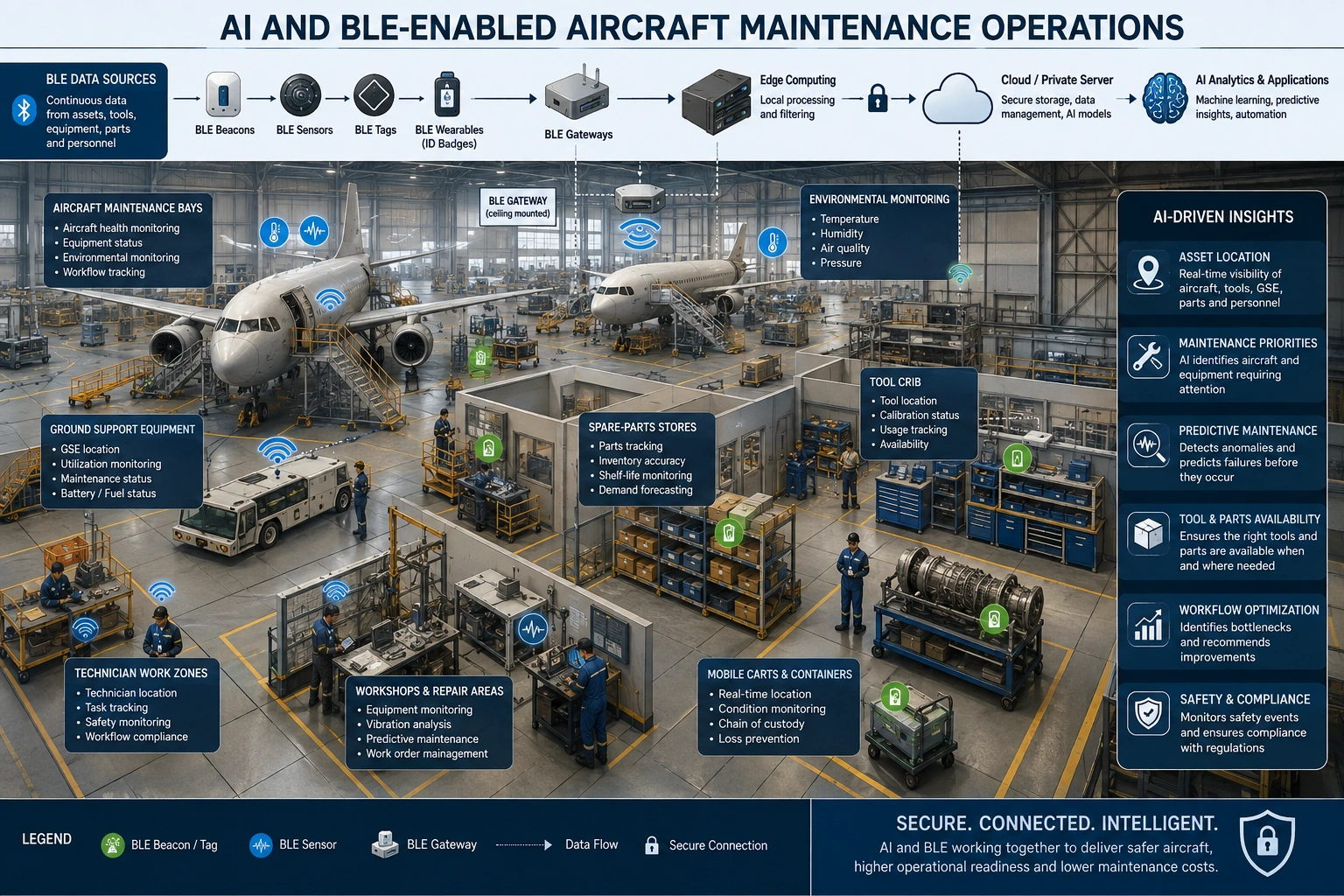
This enterprise technical illustration shows how BLE beacons, sensors, tags, wearables, and gateways capture real-time data across aircraft maintenance bays, tool cribs, spare-parts stores, workshops, and ground support areas. Edge computing, secure cloud or private servers, and AI analytics transform this data into asset-location visibility, predictive maintenance, tool and parts availability, workflow optimization, and safety insights.
What AI Means for Aircraft Maintenance Facilities
Aircraft maintenance facilities generate large volumes of operational data from aircraft maintenance records, work orders, inspection activities, tooling systems, parts inventories, equipment telemetry, technician workflows, and facility conditions. AI can analyze these data streams to identify patterns that are difficult to detect through manual monitoring alone.
For maintenance organizations, the practical objective is not simply to add AI to existing processes. The objective is to use AI where it can improve a defined maintenance or facility-management decision.
Relevant AI applications include:
- Predictive maintenance for ground support equipment, maintenance machinery, air compressors, hydraulic service equipment, power carts, and other facility-support assets
- AI-assisted maintenance scheduling based on equipment condition, work-order priority, asset availability, technician capacity, and aircraft maintenance requirements
- Computer vision for inspection support, component identification, foreign object detection, safety monitoring, and visual verification activities where appropriate
- AI-based anomaly detection for equipment telemetry and facility environmental conditions
- Intelligent asset tracking for high-value tools, calibration equipment, mobile maintenance carts, components, and spare parts
- AI-assisted inventory forecasting for frequently consumed maintenance materials and aircraft components
- Technician workflow analysis to identify waiting time, excessive movement, unavailable tooling, and material delays
- AI-supported root-cause analysis using historical maintenance events, equipment conditions, and work-order information
- Intelligent alerts for assets entering restricted, unauthorized, or operationally unsuitable areas
- Maintenance knowledge retrieval that helps authorized personnel locate relevant technical records, procedures, inspection information, or historical maintenance information
BLE provides a practical source of real-time contextual data for these applications. A BLE beacon can provide an identity reference or proximity signal, while BLE sensors can generate condition measurements. Gateways collect those signals and forward them to the software environment where AI models can combine them with maintenance and operational data.
Aircraft Maintenance Facility Applications for AI-Driven Operations
AI Asset Tracking for Maintenance Tools and Ground Support Equipment
Aircraft maintenance facilities contain large numbers of tools, test instruments, maintenance carts, lifting equipment, ground power units, hydraulic service equipment, oxygen servicing equipment, air-conditioning units, and other support assets. Manual searches for equipment can consume technician time and delay maintenance work.
BLE-enabled asset tracking can associate an asset identifier with a physical location or zone. AI can use historical movement and utilization data to identify frequently misplaced equipment, unusual movement patterns, underutilized assets, or recurring availability problems.
For example, a maintenance organization can monitor whether a required torque wrench, borescope, diagnostic instrument, or specialized test set is available near a maintenance bay before a scheduled task begins. The system can also associate equipment movement with work orders and maintenance schedules.
GAO can supply BLE hardware products and systems that support asset visibility requirements across aircraft maintenance areas, including beacons, gateways, and sensing devices.
AI Tool Control and Calibration Management
Tool control is a critical operational process in aircraft maintenance because missing tools can create safety and quality concerns. Maintenance facilities also need to control calibration status for measurement and test equipment.
A connected tool-control solution can associate each tracked tool with its identity, location, assigned area, calibration status, and usage history. AI can analyze these records to identify tools approaching calibration deadlines, abnormal movement patterns, repeated transfers between work areas, or tools that are frequently unavailable when required.
The software can provide alerts to maintenance supervisors or tool-control personnel while maintaining links to the organization’s existing maintenance records.
AI Spare Parts and Component Movement
Aircraft maintenance facilities manage aircraft components, rotable parts, consumables, repairable items, serialized equipment, and other materials through receiving, inspection, storage, kitting, issue, installation, removal, repair, quarantine, and return processes.
BLE can provide additional location and movement information for mobile containers, parts carts, kitting stations, and selected high-value components. AI can combine location data with inventory records and work-order requirements to identify potential material shortages, unusual movement, delayed kits, or congestion within maintenance stores.
This is particularly useful when maintenance planners need to determine whether a component is physically available, merely recorded as available, already allocated to another work order, or waiting for inspection or disposition.
AI Monitoring of Ground Support Equipment
Ground support equipment is essential to aircraft maintenance operations and may include ground power units, air start units, hydraulic power units, tugs, forklifts, maintenance steps, access platforms, service carts, and specialized support equipment.
BLE sensors can provide operational data such as temperature, vibration, utilization, location, or other measurable conditions depending on the equipment and sensor design. AI models can then identify abnormal patterns and support condition-based maintenance.
A useful deployment does not rely on AI predictions alone. Maintenance teams should combine model outputs with manufacturer maintenance requirements, inspection procedures, operating hours, fault codes, and technician judgment.
AI Environmental Monitoring for Maintenance Areas
Aircraft maintenance facilities include areas where temperature, humidity, vibration, air quality, or other environmental conditions can affect equipment, components, materials, or maintenance processes.
BLE sensors can collect environmental measurements from aircraft maintenance bays, component workshops, electronics work areas, chemical storage areas, parts stores, and controlled maintenance environments. AI-based anomaly detection can identify deviations from established operating ranges and distinguish persistent trends from short-duration fluctuations.
This enables maintenance personnel to investigate conditions before they develop into material-storage problems, equipment issues, or process disruptions.
AI Use Cases Across an Aircraft Maintenance Facility
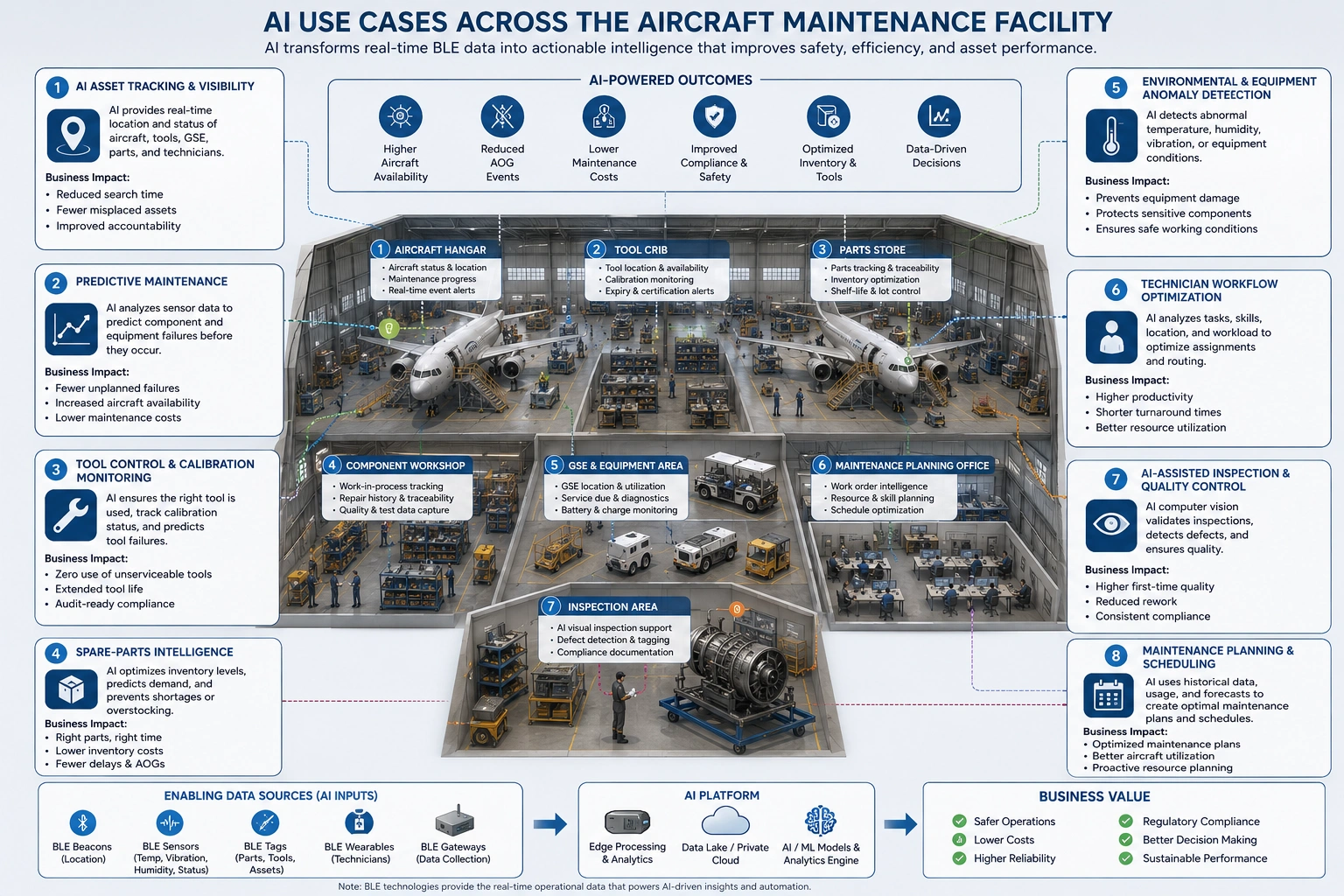
This infographic illustrates eight major AI applications across an aircraft maintenance facility, including asset tracking, predictive maintenance, tool and calibration control, spare-parts intelligence, anomaly detection, technician workflow optimization, AI-assisted inspection, and maintenance scheduling. It shows how BLE-enabled operational data feeds AI platforms to improve aircraft availability, safety, reliability, compliance, and maintenance efficiency.
From Aircraft Maintenance Data to AI-Driven Decisions
A practical AI-enabled aircraft maintenance facility follows a defined data path rather than treating connected devices as isolated hardware. The process normally begins with physical maintenance activities and ends with a maintenance, safety, planning, or asset-management action.
Data Acquisition
BLE beacons provide identifiable references for tools, equipment, carts, containers, and selected assets. BLE sensors can collect measurements such as temperature, humidity, vibration, proximity, or equipment-specific conditions. Existing maintenance systems can contribute work orders, asset records, inspection results, parts information, calibration records, and maintenance schedules.
The resulting data should include reliable timestamps, asset identifiers, facility zones, sensor identifiers, and other contextual information needed for analysis.
BLE Communication and Gateway Collection
BLE gateways receive signals from nearby BLE devices and forward relevant information to the next processing layer. Gateway placement should account for hangar dimensions, aircraft structures, metal obstructions, equipment density, radio interference, wall materials, and the required positioning accuracy.
A facility should not assume that one gateway configuration will provide uniform performance throughout every maintenance area. A radio survey and pilot deployment can help determine gateway density, signal behavior, coverage gaps, and location accuracy before large-scale installation.
Edge Processing and Data Validation
Edge processing can reduce unnecessary data transmission and provide faster local responses. Gateway or edge software can filter duplicate observations, normalize timestamps, validate sensor readings, detect missing data, and temporarily buffer information during network interruptions.
This layer is especially valuable for aircraft maintenance facilities where operational decisions may depend on timely asset-location or equipment-condition information.
Cloud or Private Server Processing
Validated information can be transferred to cloud-hosted software or privately managed servers. The appropriate choice depends on organizational cybersecurity requirements, connectivity, data governance, latency, existing IT infrastructure, and integration requirements.
Cloud deployment can support centralized analytics across multiple maintenance facilities, while private server deployment can provide greater control over data processing and integration with customer-managed systems.
AI Analytics
AI software can combine BLE-derived data with maintenance records and other operational information. Suitable methods may include anomaly detection, classification, forecasting, clustering, time-series analysis, optimization models, computer vision, and machine learning.
Model selection should be driven by the maintenance decision rather than by the availability of a particular AI technique. For example, anomaly detection may be more appropriate for identifying unusual GSE vibration patterns than a generic predictive model.
Maintenance Action
The final stage is an operational response. Depending on the use case, the system may create an alert, recommend inspection, update an asset status, prioritize a work order, identify a missing tool, notify stores personnel, flag an environmental condition, or provide information to a maintenance supervisor.
Human approval remains important for safety-critical maintenance decisions. AI should support qualified personnel rather than bypass approved aircraft maintenance procedures, engineering controls, inspection requirements, or organizational authorization processes.
AI-Enabled Aircraft Maintenance Data-to-Decision Workflow
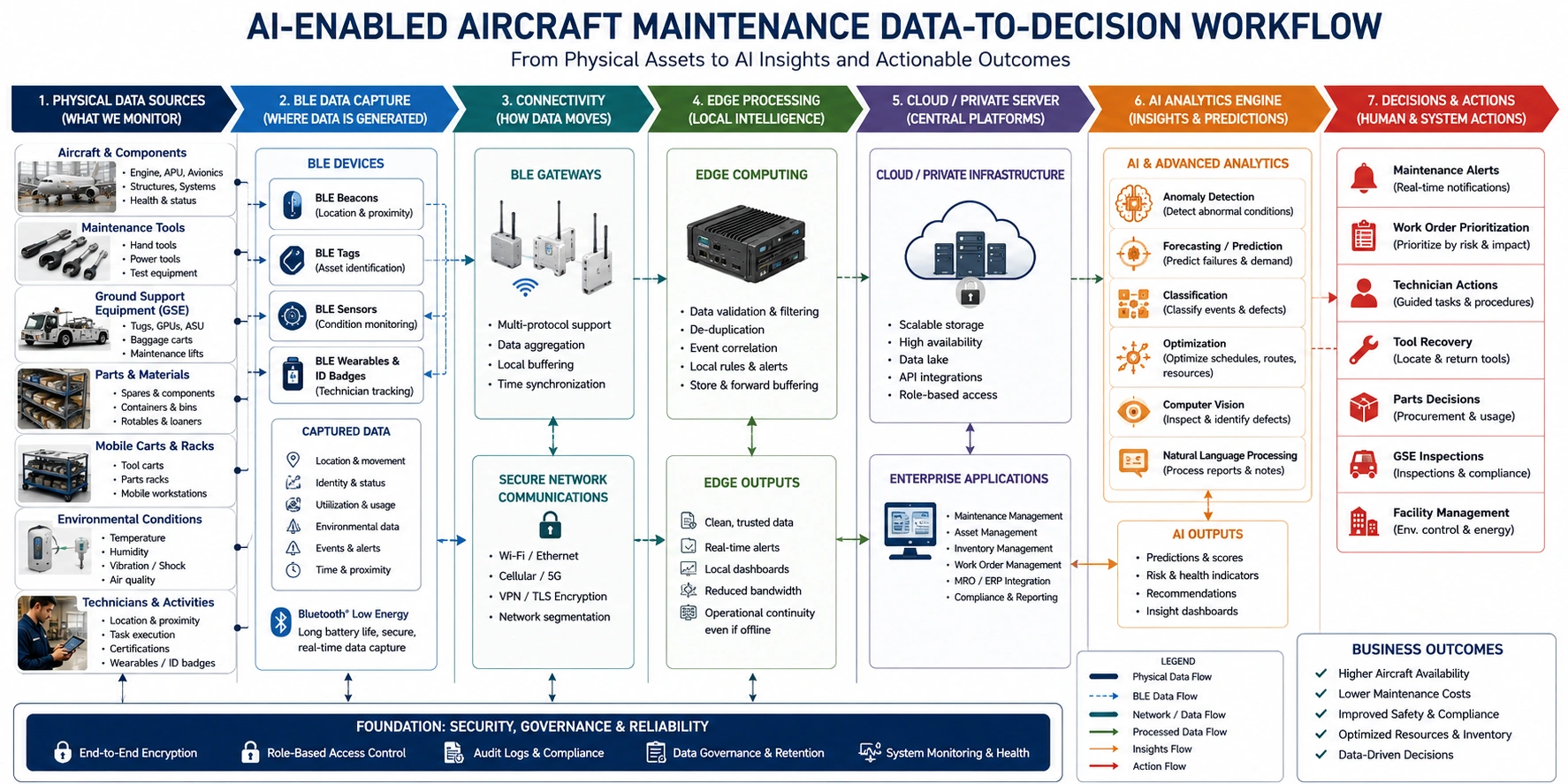
This technical workflow diagram illustrates the end-to-end flow from aircraft, tools, GSE, parts, environmental conditions, and technicians through BLE data capture, secure connectivity, edge processing, cloud or private infrastructure, enterprise maintenance systems, and AI analytics. It shows how AI-generated predictions and insights drive maintenance alerts, work-order prioritization, technician actions, tool recovery, parts decisions, GSE inspections, and facility management.
Technical Foundation for AI-Enabled Aircraft Maintenance Facilities
BLE Hardware for Maintenance Asset Visibility
BLE hardware should be selected according to the physical characteristics and operational requirements of each aircraft maintenance area. BLE beacons can identify tools, carts, equipment, parts containers, and other mobile assets. BLE sensors can extend the solution by measuring physical conditions rather than only providing identification or proximity information.
BLE gateways provide the connection between local wireless devices and the facility’s IP network. Their placement, antenna characteristics, power availability, enclosure requirements, and network connectivity should be evaluated during site engineering.
AI, Edge Computing, and Maintenance Software
The software layer can combine BLE observations with maintenance and facility information to produce operational context. Edge computing is useful when data filtering, local rules, rapid alerts, or temporary offline operation are required.
AI models can then operate on validated historical and real-time data. For aircraft maintenance organizations, model governance is important because incorrect alerts can create unnecessary maintenance activity while missed anomalies can create operational risk.
The next section continues with detailed hardware and software selection, communication protocols, cybersecurity, Cloud Version versus Server Version deployment, system integration, commissioning, testing, scalability, and engineering considerations.
Hardware, Software, and Communications for Aircraft Maintenance Facilities
A reliable AI-enabled maintenance solution depends on selecting sensing, connectivity, computing, and software components according to the physical and operational characteristics of the facility.
BLE Beacons, Sensors, and Gateways
BLE beacons are suitable for identifying mobile maintenance assets such as tool containers, carts, GSE, inspection equipment, and selected high-value components. BLE sensors add measurable operating information, including temperature, humidity, vibration, proximity, and other parameters supported by the selected device.
BLE gateways collect nearby device transmissions and forward observations through the facility network. Gateway deployment should consider hangar size, aircraft fuselage and wing structures, metallic equipment, fire-rated walls, storage racks, electromagnetic interference, and required location accuracy.
GAO supplies BLE hardware products and IoT systems that can be incorporated into aircraft maintenance asset-tracking and condition-monitoring applications.
Communication Protocols and Network Connectivity
BLE normally serves as the local wireless sensing and identification layer. Gateways can connect to facility networks through Ethernet, Wi-Fi, cellular connectivity, or other supported networking methods depending on the selected equipment and deployment environment.
A practical implementation separates the low-power device layer from the enterprise IP network. This allows BLE devices to remain power-efficient while gateways handle network communication, local filtering, buffering, and data forwarding.
Network engineering should address:
- VLAN segmentation for IoT and maintenance-related devices
- Firewall rules controlling gateway-to-server communications
- Encrypted transport between gateways and software
- Network redundancy for critical monitoring functions
- Time synchronization across gateways and servers
- Offline buffering during temporary network outages
- Device authentication and certificate or credential management
- Monitoring of gateway availability and communication health
AI Models for Maintenance Operations
Different aircraft maintenance problems require different analytical approaches.
- Time-series models can evaluate equipment-condition measurements over time.
- Anomaly detection can identify unusual vibration, temperature, utilization, or movement patterns.
- Classification models can categorize equipment conditions or operational events.
- Forecasting models can estimate future equipment demand, parts requirements, or maintenance workload.
- Optimization algorithms can help prioritize resources according to maintenance schedules, equipment availability, and operational constraints.
- Computer vision can support selected inspection and facility-monitoring applications when suitable cameras, lighting, image quality, and approved inspection processes are available.
- Natural-language AI can assist authorized personnel with searching maintenance information when it is connected to controlled and appropriately governed information sources.
AI outputs should remain traceable to the underlying data and should be evaluated against measurable maintenance outcomes. Safety-critical decisions require appropriate human review and compliance with approved maintenance procedures.
Cloud Version and Server Version
A Cloud Version can host data processing, dashboards, AI analytics, device management, and multi-facility reporting within cloud infrastructure. This model is useful when an organization operates multiple maintenance locations and needs centralized visibility without maintaining all application infrastructure locally.
A Server Version can run on customer-managed servers, private data centers, facility servers, edge servers, or other privately hosted infrastructure. This approach may be appropriate when the organization requires greater control over data processing, network boundaries, integration with existing maintenance systems, or internal cybersecurity policies.
The choice should be based on operational requirements rather than assuming that one model is universally superior.
Integration with Aircraft Maintenance Software
BLE-generated data becomes significantly more useful when connected to existing maintenance information.
Relevant systems may include:
- Computerized Maintenance Management Systems (CMMS)
- Maintenance, Repair and Overhaul (MRO) software
- Enterprise Resource Planning (ERP) systems
- Enterprise Asset Management (EAM) software
- Inventory and warehouse management systems
- Tool-control and calibration systems
- Quality management systems
- Work-order management software
- Configuration management databases
- Identity and access management systems
- Data historians and operational databases
- Business intelligence and reporting software
Integration can use REST APIs, message brokers, webhooks, database interfaces, middleware, or other supported integration mechanisms.
A common engineering pattern is to maintain a canonical asset identifier so that the BLE identifier, physical asset number, maintenance-system record, and AI data record refer to the same object. Without this relationship, AI analytics can produce technically correct observations that cannot easily be converted into maintenance actions.
For example, a gateway may report that a tracked maintenance cart has moved into Hangar Bay 3. The software becomes more useful when that cart identifier is connected to its equipment record, maintenance status, assigned work order, inspection schedule, and responsible maintenance group.
Cybersecurity and Data Governance for Aircraft Maintenance AI
Aircraft maintenance facilities require strong controls because connected systems can contain operational information, equipment data, maintenance records, and information about personnel activities.
Security should be considered throughout device deployment rather than added after commissioning.
Important controls include:
- Unique identities for BLE gateways and managed devices
- Secure gateway configuration and credential management
- Encrypted network communication
- Segmentation between IoT devices and sensitive maintenance networks
- Role-based access to maintenance dashboards
- Least-privilege access for software integrations
- Audit logging for configuration and administrative activity
- Controlled firmware and software updates
- Backup and recovery procedures
- Monitoring for abnormal gateway or device behavior
- Secure retirement and replacement of devices
- Data retention policies appropriate to operational and regulatory requirements
AI systems also require data governance. Maintenance records used for model training should be traceable, appropriately authorized, and protected against unintended modification.
Where AI is used for maintenance recommendations, organizations should establish procedures for model validation, performance monitoring, human review, exception handling, and periodic recalibration.
Engineering Deployment Lifecycle for Aircraft Maintenance Facilities
Planning and Site Assessment
Deployment should begin with a detailed survey of hangars, maintenance bays, workshops, tool-control areas, parts stores, GSE zones, access points, and network infrastructure.
The engineering team should identify:
- Assets requiring continuous or periodic tracking
- Areas requiring condition monitoring
- Required location accuracy
- Expected device density
- Gateway mounting locations
- Available power sources
- Network connectivity
- Radio-frequency interference sources
- Environmental conditions
- Existing maintenance software
- Cybersecurity requirements
- AI decisions that the system is expected to support
A limited pilot in one maintenance area can reveal radio propagation and workflow issues before facility-wide deployment.
Hardware Selection and Installation
Device selection should consider battery life, enclosure characteristics, sensor accuracy, operating temperature, mounting method, maintenance requirements, and the physical environment.
Tools that are frequently handled may require compact and durable beacons. Mobile GSE may require more robust attachment methods. Environmental monitoring requires sensor specifications appropriate to the measurement range and expected conditions.
Gateway locations should be validated through actual radio measurements rather than relying only on theoretical coverage calculations.
Commissioning and Testing
Commissioning should verify both technical performance and maintenance workflow behavior.
Testing can include:
- BLE device discovery
- Gateway coverage
- Location accuracy
- Sensor measurement accuracy
- Data transmission reliability
- Timestamp consistency
- Asset identity mapping
- Network failover behavior
- Offline buffering
- API integration
- Alert generation
- AI model response
- Dashboard accuracy
- Access control
- Audit logging
Acceptance criteria should be established before testing begins.
Optimization and Continuous Improvement
Performance should be monitored after deployment because aircraft maintenance environments change continuously. New aircraft types, additional tooling, revised hangar layouts, equipment movement, network changes, and new maintenance processes can affect system performance.
Operational feedback can be used to adjust gateway placement, sensor configuration, alert thresholds, data-processing rules, and AI models.
Aircraft Maintenance Facility AI and BLE Deployment Lifecycle
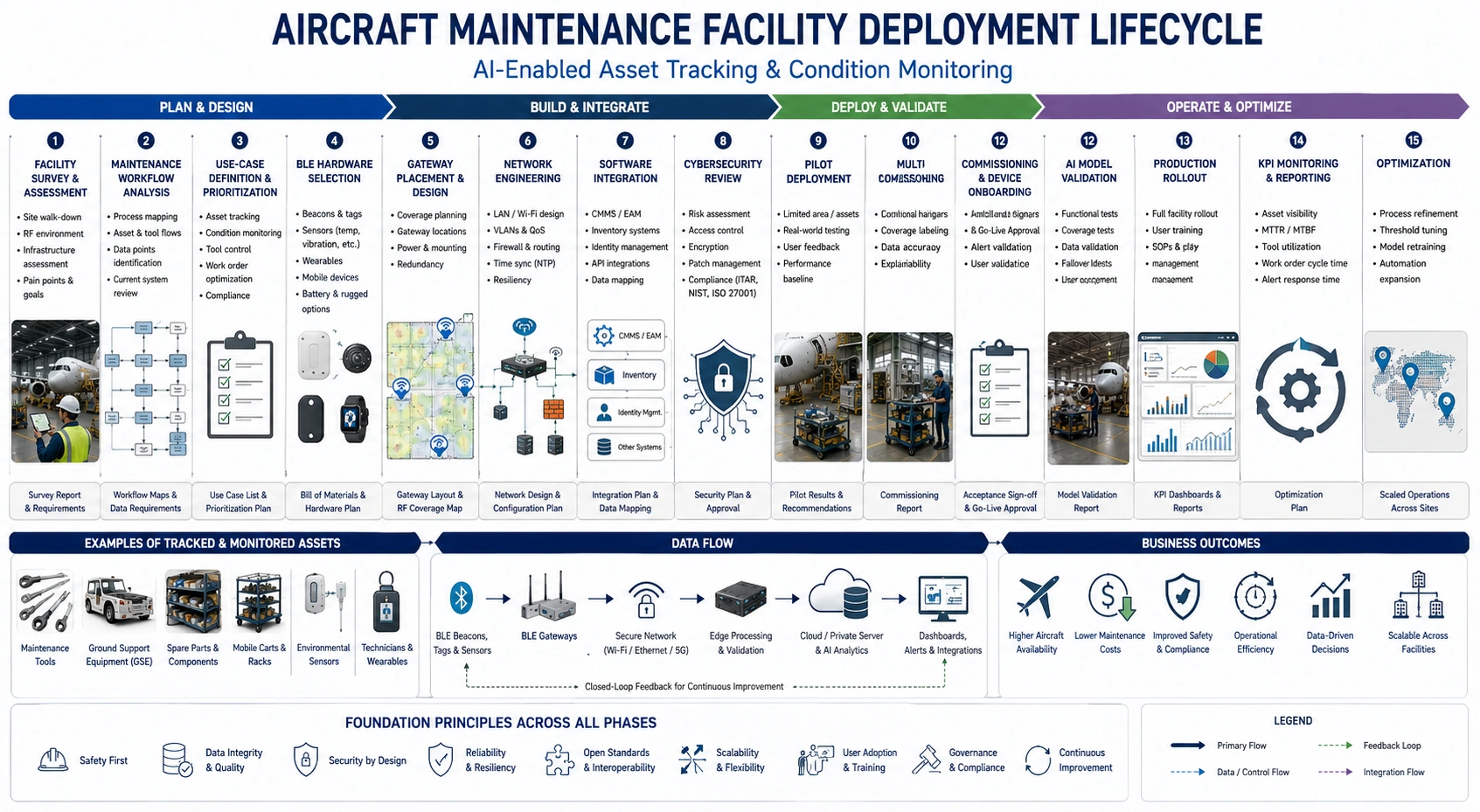
This lifecycle diagram presents the end-to-end deployment journey for AI-enabled BLE asset tracking and condition monitoring, from facility assessment and use-case planning through hardware selection, integration, cybersecurity, pilot deployment, commissioning, AI validation, production rollout, and optimization. It also connects tracked maintenance assets and data flows to operational outcomes such as higher aircraft availability, lower maintenance costs, improved safety, and scalable facility operations.
KPIs for AI-Enabled Aircraft Maintenance Facilities
Measurement should focus on operational outcomes rather than the number of BLE devices installed.
Useful KPIs include:
- Average time required to locate maintenance tools
- Tool search time per maintenance task
- Percentage of tracked assets with known current location
- GSE availability rate
- GSE unplanned downtime
- Maintenance response time
- Mean time between equipment failures
- Mean time to repair
- Preventive maintenance compliance
- Predictive-maintenance alert precision
- False-alert rate
- Missed-anomaly rate
- Spare-parts stockout frequency
- Maintenance kit readiness
- Parts retrieval time
- Tool calibration compliance
- Asset utilization rate
- Aircraft maintenance task delay attributable to unavailable equipment
- Aircraft turnaround support time
- Environmental excursion frequency
- Gateway availability
- Sensor data completeness
- Network communication reliability
- AI model accuracy and drift indicators
These KPIs should be established against a baseline before deployment so that the organization can distinguish measurable improvement from normal operational variation.
Operational Benefits of AI for Aircraft Maintenance Facilities
Combining AI with connected maintenance data can improve facility operations when the technology is linked to specific maintenance decisions.
Faster Maintenance Resource Location
Real-time or near-real-time asset visibility reduces unnecessary searches for tools, GSE, carts, and selected maintenance equipment. AI can further identify recurring location problems and resource bottlenecks.
Improved Maintenance Planning
AI can combine equipment condition, asset availability, work orders, technician schedules, and maintenance priorities to help planners identify potential conflicts before they affect aircraft maintenance activities.
Reduced Unplanned Equipment Downtime
Condition monitoring can reveal abnormal equipment behavior before a failure occurs. This provides maintenance teams with an opportunity to inspect or service equipment according to established maintenance procedures.
Better Parts and Tool Availability
Asset movement information combined with inventory and work-order data can improve visibility into whether required resources are available, allocated, in transit, undergoing inspection, or unavailable.
Stronger Facility Safety and Control
Monitoring asset movement and environmental conditions can support facility-control processes. AI-based anomaly detection can help identify unusual conditions that warrant investigation.
Scalable Multi-Hangar Operations
A standardized device and software approach can extend from one maintenance bay to multiple hangars, workshops, stores, and support areas. Cloud or privately hosted server deployments can then aggregate information according to organizational requirements.
Practical Recommendations for Aircraft Maintenance Facility Deployment
Successful implementation depends more on use-case definition and integration quality than on simply installing connected devices.
- Start with high-value maintenance problems such as tool search, GSE downtime, critical asset visibility, or environmental monitoring.
- Establish baseline KPIs before introducing AI.
- Perform an RF survey before finalizing BLE gateway locations.
- Map BLE identifiers to authoritative maintenance asset records.
- Separate IoT connectivity from sensitive maintenance networks where appropriate.
- Use edge processing where local buffering or rapid event handling is required.
- Validate sensor measurements against calibrated reference equipment.
- Keep AI recommendations explainable enough for maintenance personnel to investigate the underlying evidence.
- Test AI models against historical and real operating conditions.
- Establish human-review procedures for maintenance recommendations with safety implications.
- Integrate with existing MRO, CMMS, ERP, inventory, tool-control, and work-order systems rather than creating unnecessary duplicate records.
- Monitor device battery status, gateway health, data completeness, and AI model performance after deployment.
- Expand from pilot areas only after technical and operational acceptance criteria have been achieved.
GAO Support for Connected Aircraft Maintenance Operations
GAO has supplied BLE, RFID, and IoT hardware products and systems to organizations requiring connected asset identification, tracking, monitoring, and data collection. Its product and engineering capabilities can support aircraft maintenance facilities where BLE beacons, BLE sensors, gateways, and related IoT technologies are appropriate to the operational requirement.
Headquartered in New York City and Toronto, Canada, GAO is ranked among the top 10 leading B2B and B2G BLE and RFID suppliers in the world. GAO, together with GAO Research and GAO Tek, forms GAO Group, with operations based in New York City and Toronto.
For three decades, GAO Group has served organizations across the United States and Canada, including Fortune 500 companies, leading research and development firms, prestigious universities, and U.S. and Canadian government agencies. Its investment in research and development, quality-assurance processes, and remote or onsite technical support provides a foundation for deploying connected hardware and systems in demanding operational environments.
Key Takeaways for AI-Enabled Aircraft Maintenance Facilities
AI can help aircraft maintenance facilities move from manually observed operations toward data-supported maintenance planning, asset management, equipment monitoring, and facility control. BLE provides a practical source of asset identity, location, proximity, and sensor information, while gateways, edge processing, enterprise software, and AI analytics turn those observations into actionable maintenance information.
The strongest implementations begin with measurable maintenance problems rather than technology selection alone. Organizations should establish KPIs, conduct facility surveys, integrate authoritative asset records, validate AI outputs, secure connected devices, and introduce automation according to approved maintenance and safety procedures.
GAO can help organizations evaluate BLE, RFID, and IoT hardware products and systems for aircraft maintenance applications and provide technical support for appropriate deployment requirements.
Building the Future of Industrial AI and IoT with Aperture Venture Studio and GAO RFID Inc.
For more than three decades, GAO Group of Companies has invested heavily in R&D of industrial BLE, RFID, and IoT. As generative AI has become increasingly useful in industrial applications, we have continued developing AI and IoT technologies, including solutions relevant to aircraft maintenance, connected asset management, and facility operations. We have also founded Aperture Venture Studio to support the development and scaling of AI and IoT solutions addressing practical industrial challenges.
Aperture brings together AI and IoT technical experts, entrepreneurial and operational executives, investors, and leading companies. Through Aperture Ventures Summit and TekSummit, we also support discussions on advanced AI and IoT technologies.
We welcome you to join us as:
- Advisors, co-founders, or employees
- Investors
- Customers