
AI and BLE for Paper Manufacturing
AI-Driven Paper Manufacturing with BLE-Based Industrial Visibility
AI and BLE for Paper Manufacturing combines Industrial AI with connected sensors, beacons, and gateways to give paper mills more timely operational data about machinery, materials, mobile assets, and work activities. BLE can provide the location, condition, or identity data that AI models need to identify abnormal equipment behavior, improve maintenance planning, monitor production-support assets, and optimize mill logistics. The approach is particularly useful around paper machines, stock preparation, converting equipment, warehouses, roll storage, maintenance areas, and material-handling routes where conventional data sources may leave visibility gaps. AIoT systems can combine BLE data with PLC signals, SCADA historians, CMMS records, MES information, environmental measurements, and computer vision. For paper manufacturers, the objective is not simply connectivity. The objective is to turn distributed mill data into actionable decisions that reduce unplanned downtime, improve asset utilization, support safer work practices, and strengthen production and maintenance performance.
AIoT and BLE System for Paper Manufacturing Operations
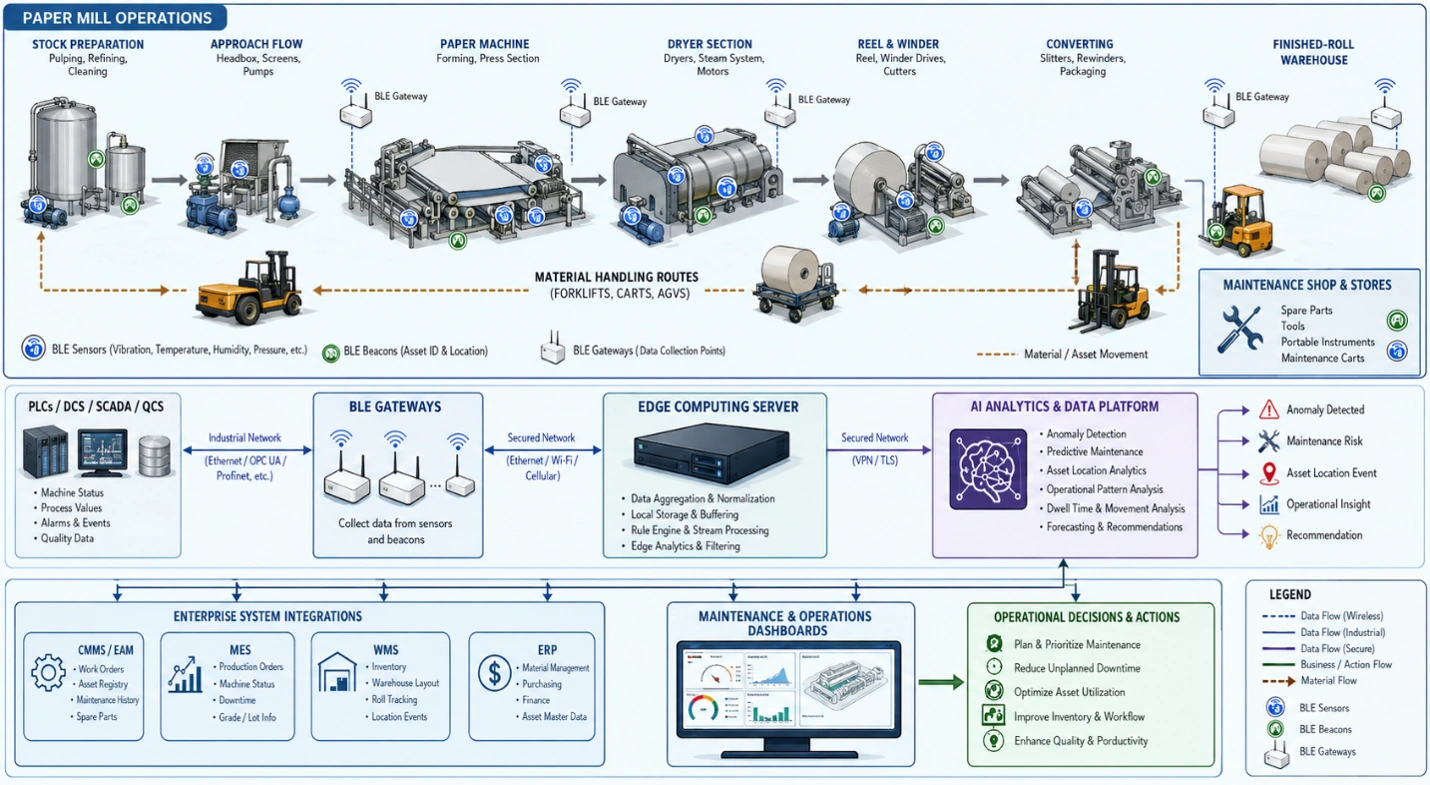
This diagram illustrates how BLE sensors, BLE beacons, and gateways connect paper mill equipment, mobile assets, and production operations to edge computing and AI analytics. It shows data integration with PLC/DCS/SCADA/QCS systems, CMMS/EAM, MES, WMS, and ERP software, leading to predictive maintenance, asset-location intelligence, workflow optimization, and operational decisions.
What AI Means for Modern Paper Manufacturing
Paper manufacturing generates a continuous stream of process, equipment, quality, environmental, maintenance, and logistics data. A typical mill may already collect temperatures, pressures, flows, motor currents, vibration, basis-weight measurements, moisture readings, speed, tension, stock consistency, and process chemistry information through PLCs, DCS, SCADA, QCS, and historians. The remaining challenge is often the visibility of assets and operating conditions that are outside fixed instrumentation.
BLE provides a practical wireless layer for those gaps. A BLE sensor can capture vibration, temperature, humidity, or other relevant measurements from equipment and mobile assets. A BLE beacon can identify a roll, tool, maintenance kit, vehicle, container, or other tagged asset. A BLE gateway can collect nearby BLE transmissions and forward normalized information to edge or server software.
AI then adds interpretation.
Machine-learning models can establish normal operating patterns for rotating equipment and identify deviations before they become obvious through conventional inspection. Classification models can help distinguish expected operating states from abnormal conditions. Time-series models can correlate temperature, vibration, motor behavior, production rate, and maintenance history. Computer vision can complement BLE data for roll identification, operator safety monitoring, defect inspection, and material-flow observation. Generative AI can provide a natural-language interface to maintenance records, operating procedures, alarms, and historical events when appropriate controls are implemented.
The strongest results generally occur when BLE is treated as an enabling data source for an AI solution, rather than as the primary objective of the project.
GAO supplies BLE, RFID, and IoT hardware products and systems that can be incorporated into these industrial data-collection designs. Its experience supplying connected hardware to manufacturing organizations is relevant where paper mills require a practical combination of wireless sensing, asset identification, gateways, and software integration.
Paper Manufacturing Applications for AI-Powered Operational Intelligence
AI Predictive Maintenance for Paper Machines
Paper machines contain large numbers of rotating and continuously operating assets, including rolls, bearings, gearboxes, motors, pumps, fans, vacuum equipment, dryers, steam-related equipment, lubrication systems, and auxiliary drives. Failures in these assets can interrupt production and create costly maintenance events.
AI predictive maintenance can correlate BLE sensor measurements with existing machine data to identify changes in equipment behavior.
Relevant applications include:
- Bearing temperature and vibration monitoring on selected rotating equipment
- Condition monitoring of motors, pumps, fans, gearboxes, and auxiliary drives
- Early detection of abnormal vibration patterns
- Identification of temperature trends associated with lubrication or mechanical problems
- Correlation of equipment condition with machine speed, grade, load, and operating state
- Maintenance prioritization based on anomaly severity and historical failure patterns
- Automated generation of maintenance alerts when defined confidence thresholds are exceeded
A practical engineering approach is to avoid putting wireless sensors on every asset initially. Criticality analysis should identify equipment where failure has a disproportionate effect on production, safety, quality, or maintenance cost.
AI Asset Tracking for Paper Mill Operations
Paper mills move large numbers of physical assets through production and support areas. These can include finished rolls, parent rolls, cores, roll-handling equipment, forklifts, carts, maintenance tools, portable instruments, spare motors, pumps, gearboxes, and other high-value equipment.
BLE asset tracking can supply location events to AI software, allowing the system to detect patterns such as:
- Excessive travel or handling of finished paper rolls
- Assets remaining in staging areas longer than expected
- Mobile equipment congestion near production or warehouse zones
- Maintenance tools remaining away from their assigned areas
- Underutilized material-handling equipment
- Repeated movement between maintenance and production areas
- Missing or misplaced mobile equipment
- Abnormal dwell time associated with specific production or warehouse processes
Bluetooth technology also supports direction-finding approaches based on Angle of Arrival. The Bluetooth SIG Asset Tracking Profile defines procedures for BLE devices to obtain information used for relative direction and optional location calculations.
The appropriate positioning method depends on mill geometry, gateway placement, metal structures, multipath effects, required accuracy, battery life, and whether the application needs zone-level presence or more precise location.
AI Quality Monitoring for Paper Production
Quality problems in paper manufacturing can arise from changes in furnish, moisture, basis weight, formation, coating, drying, tension, calendering, winding, converting, or other process variables. AI can analyze historical process and quality relationships to identify conditions associated with defects or off-specification production.
BLE does not replace QCS, DCS, or dedicated process instrumentation. Instead, BLE can add contextual information around mobile equipment, environmental conditions, temporary measurement points, or assets that are difficult to instrument conventionally.
Potential applications include:
- Correlating environmental conditions with paper handling and storage behavior
- Tracking portable quality instruments and inspection equipment
- Monitoring selected mobile process-support equipment
- Associating roll identity and movement with downstream inspection results
- Detecting unusual material-handling patterns associated with quality incidents
- Supporting root-cause analysis by combining asset history with production data
AI Inventory and Spare-Parts Management
Maintenance stores in paper mills can contain critical bearings, seals, motors, gearboxes, pumps, instrumentation components, electrical equipment, rolls, doctor blades, and other replacement parts.
AI inventory management can use asset identity, consumption history, maintenance work orders, equipment criticality, lead times, and production schedules to improve spare-parts decisions.
BLE and RFID can provide complementary identification methods. BLE is particularly useful for continuously powered or battery-operated asset-location applications, while RFID can be useful for rapid identification of tagged items at defined read points.
AI can then help identify:
- Spare parts approaching minimum stock levels
- Components with unusual consumption patterns
- Long-lead components that require earlier replenishment
- Obsolete or rarely used inventory
- Critical spares that are physically difficult to locate
- Maintenance activities likely to increase demand for specific components
AI Safety and Maintenance Workflow Support
Paper mills contain high-energy rotating equipment, conveyors, moving rolls, chemicals, steam systems, elevated work areas, and maintenance zones. OSHA specifically addresses pulp, paper, and paperboard mills under 29 CFR 1910.261, including requirements concerning lockout practices, emergency stops, machine guarding, conveyors, dust control, and other mill-specific hazards.
AI should not replace safety interlocks, emergency-stop systems, lockout/tagout procedures, or other engineered safeguards. Instead, AIoT can provide decision-support information around those controls.
Examples include:
- Detecting whether maintenance assets are entering designated equipment zones
- Supporting verification workflows for maintenance activities
- Monitoring movement of tagged tools or equipment
- Identifying unusual access patterns around restricted areas
- Combining equipment status with work-order information
- Providing supervisors with contextual information during maintenance activities
Safety-related automation should remain separated from non-safety AI functions unless the complete system has been engineered, validated, and approved for the applicable safety function.
AI Predictive Maintenance Workflow for a Paper Machine
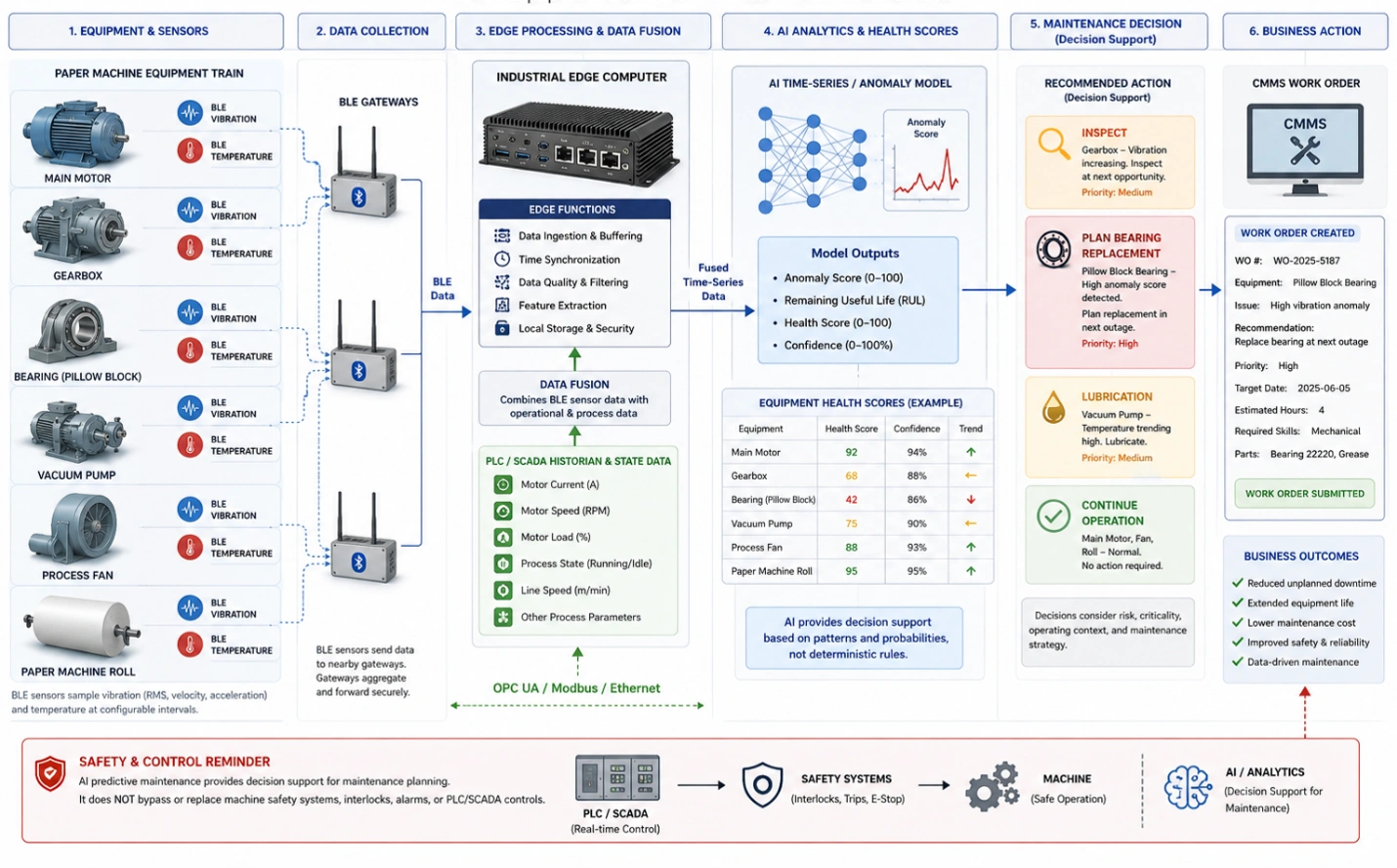
This process diagram shows how BLE vibration and temperature sensors, PLC/SCADA data, and industrial edge computing feed an AI time-series/anomaly model. The model generates equipment health scores and confidence values to support maintenance decisions such as inspection, lubrication, bearing replacement, or continued operation, followed by a CMMS work order. AI supports maintenance planning without replacing machine safety controls.
Operational Challenges AI and BLE Must Solve in Paper Mills
Paper manufacturing creates conditions that make wireless sensing more demanding than a typical office or warehouse deployment. Large metal structures, enclosed machine sections, steam, moisture, vibration, electromagnetic interference, high temperatures, moving equipment, and changing production configurations can affect wireless performance and sensor placement.
A successful deployment therefore starts with the operating problem rather than the wireless technology.
Wireless Propagation Around Paper Machines
Large rolls, frames, dryers, machine enclosures, tanks, piping, and other metallic structures can create multipath and attenuation. Gateway locations should be selected through a site survey rather than based solely on floor plans.
Important engineering considerations include:
- BLE gateway density and mounting locations
- Antenna orientation and enclosure selection
- Radio interference from nearby wireless systems
- Metal obstruction and multipath behavior
- Sensor battery performance under actual sampling rates
- Temperature and humidity limits of the selected hardware
- Maintenance accessibility for battery replacement
- Network redundancy around production-critical areas
A zone-based location system may be preferable to attempting centimeter-level positioning where the operational decision only requires knowing whether an asset is in the winder area, maintenance shop, warehouse, or shipping zone.
Data Quality and AI Model Reliability
AI models are only as useful as the operational data supporting them. Sensor drift, missing packets, incorrect asset associations, irregular sampling, maintenance events, production-grade changes, and equipment operating-state changes can produce misleading results.
Paper mills should therefore establish data-quality rules covering:
- Timestamp synchronization
- Asset identity
- Sensor identity
- Measurement units
- Sampling frequency
- Missing-data handling
- Calibration status
- Equipment operating state
- Maintenance history
- Model version
- Alert confidence
- Human validation of significant findings
NIST’s AI Risk Management Framework emphasizes managing AI risks throughout design, development, deployment, and use, with trustworthiness characteristics including validity, reliability, safety, security, resilience, accountability, transparency, explainability, and privacy.
Integration with Existing Paper Mill Systems
AI and BLE should not create another isolated data store. The solution should integrate with the systems already used by maintenance, production, quality, warehouse, and IT teams.
Common integration points include:
- PLC and DCS systems for process-state information
- SCADA systems for equipment status and alarms
- Historians for time-series process data
- QCS for paper quality measurements
- MES for production orders and production context
- CMMS or EAM systems for maintenance work orders and asset history
- WMS systems for warehouse and finished-roll movement
- ERP systems for purchasing, inventory, and financial information
- Identity and access-management systems
- Existing industrial Ethernet and Wi-Fi networks
- Security monitoring and logging infrastructure
OPC UA, MQTT, REST APIs, SQL databases, and message brokers can be considered where appropriate to the existing mill environment. The interface should be selected according to the source system, latency requirement, reliability requirement, and cybersecurity policy rather than simply choosing the newest protocol.
From Mill Data Capture to AI-Driven Action
A practical AI and BLE solution for Paper Manufacturing follows a defined operational data path.
Data Acquisition at the Equipment and Asset Level
The process begins with measurements and events generated close to the physical operation.
BLE sensors can capture selected equipment conditions such as vibration and temperature. BLE beacons can provide asset identity or presence information. Existing PLCs, DCS equipment, QCS instruments, and SCADA systems continue providing process variables that BLE cannot replace.
The resulting data should be mapped to an asset model containing information such as:
- Mill area
- Production line
- Machine section
- Equipment class
- Equipment identifier
- Sensor identifier
- Asset criticality
- Production role
- Maintenance history
- Measurement type
- Engineering unit
- Operating state
This contextual layer is essential because an AI model should know whether a temperature measurement belongs to a dryer-section bearing, stock-preparation pump, winder motor, or warehouse handling vehicle.
BLE Gateway and Industrial Network Collection
BLE gateways receive transmissions from nearby sensors and beacons. Gateway placement should reflect the physical topology of the paper mill rather than simply maximizing signal coverage.
Collected information can then move through the mill’s industrial network using appropriately secured Ethernet or wireless connectivity. Gateway buffering is valuable where network interruptions could otherwise cause data loss.
A robust design should also distinguish between:
- Raw BLE telemetry
- Normalized sensor measurements
- Asset-location events
- Derived equipment features
- AI alerts
- Confirmed maintenance actions
That separation makes troubleshooting and model validation easier.
Edge Processing for Time-Sensitive Mill Decisions
Edge processing can reduce unnecessary transmission of raw data and allow selected analytics to continue when connectivity to a central server or cloud service is unavailable.
An edge computer can perform tasks such as:
- BLE device filtering
- Sensor validation
- Timestamp normalization
- Data aggregation
- Feature extraction
- Threshold evaluation
- Local anomaly detection
- Temporary data storage
- Protocol conversion
- Secure forwarding to central software
For a paper machine, edge processing can be especially useful when an equipment condition needs to be recognized quickly or when the mill’s operational network is intentionally isolated from external services.
AI Analytics and Operational Context
Central or edge AI software can combine BLE observations with process and business data. For example, an increase in vibration may have very different meanings when a motor is operating at low load, maximum production speed, startup, shutdown, or during a known maintenance activity.
Useful model inputs can include:
- Vibration features
- Temperature trends
- Motor current
- Machine speed
- Production rate
- Grade information
- Equipment operating state
- Historical alarms
- Maintenance work orders
- Previous failure events
- Asset age
- Lubrication history
- Environmental measurements
The model can then produce an anomaly score, predicted condition, classification, or maintenance recommendation rather than simply displaying another raw sensor value.
Decision, Workflow, and Business Action
The final stage converts AI output into an operational response.
A high-confidence equipment anomaly might create a CMMS inspection request. A location anomaly might trigger an asset-recovery workflow. An inventory forecast might initiate a replenishment review. A recurring process condition might be escalated to a reliability engineer for root-cause analysis.
Human review remains important for maintenance and production decisions where the consequences of an incorrect AI recommendation are significant.
Paper Manufacturing AIoT Data-to-Decision Workflow
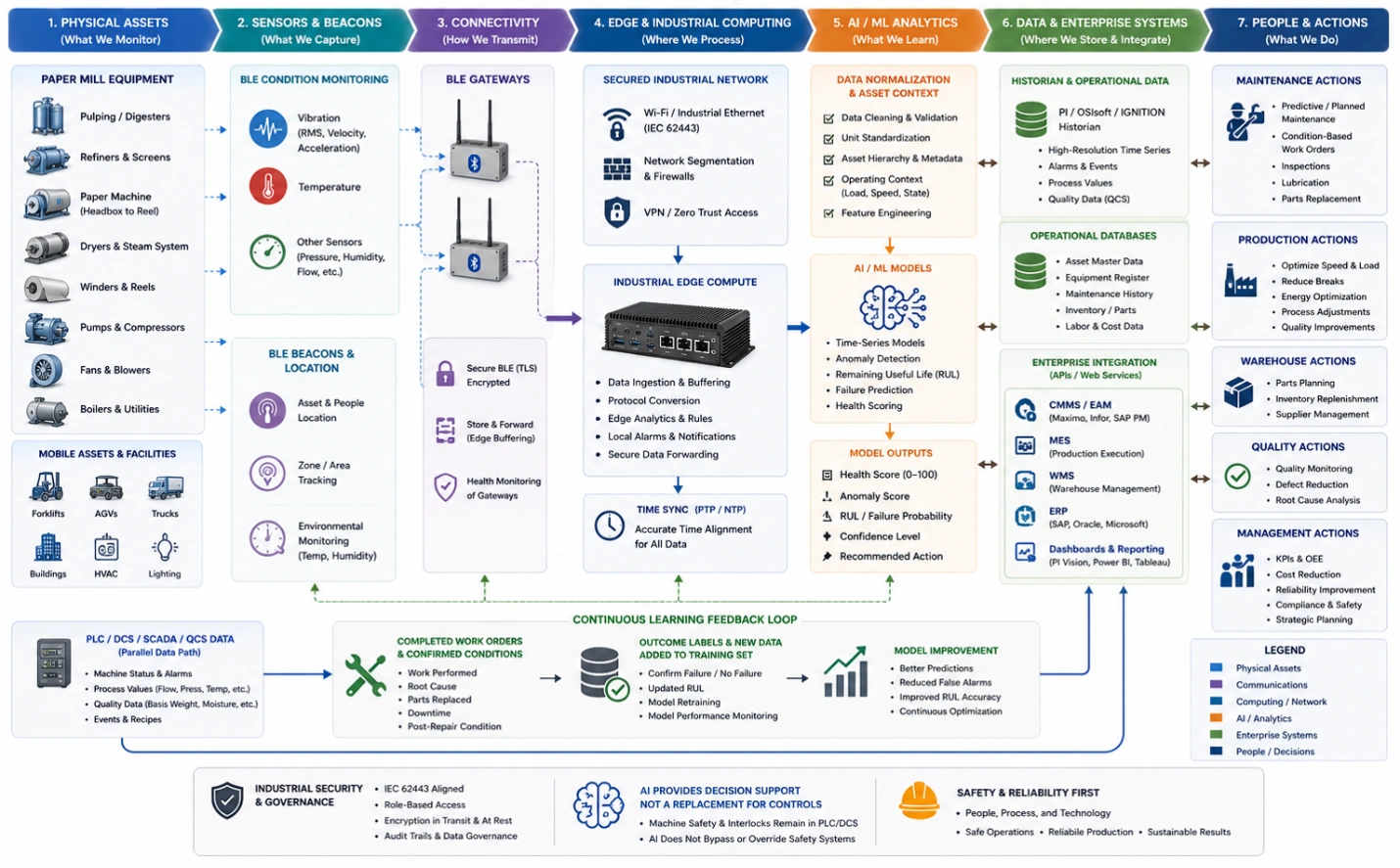
This end-to-end workflow illustrates how paper mill equipment, BLE sensors and beacons, gateways, industrial networks, edge computing, and PLC/DCS/SCADA/QCS data feed AI/ML analytics. The outputs integrate with historians, CMMS/EAM, MES, WMS, ERP, and dashboards to drive maintenance, production, warehouse, quality, and management decisions. A continuous feedback loop uses completed work orders and confirmed equipment conditions to improve AI models.
Engineering Design Considerations for Paper Manufacturing Deployments
Deployment should begin with a defined operational use case, measurable KPI, and asset population. A mill may start with critical rotating equipment, finished-roll tracking, maintenance-tool visibility, or spare-parts management before expanding to additional areas.
Define the Asset and Process Scope
A useful pilot should have clear boundaries such as:
- One paper machine
- One winder section
- One maintenance shop
- One finished-roll warehouse
- A defined group of critical rotating assets
- A specific population of mobile maintenance equipment
The project should document what constitutes success before hardware installation.
Select Measurements Based on Failure Modes
Sensor selection should follow the physical failure mechanisms being investigated.
For rotating equipment, vibration and temperature may be useful indicators. For asset tracking, identity and location events may matter more than continuous telemetry. For environmental applications, humidity or temperature may provide operational context.
The goal is not to maximize the number of sensors. The goal is to collect the minimum reliable data needed to answer the operational question.
Commission and Validate Before Scaling
Commissioning should verify:
- BLE coverage at required locations
- Sensor identity and asset association
- Gateway connectivity
- Timestamp accuracy
- Data completeness
- Measurement plausibility
- Battery behavior
- Edge buffering
- Server/cloud ingestion
- Integration with CMMS, MES, WMS, or other target systems
- Alert routing
- User permissions
- Cybersecurity controls
A paper mill should also compare AI-generated alerts against known maintenance events and operator observations before treating model outputs as reliable production indicators.
Design for Maintenance and Lifecycle Cost
BLE sensor deployments create a maintenance obligation of their own. Battery replacement schedules, sensor calibration, damaged hardware, gateway availability, firmware management, spare devices, and asset reassignment should be included in the lifecycle plan.
GAO can support this stage by supplying BLE sensors, beacons, gateways, RFID equipment, and related IoT hardware for organizations developing or expanding industrial tracking and sensing systems.
Paper Mill BLE Deployment Zone Map for Industrial IoT
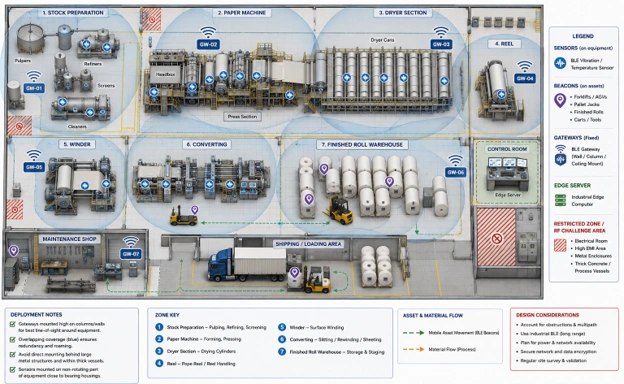
This annotated mill-floor map illustrates practical BLE deployment across stock preparation, paper machine, dryer, reel, winder, converting, warehouse, maintenance, and shipping areas. It shows gateway locations, overlapping coverage zones, equipment sensors, mobile-asset beacons, edge computing, and restricted RF areas. The key takeaway is that effective BLE deployment must account for metal machinery, obstructions, coverage redundancy, and secure industrial connectivity.
Cybersecurity and Reliability Requirements for AIoT in Paper Mills
Wireless sensing should be incorporated into the mill’s existing cybersecurity program rather than treated as a separate low-risk technology.
The design should consider device identity, authentication, encrypted communications, gateway hardening, network segmentation, least-privilege access, software updates, logging, credential management, backup procedures, and incident response.
Industrial control systems should also remain appropriately segmented from less trusted networks. ISA/IEC 62443 provides a lifecycle-oriented framework for cybersecurity of industrial automation and control systems and addresses responsibilities across asset owners, suppliers, integrators, and service providers.
For AI systems, cybersecurity extends to training data, inference data, models, model outputs, and supporting software. NIST notes that confidentiality, integrity, and availability concerns can affect AI systems and their training and output data.
Paper manufacturing also has regulatory considerations beyond cybersecurity. U.S. requirements include OSHA’s mill-specific safety requirements, while environmental compliance can involve EPA requirements governing pulp, paper, and paperboard facilities, including effluent requirements under 40 CFR Part 430 and applicable air-emissions rules.
AIoT systems should therefore support operational compliance rather than introduce uncontrolled automation into regulated or safety-critical processes.
Where Paper Manufacturers Can Start
A practical implementation roadmap typically begins with a narrowly defined business problem and expands after the data pipeline and operational workflow have been validated.
Suitable starting points include:
- AI predictive maintenance for selected critical motors, pumps, bearings, gearboxes, and fans
- AI asset tracking for finished rolls or high-value mobile equipment
- AI maintenance-tool tracking
- AI spare-parts inventory forecasting
- AI-assisted maintenance prioritization
- Environmental condition monitoring around storage and material-handling areas
- Combined BLE, RFID, PLC, SCADA, and CMMS data analysis
- AI-assisted root-cause analysis using historical production and maintenance records
The most valuable first use case is normally the one where the mill already has a measurable operational problem, sufficient historical data, a clearly identified asset population, and a decision process capable of acting on the resulting insight.
BLE Hardware and Software for AI-Enabled Paper Manufacturing
BLE is most effective in paper manufacturing when the hardware is selected around a specific operational requirement. The BLE layer should complement, rather than replace, existing PLC, DCS, SCADA, QCS, historian, CMMS, MES, WMS, and ERP systems.
BLE Sensors for Paper Mill Equipment
BLE sensors can provide wireless measurements from equipment where installing conventional wired instrumentation would be difficult or economically disproportionate. Depending on the application, sensors can monitor vibration, temperature, humidity, or other supported parameters.
For rotating equipment, sensor placement should reflect the expected failure mode. A bearing-monitoring application may require mounting on a structurally representative location, while a motor-temperature application may require direct measurement at a suitable housing or surface.
Sampling frequency should be selected according to the physical phenomenon being monitored. Continuous high-frequency vibration analysis may require a different sensing and processing approach from low-rate temperature trending.
BLE Beacons for Rolls, Tools, and Mobile Assets
BLE beacons can provide persistent asset identity and location information for objects that move around a paper mill.
Potential tagged assets include:
- Finished paper rolls
- Parent rolls
- Roll-handling equipment
- Forklifts and carts
- Maintenance tools
- Portable test instruments
- Spare motors
- Gearboxes
- Pumps
- Maintenance kits
- Containers and reusable material-handling units
The beacon should be associated with a unique enterprise asset identifier in the software rather than relying exclusively on the beacon’s hardware address. This makes replacement, reassignment, and lifecycle management easier.
BLE Gateways and Edge Connectivity
BLE gateways collect transmissions from nearby sensors and beacons and forward the information to edge or centralized software. Gateway selection should consider BLE radio performance, supported communication interfaces, enclosure requirements, operating temperature, power availability, network connectivity, and local data buffering.
Industrial Ethernet, Wi-Fi, cellular connectivity, or other appropriate backhaul methods can be used depending on the mill’s network design.
Gateway redundancy can be valuable around production-critical areas where loss of a single gateway should not eliminate visibility of critical assets.
AI Software and Data Processing
The AI layer can use machine learning, statistical anomaly detection, time-series analysis, classification models, computer vision, or other methods according to the specific paper-manufacturing problem.
A predictive-maintenance model, for example, can combine BLE vibration measurements with motor current, speed, load, historical maintenance records, and equipment operating state. An asset-management model may instead analyze location events, dwell time, movement patterns, and production schedules.
Model outputs should be expressed in operationally meaningful terms such as:
- Equipment anomaly score
- Condition classification
- Predicted maintenance priority
- Asset location
- Excessive dwell-time event
- Abnormal movement pattern
- Inventory replenishment recommendation
Cloud Version and Server Version
A Cloud Version can host data ingestion, analytics, dashboards, AI models, and application services within a managed cloud environment. This model can be appropriate when multiple paper mills need centralized visibility, remote analytics, scalable storage, or centralized model management.
A Server Version can run on an edge server, mill server, customer-managed server, private data center, or other privately hosted enterprise infrastructure. This approach is useful when paper manufacturers require tighter control over operational data, have restricted external connectivity, need local processing, or operate production networks with stringent security boundaries.
A hybrid design is also practical. Edge computing can process and buffer mill data locally while approved summaries or selected datasets are transferred to centralized infrastructure.
The deployment decision should consider:
- Mill network isolation
- Data residency requirements
- Cybersecurity policies
- Internet availability
- Latency requirements
- IT support capability
- Number of mills and facilities
- AI model management requirements
- Long-term operating cost
- Disaster recovery requirements
- Integration with existing enterprise software
Integrating AI and BLE with Paper Mill Software
The value of AIoT increases when wireless observations become part of established production and maintenance workflows.
CMMS and EAM Integration
Predictive-maintenance alerts should be associated with the correct equipment record. A mature integration can pass an AI-generated condition event into a CMMS or EAM system where reliability engineers can review the finding and, when justified, create an inspection or maintenance work order.
Feedback from completed work orders is equally important. If a bearing was inspected and found to be healthy, that information can help engineers evaluate whether an AI model is generating excessive false positives.
MES and Production Context
MES information can provide production context that makes AI outputs more meaningful. Equipment behavior during a grade change, startup, shutdown, cleaning cycle, or planned downtime should not necessarily be interpreted the same way as behavior during steady-state production.
Useful contextual fields include:
- Production order
- Paper grade
- Machine speed
- Production rate
- Machine operating state
- Grade-change event
- Planned downtime
- Unplanned downtime
- Shift
- Production lot
- Quality status
WMS, ERP, and Finished-Roll Visibility
Finished-roll tracking can combine BLE or RFID identification with warehouse-management and ERP records. AI can analyze movement history, storage duration, staging behavior, shipping schedules, and handling activity.
For example, an AI system can identify rolls that have remained in an intermediate location beyond the expected process interval. Operations personnel can then investigate whether the cause is warehouse congestion, production scheduling, quality release, shipping coordination, or an incorrect asset-location record.
Data Interfaces and Interoperability
Interoperability should be designed explicitly. Depending on the source and destination systems, appropriate interfaces can include OPC UA, MQTT, REST APIs, SQL, industrial Ethernet interfaces, message brokers, or vendor-specific APIs.
A well-designed data model should preserve the relationship between the physical asset, its measurements, location events, operating state, and business transaction.
This prevents a common deployment problem in which technically correct sensor data becomes difficult to use because the software cannot reliably determine which paper-machine asset produced it or what operating condition existed when the measurement was recorded.
Technical Capabilities and Operational Improvements
Combining AI with connected mill data can produce improvements that are difficult to obtain from isolated sensors or conventional reporting.
Earlier Detection of Equipment Degradation
AI can detect combinations of small changes that may be difficult for operators to recognize from individual readings. A slowly increasing vibration trend combined with temperature changes and altered motor behavior may provide stronger evidence of developing mechanical degradation than any one measurement alone.
This can support condition-based maintenance and allow maintenance teams to plan inspections around production requirements.
Better Maintenance Prioritization
Paper mills often manage many simultaneous maintenance demands. AI can rank equipment anomalies according to severity, asset criticality, operating conditions, historical failure behavior, and production consequences.
The resulting prioritization can help reliability engineers distinguish between an unusual reading on a noncritical auxiliary asset and a developing condition on equipment whose failure could stop a paper machine.
Improved Asset Utilization
Location analytics can reveal whether forklifts, carts, tools, roll-handling equipment, and portable instruments are being used efficiently.
AI can identify recurring idle periods, excessive travel, congestion, and abnormal movement patterns. Operations teams can then adjust asset allocation or workflow rather than purchasing additional equipment simply to compensate for poor visibility.
Reduced Search and Handling Time
A location-aware system can reduce time spent searching for maintenance tools, portable instruments, spare equipment, and mobile handling assets.
For finished paper rolls, location history can also provide a more complete record of movement between production, quality-release, storage, staging, and shipping areas.
Improved Root-Cause Analysis
AI can correlate information from multiple systems that are normally reviewed separately. A reliability engineer investigating a recurring winder problem could examine equipment condition, machine speed, grade, maintenance history, alarm history, and operating events together.
This does not guarantee that AI will identify the root cause. Its practical value is reducing the time required to find relevant evidence and identify patterns worth investigating.
Scalable Multi-Mill Monitoring
Organizations operating multiple paper mills can use standardized asset identifiers, data models, AI workflows, and reporting structures to compare equipment conditions and maintenance patterns across facilities.
Local processing remains important where network conditions or cybersecurity policies require it, while centralized analytics can support fleet-level reliability engineering.
Stronger Operational Data Security
A properly engineered AIoT system can improve data governance by controlling which devices communicate, where data is processed, which applications can access it, and which users can view or modify operational information.
Security should cover the entire chain from BLE devices and gateways through edge computers, servers, cloud services, databases, APIs, dashboards, and enterprise applications.
Measuring AI and BLE Results in Paper Manufacturing
Paper manufacturers should define KPIs before deployment so that technical performance is connected to measurable operational outcomes.
Useful measures include:
- Unplanned paper-machine downtime
- Mean time between failures
- Mean time to repair
- Maintenance response time
- Predictive-maintenance alert precision
- False-positive alert rate
- Equipment anomaly detection lead time
- Maintenance work-order completion time
- Critical-spare stockout frequency
- Maintenance inventory carrying cost
- Mobile-asset utilization
- Forklift idle time
- Asset search time
- Finished-roll dwell time
- Finished-roll location accuracy
- Warehouse handling cycle time
- Production throughput
- Production availability
- Overall equipment effectiveness where appropriately defined
- Quality-related downtime
- Scrap or off-specification production
- Energy consumption per unit of paper produced
- Sensor data availability
- Gateway uptime
- AI inference availability
- Network packet loss
- Battery replacement frequency
- Percentage of critical assets covered
- Percentage of AI alerts reviewed by qualified personnel
- Percentage of AI recommendations resulting in confirmed actionable findings
The KPI set should remain specific to the selected use case. A finished-roll tracking project should not be evaluated using the same primary metrics as a predictive-maintenance project.
Implementation Priorities for AI-Enabled Paper Manufacturing
The strongest AI and BLE deployments in paper manufacturing are built around a clearly defined operational problem, reliable data, appropriate integration, and measurable engineering outcomes.
Paper manufacturers should consider the following implementation priorities:
- Start with equipment or workflows where downtime, search time, maintenance cost, or inventory inefficiency is measurable.
- Perform a wireless site survey around paper machines, winders, warehouses, maintenance areas, and other target zones before finalizing gateway locations.
- Map BLE devices to authoritative asset identifiers maintained by the mill’s CMMS, EAM, MES, WMS, or ERP system.
- Select sensor sampling rates according to the physical failure mode and AI objective rather than using a single sampling configuration for every asset.
- Validate sensor data against calibrated instruments or known equipment conditions during commissioning.
- Preserve raw or sufficiently detailed source data so engineers can investigate unexpected AI results.
- Separate safety functions from AI decision-support functions unless a safety-rated design has been specifically engineered and validated.
- Use edge processing where local latency, network isolation, or connectivity resilience is important.
- Choose Cloud Version, Server Version, or a hybrid deployment according to security, connectivity, IT governance, and multi-site requirements.
- Integrate AI recommendations with existing maintenance and production workflows instead of creating an isolated alerting application.
- Establish model-monitoring procedures to detect drift when paper grades, equipment configurations, operating conditions, or maintenance practices change.
- Include battery replacement, sensor calibration, gateway maintenance, firmware updates, cybersecurity, and hardware replacement in lifecycle planning.
- Expand the deployment only after the initial use case demonstrates reliable data quality and measurable operational value.
GAO provides BLE sensors, beacons, gateways, RFID products, and IoT systems that can support these deployment requirements. GAO’s engineering support can also help organizations evaluate hardware selection and integration considerations for industrial sensing, identification, and asset-monitoring projects.
GAO’s Experience Supporting Industrial BLE, RFID, and IoT Deployments
GAO is headquartered in New York City and Toronto, Canada, and is ranked among the top 10 leading B2B and B2G BLE and RFID suppliers globally, with a smaller presence in B2B2C and B2D applications. Its sister companies, GAO Research and GAO Tek, together form GAO Group, with operations based in New York City and Toronto.
For three decades, GAO Group has served organizations across the United States and Canada, including Fortune 500 companies, leading research and development organizations, universities, and U.S. and Canadian government agencies.
That experience is relevant to paper manufacturing because industrial wireless deployments require more than selecting a radio device. Sensor placement, gateway coverage, asset identity, network integration, environmental conditions, data quality, and lifecycle support all influence whether the resulting system is useful in production.
GAO has invested substantially in research and development and maintains stringent quality-assurance processes. We provide remote and onsite technical support for organizations implementing BLE, RFID, and IoT hardware products and systems.
For paper manufacturers evaluating AI-driven predictive maintenance, asset tracking, inventory visibility, or connected mill operations, GAO’s BLE, RFID, and IoT capabilities can be evaluated as components of a broader engineering solution rather than as isolated wireless products.
Building the Future of Industrial AI and IoT with Aperture Venture Studio and GAO RFID Inc.
For paper manufacturing, GAO’s long-standing investment in industrial BLE, RFID, and IoT supports the development of practical AIoT solutions for equipment monitoring, asset visibility, maintenance, and mill operations. For technology development related to industrial AI and IoT, we have founded Aperture Venture Studio to build, launch, and scale next-generation AI and IoT companies for applications including manufacturing and connected industrial operations.
Aperture has attracted AI and IoT technical experts, entrepreneurial and operational executives, influential investors, and leading companies. We have also developed the Aperture Ventures Summit and TekSummit to discuss advanced AI and IoT topics.
These activities have helped build technical communities around AI and IoT. We welcome participation as:
- Advisors, co-founders, or employees
- Investors
- Customers