
AI and BLE for Smart Label Production
AI-Driven Smart Label Production with BLE Visibility
Smart label production uses specialized printing, converting, inspection, encoding, and finishing processes to produce labels with consistent dimensions, graphics, variable data, adhesives, and embedded identification features. AI can improve these operations by analyzing production data, detecting quality deviations, predicting equipment problems, optimizing material usage, and supporting production scheduling. BLE provides a practical connectivity layer for monitoring mobile assets, tools, work-in-process materials, environmental conditions, and equipment states across label production areas.
A smart label production solution can combine BLE gateways, beacons, and sensors with machine data, manufacturing software, quality records, and AI models. The resulting system can connect physical production activity with operational decisions such as maintenance scheduling, job prioritization, material replenishment, inspection escalation, and workflow correction. GAO supplies BLE and IoT hardware and systems that can support these types of production visibility requirements for organizations operating complex manufacturing and packaging processes.
Why AI Matters in Smart Label Production
Smart label manufacturing is sensitive to small variations in substrate condition, adhesive behavior, printing registration, ink performance, die-cutting accuracy, curing or drying conditions, and machine setup. A production line can therefore generate large quantities of operational data that are difficult to interpret through manual monitoring alone.
AI changes the role of this data by identifying relationships between production conditions and outcomes. Machine learning models can compare current operating data with historical production records to identify abnormal patterns before they become visible as large batches of defective labels. Computer vision can examine printed graphics, barcodes, characters, registration marks, surface defects, and other visual characteristics. Predictive models can estimate when printing, slitting, rewinding, coating, or finishing equipment is likely to require maintenance.
BLE adds another source of operational context. BLE sensors can measure temperature, humidity, vibration, equipment conditions, or other parameters relevant to label production. BLE beacons can identify mobile tools, carts, containers, inspection equipment, and material-handling assets. BLE gateways collect nearby device data and forward it to production software for analysis.
The combination is particularly useful when machine data alone cannot explain why a production problem occurred. For example, an AI model may identify a correlation between label defects and changes in humidity around a material storage area. BLE environmental sensors can provide the additional data required to investigate that relationship.
Smart Label Production Applications for AI and BLE
AI Quality Inspection for Printed Labels
AI-based inspection can analyze images captured during flexographic, digital, thermal transfer, or other label printing processes. Computer vision models can identify missing print, smudging, incorrect colors, registration errors, damaged characters, barcode defects, inconsistent graphics, and other deviations from an approved label design.
Production data can be associated with individual jobs, presses, substrates, inks, operators, and production runs. This allows quality teams to investigate recurring defects rather than treating every rejected batch as an isolated event.
BLE sensors can provide environmental information from press rooms, inspection areas, or material storage locations. Temperature and humidity measurements can help determine whether environmental conditions are contributing to print quality or substrate behavior.
Predictive Maintenance for Label Converting Equipment
Label production equipment includes printing presses, coating units, laminators, die-cutters, slitter-rewinders, inspection systems, curing systems, feeders, and finishing machinery. Unexpected downtime on any of these machines can delay production schedules and increase material waste.
AI models can analyze vibration, temperature, operating cycles, motor behavior, maintenance records, production loads, and historical failures to identify early warning patterns. BLE sensors can supplement machine-level information where direct machine integration is impractical or where additional sensing is required.
Maintenance teams can use these predictions to schedule inspections or component replacement around production requirements. The objective is not simply to predict failure, but to provide enough lead time for maintenance personnel to act before a failure disrupts a scheduled label job.
Work-in-Process and Mobile Asset Visibility
Smart label production often involves rolls, cores, dies, tooling, inspection devices, sample containers, carts, job materials, and other mobile resources moving between production stages. Manual location tracking can become difficult when several jobs are processed simultaneously.
BLE beacons attached to mobile assets can provide location information through strategically positioned BLE gateways. Production software can use these location events to determine whether required tooling or materials are near the appropriate work center.
AI can analyze movement histories to identify recurring delays, excessive travel, bottlenecks, or inefficient material staging. A production manager could use this information to redesign staging practices or improve job sequencing.
AI Material and Substrate Management
Label production depends on substrates such as paper, film, synthetic materials, pressure-sensitive stock, liners, specialty facestocks, and adhesive constructions. Material selection and storage conditions can influence printability, converting performance, adhesion, and waste.
AI forecasting can analyze historical consumption, current orders, production schedules, scrap rates, and lead times to estimate future material requirements. BLE environmental sensors can add temperature and humidity information to material storage records.
This combination can help production teams distinguish between normal material consumption and unusual usage caused by setup waste, production defects, machine instability, or changing job mixes.
Smart Label Production AI and BLE Workflow Diagram
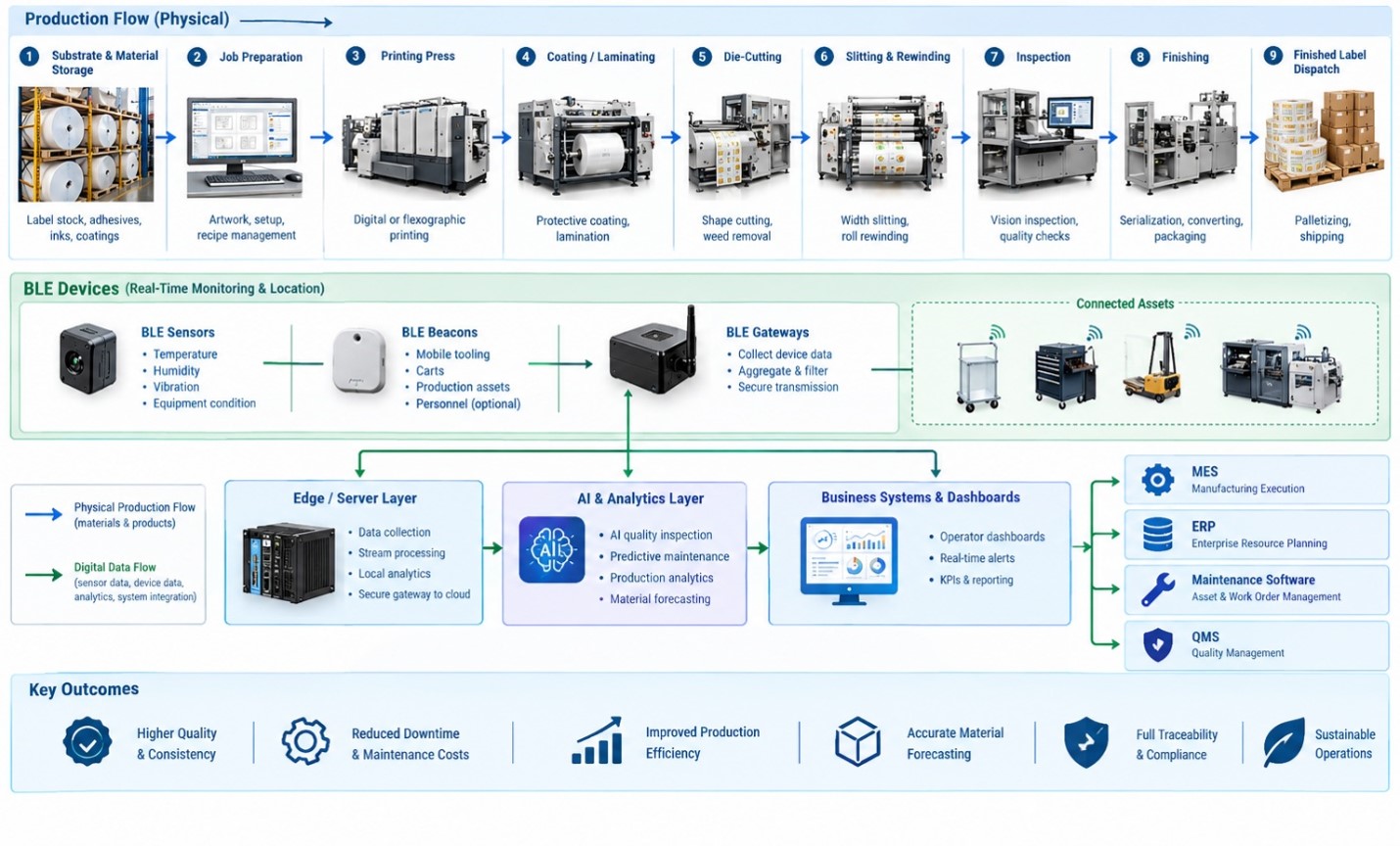
This enterprise workflow diagram illustrates smart label production from substrate storage and job preparation through printing, finishing, inspection, and dispatch. It shows how BLE sensors, beacons, and gateways feed edge/server processing, AI analytics, and integrated MES, ERP, maintenance, and QMS systems.
Smart Label Production Workflow from Data Capture to AI Decisions
A practical AI and BLE solution begins with the physical production process rather than with the analytics software. The system should identify which production decisions require better data and then determine which data sources can provide it.
Data Acquisition Across Label Production
Data can originate from printing presses, digital printers, PLCs, inspection cameras, production counters, machine controllers, maintenance systems, quality records, ERP transactions, and production scheduling software. BLE sensors provide an additional source for conditions that may not already be available through machine interfaces.
Relevant BLE devices can include temperature and humidity sensors in substrate storage, vibration sensors near rotating equipment, location beacons on tooling and mobile carts, and equipment-state sensors where appropriate.
The engineering objective is to capture data at a useful frequency without generating unnecessary network traffic or storage requirements. Sensor placement also matters. A temperature sensor positioned far from the stored substrate may provide technically valid measurements but poor operational information.
BLE Communication and Edge Collection
BLE gateways positioned around production areas receive transmissions from nearby BLE sensors and beacons. Gateway placement should account for press locations, metal structures, machinery enclosures, production walls, storage racks, and areas where radio attenuation may occur.
Gateway data can be filtered or normalized before being forwarded to production software. Edge processing is useful when immediate alerts are required or when the facility wants to reduce the amount of raw sensor data sent to centralized systems.
For example, a vibration sensor could generate frequent readings while the production system receives only calculated indicators, threshold events, or selected raw samples. This reduces data volume while preserving information needed for maintenance analysis.
Production Data Integration
The BLE data becomes significantly more useful when associated with production context. A temperature reading has limited value by itself. Linking that reading to a substrate batch, storage location, production order, press, and defect record provides much stronger analytical context.
Integration can involve MES, ERP, CMMS or EAM software, quality management systems, warehouse software, production scheduling systems, and databases. Standard interfaces and APIs can be used where available. Industrial protocols may also be required when connecting directly to equipment or control systems.
GAO’s BLE hardware and IoT systems can be incorporated into broader production monitoring solutions where organizations need wireless sensing and asset visibility alongside existing manufacturing software.
AI Processing and Decision Support
Once production and BLE data have been normalized, AI models can identify patterns that are difficult to detect through conventional threshold rules.
Supervised machine learning can classify known defect conditions when sufficient labeled production data exists. Anomaly detection can identify unusual combinations of machine conditions, environmental measurements, production speeds, and quality outcomes. Time-series models can analyze changing equipment or environmental behavior. Computer vision models can inspect printed labels and compare production output against defined quality criteria.
AI results should remain connected to operational actions. A predicted maintenance condition may generate a maintenance inspection request. A quality anomaly may trigger additional inspection. A material forecast may influence purchasing or production planning. A detected asset-location issue may alert an operator before a job is delayed.
AI Data Acquisition and Decision Flow for Smart Label Production
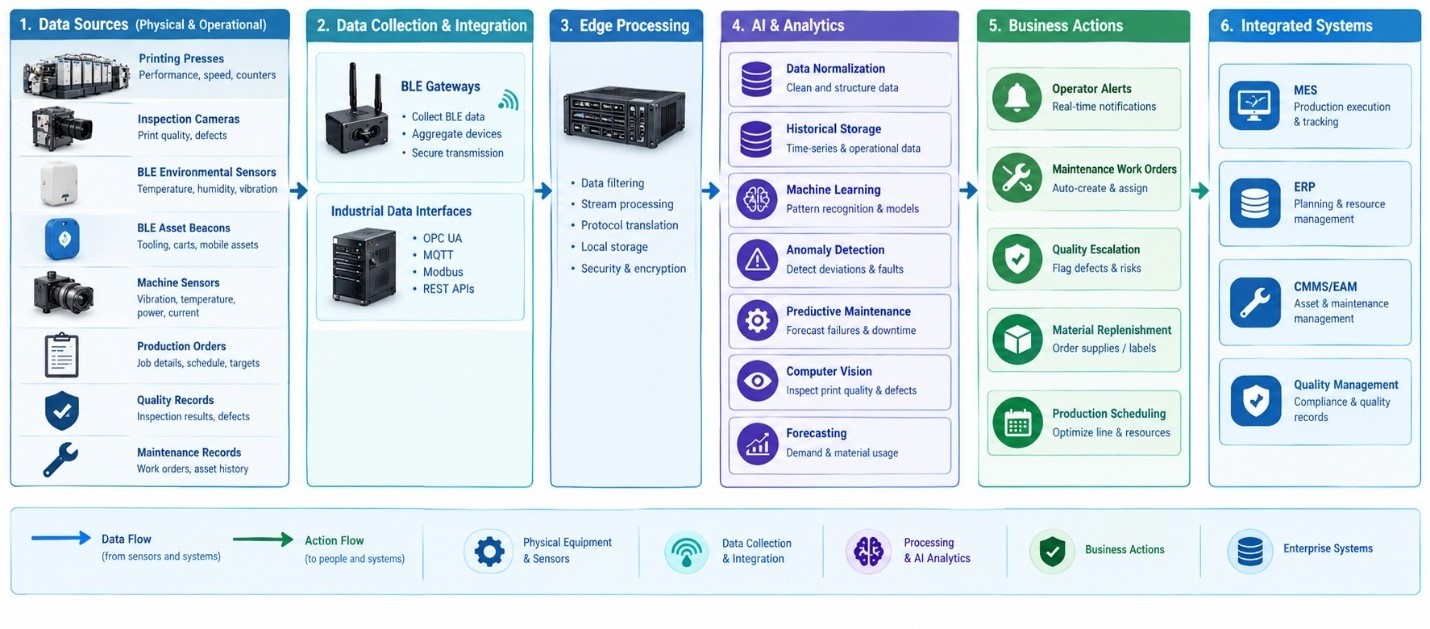
This industrial data-flow diagram shows how smart label production data moves from presses, inspection cameras, BLE sensors, asset beacons, and business records through gateways and edge processing into AI analytics. It illustrates how machine learning, anomaly detection, computer vision, predictive maintenance, and forecasting generate actionable production, quality, maintenance, and material decisions.
Engineering Considerations for BLE-Enabled Label Production
Radio Coverage Around Printing and Converting Equipment
BLE deployment requires practical consideration of radio propagation. Printing presses and converting equipment contain metal structures, motors, cabinets, frames, rollers, and other components that can affect wireless communication. Gateway locations should therefore be validated through site surveys rather than selected solely from floor plans.
Coverage testing should be performed during actual production conditions because machine states, material rolls, personnel movement, and equipment configurations can change radio performance.
Sensor Placement and Data Quality
Sensor placement must reflect the physical variable being measured. Environmental sensors should represent the conditions experienced by stored substrates or sensitive materials. Vibration sensors should be mechanically coupled to appropriate equipment locations. Asset beacons should be positioned where they are protected from damage while maintaining reliable radio visibility.
AI models are only as reliable as the data used to train and operate them. Incorrect timestamps, missing sensor readings, duplicate records, poorly calibrated devices, and inconsistent job identifiers can reduce analytical accuracy.
Production Context and Data Association
A useful smart label production system should associate data with production orders, SKUs, substrates, machine settings, tooling, operators, shifts, and quality outcomes where appropriate. This creates a traceable relationship between what happened physically and what the AI system identifies analytically.
Data association is particularly important for root-cause analysis. A defect trend becomes much more actionable when the system can identify the affected press, substrate type, tooling configuration, environmental conditions, production speed, and job parameters.
BLE Sensor and Gateway Placement in a Smart Label Production Plant
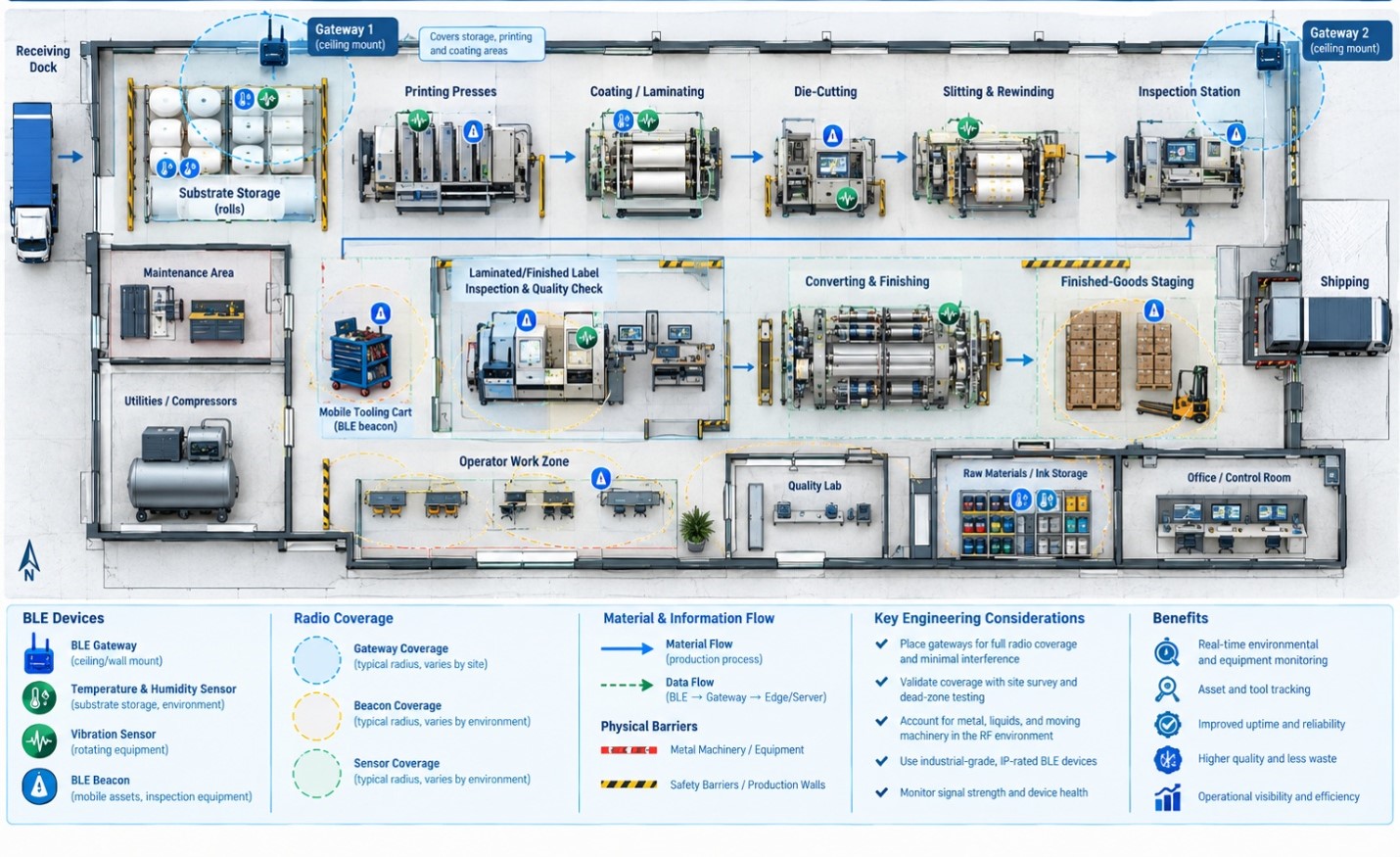
This technical floor layout illustrates practical BLE deployment across substrate storage, printing, converting, inspection, maintenance, and finished-goods areas. It highlights gateway coverage, environmental and vibration sensors, mobile asset beacons, physical barriers, and key radio-engineering considerations for reliable plant connectivity.
AI-Enabled Production Optimization for Smart Labels
AI becomes more valuable when smart label production data is used to improve decisions across multiple production stages rather than optimizing a single machine. Historical job records can reveal relationships between setup parameters, substrate types, production speeds, tooling, inspection results, waste, and changeover duration.
Production Scheduling and Job Prioritization
Label manufacturers frequently handle short production runs, variable artwork, customer-specific specifications, multiple substrates, and frequent press changeovers. AI can evaluate production orders against machine capabilities, substrate availability, tooling requirements, estimated setup time, and delivery commitments.
A scheduling model can identify job sequences that reduce unnecessary substrate changes, ink changes, tooling swaps, and press preparation. Production planners can then use the recommendations alongside established scheduling rules rather than allowing an AI model to make uncontrolled changes to production orders.
BLE location data can add another operational variable. If required dies, tooling carts, inspection devices, or material rolls are not available near the assigned work center, the scheduling system can account for the resulting delay.
Reducing Setup Waste and Changeover Losses
Setup waste is a significant concern when producing labels with multiple designs, dimensions, colors, adhesive constructions, and finishing requirements. AI can compare previous jobs with similar specifications to estimate setup requirements and identify conditions associated with excessive startup waste.
Production engineers can use these findings to refine press setup procedures, establish better parameter ranges, and identify jobs that require additional inspection during startup.
BLE-enabled location records can also help determine whether setup delays result from equipment conditions or from missing mobile resources such as dies, plates, tooling, samples, or inspection instruments.
Intelligent Scrap and Waste Analysis
Scrap analysis becomes more useful when waste is associated with production context. AI can classify waste according to job type, machine, substrate, operator shift, defect category, setup stage, or process condition.
For example, an anomaly detection model could identify an unusual increase in waste on a particular combination of substrate and press speed. Engineers can then investigate the press settings, material condition, drying performance, registration, adhesive behavior, or tooling involved.
GAO can support the underlying BLE sensing and asset visibility requirements that help production teams collect additional operational data for this type of analysis.
BLE Hardware, AI Software, and Deployment Models
A smart label production solution normally combines wireless sensing with existing manufacturing data sources rather than replacing production control systems. BLE gateways provide connectivity between nearby BLE devices and the software receiving their data. BLE beacons can identify mobile assets, while BLE sensors can capture environmental or equipment conditions relevant to production.
AI processing may run at an edge computer, factory server, private data center, or cloud environment depending on latency, data governance, connectivity, and existing IT requirements.
BLE Gateways for Production Areas
BLE gateways should be selected according to required coverage, device density, network connectivity, installation conditions, and data-processing requirements. A production facility may require multiple gateways across press rooms, material storage, converting areas, inspection stations, and finished-goods zones.
Gateway placement should be engineered around actual production conditions. Excessive gateway density increases infrastructure cost, while insufficient coverage can produce missing location or sensor events.
BLE Beacons for Tooling and Mobile Assets
Beacons can be attached to mobile tooling, die sets, carts, portable inspection instruments, sample containers, maintenance equipment, and other assets whose location affects production efficiency.
The beacon identifier should be associated with an asset record in the relevant software. A location event is therefore interpreted as a business event rather than merely a radio transmission.
BLE Sensors for Environmental and Equipment Data
BLE sensors can provide temperature, humidity, vibration, motion, occupancy, or other measurements depending on the production requirement. Environmental monitoring is particularly relevant to substrate storage because paper, films, adhesives, coatings, and liners can respond differently to changes in temperature and humidity.
Equipment condition sensing can supplement existing machine data when additional measurements are required for predictive maintenance or troubleshooting.
Cloud Version
A cloud-hosted deployment can be appropriate for label manufacturers operating multiple facilities or requiring centralized access to production analytics. BLE gateway data can be transmitted through secure network connections to cloud-hosted processing and analytics software.
Cloud deployment simplifies centralized aggregation of production data across locations, but network availability, data transfer costs, cybersecurity controls, and data residency requirements should be assessed before implementation.
Server Version
A Server Version can run on a factory server, customer-managed server, private data center, edge server, or other privately hosted infrastructure. This model can be appropriate when production data must remain within controlled infrastructure or when local processing is required for operational continuity.
A server deployment can also reduce dependency on external connectivity for time-sensitive production alerts. However, the customer becomes responsible for server capacity, software updates, backups, redundancy, access control, and infrastructure monitoring.
Integration with Label Manufacturing Software
AI and BLE data should connect to the software already used to manage label production. Integration requirements vary according to the facility’s equipment and information systems.
MES and Production Management
MES software can provide production-order identifiers, machine status, quantities, production stages, and job information. Associating BLE events and AI results with MES records allows operational teams to see production conditions in the context of active jobs.
ERP and Material Planning
ERP systems can provide customer orders, purchasing information, inventory records, bills of materials, and delivery requirements. AI forecasting can use these records with historical production consumption to improve substrate and consumable planning.
CMMS and EAM Systems
Predictive maintenance results can be transferred to CMMS or EAM software to create inspection recommendations, maintenance notifications, or work orders. Maintenance personnel can then combine AI predictions with equipment history and physical inspection.
Quality Management Systems
Quality software can receive inspection outcomes, defect classifications, corrective actions, and production traceability information. Connecting AI inspection results to quality records allows recurring defect patterns to be analyzed across production runs.
Commissioning and Validation of AI and BLE Systems
Commissioning should begin with a controlled production area rather than immediately covering every press and storage location. A pilot installation can validate wireless coverage, sensor accuracy, gateway connectivity, asset identification, data timestamps, and software integration.
BLE devices should be tested under representative conditions. Engineers should verify operation around metal presses, production racks, machinery enclosures, and moving equipment.
AI models require a separate validation process. Historical production data should be cleaned and labeled before model performance is assessed. Quality teams should establish acceptable false-positive and false-negative rates for inspection applications because excessive false alarms can cause operators to disregard legitimate alerts.
Production acceptance testing should verify the complete chain from sensor or beacon transmission through gateway collection, data processing, AI analysis, software integration, alert generation, and operator action.
Smart Label Production AI and BLE Commissioning Checklist
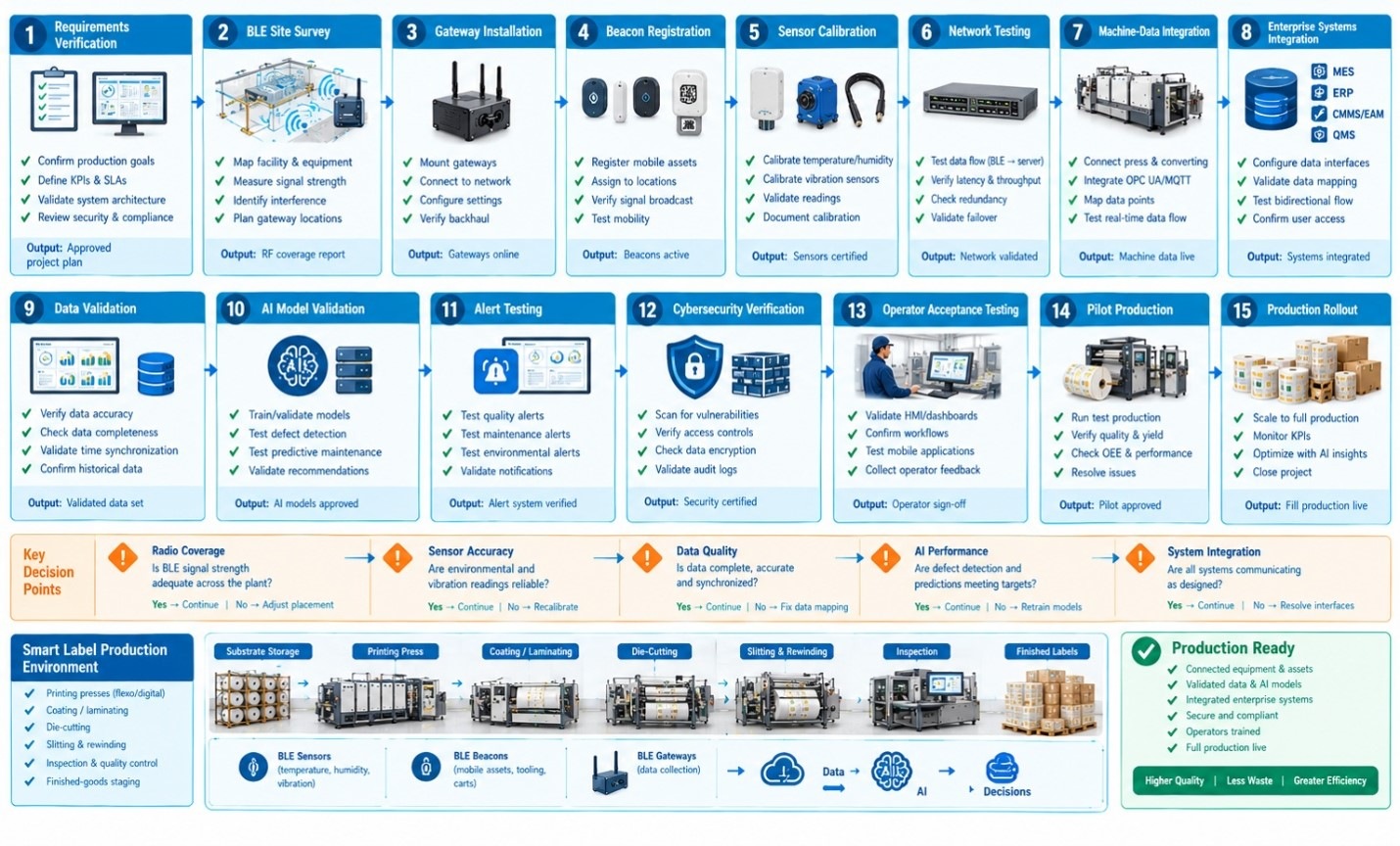
This technical commissioning flow diagram presents a 15-stage validation path from requirements verification and BLE site surveying through system integration, AI validation, cybersecurity testing, pilot production, and rollout. Decision checkpoints help confirm radio coverage, sensor accuracy, data quality, AI performance, and system integration before production deployment.
Cybersecurity and Data Protection
Wireless production monitoring introduces additional connected devices and communication paths that should be incorporated into the facility’s cybersecurity controls.
BLE devices should use appropriate authentication and secure communication capabilities supported by the selected hardware. Gateway access should be restricted, credentials managed securely, and unnecessary services disabled.
Network segmentation can separate production connectivity from general corporate networks. Firewall rules should restrict communications to required destinations and services. Server and cloud deployments should use role-based access controls, logging, encryption, patch management, and backup procedures.
AI systems also require data governance. Production records can contain customer-specific specifications, job information, production parameters, quality results, and operational data. Access should therefore follow the principle of least privilege.
Key Performance Indicators for Smart Label Production
The success of an AI and BLE deployment should be measured using production outcomes rather than the number of connected devices.
Relevant KPIs can include:
- Overall equipment effectiveness for printing and converting equipment
- First-pass yield
- Print defect rate
- Inspection rejection rate
- Scrap percentage
- Substrate waste per production order
- Setup waste per job
- Average changeover time
- Unplanned press downtime
- Mean time between failures
- Mean time to repair
- Predictive maintenance alert accuracy
- Production order cycle time
- On-time order completion
- Press utilization
- Tooling retrieval time
- Material staging time
- Inventory accuracy
- Substrate stockout frequency
- Environmental-condition excursions
- Barcode or variable-data inspection accuracy
- Rework percentage
- AI inspection false-positive rate
- AI inspection false-negative rate
KPI baselines should be recorded before deployment so improvements can be compared against actual historical performance.
Scaling AI and BLE Across Label Production Operations
A successful pilot should establish reusable standards for device naming, gateway configuration, asset identification, data models, security controls, maintenance procedures, and integration interfaces.
Expansion can then proceed by production area. A facility may begin with substrate storage and mobile tooling, expand to environmental monitoring around printing presses, and later integrate predictive maintenance and AI quality inspection.
Multi-site deployments require additional governance. Each facility may use different press models, network infrastructure, production software, substrates, and operating procedures. Standard data definitions should therefore be established while allowing local equipment interfaces to remain specific to each site.
GAO’s experience supplying BLE, RFID, and IoT hardware and systems can help organizations evaluate wireless sensing requirements, asset identification needs, and deployment considerations as smart label production operations expand.
Practical Implementation Recommendations
Successful AI-driven label production depends more on useful operational data and disciplined implementation than on simply installing more sensors.
- Define the production problem before selecting BLE devices or AI models.
- Establish baseline KPIs for scrap, downtime, quality, changeovers, and material usage.
- Conduct a BLE radio survey around presses, converting machinery, storage racks, and production barriers.
- Select sensor locations based on the physical variable being measured.
- Create consistent identifiers for jobs, machines, substrates, tooling, and mobile assets.
- Validate timestamps and production context before training AI models.
- Begin predictive maintenance with equipment where historical failure or condition data is available.
- Use computer vision where visual inspection provides measurable quality value.
- Integrate AI recommendations with MES, ERP, CMMS/EAM, and quality software rather than creating isolated alerts.
- Keep human approval in the loop for production scheduling, quality disposition, and maintenance decisions during early deployment.
- Test AI models against representative production conditions, including new substrates, short runs, changeovers, and machine-speed variations.
- Monitor false positives and false negatives after deployment and retrain models when production conditions change.
- Apply network segmentation, access controls, encryption, logging, patching, and backup procedures to connected production systems.
- Document gateway locations, device identifiers, sensor calibration procedures, and maintenance responsibilities.
- Expand from validated production areas rather than deploying wireless infrastructure across the entire facility without measurable objectives.
Building Smarter, More Traceable Label Production
AI and BLE can give smart label manufacturers a stronger connection between physical production activity and operational decision-making. AI contributes inspection, anomaly detection, predictive maintenance, scheduling, forecasting, and waste analysis, while BLE can provide wireless visibility into equipment conditions, environmental variables, tooling, and mobile production assets.
The strongest implementations connect these capabilities to existing manufacturing processes. A temperature reading becomes useful when associated with substrate storage and production quality. A beacon becomes useful when its location helps explain a tooling delay. A predictive model becomes valuable when its output leads to a verified maintenance action.
GAO provides BLE, RFID, and IoT hardware products and systems that organizations can incorporate into these production-monitoring requirements. Headquartered in New York City and Toronto, Canada, GAO is among the leading B2B and B2G BLE and RFID suppliers and has supported organizations across the United States and Canada.
Technical Expertise Supporting Smart Label Production
GAO Group includes GAO, GAO Research Inc., and GAO Tek Inc., with operations based in New York City and Toronto. Across three decades, the companies have served Fortune 500 companies, research and development organizations, universities, and U.S. and Canadian government agencies.
That experience supports practical requirements such as wireless device selection, IoT system development, deployment planning, quality assurance, and technical support. GAO has invested substantially in research and development and maintains stringent quality processes while providing technical assistance remotely or onsite.
AI and BLE for More Efficient Label Manufacturing
AI-driven smart label production is most effective when artificial intelligence is connected to reliable production data and measurable operational decisions. BLE can extend visibility into environmental conditions, mobile assets, tooling, and equipment where wired sensing or direct machine integration is not practical.
Label manufacturers should prioritize measurable production problems, validate data quality, integrate AI outputs with existing software, and scale only after pilot results are demonstrated. The combination can support better quality control, predictive maintenance, material planning, asset visibility, scheduling, and waste reduction.
GAO can provide BLE, RFID, and IoT hardware products and systems relevant to these requirements, together with technical support for organizations evaluating or expanding connected production solutions.
Building the Future of Industrial AI and IoT with Aperture Venture Studio and GAO
For more than three decades, GAO Group of Companies has invested heavily in industrial BLE, RFID, and IoT research and development. As AI became increasingly useful in industrial applications, we expanded our work in AIoT for connected manufacturing, including smart label production, and founded Aperture Venture Studio to advance AI and IoT solutions relevant to these industries.
Aperture brings together AI and IoT technical experts, entrepreneurial and operational executives, investors, and leading companies. We also support technical discussion through Aperture Ventures Summit and TekSummit, where advanced AI and IoT applications are explored.
We welcome participation as:
- Advisors, co-founders, or employees
- Investors
- Customer