
AI and BLE for Photonics Manufacturing
AI-Driven Photonics Manufacturing with BLE Asset Tracking and Smart Factory Monitoring
Photonics manufacturing combines precision optics, optoelectronic components, semiconductor materials, fiber assemblies, lasers, detectors, coatings, and highly controlled production processes. AI-driven photonics manufacturing systems can improve production visibility by combining machine data, environmental observations, equipment status, material movement, and quality records. BLE Gateways, BLE Beacons, and BLE Sensors provide a practical wireless data layer for tracking mobile assets, monitoring environmental conditions, identifying process bottlenecks, and connecting physical production activities with AI analytics. For photonics manufacturers, this combination can support equipment utilization analysis, work-in-process tracking, predictive maintenance, cleanroom monitoring, inventory control, and anomaly detection. GAO supplies BLE, RFID, and IoT hardware products and systems that can be integrated with manufacturing software and data infrastructure to support these applications.
AI-Powered Photonics Manufacturing with BLE: Smart Factory Workflow and Data Intelligence
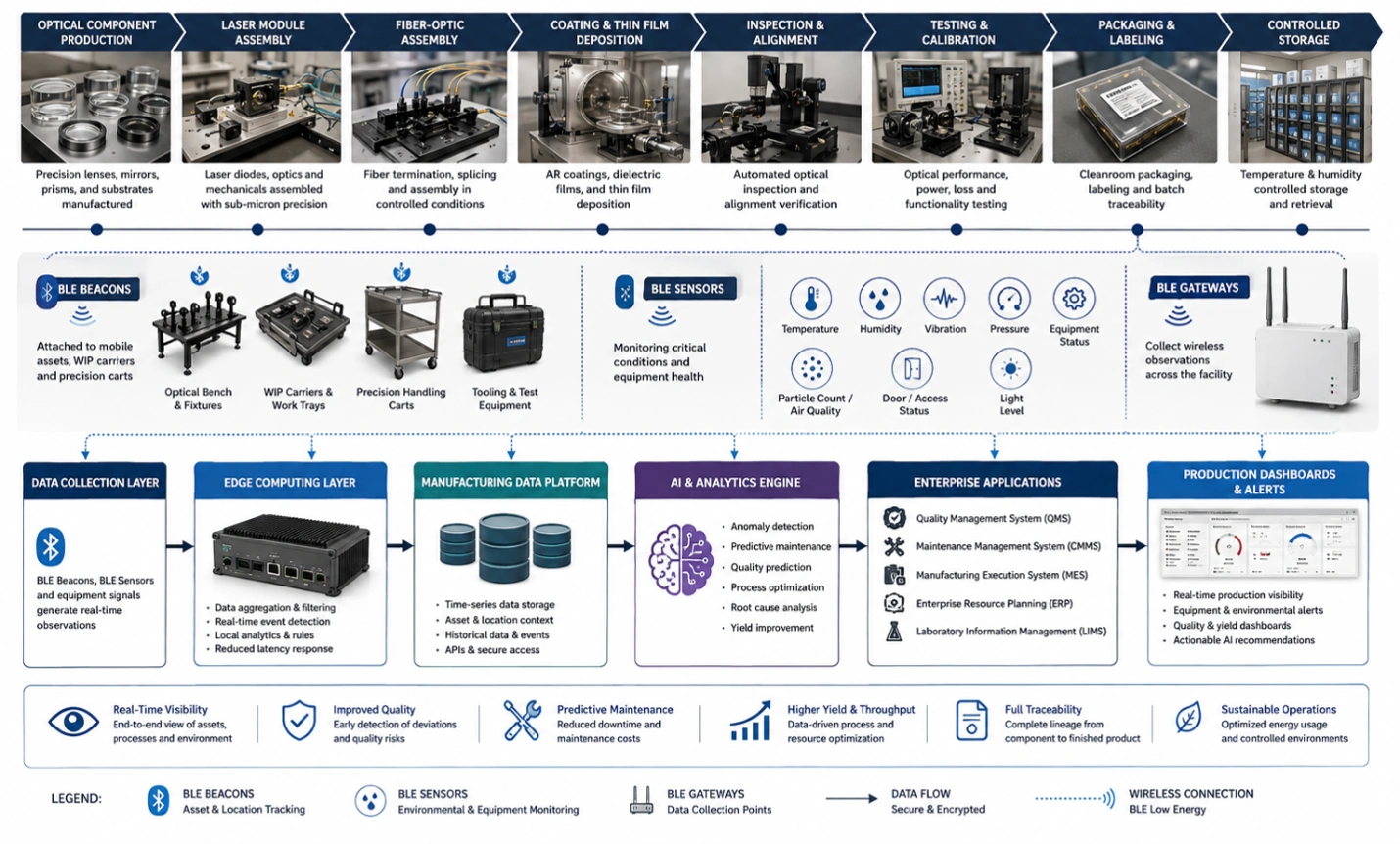
This infographic illustrates how BLE Beacons, BLE Sensors, and BLE Gateways capture real-time asset, environmental, and equipment data across photonics manufacturing. It shows the data flow from production and controlled storage through edge computing, manufacturing data platforms, AI analytics, enterprise applications, and production dashboards. The key takeaway is how AI and BLE enable real-time visibility, predictive maintenance, improved quality, higher yield, traceability, and more sustainable operations.
AI Applications That Improve Photonics Manufacturing Operations
AI in photonics manufacturing is most valuable when it converts fragmented production observations into actionable decisions. Photonics facilities often handle high-value components and assemblies through multiple controlled workstations before final inspection and shipment. A component may move between optical alignment, bonding, curing, coating, environmental testing, calibration, inspection, and packaging areas. Manual tracking can make it difficult to determine where work-in-process material is located, how long it has remained at a station, or whether a specialized tool is available.
BLE provides a wireless identification and sensing mechanism for these physical processes. A BLE Beacon can identify a tool, carrier, fixture, optical assembly, or mobile equipment item. BLE Sensors can capture environmental or equipment observations. BLE Gateways positioned around production areas can collect these signals and forward them to local servers or cloud software.
AI can then analyze this information together with manufacturing execution system records, quality data, maintenance history, equipment telemetry, and production schedules.
Important photonics manufacturing applications include:
- AI-assisted work-in-process location and dwell-time analysis
- Automated tracking of optical components, fixtures, carts, and specialized tools
- Predictive maintenance for optical inspection and production equipment
- Environmental anomaly detection for temperature and humidity-sensitive processes
- Equipment utilization and bottleneck analysis
- AI-assisted material-flow optimization
- Detection of abnormal process delays
- Quality analytics correlating production conditions with inspection results
- Tool availability and location intelligence
- Maintenance prioritization based on equipment usage and operating conditions
- Production-line anomaly detection
- Traceability support for high-value photonic assemblies
The resulting system is not simply a location-tracking solution. It creates a structured relationship between physical manufacturing activity and the digital records used by production, engineering, quality, and maintenance teams.
Why AI Matters for Modern Photonics Manufacturing
Photonics production has several characteristics that make AI-based operational analysis particularly useful. Precision manufacturing frequently depends on stable environmental conditions, controlled process sequences, specialized equipment, and highly trained personnel. A small deviation in equipment condition or material handling can create downstream quality problems that are difficult to identify after the fact.
AI can analyze patterns across multiple data sources rather than evaluating each observation independently. For example, an analytics model could correlate extended WIP dwell time with equipment availability, environmental conditions, operator workflow, and subsequent inspection results. Similarly, equipment usage information collected through BLE Sensors can complement maintenance records when estimating maintenance requirements.
The practical value comes from combining physical observations with production context.
GAO’s BLE and IoT hardware can provide the wireless identification and sensing layer required to collect these observations. The resulting data can be integrated with manufacturing databases, MES software, maintenance applications, quality systems, and AI analytics.
Photonics Manufacturing Processes Where AI and BLE Deliver Value
Optical Component and Module Assembly
Optical modules may pass through multiple assembly and alignment operations before testing. BLE Beacons can identify WIP carriers, fixtures, carts, or reusable tooling as they move between stations.
AI software can calculate dwell time, identify recurring delays, and compare actual routing with expected production sequences.
Laser and Optoelectronic Assembly
Laser modules and optoelectronic assemblies require controlled handling and specialized equipment. BLE identification can help production personnel locate mobile tooling, calibration equipment, and WIP assemblies without relying exclusively on manual records.
AI can combine location events with equipment utilization and production schedules to identify underused resources or recurring production constraints.
Fiber-Optic Assembly and Testing
Fiber preparation, connectorization, splicing, polishing, alignment, and testing can involve multiple specialized stations. BLE Beacons can associate carriers or tooling with production zones, while BLE Sensors can monitor environmental conditions relevant to controlled work areas.
AI can analyze station dwell time and routing patterns to identify process congestion and unusual production behavior.
Optical Coating and Environmental Processing
Coating and environmental processing may depend on controlled temperature, humidity, and equipment operating conditions. BLE Sensors can provide additional environmental observations around production and storage locations.
AI-based anomaly detection can identify combinations of environmental readings and process conditions that differ from normal operating patterns.
Optical Inspection and Metrology
Inspection equipment such as optical microscopes, interferometers, spectrometers, imaging systems, optical power meters, and automated inspection stations can represent critical production resources.
BLE identification can provide equipment-location information, while equipment interfaces and manufacturing databases provide measurement data. AI can then analyze inspection results together with equipment status, production history, and process conditions.
Photonics Manufacturing Workflow with BLE and AI-Powered Intelligence
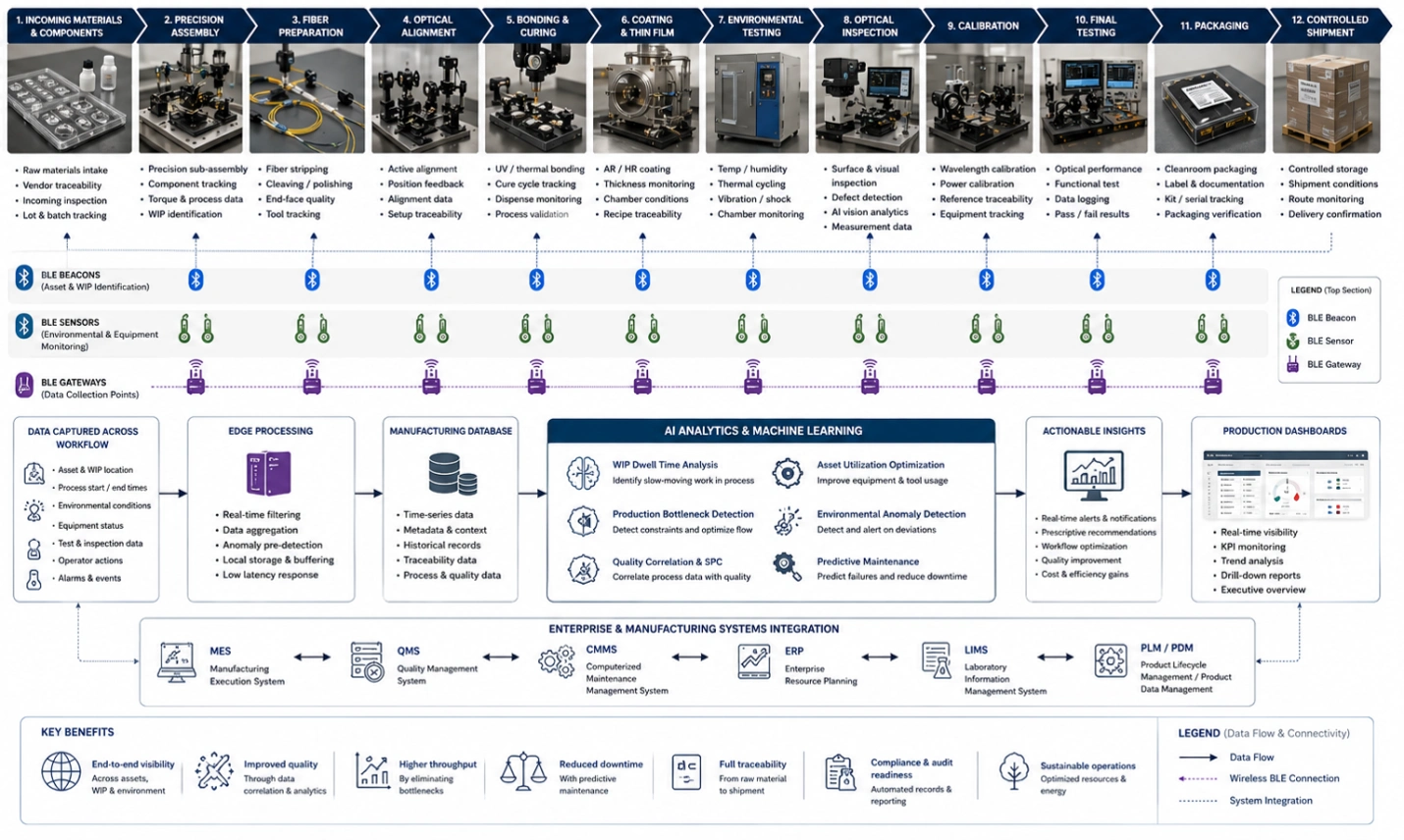
This workflow diagram maps the photonics production lifecycle from incoming optical materials and precision assembly through testing, packaging, and controlled shipment. It shows how BLE Beacons, Sensors, and Gateways provide real-time asset, WIP, environmental, and equipment data that flows through edge processing and manufacturing databases into AI analytics. Integrated MES, QMS, CMMS, ERP, LIMS, and PLM/PDM systems support traceability, quality improvement, predictive maintenance, and production optimization.
Operational Challenges in Photonics Manufacturing
Photonics manufacturing introduces several operational challenges that cannot be solved effectively through generic asset tracking alone.
- High-value WIP: Optical modules, laser assemblies, detectors, precision components, and custom assemblies can represent significant material value while moving through multiple workstations.
- Specialized tooling: Alignment fixtures, optical test equipment, calibration instruments, fiber-processing tools, and precision handling equipment may be shared between production cells.
- Long and variable process cycles: Certain assembly, curing, coating, environmental testing, and inspection processes can create substantial differences between planned and actual WIP dwell times.
- Environmental sensitivity: Temperature and humidity variations can affect selected materials, processes, and controlled manufacturing environments.
- Equipment bottlenecks: A limited number of specialized inspection, alignment, calibration, or testing systems can become production constraints.
- Manual location records: Spreadsheet-based or paper-based tracking can become unreliable when components and tools move frequently.
- Traceability requirements: Quality investigations may require relationships between material lots, equipment, environmental conditions, process stages, and inspection results.
- Maintenance visibility: Maintenance teams may lack sufficient information about actual utilization of mobile or distributed production equipment.
- Disconnected data sources: MES, QMS, ERP, CMMS, laboratory systems, inspection software, and equipment controllers may maintain separate operational records.
AI can help address these problems when the underlying data is sufficiently complete and reliable. BLE improves the availability of physical-world observations that are often missing from traditional production databases.
AI and BLE Deployment Workflow for Photonics Manufacturing
A practical deployment begins with identifying the physical objects and operating conditions that must be observed.
Data Acquisition
BLE Beacons can be attached to:
- WIP carriers
- Optical component containers
- Production carts
- Assembly fixtures
- Calibration tools
- Inspection equipment
- Mobile test instruments
- Maintenance equipment
- Specialized production tooling
BLE Sensors can monitor selected environmental or equipment parameters such as temperature, humidity, vibration, motion, or other supported measurements.
BLE Gateways installed throughout production areas receive beacon and sensor transmissions. Gateway placement should account for room geometry, equipment density, metallic structures, cleanroom partitions, interference sources, and required positioning accuracy.
Wireless Communication and Edge Collection
BLE devices communicate using Bluetooth Low Energy. Gateways aggregate observations and forward relevant records through wired or wireless IP connectivity.
Edge processing can filter duplicate observations, normalize timestamps, buffer temporary network interruptions, and perform preliminary event processing before information reaches centralized software.
For photonics manufacturing, edge processing is particularly useful when production areas require predictable local operation or when wireless observations must remain available during temporary upstream network interruptions.
Data Processing and AI Analytics
A processing layer converts raw BLE observations into manufacturing events such as:
- Asset entering a production cell
- Asset leaving an inspection area
- WIP remaining at a station beyond an expected dwell threshold
- Tool approaching a designated production zone
- Environmental readings deviating from established ranges
- Equipment utilization changing from normal patterns
AI models can then analyze these events alongside manufacturing and quality data.
Potential methods include:
- Time-series anomaly detection
- Classification models
- Regression models
- Clustering
- Predictive maintenance models
- Process-mining techniques
- Remaining-useful-life estimation
- Forecasting
- Optimization algorithms
- Graph-based analysis of production flows
The appropriate model depends on the available historical data, process stability, decision objective, and cost of false positives.
Manufacturing and Enterprise Integration
The AI system can exchange information with:
- Manufacturing Execution Systems
- Quality Management Systems
- Enterprise Resource Planning systems
- Computerized Maintenance Management Systems
- Laboratory Information Management Systems
- Warehouse Management Systems
- Manufacturing databases
- Production scheduling software
- Business intelligence software
Integration should use controlled interfaces rather than creating isolated data silos. APIs, message brokers, databases, OPC UA interfaces, MQTT messaging, REST interfaces, and other integration mechanisms may be appropriate depending on the existing factory environment.
BLE Hardware, AI Software, and Deployment Design for Photonics Facilities
A photonics manufacturing solution normally consists of several technical layers. Each layer has a distinct engineering purpose.
BLE Beacons for Identification and Location
BLE Beacons provide a low-power identity associated with a physical object. Their role is particularly useful for mobile assets that do not have reliable network connectivity of their own.
For photonics manufacturing, beacon assignment can support relationships between an identifier and an asset record such as a fixture ID, tool number, carrier ID, equipment ID, or WIP container.
The beacon itself does not determine the business meaning of an event. The manufacturing software must associate its identifier with the relevant production object.
BLE Sensors for Environmental and Condition Monitoring
BLE Sensors can extend the system beyond simple identification. Depending on the sensor design, they can provide observations related to temperature, humidity, vibration, motion, or other measurable conditions.
Sensor placement requires engineering validation. A sensor installed near a doorway may provide substantially different environmental information from one positioned directly within a controlled process zone. Sensor calibration, battery management, sampling frequency, data retention, and maintenance intervals should therefore be defined during deployment planning.
BLE Gateways for Data Collection
BLE Gateways form the connection between local BLE devices and the wider manufacturing information system.
Gateway selection should consider:
- BLE coverage requirements
- Simultaneous device density
- Ethernet or Wi-Fi connectivity
- Local buffering
- Edge processing requirements
- Environmental enclosure requirements
- Network security
- Gateway management
- Firmware maintenance
- Facility layout
- Required positioning accuracy
GAO provides BLE hardware and IoT technologies that can support organizations implementing wireless identification, sensing, and monitoring systems across manufacturing environments.
AI Analytics and Manufacturing Software
AI software should not be deployed independently of manufacturing processes. Its outputs must correspond to decisions that production, quality, maintenance, or engineering teams can act upon.
For example, a predictive maintenance model should identify which equipment requires attention, why the system considers it abnormal, and what operational evidence supports the recommendation.
Similarly, an AI WIP model should provide more than a location map. It should identify abnormal dwell time, routing deviations, queue accumulation, or resource constraints that production personnel can investigate.
Cloud Version
A cloud-hosted software deployment can be appropriate when photonics manufacturers need centralized analytics across multiple facilities or want to avoid maintaining all application infrastructure locally.
Cloud deployment can support:
- Centralized data storage
- Multi-site analytics
- Remote monitoring
- Model management
- Scalable computing resources
- Cross-facility production analysis
- Centralized software updates
However, cloud deployment requires careful consideration of network availability, cybersecurity, data governance, latency, and manufacturing-system integration.
Server Version
A Server Version can run on customer-managed servers, factory servers, private data centers, edge servers, or other privately hosted infrastructure.
This approach can be appropriate when manufacturing data must remain within controlled infrastructure or when local processing and integration are priorities.
A private server deployment can also reduce dependency on external network connectivity for selected manufacturing functions. The trade-off is that the customer generally assumes greater responsibility for server capacity, operating system maintenance, backups, cybersecurity, software updates, and system availability.
Cybersecurity and Access Control
BLE-enabled photonics manufacturing systems should be designed using defense-in-depth principles.
Important controls include:
- Device authentication where supported
- Secure gateway configuration
- Network segmentation
- Encrypted communications
- Role-based access control
- Credential management
- Firmware update controls
- Audit logging
- Secure API authentication
- Server hardening
- Backup and recovery procedures
- Monitoring of unusual network behavior
BLE should not be treated as a substitute for factory cybersecurity. Wireless device security, gateway security, IP network security, application security, and enterprise identity management must be considered together.
AI and BLE System Architecture for Photonics Manufacturing
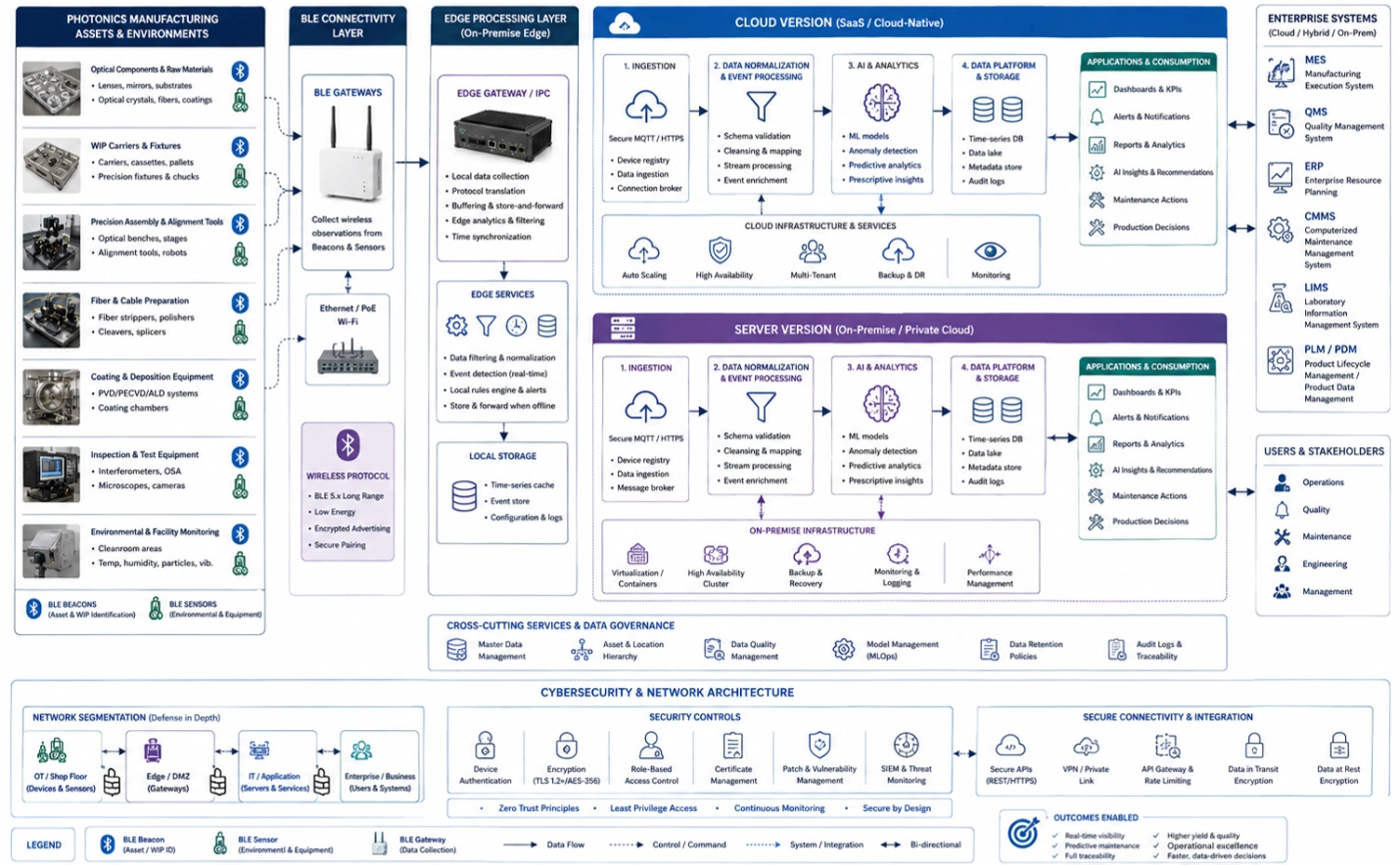
This architecture diagram shows the complete data path from photonics manufacturing assets, WIP carriers, fixtures, tools, and environmental conditions through BLE Beacons, Sensors, Gateways, and edge processing. It compares cloud-based and on-premise server architectures while showing data normalization, AI analytics, manufacturing databases, enterprise systems, dashboards, and automated decisions. Cybersecurity controls—including network segmentation, authentication, encryption, role-based access, secure APIs, and audit logging—are also integrated.
Engineering Considerations for BLE Deployment in Photonics Facilities
Successful BLE deployment depends on more than installing gateways throughout a factory. Photonics facilities can contain metallic equipment, enclosed test chambers, optical benches, production machinery, racks, cabinets, and controlled rooms that affect radio propagation.
A site survey should therefore precede large-scale installation. Engineers should evaluate expected coverage, signal attenuation, gateway density, device mounting locations, battery accessibility, and interference conditions.
Location accuracy should also be matched to the business requirement. If the objective is simply determining whether a tool is inside a production department, zone-level detection may be sufficient. If the objective is determining which workstation contains a specific fixture, greater gateway density and positioning analysis may be necessary.
Sensor sampling frequency also affects battery life and data volume. A temperature sensor monitoring a relatively stable storage area may not require the same sampling interval as a sensor used for rapidly changing equipment conditions.
The AI model should likewise be selected after understanding the physical process. Historical data quality, labeling availability, process variability, equipment population, and acceptable false-alarm rates determine whether anomaly detection, classification, forecasting, or predictive modeling is appropriate.
GAO’s experience supplying BLE, RFID, and IoT hardware products and systems helps organizations evaluate these physical-layer requirements alongside their software and manufacturing integration needs.
Key Photonics Manufacturing KPIs Enabled by AI and BLE
AI-driven analysis becomes more useful when tied to measurable manufacturing outcomes. Relevant KPIs include:
- WIP dwell time by production stage
- Average time between production stations
- Equipment utilization
- Specialized tool utilization
- Production queue time
- Asset search time
- Unplanned equipment downtime
- Mean time between failures
- Mean time to repair
- Maintenance response time
- Environmental excursion frequency
- Environmental excursion duration
- Inspection equipment utilization
- Calibration equipment utilization
- Production throughput
- First-pass yield
- Process cycle time
- Work-order completion time
- WIP aging
- Production bottleneck duration
These metrics can be calculated more accurately when physical movement and environmental observations are available alongside conventional manufacturing records.
Technical and Operational Benefits of AI-Driven Photonics Manufacturing
Combining AI analytics with BLE identification and sensing gives photonics manufacturers a way to connect physical production activity with operational decisions. The greatest value comes from using BLE observations as additional context for existing manufacturing, quality, maintenance, and engineering data rather than treating wireless tracking as an isolated application.
Improved WIP Visibility and Traceability
BLE Beacons can provide near-real-time observations of WIP carriers, optical assemblies, fixtures, and mobile tooling. AI can transform these observations into process-flow information, including station dwell time, queue accumulation, routing deviations, and abnormal movement patterns.
This can help production engineers determine whether delays originate from material movement, equipment availability, inspection capacity, or process sequencing.
For high-value photonic assemblies, this information can also support investigations by establishing a more complete operational history around a production event.
Predictive Maintenance for Photonics Equipment
Maintenance teams can combine BLE-based equipment observations with machine telemetry, service records, operating hours, alarms, and historical failures.
AI models can identify patterns associated with equipment degradation or unusual utilization. For example, increasing operating time combined with abnormal vibration observations or repeated service events may justify earlier inspection of a mobile or specialized production asset.
Predictive maintenance should be introduced only where sufficient historical data exists. A rule-based threshold or statistical anomaly model may be more appropriate than a complex machine-learning model during the early deployment stage.
Faster Asset and Tool Retrieval
Specialized photonics manufacturing tools can be expensive and shared among multiple production cells. BLE identification can reduce the time required to locate calibration instruments, optical fixtures, inspection accessories, and mobile equipment.
AI can extend this capability by analyzing historical movement patterns and identifying where particular assets are most frequently used.
The result is not merely a location display. Production planners can use utilization and movement data to identify whether additional tooling is needed, whether equipment is poorly distributed, or whether production cells are competing for the same resource.
Environmental Anomaly Detection
BLE Sensors can provide additional temperature and humidity observations in production, laboratory, storage, and controlled manufacturing areas.
AI can analyze these observations against historical operating patterns and process context. This allows the system to distinguish persistent changes from isolated readings and prioritize anomalies that are more likely to affect a photonics process.
Environmental analytics should complement, rather than replace, validated environmental control systems and required monitoring instrumentation.
Production Bottleneck Identification
Production bottlenecks are often difficult to identify when process records show only work-order completion. BLE movement events can provide additional evidence about where WIP is physically accumulating.
AI can compare movement frequency, dwell time, equipment utilization, production schedules, and inspection capacity to identify recurring constraints.
For example, repeated accumulation before a limited optical inspection station may indicate that inspection capacity, rather than assembly throughput, is controlling overall production flow.
Scalable Multi-Area Deployment
BLE is well suited to incremental deployment because manufacturers can begin with a limited production area and expand as operational value is demonstrated.
A phased implementation may begin with WIP tracking in one production cell, followed by equipment utilization, environmental sensing, and predictive maintenance.
This approach reduces deployment risk and provides operational data that can guide later gateway placement, sensor selection, and AI model development.
Integrating AI and BLE with Existing Photonics Manufacturing Systems
BLE-generated data becomes substantially more useful when connected with the systems already used by production and engineering teams.
MES Integration
MES records can provide work-order, routing, process-step, operator, and production-status information. BLE events can add physical movement context.
The combined data can answer questions such as whether a work order actually reached its assigned station, how long it remained there, and whether physical movement matched the planned process route.
QMS Integration
Quality Management Systems contain inspection results, nonconformance records, corrective actions, and quality history.
AI can correlate these records with BLE-derived location, dwell time, environmental observations, and equipment utilization. Such analysis may help engineers investigate recurring relationships between production conditions and quality outcomes.
Correlation should not automatically be interpreted as causation. Engineering validation remains necessary before changing a controlled manufacturing process.
CMMS and Maintenance Integration
CMMS data provides maintenance history, service intervals, work orders, and equipment records. BLE observations can supply additional information about actual equipment movement and utilization.
This is particularly useful for mobile inspection equipment, calibration instruments, shared production tooling, and maintenance assets whose actual usage may differ from planned schedules.
ERP and Inventory Integration
ERP systems can provide material, purchasing, inventory, and work-order information. BLE can add physical location observations for selected WIP containers, reusable carriers, tools, and inventory assets.
The combined information can help reconcile system records with physical manufacturing activity without requiring every asset to be manually scanned at each movement point.
AI Models and Analytics for Photonics Manufacturing
Different photonics manufacturing problems require different analytical methods.
Time-Series Anomaly Detection
Time-series models can analyze environmental sensor readings, equipment observations, and production events to identify deviations from established operating patterns.
This approach is useful when labeled failure data is limited but historical normal-operation data is available.
Predictive Maintenance Models
Predictive maintenance models can estimate failure probability or maintenance requirements using equipment utilization, operating conditions, service history, alarms, and other available signals.
The model should produce an actionable maintenance indicator rather than simply a numerical prediction.
Process Mining
Process-mining techniques can reconstruct actual production flows from event data. BLE movement events can provide additional process events where conventional manufacturing software does not capture physical transitions.
This can help identify unexpected routing, repeated rework loops, long queues, and variations between planned and actual production sequences.
Classification and Regression
Classification models can categorize production events or identify abnormal operating states. Regression models can estimate measurable outcomes such as expected process duration or equipment utilization.
These methods become more useful as historical production and quality datasets grow.
Optimization
Optimization algorithms can use production constraints, equipment availability, WIP status, and process requirements to recommend improved scheduling or resource allocation.
For photonics manufacturing, optimization should respect process dependencies, equipment qualifications, calibration requirements, material compatibility, and quality controls rather than optimizing throughput alone.
Deployment Lifecycle for AI and BLE in Photonics Manufacturing
A successful deployment should follow a controlled engineering lifecycle.
Requirements and Site Assessment
Begin by identifying the business problem rather than selecting hardware first.
The assessment should document:
- Which WIP, equipment, tools, or environmental conditions require visibility
- Required location accuracy
- Required sampling frequency
- Required data retention
- Existing MES, QMS, ERP, CMMS, and inspection systems
- Network availability
- Facility construction and radio propagation conditions
- Battery replacement constraints
- Cybersecurity requirements
- Cloud or private server requirements
- Expected operational decisions
Pilot Deployment
A pilot should focus on a measurable production problem, such as excessive WIP dwell time or poor visibility of shared optical inspection equipment.
The pilot should establish baseline KPIs before installation and compare them with measurements collected after deployment.
A limited production cell is often preferable to deploying hundreds of devices before the engineering assumptions have been validated.
Hardware Commissioning
During commissioning, engineers should verify:
- Beacon identity assignment
- Sensor calibration status
- Gateway connectivity
- Wireless coverage
- Timestamp synchronization
- Battery status
- Data transmission reliability
- Gateway buffering
- Network security
- Asset-to-device mapping
- Event-generation accuracy
Commissioning should also include negative testing, such as intentionally moving assets between zones to confirm that the system detects the expected transitions.
Software and AI Validation
AI models should be tested against known production conditions before their recommendations influence operational decisions.
Validation should measure:
- Detection accuracy
- False-positive rate
- False-negative rate
- Alert latency
- Model stability
- Data completeness
- Prediction consistency
- Operator acceptance
For critical production decisions, human review should remain part of the initial workflow until the model has demonstrated sufficient reliability.
Production Rollout
After the pilot has demonstrated measurable value, deployment can expand to additional production cells, inspection areas, controlled storage locations, maintenance departments, and other relevant areas.
Device naming, asset identifiers, gateway configuration, software interfaces, and cybersecurity policies should remain standardized during expansion.
Continuous Optimization
Production processes change. New equipment, new products, revised layouts, and new manufacturing routes can affect the quality of collected data.
Periodic reviews should therefore examine:
- Gateway coverage
- Battery condition
- Sensor calibration
- Device inventory
- Data quality
- AI model performance
- Integration reliability
- KPI trends
- Security events
- User feedback
Security, Reliability, and Data Governance
Photonics manufacturing data can contain production information, equipment details, quality records, and intellectual property. Security should therefore be considered during system design rather than added after deployment.
Network segmentation can isolate BLE gateways and associated devices from unrelated corporate networks. Role-based access can restrict operational data to authorized users. Encryption should be applied to supported communications, while authentication and credential management should protect interfaces between gateways, servers, APIs, and enterprise applications.
Data governance should define retention periods, ownership, access rights, backup procedures, and audit requirements.
Reliability also requires local resilience. Gateway buffering can help preserve observations during temporary network interruptions, while server redundancy and backup procedures can reduce the effect of infrastructure failures.
GAO’s long-term work in BLE, RFID, and IoT hardware supports deployments where wireless identification and sensing must operate as part of a broader industrial information system.
Standards and Communication Technologies Relevant to Photonics Manufacturing
BLE is only one component of the communication environment. Photonics manufacturing systems may also interact with:
- Ethernet
- Wi-Fi
- IPv4 and IPv6 networks
- MQTT
- REST APIs
- OPC UA
- TCP/IP
- HTTPS
- JSON-based interfaces
- Database connectivity
- Industrial automation interfaces
The appropriate combination depends on the existing factory network and application requirements.
Relevant engineering standards can include Bluetooth specifications, ISO/IEC information-security practices, IEC 62443 principles for industrial cybersecurity, OPC UA specifications, IEEE networking standards, and applicable quality-management requirements.
Specific regulatory and quality requirements depend on the products being manufactured, the intended market, customer requirements, and the manufacturing environment. Photonics manufacturers should therefore map applicable requirements during system design instead of assuming that one compliance model applies to every facility.
Practical Recommendations for Photonics Manufacturers
- Start with a clearly defined production problem such as WIP dwell time, tool availability, equipment utilization, or environmental anomaly detection.
- Perform a radio survey before determining final BLE Gateway locations.
- Use BLE Beacons for assets that require identity and movement visibility.
- Use BLE Sensors where environmental or condition data contributes to a specific manufacturing decision.
- Define asset identifiers and data ownership before deployment.
- Integrate BLE events with MES, QMS, ERP, CMMS, or other systems instead of creating an isolated tracking database.
- Select AI methods according to data availability and process characteristics.
- Establish baseline KPIs before activating AI recommendations.
- Validate AI alerts against real production events.
- Design network segmentation and access controls before commissioning gateways.
- Plan battery replacement and sensor calibration as part of normal maintenance.
- Use edge processing when local continuity, low latency, or network independence is important.
- Choose cloud deployment when centralized multi-site analytics and managed infrastructure provide greater value.
- Choose private server deployment when local control, data governance, or facility-level integration is more important.
- Expand deployment only after the pilot demonstrates measurable operational improvement.
Applying AI and BLE to Photonics Manufacturing
AI-driven photonics manufacturing becomes more effective when AI analytics are connected to reliable observations from the physical production environment. BLE Beacons can identify WIP, tooling, fixtures, and mobile equipment, while BLE Sensors can provide environmental and condition data and BLE Gateways can connect these observations with manufacturing software.
The strongest implementations begin with measurable problems such as WIP dwell time, equipment utilization, environmental anomalies, maintenance response, and production bottlenecks. From there, manufacturers can integrate BLE observations with MES, QMS, ERP, CMMS, inspection systems, and AI analytics.
GAO can support organizations evaluating BLE, RFID, and IoT hardware and system requirements for photonics manufacturing. Readers seeking additional technical information can explore GAO’s products, engineering capabilities, and technical support resources to determine how wireless identification and sensing can fit into their manufacturing operations.
GAO’s Role in Photonics Manufacturing IoT Deployments
GAO supplies BLE, RFID, and IoT hardware products and systems that can serve as building blocks for industrial identification, sensing, tracking, and monitoring applications.
Headquartered in New York City and Toronto, Canada, GAO is ranked among the top 10 leading B2B and B2G BLE and RFID suppliers in the world. Its sister companies, GAO Research and GAO Tek, together form GAO Group, with operations based in New York City and Toronto.
For three decades, GAO Group has served customers throughout the United States and Canada, including Fortune 500 companies, leading research and development organizations, prestigious universities, and U.S. and Canadian government agencies.
This experience is relevant to photonics manufacturers because successful BLE deployments require more than individual wireless devices. They require appropriate hardware selection, system integration, deployment engineering, quality assurance, technical support, and lifecycle management.
GAO has invested heavily in research and development of BLE, RFID, and IoT products and systems and maintains stringent quality assurance processes. Technical support can be provided remotely or onsite depending on project requirements.
Building the Future of Industrial AI and IoT with Aperture Venture Studio and GAO RFID Inc.
For more than three decades, GAO Group of Companies has invested heavily in R&D of industrial BLE, RFID, and IoT. As generative AI became increasingly useful for industrial applications, we expanded our work in AI and IoT technologies, including BLE and RFID, and founded Aperture Venture Studio to build, launch, and scale next-generation AI and IoT solutions relevant to manufacturing and other industries.
Aperture has attracted AI and IoT technical experts, entrepreneurial and operational executives, influential investors, and leading companies. We have also developed Aperture Ventures Summit and TekSummit to discuss advanced AI and IoT topics.
These activities have helped develop technical communities around industrial AI and IoT. We welcome participation as:
- Advisors, Co-founders, or Employees
- Investors
- Customers