
AI and BLE for Integrated Circuit Manufacturing
AI-Driven Manufacturing Traceability and Equipment Intelligence for Integrated Circuit Manufacturing
Artificial Intelligence of Things (AIoT) combines artificial intelligence with IoT devices, sensors, connected equipment, and industrial systems to turn manufacturing data into operational decisions. For integrated circuit manufacturing, AIoT can connect wafer lots, carriers, production equipment, material-handling assets, cleanroom resources, maintenance activities, and environmental conditions to support faster and more controlled fab operations. BLE beacons, BLE sensors, and BLE gateways can provide location, proximity, environmental, and equipment-status data that complements information already collected from manufacturing execution systems (MES), equipment interfaces, automated material handling systems (AMHS), and facility systems. AI models can then correlate these data sources to identify abnormal equipment behavior, improve material flow, support predictive maintenance, detect process risks, and strengthen traceability. GAO supplies BLE, RFID, and other IoT hardware and systems that can be incorporated into integrated circuit manufacturing environments where wireless identification and sensing are appropriate.
Integrated Circuit Manufacturing AIoT Overview Diagram
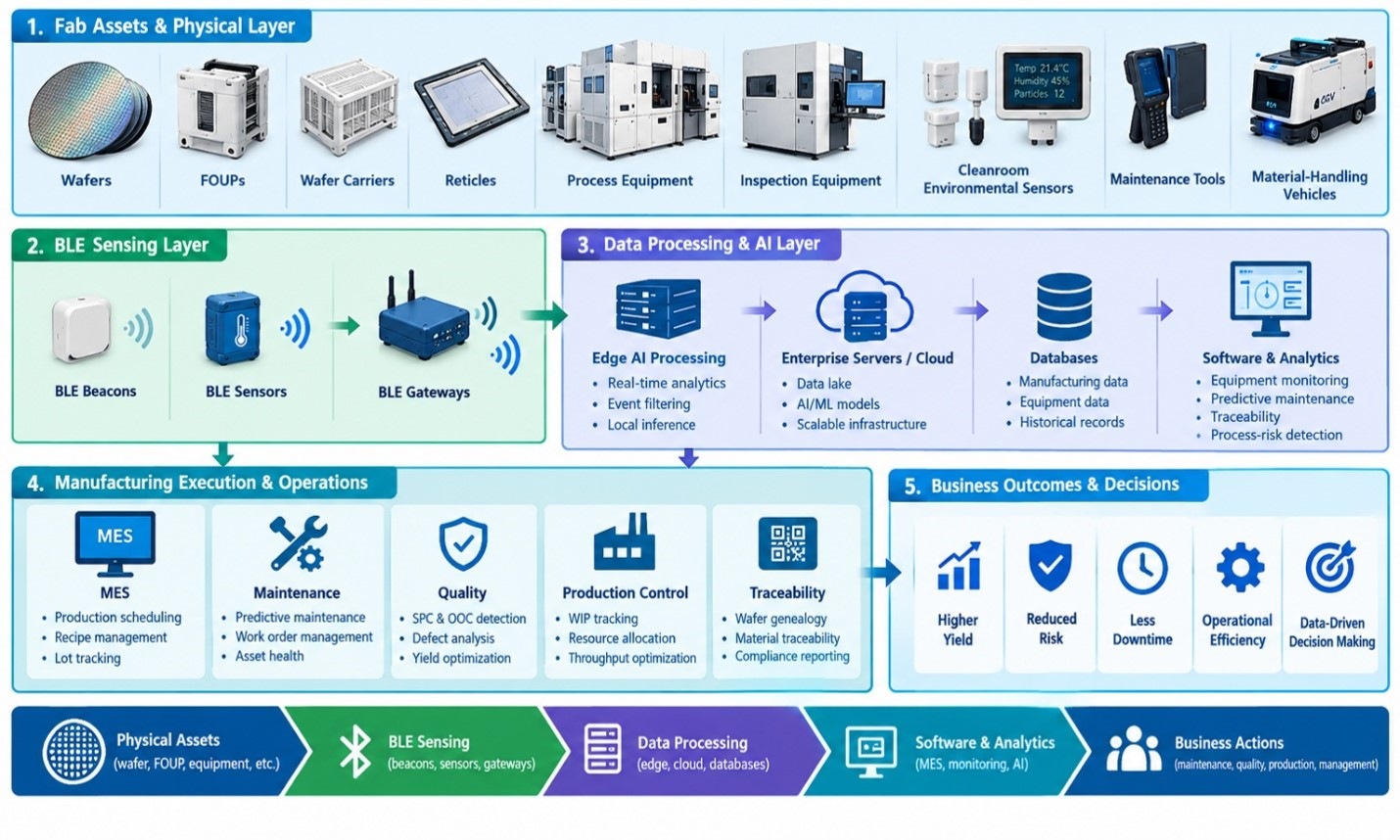
This enterprise technical diagram illustrates how AIoT connects semiconductor fab assets, BLE sensing, data processing, manufacturing software, and AI analytics. It traces data from wafers, equipment, sensors, and material-handling assets through BLE gateways and AI processing into MES, maintenance, quality, production control, traceability, and data-driven operational decisions.
How AIoT Supports Integrated Circuit Manufacturing
Integrated circuit manufacturing depends on highly controlled sequences involving wafer preparation, photolithography, deposition, etching, ion implantation, diffusion, chemical mechanical planarization, cleaning, metrology, inspection, wafer testing, packaging, and material movement. Production performance depends not only on semiconductor process recipes but also on equipment availability, environmental stability, material identity, lot genealogy, maintenance condition, and disciplined execution of manufacturing procedures.
AIoT provides a way to correlate these operational dimensions. A BLE-enabled sensing layer can contribute location and condition information for assets that are difficult to monitor continuously through fixed industrial interfaces. AI can combine those observations with structured manufacturing records to identify relationships that may not be obvious from individual systems.
For example, a semiconductor manufacturing operation may correlate:
- Wafer lot location and movement history with MES dispatch records
- FOUP or carrier movement with AMHS transactions
- Equipment utilization with maintenance history
- Equipment temperature, vibration, or power behavior with maintenance events
- Cleanroom environmental measurements with process excursions
- Technician movement around specific tools with maintenance activities
- Spare-part movement with equipment service records
- Inspection results with process and equipment conditions
- Material dwell time with production scheduling
- Tool downtime with preceding alarms and maintenance conditions
The value comes from correlation rather than from BLE data alone. BLE can supply additional observations, while AI determines which combinations of observations are operationally significant.
GAO’s BLE hardware can therefore serve as part of a larger integrated circuit manufacturing data system rather than as an isolated tracking installation.
Semiconductor Manufacturing Applications for AI and BLE
AI-Powered Wafer Lot and Carrier Traceability
Wafer lots, FOUPs, carriers, reticles, and other production assets move through highly controlled manufacturing routes. A lost carrier, unexpected dwell period, or incorrect staging location can affect cycle time and production scheduling.
BLE beacons can identify mobile assets, while strategically positioned BLE gateways receive beacon transmissions at relevant manufacturing areas. AI software can analyze movement patterns alongside MES and AMHS records to identify unusual dwell times, route deviations, staging congestion, or unexplained movement.
Potential applications include:
- Monitoring movement of selected FOUPs and wafer carriers
- Detecting unexpected dwell time between process steps
- Identifying repeated material-routing bottlenecks
- Supporting location confirmation before production dispatch
- Correlating carrier movement with equipment utilization
- Identifying material-flow patterns associated with cycle-time increases
- Providing additional location evidence during lot genealogy investigations
Wireless location should not replace validated semiconductor manufacturing controls where those controls are required for product disposition. Instead, BLE observations can provide supplementary operational intelligence.
AI-Based Semiconductor Equipment Monitoring
Integrated circuit fabs contain process tools with demanding operating requirements. Lithography systems, deposition equipment, etch tools, CMP systems, metrology instruments, inspection equipment, wafer cleaning systems, and supporting facility equipment generate large amounts of operational data.
BLE sensors can supplement native equipment data by monitoring selected physical conditions around equipment or mobile support assets. Depending on the sensor design and fab environment, measurements can include temperature, humidity, vibration, movement, or other relevant conditions.
AI models can use these observations with equipment alarms, maintenance records, utilization data, and production information to identify abnormal behavior.
Practical outcomes can include:
- Earlier identification of equipment condition changes
- Better prioritization of maintenance work orders
- Detection of recurring equipment abnormalities
- Correlation between equipment behavior and downtime
- Identification of maintenance conditions preceding failures
- Improved planning of technician interventions
- Reduced dependence on purely calendar-based maintenance
The engineering objective should be to establish whether an observed signal has predictive value for a particular tool or subsystem. Installing sensors without validating their relationship to failure modes can produce large quantities of data without improving maintenance decisions.
Cleanroom and Facility Condition Monitoring
Integrated circuit manufacturing requires tightly controlled facility conditions. Temperature, humidity, vibration, differential pressure, airborne contamination, chemical supply conditions, and other facility variables can influence manufacturing stability.
BLE sensors can provide supplementary environmental observations in locations where wireless measurement is technically appropriate. AI can compare environmental data with production events, equipment alarms, inspection results, and historical operating conditions.
Applications can include:
- Identifying abnormal environmental trends
- Correlating localized environmental changes with equipment events
- Detecting recurring conditions preceding production interruptions
- Supporting investigation of excursions
- Comparing environmental conditions across manufacturing zones
- Identifying maintenance requirements for selected facility assets
Sensor placement is critical. Cleanroom classification, contamination-control procedures, electromagnetic conditions, battery-management requirements, and qualification processes should be evaluated before wireless devices are introduced into controlled manufacturing areas.
AI-Assisted Maintenance and Spare-Part Management
Semiconductor manufacturing equipment requires specialized maintenance procedures and replacement components. A technician may need a specific valve, sensor, filter, pump component, electronic module, cable assembly, or other service item at a particular tool and maintenance window.
BLE tracking can help monitor selected mobile maintenance assets, tool carts, and service equipment. AI can combine asset-location information with maintenance schedules and historical consumption.
The resulting system can help maintenance teams determine:
- Which service assets are available near a production area
- Whether required maintenance equipment has been staged
- Which spare parts are frequently consumed for specific tool families
- Where maintenance delays occur because of missing resources
- Which components may require higher inventory coverage
- Whether maintenance demand is changing over time
GAO hardware can support the location and sensing portion of such applications, while existing maintenance-management and inventory software remains responsible for controlled work orders and inventory transactions.
Semiconductor Fab Asset and Wafer Flow with AIoT
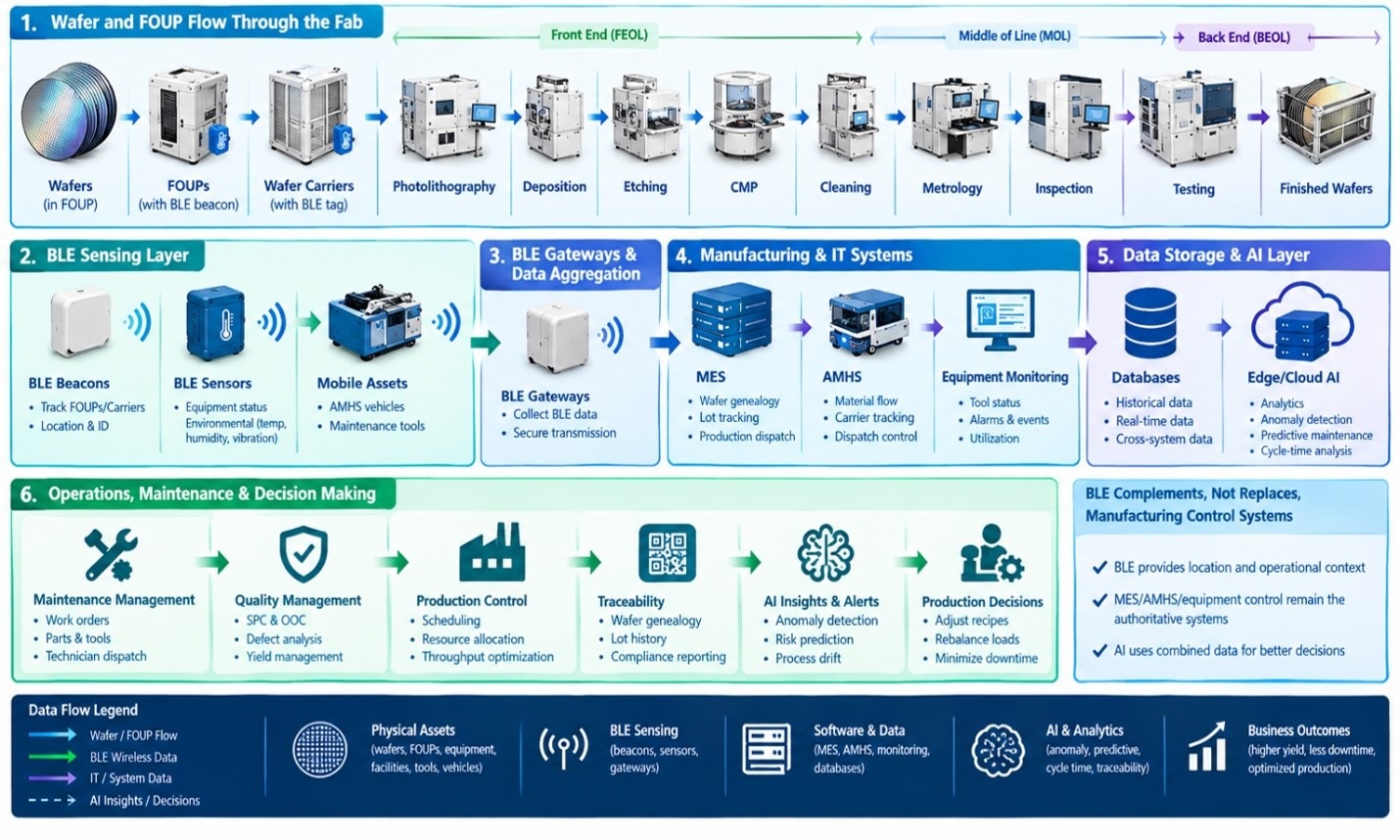
This technical flow diagram shows wafer lots and FOUPs moving through key semiconductor fabrication stages, from photolithography and deposition through etching, CMP, metrology, inspection, and testing. It illustrates how BLE beacons, sensors, and gateways supplement MES, AMHS, equipment monitoring, and maintenance systems, with AI analytics supporting anomaly detection, predictive maintenance, traceability, cycle-time analysis, and production decisions.
Integrated Circuit Manufacturing Workflow from Sensing to AI Decisions
A practical AIoT deployment should follow the physical and information flow of semiconductor manufacturing rather than treating sensing as an independent project.
Data Acquisition Across the Fab
Data originates from several sources. BLE beacons can provide identifiers for mobile assets, BLE sensors can produce environmental or condition measurements, and BLE gateways can collect wireless transmissions from defined production zones.
These observations should be combined with existing sources such as:
- MES production orders and lot records
- AMHS material movement transactions
- Equipment interface data
- Supervisory control and data acquisition systems where applicable
- Facilities management systems
- Computerized maintenance management systems
- Enterprise asset management systems
- Quality management systems
- Statistical process control databases
- Metrology and inspection systems
- Inventory and procurement records
A common implementation mistake is to send every available signal directly to AI models. Semiconductor manufacturing produces highly structured operational data, so data governance, timestamp synchronization, equipment identity, lot identity, and location normalization should be addressed before model development.
Wireless Communication and Edge Collection
BLE devices communicate within designated radio coverage areas. Gateways can collect beacon advertisements and sensor measurements and forward relevant records to processing systems.
Gateway placement should account for cleanroom layout, equipment density, metal structures, walls, radio interference, coverage overlap, maintenance access, and network availability. Coverage should be validated under actual operating conditions instead of relying solely on theoretical radio range.
Edge processing can filter duplicate observations, validate timestamps, normalize device identifiers, and perform preliminary anomaly detection before forwarding selected data to centralized systems.
Data Processing and AI Analytics
A typical processing sequence can include:
- Device and asset identification
- Timestamp validation
- Location-zone determination
- Duplicate-event filtering
- Sensor-quality validation
- Data correlation with equipment and production records
- Feature engineering
- Statistical analysis
- Machine learning inference
- Alert generation
- Integration with manufacturing or maintenance workflows
AI techniques can include anomaly detection, time-series forecasting, classification, regression, clustering, predictive maintenance models, and computer vision where visual inspection is involved.
For example, an anomaly-detection model could compare vibration and temperature patterns from selected equipment against historical normal behavior. A forecasting model could estimate maintenance demand for a tool family. A classification model could help identify operating conditions associated with particular failure or quality events.
AI recommendations should remain traceable to their source data, model version, confidence level, and decision rule, particularly when outputs could influence production, maintenance, or quality activities.
Manufacturing and Business Actions
The final stage is operational action. AI becomes valuable when its output changes a measurable manufacturing decision.
Possible actions include:
- Creating or prioritizing a maintenance work order
- Requesting technician inspection
- Adjusting maintenance scheduling
- Investigating unusual wafer-carrier dwell time
- Escalating abnormal environmental conditions
- Reviewing equipment utilization
- Checking material staging
- Replenishing maintenance inventory
- Initiating engineering analysis
- Supporting root-cause investigations
- Providing production managers with trend information
Closed-loop control should be introduced cautiously. For semiconductor manufacturing, AI recommendations often should initially operate as decision support with human review before any automated action is permitted.
AIoT Data-to-Decision Workflow for Semiconductor Manufacturing
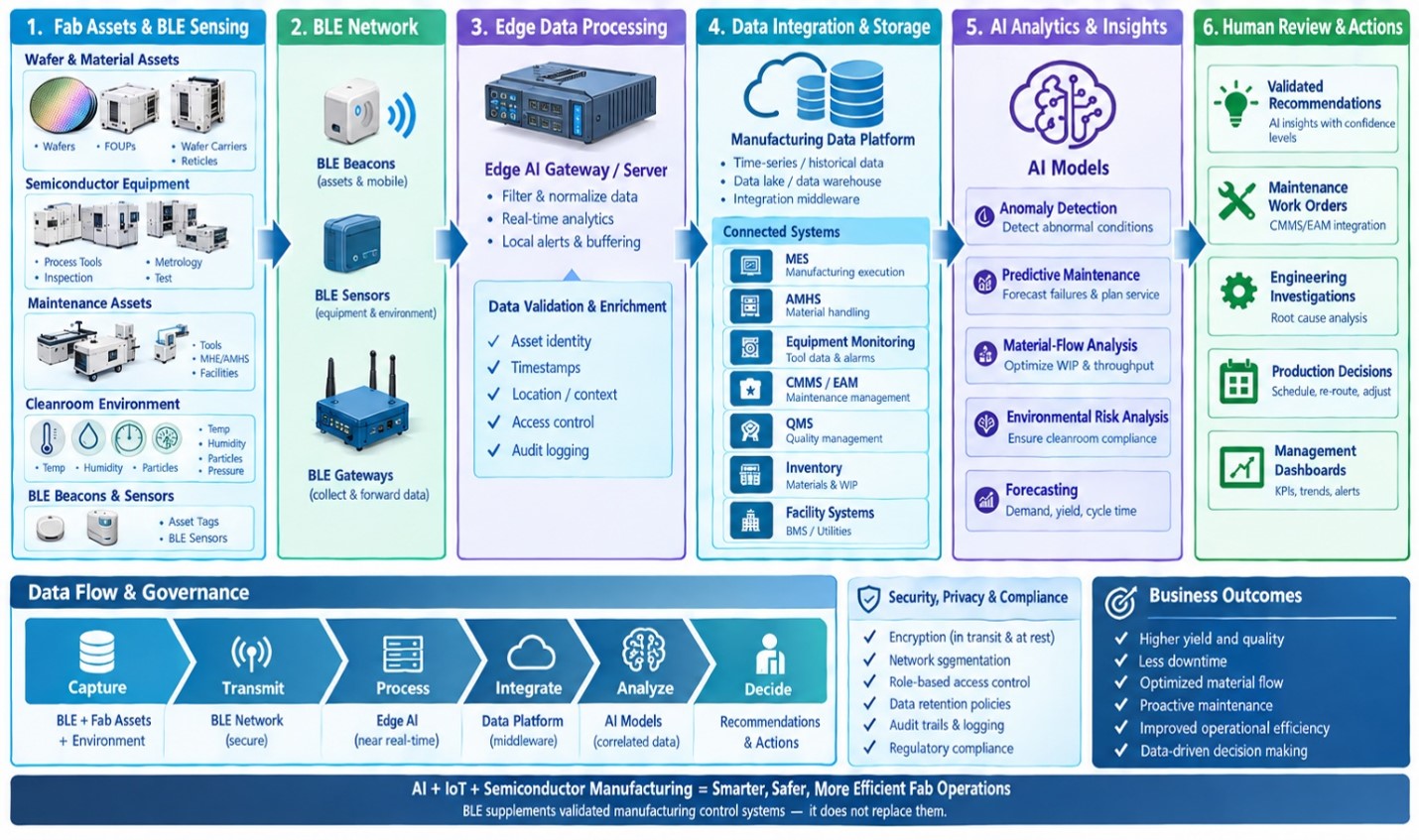
This enterprise workflow diagram illustrates the complete journey from semiconductor fab assets, BLE observations, and environmental data through edge processing, manufacturing-system integration, AI analytics, and human-reviewed actions. It highlights data validation, asset identity, timestamps, access control, and audit logging while showing how AI supports anomaly detection, predictive maintenance, material-flow analysis, environmental-risk analysis, forecasting, and production decisions.
Technical Foundation for AI-Enabled Integrated Circuit Manufacturing
A production-grade solution requires coordinated hardware, communications, software, AI processing, and security controls. BLE is most useful where wireless asset identification, proximity, location, or sensor data fills an operational information gap.
BLE Hardware for Fab Operations
BLE beacons can provide persistent identities for selected mobile assets such as carriers, maintenance carts, specialized tools, or other trackable resources. BLE sensors can provide measurements relevant to equipment condition or environmental monitoring. BLE gateways receive these wireless signals and forward them through the facility network.
GAO provides BLE hardware that can be selected according to the required sensing, coverage, battery, enclosure, communication, and integration requirements. Device selection should consider cleanroom compatibility, material restrictions, battery replacement procedures, electromagnetic conditions, mounting methods, and maintenance access.
Edge Processing and Manufacturing Servers
Edge computing can be useful when the manufacturing environment requires low-latency processing, local buffering, or reduced dependence on external network connectivity. An edge server can normalize BLE observations and perform initial analytics before sending selected information to higher-level systems.
A Server Version is appropriate when semiconductor manufacturers require software to run on customer-managed factory servers, private data centers, edge servers, or other privately hosted infrastructure. This model can provide greater control over network boundaries, data handling, integration, and operational policies.
A Cloud Version uses cloud-hosted software and infrastructure. It can be appropriate for multi-site analysis, centralized reporting, model management, fleet-level analytics, and organizations that already operate approved cloud environments. Sensitive manufacturing data may still require segmentation, anonymization, restricted connectivity, or private networking according to organizational security requirements.
Integration with Semiconductor Manufacturing Software
BLE data should normally enter existing operational workflows through controlled interfaces rather than creating another disconnected database.
Common integration targets include:
- MES for production and lot context
- AMHS software for material movement
- CMMS or EAM software for maintenance
- Facilities management systems
- Quality management systems
- Equipment monitoring software
- Inventory management systems
- Manufacturing data historians
- Enterprise resource planning systems
- Data warehouses and analytics systems
Middleware can translate device identifiers into enterprise asset identifiers, normalize timestamps and locations, and enforce data-validation rules before information reaches manufacturing applications.
AI Capabilities for Semiconductor Production and Fab Operations
AI delivers the greatest value when it is applied to a clearly defined manufacturing problem and supported by reliable operational data. For integrated circuit manufacturing, models should be evaluated against measurable production, quality, maintenance, and material-flow outcomes rather than novelty.
Anomaly Detection for Semiconductor Equipment
Anomaly detection can establish a baseline for normal operating behavior and identify deviations that warrant engineering review. Time-series data from BLE sensors can be correlated with equipment telemetry, alarm histories, maintenance records, and production conditions.
Relevant model inputs may include:
- Temperature and vibration trends around selected semiconductor tools
- Equipment utilization and operating duration
- Maintenance frequency and historical failure events
- Equipment alarm sequences
- Tool idle and restart behavior
- Environmental conditions near process equipment
- Technician intervention patterns
A model can flag a developing abnormal condition before it produces a conventional equipment alarm. Engineers can then determine whether the deviation represents genuine degradation, a sensor issue, a process change, or an environmental event.
Predictive Maintenance for Fab Equipment
Predictive maintenance uses historical and current operating data to estimate the likelihood or timing of equipment problems. For integrated circuit manufacturing, this can support maintenance planning for equipment where unexpected downtime has substantial production consequences.
Machine learning can identify combinations of signals associated with previous failures or maintenance interventions. Regression models can estimate remaining useful life where sufficient historical data exists, while classification models can rank equipment according to maintenance risk.
The resulting maintenance workflow can connect AI alerts with CMMS or EAM work orders. Maintenance engineers retain responsibility for validating the recommended intervention before production equipment is serviced.
AI for Material Flow and Cycle-Time Analysis
Wafer lots and carriers follow complex manufacturing routes. AI can analyze movement events, equipment queues, process duration, and production schedules to identify sources of excessive dwell time.
BLE location observations can supplement existing material-handling records for selected assets. Machine learning and statistical models can then identify recurring relationships between staging behavior, equipment availability, route congestion, and cycle time.
Useful measures include:
- Lot cycle time
- Queue time
- Equipment waiting time
- Carrier dwell time
- Material-handling response time
- Tool utilization
- Work-in-process inventory
- Dispatch adherence
The objective is not simply to locate a carrier. The objective is to understand how physical material movement affects semiconductor production performance.
AI-Assisted Quality and Process Investigation
Integrated circuit quality depends on tightly controlled manufacturing processes. AI can help engineers correlate inspection results, metrology measurements, equipment conditions, environmental data, lot genealogy, and process history.
Computer vision can support automated inspection where imaging systems are already used for wafer, mask, package, or component inspection. Statistical learning can identify relationships between process conditions and defect patterns.
AI outputs should support engineering analysis rather than bypass established semiconductor quality controls. Model predictions should be validated against qualified inspection methods and documented process requirements before being incorporated into production decisions.
Deployment, Commissioning, and Integration Considerations
A successful AIoT deployment in integrated circuit manufacturing requires more than installing wireless devices. Engineering teams should establish the operational problem, required data quality, physical installation constraints, integration interfaces, cybersecurity requirements, and acceptance criteria before production deployment.
Site Assessment and Hardware Selection
A site assessment should identify the areas where additional information will improve a measurable manufacturing process.
Key considerations include:
- Cleanroom classification and material restrictions
- Wireless propagation around semiconductor equipment
- Metallic structures and potential RF reflections
- Battery replacement and maintenance procedures
- Required location accuracy
- Sensor measurement accuracy and sampling frequency
- Gateway coverage and redundancy
- Network availability
- Device mounting and contamination-control requirements
- Equipment electromagnetic compatibility requirements
BLE should be deployed selectively. Fixed wired instrumentation may remain preferable for safety-critical, highly deterministic, or already-qualified measurements.
Commissioning and Validation
Commissioning should include physical installation verification, radio coverage testing, device identity validation, gateway connectivity testing, timestamp verification, data-integrity checks, and software integration testing.
A production acceptance test can verify that:
- Every deployed device has a unique enterprise identifier
- Gateway observations correspond to the correct manufacturing zones
- Sensor readings remain within expected accuracy limits
- Data timestamps are synchronized
- Network interruptions do not silently corrupt records
- Duplicate events are handled correctly
- MES, CMMS/EAM, and other interfaces receive correctly mapped information
- Alerts reach the appropriate engineering or maintenance personnel
- Audit records are retained according to organizational requirements
Pilot deployment is generally preferable to immediate fab-wide deployment. A representative production area can be used to validate coverage, data quality, AI performance, maintenance procedures, and operator acceptance before scaling.
Interoperability and Data Governance
Interoperability becomes important when BLE information must coexist with semiconductor manufacturing software from multiple vendors. Device identifiers should be mapped to controlled asset identifiers, and location data should use a consistent zone model.
APIs, message brokers, databases, industrial network protocols, and middleware can be used according to existing IT and OT requirements.
Data governance should define:
- Device ownership
- Data ownership
- Retention periods
- Timestamp standards
- Asset naming conventions
- Location hierarchy
- Data-quality thresholds
- Model version control
- Alert severity
- Human approval requirements
- Audit requirements
Cybersecurity for BLE-Enabled Semiconductor Manufacturing
Semiconductor manufacturing data can include sensitive production information, equipment status, maintenance details, and operational records. Wireless sensing should therefore be incorporated into the organization’s existing IT and OT security controls.
Security measures can include:
- Device authentication and controlled enrollment
- Encryption for communications where supported
- Network segmentation between wireless gateways and critical manufacturing networks
- Role-based access control
- Least-privilege permissions
- Secure gateway configuration
- Credential rotation
- Firmware-management procedures
- Security logging and audit trails
- Gateway hardening
- Monitoring for unauthorized devices
- Controlled API access
- Secure server and cloud connectivity
BLE devices should not be given unrestricted access to production-control networks. A gateway or intermediary service can provide a controlled boundary between wireless data collection and manufacturing applications.
AI security also requires attention. Training datasets should be governed, model access should be controlled, and changes to model versions should be traceable. Engineers should be able to determine which data and model produced an important recommendation.
Measuring AI and BLE Performance in Integrated Circuit Manufacturing
Performance should be evaluated against semiconductor manufacturing KPIs rather than device counts.
| KPI | Measurement Purpose |
|---|---|
| Equipment uptime | Measures availability of production equipment |
| Mean time between failures | Evaluates equipment reliability |
| Mean time to repair | Measures maintenance response and restoration |
| Preventive maintenance compliance | Tracks planned maintenance execution |
| Unplanned downtime | Measures unexpected production interruptions |
| Lot cycle time | Measures total manufacturing throughput time |
| Carrier dwell time | Identifies material-flow delays |
| Tool utilization | Measures productive equipment usage |
| Work-in-process inventory | Tracks material accumulation |
| Maintenance response time | Measures reaction to equipment issues |
| Spare-part stockout rate | Measures maintenance inventory availability |
| Environmental excursion frequency | Tracks abnormal facility conditions |
| AI alert precision | Measures usefulness of generated alerts |
| False-positive rate | Measures unnecessary engineering investigations |
| Location-data accuracy | Evaluates wireless asset-location quality |
| Sensor data completeness | Measures availability of required measurements |
A useful AI model is not necessarily the model with the highest statistical accuracy in a laboratory dataset. Semiconductor manufacturing teams should consider false alarms, missed events, latency, explainability, maintenance workload, model drift, and the operational consequences of incorrect recommendations.
Practical Implementation Recommendations for Semiconductor Fabs
AI-enabled integrated circuit manufacturing should be implemented as an engineering program tied to specific operational outcomes.
- Start with a measurable problem such as unplanned equipment downtime, carrier dwell time, maintenance delays, or localized environmental anomalies.
- Identify existing MES, AMHS, equipment, quality, maintenance, and facility data before determining which additional BLE measurements are necessary.
- Select BLE beacons, sensors, and gateways according to the physical conditions and qualification requirements of the intended fab area.
- Validate wireless coverage using actual equipment layouts and operating conditions rather than relying only on nominal range specifications.
- Establish asset, location, timestamp, and device-identity standards before integrating data into AI models.
- Keep AI recommendations traceable to source data, model versions, confidence information, and human review procedures.
- Use edge processing where local buffering, low latency, or network resilience is important.
- Select privately hosted server deployment where manufacturing data, network boundaries, or internal IT policies require greater infrastructure control.
- Consider cloud deployment where centralized multi-site analytics, scalable computing, and approved cloud connectivity provide clear operational value.
- Integrate alerts with existing maintenance and manufacturing workflows rather than creating parallel manual processes.
- Pilot the solution in a representative manufacturing zone before extending it across an entire fab.
- Monitor false positives, missed events, sensor failures, and model drift after commissioning.
- Review cybersecurity controls whenever devices, gateways, APIs, or AI software are added to the manufacturing environment.
- Treat BLE as a complementary sensing and identification technology where it provides useful information, not as a universal replacement for wired instrumentation or qualified semiconductor control systems.
Applying AI to More Intelligent Integrated Circuit Manufacturing
AI can improve integrated circuit manufacturing when it is connected to reliable operational data and embedded into established manufacturing workflows. BLE beacons, BLE sensors, and BLE gateways can supplement MES, AMHS, equipment, maintenance, quality, and facility data with useful location and condition information. AI can then support predictive maintenance, material-flow analysis, environmental monitoring, quality investigation, and operational decision-making.
Successful deployment depends on appropriate sensor selection, wireless validation, data governance, cybersecurity, system integration, model validation, and measurable KPIs. GAO can support organizations evaluating BLE, RFID, and IoT hardware and systems for these requirements. Technical teams can learn more about GAO’s solutions, engineering capabilities, products, and technical support when planning AI-enabled integrated circuit manufacturing initiatives.
GAO Support for AI-Enabled Integrated Circuit Manufacturing
GAO provides BLE, RFID, and IoT hardware products and systems that can support asset identification, wireless sensing, location monitoring, and connected manufacturing applications. For integrated circuit manufacturing, these technologies can be incorporated into broader solutions involving semiconductor equipment, material handling, maintenance, facility monitoring, and manufacturing software.
Headquartered in New York City and Toronto, Canada, GAO is recognized among the leading B2B and B2G suppliers of BLE and RFID technologies. GAO works with organizations that require practical hardware and system integration for specialized operating environments.
GAO and its sister companies, GAO Research Inc. and GAO Tek Inc., operate as part of GAO Group, with operations based in New York City and Toronto. For three decades, the companies have served organizations across the United States and Canada, including Fortune 500 companies, research and development organizations, universities, and government agencies.
The group’s investment in research and development supports continued work in BLE, RFID, IoT, and related technologies. Stringent quality assurance processes and remote or onsite technical support can help engineering teams address hardware selection, deployment, integration, and troubleshooting requirements.
Semiconductor Manufacturing BLE, Wired, and Hybrid Deployment Decision Tree
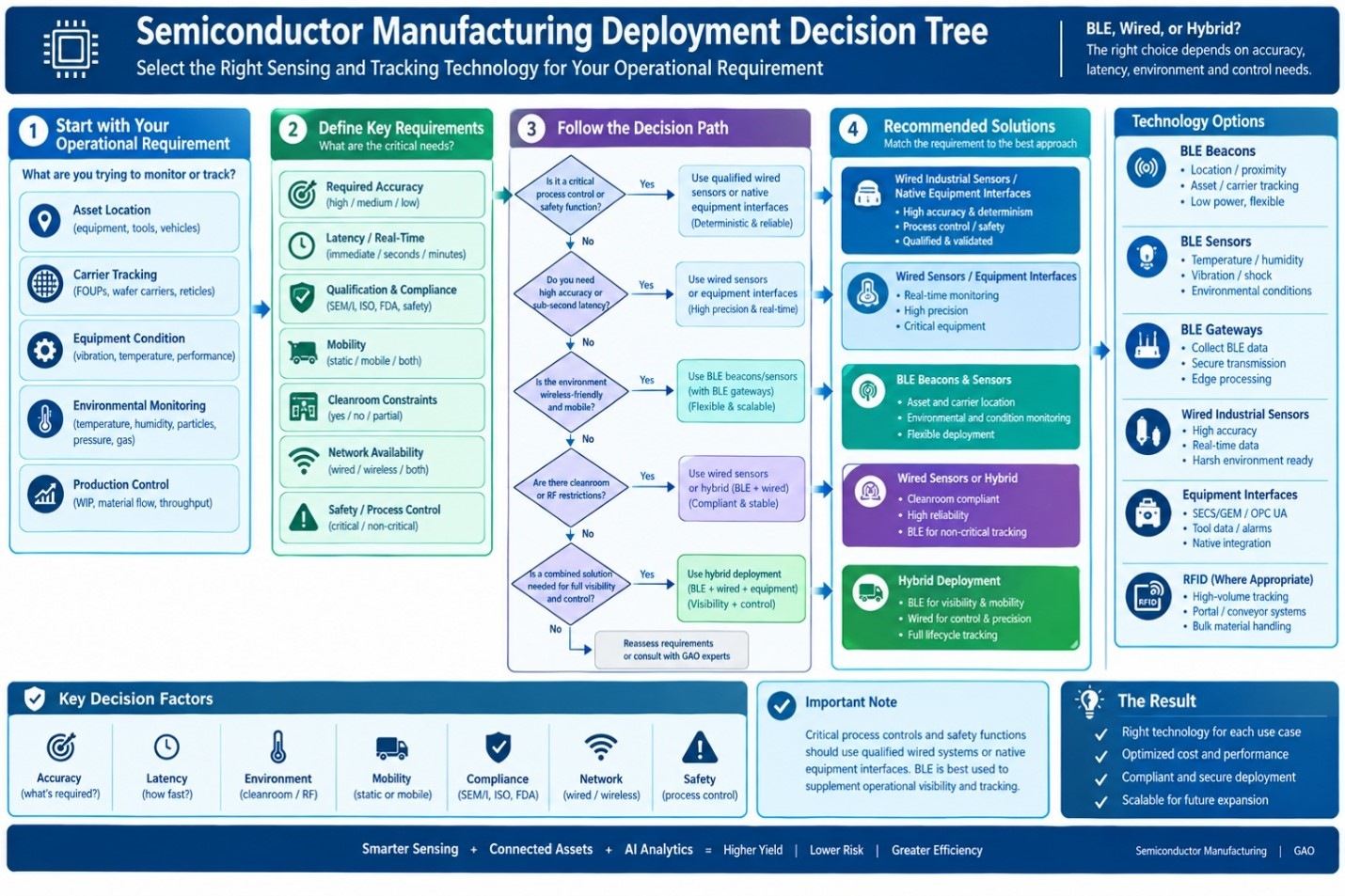
This decision tree guides semiconductor manufacturing teams through the selection of BLE, wired, native equipment interfaces, RFID, or hybrid deployments. It evaluates accuracy, latency, qualification, mobility, cleanroom constraints, network availability, and safety or process-control criticality, emphasizing qualified wired systems for deterministic controls while BLE supplements operational visibility and tracking.
Building the Future of Industrial AI and IoT with Aperture Venture Studio and GAO RFID Inc.
For more than three decades, GAO Group of Companies has invested heavily in R&D for industrial BLE, RFID, and IoT. As generative AI has become increasingly useful for industrial applications, our work has expanded toward AIoT solutions that combine AI with connected equipment, sensors, BLE, and RFID. We have also established Aperture Venture Studio to advance practical AI and IoT technologies for specialized applications such as integrated circuit manufacturing.
Aperture brings together AI and IoT technical experts, operational executives, investors, and industry participants. Through initiatives such as the Aperture Ventures Summit and TekSummit, advanced AI and IoT topics are explored with technical communities.
We welcome participation as:
- Advisors, co-founders, or employees
- Investors
- Customers