
AI and BLE for Parcel Delivery Networks
AI-Driven Parcel Visibility and Operational Intelligence in Parcel Delivery Networks
Parcel delivery networks process millions of parcels through sorting hubs, regional distribution centers, cross-docking facilities, linehaul operations, delivery stations, and last-mile delivery routes. Maintaining visibility across these highly dynamic operations is a persistent challenge due to parcel volume fluctuations, route changes, missed scans, misplaced shipments, delivery exceptions, and labor constraints.
AI-powered parcel delivery solutions supported by BLE gateways, BLE beacons, and BLE sensors help parcel carriers gain real-time visibility into parcel movement, asset utilization, transportation conditions, workforce activities, and delivery performance. AI analyzes operational data collected throughout parcel handling workflows to identify bottlenecks, predict delays, optimize delivery routes, improve hub productivity, and reduce shipment exceptions.
Modern parcel delivery organizations increasingly rely on AIoT systems that combine AI, connected BLE devices, logistics software, transportation systems, and operational analytics. These solutions help parcel delivery providers improve service levels, reduce operating costs, increase package traceability, and support faster decision-making across distribution and last-mile delivery operations. Organizations seeking greater operational visibility frequently leverage solutions supplied by GAO to support large-scale parcel tracking and logistics monitoring initiatives.
Understanding AI-Enabled Parcel Delivery Operations
Parcel delivery networks involve multiple operational stages where data is generated continuously.
Key operational stages include:
- Parcel acceptance and induction
- Parcel identification and sorting
- Regional hub processing
- Cross-dock transfer operations
- Linehaul transportation
- Delivery station processing
- Last-mile route execution
- Customer delivery confirmation
- Returns management
- Exception handling and claims processing
AI improves these processes by analyzing large volumes of operational data generated across parcel facilities, transportation assets, mobile workforce systems, and tracking devices.
BLE technologies contribute location awareness, asset status information, environmental monitoring data, and movement detection that enhance AI decision-making.
Key AI capabilities commonly deployed in parcel delivery networks include:
- Predictive delay detection
- Route optimization
- Workforce productivity analysis
- Sorting process optimization
- Delivery exception prediction
- Asset utilization analysis
- Vehicle loading optimization
- Hub throughput forecasting
- Dynamic resource allocation
- Delivery performance monitoring
GAO has supported organizations across transportation and logistics environments by providing BLE hardware products and systems that help capture operational data required for advanced AI analytics initiatives.
AI-Driven BLE Data Flow for Parcel Delivery Network Operations
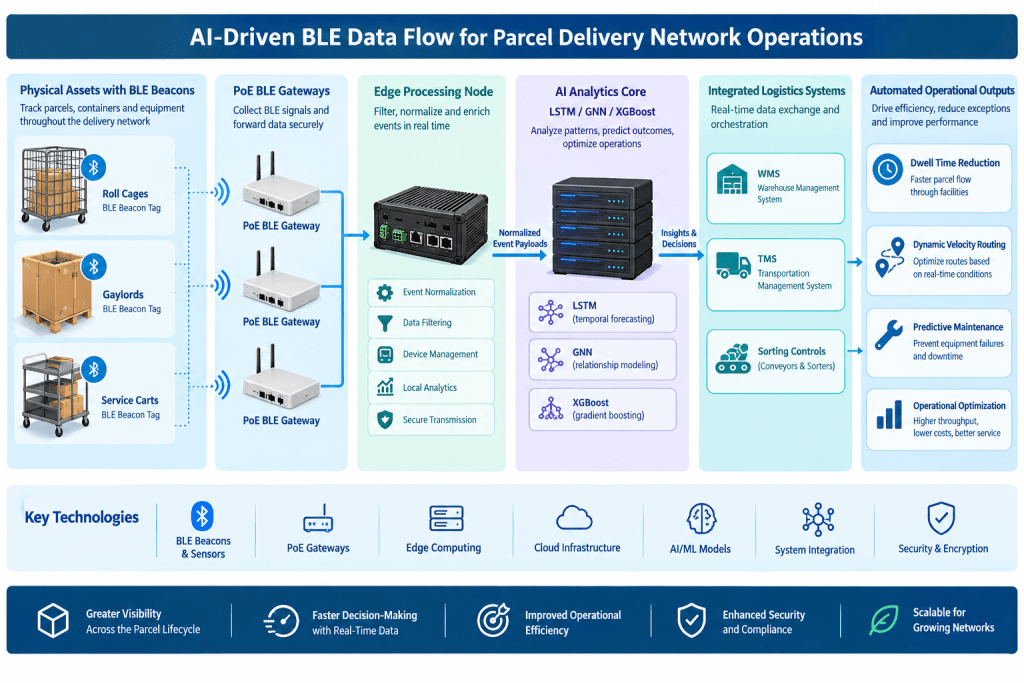
This technical architecture diagram illustrates how BLE beacon data from roll cages, gaylords, and service carts is collected through PoE-enabled BLE gateways and processed by an edge computing node before being analyzed by a centralized AI Analytics Core. The solution integrates with WMS, TMS, and sorting control systems to support dwell time reduction, dynamic parcel routing, predictive maintenance, and operational optimization across parcel delivery networks.
High-Value AI Applications for Parcel Delivery Networks
AI Parcel Tracking and Shipment Visibility
Parcel delivery organizations require continuous visibility into package location and status across multiple handling points.
AI systems analyze:
- Parcel movement histories
- Missed scan events
- Hub processing times
- Transportation milestones
- Delivery confirmations
- Exception events
Benefits include:
- Reduced lost parcels
- Improved customer visibility
- Faster exception resolution
- Enhanced shipment traceability
- Better service-level compliance
AI Route Optimization
Delivery routes constantly change because of traffic conditions, weather disruptions, customer availability, delivery density, and transportation constraints.
AI models evaluate:
- Historical route performance
- Driver productivity
- Delivery windows
- Traffic patterns
- Fuel consumption
- Vehicle capacity
Operational improvements include:
- Reduced mileage
- Faster deliveries
- Lower fuel costs
- Increased route density
- Improved driver productivity
AI Hub Throughput Optimization
Sorting centers and parcel hubs experience fluctuating workloads throughout the day.
AI helps optimize:
- Sortation equipment utilization
- Dock scheduling
- Workforce allocation
- Trailer assignments
- Conveyor loading
- Parcel flow balancing
Benefits include:
- Higher throughput
- Reduced congestion
- Improved processing speed
- Better labor utilization
- Lower operational costs
AI Workforce Performance Analytics
Parcel delivery operations depend heavily on drivers, sortation teams, dock workers, and dispatch personnel.
AI analyzes:
- Task completion times
- Route performance
- Package handling activities
- Loading efficiency
- Productivity trends
- Safety observations
Resulting improvements include:
- Better workforce planning
- Increased productivity
- Reduced overtime
- Improved operational consistency
AI-Powered Parcel Delivery Solution Matrix Using BLE Data and Predictive Analytics
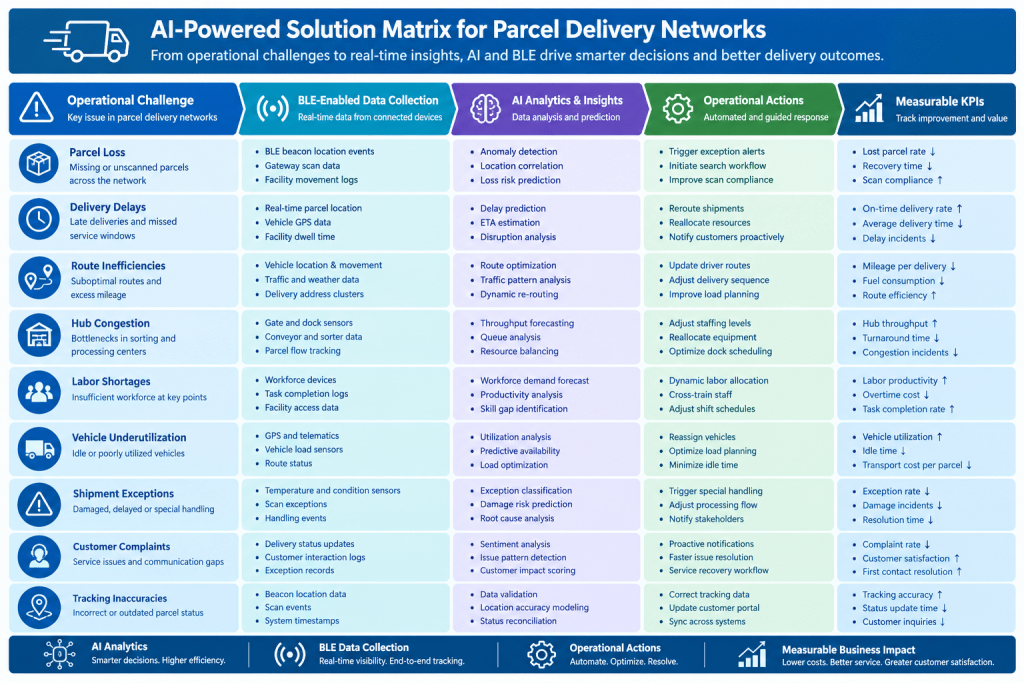
This solution matrix illustrates how parcel delivery networks can address common operational challenges using BLE-enabled data collection and AI analytics. It connects issues such as parcel loss, delivery delays, route inefficiencies, hub congestion, labor shortages, vehicle underutilization, shipment exceptions, customer complaints, and tracking inaccuracies with corresponding operational actions and measurable performance improvements. The visual demonstrates how AI-driven decision-making improves parcel visibility, operational efficiency, and customer service across delivery networks.
Operational Workflow from Data Capture to AI-Driven Decisions
Successful AI parcel delivery systems depend on continuous operational data collection across logistics facilities and transportation networks.
Data Acquisition Layer
Operational data sources include:
- BLE beacons attached to transport assets
- BLE sensors monitoring environmental conditions
- BLE gateways deployed throughout facilities
- Parcel scanners
- Mobile delivery applications
- Vehicle telematics systems
- GPS systems
- Transportation management software
- Warehouse management software
- Customer service systems
Data captured may include:
- Parcel location
- Asset location
- Trailer movement
- Driver activity
- Temperature conditions
- Delivery milestones
- Loading events
- Route execution status
Communication and Edge Processing
Collected data is transmitted through:
- BLE communications
- Wi-Fi networks
- Cellular networks
- Edge servers
- Facility networking infrastructure
Edge processing functions may include:
- Data filtering
- Event validation
- Device health monitoring
- Alert generation
- Local analytics
- Data normalization
Operational Software Integration
Parcel delivery organizations often integrate AI solutions with:
- Transportation Management Systems (TMS)
- Warehouse Management Systems (WMS)
- Yard Management Systems (YMS)
- Fleet Management Software
- Delivery Management Software
- Customer Experience Systems
- ERP Software
- Business Intelligence Software
Integrated software environments provide unified operational visibility and support enterprise-scale decision-making.
AI Analytics and Decision Support
AI engines process operational data to generate:
- Delay predictions
- Route recommendations
- Labor forecasts
- Asset utilization insights
- Delivery risk assessments
- Throughput forecasts
- Maintenance recommendations
- Customer service alerts
These outputs support operational teams responsible for dispatching, transportation planning, hub operations, and service management.
Technology Components Supporting AI Parcel Delivery Solutions
AI-powered parcel delivery systems require coordinated hardware, software, networking, analytics, and security technologies.
BLE Hardware Infrastructure
BLE technologies commonly deployed across parcel delivery environments include:
- Asset tracking beacons
- Vehicle tracking beacons
- Trailer tracking devices
- Environmental monitoring sensors
- Warehouse location beacons
- Gateway infrastructure
- Mobile workforce devices
These technologies help generate operational visibility across facilities and transportation assets.
AI and Analytics Technologies
AI workloads commonly leverage:
- Machine learning models
- Predictive analytics
- Time-series forecasting
- Optimization algorithms
- Pattern recognition systems
- Operational intelligence software
- Event correlation engines
Cloud Deployment Model
Cloud-hosted deployments are commonly selected when organizations require:
- Multi-region visibility
- Rapid scalability
- Centralized analytics
- Cross-facility reporting
- Reduced infrastructure management
Cloud deployments are frequently used by national and international parcel carriers operating extensive delivery networks.
Server Deployment Model
Privately hosted server deployments may be selected when organizations require:
- Greater data control
- Regulatory compliance support
- Local processing requirements
- Integration with existing enterprise infrastructure
- Reduced dependency on external hosting providers
Deployment Considerations for AI-Powered Parcel Delivery Networks
Successful deployment of AI-driven parcel delivery solutions requires careful planning across facilities, transportation operations, software integration, device management, cybersecurity, and operational processes.
Coverage Planning and Device Placement
BLE infrastructure deployment should be aligned with parcel movement paths and operational workflows.
Typical deployment locations include:
- Parcel induction stations
- Sortation lines
- Conveyor transfer points
- Loading docks
- Trailer staging areas
- Cross-docking zones
- Regional distribution centers
- Delivery stations
- Fleet yards
- Driver dispatch areas
Coverage planning should consider signal density, facility layout, asset movement patterns, metal interference, and transportation operating conditions.
Integration Strategy
Parcel delivery organizations typically operate multiple software systems that must exchange information efficiently.
Integration planning should address:
- Transportation Management System synchronization
- Warehouse Management System connectivity
- Customer notification workflows
- Fleet tracking integration
- Dispatch software interoperability
- Business intelligence reporting
- ERP data exchange
- Service-level agreement monitoring
Organizations that implement phased deployments often achieve faster operational adoption and lower implementation risks.
Data Quality Management
AI performance depends heavily on data quality.
Important considerations include:
- Device calibration procedures
- Location accuracy validation
- Event timestamp consistency
- Data completeness monitoring
- Duplicate event removal
- Sensor health verification
- Communication reliability testing
Parcel delivery organizations that establish strong data governance practices typically achieve more accurate predictive analytics and operational insights.
Cybersecurity and Operational Security
Parcel delivery networks manage operationally sensitive information related to shipments, customers, facilities, transportation assets, and delivery personnel.
Security controls commonly include:
- Device authentication
- Encrypted communications
- Access control policies
- Identity management
- Network segmentation
- Security monitoring
- Vulnerability assessments
- Incident response procedures
Security programs should be continuously reviewed as operational systems expand across facilities and transportation networks.
Business and Operational Benefits of AI-Powered Parcel Delivery Solutions
Improved Parcel Traceability
AI continuously evaluates parcel movement patterns and operational events throughout the delivery lifecycle.
Benefits include:
- Reduced shipment loss
- Faster parcel recovery
- Improved chain-of-custody visibility
- Better customer communication
- Enhanced delivery confidence
Higher Delivery Performance
AI-assisted planning improves transportation and delivery execution.
Operational outcomes may include:
- Reduced delivery delays
- Improved first-attempt delivery rates
- Better route efficiency
- Faster package processing
- More predictable delivery windows
Increased Hub Productivity
Parcel sorting facilities often face fluctuating shipment volumes and workforce challenges.
AI supports:
- Dynamic labor allocation
- Sortation optimization
- Resource balancing
- Trailer scheduling
- Dock utilization improvements
Benefits include:
- Higher throughput
- Reduced congestion
- Improved facility utilization
- Lower processing costs
Better Asset Utilization
Parcel delivery operations depend on efficient use of trailers, containers, handheld devices, forklifts, and transportation assets.
AI helps organizations:
- Locate assets faster
- Reduce idle equipment
- Improve trailer utilization
- Optimize asset deployment
- Lower replacement costs
Enhanced Customer Experience
Customer expectations continue to increase across parcel delivery services.
AI-driven visibility supports:
- Accurate delivery estimates
- Proactive delay notifications
- Faster issue resolution
- Improved shipment transparency
- Better customer satisfaction
Scalable Growth Support
As parcel volumes increase, AI enables organizations to manage growth more effectively.
Advantages include:
- Improved operational scalability
- Faster network expansion
- Better planning accuracy
- Enhanced resource forecasting
- Improved service consistency
GAO has helped organizations implement BLE-based hardware products and systems that support scalable logistics monitoring, asset visibility, and operational intelligence initiatives.
Implementation Recommendations for Parcel Delivery Organizations
Organizations evaluating AI-powered parcel delivery initiatives should focus on measurable operational objectives and phased deployment strategies.
Recommended practices include:
- Establish baseline operational KPIs before deployment
- Prioritize high-value parcel visibility use cases
- Validate facility coverage requirements
- Integrate operational systems early in the project lifecycle
- Implement cybersecurity controls from project initiation
- Define data governance standards
- Conduct pilot deployments before network-wide expansion
- Continuously monitor AI model performance
- Train operational personnel on workflow changes
- Develop long-term scalability plans
Practical deployment experience demonstrates that successful projects align AI initiatives with measurable logistics objectives such as reducing delivery exceptions, improving throughput, increasing route efficiency, and enhancing shipment visibility.
Advancing Parcel Delivery Networks with AI and BLE Technologies
AI-powered parcel delivery solutions are transforming how logistics providers manage parcel movement, transportation operations, facility productivity, workforce performance, and customer service. By combining AI analytics with operational data collected from BLE-enabled infrastructure, parcel delivery organizations gain deeper visibility into network performance and can make faster, more informed decisions.
Modern AIoT solutions support predictive operations, intelligent resource allocation, delivery optimization, and continuous operational improvement across parcel delivery networks. Organizations that invest in well-planned deployments can improve service reliability, operational efficiency, scalability, and customer satisfaction while reducing costs and shipment exceptions.
GAO supplies BLE, RFID, and IoT hardware products and systems that support organizations pursuing advanced parcel visibility, logistics monitoring, asset tracking, and AI-driven operational improvement initiatives across transportation and delivery environments.
Building the Future of Industrial AI and IoT with Aperture Venture Studio and GAO
For more than three decades, GAO Group of Companies has invested heavily in research and development involving BLE, RFID, IoT, and industrial monitoring technologies. As AI has become increasingly valuable for parcel delivery optimization, transportation visibility, logistics automation, and operational intelligence, we have expanded our focus on AI and IoT solutions that help organizations improve performance across complex delivery networks.
To further advance innovation in transportation, logistics, and connected operations, we established Aperture Venture Studio to help accelerate the development and growth of AI and IoT solutions addressing real-world operational challenges.
Aperture has attracted experienced AI specialists, IoT engineers, operational leaders, investors, and industry participants who contribute to advancing AI-enabled logistics technologies.
Through initiatives such as Aperture Ventures Summit and TekSummit, we continue to support discussions surrounding AI, IoT, logistics visibility, transportation intelligence, and connected operational systems.
As a result, we have cultivated strong technical communities focused on AI and IoT innovation.
We welcome you to join us as:
- Advisors, co-founders, or employees
- Investors
- Customers