
AI and BLE for Smart Irrigation
AI-Powered Smart Irrigation Using BLE Technologies for Precision Water Management
Modern smart irrigation is rapidly evolving from timer-based watering schedules toward AI-driven, data-centric irrigation systems capable of making autonomous decisions based on real-time field conditions. Artificial Intelligence of Things (AIoT) combines artificial intelligence with connected BLE sensors, BLE gateways, environmental monitoring devices, irrigation controllers, weather intelligence, and agricultural software to optimize irrigation while reducing water consumption and improving crop productivity. Within smart irrigation, BLE technologies provide reliable short-range connectivity for distributed sensing, while AI continuously analyzes soil moisture, evapotranspiration, crop growth, weather forecasts, hydraulic performance, and irrigation history to determine optimal irrigation schedules. The result is improved water-use efficiency, healthier crops, lower operating costs, and better sustainability. Drawing on decades of experience supplying BLE, RFID, and industrial IoT technologies, GAO helps organizations implement reliable smart irrigation solutions that integrate modern sensing technologies with AI-driven operational intelligence for commercial agriculture, orchards, vineyards, greenhouses, golf courses, municipal landscapes, and research facilities.
AI-Powered Smart Irrigation Using BLE Technologies: Intelligent Field Monitoring and Automated Irrigation Architecture
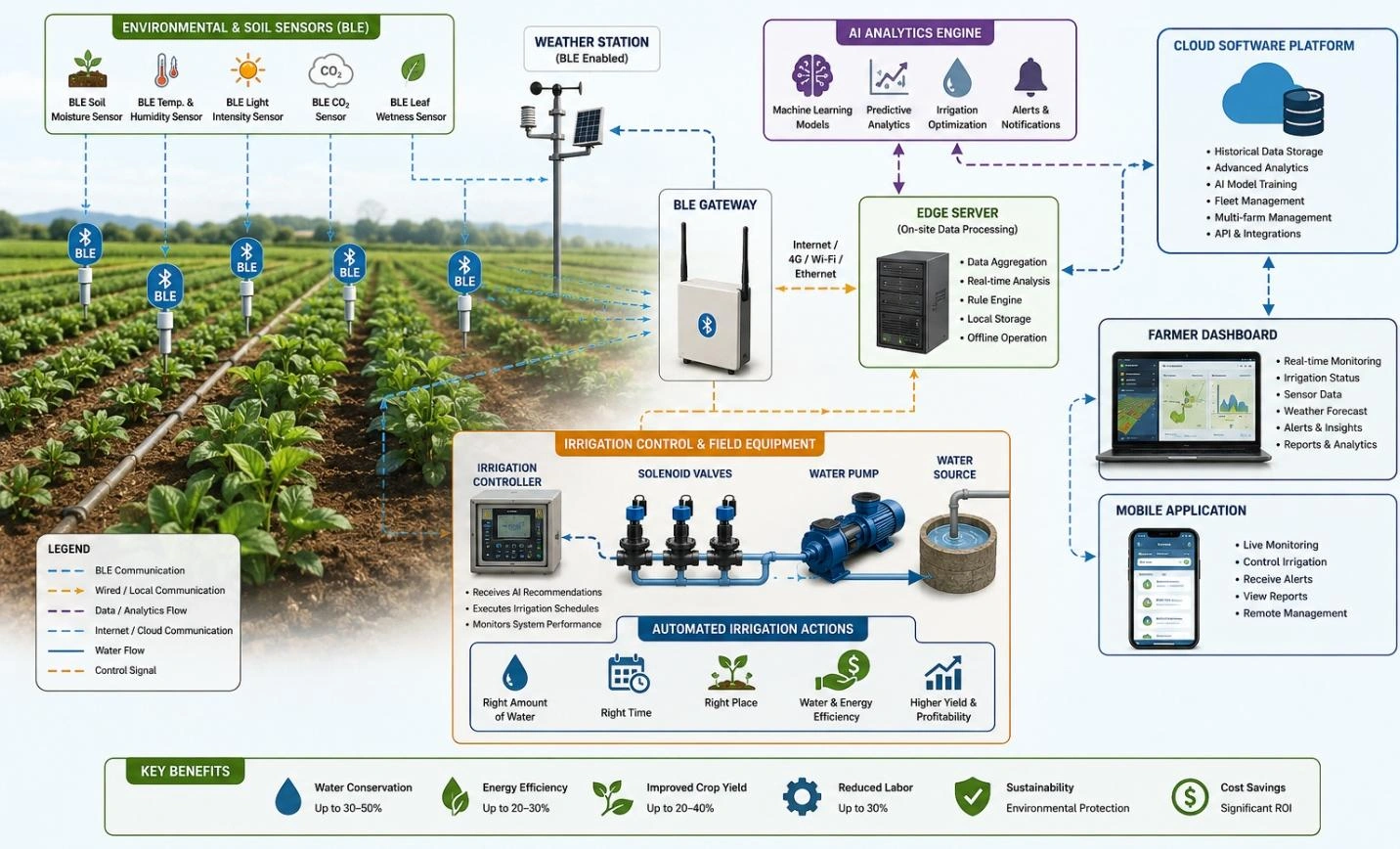
This engineering illustration presents the architecture of an AI-powered smart irrigation system that combines Bluetooth Low Energy (BLE) sensors, edge computing, cloud analytics, and automated irrigation equipment. BLE soil moisture and environmental sensors continuously monitor field conditions and transmit data through BLE gateways to an edge server and AI analytics engine. The AI platform analyzes sensor and weather data to optimize irrigation schedules, automatically controlling irrigation valves and water pumps while providing real-time monitoring through farmer dashboards and mobile applications.
Understanding AI-Powered Smart Irrigation Using BLE Technologies
Smart irrigation refers to intelligent irrigation systems that automatically determine when, where, and how much water should be applied according to actual field conditions rather than fixed irrigation schedules. Artificial intelligence significantly enhances these systems by continuously learning from environmental data, historical irrigation records, weather forecasts, crop growth models, and operational performance.
BLE technologies serve as an important sensing and communication layer within smart irrigation deployments. BLE soil moisture sensors, temperature sensors, humidity sensors, water pressure sensors, flow meters equipped with BLE interfaces, BLE gateways, and BLE beacons provide localized environmental intelligence while consuming very little power. This enables long battery life across large agricultural fields and distributed irrigation zones.
Rather than relying solely on threshold-based irrigation rules, AI evaluates multiple variables simultaneously, including:
- Soil moisture profile
- Root zone moisture
- Crop evapotranspiration
- Soil temperature
- Air temperature
- Relative humidity
- Solar radiation
- Rainfall probability
- Wind speed
- Irrigation system efficiency
- Pump performance
- Valve operation
- Historical irrigation patterns
- Crop growth stage
- Seasonal water demand
The combination enables predictive irrigation rather than reactive irrigation.
Agricultural producers increasingly deploy these intelligent irrigation systems because water scarcity, energy costs, labor shortages, and sustainability initiatives require significantly greater operational efficiency than traditional irrigation methods can provide.
GAO has supported organizations throughout North America by providing industrial BLE technologies, RFID systems, and IoT hardware that enable reliable data collection for intelligent agricultural monitoring solutions.
Smart Irrigation Applications and AI Deployment Scenarios
Although irrigation principles remain consistent across agriculture, AI implementation differs considerably according to crop type, irrigation infrastructure, terrain, water availability, and production objectives.
Row Crop Irrigation
AI continuously optimizes irrigation scheduling across corn, soybean, wheat, cotton, and similar large-scale crops by analyzing moisture variability across irrigation management zones.
Typical applications include:
- Variable rate irrigation
- Center pivot optimization
- Soil moisture forecasting
- Water allocation planning
- Irrigation scheduling
- Pump optimization
- Seasonal irrigation planning
Operational challenges include:
- Uneven soil composition
- Water distribution inefficiency
- High pumping costs
- Weather variability
- Groundwater restrictions
Orchard Irrigation
Fruit orchards require irrigation that considers tree age, canopy size, fruit development, and root depth.
AI models improve:
- Tree-specific irrigation
- Deficit irrigation strategies
- Root-zone moisture control
- Water stress prediction
- Fruit quality optimization
BLE environmental sensors installed throughout orchard blocks allow localized monitoring where soil characteristics vary considerably.
Vineyard Irrigation
Viticulture frequently uses deficit irrigation strategies to improve grape quality.
AI evaluates:
- Vine water stress
- Berry development
- Soil moisture gradients
- Weather forecasts
- Canopy temperature
Rather than maximizing water application, irrigation decisions focus on optimizing grape quality while minimizing unnecessary irrigation.
Greenhouse Irrigation
Greenhouse irrigation requires extremely precise environmental control.
AI continuously analyzes:
- Growing media moisture
- Nutrient solution delivery
- Drainage rates
- Greenhouse humidity
- Temperature stability
- Plant growth response
BLE sensors provide dense environmental monitoring without extensive wiring throughout greenhouse structures.
Landscape and Municipal Irrigation
Municipal parks, sports fields, campuses, golf courses, and commercial landscapes benefit from AI-based irrigation scheduling that balances plant health with municipal water conservation objectives.
AI optimizes:
- Zone scheduling
- Weather-adjusted irrigation
- Leak detection
- Sprinkler performance
- Water budgeting
- Seasonal scheduling
Research Farms and Agricultural Experiment Stations
Research organizations frequently deploy AI-driven irrigation systems to evaluate:
- Irrigation strategies
- Crop genetics
- Water productivity
- Fertilizer response
- Climate adaptation
Continuous BLE sensor data improves experimental repeatability while reducing manual measurements.
GAO supports research organizations, universities, commercial agriculture, and government agencies by supplying industrial BLE technologies that enable reliable environmental data collection across diverse irrigation environments.
AI Deployment Across Major Smart Irrigation Environments: Comparative Analysis of Applications, BLE Technologies, and Enterprise Integration
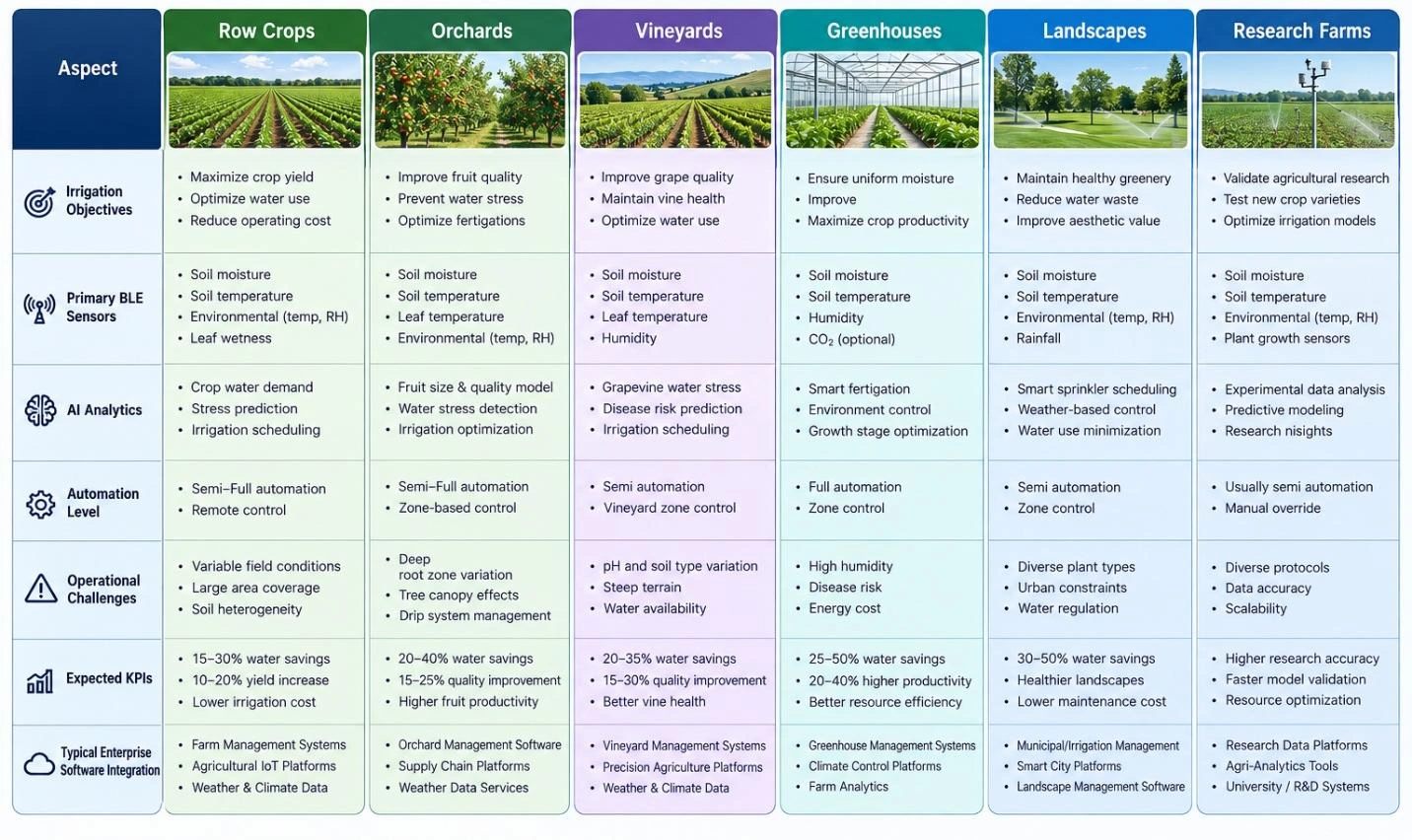
This professional comparison table illustrates how AI-powered smart irrigation is deployed across six major agricultural and landscape environments: row crops, orchards, vineyards, greenhouses, landscapes, and research farms. It compares irrigation objectives, primary BLE-enabled sensors, AI analytics capabilities, automation levels, operational challenges, expected key performance indicators (KPIs), and typical enterprise software integrations.
Operational Workflow of an AI-Driven Smart Irrigation System
Successful smart irrigation depends on continuous feedback between environmental sensing, AI analysis, irrigation control, and operational decision-making rather than isolated automation.
Environmental Data Acquisition
BLE-connected sensing devices continuously collect environmental information throughout irrigation zones.
Typical sensing devices include:
- Soil moisture sensors
- Soil temperature sensors
- Soil electrical conductivity sensors
- Leaf wetness sensors
- Relative humidity sensors
- Ambient temperature sensors
- Solar radiation sensors
- Rain gauges
- Water level sensors
- Water pressure sensors
- Flow sensors
- Pump vibration sensors
- Reservoir level sensors
Rather than concentrating measurements in one location, sensors are distributed according to irrigation zones, soil types, crop varieties, elevation changes, and hydraulic characteristics.
Local BLE Communication
BLE sensors transmit measurements to nearby BLE gateways using low-energy wireless communication.
Engineering considerations include:
- Gateway placement
- Sensor density
- Battery life
- Signal propagation
- Vegetation interference
- Terrain variation
- Gateway redundancy
- Communication latency
BLE minimizes power consumption while supporting years of field operation for battery-powered sensing devices.
Edge Processing
Before transmitting information to centralized software, edge computing devices perform preliminary processing.
Typical edge functions include:
- Data validation
- Noise filtering
- Sensor health monitoring
- Outlier removal
- Timestamp synchronization
- Data compression
- Local buffering
- Temporary decision support during communication outages
Edge processing reduces bandwidth usage while improving overall system reliability.
AI Analytics
Artificial intelligence combines real-time sensor measurements with additional information sources including:
- Weather forecasts
- Historical irrigation records
- Satellite imagery
- Drone imagery
- Crop growth models
- Soil maps
- Seasonal climate trends
- Irrigation equipment performance
Machine learning models evaluate both immediate irrigation requirements and future water demand.
Common AI methods include:
- Time-series forecasting
- Regression models
- Reinforcement learning
- Predictive analytics
- Anomaly detection
- Optimization algorithms
- Deep neural networks
- Decision support models
Irrigation Control
AI recommendations may either assist irrigation managers or directly automate irrigation equipment.
Automated actions include:
- Valve control
- Pump scheduling
- Variable frequency drive adjustment
- Irrigation duration optimization
- Zone prioritization
- Water allocation
- Emergency shutdown
- Leak isolation
Human operators retain supervisory control while AI continuously recommends or executes optimal irrigation strategies according to configured operational policies.
Enterprise Integration and Business Actions
Operational intelligence becomes significantly more valuable when irrigation data integrates with agricultural business software.
Common integrations include:
- Farm Management Information Systems (FMIS)
- Geographic Information Systems (GIS)
- Supervisory Control and Data Acquisition (SCADA)
- Computerized Maintenance Management Systems (CMMS)
- Enterprise Resource Planning (ERP)
- Asset Management Systems
- Water resource management software
- Sustainability reporting software
- Agronomic decision support systems
- Weather intelligence services
Integrated reporting supports water compliance, operational planning, maintenance scheduling, energy management, and long-term agricultural sustainability initiatives.
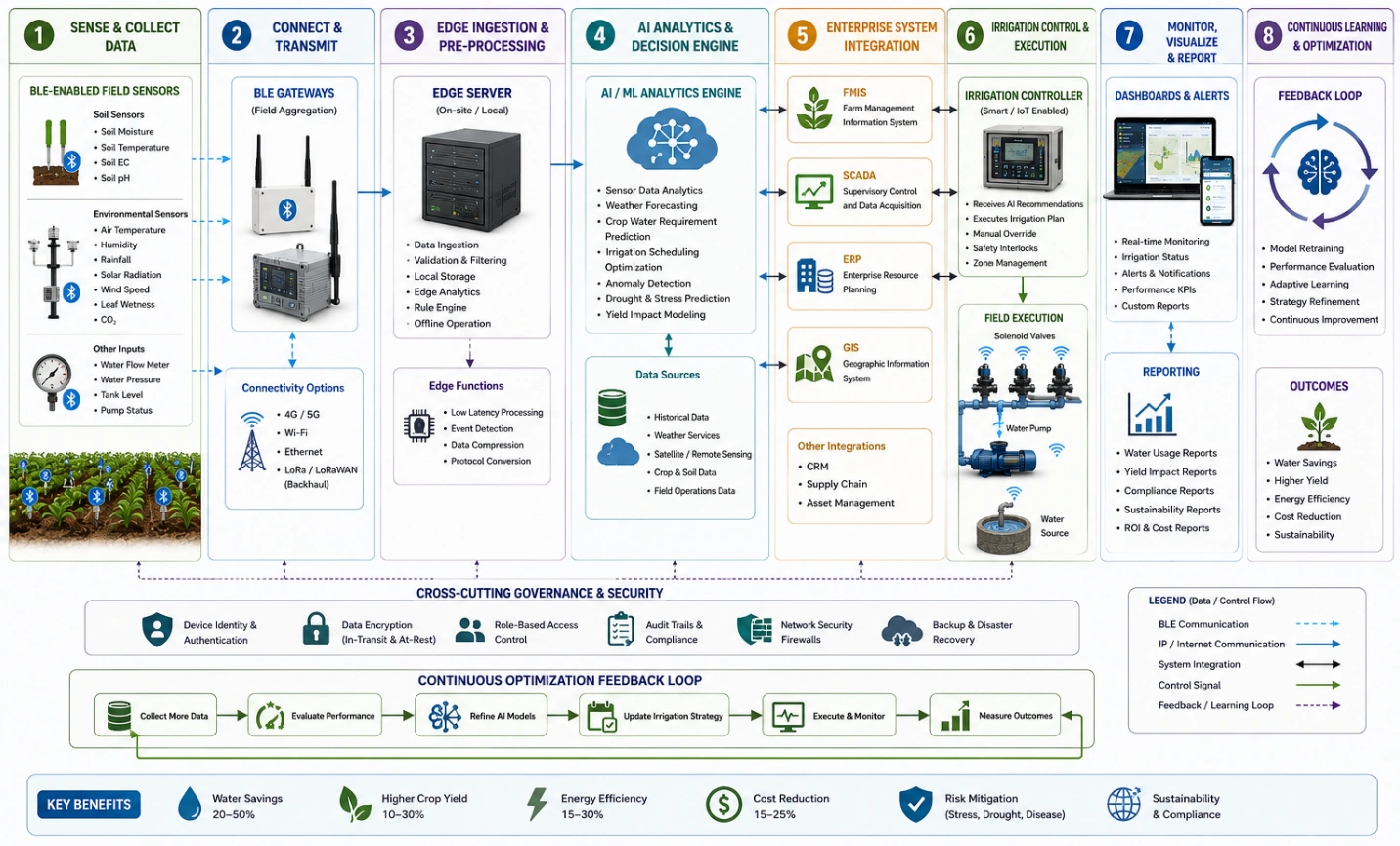
This engineering workflow diagram illustrates the complete operational process of an AI-enabled smart irrigation system. It demonstrates how Bluetooth Low Energy (BLE) soil and environmental sensors collect real-time field data, which is transmitted through BLE gateways to edge servers for preprocessing.
Core Technologies Supporting AI-Driven Smart Irrigation
Reliable AI-enabled smart irrigation depends on coordinated sensing, communications, computing, cybersecurity, and software integration rather than AI algorithms alone. Each layer contributes to accurate irrigation decisions, operational resilience, and long-term scalability across distributed agricultural environments.
BLE Hardware and Field Devices
BLE technologies provide the field-level connectivity that enables continuous environmental monitoring while maintaining low power consumption. Typical hardware deployed across smart irrigation systems includes:
- BLE soil moisture sensors for monitoring volumetric water content within the root zone.
- BLE soil temperature sensors to improve irrigation timing and crop growth modeling.
- BLE ambient temperature and relative humidity sensors for microclimate monitoring.
- BLE water pressure sensors to identify pressure drops, blocked pipelines, or failing pumps.
- BLE-enabled flow meters to measure irrigation volumes, detect leaks, and verify application rates.
- BLE gateways that aggregate data from multiple sensing nodes and securely forward information to edge computers or centralized software.
- BLE beacons that assist with location awareness for mobile maintenance personnel, irrigation assets, valve stations, and equipment inspections.
Device selection should account for environmental protection ratings, battery longevity, sensing accuracy, operating temperature range, calibration requirements, and compatibility with irrigation infrastructure. In large orchards, vineyards, and row crop operations, gateway placement should minimize communication blind spots caused by terrain changes, dense vegetation, irrigation structures, or equipment enclosures.
GAO supplies industrial-grade BLE hardware designed for demanding agricultural environments, helping organizations deploy reliable field monitoring systems that support AI-driven irrigation decisions.
Artificial Intelligence Models for Irrigation Optimization
AI software transforms raw sensor measurements into irrigation recommendations by combining environmental observations with agronomic knowledge and historical operating data. Rather than relying on a single algorithm, production-grade systems frequently employ multiple complementary AI techniques to address different irrigation objectives.
Different AI models address distinct operational objectives throughout the irrigation lifecycle.
Common AI capabilities include:
- Time series forecasting to predict future soil moisture depletion based on weather, crop growth, and irrigation history.
- Machine learning regression models that estimate irrigation demand using evapotranspiration, rainfall, soil characteristics, and crop coefficients.
- Reinforcement learning algorithms that continuously improve irrigation scheduling by learning from previous watering outcomes.
- Deep learning models that correlate multiple environmental variables with crop water stress across large production areas.
- Computer vision models analyzing drone imagery, multispectral satellite imagery, and fixed cameras to identify drought stress, canopy health, irrigation non-uniformity, and vegetation indices such as NDVI and NDRE.
- Predictive maintenance models that forecast failures in pumps, valves, filters, pressure regulators, and irrigation controllers before operational disruptions occur.
- Anomaly detection algorithms that recognize abnormal water consumption, leaking pipelines, clogged emitters, malfunctioning sprinklers, sensor drift, unauthorized water usage, or unexpected hydraulic behavior.
- Optimization algorithms that allocate limited water resources among irrigation zones during drought restrictions while maintaining crop productivity.
Rather than replacing agronomists or irrigation managers, AI serves as an advanced decision support capability by continuously evaluating millions of environmental observations that would be impractical to analyze manually.
Engineering teams should retrain AI models periodically to accommodate seasonal weather changes, crop rotation, soil amendments, equipment upgrades, and evolving irrigation practices. Continuous model validation improves long-term prediction accuracy while reducing the risk of biased irrigation recommendations.
Communication Infrastructure
Reliable communication is essential because irrigation decisions depend on continuous environmental data collection.
BLE provides efficient local wireless communication between field devices and nearby gateways. Larger irrigation systems typically combine BLE with additional networking technologies for long-distance communication.
Common communication technologies include:
- Bluetooth Low Energy (BLE)
- Wi-Fi
- Ethernet
- Cellular LTE and 5G
- NB-IoT
- LoRaWAN where long-range sensing is required
- MQTT
- HTTPS
- OPC UA
- Modbus TCP
- Modbus RTU
- BACnet where irrigation integrates with building automation
- REST APIs
- WebSocket communication
- Secure VPN connectivity
Engineering considerations include:
- Communication redundancy
- Gateway failover
- Quality of Service (QoS)
- Bandwidth management
- Network segmentation
- Remote firmware updates
- Time synchronization
- Offline buffering
Selecting the appropriate communication strategy depends on field size, irrigation topology, network availability, latency requirements, cybersecurity policies, and existing agricultural infrastructure.
Cloud Version and Server Version Deployment
AI-enabled smart irrigation software may be deployed as either a cloud-hosted solution or a privately managed server solution depending on operational, regulatory, and technical requirements.
Cloud Version
Cloud-hosted deployments place AI software, analytics, reporting, long-term data storage, and centralized management within managed cloud infrastructure.
Typical advantages include:
- Rapid deployment
- Automatic software updates
- Elastic computing resources
- Multi-site irrigation management
- Centralized dashboards
- Remote agronomic collaboration
- Long-term historical analytics
- Simplified disaster recovery
Cloud deployments are well suited for:
- Agricultural enterprises operating across multiple regions
- Irrigation service providers
- Commercial landscape management companies
- Municipal irrigation departments
- Research organizations managing geographically distributed field trials
Server Version
Server deployments place irrigation software on customer-managed infrastructure such as private servers, regional data centers, edge servers, or agricultural control facilities.
Typical advantages include:
- Greater operational control
- Lower dependency on Internet connectivity
- Local processing with minimal latency
- Data residency compliance
- Integration with existing private agricultural software
- Custom cybersecurity policies
- Simplified operation during limited WAN connectivity
Server deployments are often preferred for:
- Critical irrigation infrastructure
- Government agricultural facilities
- Water authorities
- Large commercial farms
- Research institutions with strict data governance
- Operations requiring continuous irrigation even during Internet outages
Hybrid deployments frequently combine edge servers with cloud analytics, enabling local irrigation control while leveraging cloud computing for long-term optimization and enterprise reporting.
Enterprise Software Integration
Maximum operational value is achieved when irrigation intelligence is integrated with business systems rather than remaining isolated.
Common software integrations include:
- Farm Management Information Systems (FMIS)
- Geographic Information Systems (GIS)
- Supervisory Control and Data Acquisition (SCADA)
- Enterprise Resource Planning (ERP)
- Computerized Maintenance Management Systems (CMMS)
- Laboratory Information Management Systems (LIMS) for water quality testing
- Environmental Management Information Systems (EMIS)
- Water resource management software
- Sustainability reporting software
- Asset Management Systems
- Business Intelligence (BI) software
- Weather intelligence services
- Digital twin software for irrigation simulation
Integrated software enables coordinated decision-making across irrigation operations, maintenance, compliance reporting, production planning, water resource management, and financial analysis.
Cybersecurity for Smart Irrigation Systems
Because irrigation systems increasingly connect operational technology with enterprise IT networks, cybersecurity must be incorporated throughout the solution lifecycle.
Important security mechanisms include:
- Zero Trust security principles
- Multi-factor authentication
- Role-based access control
- Device identity management
- Digital certificates
- Secure boot
- Firmware signing
- TLS encryption
- VPN connectivity
- Network segmentation
- Intrusion detection
- Security Information and Event Management (SIEM)
- Continuous vulnerability assessment
- Security logging
- Endpoint monitoring
Agricultural operations should establish lifecycle management procedures for firmware updates, device replacement, credential management, backup policies, disaster recovery, and incident response planning.
GAO has supported industrial IoT deployments for more than three decades by providing reliable hardware, stringent quality assurance, and expert technical support for organizations implementing secure BLE and IoT solutions.
AI-Driven Smart Irrigation Solution Architecture: End-to-End BLE, Edge AI, Enterprise Integration, and Secure Deployment
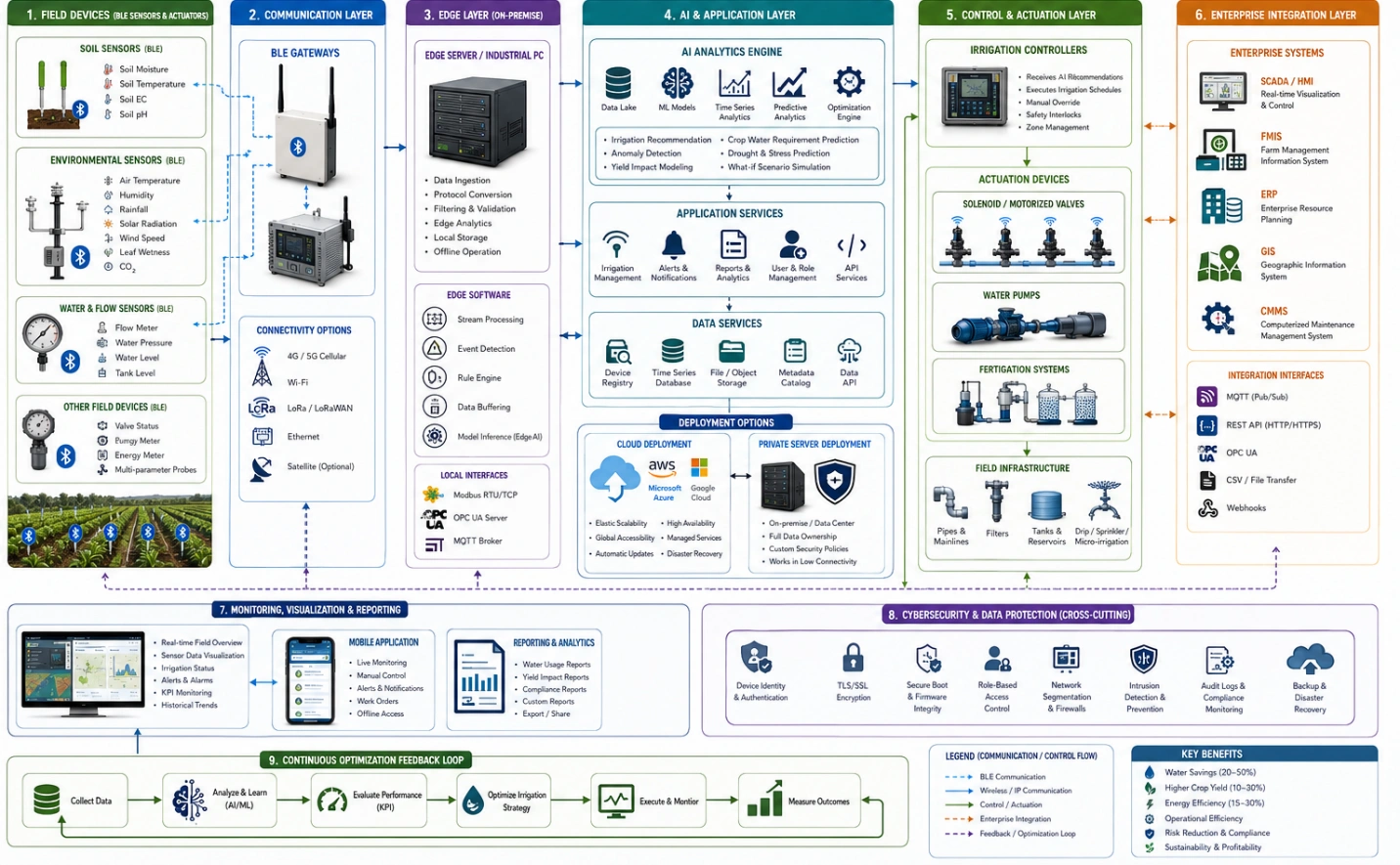
This engineering solution diagram presents the complete technical architecture of an AI-driven smart irrigation platform powered by Bluetooth Low Energy (BLE) technologies. It illustrates how BLE soil moisture and environmental sensors communicate through BLE gateways to edge servers, cloud platforms, and private server deployments where AI analytics optimize irrigation decisions.
Technical Capabilities and Business Value of AI-Driven Smart Irrigation
Combining artificial intelligence with BLE-enabled sensing technologies enables irrigation systems to move beyond fixed scheduling toward adaptive, data-driven water management.
Intelligent Water Optimization
AI continuously evaluates changing environmental conditions instead of relying on predefined irrigation schedules.
Benefits include:
- Improved irrigation timing
- Reduced overwatering
- Reduced underwatering
- Improved water-use efficiency
- Better drought resilience
- Improved irrigation uniformity
Improved Crop Performance
Continuous environmental monitoring enables irrigation decisions that support crop health throughout the growing season.
Expected improvements include:
- Higher crop yield consistency
- Improved fruit quality
- Better crop uniformity
- Reduced plant stress
- Improved nutrient uptake
- Better root development
Lower Operating Costs
Operational savings result from optimized resource utilization rather than simple automation.
Examples include:
- Lower pumping energy consumption
- Reduced labor requirements
- Reduced equipment downtime
- Lower maintenance costs
- Reduced fertilizer loss through excessive irrigation
- Lower water procurement costs
Predictive Maintenance
AI continuously evaluates irrigation infrastructure health.
Predictive capabilities include:
- Pump bearing failure prediction
- Valve degradation detection
- Pipeline leak identification
- Filter clog prediction
- Sensor failure detection
- Pressure instability analysis
Maintenance teams can schedule repairs before irrigation interruptions affect crop production.
Scalability
BLE-enabled smart irrigation solutions scale from small research plots to regional agricultural operations by adding sensing zones, gateways, AI computing resources, and enterprise software integration without redesigning the overall solution.
Sustainability
AI contributes directly to sustainable agriculture by improving resource utilization.
Key sustainability outcomes include:
- Reduced freshwater consumption
- Lower energy usage
- Reduced greenhouse gas emissions associated with pumping
- Improved groundwater conservation
- Better watershed management
- Improved environmental reporting
GAO has supplied BLE, RFID, and industrial IoT hardware to commercial organizations, research institutions, Fortune 500 companies, universities, and government agencies throughout the United States and Canada, supporting dependable environmental monitoring and operational automation initiatives.
AI – Enabled Smart Irrigation System
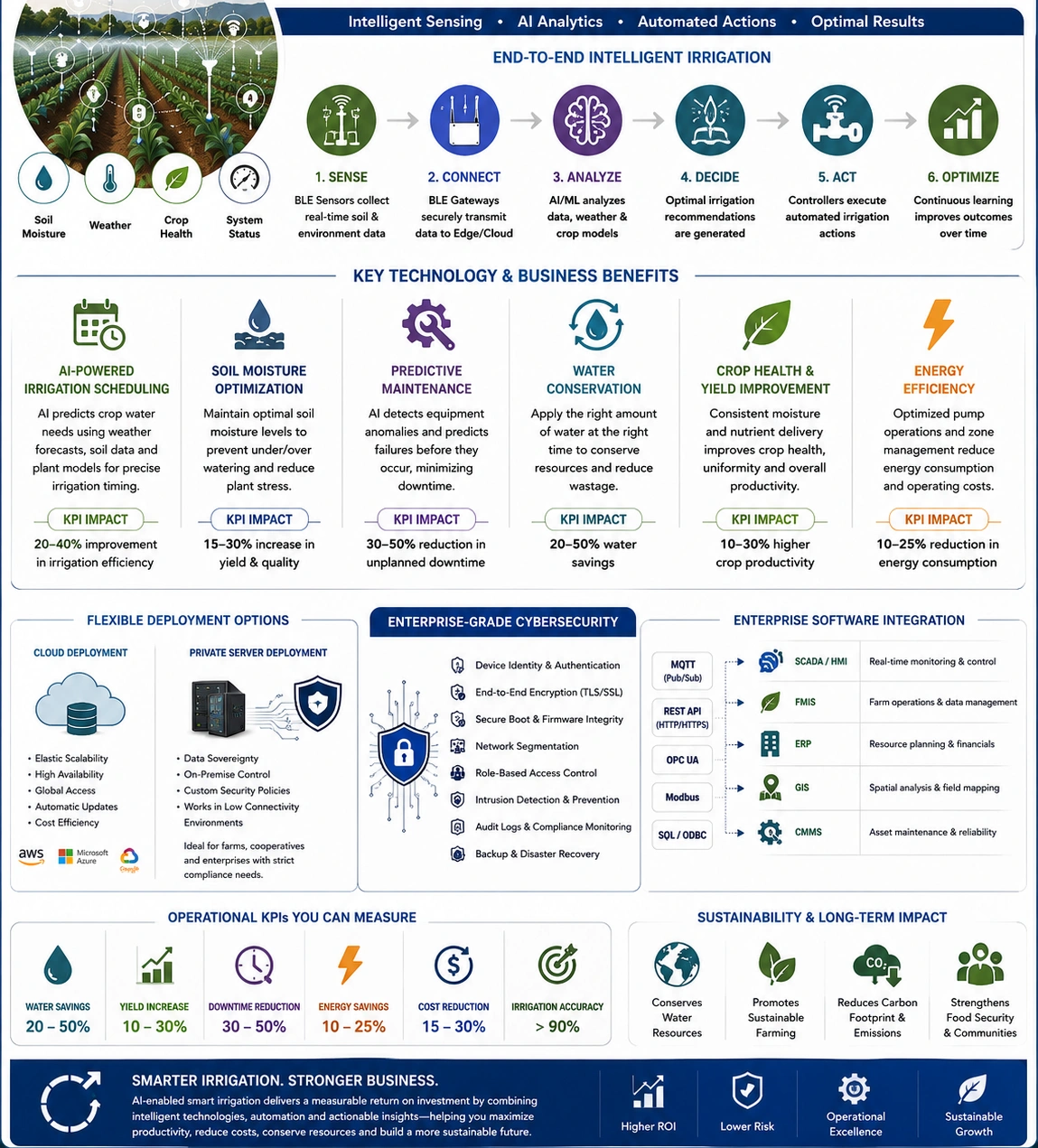
This executive infographic summarizes the technical, operational, and business benefits of AI-enabled smart irrigation powered by Bluetooth Low Energy (BLE), artificial intelligence, and enterprise IoT technologies. It highlights intelligent irrigation scheduling, soil moisture optimization, predictive maintenance, water conservation, crop health improvement, energy efficiency, flexible cloud and private server deployment, enterprise-grade cybersecurity, integration with enterprise software platforms, measurable operational KPIs, and sustainability outcomes.
Engineering Recommendations for Successful Smart Irrigation Deployments
Successful AI-enabled smart irrigation projects require careful planning that extends beyond hardware installation.
Recommended engineering practices include:
- Conduct detailed site surveys covering soil variability, irrigation zones, topography, crop types, and hydraulic infrastructure.
- Select BLE sensors based on measurement accuracy, environmental ratings, battery life, and calibration requirements.
- Design communication coverage with redundant gateway placement to minimize signal loss.
- Validate AI models using local agronomic data before enabling automated irrigation decisions.
- Integrate irrigation intelligence with existing FMIS, GIS, SCADA, ERP, and maintenance software.
- Establish cybersecurity policies covering device authentication, firmware management, encryption, and network segmentation.
- Continuously monitor key performance indicators including water-use efficiency, irrigation uniformity, system availability, leak frequency, pumping energy, equipment reliability, and crop response.
- Develop preventive maintenance schedules for sensors, gateways, pumps, valves, and communication infrastructure.
- Periodically review AI model performance as crop varieties, climate patterns, irrigation equipment, and production objectives evolve.
Organizations implementing these practices are better positioned to achieve reliable operation, measurable resource savings, and long-term scalability.
Conclusion
AI-powered smart irrigation supported by BLE sensing technologies is transforming agricultural water management through intelligent monitoring, predictive analytics, and automated decision-making. Continuous environmental sensing, edge computing, enterprise software integration, and advanced AI models enable irrigation systems to respond dynamically to changing field conditions while improving crop productivity, reducing water consumption, lowering operating costs, and strengthening sustainability initiatives. Careful attention to communication design, cybersecurity, deployment strategy, software integration, and lifecycle maintenance ensures that these solutions remain reliable and scalable as agricultural operations expand.
Headquartered in New York City and Toronto, Canada, GAO is recognized among the world’s leading B2B suppliers of BLE and RFID technologies. Together with its sister companies, GAO Research Inc. and GAO Tek Inc., we have invested extensively in research and development, supported customers for more than three decades, and delivered industrial IoT hardware and expert technical assistance to organizations across North America. We invite you to learn more about GAO’s smart irrigation technologies, engineering expertise, and technical support for AI-enabled agricultural solutions.
Building the Future of Industrial AI and IoT with Aperture Venture Studio and GAO RFID Inc.
For more than three decades, GAO Group of Companies has invested heavily in research and development of industrial BLE, RFID, and IoT technologies. As generative AI has demonstrated significant value in agricultural automation and industrial operations, we have accelerated the development of AI and IoT solutions, including BLE and RFID technologies, and established Aperture Venture Studio to help advance, commercialize, and expand practical AI and IoT innovations across agriculture and many other industries. Aperture has attracted leading AI and IoT experts, experienced business leaders, influential investors, and established organizations. Through initiatives such as the Aperture Ventures Summit and TekSummit, we have fostered strong technical communities dedicated to advancing AI and IoT. We welcome advisors, co-founders or employees, investors, and customers to join us in shaping the future of intelligent connected technologies.