
AI and BLE for Chip Packaging Facilities
AI-Driven Operations for Chip Packaging Facilities
AIoT combines artificial intelligence with connected sensors, equipment, and industrial systems to turn operational data into decisions and actions. For chip packaging facilities, AI-enabled BLE solutions can improve how semiconductor packages, substrates, lead frames, trays, carriers, tooling, test fixtures, and production-support assets are located, monitored, and managed across controlled manufacturing environments. BLE beacons, BLE sensors, and BLE gateways provide location and condition data that can be correlated with manufacturing execution system (MES) records, equipment status, maintenance history, quality events, and material movements.
The resulting system can support real-time asset visibility, work-in-process tracking, environmental monitoring, predictive maintenance, material-flow analysis, and exception management. AI models can identify abnormal movement patterns, predict equipment-service requirements, detect process-support anomalies, and prioritize operational responses. For packaging facilities handling high-value semiconductor materials and tightly controlled production processes, the combination provides a practical way to connect physical operations with data-driven decision-making.
Why AI Matters in Semiconductor Packaging Operations
Chip packaging facilities operate across a sequence of tightly coordinated activities that may include wafer preparation and incoming inspection, die handling, die attach, wire bonding, flip-chip assembly, molding, curing, singulation, marking, package inspection, electrical testing, packing, and shipment. Production-support activities such as material staging, tooling preparation, equipment changeover, preventive maintenance, calibration, environmental monitoring, and quality investigation must remain synchronized with these processes.
A packaging operation can therefore generate large volumes of operational information without necessarily having a complete picture of what is happening to physical assets at each point in the process. Conventional records may indicate that a carrier, fixture, material lot, or maintenance tool was issued, but they may not provide continuous information about its physical location, environmental exposure, dwell time, or movement history.
AI can add analytical capability to this operational data.
- AI asset tracking can identify unusual movement, prolonged dwell, misplaced production-support equipment, or unexpected routing.
- AI material-flow analysis can examine movement histories to identify congestion around die attach, molding, singulation, inspection, or test areas.
- AI maintenance analytics can correlate equipment utilization, sensor readings, maintenance records, and production schedules to identify developing service needs.
- AI environmental monitoring can detect abnormal temperature, humidity, vibration, or other conditions affecting sensitive materials and packaging operations.
- AI workflow optimization can compare actual movement and processing times with expected production sequences.
- AI exception management can prioritize events according to production impact, material value, process criticality, and historical risk.
- AI quality support can associate physical asset histories with manufacturing records during root-cause investigations.
The value does not come from BLE alone. BLE provides a practical source of physical-world data, while AI determines patterns, relationships, predictions, and recommended actions from that data.
Where AI-Enabled BLE Creates Value in Chip Packaging Facilities
Work-in-Process and Carrier Visibility
Packaging facilities depend on the controlled movement of wafers, substrates, lead frames, trays, carriers, reels, magazines, package components, and partially completed assemblies. Delays can occur when material is staged in the wrong area, a carrier is difficult to locate, or a work order waits for material or tooling.
BLE-enabled location monitoring can provide movement events as tagged assets pass through designated production areas. AI can analyze those events against MES schedules and expected routing.
A practical system can flag conditions such as:
- A carrier remaining too long near a staging area.
- A production lot moving toward an unexpected process area.
- Repeated back-and-forth movement between inspection and production stations.
- Material waiting substantially longer than historical process intervals.
- A production-support asset entering a restricted or inappropriate area.
- A high-value fixture being absent when a scheduled operation is approaching.
The objective is not simply to display an asset on a floor map. The more useful objective is to determine whether its location and movement are consistent with the packaging process.
Tooling and Fixture Management
Die attach tools, bonding fixtures, test fixtures, molds, carriers, jigs, sockets, gauges, and other production-support assets can be difficult to manage when multiple packaging lines share equipment.
BLE beacons attached to suitable reusable assets can provide identification and location events through BLE gateways positioned around production and support areas. AI can analyze utilization patterns to identify frequently moved tools, underutilized assets, unusual transfers, and recurring shortages.
For example, if a particular wire-bonding fixture repeatedly arrives late at a scheduled workstation, historical movement data can reveal whether the cause is insufficient inventory, inefficient staging, excessive movement between lines, or a maintenance-related delay.
GAO can supply BLE hardware products and systems that support these types of asset-monitoring deployments, allowing the facility to select device configurations according to asset size, operating environment, required battery life, and location accuracy.
Equipment and Maintenance Monitoring
Packaging equipment can include die bonders, wire bonders, flip-chip bonders, molding systems, curing ovens, singulation equipment, marking systems, inspection stations, handlers, testers, conveyors, and automated material-handling equipment.
BLE is not normally a replacement for native equipment-control interfaces. Its value is often complementary. BLE sensors can provide additional information around equipment, support assets, environmental conditions, or maintenance resources that may not be available through existing machine interfaces.
AI can combine these observations with equipment utilization and maintenance records.
A maintenance model might evaluate:
- Equipment operating or utilization intervals.
- Vibration or temperature trends from suitable BLE sensors.
- Frequency and duration of maintenance interventions.
- Repeated technician visits.
- Spare-tool movement patterns.
- Production volume associated with specific equipment.
- Historical failure and repair records.
- Abnormal changes preceding previous equipment events.
The result can be a maintenance priority rather than a simple alarm. A technician may receive a recommendation to inspect a particular machine or support component because its operating pattern resembles conditions previously associated with failures.
AI-Enabled Maintenance Workflow for Semiconductor Chip Packaging
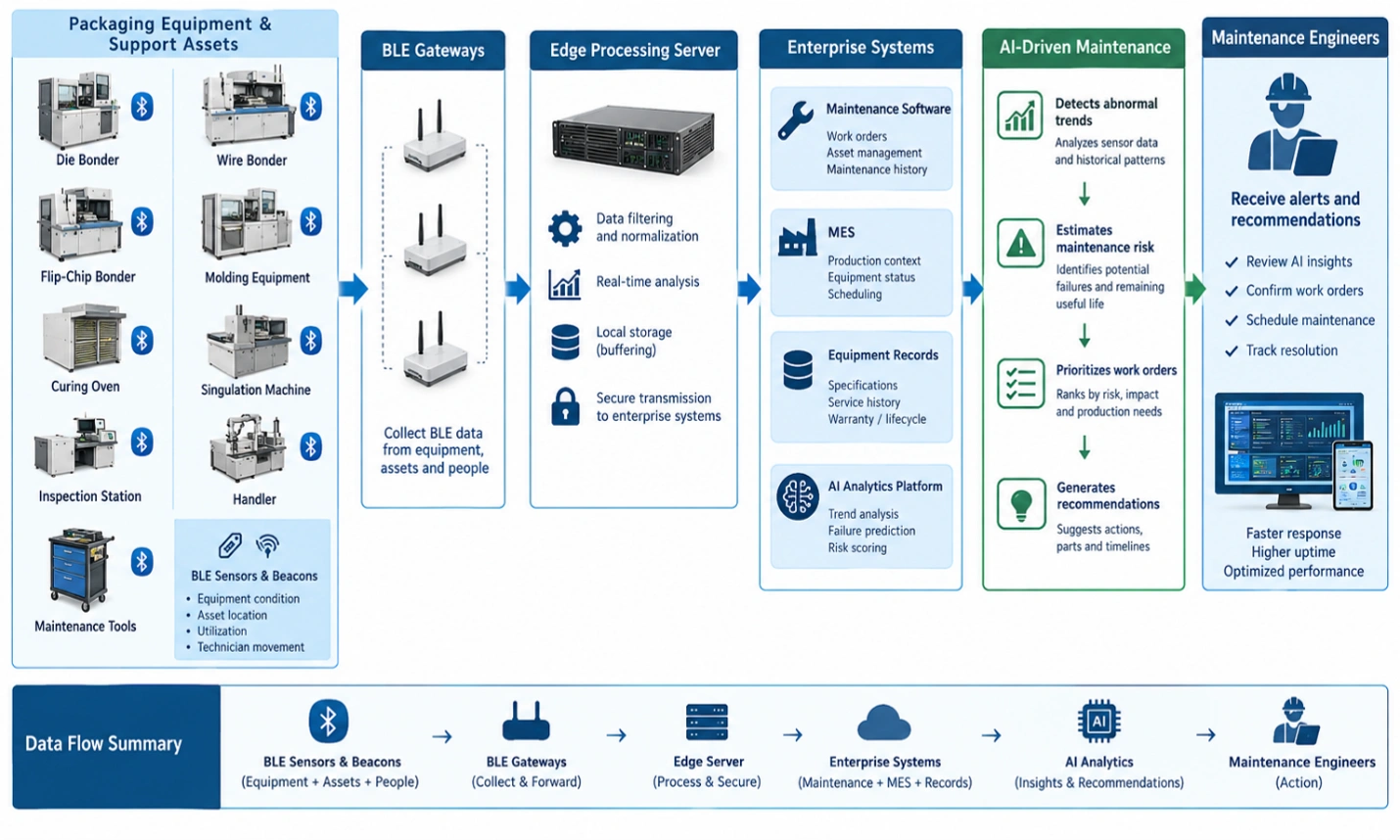
Chip Packaging Workflows Supported by AI and BLE
Material Staging and Line Feeding
Material availability directly affects packaging-line utilization. Substrates, lead frames, trays, carriers, molding compounds, bonding materials, consumables, and packaging components may need to reach specific workstations at controlled times.
BLE location data can establish where reusable carriers and selected material-handling assets are located. AI can then compare asset positions with production schedules and material requirements.
This supports decisions such as:
- Which material-handling assets should be moved first.
- Which staging areas are becoming congested.
- Which production line is likely to experience a support-material delay.
- Which carriers have remained outside their expected process window.
- Which reusable containers require replenishment or return.
This approach can reduce time spent searching for physical resources without attempting to automate safety-critical material decisions without appropriate human validation.
Die Attach and Wire Bonding Support
Die attach and wire bonding involve specialized equipment, fixtures, tooling, material handling, and quality controls. Production interruptions may result from unavailable tooling, delayed carriers, maintenance requirements, or unexpected equipment-support activity.
AI can use historical BLE movement data to identify recurring operational patterns. For example, repeated delays between a tool crib and a bonding line can indicate that tooling is being staged too late or that the current tool inventory is insufficient for the production schedule.
BLE location information can also help distinguish between a genuine equipment shortage and a simple location problem. That distinction is important because adding equipment does not solve a problem caused by poor asset visibility.
Molding, Curing, and Singulation
Molding and curing introduce additional process dependencies involving molds, compounds, trays, carriers, curing equipment, and downstream inspection or singulation.
AI can analyze dwell times and movement sequences to identify deviations from normal material flow. A carrier that remains near a curing area substantially longer than historical norms may warrant investigation, particularly when the production schedule indicates that downstream singulation should already have started.
BLE sensors can also support monitoring of selected environmental or equipment conditions where the sensor specifications are suitable for the facility’s operating environment.
Inspection and Electrical Test
Automated optical inspection, package inspection, electrical test, burn-in, handlers, sockets, fixtures, and test-support equipment can create complex movement patterns.
AI can correlate asset movement with test schedules and quality records to identify:
- Test fixtures that are repeatedly unavailable.
- Abnormal movement between test cells.
- Excessive fixture dwell time.
- Repeated transfers associated with particular package types.
- Maintenance assets repeatedly required at specific test stations.
- Potential bottlenecks caused by shared equipment.
The resulting information can help operations and engineering teams investigate throughput limitations using historical evidence rather than relying only on manual observations.
AIoT Data Flow for Chip Packaging Facilities
A practical AIoT solution begins with physical observations and ends with an operational decision. Each layer must be engineered around the packaging process rather than deployed as an isolated tracking system.
Data Acquisition
BLE beacons can identify carriers, tooling, fixtures, maintenance equipment, or other suitable assets. BLE sensors can capture selected environmental or condition-related measurements. Device selection should consider cleanroom compatibility, mounting method, battery life, temperature range, electromagnetic conditions, maintenance access, and whether the asset passes through ovens, molding areas, wash processes, or other environments unsuitable for conventional devices.
BLE Gateways and Communication
BLE gateways receive transmissions from nearby BLE devices and forward relevant information to processing software. Gateway placement should account for production-cell geometry, metal equipment, walls, racks, moving machinery, electromagnetic interference, and the required location accuracy.
A facility seeking room-level asset visibility does not necessarily need the same gateway density as one requiring workstation-level location decisions. Excessive gateway density increases installation and maintenance requirements, while insufficient coverage can create ambiguous location events.
Edge Processing and Data Validation
Edge processing can filter duplicate observations, normalize device identifiers, apply timestamp validation, and reduce unnecessary upstream traffic. It can also continue selected local processing when connectivity to centralized services is temporarily unavailable.
Data quality is particularly important for AI. Incorrect timestamps, duplicate observations, missing gateway identifiers, and inconsistent asset mappings can cause an AI model to learn operational noise rather than meaningful packaging-process behavior.
AI Analytics and Operational Decisions
Validated BLE observations can be combined with MES, computerized maintenance management system (CMMS), enterprise asset management (EAM), warehouse management software, quality-management records, production schedules, and equipment data.
AI models may include anomaly detection, classification, forecasting, clustering, time-series analysis, and predictive models. The appropriate method depends on the decision being supported and the quality and volume of available historical data.
AIoT Architecture for Semiconductor Chip Packaging
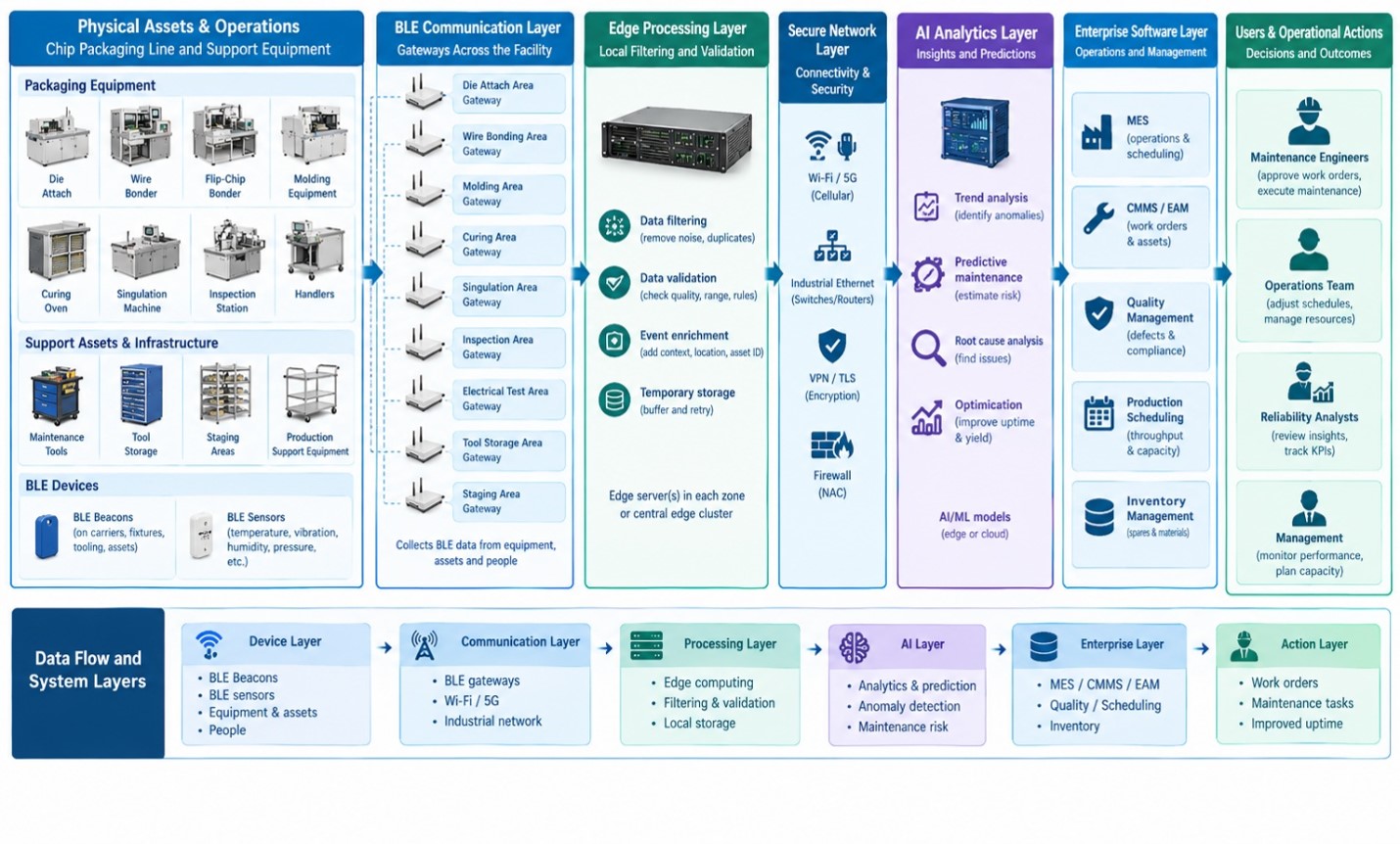
BLE Hardware Selection for Packaging Facilities
BLE device selection should follow the physical and process requirements of the packaging facility rather than starting with a preferred device type.
| Requirement | Relevant BLE consideration | Chip packaging application |
|---|---|---|
| Asset identification | Beacon identifier, mounting method, battery life | Carriers, fixtures, tooling |
| Location visibility | Gateway density and signal behavior | Production cells and staging areas |
| Environmental monitoring | Sensor type, measurement range, calibration | Storage and controlled production areas |
| Equipment monitoring | Suitable condition sensors | Maintenance and support equipment |
| Cleanroom requirements | Materials, enclosure, mounting, maintenance procedure | Controlled packaging areas |
| Battery management | Battery chemistry, reporting interval, replacement access | Long-term asset tracking |
| Metal-rich environment | RF propagation and mounting position | Bonding and test equipment areas |
| Data integration | Gateway APIs and software interfaces | MES, CMMS/EAM, analytics |
Metal equipment and dense production machinery deserve particular attention because BLE radio behavior can change significantly around conductive surfaces. A beacon mounted directly against metal may behave differently from one mounted on a polymer carrier or fixture. Site testing should therefore be performed using the actual mounting method and representative production equipment.
GAO’s BLE hardware selection can be evaluated around these operational factors, including beacon form factor, BLE sensor capabilities, gateway placement, power requirements, and integration needs.
Cloud and Server Deployment for Chip Packaging AIoT
A chip packaging facility can use either a cloud-hosted deployment or privately hosted server software depending on production connectivity, cybersecurity requirements, data-governance policies, integration constraints, and operational preferences.
A Cloud Version can centralize BLE data, AI analytics, dashboards, asset histories, and software integrations through cloud infrastructure. This model can be appropriate when multiple packaging facilities need centralized analytics, corporate engineering teams require cross-site visibility, or the organization prefers cloud-managed software.
A Server Version can run software on factory servers, customer-managed infrastructure, private data centers, edge servers, or other privately hosted enterprise infrastructure. This approach can be useful when production data must remain within controlled environments, when integration with local MES and equipment systems is critical, or when connectivity to external cloud services is restricted.
Hybrid designs are also practical. Time-sensitive filtering and selected AI functions can run close to the packaging operation while aggregated data and longer-term analytics are handled centrally. The key engineering decision is not simply cloud versus server. It is determining where each data-processing function should operate based on latency, availability, security, integration, and operational requirements.
AI-Enabled Operational Capabilities in Chip Packaging Facilities
AI becomes most useful when BLE observations are connected to decisions that affect throughput, quality, maintenance, material availability, and production control. The following capabilities are particularly relevant to semiconductor packaging facilities.
Real-Time Asset Visibility and Location Intelligence
A BLE-based asset system can provide current and historical location information for carriers, fixtures, tooling, maintenance equipment, carts, and other reusable assets. AI can move this capability beyond simple location display by learning normal movement patterns.
For example, an AI model can establish expected routes between material storage, staging, die attach, wire bonding, molding, curing, singulation, inspection, and test. Deviations can then be identified as exceptions rather than requiring operators to manually inspect every movement.
This can help packaging operations reduce asset-search time, identify misplaced tooling, improve line-side availability, and understand where physical movement is creating production delays.
Production Flow and Bottleneck Analysis
Packaging throughput depends on coordination among equipment, operators, material handlers, carriers, tooling, and production schedules. BLE movement events provide another source of evidence for understanding these interactions.
AI can analyze dwell time, queue duration, transfer frequency, and movement sequences. When combined with MES data, the analysis can distinguish between a material waiting because a downstream machine is occupied and a material waiting because it has not been correctly staged.
Useful KPIs include:
- Work-in-process dwell time
- Average carrier travel time
- Queue time by process step
- Tool retrieval time
- Production-line support response time
- Equipment utilization
- First-pass yield
- Cycle time
- On-time completion
- Unplanned downtime
The resulting analysis can support production engineering and industrial engineering teams when evaluating line balancing or changes to material staging.
Predictive Maintenance and Condition-Based Service
Predictive maintenance should not be implemented simply because an AI model is available. The model must have a measurable relationship to equipment condition or failure risk.
BLE sensors can provide selected vibration, temperature, humidity, or other measurements where the sensor’s specification and mounting arrangement are appropriate. AI can analyze time-series behavior and combine it with maintenance work orders, equipment utilization, alarms, and failure history.
A packaging facility might use this approach to prioritize inspection of equipment showing an unusual condition trend rather than applying identical maintenance urgency to every machine.
Human maintenance engineers should remain responsible for confirming maintenance actions, especially where equipment intervention could affect product quality, safety, or validated processes.
Integration with Semiconductor Manufacturing Software
AI-enabled BLE solutions become substantially more useful when their data is connected with systems already used to control packaging operations.
MES Integration
The MES can provide production context such as:
- Work-order identity
- Product and package type
- Lot or batch information
- Process routing
- Work-center assignment
- Production status
- Equipment association
- Process completion events
BLE data can provide physical context around these records. Combining the two allows software to determine whether a physical carrier or fixture is where it should be for a particular production operation.
Care is required around data ownership. The BLE system should not become an uncontrolled parallel source of production truth. Production status should remain governed by the appropriate manufacturing system, while BLE contributes location and physical-observation data.
CMMS and EAM Integration
CMMS or EAM software can provide maintenance schedules, work orders, technician assignments, equipment history, spare-part records, and failure information.
BLE data can add the physical location of maintenance tools, equipment, selected spare assets, or technicians’ authorized work resources. AI can then identify relationships between maintenance activity and asset movement.
A useful implementation can automatically associate the location of a maintenance resource with a work order while retaining appropriate authorization and audit controls.
Quality Management Integration
Quality systems may contain nonconformance records, inspection results, corrective actions, process deviations, and investigation histories.
BLE movement histories can provide supporting evidence during investigations. For example, engineering teams may examine whether a fixture, carrier, or production-support asset passed through an unexpected area before a quality event.
Such information should be treated as supporting evidence rather than automatic proof of causation. Root-cause analysis still requires process, equipment, material, and quality expertise.
AI-Enabled BLE Integration Architecture for Semiconductor Chip Packaging
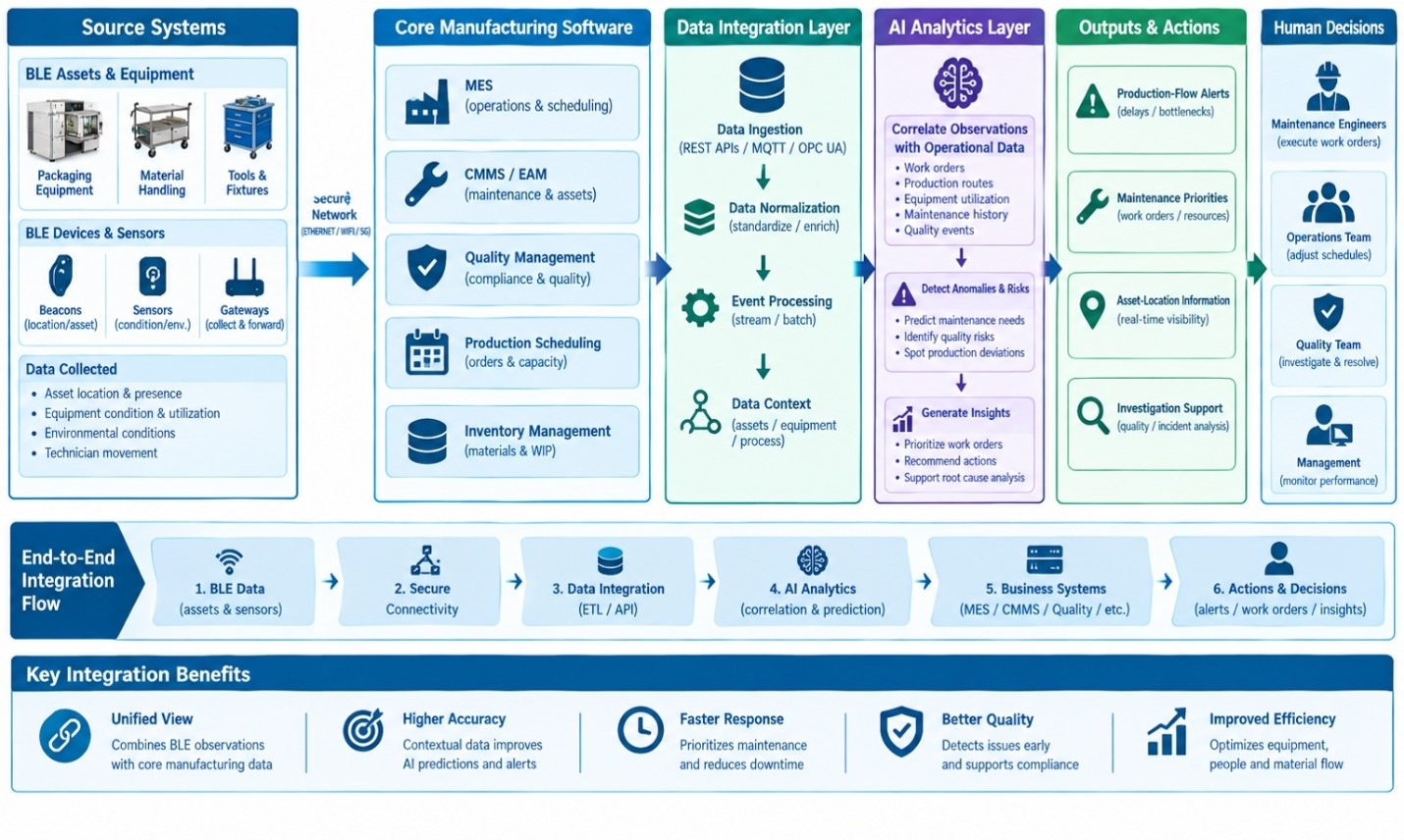
Commissioning and Validation of AIoT Systems
Deployment should begin with a controlled pilot rather than immediately installing BLE devices throughout an entire packaging facility.
A representative pilot can include one production area, selected carriers or fixtures, several gateways, and a defined set of operational questions. Engineering teams can then validate radio coverage, asset identification, location behavior, data quality, gateway reliability, and software integration.
Site Survey and Radio Testing
A BLE survey should consider:
- Production equipment and metal structures
- Equipment enclosures
- Racks and material-storage locations
- Cleanroom partitions
- Human traffic
- Automated material-handling equipment
- Gateway mounting height
- Beacon orientation
- Expected interference
- Required location granularity
Testing should use actual production conditions where possible. A laboratory test using an empty room may not accurately represent RF behavior around production machinery.
Data Validation
Before AI models are introduced, engineering teams should verify that the underlying observations are trustworthy.
Validation should include:
- Device identity accuracy
- Timestamp consistency
- Gateway identification
- Duplicate-event handling
- Missing-event detection
- Battery status
- Sensor measurement plausibility
- Asset-to-device mapping
- Location-zone accuracy
- Network connectivity
Poor data quality can produce false alarms and misleading AI recommendations. Data validation therefore represents a core engineering requirement rather than an optional software feature.
AI Model Commissioning
AI models should first operate in observation or advisory mode. Historical data can establish baseline behavior, while engineers compare AI findings with known production conditions.
Performance should be evaluated using measurable criteria such as:
- False-positive rate
- False-negative rate
- Detection latency
- Prediction accuracy
- Alert precision
- Alert frequency
- Mean time to acknowledge
- Mean time to resolve
- Operational impact of recommended actions
A model should not be considered successful merely because it generates a large number of alerts.
AI-Enabled BLE System Commissioning Workflow for Semiconductor Packaging
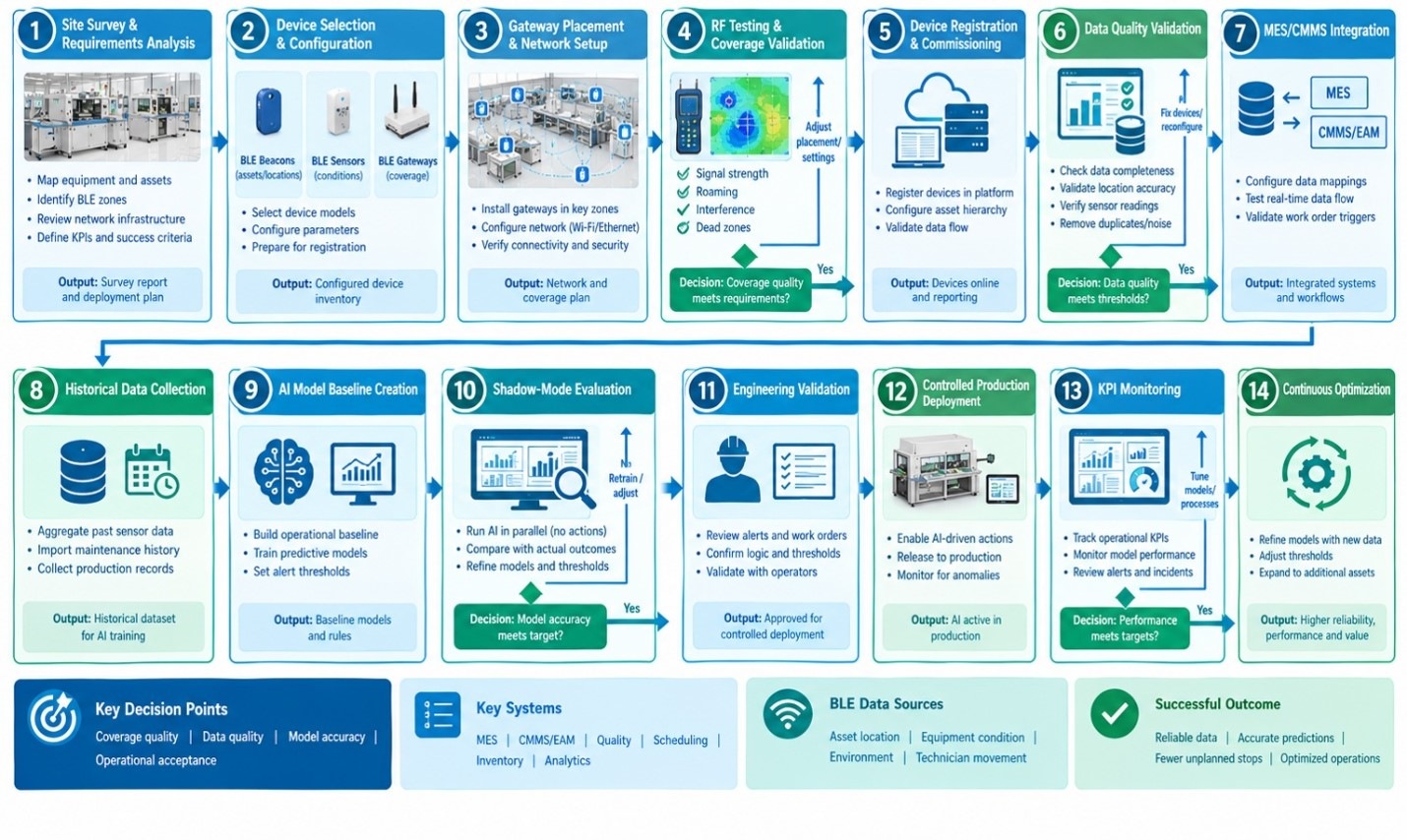
Cybersecurity and Data Protection
BLE devices introduce wireless communication into an environment that may already contain industrial Ethernet, Wi-Fi, equipment networks, servers, and manufacturing applications. Security must therefore cover the complete data path.
Relevant controls can include:
- Device identity management
- Secure gateway configuration
- Network segmentation
- Role-based access control
- Encrypted communications where supported
- Credential management
- Software patching
- Gateway hardening
- Audit logging
- API authentication
- Server access controls
- Monitoring for abnormal device behavior
- Controlled administrative privileges
Production networks should be segmented according to the facility’s cybersecurity policy. BLE gateways should not automatically receive unrestricted access to MES, equipment-control networks, or corporate systems.
The distinction between monitoring and control is also important. A BLE system collecting location information has a different risk profile from a system authorized to issue commands to manufacturing equipment. AI-generated recommendations should normally pass through established operational controls before they can affect production processes.
GAO’s hardware and systems can be evaluated as part of a broader security design that includes the customer’s network controls, software environment, access policies, and operational procedures.
Performance Optimization and Scalability
Once the initial deployment is operational, optimization should focus on measurable production outcomes rather than the number of connected devices.
Gateway placement can be refined where location accuracy is inadequate. Reporting intervals can be adjusted to balance responsiveness with battery consumption. AI models can be retrained as production patterns change. Asset groups can be expanded when the initial use case demonstrates measurable value.
Scaling Across Packaging Lines
A facility can expand from one production cell to multiple packaging lines, process areas, tool rooms, maintenance zones, and material staging locations.
Scaling considerations include:
- Device inventory management
- Gateway capacity
- Network bandwidth
- Data retention
- Asset master-data quality
- AI model lifecycle management
- Software licensing
- Battery replacement procedures
- Cybersecurity monitoring
- Cross-line reporting
- Integration with additional MES or maintenance records
Multi-site organizations should also determine whether models should be centrally managed or locally adapted. Packaging processes, equipment mixes, environmental conditions, and operating practices can differ substantially between facilities.
Practical KPIs for AI-Enabled Chip Packaging Facilities
A deployment should establish baseline measurements before claiming operational improvement.
| KPI | AIoT contribution |
|---|---|
| Asset search time | Identifies location and movement history |
| Carrier dwell time | Detects abnormal process waiting |
| Tool availability | Shows where shared tooling is located |
| Material staging delay | Identifies late or misplaced resources |
| Equipment utilization | Correlates physical activity with production data |
| Unplanned downtime | Supports maintenance analysis |
| Mean time to repair | Helps locate maintenance resources |
| Maintenance response time | Tracks movement and work-order timing |
| Production cycle time | Analyzes physical process flow |
| Queue time | Identifies congestion between operations |
| First-pass yield | Provides contextual data for investigations |
| On-time production completion | Connects physical movement with schedules |
| Inventory accuracy | Supports physical asset verification |
| Environmental excursions | Detects abnormal monitored conditions |
| Alert precision | Measures AI usefulness |
| False-positive rate | Controls unnecessary interventions |
The most valuable KPI depends on the business problem. A facility experiencing recurring tooling shortages should prioritize tool availability and retrieval time rather than beginning with a broad asset-tracking deployment.
Engineering Trade-Offs and Implementation Lessons
Several practical trade-offs should be addressed before full deployment.
Location accuracy versus infrastructure cost: More gateways can improve zone discrimination, but they increase installation, network, power, and maintenance requirements.
Reporting frequency versus battery life: Frequent beacon or sensor transmissions provide more observations but can shorten battery life. The appropriate interval depends on how quickly the operational condition must be detected.
Cloud analytics versus local processing: Cloud services can simplify centralized analysis, while local processing can reduce dependency on external connectivity and keep selected operational data within controlled infrastructure.
AI complexity versus explainability: A highly complex model is not automatically better for manufacturing operations. Engineers may prefer models that provide interpretable reasons for an alert, particularly when decisions affect production schedules or maintenance.
Automation versus human control: AI recommendations can accelerate decisions, but safety-critical and quality-critical actions should retain appropriate human authorization and established process controls.
Coverage versus maintainability: Installing devices everywhere can create unnecessary maintenance work. Asset selection should focus on physical resources whose visibility has a measurable operational benefit.
Business Value of AI-Enabled BLE for Chip Packaging Facilities
A properly designed system can deliver value across several operational dimensions.
- Higher production visibility: Physical movement becomes measurable rather than dependent entirely on manual updates.
- Reduced asset-search time: Engineers and operators can locate selected carriers, fixtures, tooling, and support resources more quickly.
- Improved production flow: AI can identify abnormal dwell and recurring movement bottlenecks.
- Better maintenance prioritization: Condition and utilization information can supplement maintenance records.
- Stronger quality investigations: Historical movement provides additional context for selected nonconformances and process events.
- Improved material coordination: Location information helps identify staging and availability problems.
- Scalable operational analytics: Historical BLE observations can support trend analysis as more packaging lines become connected.
- Better resource utilization: Shared tooling and support equipment can be analyzed according to actual movement and usage patterns.
These outcomes depend on disciplined implementation. Connecting BLE devices without reliable asset master data, validated workflows, suitable integration, and measurable KPIs is unlikely to produce sustained value.
Implementing AI and BLE in Chip Packaging Facilities with GAO
A practical implementation should begin with a clearly defined operational problem. Examples include excessive tooling-search time, carrier-location uncertainty, material-staging delays, maintenance-resource visibility, or unexplained production-flow bottlenecks.
GAO has supplied BLE, RFID, and IoT hardware products and systems to organizations requiring physical-world data collection and connected operational solutions. For chip packaging facilities, implementation discussions can focus on the required asset types, operating areas, location precision, sensor measurements, gateway coverage, software integration, deployment model, and cybersecurity requirements rather than starting with technology selection alone.
A disciplined deployment typically progresses from process assessment and site survey to pilot installation, data validation, software integration, AI evaluation, KPI measurement, and controlled expansion. This approach gives engineering teams evidence that the solution addresses an actual packaging-facility requirement before broader deployment.
Key Takeaways for AI-Enabled Chip Packaging Operations
AI-enabled BLE systems can give chip packaging facilities a stronger connection between physical production activity and digital decision-making. BLE beacons and sensors provide observations from carriers, tooling, fixtures, maintenance resources, and selected operating conditions, while gateways transport those observations to processing and enterprise software.
AI adds value by identifying abnormal movement, predicting selected maintenance conditions, analyzing production flow, and prioritizing operational exceptions. MES, CMMS/EAM, quality software, and production scheduling provide the context needed to make those insights useful.
Successful implementation depends on accurate data, appropriate device placement, validated workflows, cybersecurity controls, measurable KPIs, and careful integration with existing manufacturing systems. Organizations evaluating these applications can learn more from GAO about BLE hardware products, IoT systems, deployment approaches, and technical support for connected manufacturing environments.
About GAO and Its Industrial Technology Experience
Headquartered in New York City and Toronto, Canada, GAO is among the top 10 leading B2B and B2G suppliers of BLE and RFID technologies globally, with additional activity in B2B2C and B2D markets. GAO, GAO Research Inc., and GAO Tek Inc. form GAO Group, with operations based in New York City and Toronto.
For three decades, GAO Group has served organizations across the United States and Canada, including Fortune 500 companies, leading R&D firms, universities, and U.S. and Canadian government agencies. Its work includes substantial investment in product and systems R&D, stringent quality assurance processes, and technical support delivered remotely or onsite. For organizations evaluating AIoT for chip packaging facilities, this experience provides a foundation for assessing connected hardware, system integration, deployment requirements, and long-term operational support.
Primary Keywords: AI for chip packaging facilities, AI and BLE for chip packaging facilities, AIoT chip packaging, AI asset tracking semiconductor packaging, AI manufacturing monitoring, BLE chip packaging facilities
Secondary Keywords: BLE gateways, BLE beacons, BLE sensors, semiconductor packaging, semiconductor assembly, die attach, wire bonding, flip-chip packaging, molding, curing, singulation, package inspection, electrical testing, MES integration, CMMS integration, predictive maintenance, asset tracking, production flow monitoring, AI manufacturing analytics, industrial IoT, Edge AI, semiconductor manufacturing systems, packaging equipment monitoring.
Building the Future of Industrial AI and IoT with Aperture Venture Studio and GAO RFID Inc.
For more than three decades, GAO Group of Companies has invested heavily in industrial BLE, RFID, and IoT R&D. As AI became increasingly useful for industrial applications, we expanded work on AIoT technologies and founded Aperture Venture Studio to advance AI and IoT solutions relevant to manufacturing environments such as chip packaging facilities. Aperture brings together AI and IoT technical experts, entrepreneurs, operational executives, investors, and leading companies. Through Aperture Ventures Summit and TekSummit, we also support technical discussions around advanced AI and IoT applications. We welcome advisors, co-founders or employees, investors, and customers.