
AI and BLE for Visitor Experience in Positioning & Location-Based Services
AI Visitor Experience for Real-Time Location and Engagement
AI-powered visitor experience solutions use location data, behavioral analytics, digital maps, mobile applications, and connected facility systems to make visitor journeys more responsive and measurable. BLE gateways, beacons, and sensors provide a practical source of proximity and location signals that AI software can interpret for wayfinding, exhibit engagement, queue analysis, occupancy awareness, personalized content, and operational decision-making.
For museums, galleries, science centers, zoos, aquariums, convention venues, stadiums, cultural attractions, campuses, transportation facilities, and large public venues, visitor experience depends on more than delivering information. Operators need to understand where visitors move, where they stop, which exhibits attract attention, where queues develop, and where navigation becomes difficult. AI can transform these signals into recommendations and automated actions, while BLE helps establish location context at practical indoor ranges.
GAO supplies BLE beacons, gateways, sensors, and related IoT hardware products and systems that organizations can incorporate into visitor-location solutions. Our experience supplying connected hardware for positioning and tracking applications supports deployments where reliable device behavior, gateway coverage, battery management, and system integration are critical.
AI-Powered Visitor Experience Journey Map
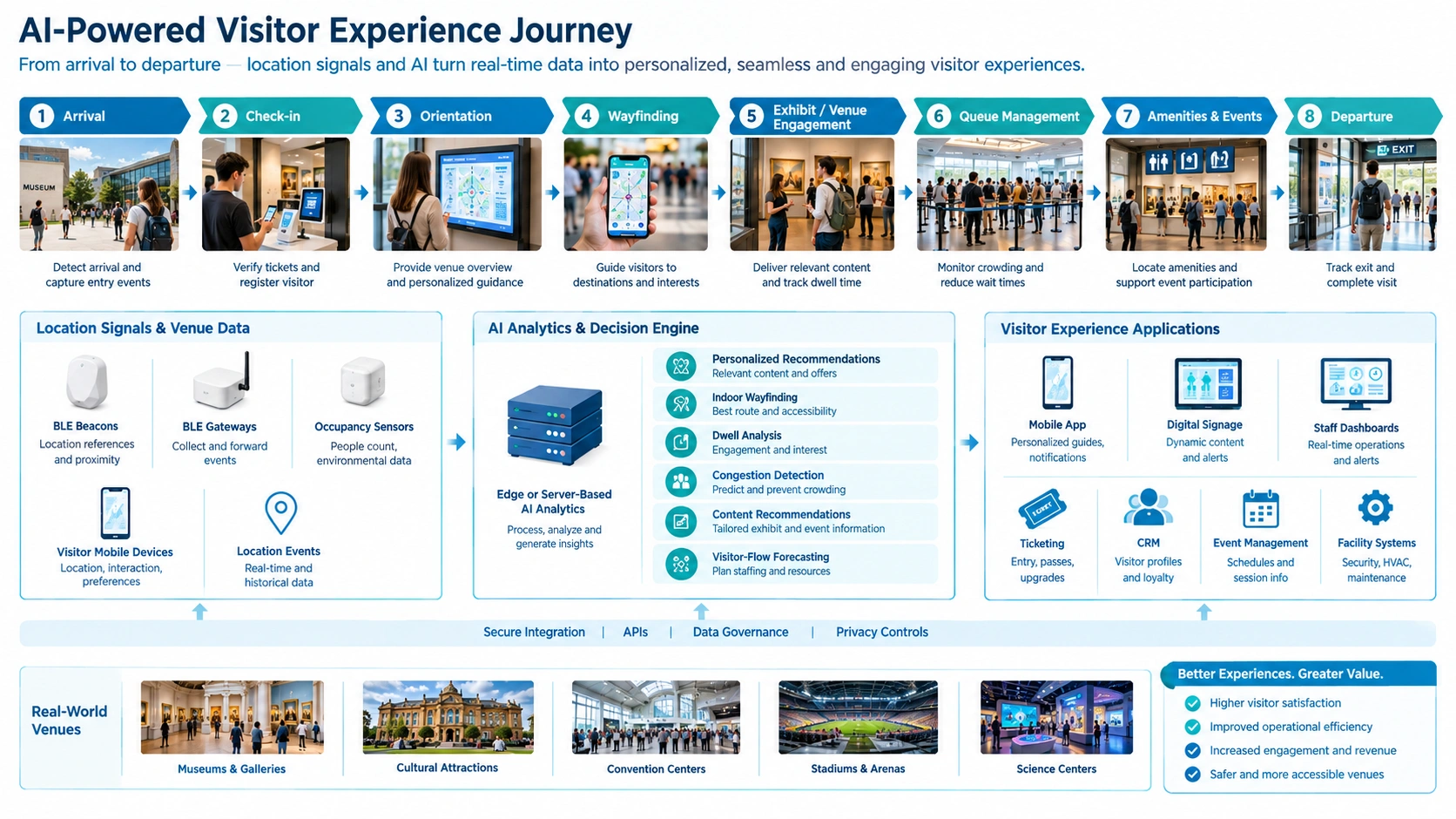
The infographic shows how BLE location signals and venue data move through AI analytics to support wayfinding, personalized recommendations, dwell analysis, congestion detection, and visitor-flow forecasting. It connects these capabilities to mobile apps, digital signage, staff dashboards, ticketing, CRM, event management, and facility systems across major visitor venues.
What AI-Powered Visitor Experience Means for Location-Based Services
AI-powered visitor experience combines artificial intelligence with real-world location and interaction data to understand visitor behavior and improve services. BLE contributes proximity and presence information, while other systems can provide ticketing events, mobile-app interactions, Wi-Fi telemetry, video analytics, occupancy counts, transaction records, and facility data.
The resulting solution can answer operational questions such as:
- Which gallery zones receive the highest visitor traffic during different hours?
- Where do visitors experience navigation difficulties?
- Which exhibits generate unusually long dwell times?
- Which entrances are developing congestion?
- How does a special event change visitor movement?
- Which amenities are difficult for visitors to locate?
- When should staff be redirected toward a crowded area?
- Which visitor segments respond to particular exhibits, events, or recommendations?
- How does visitor movement differ between weekdays, weekends, holidays, and special events?
- Which areas consistently produce short dwell times that may indicate poor engagement?
The business significance is therefore broader than indoor positioning. Location-aware AI can connect physical visitor movement with digital engagement and operational processes. A museum can correlate exhibit proximity with content interactions. A convention center can analyze movement between registration, session rooms, food service, and exhibitor areas. A stadium can combine location events with entry queues and concession activity to identify congestion and service opportunities.
GAO supports these deployments by providing BLE and IoT hardware that can be incorporated into location-based systems, while software integrators can connect the resulting data with mobile applications, analytics, CRM, ticketing, content management, and facility-management software.
Core AI and BLE Concepts for Visitor Experience
Location Signals Become Visitor Context
A BLE beacon can transmit an identifier associated with a known physical location, exhibit, room, entrance, zone, or asset. A visitor smartphone or dedicated receiver can detect nearby beacon signals. Gateways can collect BLE data from sensors or tags and forward events to local servers or cloud software.
The useful information is not simply that a BLE signal exists. The solution must establish context. A signal detected near an exhibit may indicate proximity, while repeated detections over a defined interval can contribute to dwell estimation. Multiple receivers can improve location estimation when the deployment requires greater spatial resolution.
Visitor-location data should therefore be modeled around meaningful venue zones rather than treating every raw radio event as an independent business event. Typical zones include:
- Main entrance and security screening
- Ticketing and admission areas
- Orientation spaces
- Galleries and exhibit rooms
- Interactive exhibit zones
- Auditorium and theater entrances
- Conference and session rooms
- Retail and food-service areas
- Restrooms and visitor amenities
- Emergency exits and restricted areas
- Outdoor attraction zones
- Parking and shuttle areas
AI Converts Location Events into Operational Decisions
Machine learning models can identify recurring movement patterns from historical visitor-location data. Rules-based analytics may handle immediate conditions such as excessive occupancy, while statistical models can forecast visitor volumes and expected congestion.
AI methods applicable to visitor experience include:
- Visitor-flow prediction based on historical attendance, ticket schedules, weather, events, and calendar patterns
- Dwell-time classification for exhibits and venue zones
- Anomaly detection for unusual crowd movement
- Congestion prediction around entrances, elevators, exhibits, or session rooms
- Recommendation models for relevant exhibits, sessions, attractions, or amenities
- Visitor-route optimization for indoor wayfinding
- Segmentation based on observed movement and digital engagement patterns
- Natural-language interfaces for staff querying visitor-flow data
- Computer vision combined with BLE location data where privacy policies and applicable regulations permit
- Predictive staffing recommendations based on expected visitor demand
AI should not automatically infer sensitive personal characteristics merely because location data is available. Visitor experience systems should use data minimization, appropriate consent mechanisms, access controls, retention policies, and aggregation wherever individual-level identification is unnecessary.
BLE Provides a Practical Location Layer
BLE is particularly useful where a venue needs relatively low-power proximity detection and practical indoor location coverage. Beacons can be positioned at exhibits, entrances, corridors, rooms, or other defined zones. BLE sensors can add environmental information such as temperature or occupancy-related measurements, depending on the device and application.
Gateway placement requires engineering attention. Dense walls, reinforced structures, metallic surfaces, exhibit enclosures, crowds, and equipment can affect radio propagation. A design that works during an empty-site survey may behave differently during peak attendance.
GAO can supply BLE beacons, gateways, and sensors for deployments where hardware characteristics such as transmission interval, battery life, enclosure type, mounting method, communication range, and integration interfaces must match venue conditions.
Visitor Experience Applications for AI Location Analytics
Indoor Wayfinding and Dynamic Navigation
Large visitor facilities can contain complex intersections, multiple floors, temporary exhibits, event rooms, restricted corridors, and changing access routes. Static signs may not provide sufficient guidance when an event changes room assignments or a gallery closes temporarily.
AI-powered wayfinding can combine BLE-derived proximity, digital floor plans, accessibility requirements, visitor destinations, congestion conditions, and temporary closures. A mobile application can recommend an appropriate route while the location system updates the visitor’s approximate position.
Engineering teams should distinguish between zone-level proximity and high-precision positioning. A beacon-based solution may be sufficient for triggering location-specific content or identifying the visitor’s current room. More precise navigation may require multiple BLE receivers, calibrated signal models, inertial positioning, smartphone sensor fusion, or other location technologies.
Exhibit and Attraction Engagement
Museums and cultural attractions can use BLE proximity events to trigger relevant digital content when a visitor approaches an exhibit. AI can then analyze aggregated engagement patterns to determine which exhibits attract sustained attention and which content formats produce stronger interaction.
A visitor application might provide an audio guide, multilingual information, accessibility content, historical context, related exhibits, or interactive material based on the visitor’s location. The solution should avoid excessive notifications. AI can help determine when a recommendation is relevant by considering location, recent interactions, visit context, and venue rules.
Queue and Congestion Management
Queues can form at ticket counters, security checkpoints, elevators, popular exhibits, theaters, food-service areas, and event entrances. BLE location events can provide additional evidence about movement through these zones.
AI can compare current movement patterns with historical baselines to identify developing congestion. Operations staff can receive alerts before a queue becomes a major visitor-experience problem. Depending on the venue, actions can include opening an additional admission lane, redirecting visitors, changing digital signage, assigning staff to a high-demand area, or adjusting access to a specific attraction.
Convention and Event Navigation
Convention centers create a particularly dynamic visitor environment because session schedules, room assignments, exhibitor areas, networking events, and food-service locations change throughout the day.
AI visitor analytics can identify movement between registration, keynote halls, breakout rooms, exhibition floors, and amenities. BLE location events can help determine whether attendees reach scheduled sessions efficiently and where congestion develops between sessions.
A conference organizer can use these insights to improve room assignments, signage placement, session scheduling, exhibitor positioning, and staffing. The same infrastructure can support temporary event maps without requiring a completely separate location system.
Stadium and Large Venue Visitor Operations
Stadiums and large entertainment venues experience sharp changes in visitor density before events, during intermissions, and immediately after events. Location analytics can help operations teams understand movement around gates, seating sections, restrooms, concessions, merchandise areas, and transportation exits.
AI can forecast pressure points using event schedules, ticket distributions, historical attendance, and current location patterns. BLE-enabled proximity events can complement ticketing and access-control data, helping staff distinguish normal movement from unusual congestion.
Accessibility-Aware Visitor Services
Visitor experience solutions should also account for accessibility. Wayfinding can provide routes that avoid stairs, temporary obstructions, or inaccessible entrances when appropriate facility data is available. AI can prioritize accessible paths based on the visitor’s selected requirements without requiring unnecessary collection of personal information.
BLE location information can also support location-aware accessibility services such as identifying accessible restrooms, elevators, quiet areas, assistance points, or designated entrances.
Visitor Experience Data Workflow from BLE Events to AI Decisions
A reliable AI visitor experience system begins with physical data acquisition and ends with a clearly defined operational action. Treating the workflow as a complete chain helps engineering teams identify where data quality, latency, interoperability, or security could affect the final visitor service.
Data Acquisition at Visitor Locations
BLE beacons establish location references, while BLE sensors can contribute environmental or operational measurements. Smartphones, BLE tags, kiosks, and dedicated receivers may provide additional event sources depending on the visitor service.
The deployment should establish a location dictionary that maps device identifiers to physical zones. Every beacon should have documented coordinates or zone membership, installation status, battery condition, transmission parameters, and maintenance ownership.
Communication and Edge Processing
BLE gateways collect relevant radio events and forward them using available IP connectivity such as Ethernet, Wi-Fi, or cellular networks. Edge processing can filter duplicate events, normalize timestamps, buffer temporary connectivity losses, and apply basic rules before transmitting information to centralized software.
Edge processing becomes particularly useful for venues that require rapid local alerts or cannot depend entirely on continuous external connectivity. It can also reduce unnecessary transmission of raw radio observations when summarized events are sufficient.
Middleware and Enterprise Software Integration
Middleware converts device-level information into usable application events. A normalized event might contain a device identifier, zone identifier, timestamp, signal measurement, event type, and confidence value.
APIs, message brokers, webhooks, or other integration mechanisms can connect location software with:
- Ticketing and admission systems
- Visitor mobile applications
- CRM systems
- Content management systems
- Digital signage
- Event-management software
- Museum collection and exhibit systems
- Facility-management software
- Workforce scheduling systems
- Customer-service applications
- Business intelligence dashboards
GAO’s BLE and IoT hardware can serve as the field-device layer within such integrated systems, allowing system integrators to select gateways and sensors appropriate to the venue’s physical conditions and communication requirements.
AI Analytics and Business Actions
The analytics layer transforms normalized location events into visitor-experience insights. A simple rule can trigger exhibit content when a visitor enters a defined zone. A more advanced model can estimate congestion probability from visitor-flow patterns, event schedules, historical attendance, and current movement.
The final objective should always be an operationally meaningful action. Examples include:
- Recommend an alternate route
- Trigger location-specific visitor content
- Alert staff to developing congestion
- Recommend additional staffing
- Adjust digital signage
- Identify an exhibit requiring operational review
- Forecast visitor demand for a future time period
- Provide management with visitor-flow KPIs
- Detect abnormal movement requiring investigation
Engineering Considerations Before Scaling Visitor Location Services
Successful visitor-location deployments require more than placing beacons throughout a venue. Engineers should establish the required positioning accuracy before selecting hardware. Exhibit-content triggering may need only zone-level proximity, while turn-by-turn indoor navigation demands substantially stronger location resolution.
Other design variables include visitor density, venue construction materials, beacon mounting height, radio interference, gateway placement, battery replacement access, network availability, privacy requirements, mobile-device compatibility, and temporary changes to venue layouts.
A useful deployment approach begins with a representative pilot zone. Engineers can test location accuracy during both low and peak visitor density, evaluate gateway packet reception, measure battery behavior, verify mobile-app interactions, and compare calculated dwell times against observed visitor behavior. Calibration should use real operating conditions rather than relying only on an empty-building RF survey.
AI and BLE for Visitor Experience: Deployment, Integration, and Optimization
BLE Hardware and Software Stack for Visitor Experience
A visitor-location solution depends on coordinated field hardware, communications, software, and AI processing rather than on BLE devices alone. The appropriate design depends on the venue layout, required location accuracy, visitor density, network availability, maintenance model, and integration requirements.
BLE Beacons for Venue Zones and Visitor Interactions
BLE beacons can establish location references around galleries, exhibits, entrances, session rooms, stadium sections, visitor amenities, and outdoor attraction areas. Beacon configuration should match the application. A beacon used to trigger exhibit information can operate differently from equipment supporting more frequent location updates.
Battery-powered beacons simplify installation where cabling is impractical, but maintenance planning remains important. Large museums, convention centers, and stadiums may contain hundreds or thousands of physical points that require documented battery status, mounting locations, device identifiers, and replacement procedures.
BLE Gateways for Location Event Collection
BLE gateways provide the communication bridge between local BLE devices and IP-connected software. Gateway selection should consider BLE scanning capacity, simultaneous device visibility, Ethernet or Wi-Fi connectivity, cellular options, local processing capability, enclosure requirements, and management interfaces.
Gateway placement should be validated through an RF survey and operational testing. Metallic structures, reinforced concrete, exhibit cases, crowds, elevators, and temporary structures can change radio behavior. Engineers should also consider whether a gateway failure affects one room, an entire floor, or multiple visitor zones.
BLE Sensors and Supporting Location Data
BLE sensors can supplement visitor-location information with environmental or facility measurements. Temperature, humidity, occupancy-related measurements, equipment status, and other sensor data may help explain changes in visitor behavior or operational conditions.
A museum, for example, could correlate environmental conditions with visitor movement without treating environmental data as a substitute for visitor-location information. A convention center could combine room occupancy data with session schedules to identify rooms approaching capacity.
AI Software and Data Processing
The software layer should normalize location events before AI processing. Typical data fields include device identifier, timestamp, venue zone, signal measurement, gateway identifier, event type, and confidence score.
AI models can operate on historical and real-time information. Statistical forecasting can estimate visitor volumes, anomaly detection can identify unusual movement, and recommendation models can identify relevant content or routes. Rule-based logic remains valuable for deterministic actions such as triggering a notification when a visitor enters a designated exhibit zone.
GAO supplies BLE gateways, beacons, sensors, and related IoT hardware products that can be incorporated into these software-driven visitor-location systems. Integrators can combine GAO hardware with venue applications and existing enterprise software according to project requirements.
Cloud Version vs. Server Version for Visitor Experience
Visitor experience deployments generally fall into two broad software models. A Cloud Version uses cloud-hosted software managed within cloud infrastructure, while a Server Version runs on customer-managed or privately hosted infrastructure such as an edge server, private data center, facility server, or other controlled computing environment.
Cloud deployment is useful when an attraction operator manages multiple venues and wants consolidated visitor-flow analytics. Cloud infrastructure can also simplify model training across locations when appropriate data governance controls are in place.
Server deployment may be preferable where visitor-location information must remain within controlled infrastructure or where network connectivity is constrained. A local server can continue processing operational events when external connectivity is interrupted.
Hybrid deployment can place latency-sensitive processing near the venue while sending selected aggregated information to centralized software. This approach can reduce bandwidth requirements while preserving organization-wide reporting.
GAO can support hardware selection for these models by providing BLE field devices and gateways suitable for integration with cloud-connected or privately hosted visitor-location systems.
AI Capabilities That Improve Visitor Experience Operations
AI becomes valuable when location data can be connected to measurable visitor and operational outcomes. The strongest deployments define these outcomes before selecting models.
Visitor Flow Forecasting
Historical attendance, ticket schedules, event calendars, holidays, school visits, weather data, and real-time location events can support visitor-flow forecasting. Models can estimate expected demand for entrances, galleries, session rooms, attractions, concessions, or transportation areas.
Forecasting allows managers to schedule personnel before congestion develops rather than responding only after queues become visible.
Dwell-Time and Engagement Analysis
Dwell time can provide a useful proxy for visitor engagement when interpreted carefully. AI can distinguish normal transit from extended presence within an exhibit zone by combining sequential location events and timestamps.
Operators can compare dwell patterns by exhibit, time of day, event type, or visitor journey stage. The resulting insight can support exhibit planning, signage improvements, content redesign, and facility layout decisions.
Dwell time should not automatically be interpreted as satisfaction. A long stay may indicate strong interest, confusion, congestion, or an operational constraint. AI analysis should therefore correlate dwell with other available signals.
Intelligent Wayfinding
AI-supported navigation can recommend routes based on destination, current location, accessibility requirements, temporary closures, crowd density, and venue operating conditions.
Dynamic routing is particularly useful for large convention centers and attractions where session changes or temporary closures alter the visitor journey. A route engine can prioritize less congested paths while still respecting safety and accessibility rules.
Personalized Visitor Content
Location context can determine which digital information is relevant at a particular moment. AI can rank exhibit descriptions, audio guides, event information, related attractions, or facility services based on the visitor’s current context and prior interactions when such personalization is appropriately consented and governed.
Personalization should remain useful rather than intrusive. A location-aware system should provide clear privacy information and minimize collection of personally identifiable information when anonymous or aggregated operation is sufficient.
Predictive Queue Management
AI can combine current zone occupancy, visitor arrival rates, historical queue behavior, scheduled events, and ticketing information to estimate future congestion.
The operational response may include opening additional service points, redirecting visitors, adjusting digital signage, changing staff assignments, or modifying access routes. Such actions can improve visitor experience while reducing operational disruption.
Staff Allocation and Facility Operations
Visitor-location analytics can support staff deployment across admissions, guest services, security support, exhibit areas, concessions, accessibility assistance, and event operations.
AI recommendations should remain subject to operational rules and human oversight. Staff allocation decisions can involve safety, labor policies, qualifications, and emergency procedures that should not be delegated blindly to a statistical model.
Privacy, Cybersecurity, and Responsible Visitor Location Data
Visitor location can become sensitive information when it is associated with an identifiable person. A technically effective solution therefore requires privacy controls alongside radio and network security.
Data Minimization and Visitor Consent
The system should collect only the information required for the intended service. A venue may need only anonymous zone-level events for occupancy analytics, while personalized mobile services may require a user account and explicit permission.
Recommended controls include:
- Define whether each use case requires anonymous, pseudonymous, or identifiable information
- Separate visitor identity data from location events when operationally possible
- Establish clear retention periods
- Delete or aggregate historical data when detailed records are no longer required
- Provide appropriate privacy notices and consent mechanisms
- Restrict individual-level location access to authorized personnel
- Document data-processing purposes and ownership
Device and Network Security
BLE devices should use appropriate authentication and configuration controls. Gateways should be hardened, securely managed, and updated according to the operator’s maintenance policy.
Network segmentation can isolate visitor-location gateways from critical facility-control networks. Encrypted communications should protect data moving from gateways to servers or cloud services. Administrative access should use strong authentication and role-based permissions.
Logs should capture gateway connectivity, configuration changes, authentication events, software updates, and unusual system behavior. Backup and recovery procedures should be tested rather than merely documented.
AI Governance and Model Reliability
AI outputs can influence staffing, visitor routing, content recommendations, and operational decisions. Models should therefore be tested against real venue conditions and monitored for drift.
A useful governance process includes:
- Validate models against representative visitor-flow data
- Establish acceptable false-positive and false-negative thresholds
- Monitor model performance during seasonal attendance changes
- Review unusual recommendations before automating consequential actions
- Maintain audit records for important automated decisions
- Recalibrate models following major venue layout or operational changes
GAO’s role as a supplier of BLE and IoT hardware can complement the work of system integrators and venue IT teams responsible for software security, identity management, data governance, and AI operations.
Integration with Visitor Experience Systems
BLE location data becomes substantially more useful when connected to software already used by venue operators.
Common integration targets include:
- Ticketing and admission management
- Customer relationship management systems
- Visitor mobile applications
- Digital signage and content management
- Event and conference management software
- Museum exhibit content systems
- Venue-management software
- Workforce scheduling
- Facility management
- Business intelligence and reporting
- Emergency communication systems
- Accessibility service applications
An integration should define the system of record for each data type. Ticketing software may remain authoritative for admission status, while the location system manages real-time zone events. Middleware should prevent conflicting updates and normalize identifiers between systems.
API design should also account for temporary network loss, duplicate events, delayed messages, clock differences, and gateway restarts. Idempotent event processing can prevent duplicated visitor actions when messages are retransmitted.
KPIs for AI-Powered Visitor Experience
A visitor-location deployment should measure both visitor outcomes and technical performance. Useful KPIs include:
KPI interpretation should remain specific to the venue. A museum may prioritize exhibit engagement and dwell patterns, while a convention center may emphasize session navigation, room congestion, and inter-session movement.
Deployment Lifecycle for AI Visitor Experience
Requirements and Site Assessment
Start by documenting the visitor journeys that need improvement. Identify entrances, exhibits, attractions, corridors, elevators, service counters, session rooms, amenities, and other operational zones.
Requirements should specify whether the solution needs proximity detection, room-level location, zone-level tracking, or more precise positioning. Define acceptable latency, expected visitor volume, battery replacement constraints, network availability, privacy requirements, and integration targets.
RF Survey and Hardware Design
Map potential beacon and gateway locations against floor plans. Test representative wall materials, exhibit structures, metal surfaces, visitor density, and interference conditions.
A pilot should include both normal and peak operating conditions. Measurements should verify actual signal behavior rather than relying solely on theoretical range.
Commissioning and Integration
Each deployed device should receive a unique identifier and documented physical location. Gateway connectivity, event timestamps, data forwarding, and middleware mappings should be verified before visitor-facing services are activated.
Integration testing should include duplicate events, network interruption, gateway restart, device replacement, API failures, and temporary venue closures.
AI Model Validation
AI models should first operate in an observational or advisory mode where practical. Compare predicted congestion, dwell classifications, and visitor-flow forecasts with actual operating conditions.
Human operators can review recommendations and identify cases where venue-specific rules are not represented in the model.
Optimization and Fleet Expansion
After the pilot achieves defined accuracy and reliability targets, expand to additional galleries, floors, event spaces, or facilities.
Deployment documentation should track device locations, firmware, battery status, gateway assignments, network configuration, software versions, and maintenance ownership. This operational record becomes increasingly important as the number of venues and BLE devices increases.
Practical Implementation Recommendations for Visitor Experience
Several engineering practices consistently improve the reliability of AI-powered location services:
- Define the visitor problem before selecting BLE hardware or AI models.
- Use zone-level positioning when proximity is sufficient instead of unnecessarily pursuing centimeter-level accuracy.
- Perform RF testing with realistic visitor density and venue conditions.
- Maintain a precise inventory of beacon identifiers, gateway locations, firmware, batteries, and physical zones.
- Separate visitor identity from location data whenever the service does not require identification.
- Establish data retention and access policies before collecting large historical datasets.
- Use edge processing when local alerts or connectivity resilience are important.
- Select Cloud Version, Server Version, or hybrid deployment based on connectivity, data governance, latency, and operational requirements.
- Test mobile-device compatibility across the visitor devices actually used by the target audience.
- Integrate location events with ticketing, content, event, and facility systems through clearly defined interfaces.
- Validate AI predictions against observed venue behavior before automating operational decisions.
- Monitor model performance after changes to exhibits, floor plans, ticketing patterns, or event schedules.
- Design gateway redundancy for zones where loss of location data would affect important visitor services.
- Plan beacon battery replacement and physical inspection as part of routine facility maintenance.
- Provide clear privacy information for personalized visitor services.
- Keep safety-critical and emergency decisions under appropriate human and facility-control procedures.
GAO BLE and IoT Hardware for Visitor Experience Systems
GAO provides BLE beacons, BLE gateways, BLE sensors, RFID products, and other IoT hardware that can support location-aware visitor applications. Our products can serve as field components in systems for museums, galleries, convention centers, stadiums, science centers, cultural attractions, campuses, and other high-traffic visitor environments.
Headquartered in New York City and Toronto, Canada, GAO is ranked among the top 10 leading B2B and B2G BLE and RFID suppliers worldwide. GAO, GAO Research, and GAO Tek form GAO Group, with operations based in New York City and Toronto. This technical presence supports customers requiring hardware sourcing, engineering assistance, and system-level implementation support.
GAO Group has served organizations throughout the U.S. and Canada for three decades, including Fortune 500 companies, leading R&D firms, prestigious universities, and U.S. and Canadian government agencies. Our investment in product and system R&D is supported by stringent quality assurance processes and remote or onsite technical support.
For visitor experience projects, this matters because location services depend on dependable field hardware as much as on software and AI. Beacon placement, gateway performance, sensor reliability, battery behavior, communications, and integration interfaces all influence the quality of the resulting visitor analytics.
AI-Powered Visitor Experience Deployment Lifecycle
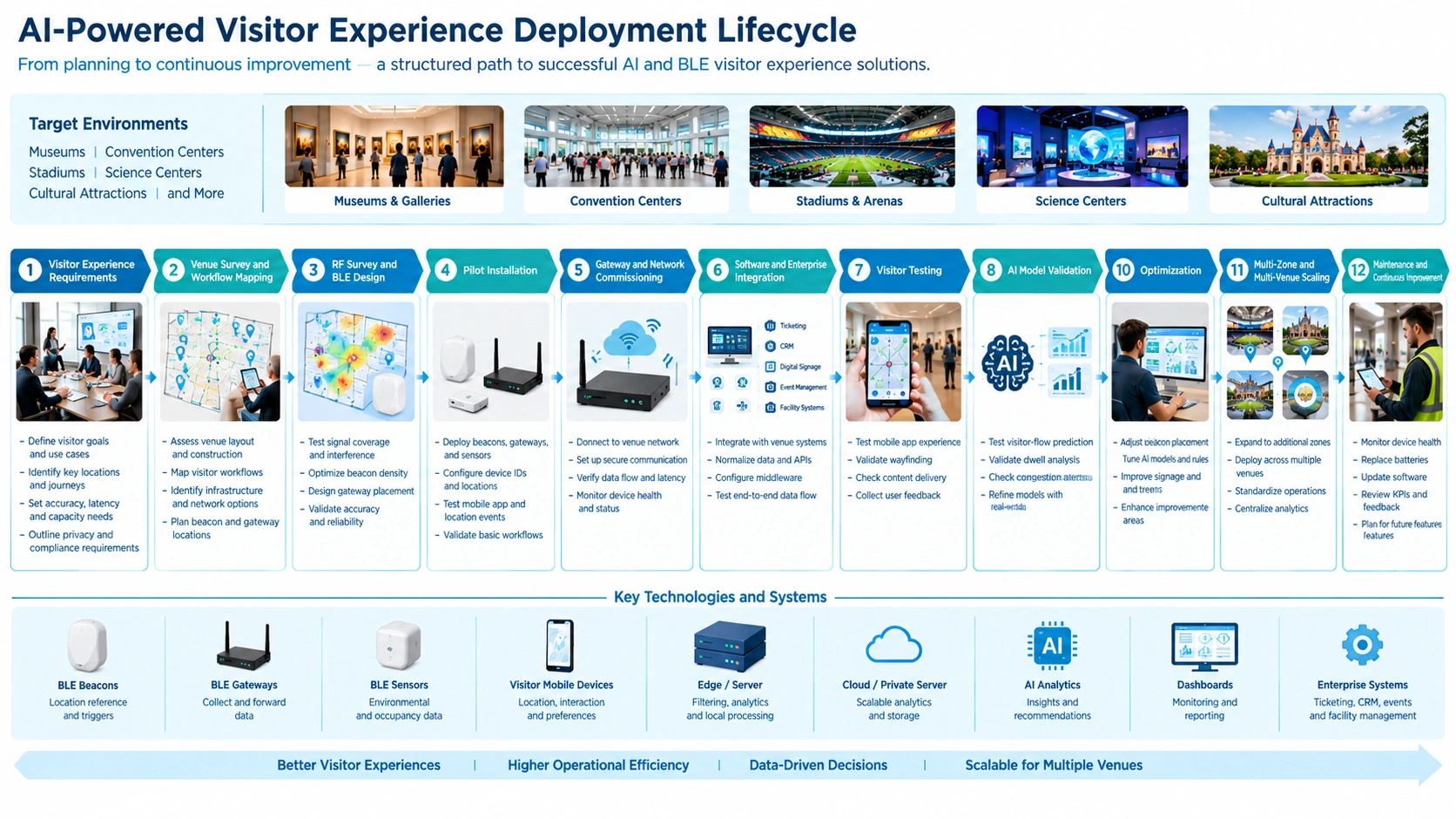
This lifecycle diagram presents a structured deployment path for AI-powered visitor experience solutions, from requirements assessment and RF surveying through BLE installation, integration, visitor testing, AI validation, optimization, scaling, and maintenance. It also shows the key technologies and systems supporting multi-venue visitor services.
Key Takeaways for AI-Powered Visitor Experience
AI-powered visitor experience systems can turn location events into practical improvements across wayfinding, exhibit engagement, queue management, accessibility, event navigation, visitor-flow forecasting, and staff allocation. BLE beacons, gateways, and sensors provide useful physical-location signals, but their value depends on appropriate RF engineering, reliable networking, well-defined data models, secure integrations, and validated AI analytics.
The most effective deployments begin with a clearly defined visitor problem and measurable KPI. They then progress through site assessment, pilot testing, software integration, privacy controls, AI validation, and controlled scaling.
GAO can help organizations evaluate and source BLE, RFID, and IoT hardware products and systems for visitor-location applications. Technical teams can learn more about our products, integration capabilities, engineering expertise, and support options when planning AI-powered visitor experience deployments.
Building the Future of Industrial AI and IoT with Aperture Venture Studio and GAO RFID Inc.
For more than three decades, GAO Group of Companies has invested heavily in R&D for industrial BLE, RFID, and IoT. As AI has become increasingly useful in real-world applications, we have advanced AI and IoT technologies for location-based services, including BLE-enabled visitor experience solutions, and founded Aperture Venture Studio to build, launch, and scale AI and IoT companies serving practical industry needs.
Aperture has attracted AI and IoT technical experts, entrepreneurial and operational executives, investors, and leading companies. We have also developed Aperture Ventures Summit and TekSummit to discuss advanced AI and IoT topics.
We welcome you to join us as:
- Advisors, Co-founders, or Employees
- Investors
- Customers