
AI and BLE for Pharmacy Retail
AI-Driven Pharmacy Retail Operations for Inventory, Compliance, and Patient Service
AI-driven pharmacy retail combines AI, connected devices, pharmacy management software, inventory systems, and operational data to improve how pharmacies manage medications, prescriptions, cold-chain products, store assets, and customer service. BLE gateways, beacons, and sensors can provide proximity, location, environmental, and asset-status data that gives AI models more context for pharmacy operations.
For pharmacy retailers, the value extends beyond simply locating products. AI can analyze dispensing patterns, inventory movement, replenishment requirements, prescription workflows, refrigerator conditions, equipment status, and store activity to identify exceptions and recommend actions. BLE can provide supporting data from medication storage areas, refrigerators, mobile equipment, carts, bins, and other operational assets.
GAO provides BLE, RFID, and other IoT technology-based hardware products and systems that can support pharmacy retail applications requiring connected asset identification, environmental monitoring, location-related events, and integration with operational software.
How AI Improves Pharmacy Retail Operations
Pharmacy retail involves highly controlled workflows where product availability, prescription accuracy, storage conditions, inventory records, and timely customer service must work together. AI can process large volumes of pharmacy transaction, inventory, environmental, and operational data to identify patterns that are difficult to detect through manual monitoring.
AI applications can support:
- Pharmacy inventory forecasting based on dispensing history, seasonal demand, prescription patterns, promotions, and local demand.
- Medication replenishment recommendations based on stock levels, lead times, safety stock, and expected demand.
- Expiration-risk identification for medications and other pharmacy products.
- Prescription workflow analysis to identify bottlenecks in filling, verification, pickup, and returns.
- Cold-chain monitoring for temperature-sensitive medications and vaccines.
- Store-level asset utilization for refrigerators, dispensing equipment, carts, bins, and other operational equipment.
- Anomaly detection for unusual inventory movement, storage conditions, or workflow activity.
- Workforce scheduling and task prioritization based on prescription volume and operational demand.
- Predictive maintenance for refrigeration and pharmacy equipment.
- Customer service forecasting based on prescription pickup patterns and store traffic.
AI does not replace pharmacist judgment or regulated pharmacy procedures. Instead, AI systems can provide additional analysis, alerts, forecasts, and recommendations while established pharmacy controls remain responsible for clinical and regulatory decisions.
Pharmacy Retail Workflows Supported by AI
Pharmacy operations span medication procurement, receiving, storage, inventory control, prescription processing, dispensing, pickup, returns, and compliance activities. AI becomes more useful when it is connected to these workflows rather than operating as an isolated analytics application.
Medication Receiving and Inventory Intake
Medication receiving begins when products arrive from wholesalers, distributors, manufacturers, or other approved sources. Pharmacy personnel verify shipments, quantities, product identifiers, lot information, expiration dates, and storage requirements before products enter inventory.
AI can compare expected shipments with received quantities and historical ordering patterns. Exception detection can identify unusual quantities, missing items, unexpected product substitutions, or discrepancies that require human review.
BLE-enabled asset and environmental data can provide additional operational context around receiving areas, refrigerated products, mobile carts, and temporary storage locations.
Medication Storage and Inventory Control
Pharmacy inventory includes prescription medications, over-the-counter products, vaccines, refrigerated medications, controlled substances, medical supplies, and other healthcare merchandise. Each category may have different storage, handling, replenishment, and security requirements.
AI inventory systems can evaluate:
- Current inventory
- Historical dispensing volume
- Prescription demand
- Seasonal patterns
- Supplier lead times
- Safety-stock requirements
- Product expiration dates
- Reorder points
- Stockout frequency
- Overstock exposure
- Store-level demand differences
AI can then recommend replenishment quantities or identify products that require attention.
BLE sensors can provide temperature or humidity measurements for appropriate pharmacy storage environments. BLE gateways can collect readings from connected devices and forward them to the processing system. AI can analyze time-series data to distinguish normal fluctuations from persistent conditions requiring intervention.
Prescription Filling and Verification
Prescription fulfillment involves multiple steps, including order intake, medication selection, counting or dispensing, labeling, pharmacist verification, and customer pickup or delivery preparation.
AI can analyze workflow timestamps to identify recurring bottlenecks. For example, unusually long intervals between prescription intake and filling may indicate workload imbalance, inventory shortages, equipment constraints, or process exceptions.
Computer vision, machine learning, pharmacy automation systems, and other AI methods can support specific workflow applications where appropriate. These systems should be configured around established pharmacy procedures and validated according to the intended use.
Prescription Pickup and Customer Service
Pharmacy retailers must balance prescription availability with customer waiting times, pickup demand, delivery schedules, and staff capacity. AI can forecast pickup volume and identify periods when additional staffing or inventory preparation may be required.
Operational data can include prescription queue volume, historical pickup patterns, store traffic, scheduled deliveries, and time-of-day demand. AI forecasting can help pharmacy managers prioritize tasks before demand peaks.
BLE-based proximity information can also support selected operational workflows involving carts, equipment, or staff-assigned devices, although patient identification and clinical workflows should use appropriate secure systems rather than relying on BLE proximity alone.
Refrigerated Medication and Cold-Chain Monitoring
Temperature-sensitive medications and vaccines require controlled storage conditions. A pharmacy refrigerator can experience temperature changes because of door openings, equipment failure, power interruptions, overloaded storage, or environmental conditions.
BLE temperature sensors can periodically collect measurements and transmit them through BLE gateways. AI can evaluate the time series for abnormal trends rather than relying exclusively on a fixed threshold.
Potential AI outputs include:
- Early indication of refrigerator temperature drift
- Persistent temperature abnormalities
- Repeated door-opening patterns
- Potential refrigeration equipment deterioration
- Temperature excursion risk
- Maintenance prioritization
- Environmental trend analysis
The system should retain appropriate records and support established pharmacy procedures for responding to temperature excursions. AI alerts should supplement, not replace, required monitoring and documented response processes.
AI-Enabled Pharmacy Retail Operations with BLE
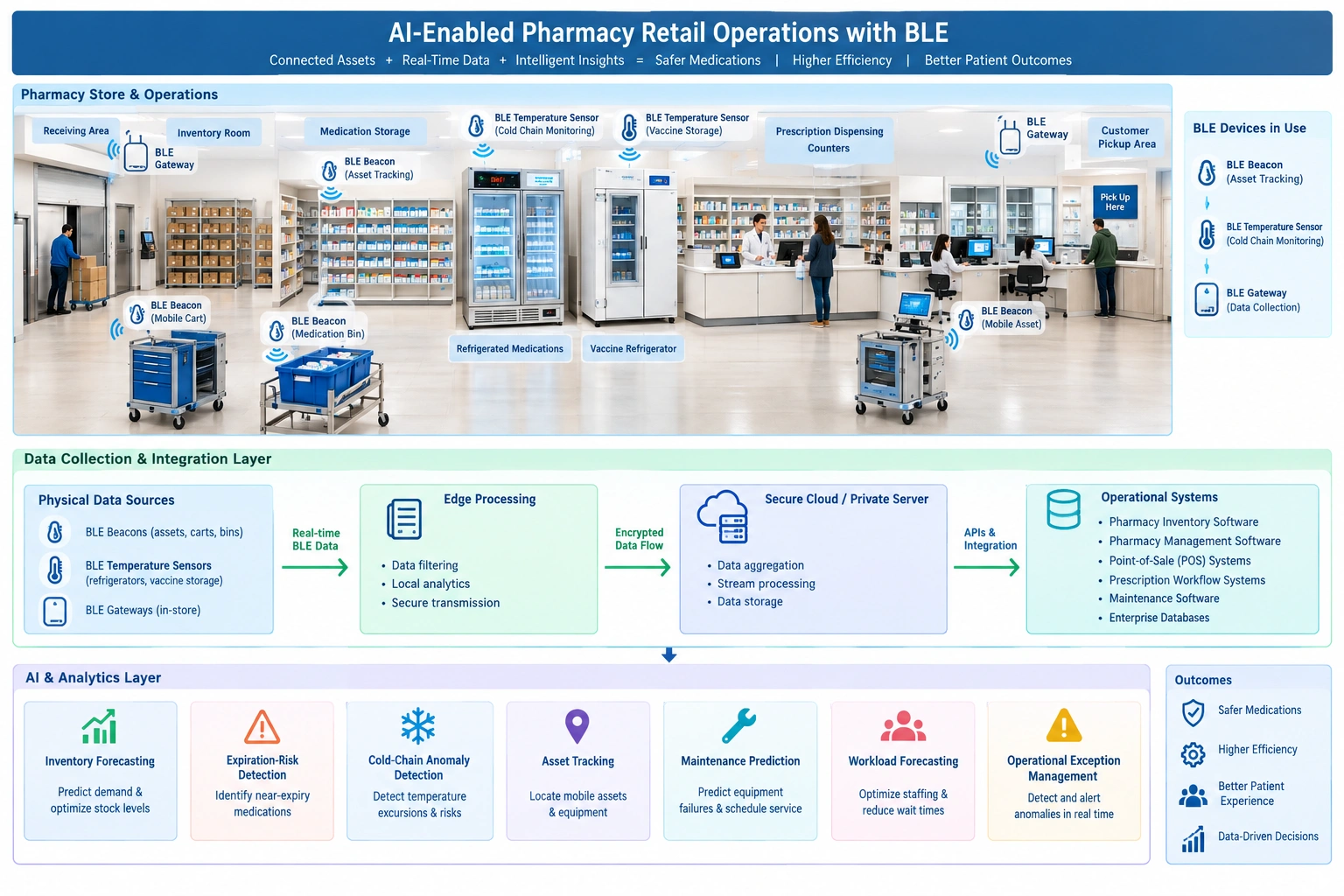
This enterprise-grade overview illustrates how BLE-enabled pharmacy assets, temperature sensors, and gateways connect physical store operations with edge processing, secure cloud or private-server infrastructure, and operational software. AI functions support inventory forecasting, expiration-risk detection, cold-chain anomaly detection, asset tracking, maintenance prediction, workload forecasting, and operational exception management. The visual highlights how connected data can support safer medication handling, greater efficiency, and better patient experiences.
AI Applications Across Pharmacy Retail
AI applications in pharmacy retail should be selected according to measurable operational problems. The strongest use cases generally combine transaction data, inventory information, workflow events, equipment information, environmental measurements, and business rules.
AI Pharmacy Inventory Management and Demand Forecasting
Pharmacy inventory demand varies by prescription volume, disease seasonality, patient demographics, local events, physician prescribing patterns, product substitutions, and supplier availability.
AI forecasting models can combine historical dispensing data with current inventory, replenishment lead times, prescription trends, and product characteristics. The system can estimate future demand and identify medications that may reach critical stock levels.
This can help pharmacy retailers reduce:
- Medication stockouts
- Excess inventory
- Emergency replenishment
- Expired product exposure
- Manual inventory review
- Inefficient inter-store transfers
AI can also compare inventory across multiple pharmacy locations to identify opportunities for inventory balancing when business rules and regulatory requirements permit.
AI Expiration and Shelf-Life Management
Medication expiration management is more complex than simply identifying products with an approaching expiration date. The system must consider current stock, dispensing velocity, product location, replenishment schedules, and applicable inventory policies.
AI can rank products by expiration risk and recommend operational actions such as prioritizing appropriate stock, adjusting replenishment quantities, or transferring eligible inventory between locations.
BLE-based asset identification can provide supporting location information for mobile bins, carts, storage containers, or other pharmacy assets used during inventory workflows.
AI Cold-Chain Risk Prediction
Temperature monitoring becomes more valuable when AI can analyze patterns over time. A refrigerator showing temperatures within an acceptable range today may still display a gradual trend that indicates potential equipment deterioration.
Machine learning models can compare current temperature behavior with historical patterns and operating conditions. AI can then identify abnormal trends and prioritize maintenance before a significant temperature excursion occurs.
For pharmacy retailers, this can reduce the risk of avoidable product loss while supporting more proactive equipment management.
AI Pharmacy Equipment Maintenance
Pharmacy stores rely on refrigeration equipment, dispensing equipment, automated counting systems, printers, scanners, computers, network equipment, security systems, and other operational assets.
AI maintenance systems can combine equipment runtime, fault records, service history, environmental conditions, inspection records, and maintenance work orders to estimate failure risk.
BLE-enabled condition or identity devices can provide supplementary information for equipment that is not directly connected to the pharmacy management system.
Maintenance teams can use AI recommendations to prioritize:
- Refrigeration inspections
- Preventive maintenance
- Equipment service
- Battery replacement
- Asset inspection
- Fault investigation
- Spare-parts planning
AI Pharmacy Workforce and Workflow Optimization
Pharmacy workload changes throughout the day. Prescription volume, phone calls, customer arrivals, vaccinations, deliveries, insurance-related activities, and inventory work can compete for staff attention.
AI can analyze historical workload and current queue conditions to help managers prioritize tasks and allocate available resources.
Potential outputs include predicted prescription volume, expected pickup demand, workflow bottlenecks, task prioritization, and staffing requirements. These recommendations should remain subject to pharmacy management policies, pharmacist judgment, labor requirements, and patient-care considerations.
AI Detection of Operational Exceptions
AI anomaly detection can identify unusual patterns across pharmacy operations. Examples include unexpected inventory movement, abnormal refrigerator behavior, unusual equipment downtime, repeated workflow delays, or discrepancies between expected and observed operational events.
Exception management becomes more useful when alerts contain context. Rather than simply stating that a device has reported an abnormal condition, the system can associate the event with a pharmacy location, asset, product category, work order, historical pattern, and recommended response.
AI Pharmacy Inventory and Cold-Chain Workflow
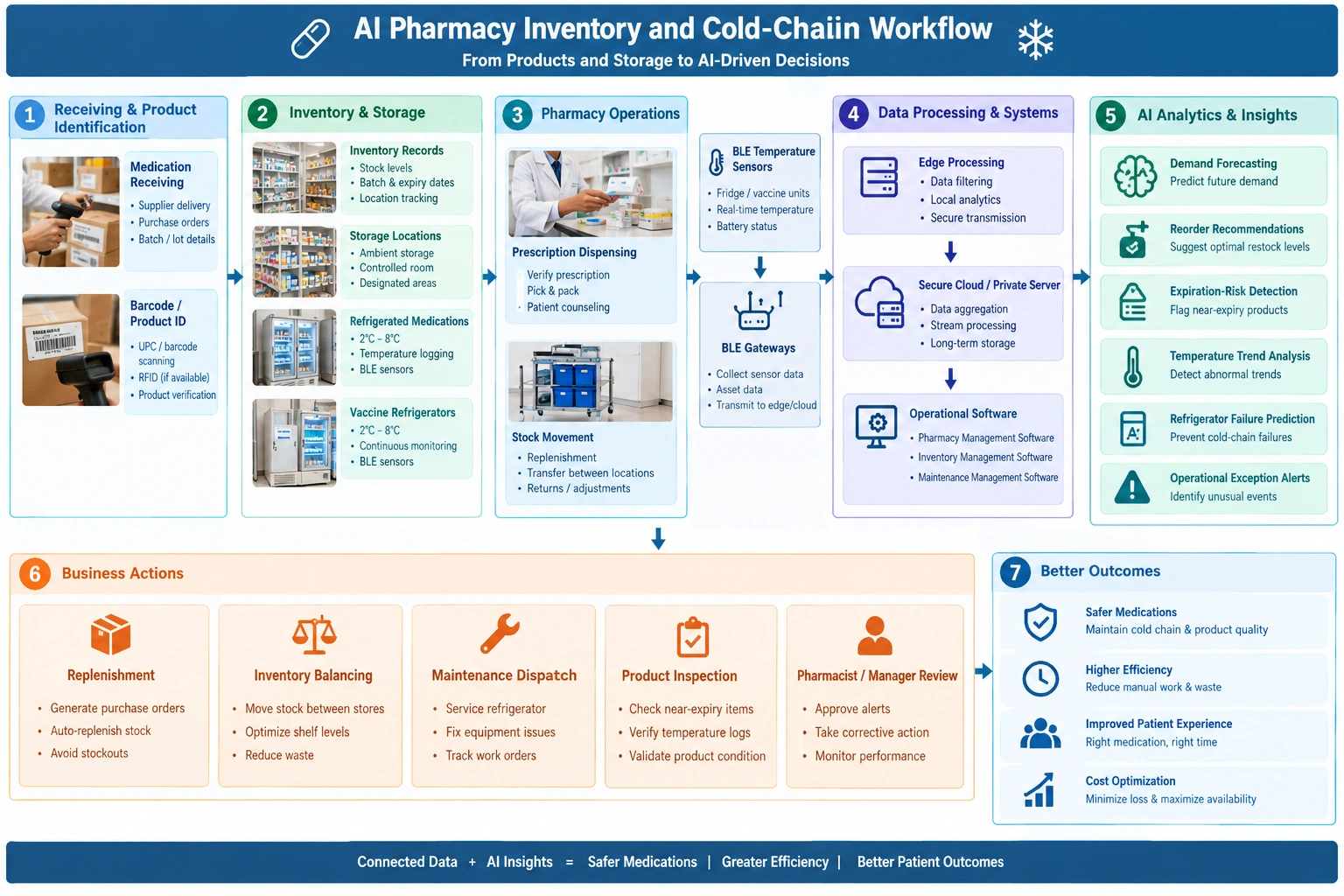
This enterprise workflow diagram illustrates how medication receiving, product identification, inventory records, storage locations, and pharmacy stock movement connect with BLE temperature sensors and gateways. Data flows through edge processing, secure cloud or private-server software, and operational systems into AI-driven insights such as demand forecasting, reorder recommendations, expiration-risk detection, temperature trend analysis, and refrigerator failure prediction. The workflow concludes with replenishment, inventory balancing, maintenance dispatch, product inspection, and pharmacist or manager review.
BLE Hardware and AI Software for Pharmacy Retail
BLE serves as an enabling communication technology for selected pharmacy retail applications. The most appropriate deployment depends on the physical environment, required data frequency, asset mobility, environmental monitoring requirements, and integration with pharmacy software.
BLE Beacons for Pharmacy Asset and Zone Identification
BLE beacons can provide identifiers that help pharmacy systems detect proximity or presence. Suitable applications can include mobile medication carts, inventory bins, pharmacy equipment, maintenance tools, delivery containers, and selected store assets.
Beacon deployment should account for asset movement, radio interference, battery replacement, physical mounting, cleaning requirements, and the presence of shelving and metal equipment.
BLE Gateways for Pharmacy Data Collection
BLE gateways collect advertisements or sensor messages from nearby BLE devices and forward relevant data to a processing system through available network connectivity.
A pharmacy deployment may use cellular, Wi-Fi, Ethernet, or another appropriate backhaul depending on store infrastructure. Gateway placement should provide suitable coverage for refrigeration areas, inventory rooms, receiving areas, or other monitored zones.
Store-and-forward capability can be valuable when temporary network interruptions occur because environmental measurements and asset events may need to be retained until connectivity is restored.
BLE Sensors for Pharmacy Environmental Monitoring
BLE sensors can measure conditions such as temperature and humidity where the selected device is suitable for the pharmacy environment and intended measurement range.
For refrigerated medication storage, sensor placement is important. A sensor positioned near the refrigerator door may experience different conditions from one placed among stored products. Engineering teams should validate sensor placement against the monitoring objective and applicable pharmacy procedures.
Battery life also depends on sampling frequency, transmission intervals, temperature, radio conditions, and device configuration.
AI, Middleware, and Pharmacy Software Integration
The BLE layer should feed a broader software process rather than becoming an isolated monitoring system. Middleware can normalize device events and associate them with pharmacy locations, assets, storage units, and operational records.
AI software can then combine BLE-derived information with:
- Pharmacy management systems
- Inventory management systems
- Prescription workflow software
- Point-of-sale systems
- Enterprise resource planning systems
- CMMS and EAM software
- Facility management systems
- Building management systems
- Security systems
- Maintenance databases
- Data warehouses
- Analytics software
GAO can supply connected hardware products and systems that support integration with broader IoT deployments, helping pharmacy retailers connect physical operational data with software-based analysis and workflows.
Cloud and Server Deployment for Pharmacy Retail AI
Pharmacy retailers can deploy AI and BLE software using cloud-hosted or privately hosted infrastructure. The appropriate model depends on store count, IT policies, integration requirements, data governance, network connectivity, and the need for centralized management.
Cloud Version
A cloud-hosted deployment centralizes AI processing, device management, analytics, dashboards, and data storage within managed cloud infrastructure. This approach can be appropriate for pharmacy chains operating many stores because centralized software can support standardized device management and analytics across geographically distributed locations.
Cloud deployment can simplify:
- Multi-store monitoring
- Centralized dashboards
- AI model updates
- Data aggregation
- Fleet-wide inventory analytics
- Remote device management
- Cross-store performance comparison
- Enterprise reporting
Store gateways can transmit BLE events and environmental measurements securely to cloud services. Edge processing can still be used for immediate local decisions, buffering, filtering, or temporary connectivity loss.
Server Version
A server deployment places the pharmacy AI and IoT software on customer-managed servers, private data centers, edge servers, or other privately hosted infrastructure. This model can be appropriate when pharmacy organizations require greater control over data location, network boundaries, system integration, or internal IT operations.
Server-based deployment may support:
- Private network operation
- Local data processing
- Integration with internal pharmacy databases
- Custom security policies
- Controlled data retention
- Local analytics
- Edge processing for selected workflows
A hybrid model can also combine local gateway and edge processing with centralized private or cloud-based analytics. Pharmacy retailers should select the deployment model based on operational requirements rather than treating cloud or server deployment as a universal choice.
Engineering Considerations for AI-Enabled Pharmacy Retail
AI and BLE deployments in pharmacy retail require careful engineering because medication storage, prescription workflows, inventory control, and store operations have different data requirements. A temperature sensor for a vaccine refrigerator has different requirements from a BLE beacon used to identify a mobile pharmacy cart. Likewise, AI forecasting for medication demand requires different data and validation from an anomaly model monitoring refrigeration equipment.
A successful system should therefore be designed around specific pharmacy workflows, operational responsibilities, data quality requirements, and applicable policies.
BLE Coverage and Device Placement in Pharmacy Stores
Pharmacy stores commonly contain metal shelving, refrigeration equipment, dispensing machinery, cabinets, computers, security equipment, and dense product inventories. These physical conditions can influence BLE signal propagation and gateway coverage.
Engineering teams should evaluate:
- BLE coverage in medication storage rooms and dispensing areas
- Gateway placement relative to refrigerators and monitored equipment
- Radio attenuation caused by shelving, cabinets, and refrigeration units
- BLE beacon mounting locations on mobile carts, bins, equipment, and containers
- Transmission intervals and battery-life requirements
- Cleaning and sanitation requirements for mounted devices
- Environmental conditions surrounding sensors
- Network connectivity between gateways and enterprise software
- Store-and-forward requirements during network interruptions
- Device identification and association with pharmacy assets
A coverage survey should be performed under normal store conditions rather than in an empty facility because stocked shelves, equipment movement, and human activity can change RF conditions.
Temperature Sensor Placement and Cold-Chain Data Quality
Cold-chain monitoring requires more than placing a BLE temperature sensor inside a refrigerator. The sensor location, sampling interval, transmission interval, calibration, battery performance, and gateway connectivity all influence the quality of the resulting data.
Pharmacy operators should define whether the objective is general refrigerator monitoring, environmental trend analysis, or a specific regulated monitoring workflow. Sensors should be installed according to the monitoring procedure and validated under realistic operating conditions.
AI can analyze temperature time series for trends such as:
- Gradual temperature drift
- Repeated temperature fluctuations
- Extended recovery periods after door openings
- Unusual overnight behavior
- Differences between refrigerators
- Potential equipment deterioration
- Repeated excursions requiring investigation
The AI model should provide contextual alerts rather than creating unnecessary alarm volume. Thresholds, escalation procedures, and response responsibilities should remain clearly defined.
Pharmacy Inventory Data Quality and Product Identity
AI inventory forecasting depends heavily on accurate product records. Pharmacy systems may contain information about NDCs, product descriptions, package sizes, dosage forms, strengths, lot numbers, expiration dates, locations, suppliers, and inventory quantities.
Data quality issues can produce misleading forecasts even when the AI model itself is technically sound.
Implementation teams should validate:
- Product master data
- Medication identifiers
- Inventory quantities
- Unit-of-measure definitions
- Reorder points
- Supplier lead times
- Store locations
- Expiration information
- Dispensing transactions
- Returns and adjustments
- Inventory transfers
BLE identifiers should also be mapped to stable asset records. A gateway event is useful only when the system can determine which physical asset or monitored location generated it.
Integration with Pharmacy Management and Retail Software
AI and BLE systems should integrate with existing pharmacy software instead of forcing pharmacy personnel to maintain separate records.
Potential integration points include:
- Pharmacy management systems
- Prescription processing software
- Inventory management
- Point-of-sale systems
- Enterprise resource planning
- Procurement software
- Warehouse management systems
- CMMS and EAM software
- Building management systems
- Refrigeration monitoring systems
- Workforce management
- Customer notification systems
- Business intelligence software
APIs, webhooks, MQTT, HTTPS, database interfaces, and enterprise middleware can be used depending on the software environment.
A normalized event model should establish consistent relationships among store, pharmacy area, product, asset, device, gateway, temperature reading, work order, and operational event. This allows AI applications to combine information from multiple systems without creating conflicting records.
GAO supplies BLE, RFID, and other IoT technology-based hardware products and systems that can provide the physical data layer for pharmacy retail solutions and broader connected-store deployments.
AI Use Cases That Improve Pharmacy Retail Performance
The most useful AI applications connect operational data to specific decisions. Pharmacy retailers can use AI for demand forecasting, inventory management, equipment maintenance, cold-chain risk detection, workforce planning, and exception management.
Predictive Pharmacy Inventory Management
AI demand forecasting can estimate future medication requirements using historical dispensing patterns and current operating conditions. Models may consider prescription volume, seasonal demand, supplier lead times, product substitutions, local demand changes, and inventory levels.
The system can generate recommendations for:
- Reorder quantities
- Reorder timing
- Safety-stock adjustments
- Inventory transfers
- Stockout risk
- Overstock risk
- Expiration exposure
- High-velocity product monitoring
Pharmacy managers can use these recommendations to prioritize inventory actions while retaining established purchasing controls and professional review.
Expiration-Risk Prediction and Inventory Rotation
Expiration management becomes more difficult when pharmacy inventory is distributed across many locations. AI can rank inventory according to expiration exposure by comparing remaining shelf life with predicted dispensing velocity.
The system can identify products where current demand may not consume available stock before expiration and highlight locations requiring review.
When permitted by organizational policies and applicable requirements, pharmacy retailers can use these insights to improve inventory balancing and reduce avoidable product waste.
Refrigeration Failure Prediction
AI can analyze temperature history, refrigerator operating behavior, maintenance records, service events, and environmental conditions to estimate refrigeration failure risk.
A model might identify a refrigerator that still operates within an acceptable range but takes progressively longer to return to its normal temperature after door openings. That pattern can become an early maintenance indicator.
Maintenance teams can then inspect the equipment before a major failure results in a prolonged temperature excursion.
Pharmacy Equipment and Asset Utilization
Pharmacy operations depend on equipment that must remain available and correctly maintained. AI can analyze asset usage, service records, downtime, location, and maintenance history to identify underused, overused, or failure-prone equipment.
BLE can provide supporting asset-presence information for mobile carts, bins, maintenance equipment, and other movable assets.
AI can help answer questions such as:
- Which pharmacy assets are frequently misplaced?
- Which equipment has unusually high downtime?
- Which stores require additional equipment?
- Which mobile assets remain unused for extended periods?
- Which equipment requires recurring maintenance?
- Which asset categories experience the highest service demand?
AI Workflow and Queue Optimization
Pharmacy managers need to balance prescription workload, verification tasks, pickup activity, vaccination services, inventory activities, phone calls, delivery preparation, and other store responsibilities.
AI can analyze historical workflow patterns and current queues to estimate workload and identify potential bottlenecks.
Possible outputs include:
- Predicted prescription workload
- Pickup demand forecasts
- Estimated workflow delays
- Task prioritization
- Workload balancing recommendations
- Staffing demand forecasts
- Delivery preparation requirements
The objective is to help pharmacy personnel manage workload more effectively without replacing professional judgment.
Operational Anomaly Detection
AI anomaly detection can identify unusual pharmacy activity that may otherwise remain hidden in large operational datasets.
Examples include:
- Unexpected inventory changes
- Repeated temperature fluctuations
- Abnormally long dispensing intervals
- Unusual equipment downtime
- Repeated refrigeration alerts
- Unexpected asset movement
- Unusual store-level demand changes
- Repeated inventory discrepancies
AI-generated alerts should contain sufficient context for pharmacy personnel to investigate the underlying event.
Cybersecurity and Data Protection for Connected Pharmacy Retail
Connected pharmacy systems handle operational information, device data, inventory records, and potentially sensitive information depending on the integration design. Security must therefore be considered across BLE devices, gateways, networks, servers, cloud services, APIs, and user applications.
Recommended controls include:
- Unique credentials for connected devices
- Secure gateway configuration
- Encrypted communications
- API authentication
- Role-based access control
- Network segmentation
- Device inventory and lifecycle management
- Firmware and software update procedures
- Centralized logging
- Security monitoring
- Backup and recovery procedures
- Credential and certificate management
- Controlled administrative access
- Secure device decommissioning
- Data retention policies
BLE should not be treated as an inherently trusted network. Pharmacy organizations should authenticate gateways, protect application interfaces, restrict administrative privileges, and monitor unusual device or network behavior.
Patient-related information should also be handled according to the pharmacy organization’s privacy, security, compliance, and data-governance requirements. BLE should generally provide operational context rather than serve as an unrestricted mechanism for handling sensitive patient information.
Deployment Lifecycle for AI and BLE Pharmacy Retail
A pharmacy retailer should approach AI and BLE deployment as an operational improvement project rather than simply installing connected devices. The lifecycle should connect business objectives, pharmacy workflows, hardware, software, data engineering, AI validation, cybersecurity, and measurable outcomes.
Pharmacy Assessment and Use-Case Planning
The first stage is to identify the pharmacy workflows where improved visibility or prediction can create measurable value.
Potential priorities include:
- Medication stockout reduction
- Expiration-risk management
- Cold-chain monitoring
- Refrigerator maintenance
- Mobile asset tracking
- Inventory accuracy
- Prescription workflow improvement
- Store workload forecasting
- Equipment utilization
The assessment should document store layouts, refrigerator locations, inventory systems, pharmacy software, network infrastructure, existing sensors, maintenance processes, and staff responsibilities.
Hardware Selection and Pilot Deployment
Hardware should be selected according to the pharmacy environment and the specific application.
BLE beacons may be appropriate for selected asset identification. BLE sensors may support environmental monitoring. BLE gateways provide the connection between local BLE devices and centralized software.
A pilot should include representative pharmacy stores, refrigerator types, inventory environments, network conditions, and operating schedules.
Pilot testing should measure:
- BLE coverage
- Device detection reliability
- Sensor measurement stability
- Gateway connectivity
- Battery performance
- Data transmission reliability
- Asset identification accuracy
- Temperature-data availability
- Alert performance
- Integration reliability
Software Integration and AI Validation
After hardware deployment, data should be integrated with pharmacy management, inventory, maintenance, and other relevant systems.
AI models should be evaluated using representative operational data. Forecasting models should be tested against actual pharmacy demand. Temperature anomaly models should be evaluated against known refrigerator events. Asset analytics should be checked against verified physical conditions.
Model validation should consider:
- Prediction accuracy
- False positives
- False negatives
- Alert latency
- Data completeness
- Seasonal variation
- Store-level differences
- Model drift
Commissioning and Operational Optimization
Commissioning should confirm that devices, gateways, integrations, AI models, dashboards, alerts, and user procedures operate together.
Engineering teams may need to adjust BLE device locations, gateway placement, sampling rates, advertising intervals, alert thresholds, data retention, or model parameters.
Pharmacy personnel should also verify that alerts are understandable and actionable. An technically accurate alert that cannot be acted upon by the responsible team has limited operational value.
Scaling Across Pharmacy Locations
Once the pilot produces measurable results, deployment can expand across additional stores, distribution facilities, refrigeration assets, or pharmacy regions.
Standardized procedures should define:
- Device provisioning
- Asset labeling
- Installation
- Gateway configuration
- Sensor placement
- Network configuration
- Testing
- Commissioning
- Maintenance
- Battery replacement
- Device reassignment
- Decommissioning
A centralized device and asset registry becomes increasingly important as the number of pharmacy locations increases.
KPIs for AI-Enabled Pharmacy Retail
Pharmacy retailers should evaluate AI and BLE deployments using operational, inventory, equipment, and service KPIs.
Relevant measures include:
- Medication stockout rate
- Inventory accuracy
- Inventory turnover
- Expired medication value
- Expiration-risk inventory
- Forecast accuracy
- Replenishment accuracy
- Emergency replenishment frequency
- Prescription turnaround time
- Prescription queue time
- Customer pickup wait time
- Prescription fulfillment rate
- Inventory adjustment frequency
- Cold-chain excursion rate
- Temperature compliance rate
- Refrigerator downtime
- Refrigeration maintenance cost
- Equipment downtime
- Asset recovery time
- Mobile asset utilization
- Store labor utilization
- Workflow exception rate
- AI alert precision
- AI prediction accuracy
- BLE device availability
- Gateway connectivity rate
- Sensor data completeness
- Mean time to detect equipment anomalies
- Mean time to respond to operational alerts
- Preventive maintenance completion rate
KPIs should be compared against a baseline established before deployment. Measuring device counts alone does not demonstrate business value.
Practical Benefits of AI and BLE for Pharmacy Retail
Combining AI with BLE-enabled operational data can improve pharmacy retail performance when each technology is connected to a defined business workflow.
Potential benefits include:
- More accurate medication demand forecasting
- Earlier identification of stockout risk
- Better expiration-risk management
- Improved inventory visibility
- More proactive refrigerator maintenance
- Earlier detection of cold-chain anomalies
- Improved mobile asset accountability
- Better pharmacy workflow visibility
- More informed staffing and workload decisions
- Faster identification of operational exceptions
- Reduced manual monitoring
- Improved maintenance planning
- Better multi-store operational reporting
- More consistent asset and equipment records
- Improved response to abnormal operating conditions
The value comes from combining data sources. BLE provides physical-world events and measurements, while AI analyzes those signals together with pharmacy transactions, inventory records, maintenance information, and operational history.
Implementation Recommendations for Pharmacy Retail
Pharmacy retailers should begin with specific operational objectives and then select the AI models, BLE hardware, software integrations, and deployment model required to achieve them.
Recommended practices include:
- Establish baseline KPIs before deployment.
- Select use cases with measurable pharmacy operational value.
- Map pharmacy workflows before installing devices.
- Validate product and inventory master data.
- Test BLE coverage under fully stocked store conditions.
- Validate refrigerator sensor placement and measurement behavior.
- Use appropriate device sampling and transmission intervals.
- Integrate connected-device data with existing pharmacy software.
- Maintain consistent identifiers for stores, assets, devices, and equipment.
- Use edge processing where low-latency alerts or temporary network independence are required.
- Select cloud or private server deployment according to data governance and IT requirements.
- Validate AI models against representative pharmacy data.
- Establish human review procedures for AI-generated recommendations.
- Implement cybersecurity controls across devices, gateways, networks, APIs, and software.
- Monitor device batteries and gateway connectivity.
- Establish procedures for device replacement and decommissioning.
- Scale only after pilot KPIs demonstrate measurable improvement.
GAO has served customers across the United States and Canada for three decades, including Fortune 500 companies, leading R&D firms, prestigious universities, and U.S. and Canadian government agencies. Our work includes supplying connected hardware products and systems supported by substantial R&D investment, stringent quality assurance, and remote or onsite technical support.
Building More Responsive Pharmacy Retail Operations with GAO
AI-enabled pharmacy retail requires a coordinated connection between medication inventory, prescription workflows, refrigeration, equipment, store operations, and enterprise software. GAO provides BLE, RFID, and other IoT technology-based hardware products and systems that can support these connected workflows.
Headquartered in New York City and Toronto, Canada, GAO is recognized among leading global B2B and B2G suppliers of BLE and RFID technologies. Our solutions can support pharmacy retailers seeking practical approaches to asset visibility, environmental monitoring, inventory operations, equipment management, and AI-driven analysis.
Building the Future of Industrial AI and IoT with Aperture Venture Studio and GAO RFID Inc.
For more than three decades, GAO has invested heavily in R&D of industrial BLE, RFID, and IoT. As generative AI has become useful in industrial applications, we have expanded our work in AI and IoT technologies, including BLE and RFID, with Aperture Venture Studio supporting practical AI and IoT collaboration for industries such as pharmacy retail, healthcare operations, logistics, and connected commerce. Aperture brings together AI and IoT technical experts, operational executives, investors, and leading organizations through professional communities and events including Aperture Ventures Summit and TekSummit. We welcome pharmacy retailers and technology professionals to work with us as customers, advisors, investors, or technical collaborators.