
AI and BLE for Luxury Brand Retail
AI-Driven Luxury Brand Retail for Inventory, Clienteling, and Store Operations
AI-driven luxury brand retail combines AI, connected store technologies, inventory data, customer-facing systems, and operational software to improve how luxury products are received, stored, displayed, sold, transferred, and serviced. BLE gateways, beacons, and sensors can provide supporting information about product-associated assets, store zones, mobile equipment, environmental conditions, and operational events.
Luxury retail has requirements that differ significantly from conventional retail. High-value handbags, watches, jewelry, apparel, footwear, accessories, beauty products, and limited-edition merchandise require accurate inventory records, controlled movement, strong loss-prevention processes, and consistent customer experiences. AI can analyze sales history, inventory positions, clienteling information, store traffic, product movement, and operational events to support better decisions.
BLE can provide physical-world data that helps connect selected store assets and operational events with AI applications. GAO supplies BLE, RFID, and other IoT technology-based hardware products and systems that can support luxury retail applications involving asset visibility, environmental monitoring, store operations, and connected inventory workflows.
How AI Improves Luxury Brand Retail Operations
Luxury brand retailers operate through boutiques, flagship stores, department-store concessions, outlets, regional distribution centers, warehouses, e-commerce fulfillment operations, and clienteling channels. AI can connect information across these environments to improve inventory availability, merchandise allocation, customer service, and operational control.
AI applications can support:
- Luxury inventory forecasting based on product demand, seasonality, collection launches, regional preferences, and sales history.
- Product allocation across boutiques according to expected demand and available inventory.
- Detection of unusual product movement and inventory discrepancies.
- Store-level assortment optimization for handbags, watches, jewelry, apparel, footwear, and accessories.
- Clienteling recommendations based on authorized customer interaction and purchasing data.
- Predictive replenishment for high-value merchandise.
- Returns and reverse-logistics analysis.
- Loss-prevention analytics and anomaly detection.
- Store equipment and environmental monitoring.
- Maintenance prediction for selected retail equipment.
- Omnichannel order fulfillment and inventory availability analysis.
- Demand forecasting for product launches and seasonal collections.
AI should support rather than replace the judgment of store associates, inventory managers, loss-prevention personnel, merchandising teams, and brand management. For luxury retailers, maintaining appropriate human oversight is particularly important where decisions involve high-value merchandise, customer relationships, or product authenticity.
Luxury Brand Retail Workflows Supported by AI
Luxury retail operations involve tightly controlled merchandise workflows from receiving through final customer fulfillment. AI becomes more useful when it connects sales, inventory, logistics, clienteling, store operations, and physical asset information.
Luxury Merchandise Receiving and Inventory Intake
Luxury products often arrive through controlled distribution channels and may be associated with product identifiers, purchase orders, shipment records, collection information, SKU data, serial numbers, or other traceability information.
Receiving teams must verify shipment contents before products enter sellable inventory. AI can compare expected shipments with received merchandise and identify discrepancies requiring investigation.
Potential AI-supported checks include:
- Expected versus received quantities
- Product assortment discrepancies
- Unexpected SKU or product variants
- Receiving delays
- Repeated supplier or shipment exceptions
- Unusual receiving patterns
- Inventory posting delays
- Product allocation discrepancies
BLE can support selected operational assets used during receiving, such as mobile carts, handheld equipment, transport containers, and other reusable store equipment.
Boutique Inventory and Merchandise Visibility
Luxury boutiques may carry relatively small quantities of high-value merchandise compared with mass-market retail stores, making individual product availability particularly important. A missing handbag, watch, jewelry item, or limited-edition product can represent significant financial exposure as well as a missed sales opportunity.
AI inventory management can analyze:
- Available-to-sell inventory
- Reserved merchandise
- Products in transit
- Store transfers
- E-commerce reservations
- Client holds
- Returns
- Damaged merchandise
- Display inventory
- Historical sell-through
- Product aging
AI can identify inventory anomalies and recommend actions such as stock verification, replenishment, transfer review, or inventory reconciliation.
Product Transfers Between Boutiques and Distribution Facilities
Luxury brands frequently move merchandise between boutiques, regional distribution centers, warehouses, fulfillment locations, and other authorized sales channels.
AI can analyze transfer demand and recommend how merchandise should be positioned across locations. Models can consider local sales velocity, collection demand, store capacity, upcoming events, seasonal patterns, and existing inventory.
BLE-enabled tracking of selected reusable transport assets can provide additional information about carts, containers, cases, or equipment used during merchandise movement.
Luxury Store Display and Merchandising Operations
Visual merchandising is a major component of luxury brand retail. Product placement, collection presentation, display cases, mannequins, fixtures, and promotional installations all influence the customer experience.
AI can analyze sales performance against product placement, store zones, collection categories, customer traffic, and historical merchandising configurations.
Potential applications include:
- Product placement analysis
- Display performance forecasting
- Store-zone demand analysis
- Collection-level sell-through analysis
- Fixture utilization
- Display inventory optimization
- Product rotation recommendations
BLE proximity information can provide supporting context for selected mobile fixtures, equipment, or store assets when location-related events are useful to the workflow.
Clienteling and Personalized Luxury Retail
Luxury customer relationships frequently extend beyond a single transaction. Store associates may maintain relationships with clients through appointments, product recommendations, product launches, special events, and follow-up communications.
AI can analyze authorized customer interaction data to help associates identify relevant products, anticipate purchasing interests, and prioritize client outreach.
Potential AI applications include:
- Product recommendation
- Client preference analysis
- Appointment preparation
- Collection launch targeting
- Client follow-up prioritization
- Purchase-pattern analysis
- Cross-category recommendation
- Customer engagement forecasting
AI-generated recommendations should remain subject to brand policies, privacy requirements, customer preferences, and associate judgment.
AI-Enabled Luxury Brand Retail Operations with BLE
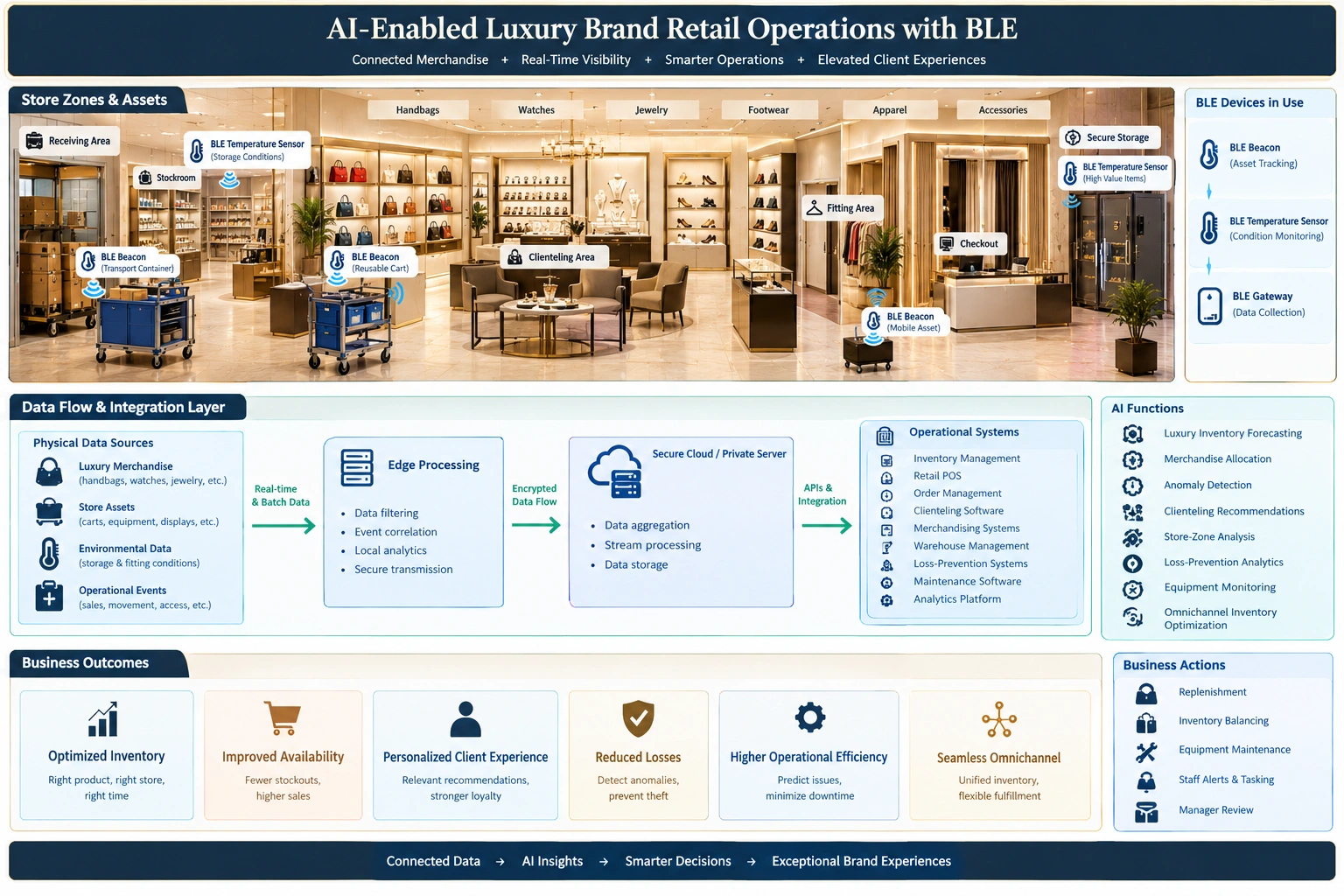
This enterprise-grade overview illustrates how BLE-enabled merchandise assets, environmental sensors, and operational events connect luxury boutique zones with edge processing, secure cloud or private-server infrastructure, and retail software. AI functions support inventory forecasting, merchandise allocation, anomaly detection, clienteling recommendations, store-zone analysis, loss-prevention analytics, equipment monitoring, and omnichannel inventory optimization. The visual highlights business actions and outcomes including replenishment, inventory balancing, personalized client experiences, reduced losses, and higher operational efficiency.
AI Applications Across Luxury Brand Retail
AI applications in luxury brand retail should be connected to measurable business and operational outcomes. The strongest applications combine transaction data, merchandise records, store activity, supply-chain information, customer interactions, and physical-world operational data.
AI Luxury Inventory Management and Demand Forecasting
Luxury merchandise demand can vary significantly between stores, cities, regions, product categories, collections, and customer segments. A product that sells quickly in one flagship boutique may have a much slower sales cycle in another location.
AI demand forecasting can evaluate:
- Historical sales
- Sell-through rates
- Product launches
- Collection changes
- Seasonal demand
- Regional preferences
- Store-level performance
- Product price
- Inventory availability
- Customer demand signals
- E-commerce activity
- Lead times
- Inter-store transfer history
These models can estimate future demand and help merchandising teams make more informed allocation and replenishment decisions.
AI Merchandise Allocation Across Boutiques
Luxury brands must balance merchandise availability with the need to maintain carefully selected store assortments. Excess inventory in one boutique can coexist with unmet demand at another.
AI can compare inventory positions across boutiques and identify potential allocation opportunities. Models can account for store sales velocity, product category, collection, regional demand, customer profiles, planned events, and expected future sales.
This can improve inventory productivity while reducing unnecessary transfers and preventing avoidable stockouts.
AI Product Availability and Omnichannel Fulfillment
Luxury customers may interact with a brand through boutiques, websites, mobile applications, client advisors, appointment systems, and other channels.
AI can analyze available-to-sell inventory and order requirements to improve fulfillment decisions. It can identify products that are physically available but temporarily unavailable for sale because they are reserved, undergoing inspection, awaiting transfer, or assigned to another workflow.
A more accurate inventory picture can improve:
- Buy-online-pickup-in-store workflows
- Ship-from-store fulfillment
- Client reservations
- Boutique transfers
- E-commerce availability
- Client advisor recommendations
- Order exception management
AI Loss Prevention and Merchandise Anomaly Detection
High-value merchandise creates a strong need for accurate inventory control and anomaly detection. AI can identify patterns that may indicate inventory discrepancies, unauthorized movement, unusual transaction activity, or process failures.
AI can correlate:
- Inventory adjustments
- Product movement
- Sales transactions
- Returns
- Transfer records
- Store-zone activity
- Access events
- Shipment records
- Historical exceptions
BLE proximity events can provide supporting information about selected operational assets or zones, but security-critical identification should use the appropriate combination of access control, product identification, surveillance, transaction data, and other security technologies.
AI Luxury Clienteling and Product Recommendations
AI can help client advisors prepare for appointments by analyzing authorized customer preferences, previous purchases, product interactions, appointment history, and current merchandise availability.
The system can identify relevant products and collections while considering actual inventory at the customer’s preferred boutique.
AI recommendations can support:
- Appointment preparation
- New collection outreach
- Complementary product recommendations
- Product availability checks
- Client follow-up prioritization
- Event invitations
- Purchase-pattern analysis
Privacy, consent, data minimization, and access controls should be incorporated into clienteling AI systems.
AI Store Operations and Equipment Management
Luxury boutiques depend on retail fixtures, display equipment, point-of-sale devices, secure storage, lighting systems, climate control, networking equipment, fitting-room systems, and other operational infrastructure.
AI can combine equipment status, service history, environmental conditions, maintenance records, and operational events to identify equipment requiring attention.
Predictive maintenance can help store operations teams prioritize:
- Climate-control equipment
- Refrigeration where applicable
- Point-of-sale equipment
- Networking equipment
- Security-related equipment
- Display systems
- Store fixtures
- Mobile operational equipment
GAO provides connected hardware products and systems that can support luxury retail organizations seeking to collect physical-world data for asset visibility, environmental monitoring, equipment management, and AI-enabled operational analysis.
AI Luxury Merchandise Visibility and Inventory Flow
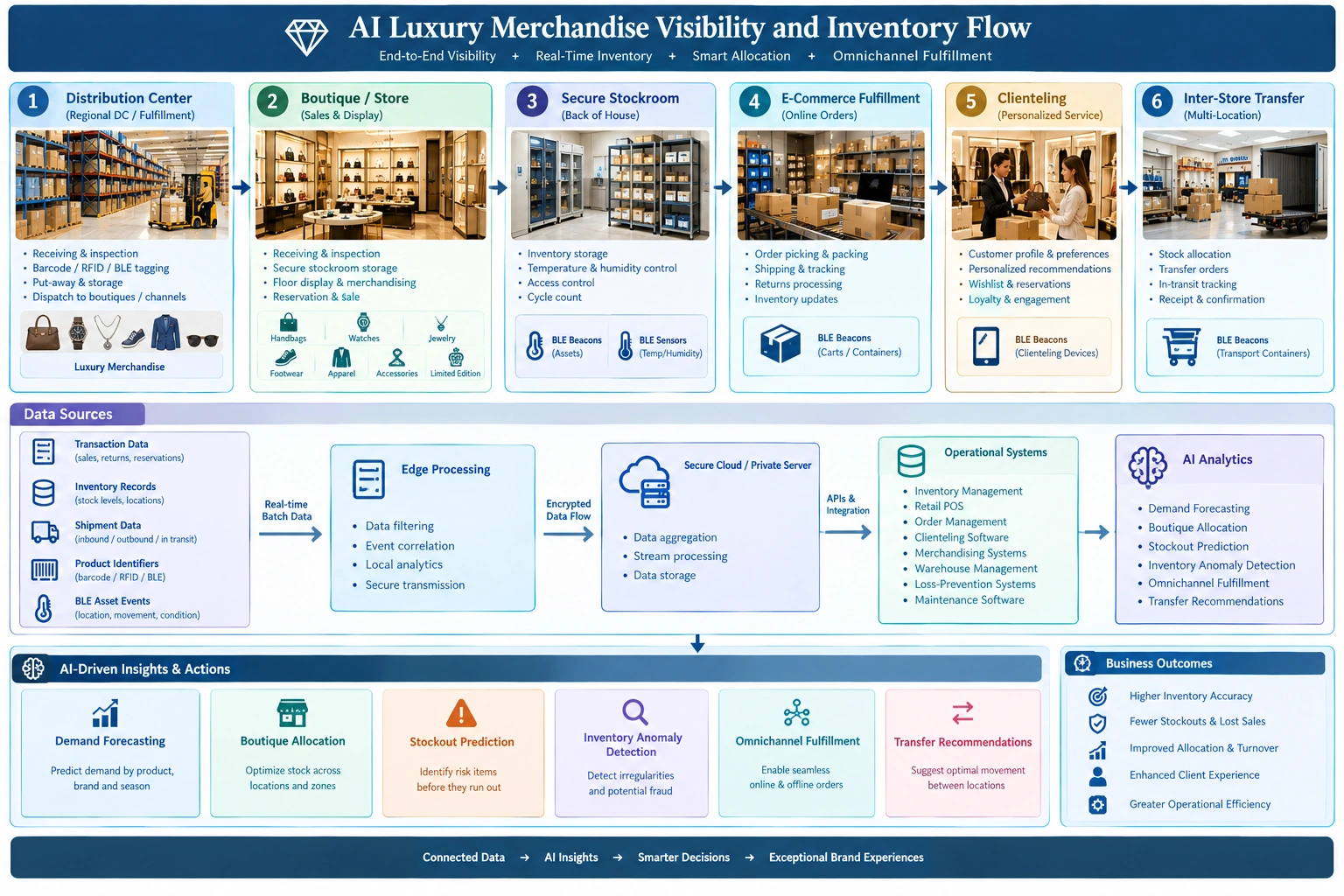
This enterprise workflow diagram illustrates how luxury merchandise moves from regional distribution centers through boutiques, secure stockrooms, e-commerce fulfillment, clienteling, and inter-store transfers. Transaction data, inventory records, shipment data, product identifiers, and BLE asset events flow through edge processing, secure cloud or private-server systems, and operational software into AI analytics. The visual highlights demand forecasting, boutique allocation, stockout prediction, anomaly detection, omnichannel fulfillment, and transfer recommendations, supporting more accurate inventory and efficient operations.
BLE Hardware and AI Software for Luxury Brand Retail
BLE acts as a supporting connectivity layer for selected luxury retail applications. It is particularly useful where a retailer needs low-power wireless identification, proximity detection, environmental measurements, or data collection from distributed store assets.
BLE Beacons for Luxury Retail Assets
BLE beacons can provide identifiers for selected reusable assets and equipment. Suitable applications may include:
- Merchandise transport carts
- Reusable product containers
- Display equipment
- Mobile fixtures
- Store operations equipment
- Maintenance tools
- Delivery or transfer containers
- Selected warehouse assets
Beacon placement should account for physical security, cleaning procedures, asset handling, radio propagation, battery replacement, and the risk of accidental removal.
For high-value merchandise, BLE should not automatically be treated as the sole product identification technology. Luxury retailers may combine BLE with RFID, barcode identification, computer vision, transaction records, access control, and other technologies depending on the required identification accuracy and security level.
BLE Gateways for Boutique and Stockroom Data Collection
BLE gateways collect nearby beacon and sensor transmissions and forward relevant information to edge, cloud, or privately hosted software.
A luxury boutique may use gateways in selected stockroom, receiving, display-support, or operational areas. Gateway placement should be validated against store layout, shelving, secure cabinets, wall materials, and other RF conditions.
Gateway connectivity may use:
- Wi-Fi
- Ethernet
- Cellular connectivity
- Other approved network infrastructure
Store-and-forward capabilities can help preserve events during temporary network interruptions.
BLE Sensors for Luxury Store Environmental Monitoring
BLE sensors can monitor selected environmental conditions where appropriate. Applications may include temperature and humidity monitoring for sensitive merchandise storage, stockrooms, display areas, or other controlled environments.
Sensor selection should consider:
- Measurement accuracy
- Operating temperature range
- Sampling frequency
- Battery life
- Physical enclosure
- Cleaning requirements
- Mounting location
- Gateway coverage
- Calibration requirements
AI can then analyze environmental trends rather than simply reporting individual readings.
AI, Middleware, and Luxury Retail Software Integration
The BLE layer should be integrated with the broader luxury retail software environment. Middleware can normalize device events and associate them with stores, zones, assets, equipment, and operational workflows.
Potential integration points include:
- Retail POS systems
- Inventory management
- Order management systems
- Product information management
- Warehouse management systems
- Enterprise resource planning
- Clienteling software
- Customer relationship management
- Loss-prevention systems
- Maintenance management
- Workforce management
- E-commerce systems
- Business intelligence software
- Data warehouses
APIs, webhooks, MQTT, HTTPS, message queues, and other integration methods can be selected according to the existing IT environment.
Cloud and Server Deployment for Luxury Brand Retail AI
Luxury retailers operating across multiple boutiques require centralized visibility while also maintaining appropriate control over operational data, integrations, and store-level systems.
Cloud Version
A cloud-hosted deployment centralizes AI processing, dashboards, device management, analytics, and data storage. This approach is particularly useful for luxury brands with geographically distributed boutiques, regional offices, distribution centers, and omnichannel operations.
Cloud deployment can support:
- Multi-boutique inventory analytics
- Centralized AI forecasting
- Cross-store merchandise comparison
- Remote device management
- Centralized environmental monitoring
- Enterprise reporting
- Clienteling data integration
- AI model updates
- Store performance analysis
Edge processing can remain useful inside boutiques for filtering events, buffering data, or supporting time-sensitive local decisions.
Server Version
A server deployment places AI and IoT software on customer-managed servers, private data centers, edge servers, or other privately hosted infrastructure.
This model may be appropriate for luxury brands that require tighter control over network boundaries, data processing, internal integrations, or operational systems.
Server deployment can support:
- Private network operation
- Local processing
- Controlled data retention
- Integration with internal retail systems
- Store-level processing
- Custom security policies
- Local analytics
- Hybrid cloud and private infrastructure
A hybrid approach can combine local gateway and edge processing with centralized cloud or private-server analytics. The appropriate deployment model should be selected based on store connectivity, data governance, IT policies, integration complexity, and the scale of the luxury retail operation.
Engineering Considerations for AI-Enabled Luxury Brand Retail
AI-driven luxury retail systems require careful engineering because boutiques, flagship stores, stockrooms, concessions, outlets, and distribution facilities have different physical layouts and operational requirements. BLE gateways, beacons, and sensors should be deployed according to coverage requirements, asset density, building materials, network availability, and the importance of each operational zone.
BLE Coverage and Device Placement in Boutiques
BLE coverage planning should consider sales floors, secure stockrooms, receiving areas, fitting rooms, display areas, back-of-house corridors, service rooms, and merchandise transfer points. Dense shelving, metal fixtures, reinforced walls, glass structures, display cases, and other obstructions can affect radio performance.
Gateways should be positioned to provide sufficient coverage while avoiding unnecessary hardware duplication. Wi-Fi, Ethernet, or cellular backhaul can connect gateways to local or remote software. Store-and-forward capabilities can help preserve operational events when temporary network interruptions occur.
GAO can provide BLE gateways, BLE beacons, BLE sensors, RFID products, and other IoT hardware products and systems that can be incorporated into luxury retail deployments according to coverage and integration requirements.
Asset Identity and Product Traceability
Luxury retail systems should distinguish between merchandise identifiers and operational asset identifiers. Handbags, watches, jewelry, footwear, apparel, beauty products, display fixtures, mobile carts, transport containers, maintenance equipment, and handheld devices may each require different identification strategies.
A BLE asset identifier can be associated with an enterprise asset record containing SKU information, serial numbers where applicable, store location, department, collection, responsible team, maintenance status, or transfer status. RFID, barcode scanning, computer vision, POS transactions, access-control events, and shipping records can supplement BLE where more precise product-level identification is required.
This approach prevents BLE location events from being incorrectly treated as proof of product authenticity or transaction completion. AI can combine multiple evidence sources to improve inventory reconciliation, movement analysis, and exception detection.
Data Quality and Event Normalization
AI models depend on consistent data. Raw BLE events should be normalized before entering analytics workflows. Important fields can include device identifier, gateway identifier, timestamp, signal information, estimated zone, event type, asset identity, store identifier, and confidence level.
Data processing should remove duplicate events, identify stale devices, handle missing readings, synchronize timestamps, and distinguish genuine movement from temporary radio fluctuations. A normalized event model also makes it easier to combine BLE data with POS, OMS, WMS, ERP, CRM, PIM, loss-prevention, and maintenance records.
Integration with Luxury Retail Software
A practical deployment connects physical events to the software already used by luxury retailers. Common integrations include:
- POS systems for transaction and sales information
- OMS software for order orchestration and fulfillment
- PIM systems for product information
- WMS software for distribution and warehouse operations
- ERP systems for financial, purchasing, and inventory records
- CRM and clienteling software for customer engagement
- Loss-prevention software for security events and anomalies
- CMMS or EAM software for equipment maintenance
- E-commerce systems for online availability and fulfillment
- Business intelligence software for management reporting
APIs, message queues, integration middleware, webhooks, databases, and scheduled data exchanges can connect these systems. The integration design should define data ownership, event frequency, error handling, authentication, retry mechanisms, and audit requirements.
AI Use Cases That Improve Luxury Retail Performance
AI creates value when operational data is converted into decisions that improve merchandise availability, customer service, store productivity, security, and financial performance. BLE provides selected physical-location and environmental signals that can strengthen these AI workflows.
Predictive Demand and Assortment Planning
AI demand forecasting can evaluate historical sales, seasonal patterns, collection launches, store-level demand, product attributes, regional preferences, promotions, inventory levels, and external business factors.
Forecasts can support assortment planning by estimating which products are likely to require additional inventory and which products may experience slower sell-through. Luxury retailers can use these predictions to reduce avoidable stock imbalances while protecting availability for important collections and client requests.
Inventory Anomaly and Shrink Detection
AI can compare expected merchandise and asset movements against observed operational events. A discrepancy between a stock transfer, POS transaction, warehouse record, BLE movement event, and physical inventory count can trigger an exception for review.
Potential applications include unusual movement patterns, unexplained inventory discrepancies, repeated stockroom exceptions, irregular transfer behavior, unexpected movement outside approved zones, and abnormal timing between receiving and inventory availability.
AI should support human investigation rather than automatically treating every unusual event as theft. Multiple data sources can improve confidence and reduce false positives.
Clienteling and Appointment Optimization
Luxury clienteling systems can use AI to help client advisors identify relevant products, understand customer preferences, prepare appointments, and prioritize follow-up activities. CRM information can be combined with inventory availability, product attributes, purchase history, appointment information, and store-level merchandise status.
AI can help determine which available products may be relevant to a client appointment and identify alternative products when the preferred merchandise is unavailable. Customer data should be handled according to applicable privacy requirements and organizational policies.
Store and Equipment Predictive Maintenance
Luxury boutiques depend on POS terminals, networking equipment, security systems, lighting, HVAC equipment, display fixtures, fitting-room systems, handheld devices, and other operational equipment.
AI can analyze maintenance records, equipment status, environmental conditions, operating patterns, and failure history to identify potential maintenance requirements. BLE sensors can provide additional operational signals for selected equipment or mobile assets.
This approach can reduce unexpected equipment downtime and help facilities teams prioritize maintenance based on operational impact.
Omnichannel Fulfillment and Transfer Optimization
AI can evaluate available-to-sell inventory, customer orders, store inventory, distribution-center inventory, transfer schedules, shipping constraints, and fulfillment performance.
Optimization models can recommend whether an order should be fulfilled from a distribution facility, boutique, or another location. Similar models can recommend inventory transfers between stores to balance availability while considering demand forecasts, transfer costs, service levels, and merchandise priorities.
Cybersecurity and Data Protection for Luxury Brand Retail
Luxury retail deployments connect physical devices with systems containing commercially sensitive information. Security controls should therefore cover BLE devices, gateways, networks, APIs, software accounts, databases, cloud services, and operational applications.
Recommended controls include:
- Unique credentials for gateways and connected devices
- Strong authentication for administrative and integration accounts
- Encryption for data in transit and at rest where appropriate
- Network segmentation for IoT devices and enterprise systems
- Role-based access control for store, operations, IT, security, and management users
- API authentication and authorization
- Device certificate and credential lifecycle management
- Centralized security logging and monitoring
- Secure firmware and software update procedures
- Backup and disaster-recovery procedures
- Controlled device commissioning and decommissioning
- Regular vulnerability assessment and patch management
- Data retention and deletion policies
- Privacy controls for customer and clienteling information
Payment-related integrations should account for applicable PCI DSS requirements. Customer information should be handled according to applicable privacy regulations, contractual requirements, consent practices, and data-minimization principles. BLE deployment alone does not make a luxury retail system compliant with any particular regulation.
Deployment Lifecycle for AI and BLE Luxury Retail
A controlled deployment reduces technical risk and provides a repeatable method for expanding from one boutique to a regional or global retail estate.
Planning and Boutique Assessment
The initial assessment should document store layouts, merchandise zones, stockrooms, receiving procedures, existing networking, gateway mounting options, equipment inventories, software systems, security requirements, and business objectives.
Teams should define the operational problems that AI is expected to address before selecting hardware. Typical objectives include inventory accuracy, asset visibility, fulfillment improvement, loss-prevention analysis, equipment uptime, or environmental monitoring.
Hardware Selection and Pilot
Hardware should be selected according to the required coverage, battery life, environmental conditions, mounting requirements, network connectivity, physical security, and expected device density.
A pilot should represent realistic store conditions rather than an empty test area. Testing should include shelves, display fixtures, secure storage, customer traffic, staff movement, receiving activity, and normal network conditions.
Integration and System Testing
Integration testing should validate the complete data path from BLE devices and gateways through edge processing, middleware, software applications, analytics, and business workflows.
Testing should cover:
- Device registration and identity mapping
- Gateway connectivity
- Event transmission
- Data normalization
- Asset-location accuracy
- POS and inventory synchronization
- API authentication
- Error handling
- Offline and recovery behavior
- AI model inputs and outputs
- Dashboard reporting
- Alert generation
- User permissions
- Audit logging
Commissioning and Optimization
Commissioning should verify gateway placement, BLE coverage, device naming, asset associations, network configuration, software connectivity, alert thresholds, and operational procedures.
AI models should be monitored after deployment because actual retail behavior may differ from assumptions made during development. Forecast accuracy, anomaly detection performance, inventory reconciliation, and user feedback should guide ongoing optimization.
Scaling Across Boutiques and Distribution Facilities
Once the pilot meets defined acceptance criteria, deployment can expand to additional boutiques, flagship stores, outlets, concessions, regional distribution centers, and warehouses.
Standardized device configurations, installation procedures, naming conventions, software interfaces, cybersecurity controls, and support processes make multi-location deployment easier to manage. Store-specific differences should still be documented rather than forcing every location into an identical configuration.
KPIs for AI-Enabled Luxury Brand Retail
AI and BLE programs should be evaluated using business and technical measurements rather than device counts alone. Relevant KPIs include:
- Sell-through rate
- Inventory accuracy
- Stockout rate
- Inventory turnover
- Inventory aging
- Transfer cycle time
- Order fulfillment time
- Omnichannel fill rate
- Ship-from-store fulfillment rate
- Forecast accuracy
- Merchandise allocation accuracy
- Inventory discrepancy rate
- Shrink and loss rate
- Anomaly detection precision
- Return rate
- Markdown or discount rate where applicable
- Client appointment conversion
- Clienteling engagement
- Average transaction value
- Store traffic conversion
- Equipment uptime
- Maintenance cost
- Asset recovery time
- BLE gateway connectivity
- BLE device availability
- Sensor data completeness
- Alert response time
- Data synchronization latency
Business KPIs should be connected to the operational events and AI decisions that influence them. This makes it possible to determine whether technology investment is improving merchandise availability, store productivity, customer service, security, or operating cost.
Practical Benefits of AI and BLE for Luxury Brand Retail
A properly integrated AI and BLE solution can improve luxury retail operations without requiring every process to depend on BLE. AI can combine inventory, transaction, customer, merchandise, facility, security, and operational information to support better decisions.
Key benefits include:
- Better visibility into selected store assets and operational equipment
- More accurate inventory reconciliation
- Earlier identification of unusual merchandise movement
- Improved merchandise allocation between locations
- More responsive omnichannel fulfillment
- Better preparation for client appointments
- Improved product availability for client advisors
- More effective maintenance prioritization
- Better visibility into stockroom and secure-storage conditions
- Faster identification of operational exceptions
- Improved management reporting
- More consistent processes across multiple retail locations
The greatest value generally comes from connecting AI recommendations with defined business workflows. An exception should lead to an investigation, a forecast should influence allocation, and a maintenance prediction should create an actionable service task.
Implementation Recommendations for Luxury Brand Retail
Luxury retailers should begin with clearly defined business problems rather than deploying BLE devices simply to increase connected-device counts. A focused implementation can establish measurable value before expanding across the organization.
Recommended practices include:
- Define measurable business objectives for each use case.
- Map existing inventory, clienteling, fulfillment, security, and maintenance workflows.
- Separate merchandise identification from operational asset tracking.
- Select BLE hardware according to physical coverage and environmental requirements.
- Conduct RF and network surveys before large-scale installation.
- Establish consistent device and asset identity rules.
- Integrate with existing POS, OMS, WMS, ERP, CRM, PIM, and loss-prevention systems.
- Establish data-quality rules before training AI models.
- Pilot in representative boutiques or flagship locations.
- Validate AI recommendations with retail operations personnel.
- Establish cybersecurity controls before production deployment.
- Define device replacement, battery management, and maintenance procedures.
- Measure both technical performance and business outcomes.
- Establish governance for customer data and AI-generated recommendations.
- Design the system for expansion to additional stores and distribution facilities.
GAO brings three decades of experience serving U.S. and Canadian customers, including Fortune 500 companies, leading R&D organizations, universities, and government agencies. Our approach combines substantial R&D investment, stringent quality-assurance processes, and remote and onsite technical support for organizations deploying BLE, RFID, and other IoT technology-based hardware products and systems.
Building More Responsive Luxury Brand Retail Operations with GAO
GAO is headquartered in New York City and Toronto, Canada, and is ranked among the top 10 leading global B2B and B2G suppliers of BLE and RFID technologies, with additional activity supporting B2B2C and B2D applications. For luxury retailers, our role can include supplying BLE gateways, beacons, sensors, RFID products, and related IoT hardware that support connected retail workflows.
A practical solution can combine BLE asset visibility with RFID identification, barcode data, computer vision, POS events, inventory systems, and AI analytics. This multi-source approach helps retailers address merchandise availability, store operations, clienteling, fulfillment, maintenance, and loss-prevention requirements according to their specific operating environments.
Building the Future of Industrial AI and IoT with Aperture Venture Studio and GAO RFID Inc.
Aperture Venture Studio supports technical collaboration around AI and IoT applications for luxury retail, connected commerce, supply-chain operations, store technologies, and enterprise systems. Its activities can help connect technical professionals, industry participants, customers, advisors, and investors around practical AI and IoT applications. Events such as the Aperture Ventures Summit and TekSummit provide opportunities to exchange technical knowledge, discuss emerging applications, and evaluate implementation approaches. GAO contributes hardware products, engineering knowledge, R&D capabilities, quality processes, and technical support for organizations applying AI and IoT technologies to demanding retail environments.